
Human Respiratory System
Authored by Wayground Content
Health Sciences
University
Used 3+ times


AI Actions
Add similar questions
Adjust reading levels
Convert to real-world scenario
Translate activity
More...
Content View
Student View
20 questions
Show all answers
1.
MULTIPLE CHOICE QUESTION
30 sec • 1 pt
Etiology of lung disease
Underlying lung disease, especially emphysema, may have blister-like defects in lung tissue called bullae or blebs.
Lung disease is primarily caused by viral infections.
Exposure to cold weather is a major cause of lung disease.
Lung disease is solely due to genetic factors.
2.
MULTIPLE CHOICE QUESTION
30 sec • 1 pt
It is a medical emergency
Types of Pneumothorax
Common Cold
Seasonal Allergies
Chronic Bronchitis
3.
MULTIPLE CHOICE QUESTION
30 sec • 1 pt
Gunshot Wounds
A type of penetrating injury that can cause open chest wounds.
A type of blunt force trauma that results in bruising.
A superficial injury that only affects the skin.
A type of injury caused by a fall from a height.
4.
MULTIPLE CHOICE QUESTION
30 sec • 1 pt
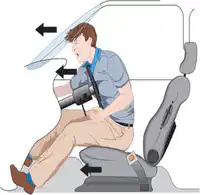
Illustration of a person in a car accident with an airbag deployment.
Depicts a non-penetrating chest trauma scenario in a motor vehicle accident.
Illustrates a penetrating chest injury caused by a sharp object.
Shows a person safely exiting a vehicle after a crash.
Represents a minor fender bender with no injuries.
5.
MULTIPLE CHOICE QUESTION
30 sec • 1 pt
Stabbing
A type of injury caused by a blunt object.
A penetrating injury that can lead to open chest wounds.
A superficial cut that does not penetrate the skin.
An injury caused by a fall from a height.
6.
MULTIPLE CHOICE QUESTION
30 sec • 1 pt
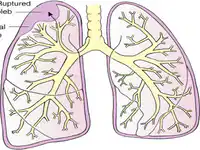
Mechanism for development of spontaneous pneumothorax
Illustration of ruptured bleb and pleural space.
Presence of fluid in the pleural cavity.
Increased intrathoracic pressure due to coughing.
Weakness of the lung tissue due to infection.
7.
MULTIPLE CHOICE QUESTION
30 sec • 1 pt
Effect of increased tension in tension pneumothorax
Pressure is placed on the heart and great vessels, causing a mediastinal shift.
Increased lung capacity due to air accumulation.
Decreased blood flow to the lungs.
Expansion of the thoracic cavity without any effect on the heart.
Access all questions and much more by creating a free account
Create resources
Host any resource
Get auto-graded reports

Continue with Google

Continue with Email

Continue with Classlink

Continue with Clever
or continue with

Microsoft
%20(1).png)
Apple

Others
Already have an account?

