
Comp-CBSE-9-S-C5
Authored by Anwar Sheikh
Science
9th Grade


AI Actions
Add similar questions
Adjust reading levels
Convert to real-world scenario
Translate activity
More...
Content View
Student View
10 questions
Show all answers
1.
DROPDOWN QUESTION
1 min • 1 pt
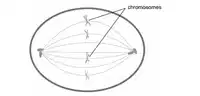
Cells grow by dividing. The given picture shows one such growing cell ready to divide.
A. The number of daughter cells formed after the cell divides completely is (a)
B. The number of chromosomes received by each daughter cell is (b)
Answer explanation
A. Number of Cells: Cell division for growth (mitosis) is an equational division where one parent cell divides once to form two genetically identical daughter cells.
B. Number of Chromosomes: The key is that during mitosis, the sister chromatids of each duplicated chromosome are pulled apart. Each daughter cell receives one copy of every chromosome.
The parent cell has 4 duplicated chromosomes.
After they split, each new daughter cell will receive 4 single-stranded chromosomes.
A. Number of Cells: Cell division for growth (mitosis) is an equational division where one parent cell divides once to form two genetically identical daughter cells.
B. Number of Chromosomes: The key is that during mitosis, the sister chromatids of each duplicated chromosome are pulled apart. Each daughter cell receives one copy of every chromosome.
The parent cell has 4 duplicated chromosomes.
After they split, each new daughter cell will receive 4 single-stranded chromosomes.
2.
MULTIPLE CHOICE QUESTION
30 sec • 1 pt
In an experiment, two beakers are set up. Beaker 1 contains a cell with a cell wall in a hypotonic solution. Beaker 2 contains a cell without a cell wall in the same hypotonic solution. What would be the most likely outcomes after 30 minutes?
Cell in Beaker 1 bursts; Cell in Beaker 2 becomes turgid.
Cell in Beaker 1 becomes turgid; Cell in Beaker 2 bursts.
Both cells become turgid.
Both cells burst.
Answer explanation
In a hypotonic solution, water enters both cells by osmosis.
Beaker 1 (Cell with wall): The rigid cell wall prevents the cell from bursting. The cell swells and becomes turgid.
Beaker 2 (Cell without a wall): No cell wall is present to resist the internal pressure. The cell continues to swell until it bursts.
3.
MULTIPLE CHOICE QUESTION
30 sec • 1 pt
Farmers use fertilizers rich in Nitrogen and Phosphorus. These elements are crucial for the synthesis of proteins and nucleic acids. Which cell organelle would be most active in utilizing these fertilizers for plant growth and repair?
Chloroplast
Vacuole
Ribosome
Lysosome
Answer explanation
While fertilizers provide the raw materials (Nitrogen for amino acids, Phosphorus for DNA/RNA), the ribosome is the primary organelle that directly utilizes these building blocks.
Ribosomes are the sites of protein synthesis. They read genetic instructions from mRNA and assemble amino acids (which contain nitrogen) into proteins, which are essential for plant growth, enzyme function, and tissue repair.
4.
HOTSPOT QUESTION
1 min • 1 pt
In the given figure, mark the correct name for X and Y from the given options
Answer explanation
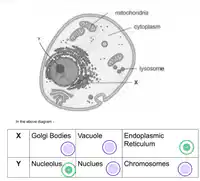
X represents the Endoplasmic Reticulum (ER).
The Endoplasmic Reticulum (ER) is a network of membrane-bound tubes and sheets inside the cell. It serves as a transportation system, connecting the nucleus to the cytoplasm and other organelles.
5.
MATCH QUESTION
1 min • 1 pt
A cell functions like a highly efficient factory. If one of its organelles fails, it causes a specific problem. Match the correct consequence to the malfunctioning organelle.
Mitochondria
Material transport channels break down.
Endoplasmic Reticulum
Energy currency (ATP) not produced.
Lysosomes
Toxic waste and worn-out parts accumulate
Cell Wall
Proteins are synthesized but not modified and packaged.
Golgi Apparatus
The cell loses its shape and support.
Answer explanation
Mitochondria: This is the "powerhouse of the cell." Its sole function is to produce ATP (energy). If it fails, energy production stops.
Golgi Apparatus: This organelle acts as the cell's "post office," modifying, sorting, and packaging proteins. If it fails, proteins are made but cannot be processed correctly.
Lysosomes: These are the cell's "stomachs" or "waste disposals," containing digestive enzymes to break down waste. If they fail, toxins and cellular debris build up.
Endoplasmic Reticulum (ER): The ER is a network of transport channels. The Rough ER also has ribosomes for protein synthesis. If it fails, the cell's internal transport and synthesis system collapses.
Cell Wall: This rigid outer layer (in plants, fungi, and bacteria) provides structural support and shape. If it breaks down, the cell loses its shape.
Mitochondria: This is the "powerhouse of the cell." Its sole function is to produce ATP (energy). If it fails, energy production stops.
Golgi Apparatus: This organelle acts as the cell's "post office," modifying, sorting, and packaging proteins. If it fails, proteins are made but cannot be processed correctly.
Lysosomes: These are the cell's "stomachs" or "waste disposals," containing digestive enzymes to break down waste. If they fail, toxins and cellular debris build up.
Endoplasmic Reticulum (ER): The ER is a network of transport channels. The Rough ER also has ribosomes for protein synthesis. If it fails, the cell's internal transport and synthesis system collapses.
Cell Wall: This rigid outer layer (in plants, fungi, and bacteria) provides structural support and shape. If it breaks down, the cell loses its shape.
6.
HOTSPOT QUESTION
1 min • 1 pt
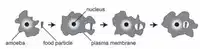
The diagram shows a single-celled organism with an irregular shape. A large food particle is positioned near the cell. The cell membrane is shown extending outward toward the particle, forming arm-like projections called pseudopodia that are beginning to surround the particle.
Click on the part of the cell where this process begins.
Answer explanation
Endocytosis is the process by which a cell engulfs external material, such as a food particle, by flexing its cell membrane inward to form a vesicle or vacuole inside the cell.
How it works: The cell's flexible plasma membrane extends outward, surrounds the food particle, and pinches off, bringing the particle into the cytoplasm.
7.
MULTIPLE CHOICE QUESTION
30 sec • 1 pt
You are given two slides: one of a cheek cell and one of an onion peel. Which of the following structures would you observe in the onion peel cell but NOT in the cheek cell?
Cell Membrane and Cytoplasm
Nucleus and Mitochondria
Cell Wall and Chloroplasts
Ribosomes and Golgi Apparatus
Answer explanation
The onion peel is from a plant, while the cheek cell is from an animal. The key differences are:
Cell Wall: A rigid outer layer made of cellulose that provides structure and support. It is present in onion (plant) cells but completely absent in cheek (animal) cells.
Chloroplast: The organelle that performs photosynthesis. It is found in onion (plant) cells (specifically in the green parts, but the peel cells may have some or the potential for them) and is absent in cheek (animal) cells.
Structures like the cell membrane, cytoplasm, nucleus, and mitochondria are common to both cell types.
Access all questions and much more by creating a free account
Create resources
Host any resource
Get auto-graded reports

Continue with Google

Continue with Email

Continue with Classlink

Continue with Clever
or continue with

Microsoft
%20(1).png)
Apple

Others
Already have an account?



