
Compulsory Voting Mini-Q
Authored by Ethan Hopson
Social Studies
9th Grade
Used 4+ times


AI Actions
Add similar questions
Adjust reading levels
Convert to real-world scenario
Translate activity
More...
Content View
Student View
30 questions
Show all answers
1.
MULTIPLE CHOICE QUESTION
30 sec • 1 pt
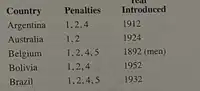
Document A: What country has had compulsory voting the longest? (Use the table 'Selected Countries with Compulsory Voting Systems' for reference.)
Australia
Belgium
Brazil
Argentina
2.
MULTIPLE CHOICE QUESTION
30 sec • 1 pt
What are the possible consequences to someone who doesn’t vote in Peru? (Refer to the Penalty Key and the table for Peru.)
They may have to pay a fine.
They lose their citizenship.
They are banned from public places.
They are imprisoned.
3.
MULTIPLE CHOICE QUESTION
30 sec • 1 pt
Document A: How can this document be used to argue for requiring people to vote? (Use information from the table and comments section.)
It shows that countries with compulsory voting have higher voter turnout.
It explains the history of voting rights in different countries.
It lists the penalties for not voting in various countries.
It describes the process of registering to vote.
4.
MULTIPLE CHOICE QUESTION
30 sec • 1 pt
Document A: How can this document be used to argue against requiring people to vote? (Use information from the table and comments section.)
It shows that some people believe voting should be a choice, not a requirement.
It proves that mandatory voting increases voter turnout.
It demonstrates that all citizens support compulsory voting.
It suggests that not voting should be punished by law.
5.
MULTIPLE CHOICE QUESTION
30 sec • 1 pt
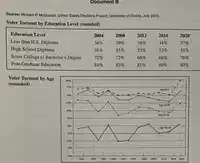
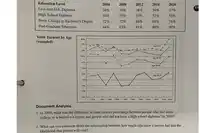
In 2004, what was the difference in voter turnout percentage between people who had some college or a bachelor's degree and people who did not have a high school diploma? In 2020?
The difference was 36% in 2004 and 39% in 2020.
The difference was 20% in 2004 and 25% in 2020.
The difference was 50% in 2004 and 55% in 2020.
The difference was 10% in 2004 and 15% in 2020.
6.
MULTIPLE CHOICE QUESTION
30 sec • 1 pt
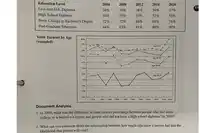
Refer to the table 'Voter Turnout by Education Level (rounded)'. What can you conclude about the relationship between how much education a person has and the likelihood that person will vote?
People with higher education levels are more likely to vote.
People with lower education levels are more likely to vote.
Education level does not affect voter turnout.
People with moderate education levels are least likely to vote.
7.
MULTIPLE CHOICE QUESTION
30 sec • 1 pt
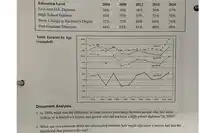
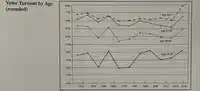
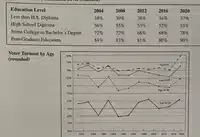
In 2008, what was the difference in voter turnout percentage between people ages 18-29 and people ages 60 and over? In 2020?
In 2008, the difference in voter turnout percentage between people ages 18-29 and people ages 60 and over was 24%, and in 2020 it was 18%.
In 2008, the difference in voter turnout percentage between people ages 18-29 and people ages 60 and over was 10%, and in 2020 it was 5%.
In 2008, the difference in voter turnout percentage between people ages 18-29 and people ages 60 and over was 30%, and in 2020 it was 25%.
In 2008, the difference in voter turnout percentage between people ages 18-29 and people ages 60 and over was 15%, and in 2020 it was 12%.
Access all questions and much more by creating a free account
Create resources
Host any resource
Get auto-graded reports

Continue with Google

Continue with Email

Continue with Classlink

Continue with Clever
or continue with

Microsoft
%20(1).png)
Apple

Others
Already have an account?



