
Wayground 10- Punnett Squares
Authored by Lee Leon
Science
6th Grade
NGSS covered


AI Actions
Add similar questions
Adjust reading levels
Convert to real-world scenario
Translate activity
More...
Content View
Student View
20 questions
Show all answers
1.
MULTIPLE CHOICE QUESTION
30 sec • 1 pt
What is the chance of a coin landing on heads?
100%
75%
50%
25%
Answer explanation
A fair coin has two sides: heads and tails. Therefore, the probability of landing on heads is 1 out of 2 possible outcomes, which is 50%.
2.
MULTIPLE CHOICE QUESTION
30 sec • 1 pt
What does a parent give to its offspring for each trait?
No alleles
Three alleles
One allele
Two alleles
Answer explanation
A parent gives one allele for each trait to its offspring. This is because offspring inherit one allele from each parent, resulting in two alleles per trait, but each parent contributes only one.
Tags
NGSS.HS-LS3-1
3.
MULTIPLE CHOICE QUESTION
30 sec • 1 pt
If a parent has one dominant and one recessive allele, what is the chance of passing on the dominant allele?
100%
75%
50%
25%
Answer explanation
A parent with one dominant and one recessive allele has a 50% chance of passing on the dominant allele. Each allele has an equal chance of being inherited, so the dominant allele can be passed on half the time.
Tags
NGSS.HS-LS3-3
4.
MULTIPLE CHOICE QUESTION
30 sec • 1 pt
What is a Punnett square used for?
Predicting weather patterns
Predicting possible offspring traits
Calculating coin probabilities
Determining plant growth rates
Answer explanation
A Punnett square is a tool used in genetics to predict the possible traits of offspring based on the genetic makeup of the parents. It helps visualize the combinations of alleles that can result from a genetic cross.
Tags
NGSS.HS-LS3-1
NGSS.HS-LS3-2
5.
LABELING QUESTION
1 min • 1 pt
Complete the punnett square
T T
T t bottom row
t t
T t top row
Tags
NGSS.HS-LS3-1
NGSS.HS-LS3-2
6.
LABELING QUESTION
1 min • 1 pt
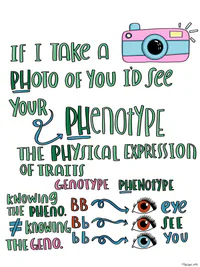
Fill in the missing genotypes
bb
bB
Bb
BB
Tags
NGSS.HS-LS3-1
NGSS.HS-LS3-2
7.
MATCH QUESTION
5 mins • 1 pt

Having a Widow's Peak is dominant (W) over not having one (w). If parent A (WW) and parent B (ww) have a child, what is the likelihood that--
100%
The child will have a widow's peak
Ww
The child will not have a widow's peak
0%
The genotype of these children
Tags
NGSS.HS-LS3-1


Access all questions and much more by creating a free account
Create resources
Host any resource
Get auto-graded reports

Continue with Google

Continue with Email

Continue with Microsoft
or continue with

%20(1).png)
Apple

Others
By signing up, you agree to our Terms of Service & Privacy Policy
Already have an account?


