
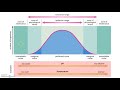
Ecological Tolerance: Understanding Organism Survival in Changing Environments

Interactive Video
•
Biology, Science, Geography
•
9th - 10th Grade
•
Practice Problem
•
Hard

Patricia Brown
FREE Resource
Read more
10 questions
Show all answers
1.
MULTIPLE CHOICE QUESTION
30 sec • 1 pt
What happens to organisms when they exceed their ecological tolerance limits?
They thrive and reproduce more.
They experience injury and eventually die.
They become more adaptable.
They migrate to new areas.
2.
MULTIPLE CHOICE QUESTION
30 sec • 1 pt
Which of the following is NOT an environmental factor affecting ecological tolerance?
Amount of sunlight
Dietary preferences
Salinity
Temperature
3.
MULTIPLE CHOICE QUESTION
30 sec • 1 pt
In the context of ecological tolerance, what does the 'optimum range' refer to?
The range where organisms start to die off.
The range where organisms are under stress.
The range where no organisms can survive.
The range where most organisms thrive.
4.
MULTIPLE CHOICE QUESTION
30 sec • 1 pt
What is the 'zone of physiological stress' in ecological tolerance?
Where organisms thrive the most.
Where organisms start to experience stress but can still survive.
Where no organisms can survive.
Where organisms are unaffected by environmental changes.
5.
MULTIPLE CHOICE QUESTION
30 sec • 1 pt
What defines the 'zone of intolerance' in ecological tolerance?
Where organisms thrive the most.
Where organisms start to experience stress.
Where no organisms can survive.
Where organisms are unaffected by environmental changes.
6.
MULTIPLE CHOICE QUESTION
30 sec • 1 pt
What is the 'preferred niche' in ecological tolerance?
The range where organisms thrive the most.
The range where organisms are unaffected by environmental changes.
The range where organisms are under stress.
The range where organisms do not survive.
7.
MULTIPLE CHOICE QUESTION
30 sec • 1 pt
How do polar bears' temperature tolerance ranges compare to giraffes'?
Polar bears have a higher tolerance for cold temperatures.
Polar bears have a lower tolerance for cold temperatures.
Polar bears have a higher tolerance for warm temperatures.
Polar bears and giraffes have the same temperature tolerance.
Access all questions and much more by creating a free account
Create resources
Host any resource
Get auto-graded reports

Continue with Google

Continue with Email

Continue with Classlink

Continue with Clever
or continue with

Microsoft
%20(1).png)
Apple

Others
Already have an account?

