
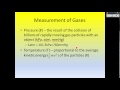
Gas Laws and Kinetic Theory

Interactive Video
•
Physics, Chemistry, Science
•
9th - 10th Grade
•
Practice Problem
•
Hard

Patricia Brown
FREE Resource
Read more
10 questions
Show all answers
1.
MULTIPLE CHOICE QUESTION
30 sec • 1 pt
What is the primary focus of chapters 13.1 and 14.1 in the context of gases?
States of matter and liquids
Solid state and its properties
Kinetic theory and gases
Chemical reactions of gases
2.
MULTIPLE CHOICE QUESTION
30 sec • 1 pt
According to the kinetic molecular theory, what is assumed about the volume of gas particles?
They have variable volume
They have no volume
They have significant volume
They have insignificant volume
3.
MULTIPLE CHOICE QUESTION
30 sec • 1 pt
How do gas particles move according to the kinetic molecular theory?
In a zigzag pattern
In a circular and predictable path
In a rapid, constant, linear, and random manner
In a slow and steady motion
4.
MULTIPLE CHOICE QUESTION
30 sec • 1 pt
What happens when gas particles collide with each other?
They lose energy
They gain energy
They transfer energy without loss
They stop moving
5.
MULTIPLE CHOICE QUESTION
30 sec • 1 pt
What is the result of billions of gas particles colliding with an object?
Mass increase
Pressure
Temperature increase
Volume expansion
6.
MULTIPLE CHOICE QUESTION
30 sec • 1 pt
Which unit is commonly used to measure gas pressure?
Newton
Joules
Kilopascal
Kelvin
7.
MULTIPLE CHOICE QUESTION
30 sec • 1 pt
How is temperature related to the kinetic energy of gas particles?
Temperature is inversely proportional to kinetic energy
Temperature is directly proportional to kinetic energy
Temperature is proportional to velocity
Temperature is unrelated to kinetic energy
Access all questions and much more by creating a free account
Create resources
Host any resource
Get auto-graded reports

Continue with Google

Continue with Email

Continue with Microsoft
or continue with

%20(1).png)
Apple

Others
Already have an account?

