How Wayground met Altoona's needs for a districtwide rollout
District Snapshot
- K-12 District: Altoona Area School District, Blair County, Pennsylvania
- Size: ~7,845 students, 652 teachers, 12 schools
- With Wayground since: Junior High in 2024, High School in 2025, districtwide in 2026
- Usage: Districtwide license used across 8 elementary schools, a junior high, and a high school, along with a cyber school program
Where they started
Altoona Area School District moved from two building-level licenses to a districtwide license with Wayground.
Dr. Caminiti came to that decision with 17 years of experience in education: 8 years as an elementary classroom teacher, seven years as an instructional technology coach, and 2 years as Director of Instructional Technology. This is his second year as director. He began using the platform as an instructional technology coach in a single building of roughly 200 teachers and 1,800 students, back when we were Quizizz, and kept up with the product through Kyle Niemis's posts, the community sessions Kyle runs, and product walkthroughs at ISTE.
It started with an audit of the district's existing edtech. He wanted one platform that could carry assessments, reporting, and resources across subjects, including math.
"A school district can quickly go down the rabbit hole with edtech products. It is easy to spend a significant amount of money on multiple subscriptions in a single year. Before long, the district may find itself managing a large number of products without a clear understanding of how effective these tools are in the classroom. Is the product actually contributing to student growth?."
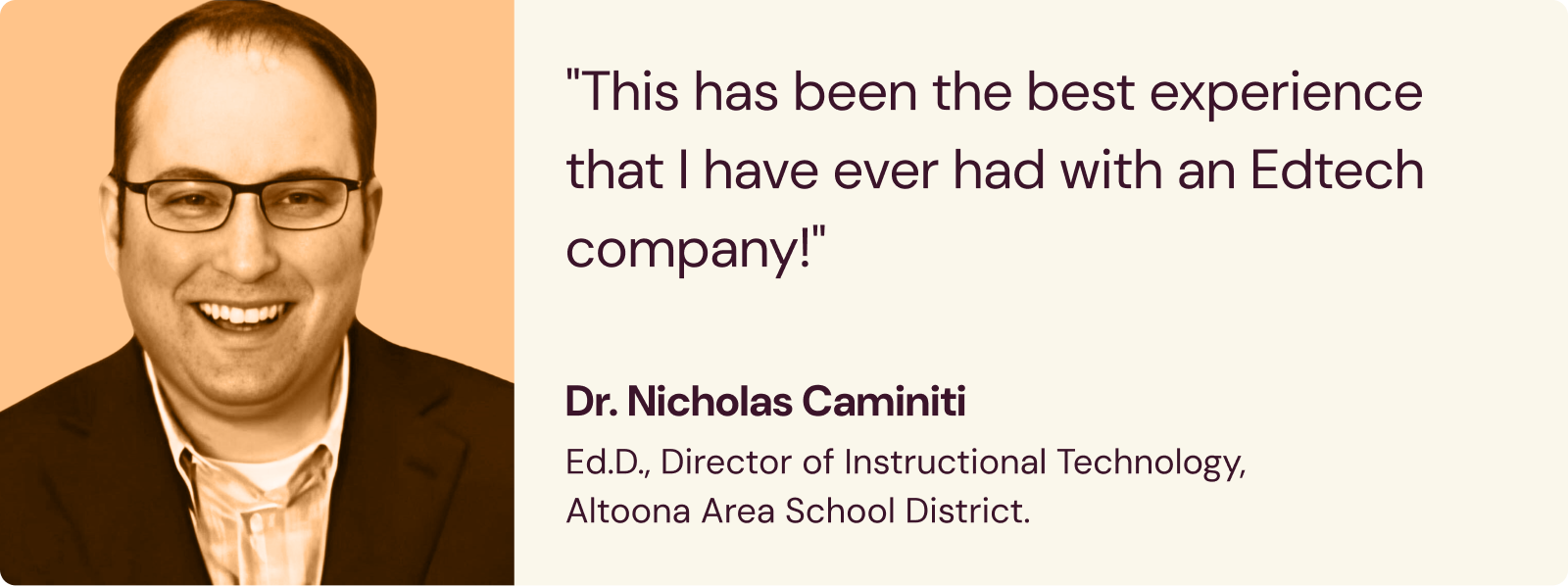
— Dr. Nicholas Caminiti
Consolidating meant bringing across work teachers were already doing in other tools. Interactive video had the tightest deadline because many Altoona teachers used it daily and needed it to work the week they returned from summer.
What we built together
What follows came from a working relationship that ran from May through August between Altoona's instructional technology team and Wayground's community, account, product, and engineering teams.
Enhanced Video Editor. Previously, teachers could only edit videos at the beginning or end. However, they often need specific sections of a video for their lessons. So, we built flexible video trimming and rolled it out districtwide before the school year. Teachers can set start and end points anywhere in the video, including removing a section in the middle. The remaining footage plays through intact.
A clearer video editing interface. After trimming shipped, the district gave us feedback on how the editing controls read. We changed the interface so cut points show a visible timestamp and a scissor icon on the progress bar. A teacher can now see where a video was edited without replaying it, and the district's instructional technology team can point at it in a training session.
Reporting and gradebook clarity. The district raised questions about score reporting and about how results appeared in their gradebook. We investigated each one, corrected what sat on our side, and gave the district a clear explanation of what didn't, so their instructional technology team could pass accurate guidance to teachers.
Enablement and support for the district's use cases. Some of what Altoona needed was already in the platform. Teachers assign videos that students watch from start to finish, without skipping ahead and in a single attempt, and the settings were already in place. We pointed the district's instructional technology team to those controls so they could carry them into teacher training. Dr. Caminiti used our support library the same way across the rollout, as source material for how-to videos he made himself for Altoona's teachers.
"If we want an edtech product to be successful and teachers to implement it effectively, we have to get the rollout right from the beginning. In many cases, we only get one real opportunity to build teacher confidence, establish strong practices, and create lasting buy-in."
— Dr. Nicholas Caminiti
Still in progress. Grading a student on video completion rate without attached questions is in development. It came from Altoona, and they'll be the first to know when it lands.
Beyond the product
"I was pleasantly shocked at the response, and the amount of people that were getting back to me very quickly. You listened, you understood the objective, and then you went in and actually added the suggested updates."
— Dr. Nicholas Caminiti
Altoona's feedback reached the people who could act on it. A screen recording from the district went to our engineering team the same day it arrived, with the account team in the loop. Our product team stayed on the email thread throughout, so the district dealt directly with the engineers and product managers building the capability.
"When you see a company with a shared work ethic just like yours, it makes you glad you went with that company."
— Dr. Nicholas Caminiti
When the new capability shipped, we walked the district's instructional technology team through the workflow so that they could build training materials for teachers from a working demonstration
What changed
"Just watching teachers over the past two weeks create videos and build assignments with very few questions or support requests shows how quickly they are adapting to the platform. A big part of that success is the seamless integration with Google Classroom, which has made the transition much easier for our teachers."
— Dr. Nicholas Caminiti
Grades synced without manual entry. Teachers assign through Google Classroom, Wayground grades the work, and the scores sync back into Google Classroom and on into the district's student information system. Dr. Caminiti puts the manual version at two to three hours of a classroom teacher's time. He connects those hours back to MTSS, where teacher time is the constraint on getting support to the students who need it.
The district didn't have to buy an AI checker. English teachers at the district had asked for an AI integrity checker, and it came as part of the Wayground extension. A teacher in the district's cyber program found the extension's recording capability on her own and built interactive videos for her students before it came up in training.
What's next
The district's goal this year is to identify struggling students and act quickly. In Pennsylvania, that means working at the level of eligible content beneath the PSSA standards. A teacher looks across the year's assignments, sees which students keep missing the same content, and plans remediation from there.
That is how Dr. Caminiti has been positioning Wayground with his own staff: as a source of data to teach from, not a way to assign videos or run games.
"This tool provides teachers with different types of data that they can use to guide lesson planning, drive their instruction, and address individual student needs. This is the ultimate goal when selecting an edtech tool."
— Dr. Nicholas Caminiti
We're looking forward to the year ahead with Altoona, to supporting their teachers, and to the feedback that keeps shaping what we build.