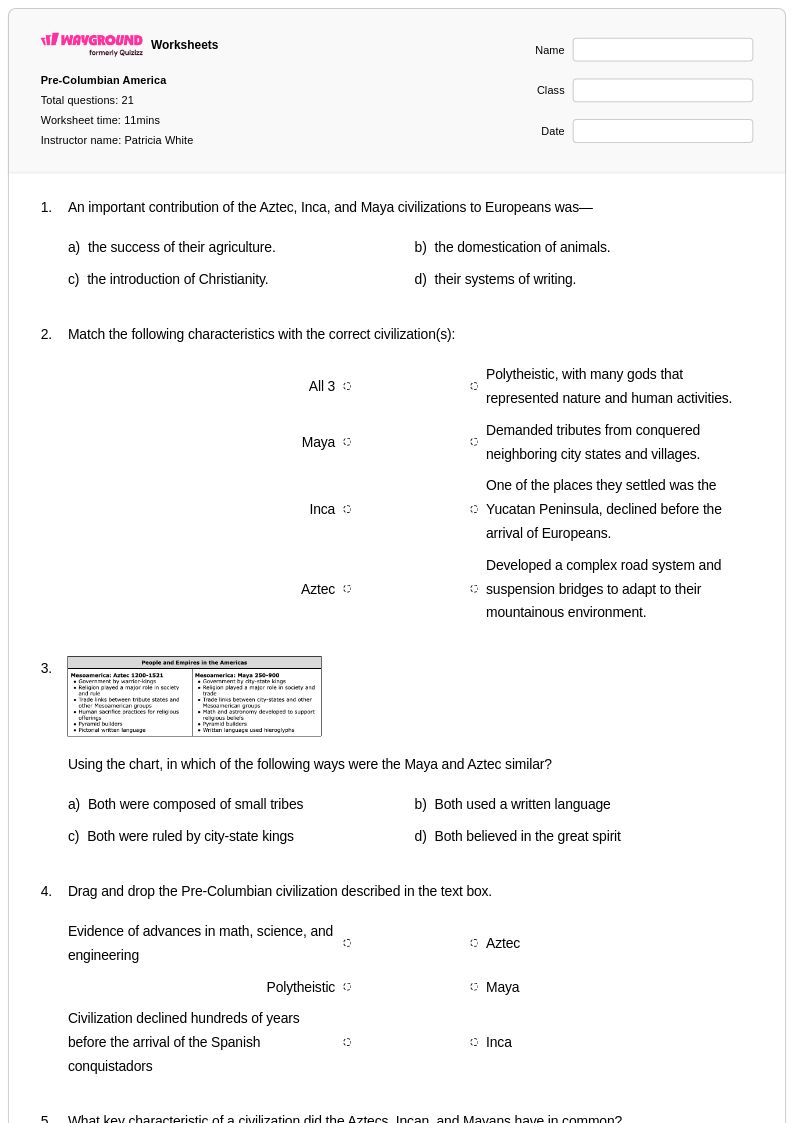
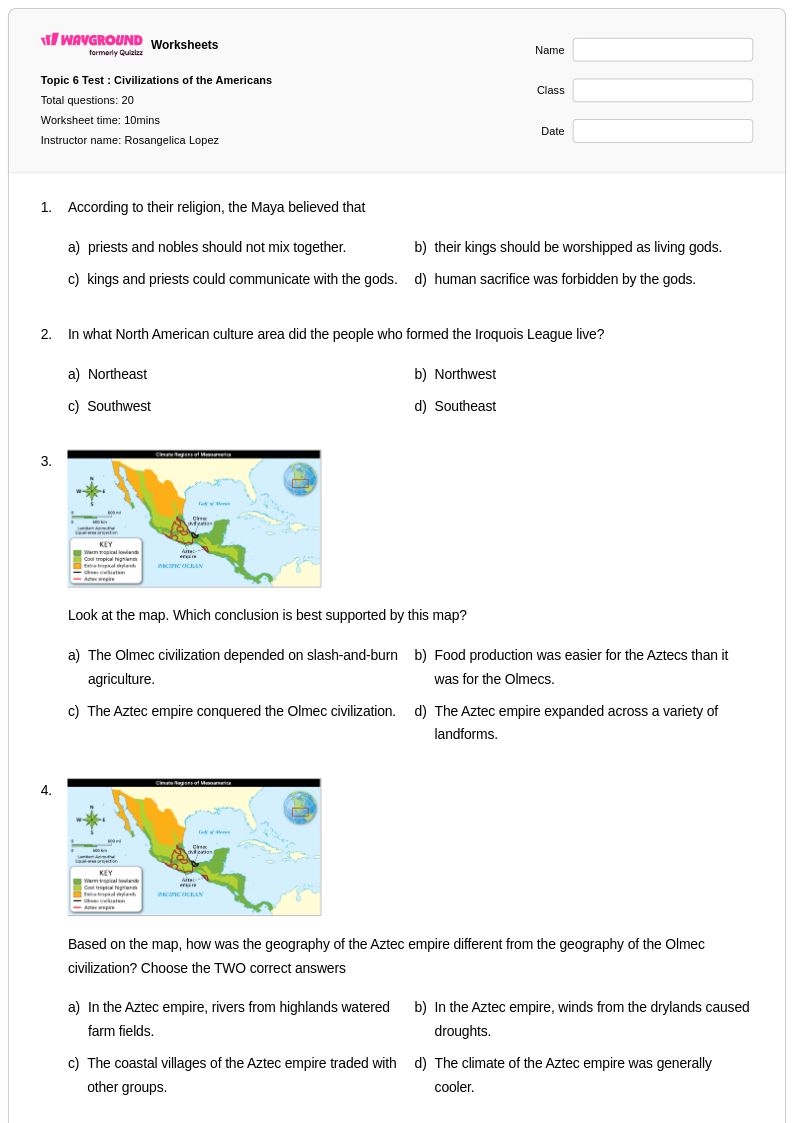
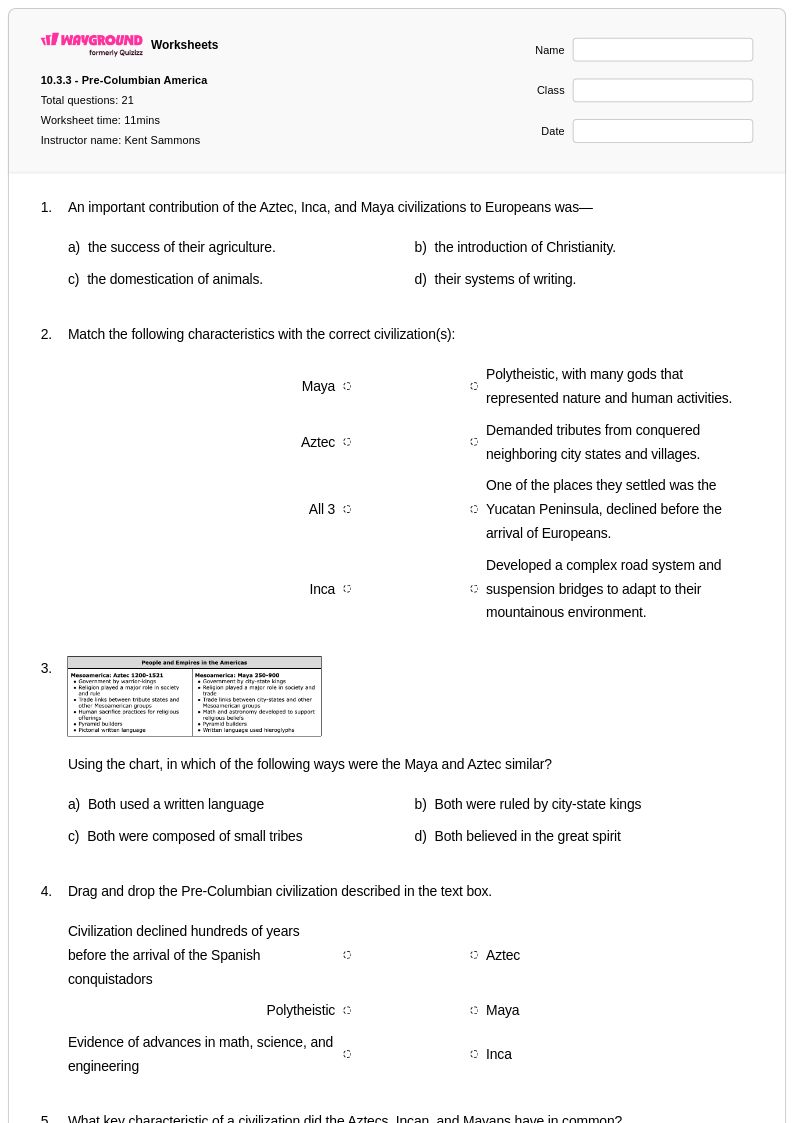
Explore Wayground's free Aztec Civilization worksheets and printables that help students discover the rich history, culture, and achievements of this fascinating Mesoamerican empire through engaging practice problems and comprehensive answer keys.
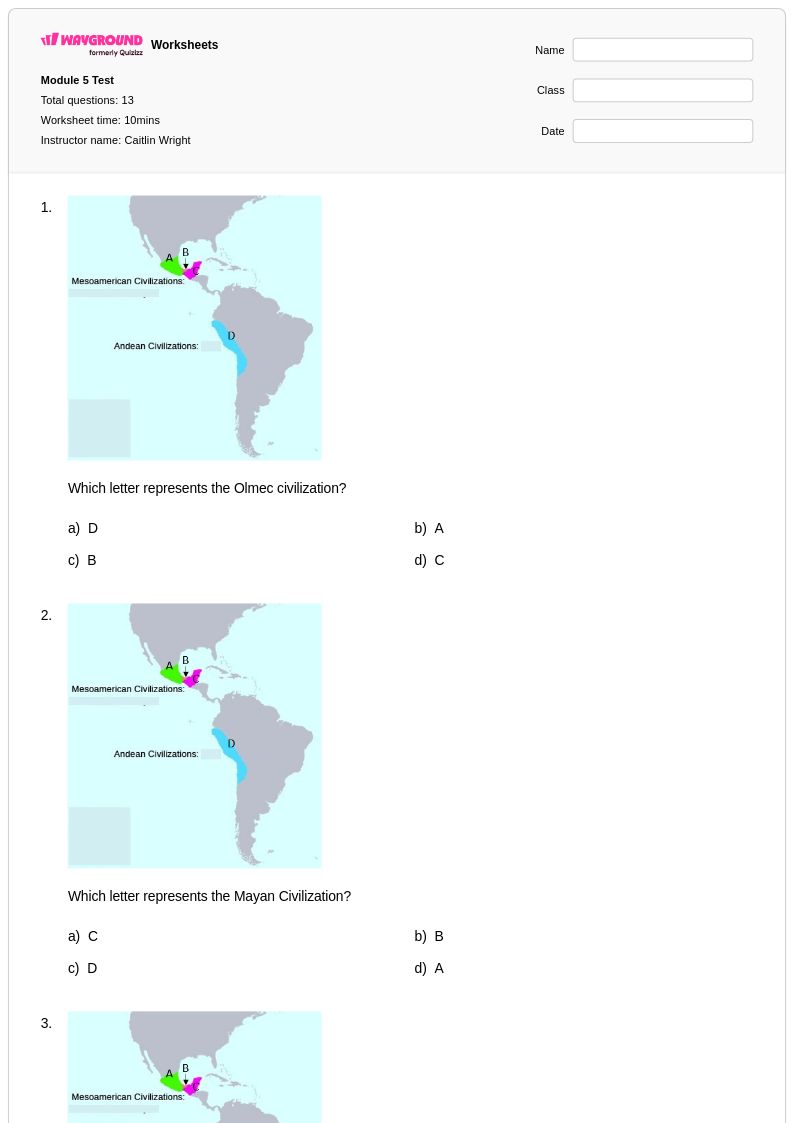
Aztec Civilization worksheets available through Wayground (formerly Quizizz) provide comprehensive educational resources that immerse students in the rich history and complex society of this remarkable Mesoamerican empire. These expertly crafted materials strengthen critical thinking skills through engaging practice problems that explore Aztec religious beliefs, political structures, agricultural innovations, and cultural achievements. Students develop analytical abilities as they examine primary source excerpts, interpret historical maps of Tenochtitlan, and evaluate the impact of Spanish conquest on indigenous populations. Each worksheet includes a detailed answer key to support both independent study and classroom instruction, while the free printables offer flexible options for teachers seeking to supplement their curriculum with authentic historical content in convenient pdf format.
Wayground (formerly Quizizz) empowers educators with an extensive collection of millions of teacher-created resources specifically designed to bring Aztec Civilization studies to life in the classroom. The platform's robust search and filtering capabilities enable teachers to quickly locate materials that align with curriculum standards while supporting diverse learning needs through built-in differentiation tools. These customizable worksheets are available in both printable and digital formats, including downloadable pdf versions, making them ideal for various instructional settings from traditional classrooms to remote learning environments. Teachers can seamlessly integrate these resources into their lesson planning for skill practice, targeted remediation, or enrichment activities, ensuring that students develop a deep understanding of how the Aztec Empire's sophisticated society, from its innovative chinampas farming system to its complex tribute networks, shaped the course of world history.
FAQs
How do I teach Aztec civilization to my students?
Teaching Aztec civilization is most effective when students engage with multiple dimensions of the empire simultaneously — its religious structures, political hierarchy, agricultural innovations like chinampas, and tribute networks. Start with Tenochtitlan as an anchor concept, using historical maps to ground students in geography before expanding into society and culture. Connecting Aztec achievements to broader world history themes, such as urbanization and imperial expansion, helps students see the civilization's global significance rather than treating it as an isolated topic.
What kinds of practice exercises help students learn about the Aztec Empire?
Effective practice exercises for Aztec civilization include analyzing primary source excerpts from Spanish conquistadors and indigenous codices, interpreting historical maps of Tenochtitlan, and evaluating cause-and-effect relationships around the Spanish conquest. Comprehension questions on Aztec religious beliefs, political structures, and agricultural methods reinforce content knowledge, while short-answer prompts that ask students to compare Aztec society to other civilizations develop higher-order thinking skills.
What misconceptions do students commonly have about the Aztec Empire?
A common misconception is that the Aztec Empire was a monolithic, unified state — in reality, it functioned largely as a tribute-based network of conquered peoples with varying degrees of autonomy. Students also frequently conflate the Aztec collapse with military defeat alone, overlooking the role of disease, internal alliances against the empire, and logistical advantages that Spanish forces exploited. Addressing these errors directly through document analysis and guided questioning helps students develop a more accurate and nuanced understanding.
How do I assess whether my students understand Aztec history?
Effective assessment of Aztec civilization knowledge goes beyond factual recall and should probe students' ability to analyze cause and effect, interpret historical evidence, and evaluate competing perspectives. Look for whether students can explain how chinampas agriculture supported Tenochtitlan's population density, describe the religious justifications for Aztec expansion, and assess the long-term consequences of Spanish colonization on indigenous populations. Short constructed-response questions paired with map interpretation tasks are particularly strong diagnostic tools for this topic.
How do I use Aztec civilization worksheets in my classroom?
Aztec civilization worksheets on Wayground are available as printable PDFs for traditional classroom use and in digital formats for technology-integrated or remote learning environments, including the option to host them as a quiz directly on Wayground. Teachers can use them for direct instruction support, independent practice, targeted remediation, or enrichment activities. Each worksheet includes a complete answer key, making them practical for self-paced student work as well as structured classroom sessions.
How can I support students with different learning needs during an Aztec civilization unit?
Wayground includes built-in accommodation tools that allow teachers to differentiate at the individual student level without disrupting the rest of the class. Options include read aloud support for students who benefit from audio delivery of questions, reduced answer choices to lower cognitive load, extended time per question, and adjustable reading modes with different font sizes and themes. These settings can be applied to individual students or the whole class and carry over across future sessions, reducing setup time during a multi-week unit.