Free Printable Centripetal Force and Gravitation Worksheets for Year 10
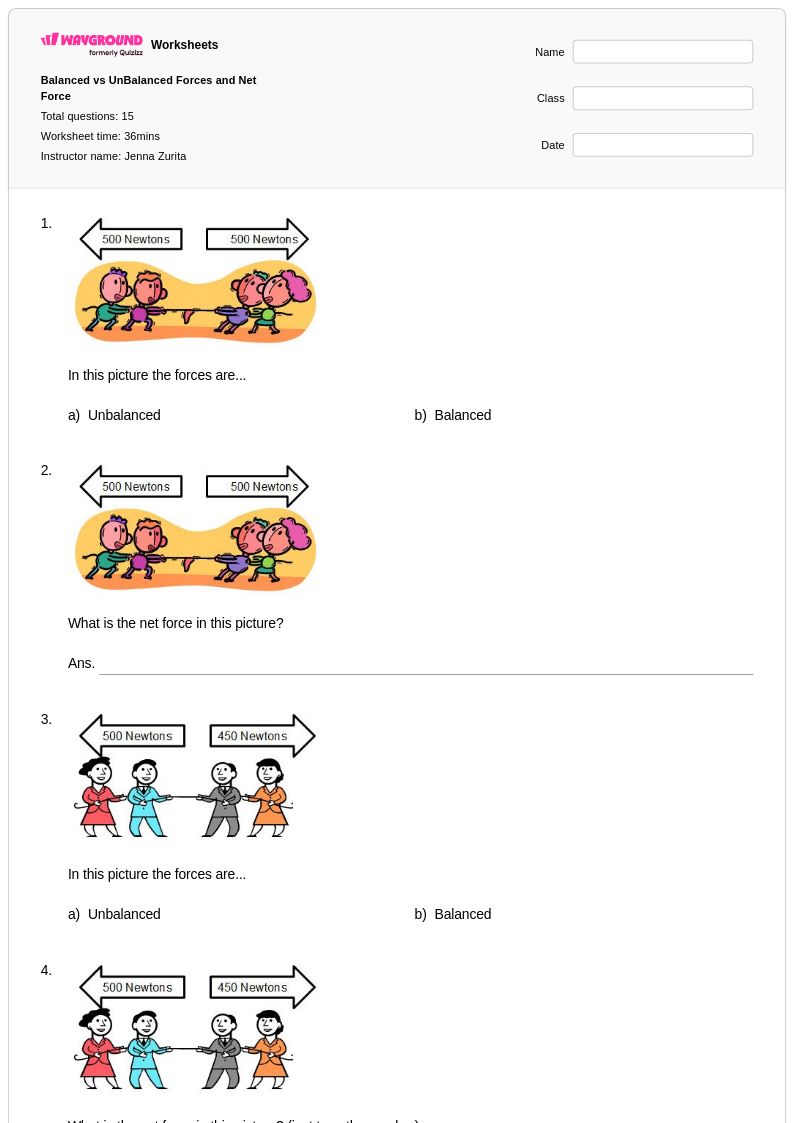
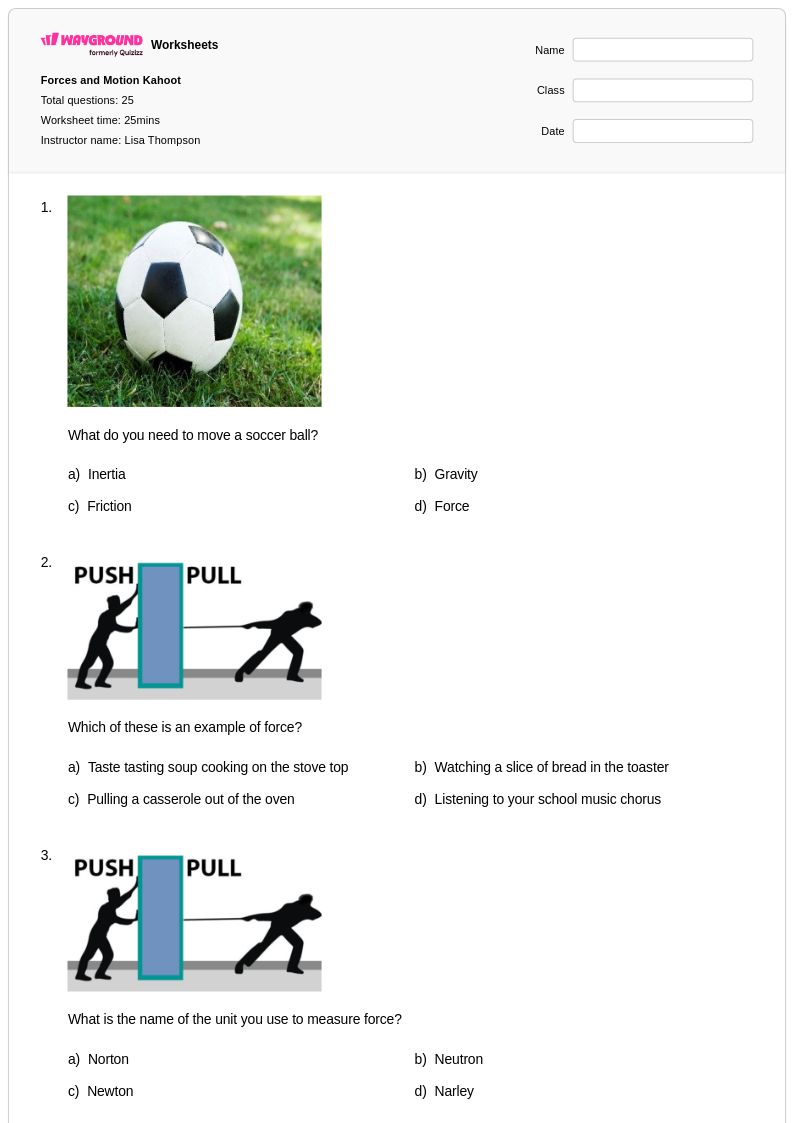
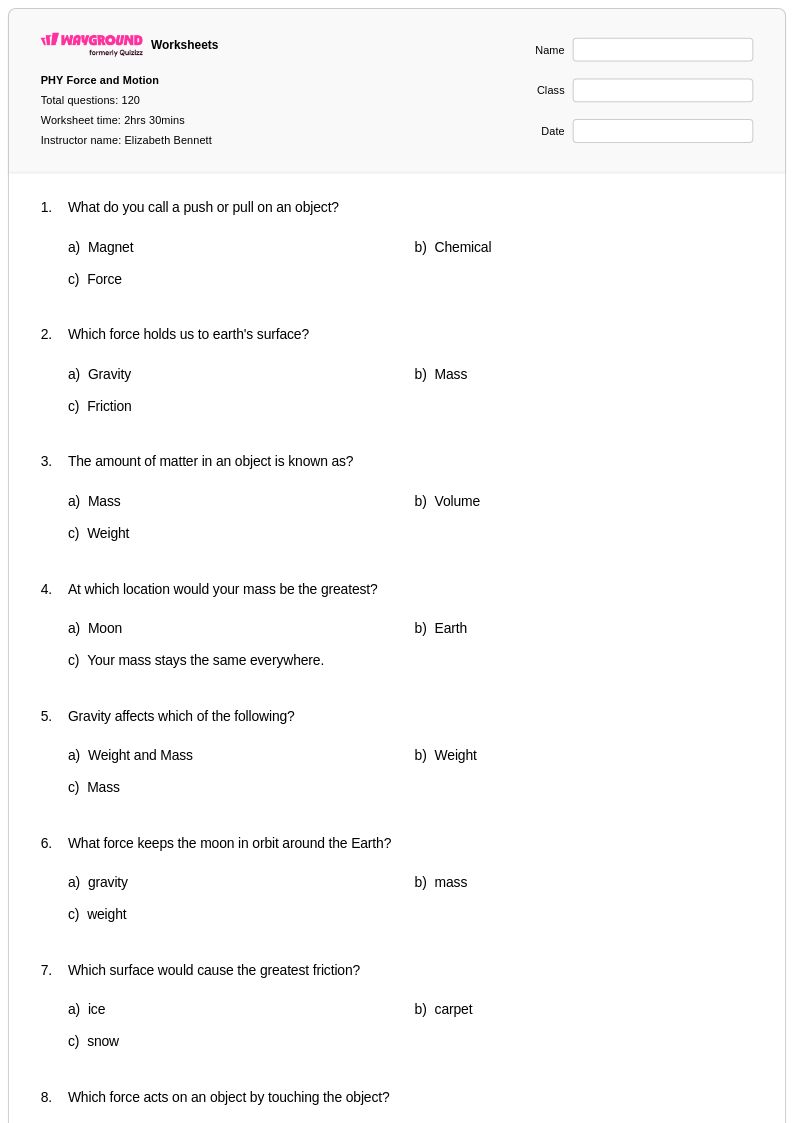
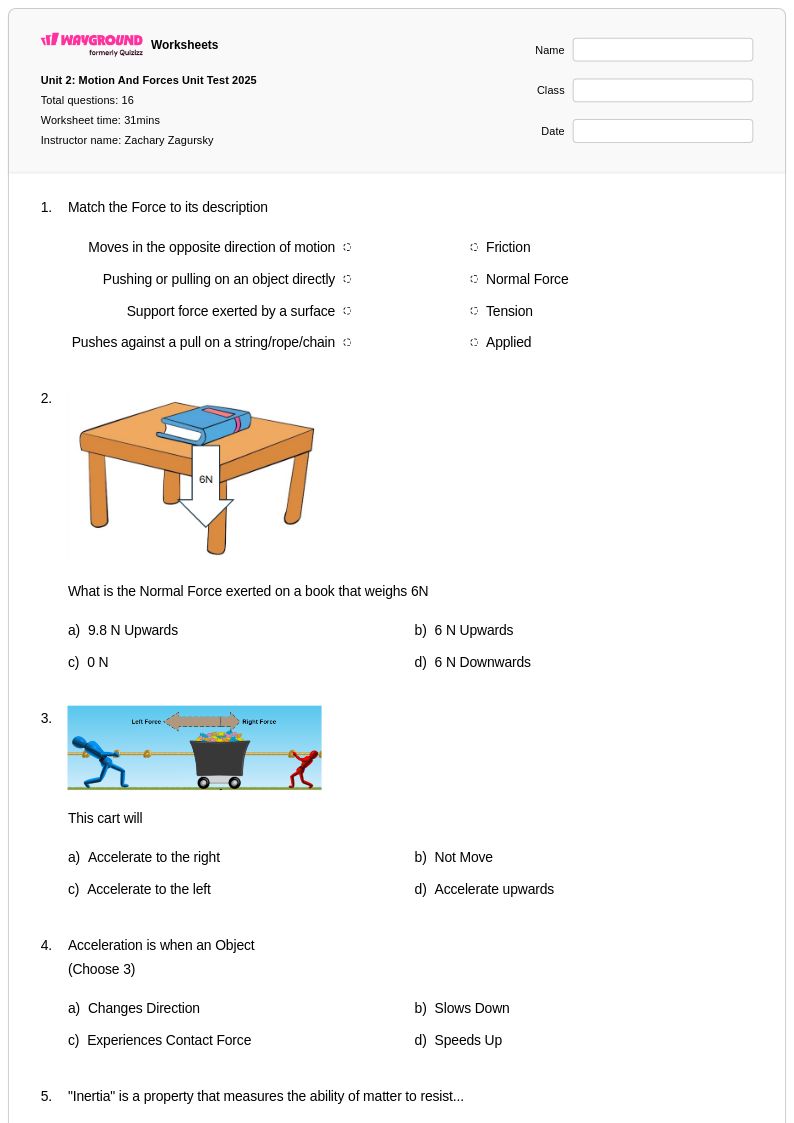
Year 10 centripetal force and gravitation worksheets from Wayground help students master circular motion principles through comprehensive practice problems, free printable PDFs, and detailed answer keys for effective physics learning.
Explore printable Centripetal Force and Gravitation worksheets for Year 10
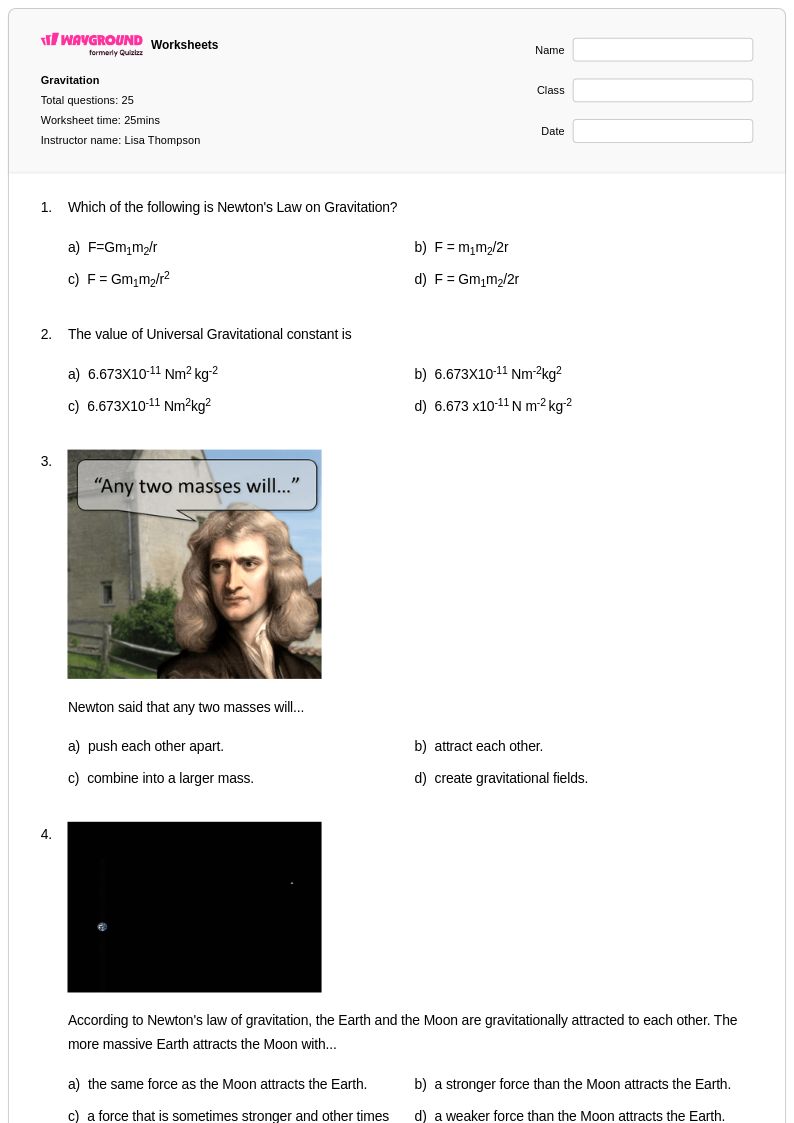
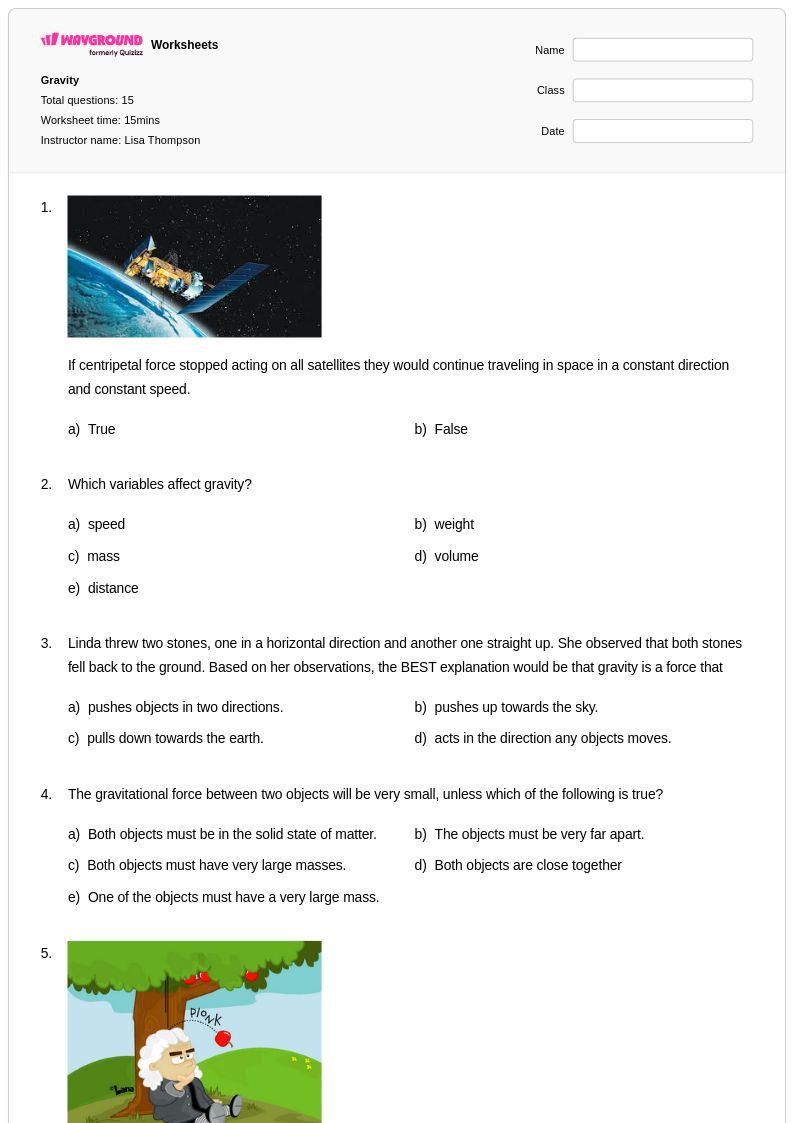
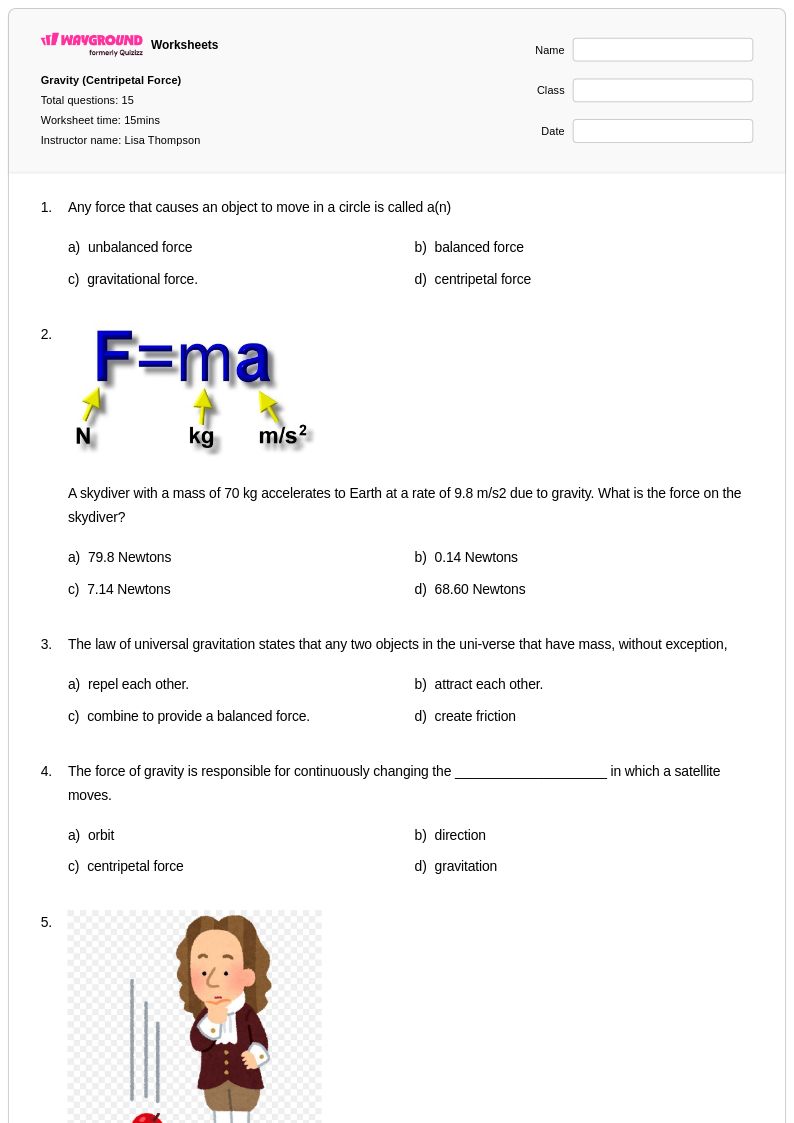
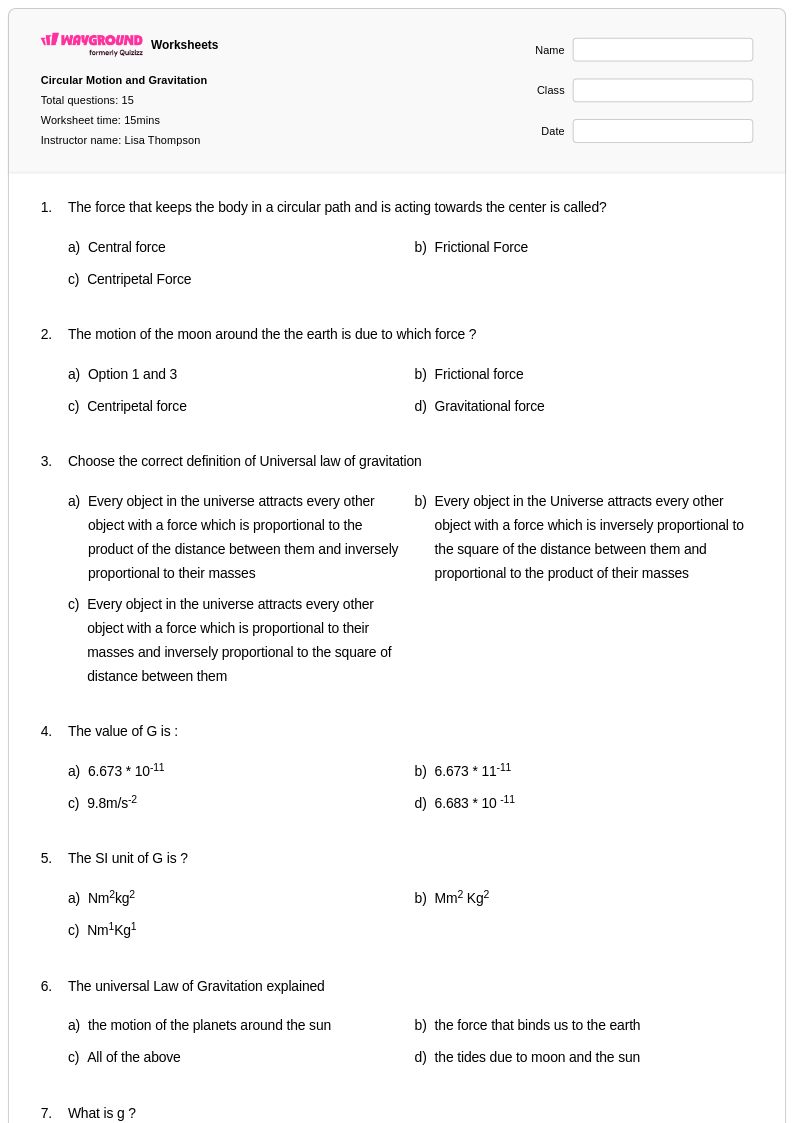
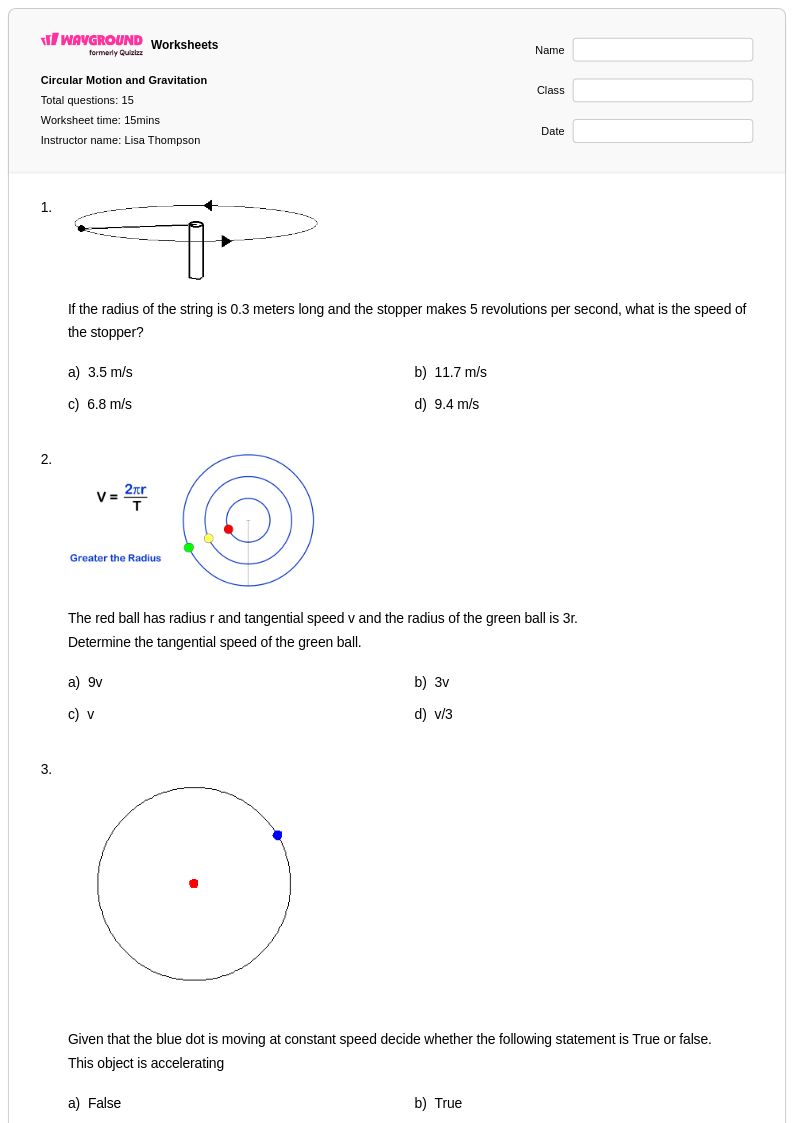
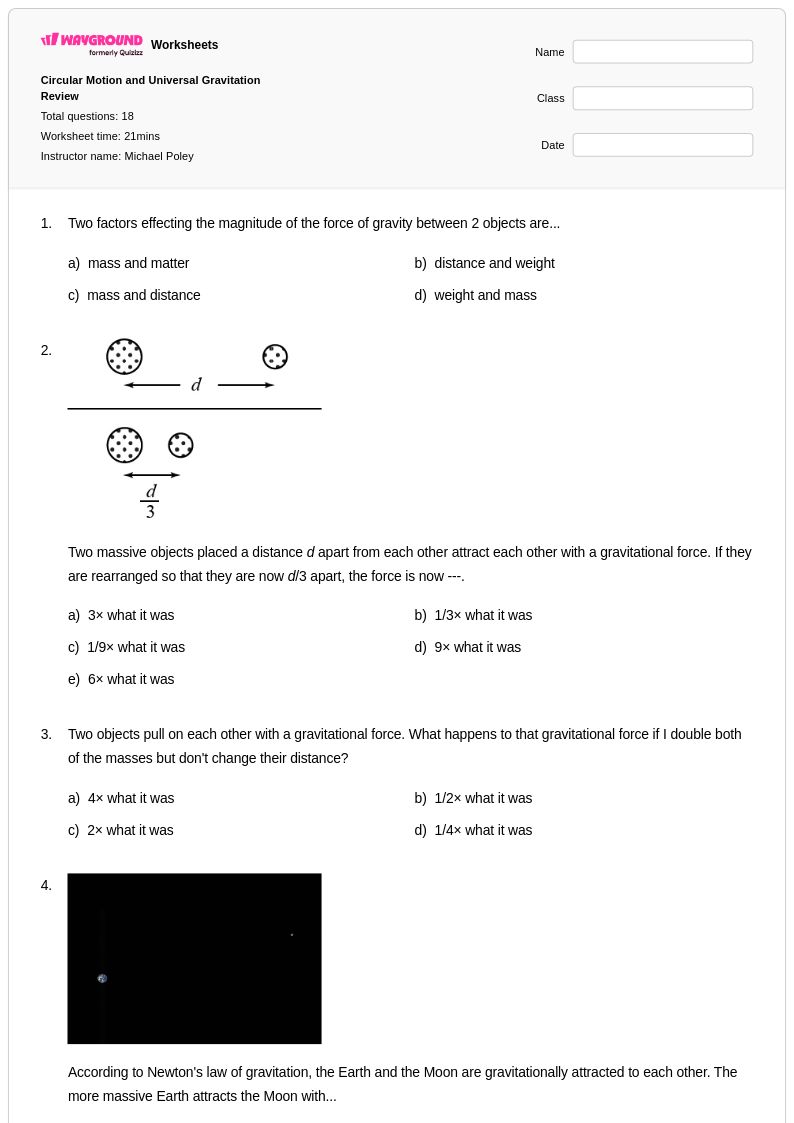
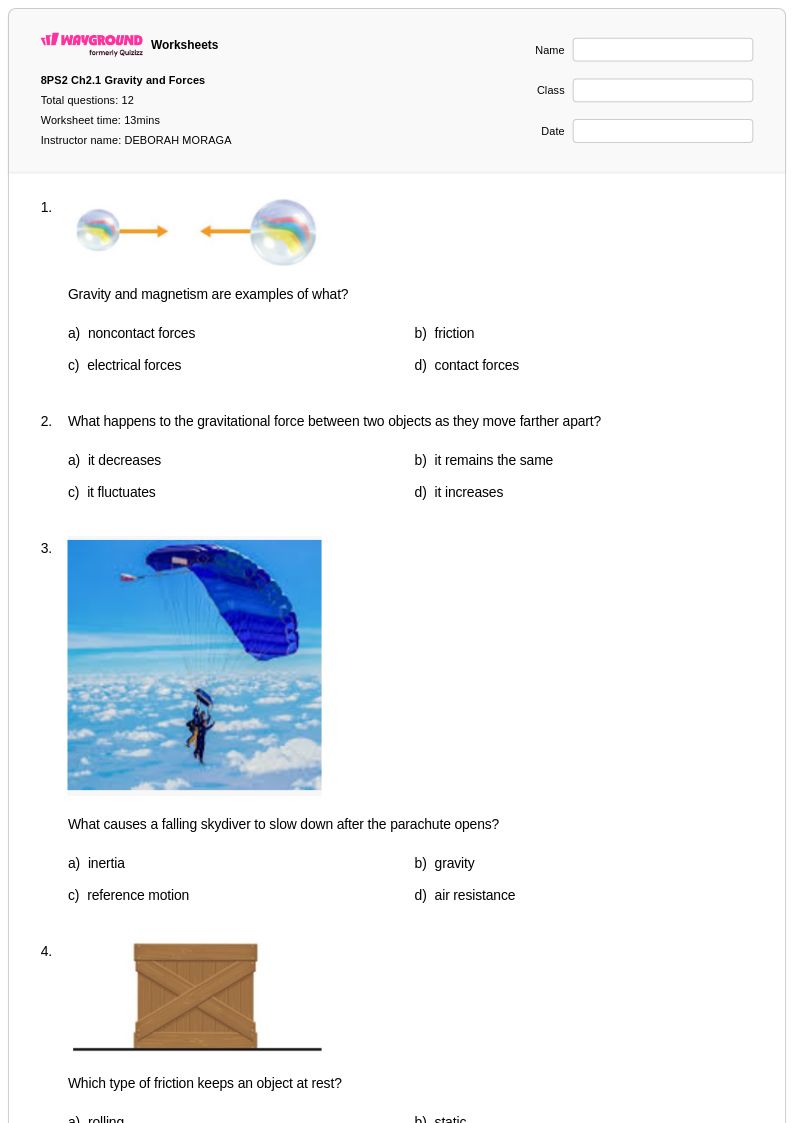
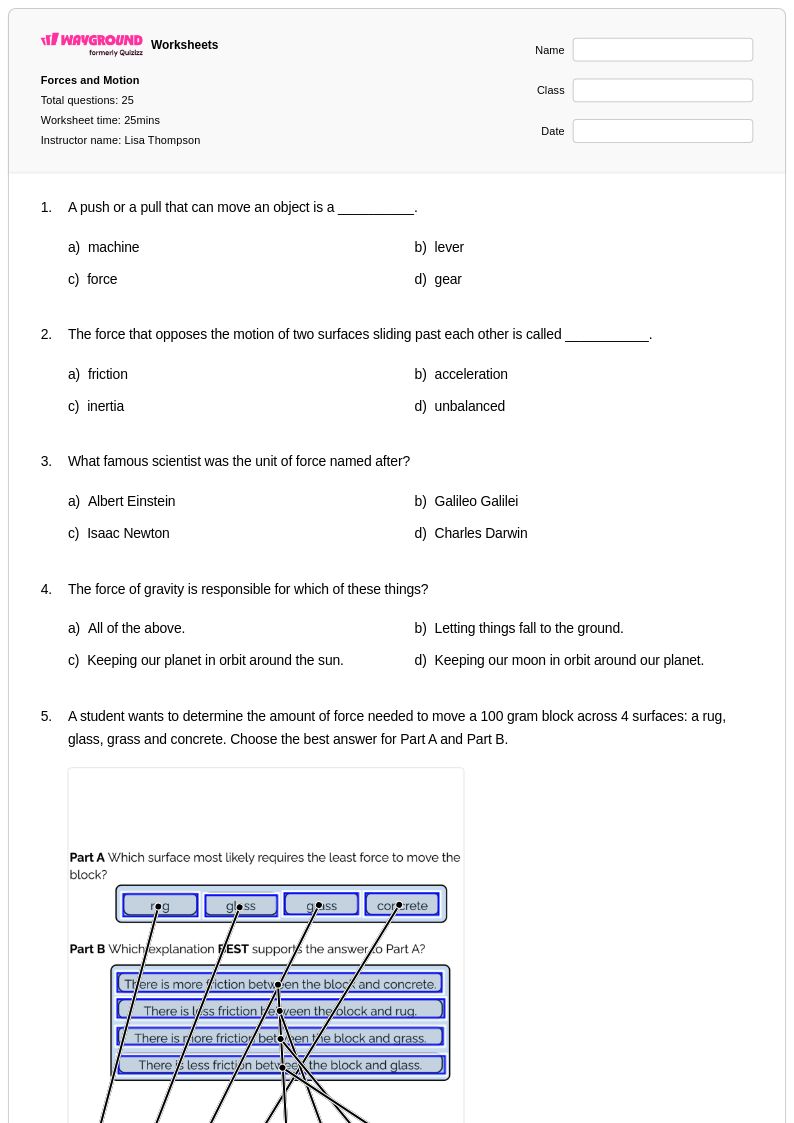
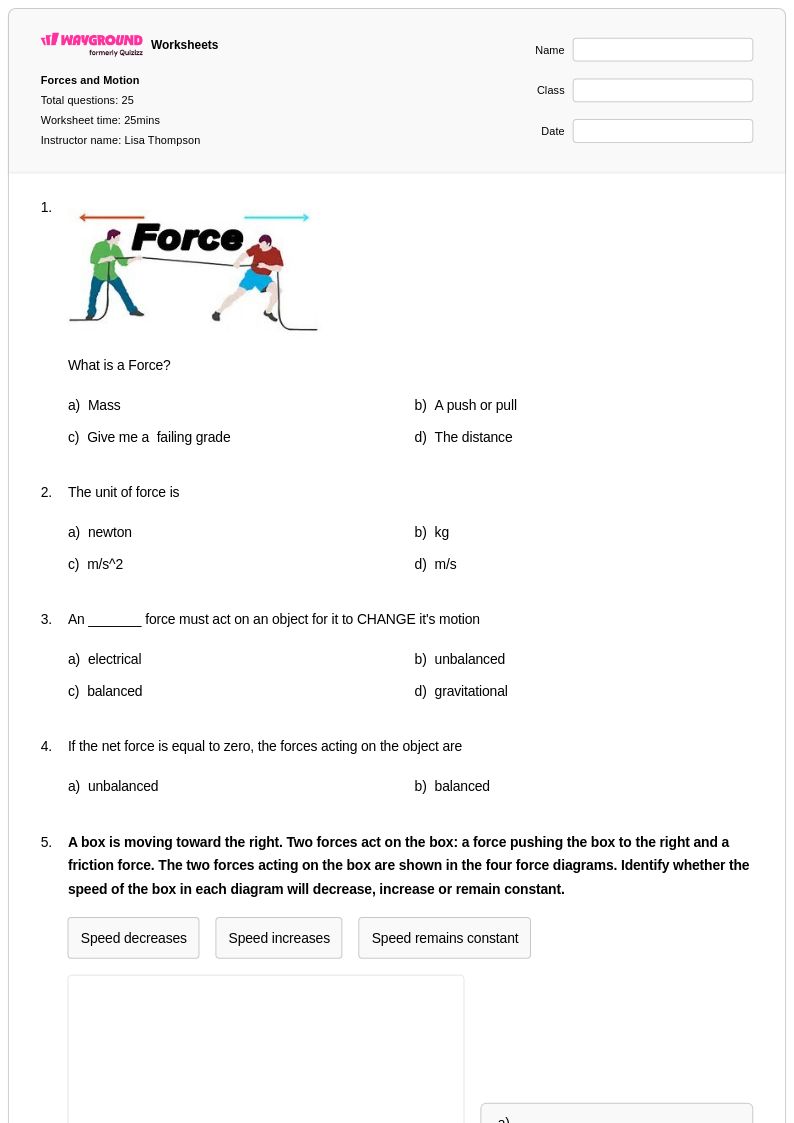
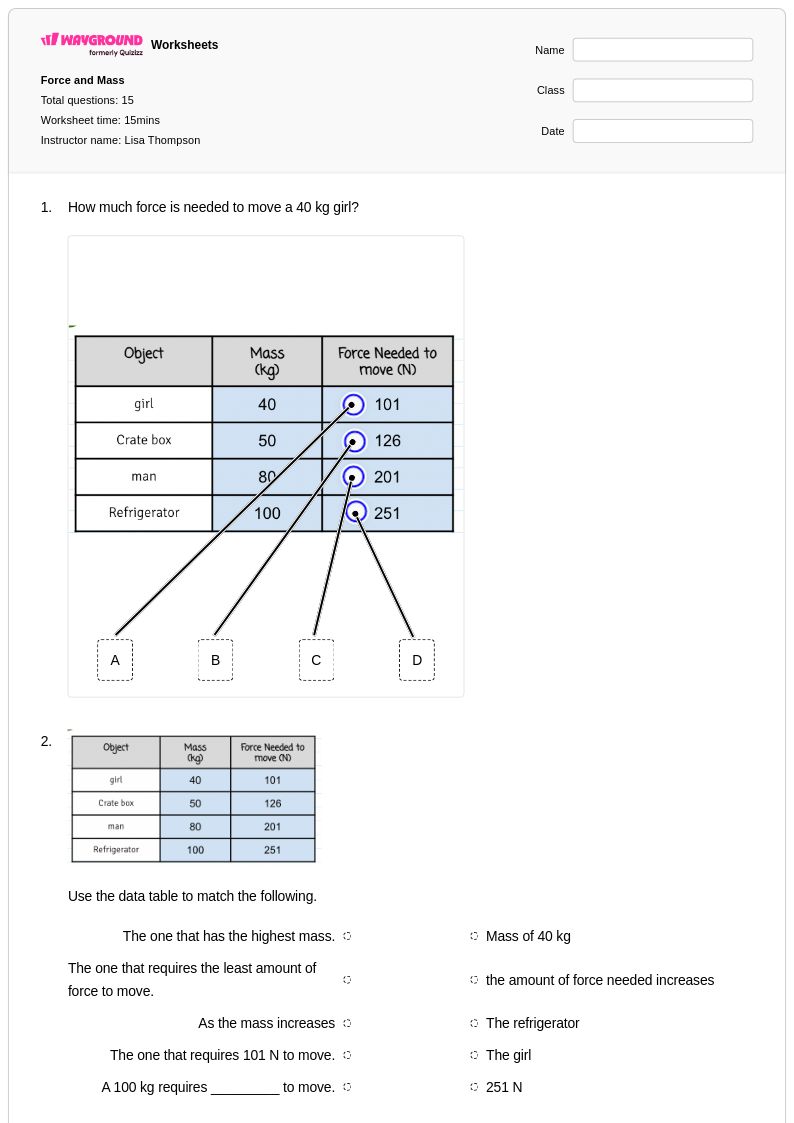
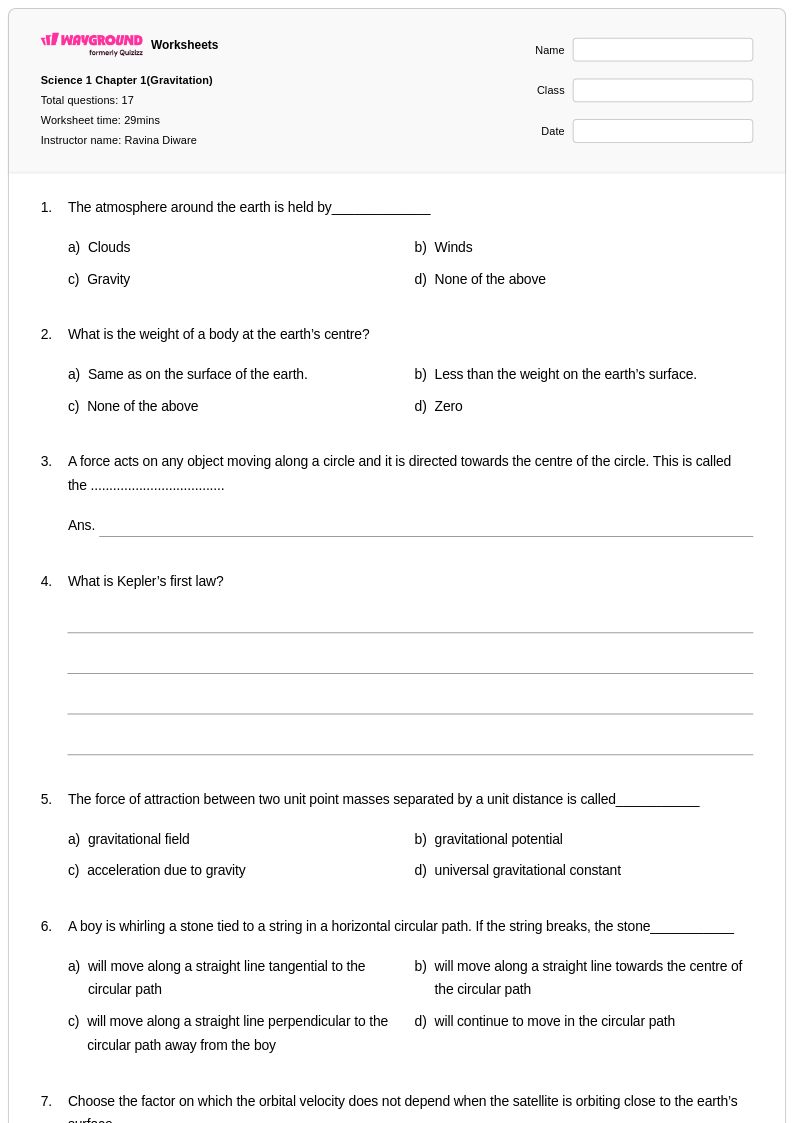
Centripetal force and gravitation worksheets for Year 10 students available through Wayground (formerly Quizizz) provide comprehensive coverage of these fundamental physics concepts that govern circular motion and gravitational interactions. These carefully designed practice problems help students master the mathematical relationships between centripetal acceleration, velocity, radius, and mass while exploring how gravitational forces create the centripetal acceleration necessary for orbital motion. The worksheets strengthen critical analytical skills by challenging students to apply Newton's laws to real-world scenarios involving satellites, planets, and everyday rotating objects, with each resource including detailed answer keys that support independent learning and self-assessment. Students work through progressive difficulty levels that build conceptual understanding alongside computational proficiency, with free printable pdf formats ensuring accessibility for both classroom instruction and homework assignments.
Wayground (formerly Quizizz) empowers educators with an extensive collection of millions of teacher-created resources specifically focused on centripetal force and gravitation concepts, complete with advanced search and filtering capabilities that allow precise targeting of Year 10 physics standards and learning objectives. The platform's robust differentiation tools enable teachers to customize worksheets for diverse learning needs, adjusting complexity levels and problem types to support both remediation for struggling students and enrichment opportunities for advanced learners. These resources are available in both printable pdf and interactive digital formats, providing flexibility for various classroom environments and teaching styles while maintaining alignment with curriculum standards. Teachers can seamlessly integrate these materials into lesson planning, formative assessment strategies, and targeted skill practice sessions, ensuring students develop solid conceptual foundations in the physics principles that explain everything from car navigation around curves to planetary motion throughout the solar system.
FAQs
How do I teach centripetal force and gravitation to physics students?
Start by building students' intuition for circular motion using concrete examples like a ball on a string or a car rounding a curve before introducing the centripetal force formula (F = mv²/r). Once students can identify the net inward force in non-gravitational scenarios, transition to orbital mechanics by showing how gravity provides the centripetal force that keeps satellites and planets in orbit. Connecting Newton's Law of Universal Gravitation to Kepler's Laws gives students a unified framework for understanding both terrestrial and astronomical circular motion.
What practice problems help students master centripetal force calculations?
Effective practice should progress from single-variable solving — finding centripetal force given mass, velocity, and radius — to multi-step problems where students must derive velocity from orbital period or calculate gravitational field strength at a given distance. Problems involving satellite orbits, banked curves, and vertical circular motion (such as a roller coaster loop) are especially valuable because they require students to correctly identify which real-world force is acting as the centripetal force. Worked examples with answer keys that show intermediate steps help students self-correct during independent practice.
What mistakes do students commonly make with centripetal force and gravitation?
The most persistent misconception is treating centripetal force as a separate, named force rather than recognizing it as the net inward force provided by gravity, tension, friction, or another agent. Students also frequently confuse centripetal acceleration with centrifugal force, incorrectly applying an outward force in their free-body diagrams. In gravitation problems, a common algebraic error is misapplying the inverse-square relationship — students often halve the force when doubling the distance rather than reducing it by a factor of four.
How do I use centripetal force and gravitation worksheets in my physics class?
Centripetal force and gravitation worksheets work well as structured independent practice after direct instruction, as homework that reinforces problem-solving procedures, or as targeted remediation for students who struggle with circular motion free-body diagrams. On Wayground, these worksheets are available as printable PDFs for traditional classroom use and in digital formats for technology-integrated environments, including the option to host them as an interactive quiz — making them adaptable for in-class work, remote learning, or blended instruction.
How do I help students who struggle with the math in centripetal force and gravitation problems?
Students who struggle often benefit from a consistent problem-solving template: identify the type of circular motion, draw and label the free-body diagram, identify which force provides the centripetal acceleration, and then set up the equation before substituting values. Breaking multi-step gravitation problems into labeled stages — calculating gravitational force, then setting it equal to centripetal force, then solving for the unknown — reduces errors caused by rushing algebraic manipulation. On Wayground, teachers can enable the Read Aloud accommodation for students who need questions read to them, and Reduced Answer Choices for those who need lower cognitive load on multiple-choice items.
How do Kepler's Laws connect to Newton's Law of Universal Gravitation in worksheet problems?
Kepler's Third Law (T² ∝ r³) can be derived directly from Newton's Law of Universal Gravitation combined with the centripetal force equation, which means students who understand one framework can verify the other. Worksheet problems that ask students to calculate orbital periods from gravitational constants, or to rank planets by orbital speed using only their orbital radii, make this connection explicit. This cross-concept practice strengthens students' understanding that gravitational physics provides the mechanistic explanation behind Kepler's empirical observations.