Free Printable Fission and Fusion Worksheets for Year 10
Explore Wayground's free Year 10 fission and fusion worksheets featuring comprehensive practice problems, printable PDFs, and detailed answer keys to help students master nuclear physics concepts and energy transformations.
Explore printable Fission and Fusion worksheets for Year 10
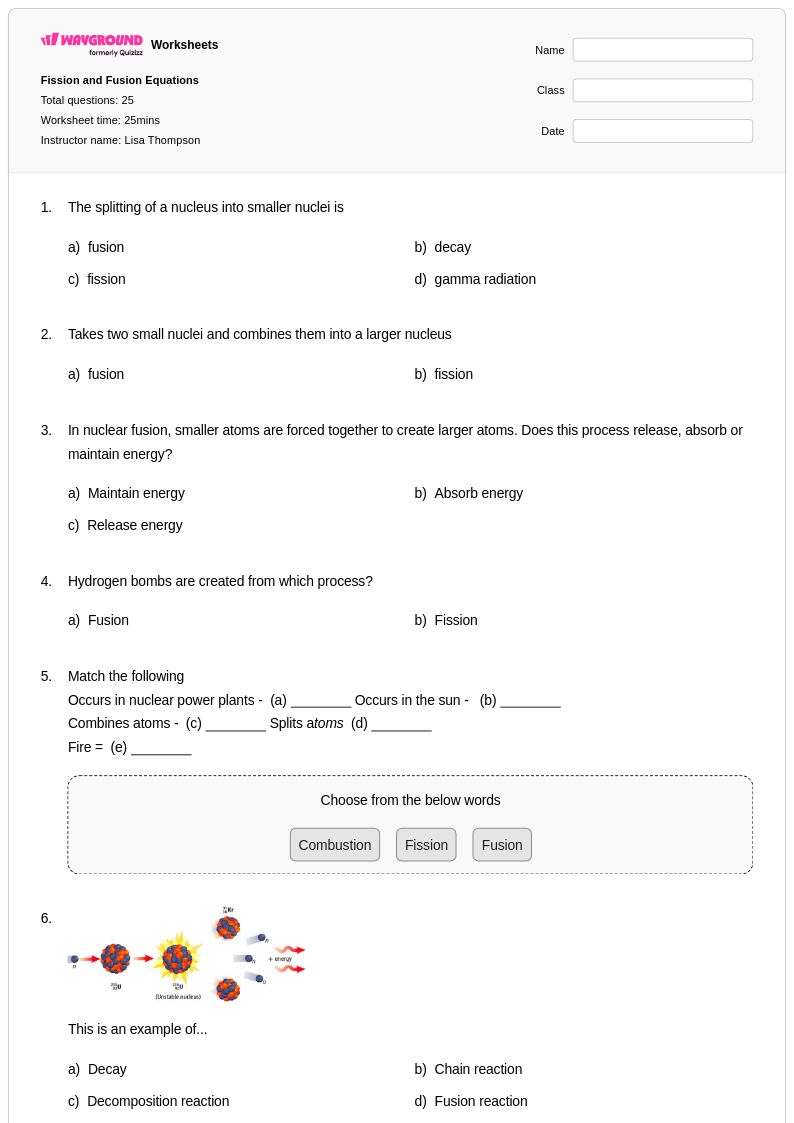
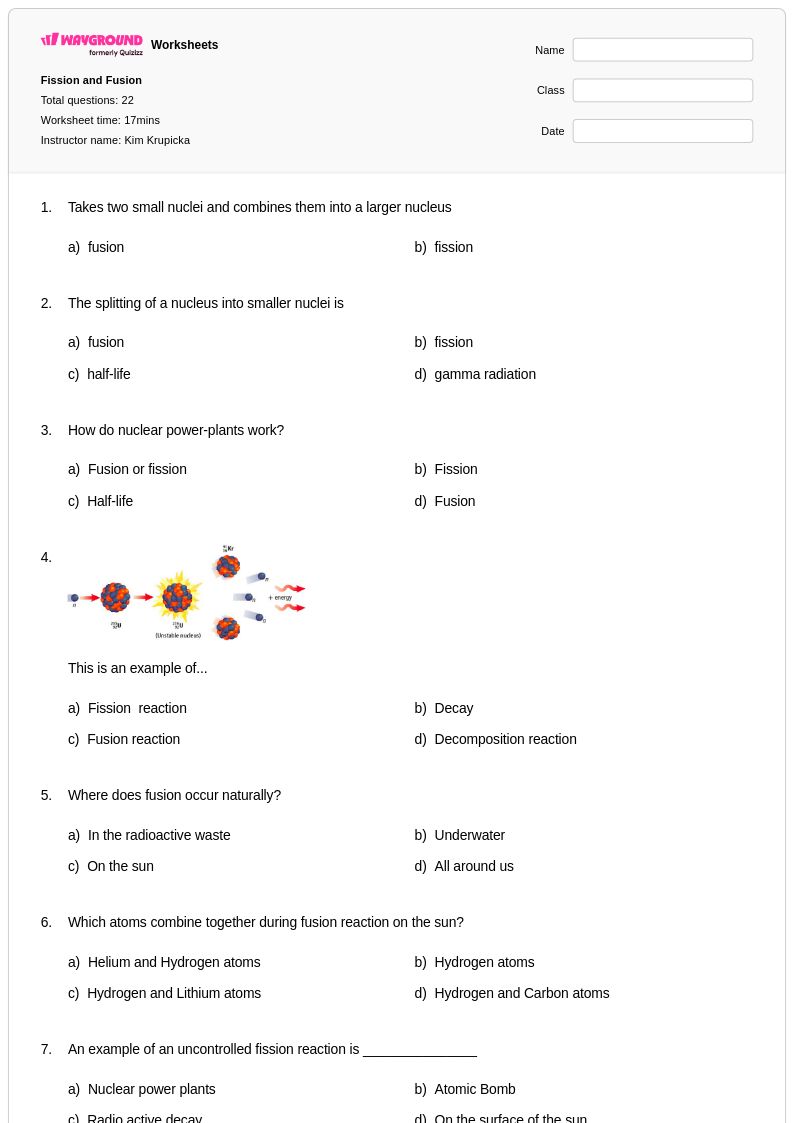
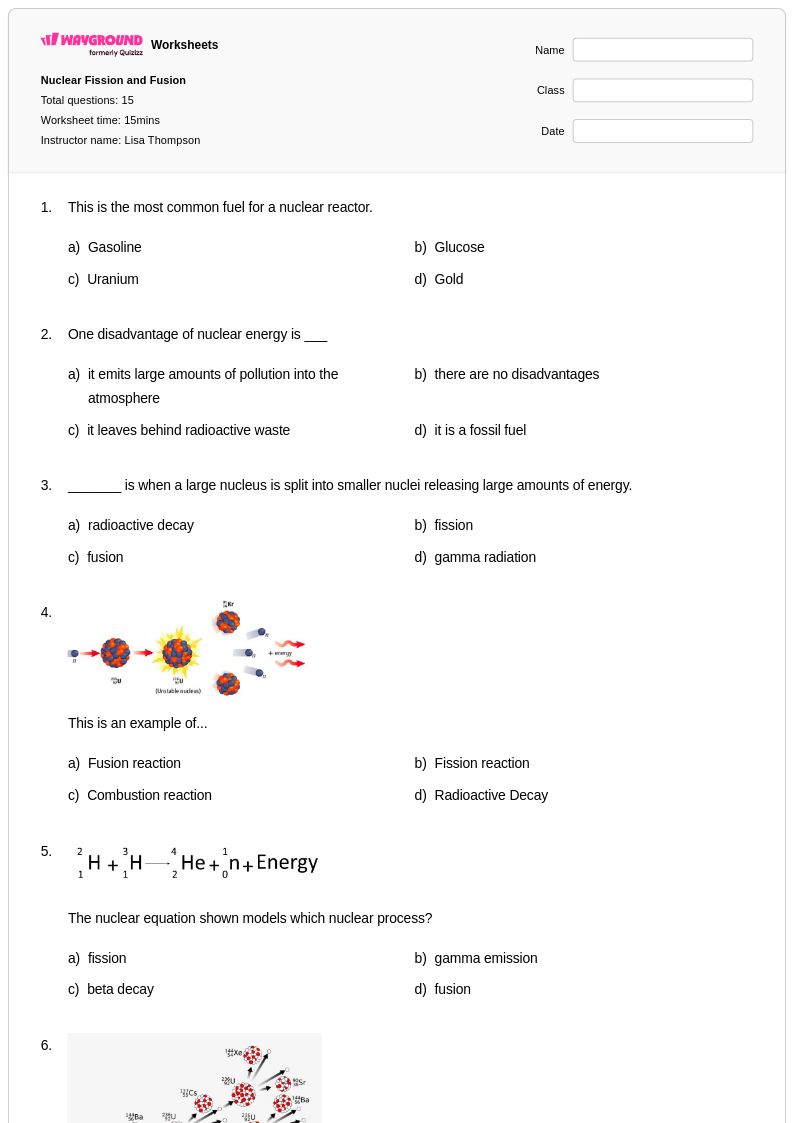
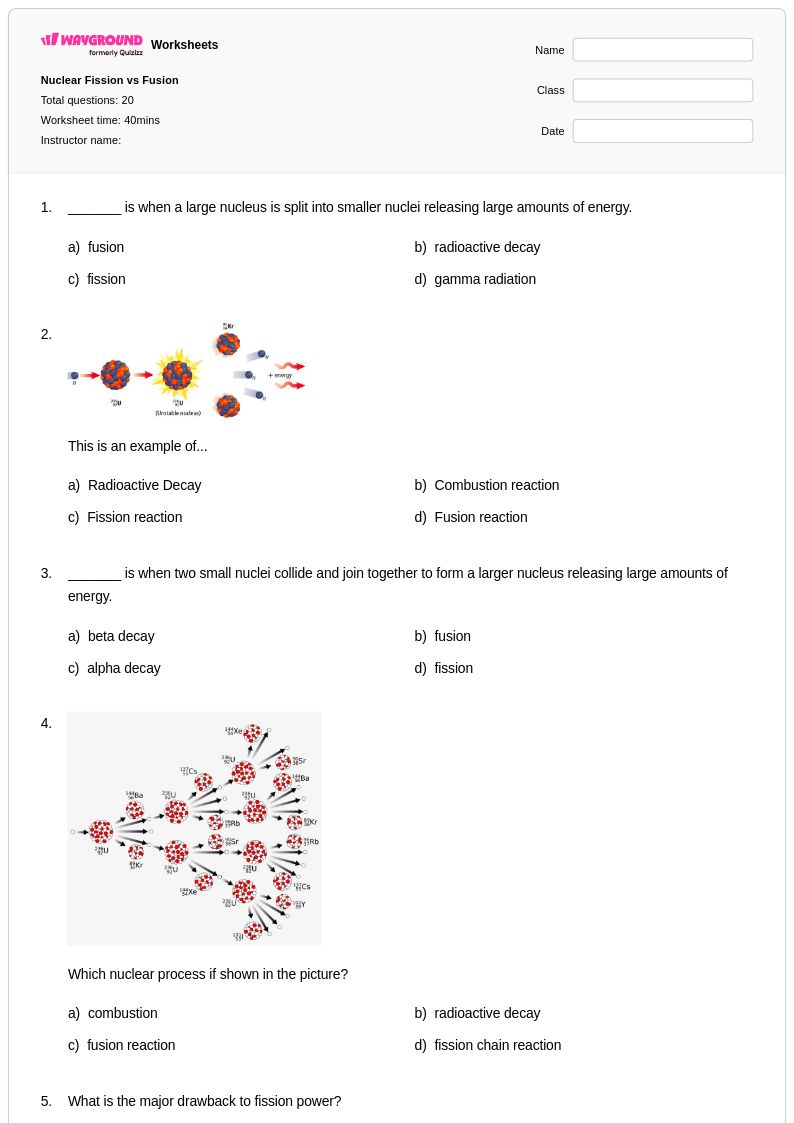
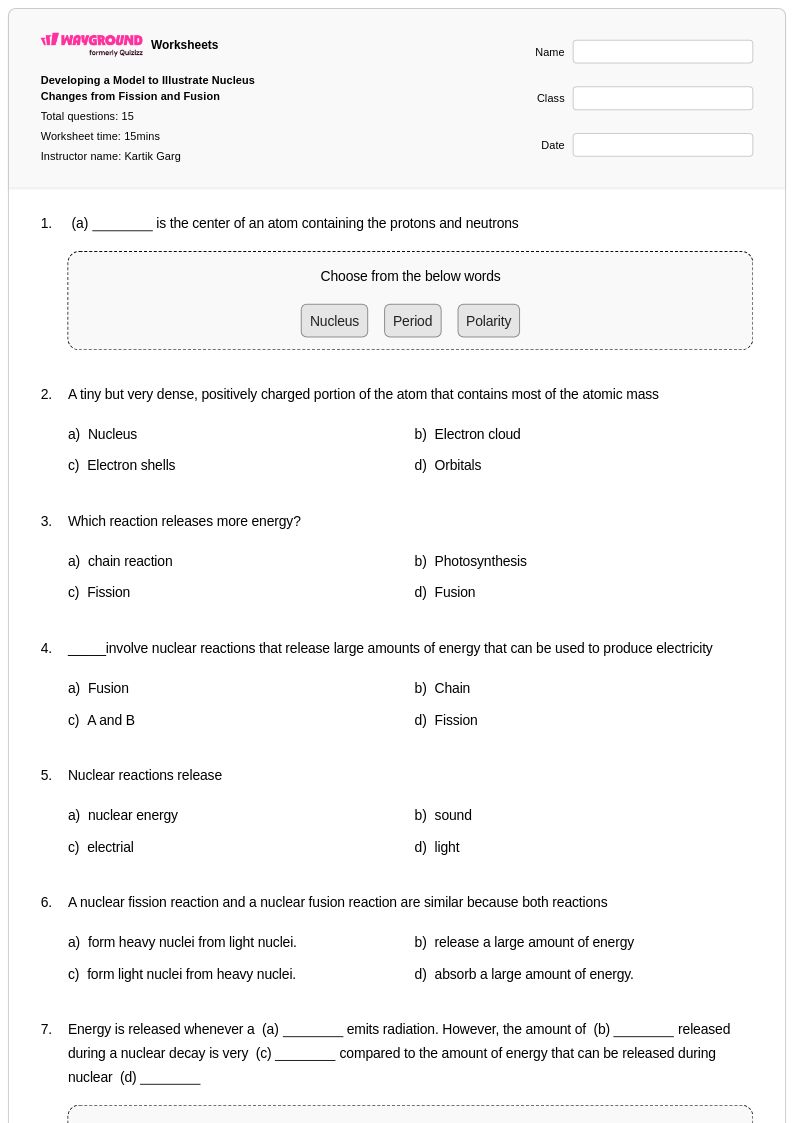
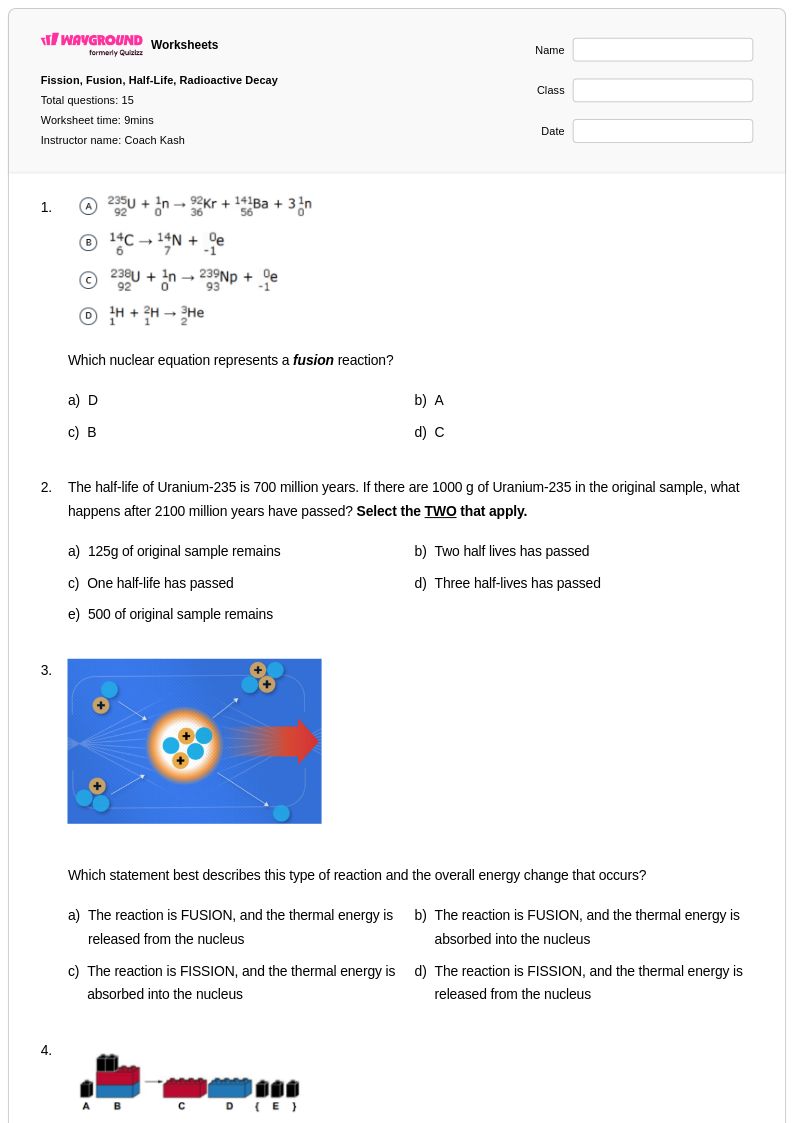
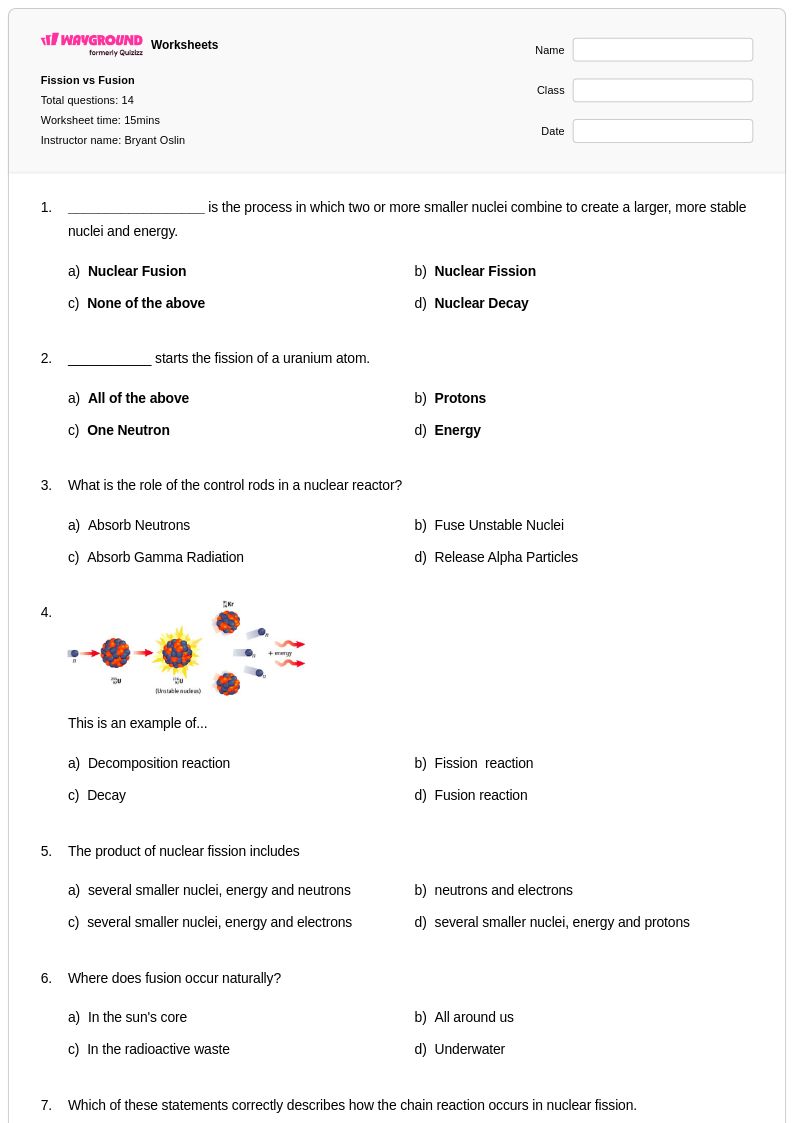
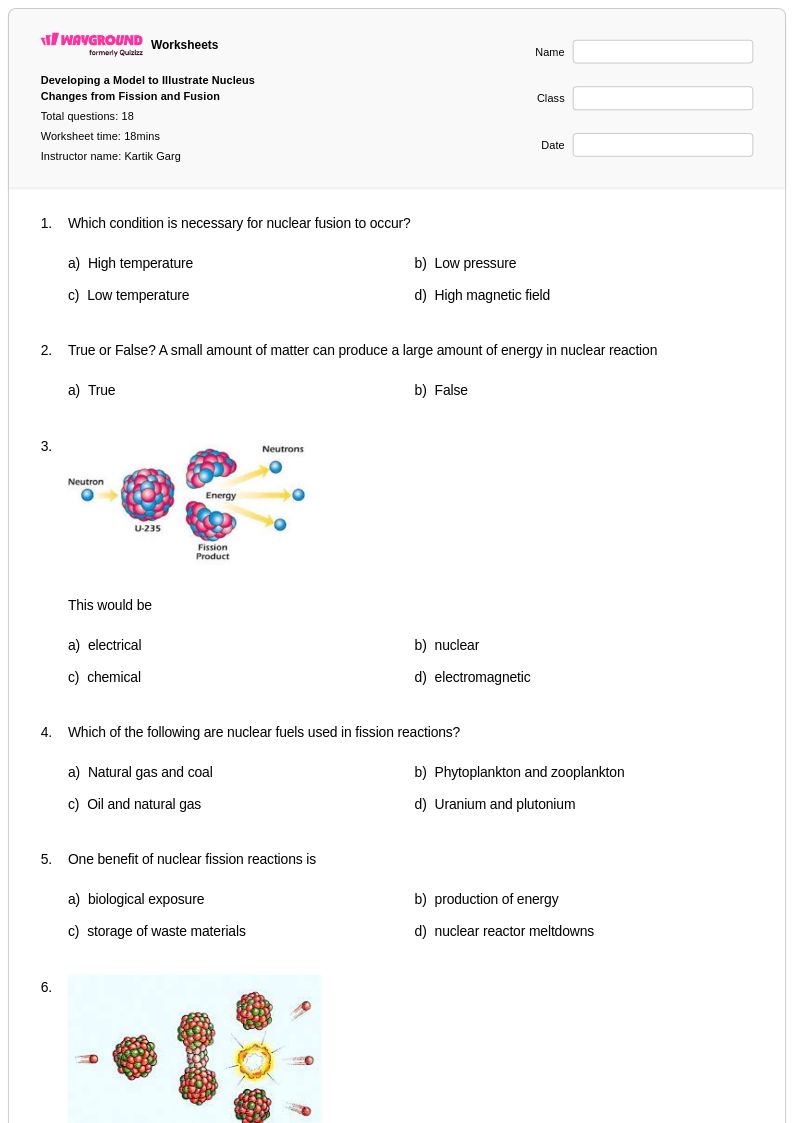
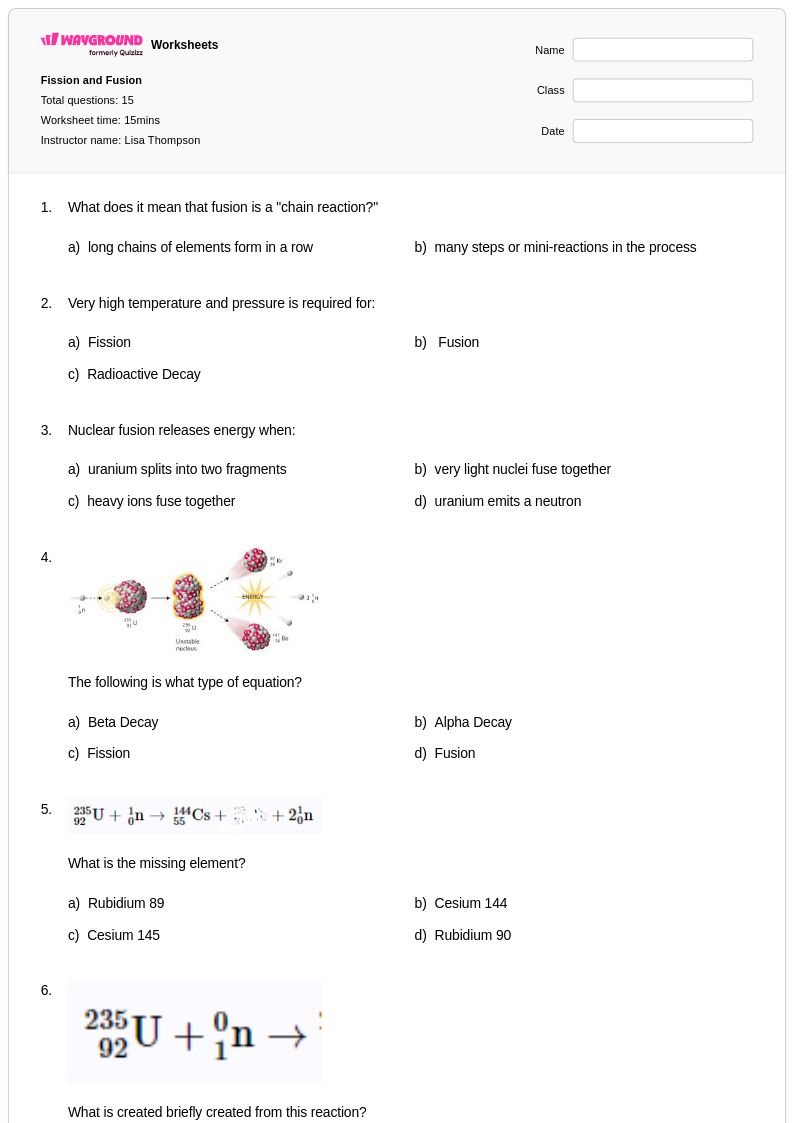
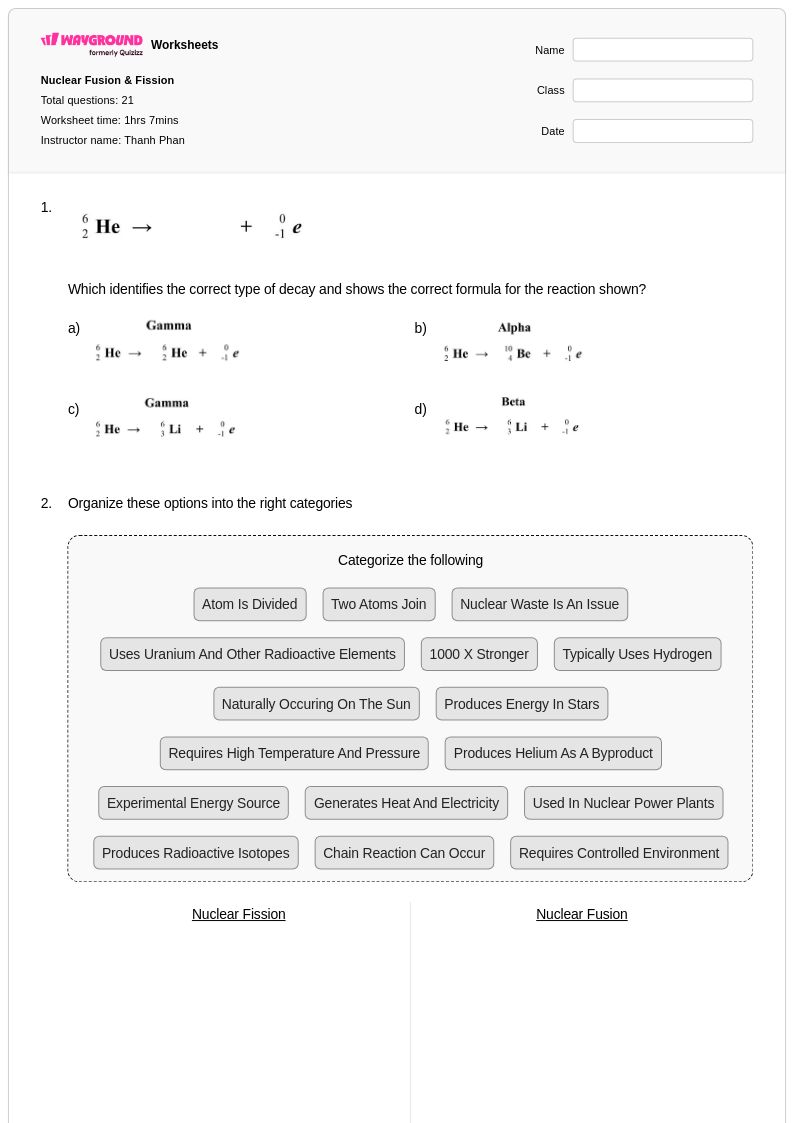
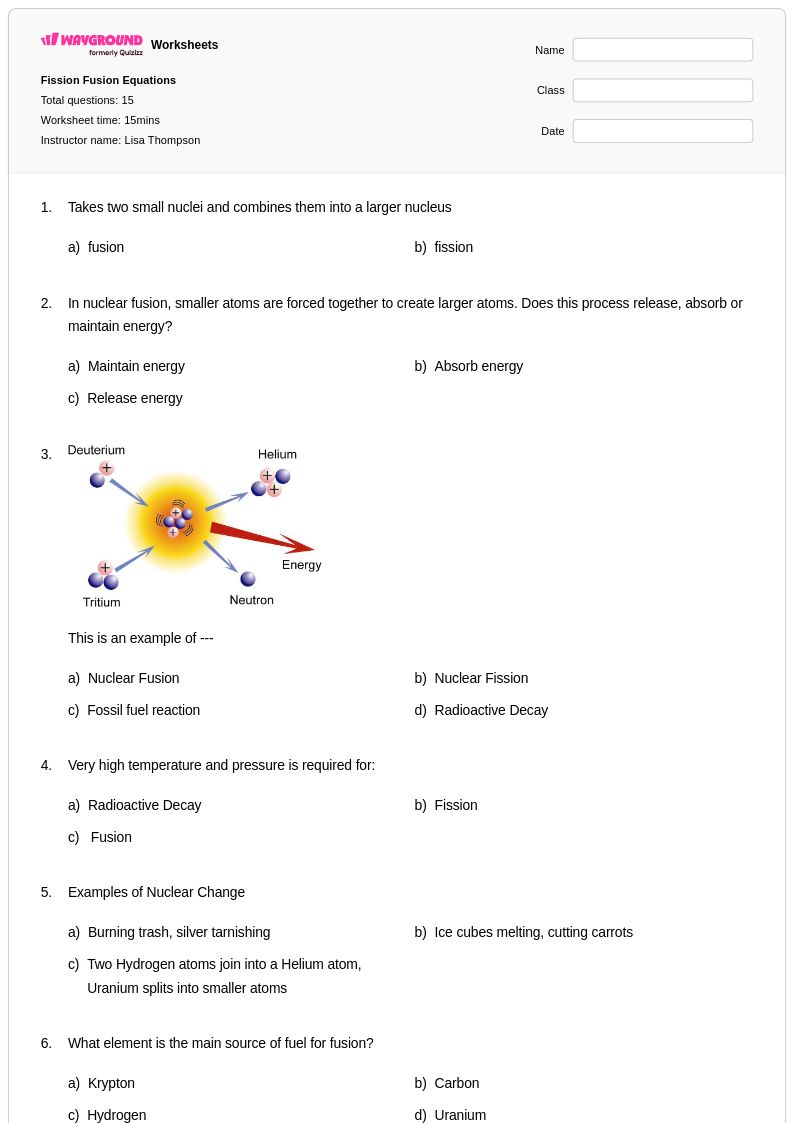
Fission and fusion worksheets for Year 10 students available through Wayground (formerly Quizizz) provide comprehensive coverage of nuclear reactions and energy transformations that define modern physics understanding. These expertly designed resources strengthen students' abilities to distinguish between nuclear fission and fusion processes, calculate binding energies, analyze mass-energy equivalence using Einstein's equation, and evaluate the applications of nuclear reactions in power generation and stellar processes. The worksheet collection includes detailed practice problems that guide students through uranium fission chain reactions, hydrogen fusion in stellar cores, and the energy calculations that demonstrate why these processes release tremendous amounts of energy. Each printable resource comes with a complete answer key, allowing students to verify their understanding of nuclear stability, critical mass concepts, and the fundamental differences between controlled nuclear reactions in power plants versus uncontrolled reactions in weapons, all available as free pdf downloads.
Wayground (formerly Quizizz) supports physics educators with an extensive library of millions of teacher-created fission and fusion worksheets that can be easily located through robust search and filtering capabilities aligned with national science standards. The platform's differentiation tools enable teachers to customize nuclear physics content for varying student ability levels, from introductory conceptual understanding to advanced quantitative analysis involving nuclear binding energy graphs and reaction equations. These versatile resources are available in both printable pdf formats for traditional classroom use and digital formats for interactive learning, making them ideal for lesson planning, targeted remediation of nuclear physics misconceptions, enrichment activities for advanced learners, and systematic skill practice in nuclear reaction balancing and energy calculations. The comprehensive worksheet collections help educators address the complex mathematical and conceptual challenges inherent in teaching nuclear physics while providing students with the structured practice necessary to master these fundamental scientific principles.
FAQs
How do I teach fission and fusion in a high school physics class?
Start by grounding students in atomic structure and nuclear binding energy before introducing fission and fusion as separate processes. Teach fission first using the uranium-235 chain reaction as a concrete example, then contrast it with fusion by examining hydrogen nuclei combining in stellar cores. Connecting both processes to real-world contexts, such as nuclear power plants for fission and the Sun for fusion, helps students move from abstract equations to meaningful understanding.
What exercises help students practice fission and fusion concepts?
Effective practice includes mass-energy conversion problems using Einstein's E=mc² equation, nuclear equation balancing tasks where students track atomic and mass numbers, and comparison charts that require students to contrast the conditions, fuels, and energy outputs of fission versus fusion. Problems that ask students to calculate energy released during specific reactions reinforce quantitative reasoning alongside conceptual understanding.
What mistakes do students commonly make when learning about fission and fusion?
Students frequently confuse which process applies to which elements, mistakenly believing fusion splits atoms or that fission can occur in light nuclei. A persistent misconception is that both processes always release the same amount of energy regardless of the nucleus involved, when in fact energy release depends on the binding energy curve. Students also struggle with mass defect calculations, often forgetting to convert mass differences to energy using consistent units.
How do I help students understand the difference between nuclear fission and nuclear fusion?
Use the nuclear binding energy curve as a visual anchor: fission is energetically favorable for heavy nuclei like uranium, while fusion is favorable for light nuclei like hydrogen. A side-by-side comparison activity, where students map the inputs, outputs, conditions, and applications of each process, is more effective than treating them separately. Emphasizing that both processes release energy by moving nuclei toward the iron peak on the binding energy curve gives students a unifying framework.
How can I use fission and fusion worksheets in my classroom?
Fission and fusion worksheets on Wayground are available as printable PDFs for traditional classroom use and in digital formats for technology-integrated environments, including the option to host them as a quiz directly on Wayground. Printable versions work well for guided note-taking or lab follow-up activities, while digital formats allow teachers to assign practice asynchronously or use Wayground's accommodation tools, such as read aloud or extended time, for students who need additional support.
How do I address different skill levels when teaching nuclear fission and fusion?
Differentiate by varying the complexity of problems: beginning learners benefit from labeling diagrams of chain reactions and matching vocabulary, while advanced students can tackle multi-step mass-energy calculations and analyze engineering constraints on fusion reactors. On Wayground, teachers can apply student-level accommodations, including reduced answer choices, read aloud, and extended time, to individual students without alerting the rest of the class, making it practical to support diverse learners within a single assignment.