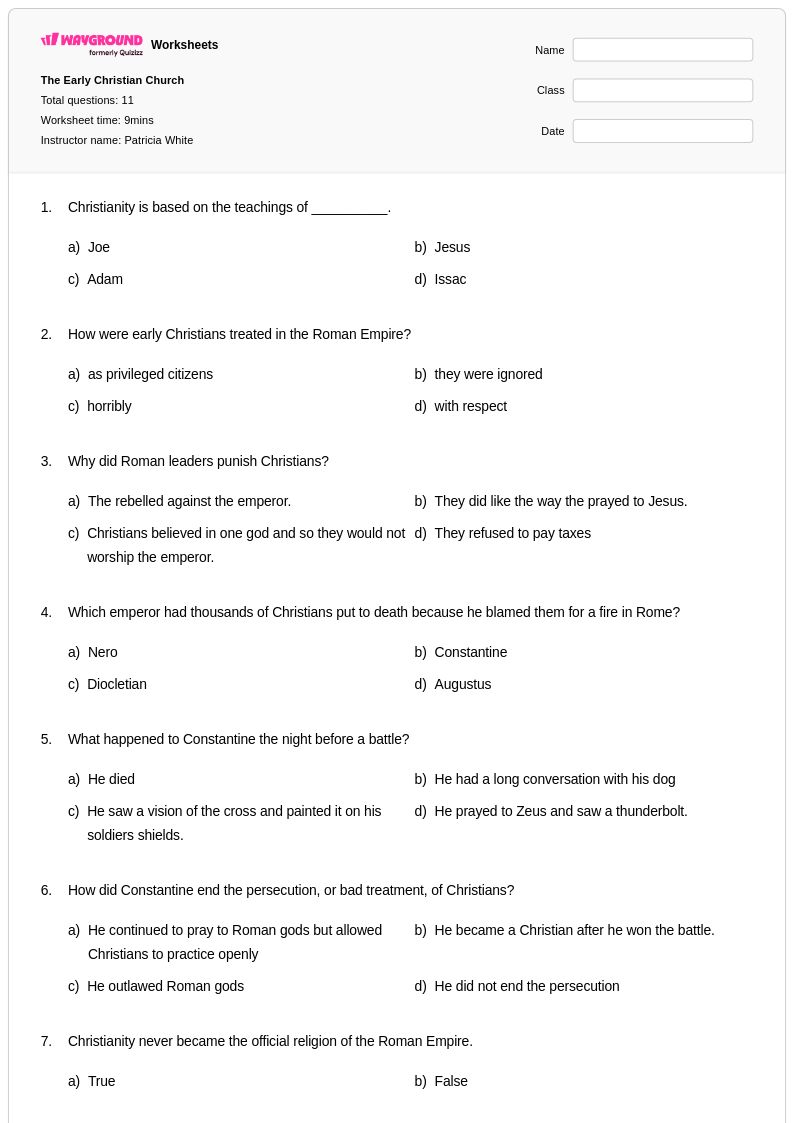
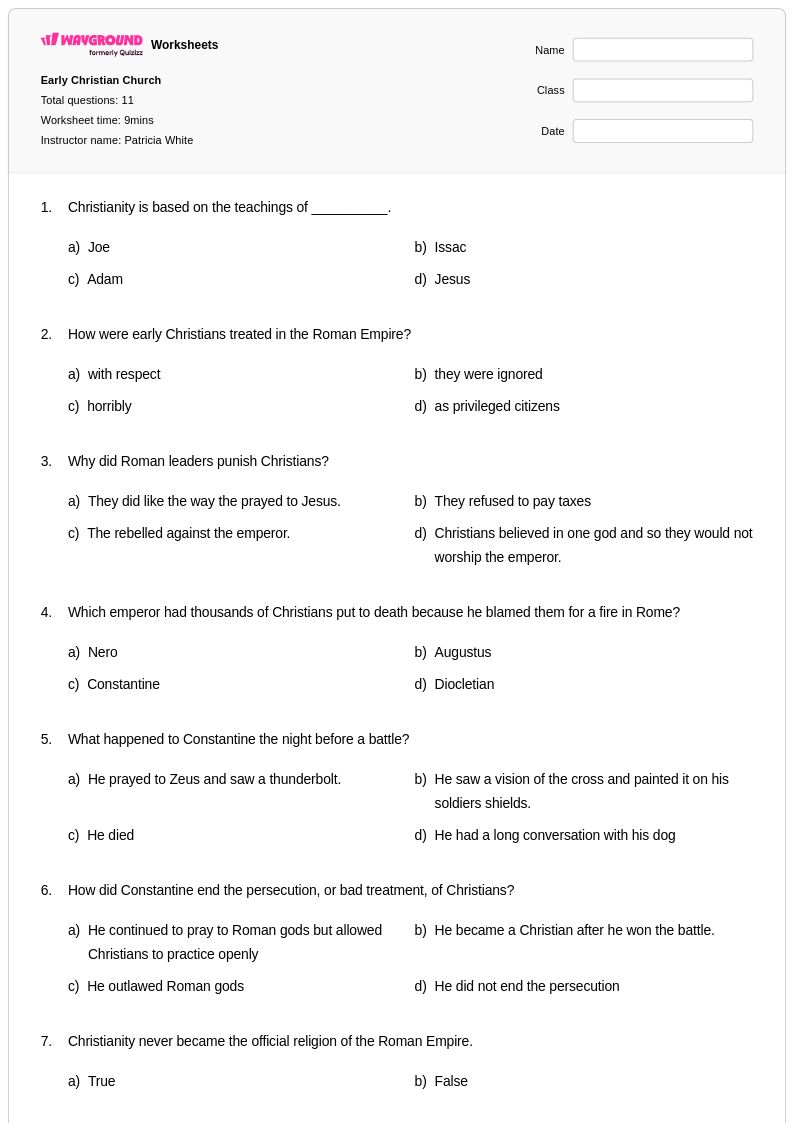
Explore Wayground's comprehensive collection of free Constantine the Great worksheets and printables that help students master this pivotal Roman emperor's impact on ancient civilizations through engaging practice problems and detailed answer keys.
Explore printable Constantine the Great worksheets
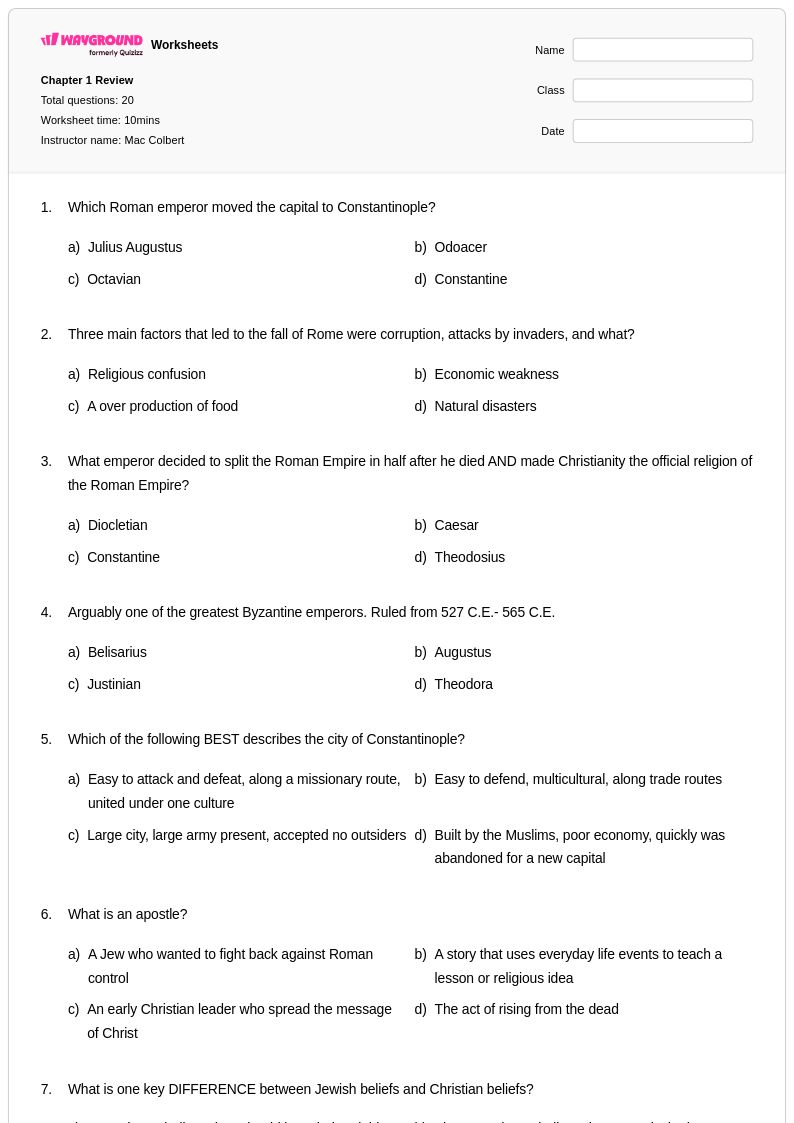
Constantine the Great worksheets available through Wayground (formerly Quizizz) provide comprehensive educational resources that examine one of history's most influential Roman emperors and his transformative impact on the ancient world. These carefully crafted materials guide students through Constantine's rise to power, his military campaigns, the Battle of the Milvian Bridge, and his groundbreaking Edict of Milan that legalized Christianity throughout the Roman Empire. Students develop critical thinking skills by analyzing primary sources, examining the political and religious changes during Constantine's reign, and evaluating his role in the transition from the classical Roman Empire to the Byzantine Empire. The worksheets include detailed answer keys that support both independent study and classroom instruction, while free printables offer accessible practice problems covering topics such as Constantine's conversion to Christianity, the founding of Constantinople, and the lasting legacy of his reforms on European civilization.
Wayground (formerly Quizizz) empowers educators with an extensive collection of teacher-created resources focused on Constantine the Great, drawing from millions of high-quality materials that have been developed and refined by social studies professionals worldwide. The platform's robust search and filtering capabilities allow teachers to quickly locate worksheets that align with specific curriculum standards and learning objectives, while differentiation tools enable customization for diverse student needs and ability levels. These resources are available in both printable pdf formats for traditional classroom use and digital formats for online learning environments, providing maximum flexibility for lesson planning and implementation. Teachers can effectively utilize these materials for targeted skill practice, remediation of challenging concepts such as the complex relationship between church and state in the late Roman Empire, and enrichment activities that encourage deeper exploration of Constantine's enduring influence on Western civilization and the spread of Christianity.
FAQs
How do I teach Constantine the Great to middle or high school students?
Teaching Constantine the Great effectively means anchoring his story in two pivotal moments: the Battle of the Milvian Bridge and the Edict of Milan. Start by establishing the political instability of the late Roman Empire so students understand why Constantine's consolidation of power was so significant. From there, guide students through the religious, political, and geographic transformations of his reign, including the founding of Constantinople and the shift toward what would become the Byzantine Empire. Primary source analysis and cause-and-effect organizers work particularly well for helping students connect these developments.
What exercises help students practice their knowledge of Constantine the Great?
Effective practice exercises for Constantine the Great include timeline sequencing activities that track his rise to power, military campaigns, and key edicts, as well as short-answer and document-based questions that ask students to evaluate the significance of the Edict of Milan or his conversion to Christianity. Compare-and-contrast tasks pairing the Western and Eastern Roman Empire help reinforce the long-term consequences of his reign. Worksheets with targeted practice problems and detailed answer keys allow students to self-check their understanding of these complex historical shifts.
What misconceptions do students commonly have about Constantine the Great?
A common misconception is that Constantine personally converted the entire Roman Empire to Christianity through the Edict of Milan, when in fact the edict legalized Christianity rather than establishing it as the sole state religion. Students also frequently confuse Constantinople as a replacement for Rome rather than understanding it as a new eastern capital that coexisted with Rome before eventually becoming the center of the Byzantine Empire. Another error is oversimplifying Constantine's own religious beliefs, which historians continue to debate given the complexity of his political motivations alongside his personal faith.
How does Constantine the Great connect to broader ancient civilizations curriculum?
Constantine the Great sits at the intersection of Roman history, early Christian history, and the origins of the Byzantine Empire, making him a natural bridge figure in any ancient civilizations unit. His reign marks the transition from the classical Roman world to the medieval period, which means studying him reinforces students' understanding of how empires evolve, fragment, and transform over time. Teachers can use his story to connect earlier lessons on the Roman Republic and Pax Romana with later content on the Byzantine Empire and the spread of Christianity through Europe.
How can I use Constantine the Great worksheets in my classroom?
Constantine the Great worksheets on Wayground are available as printable PDFs for traditional classroom use and in digital formats for technology-integrated or remote learning environments, giving teachers flexibility in how they assign and collect work. Teachers can also host these materials as a quiz directly on Wayground, which is useful for formative assessment or exit tickets after a lesson on the Edict of Milan or the founding of Constantinople. Each worksheet includes a detailed answer key, supporting both guided instruction and independent student practice.
How do I differentiate Constantine the Great instruction for students with different learning needs?
For students who need additional support, simplifying primary source excerpts and using graphic organizers that break Constantine's reign into discrete events, such as his conversion, the Edict of Milan, and the founding of Constantinople, can reduce cognitive load. When using Wayground's digital format, teachers can apply individual accommodations such as read-aloud support, extended time, reduced answer choices, and adjustable reading modes for students who need them, without affecting the experience of other students in the class. These settings can be configured per student from the Students or Classes tab and reused across future sessions.