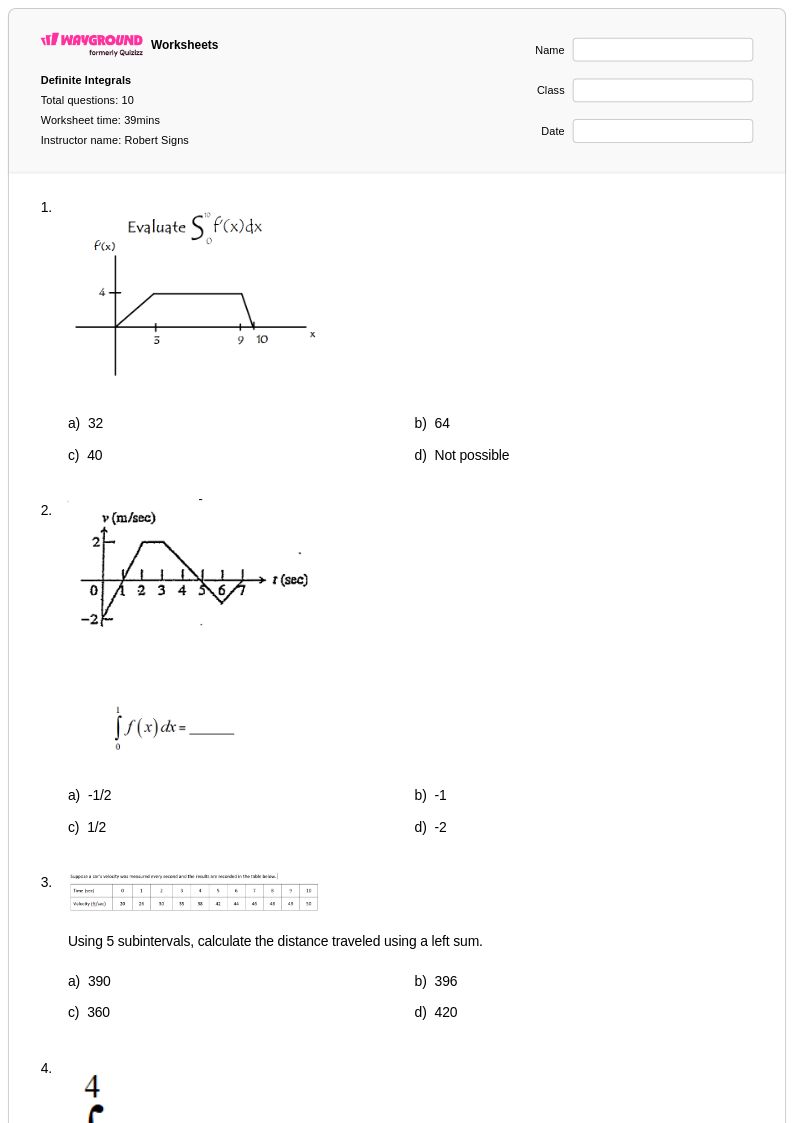
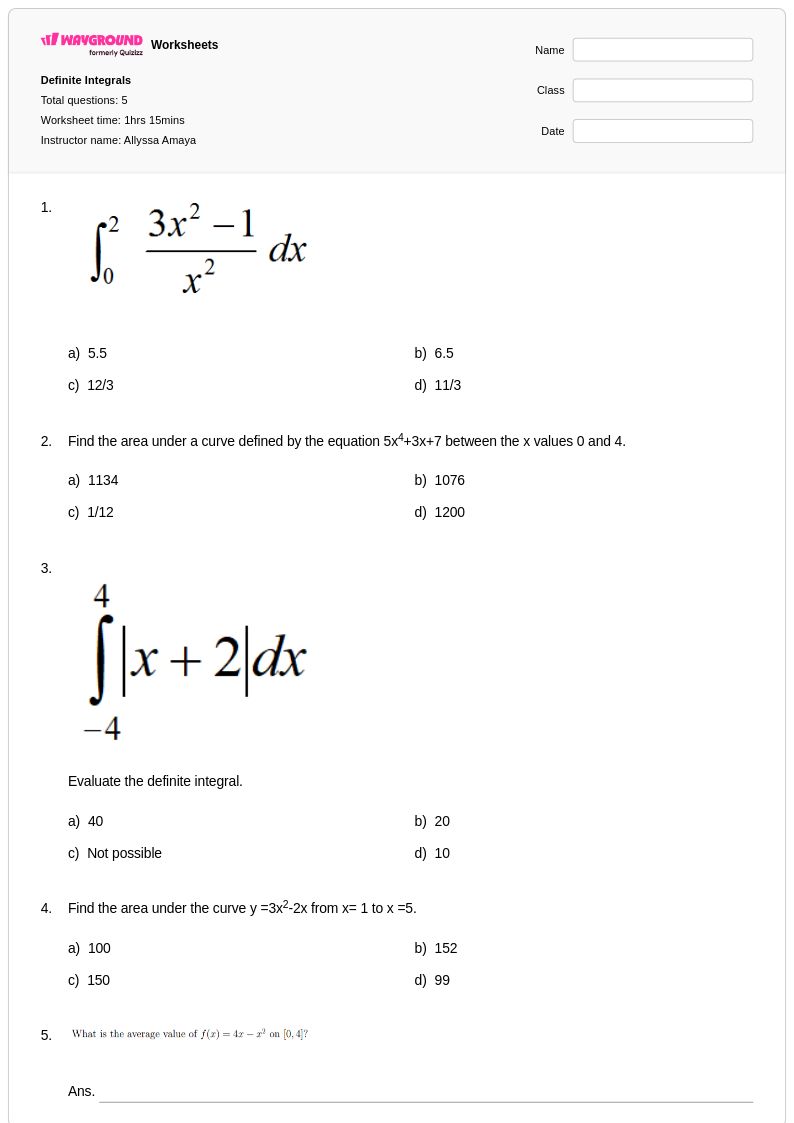
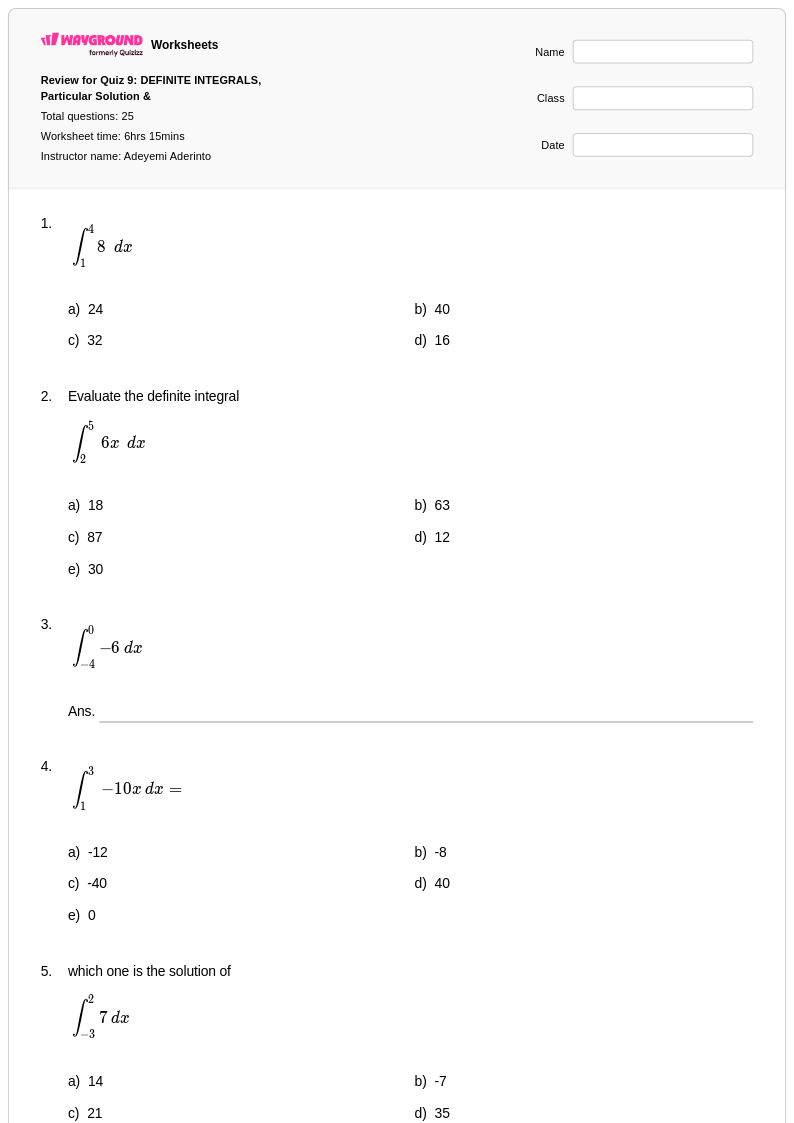
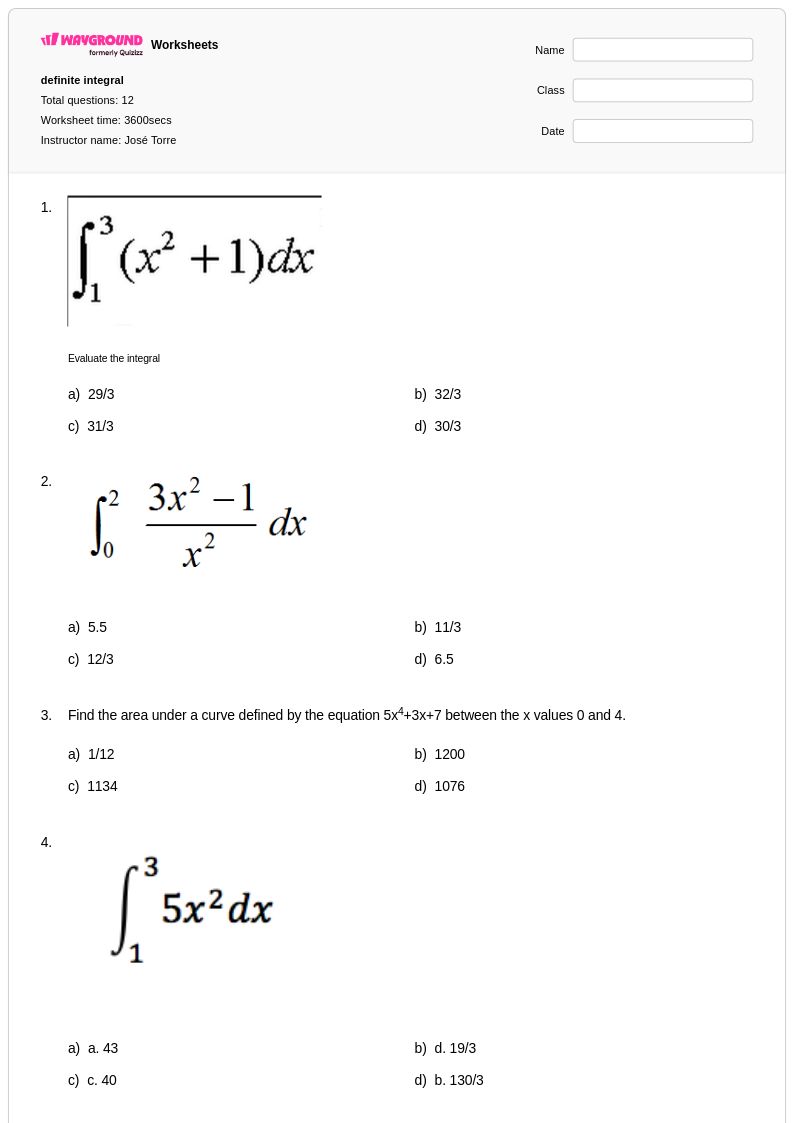
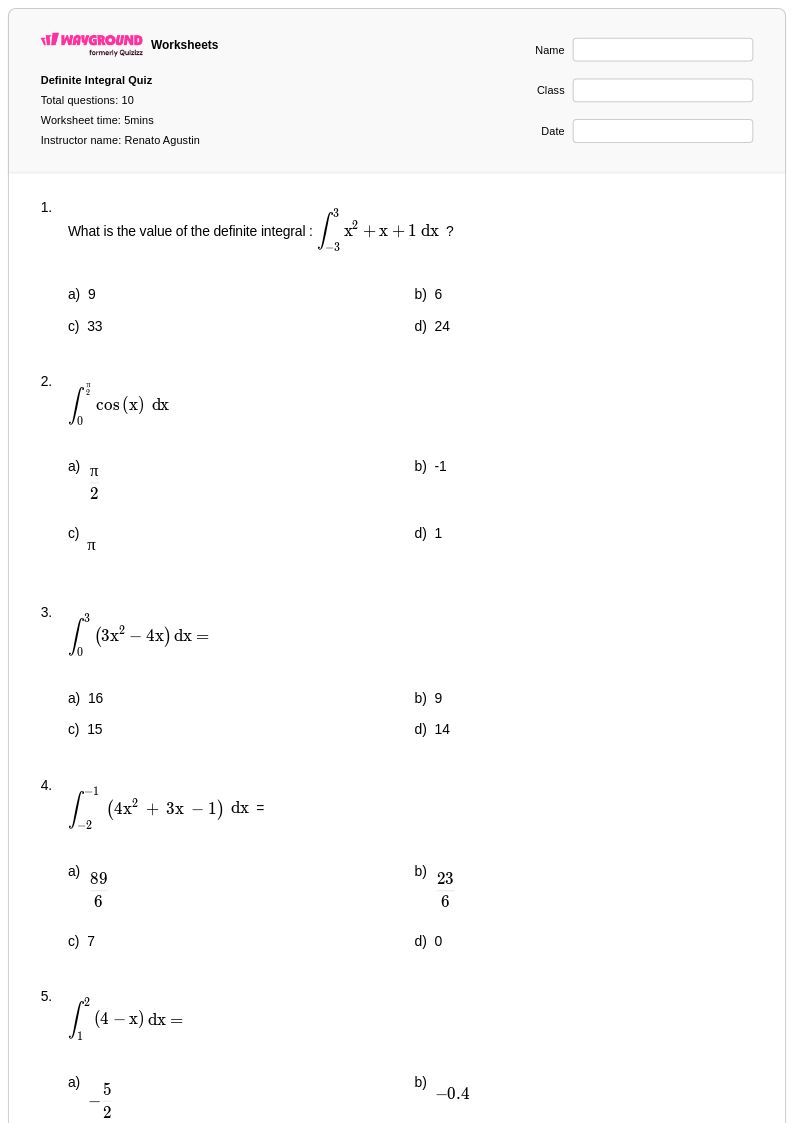
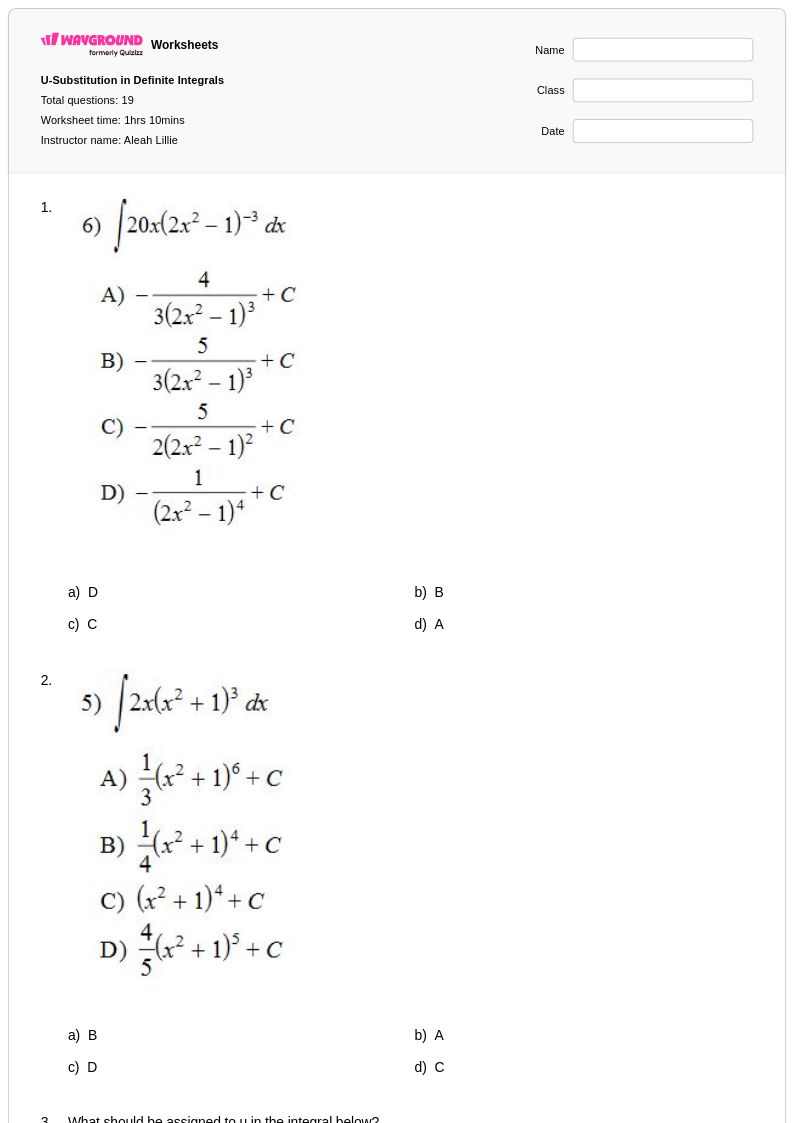
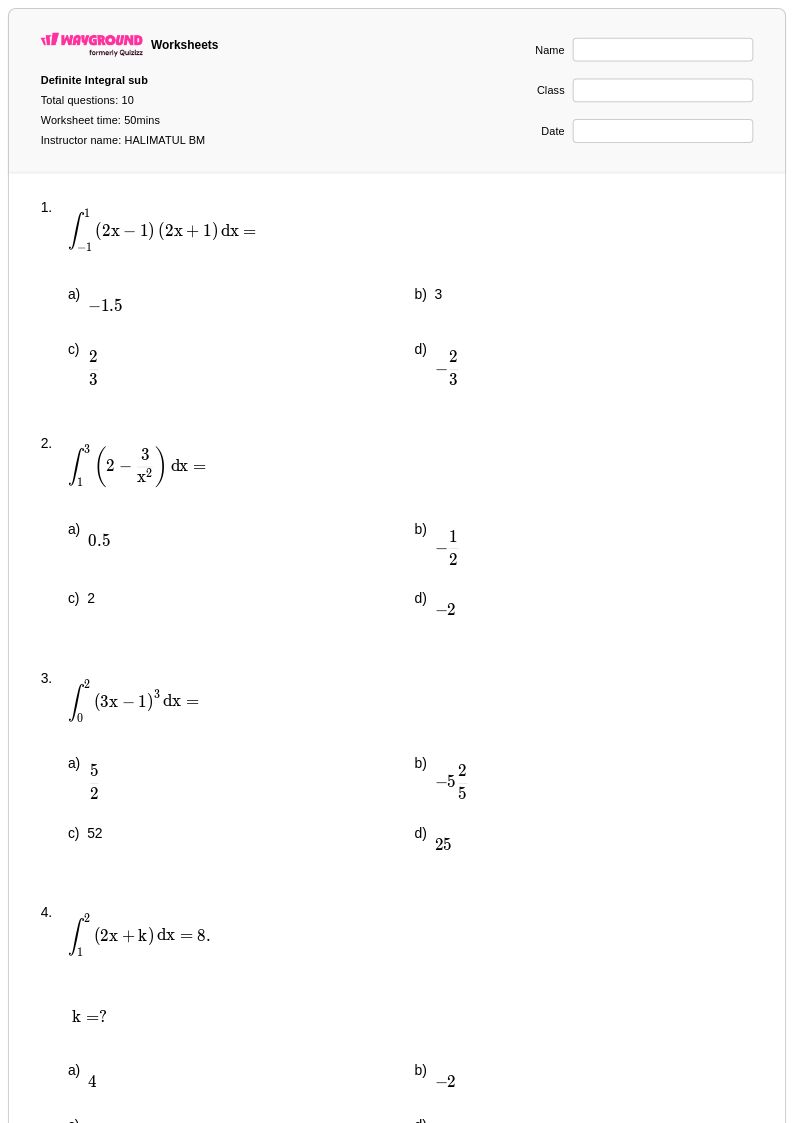
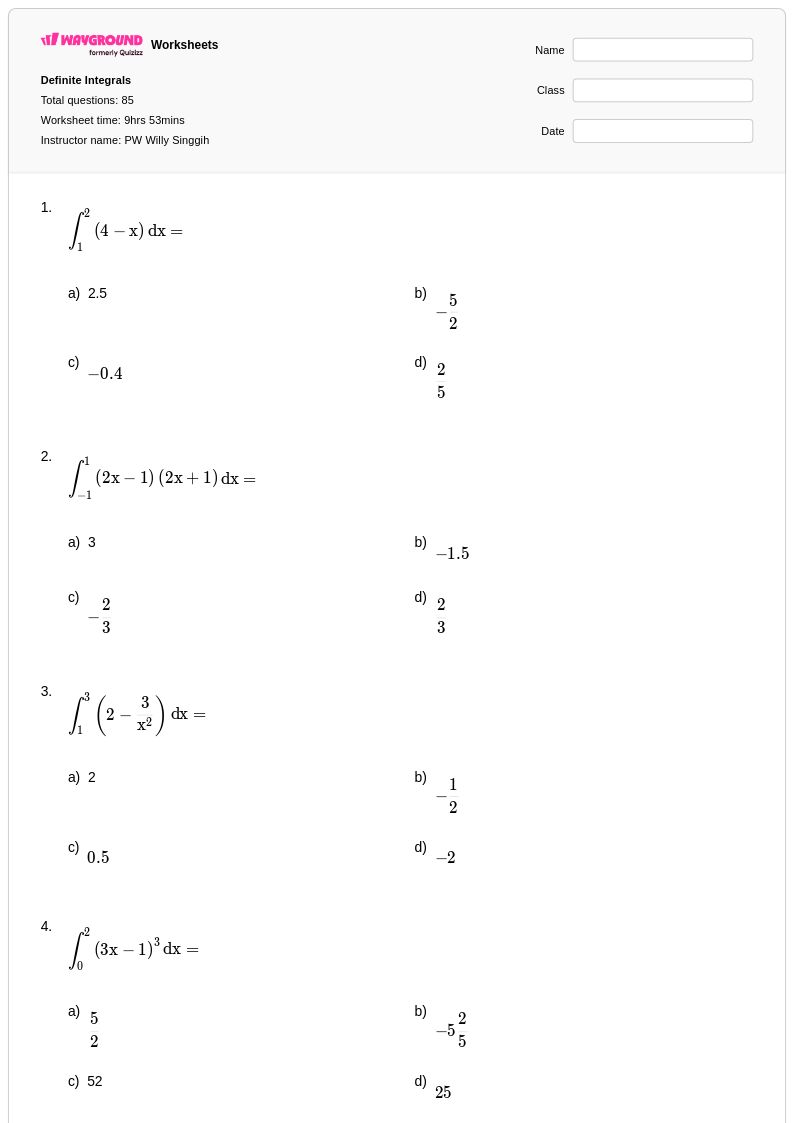
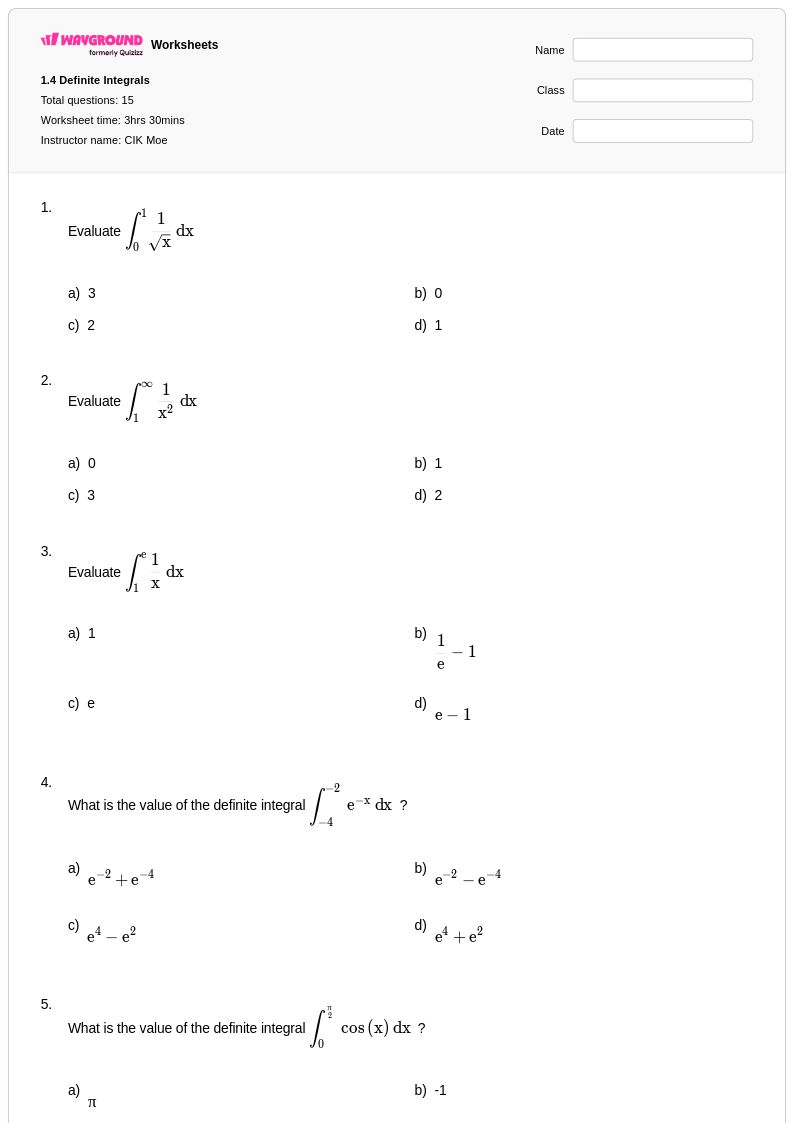
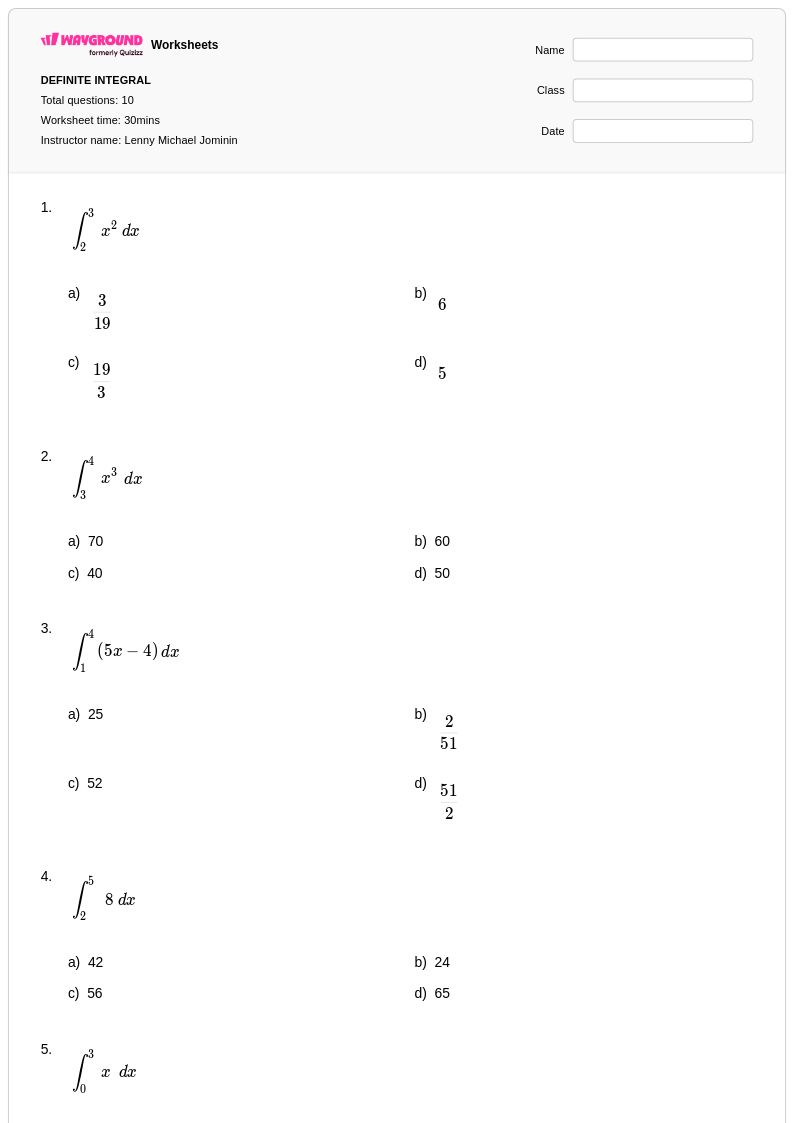
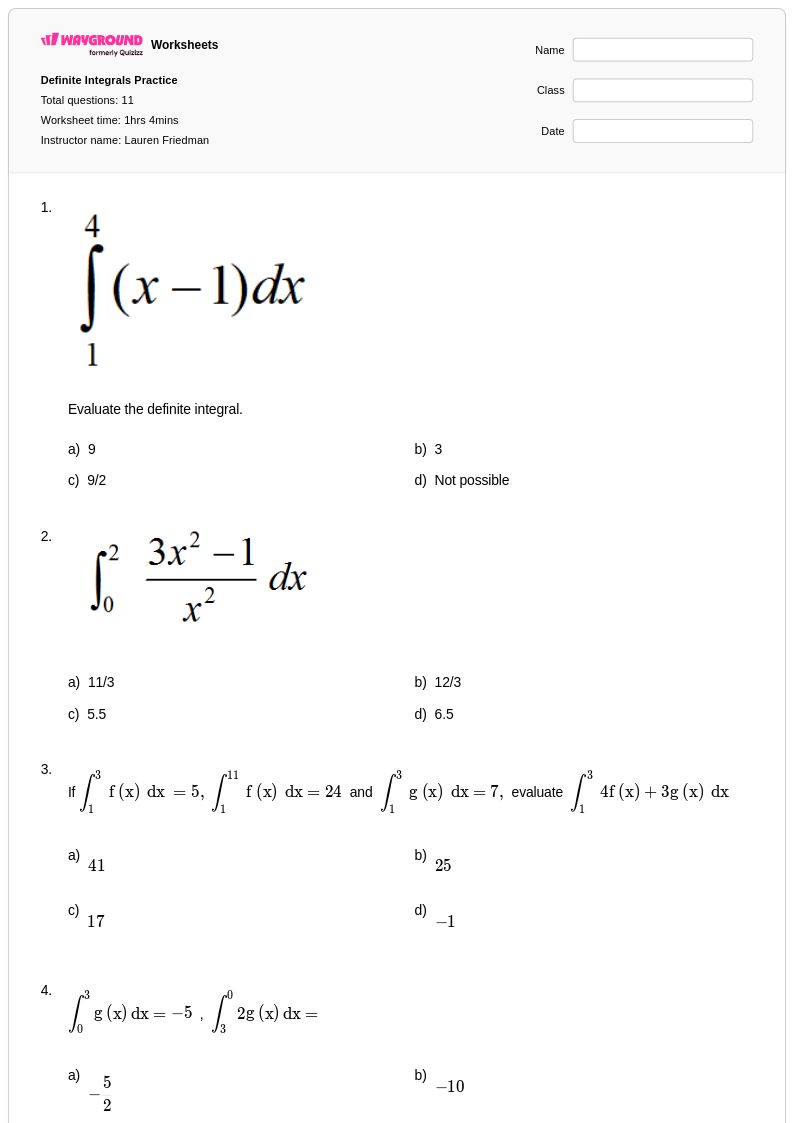
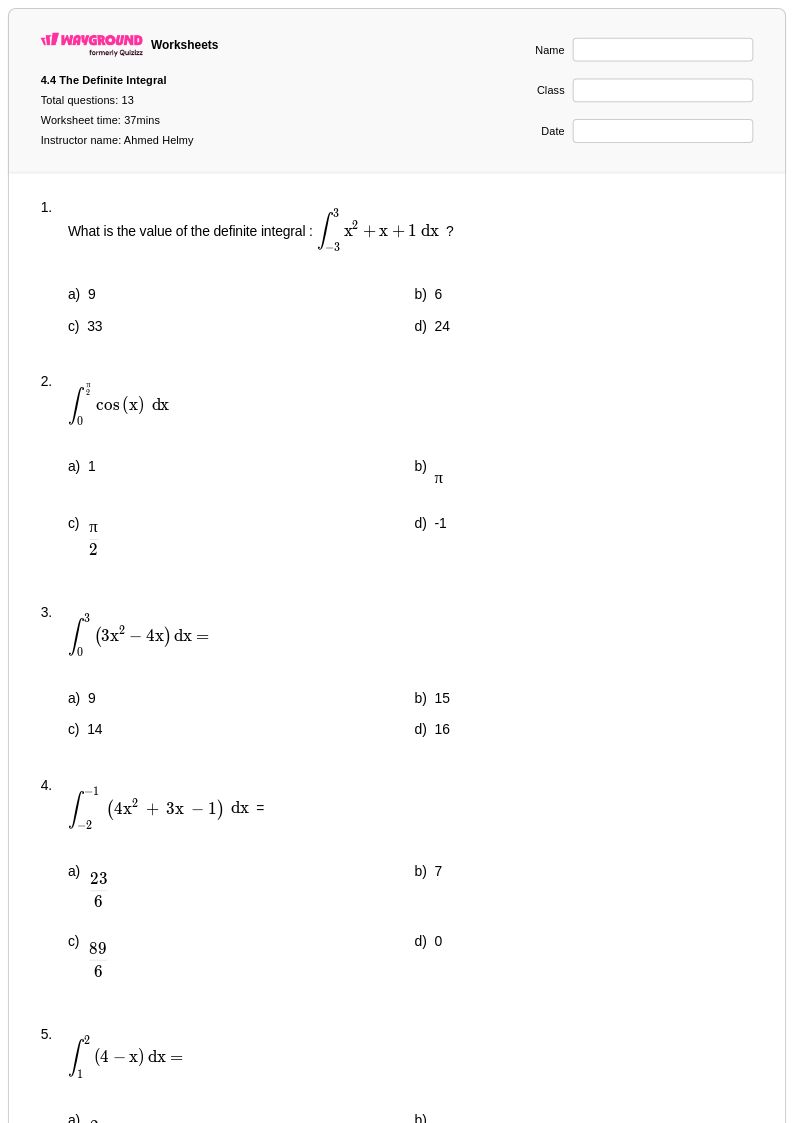
Wayground's free definite integral worksheets provide comprehensive practice problems and answer keys to help students master fundamental calculus concepts through structured printable PDFs and engaging mathematical exercises.
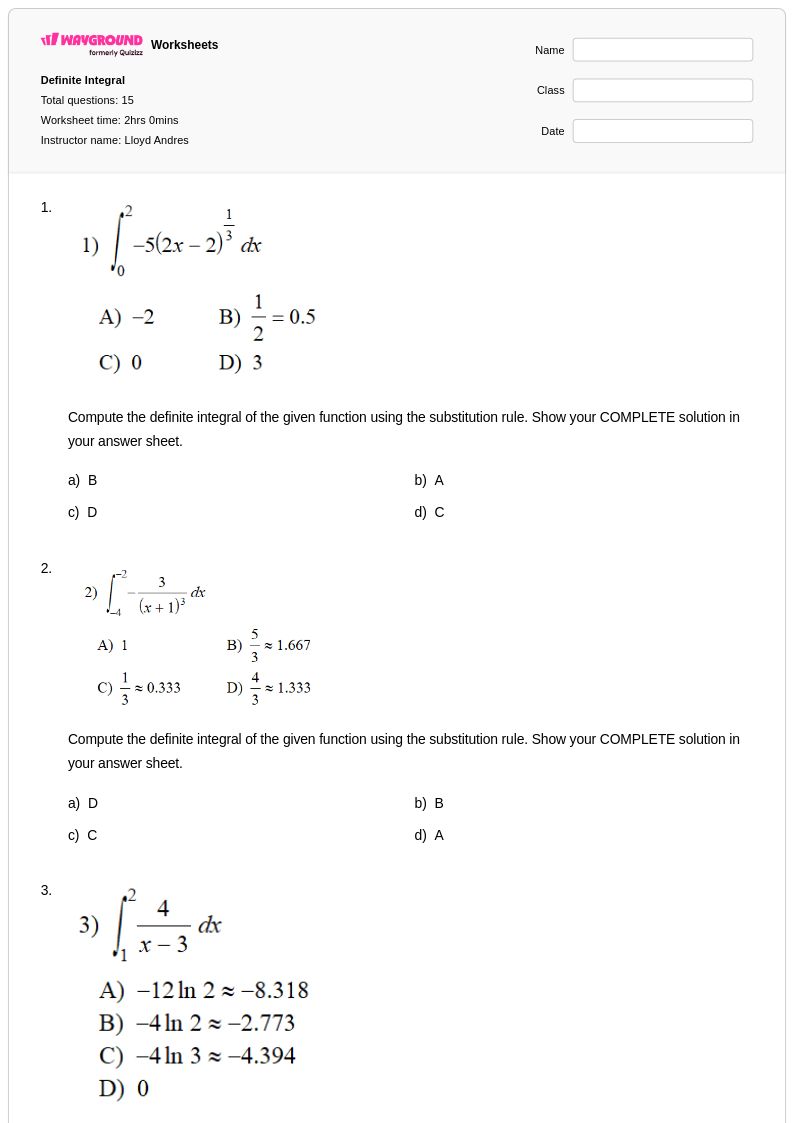
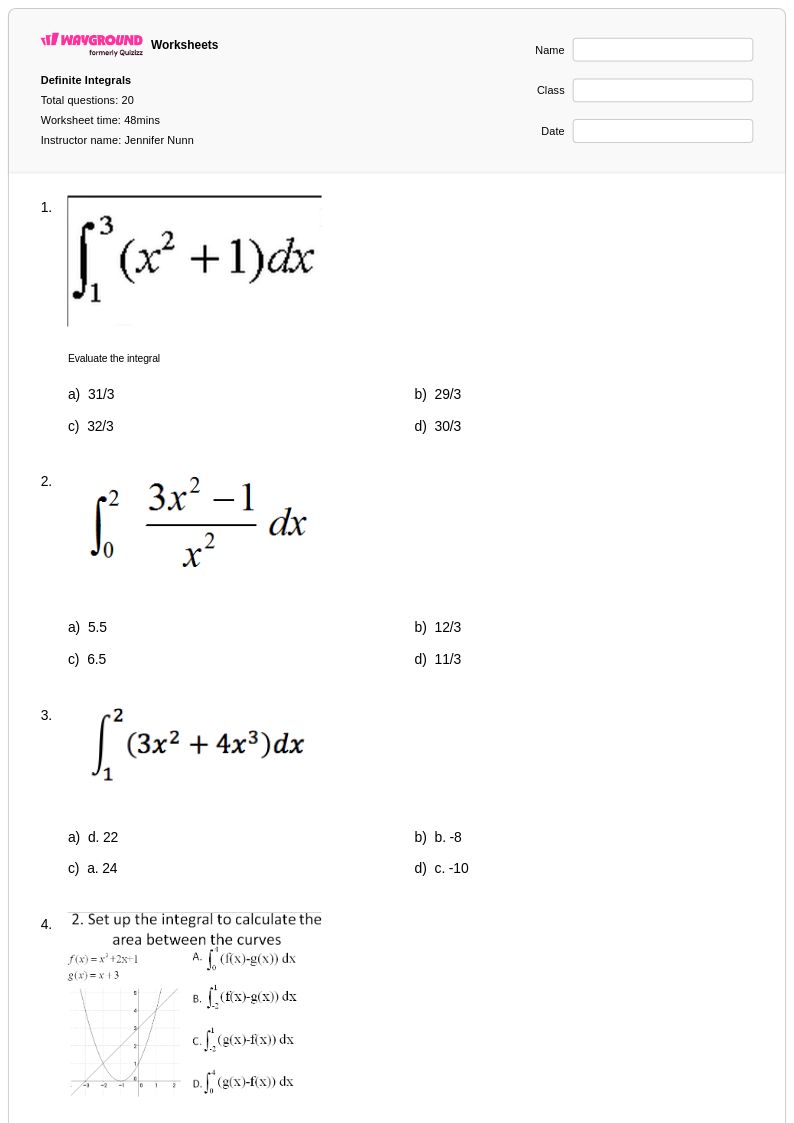
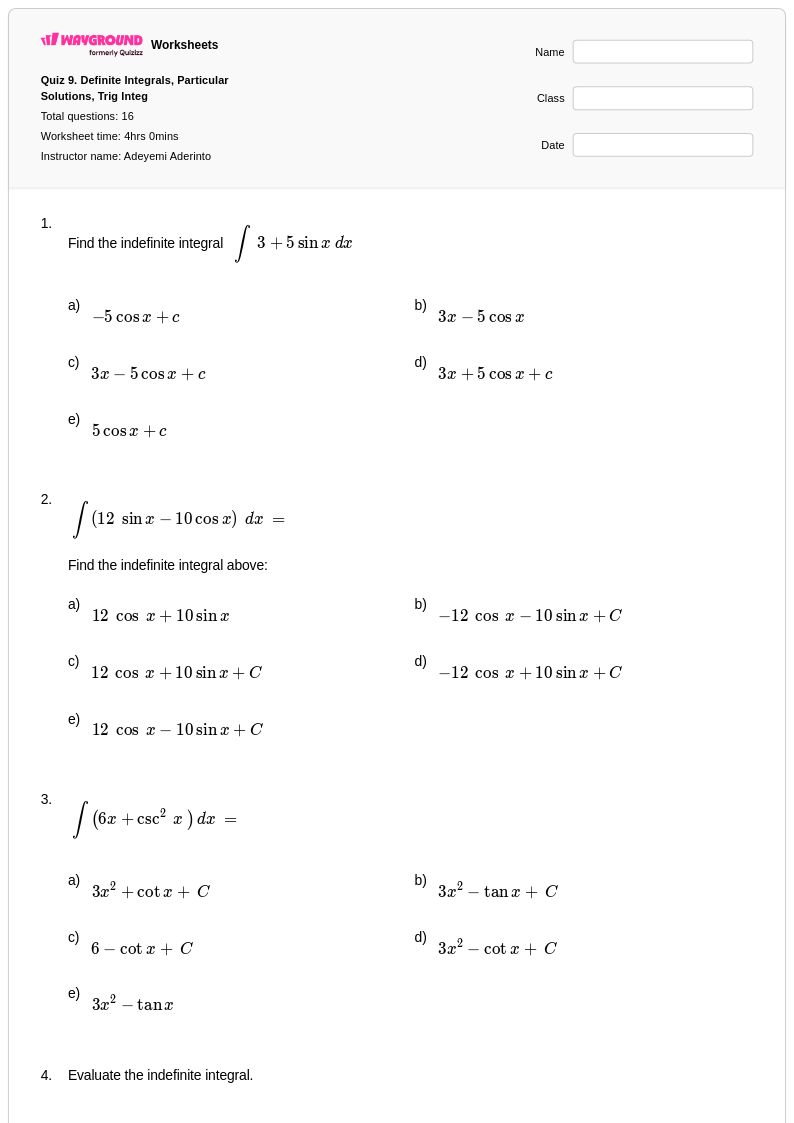
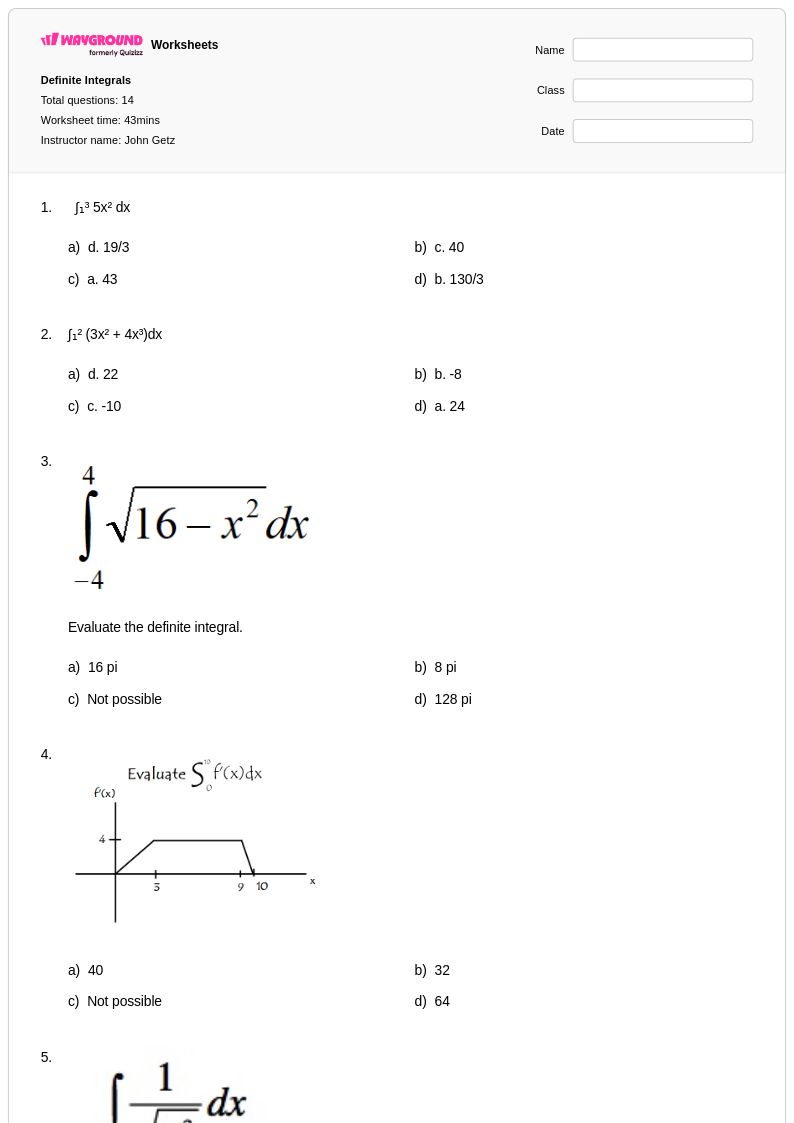
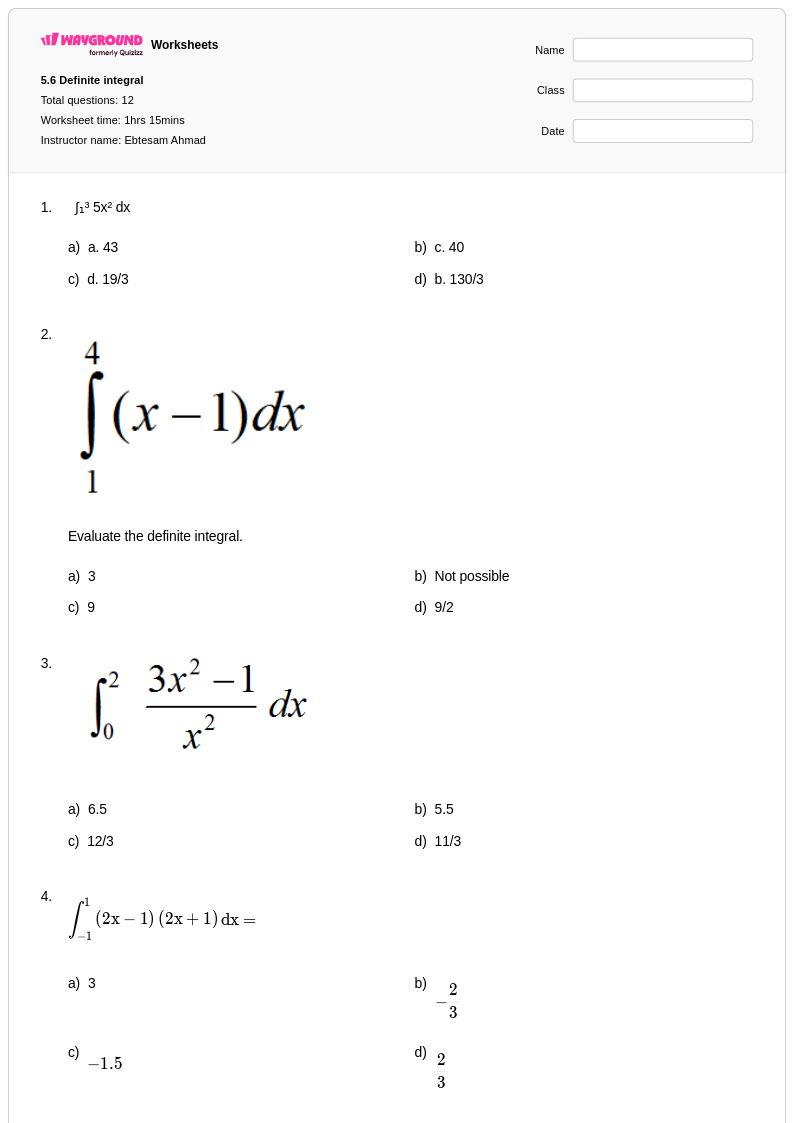
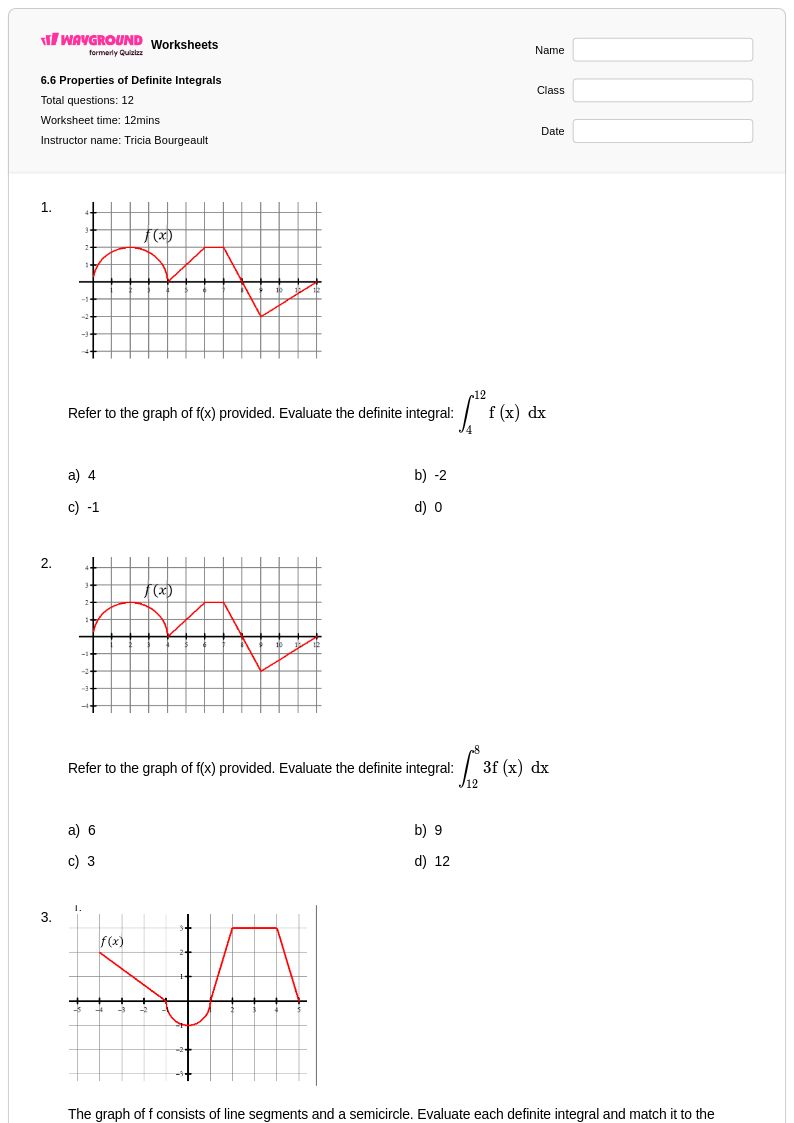
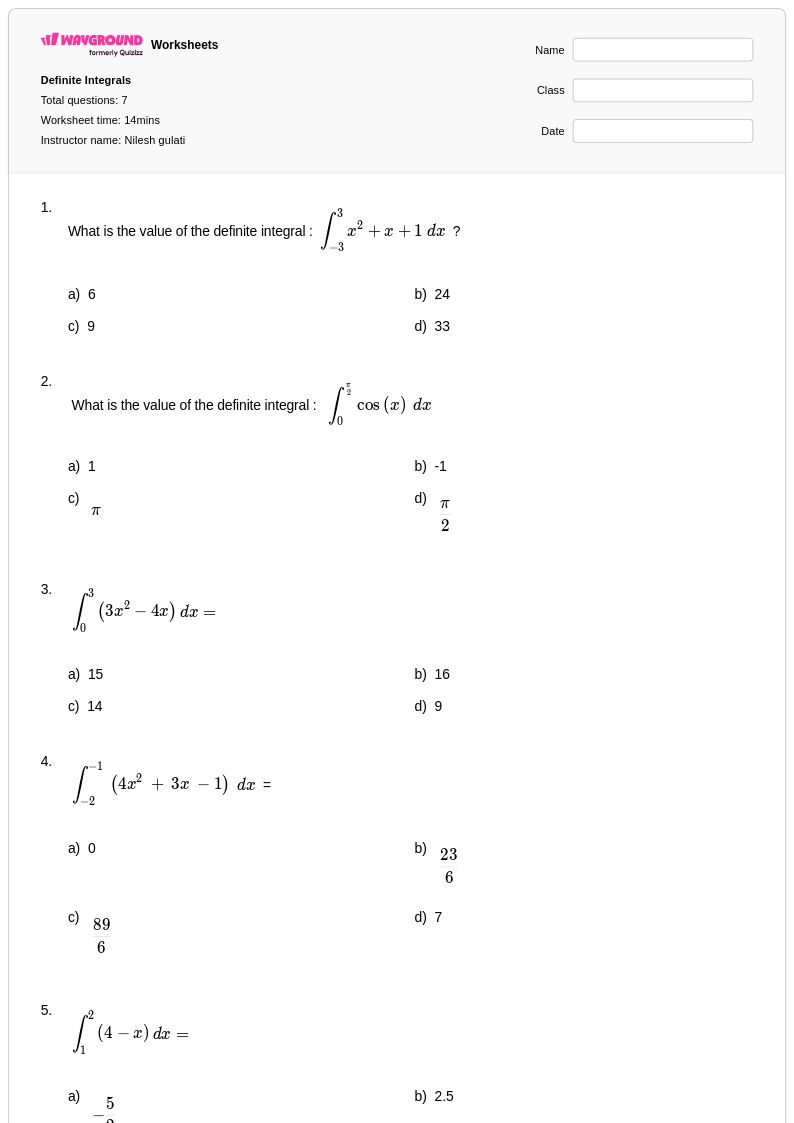
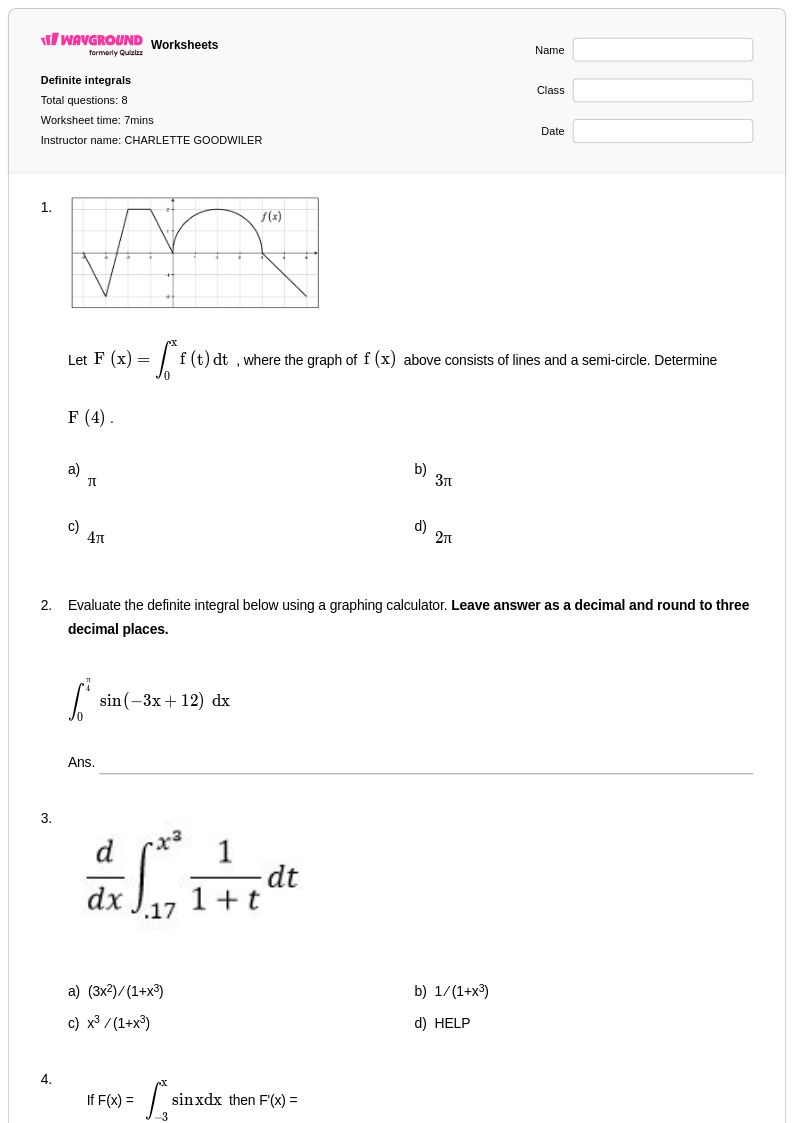
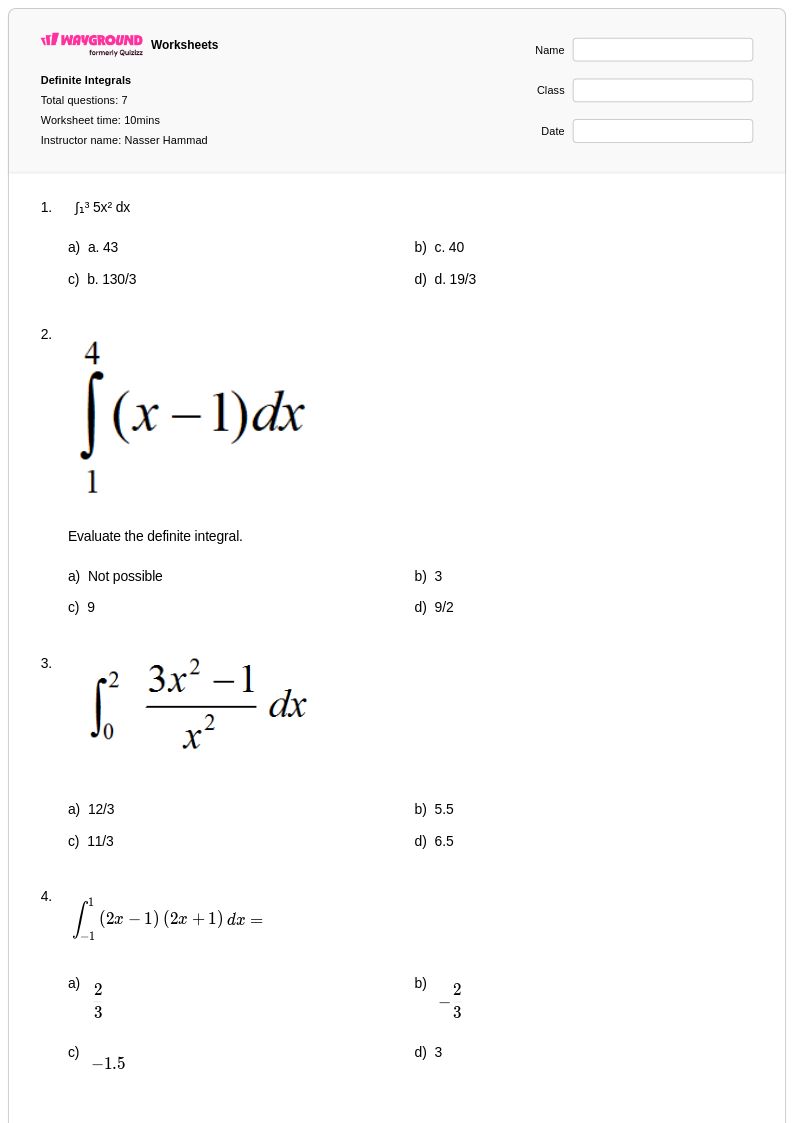
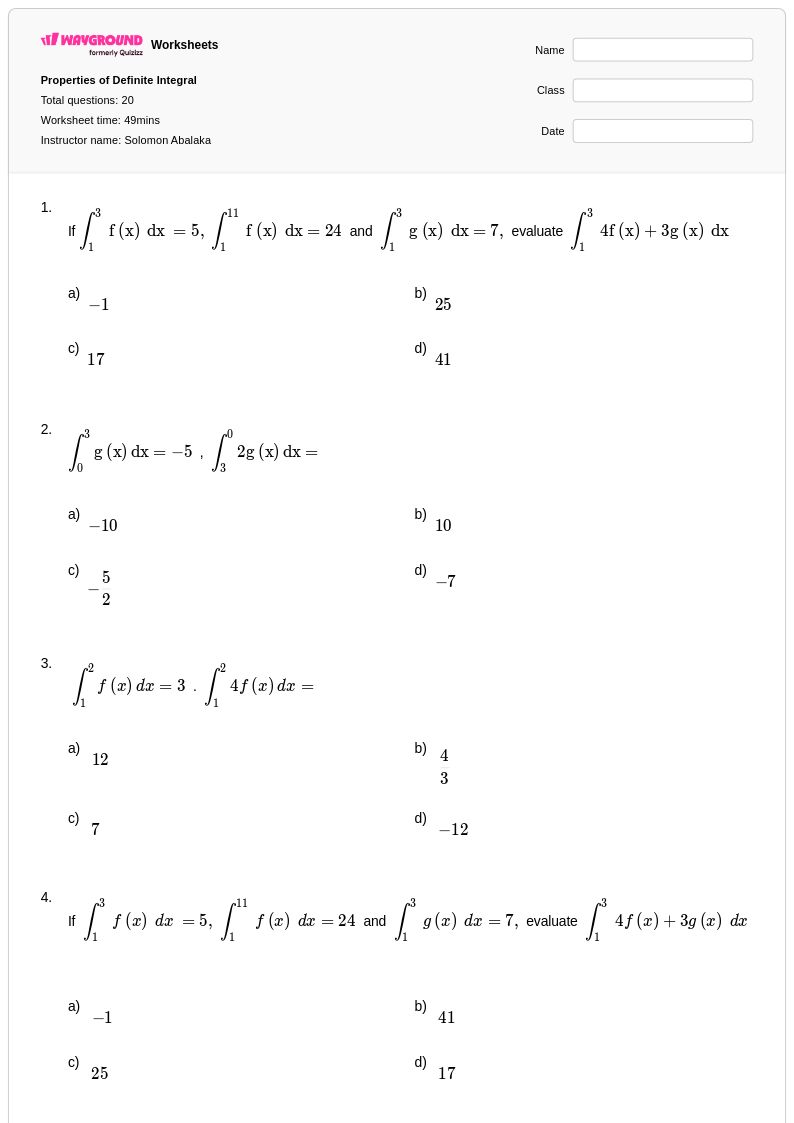
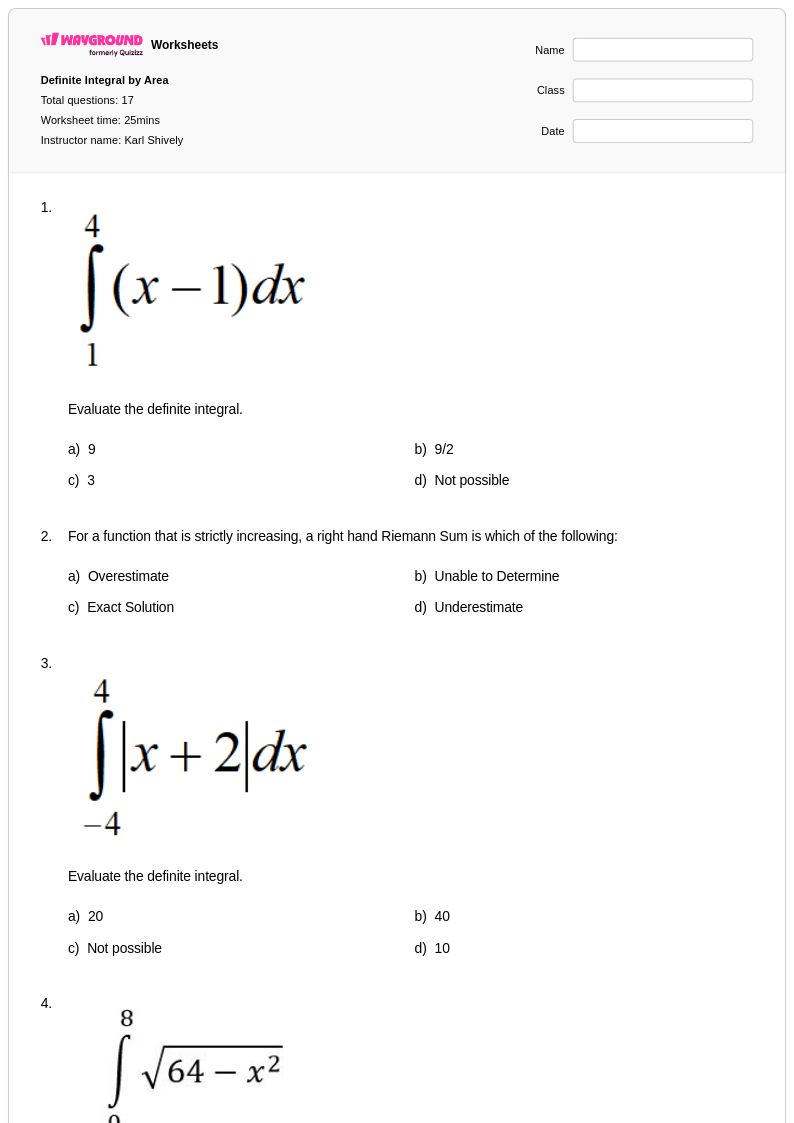
Definite integral worksheets available through Wayground (formerly Quizizz) provide comprehensive practice opportunities for students mastering this fundamental calculus concept. These carefully crafted resources focus on developing essential skills including evaluating definite integrals using the Fundamental Theorem of Calculus, applying various integration techniques within specified bounds, and interpreting definite integrals as areas under curves and accumulated change. Students work through practice problems that range from basic polynomial functions to more complex trigonometric and exponential expressions, building proficiency in substitution methods, integration by parts, and partial fraction decomposition within definite bounds. Each worksheet comes complete with detailed answer keys and step-by-step solutions, available in convenient pdf format as free printables that support both classroom instruction and independent study.
Wayground (formerly Quizizz) empowers mathematics educators with access to millions of teacher-created definite integral resources that streamline lesson planning and enhance student learning outcomes. The platform's robust search and filtering capabilities allow instructors to quickly locate worksheets aligned with specific curriculum standards and difficulty levels, while built-in differentiation tools enable seamless customization for diverse learning needs. Teachers can easily modify existing worksheets or create entirely new problem sets, choosing between printable pdf formats for traditional paper-based practice or interactive digital versions for enhanced engagement. These flexible resources prove invaluable for targeted skill practice, remediation support for struggling students, and enrichment opportunities for advanced learners, ensuring that every student develops strong computational fluency and conceptual understanding of definite integration applications.
FAQs
How do I teach definite integrals effectively?
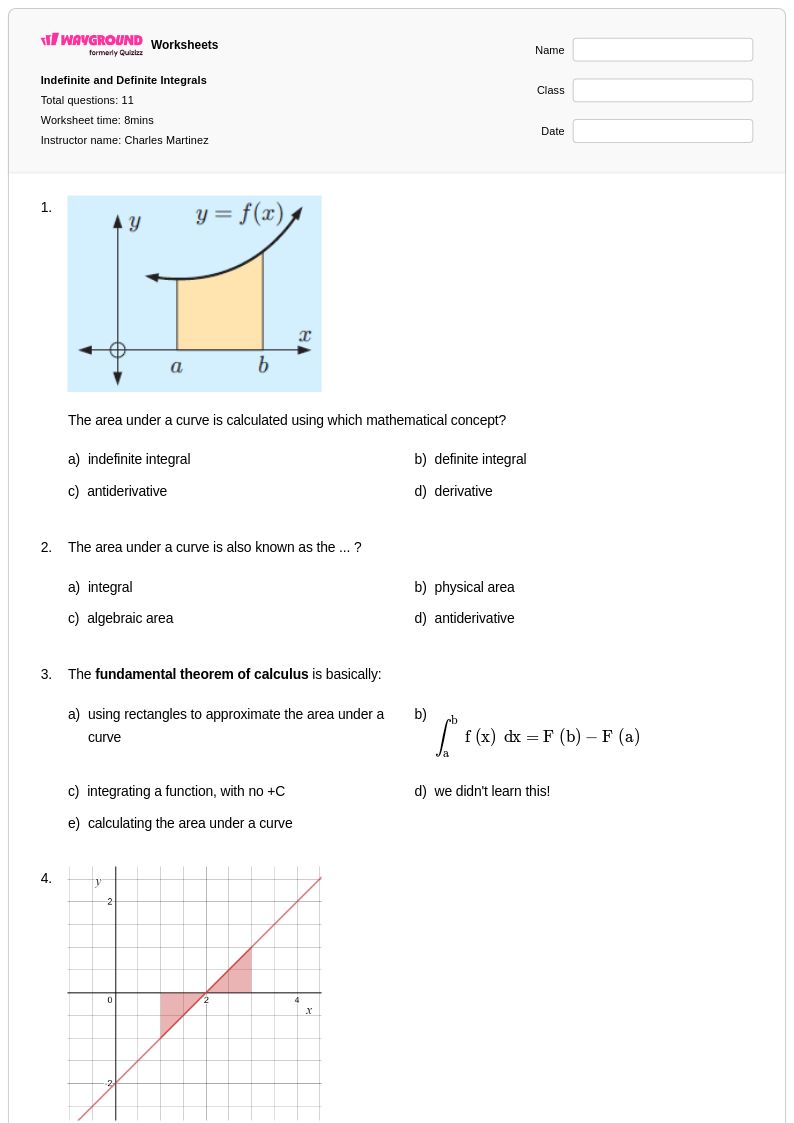
Start with the geometric interpretation: the definite integral as the signed area between a curve and the x-axis. Once students can visualize what they're computing, introduce the Fundamental Theorem of Calculus as the bridge between antiderivatives and that area. From there, build technique progressively — basic polynomials first, then substitution, then integration by parts. Students who skip the geometric foundation often evaluate integrals correctly but can't interpret what the answer means in context.
What exercises help students practice definite integrals?
The most productive practice moves through three layers: evaluating integrals of standard functions (polynomials, trig, exponentials) within given bounds, applying substitution and integration by parts under those bounds, and interpreting results as accumulated change or area in applied problems. Mixing pure computation with interpretation problems prevents students from treating definite integrals as purely mechanical — which is where most conceptual gaps form.
What mistakes do students commonly make with definite integrals?
Three errors come up repeatedly. First, forgetting to change the limits of integration when using u-substitution, students substitute correctly in the integrand but leave the original bounds unchanged. Second, sign errors with the Fundamental Theorem: subtracting F(a) from F(b) in the wrong order. Third, confusing the definite integral (a number) with the indefinite integral (a family of functions), students add a constant C to a definite integral result, which signals a fundamental misunderstanding of what the bounds do.
How do I use Wayground's definite integral worksheets in my class?
Each worksheet includes a complete answer key, so you can assign it for independent practice without extra prep. For in-class work, print the PDF and have students work through problems on paper — if you're grading submissions, the Wayground for Teachers app lets you scan or capture student work directly. Alternatively, host the worksheet as a digital quiz on Wayground so students submit answers online and you see results immediately. Both routes work from the same worksheet.
Are definite integral worksheets aligned to Common Core?
Definite integrals sit beyond the K–8 Common Core scope and are typically addressed in Advanced Placement or state-level precalculus/calculus standards. Common Core's high school functions progression does build toward this, students move from understanding rates of change to modeling with functions, but the formal treatment of integration, including the Fundamental Theorem of Calculus and techniques like substitution and integration by parts, belongs to AP Calculus AB/BC or equivalent courses rather than a specific Common Core standard.
How can I differentiate definite integral practice for mixed-ability students?
For students who are still shaky on antiderivatives, Wayground's reduced answer choices accommodation lowers the cognitive load so they can focus on the integration process rather than getting lost in options. The Read Aloud feature helps students who struggle to parse dense mathematical language in word problems involving accumulated change. For worksheet-level scaffolding, adjusting font size and spacing, or applying a dyslexia-friendly font, can make a problem-heavy calculus worksheet significantly more accessible without changing the mathematical content.
What topics should students know before starting definite integrals?
Students need a solid grasp of antiderivatives and basic integration rules before definite integrals make sense. Familiarity with function notation, limits, and the concept of area is also important — the Fundamental Theorem of Calculus only clicks when students already understand what a limit represents. If students are shaky on derivatives, definite integral work will stall quickly, since recognizing antiderivatives of standard functions is the core mechanical skill the entire topic depends on.