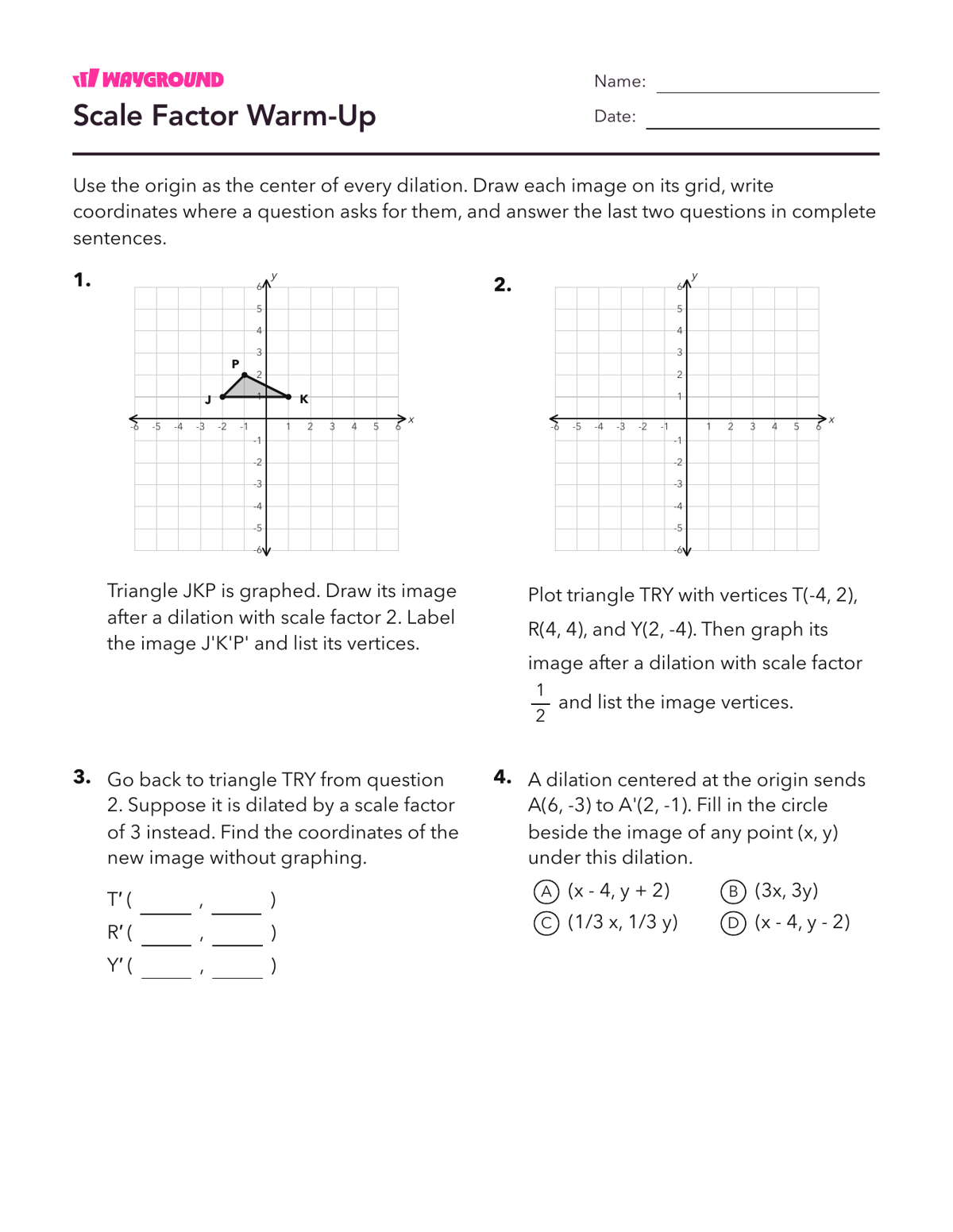
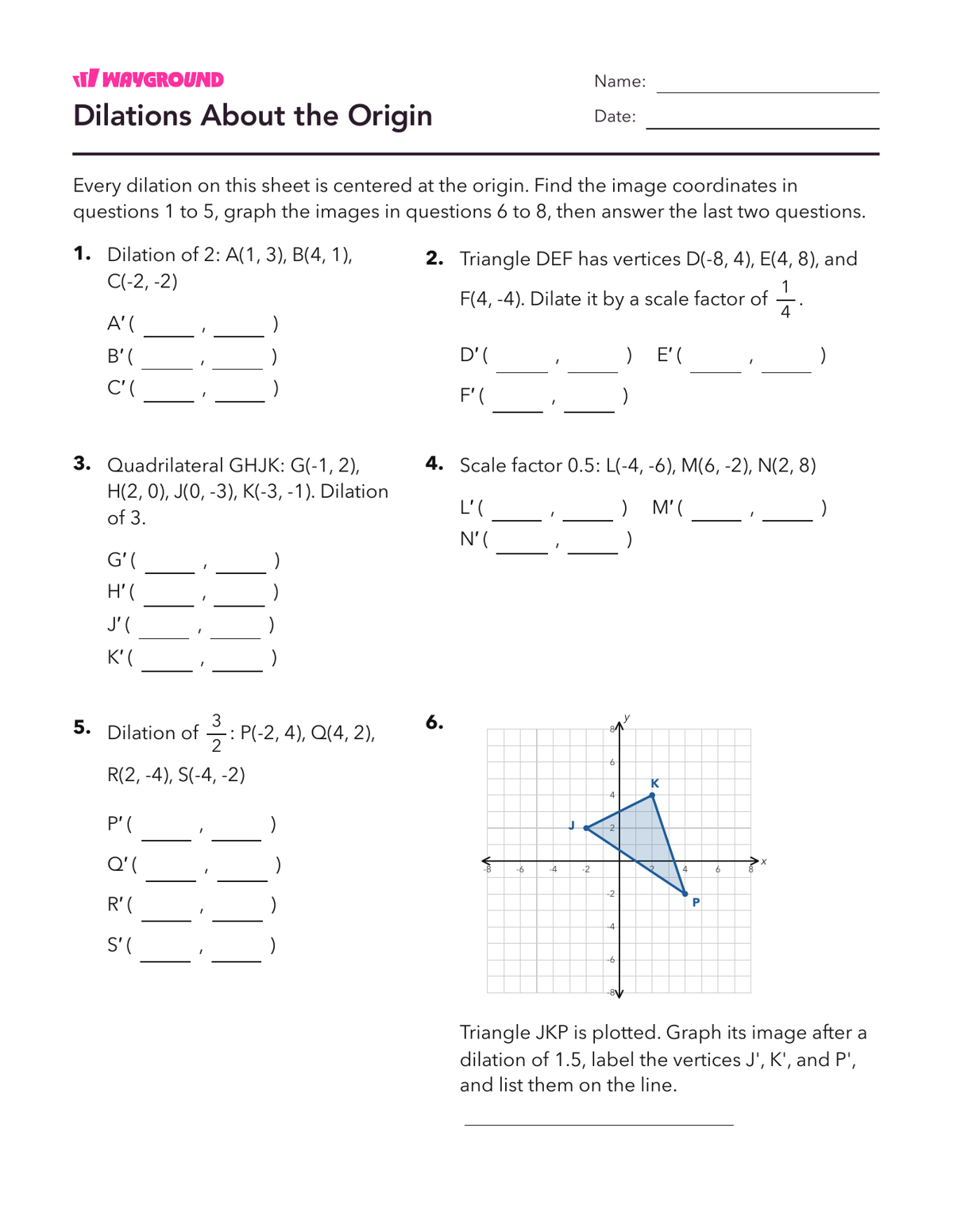
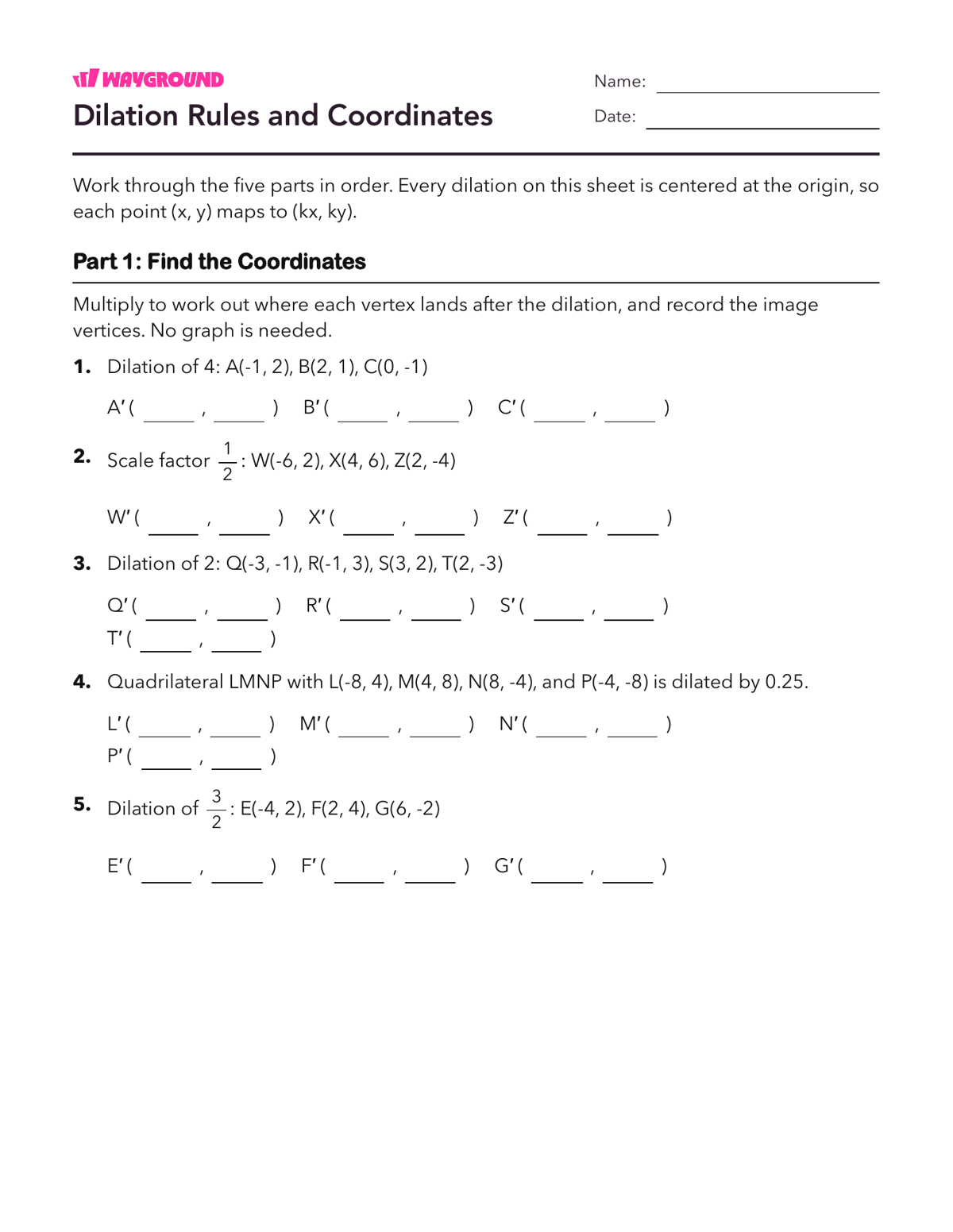
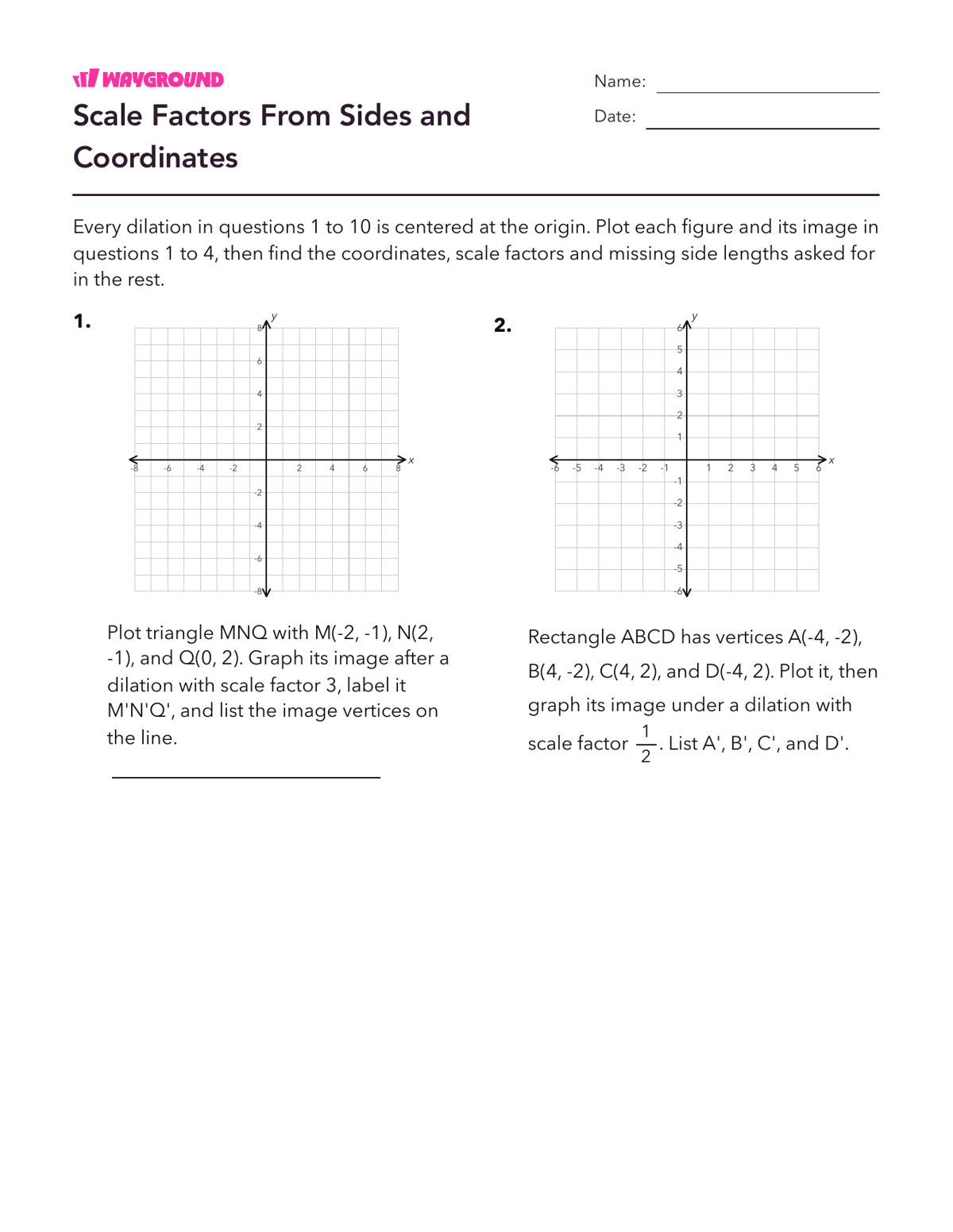
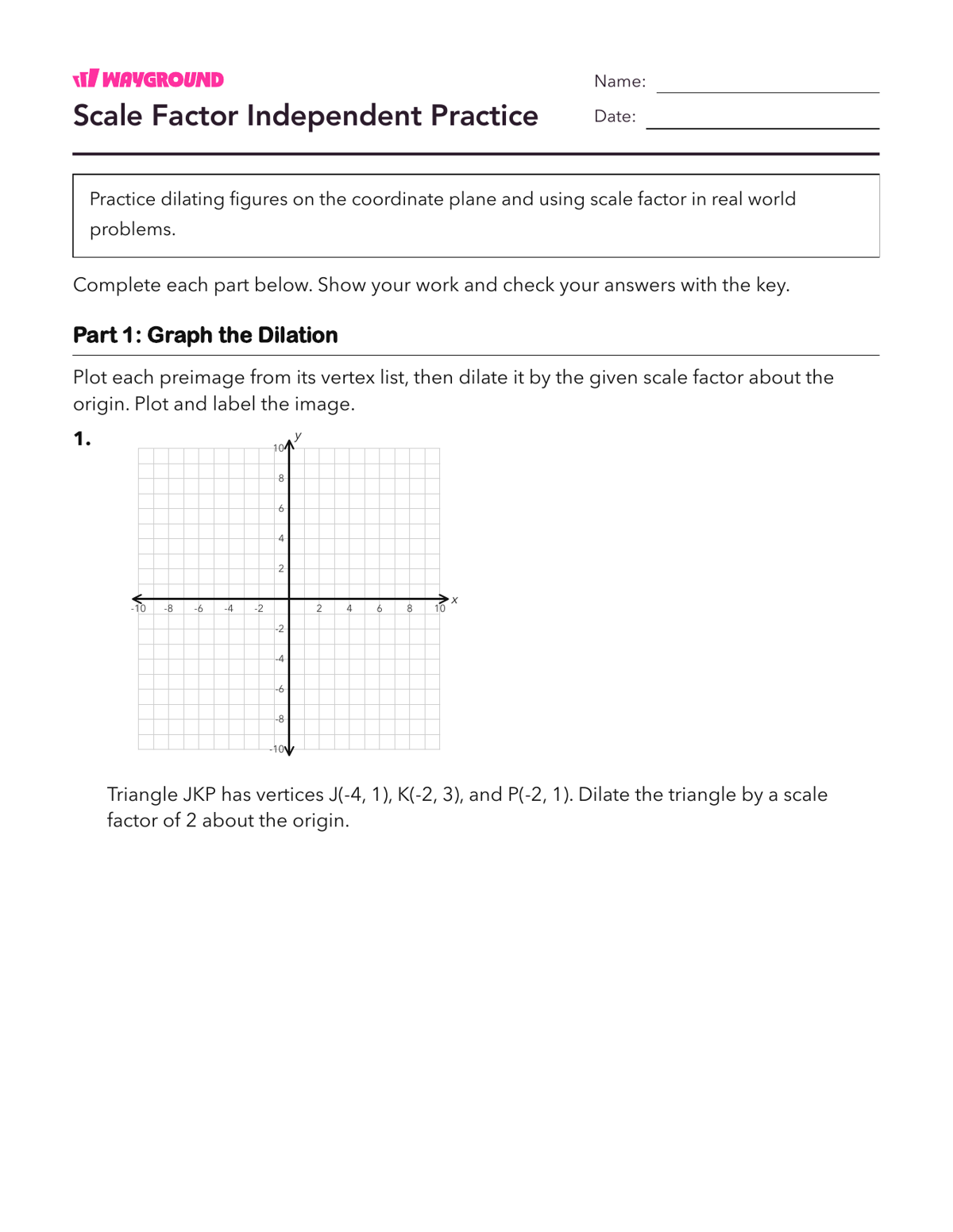
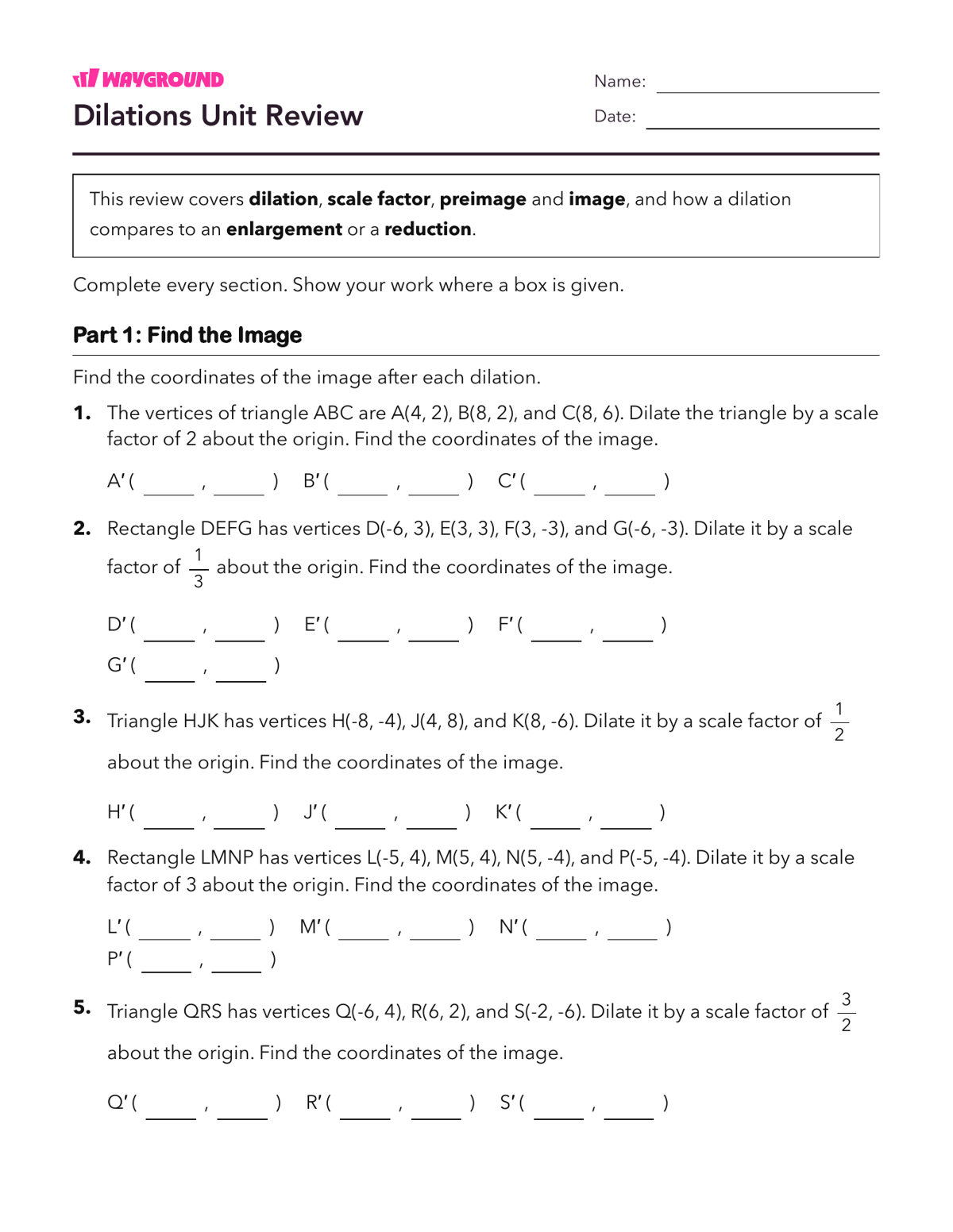
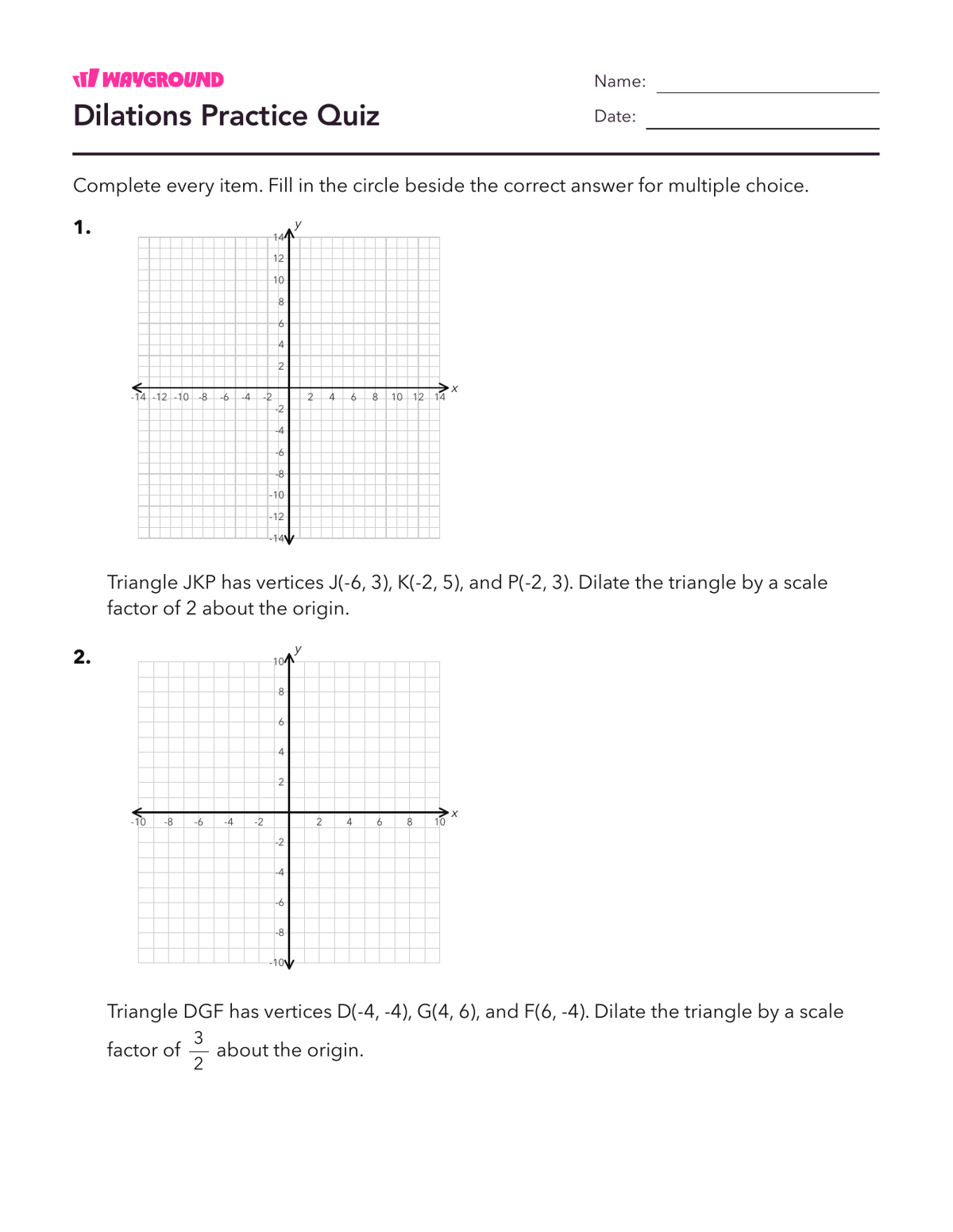
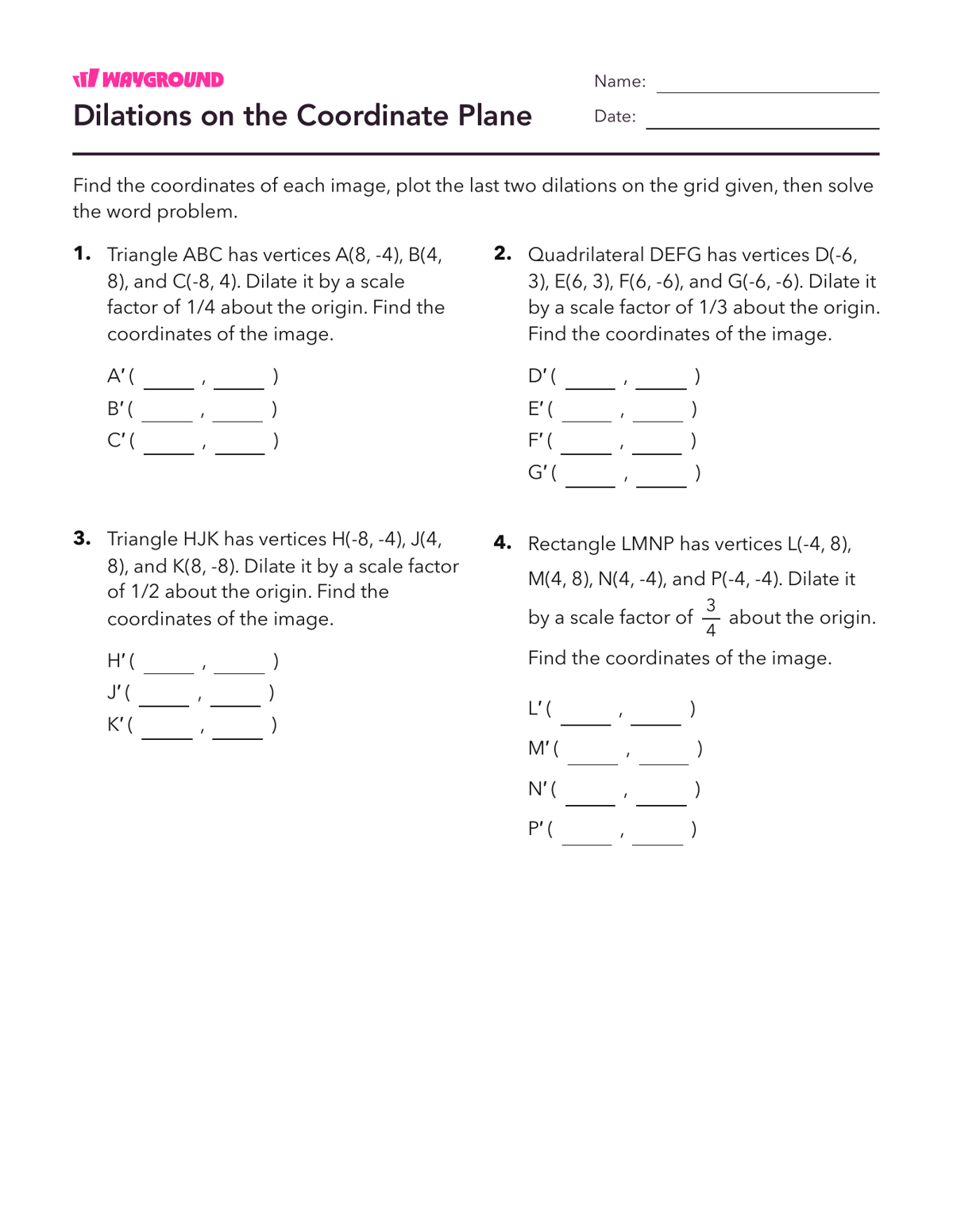
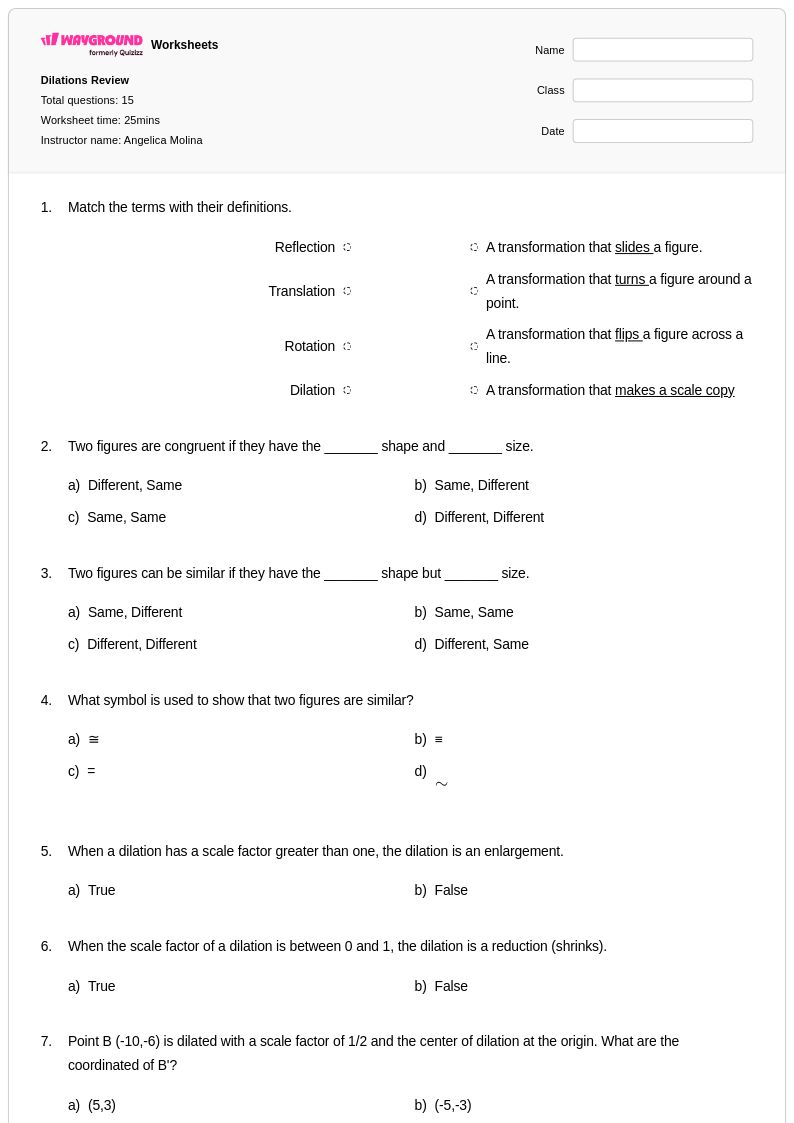
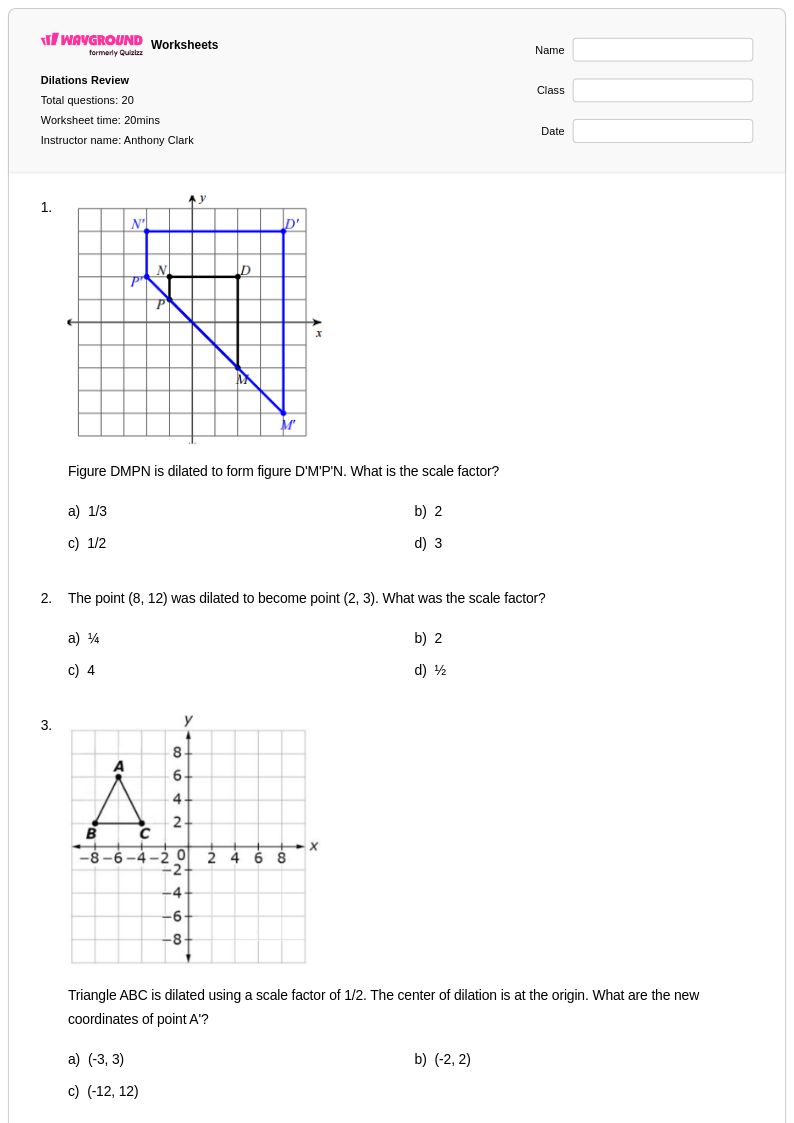
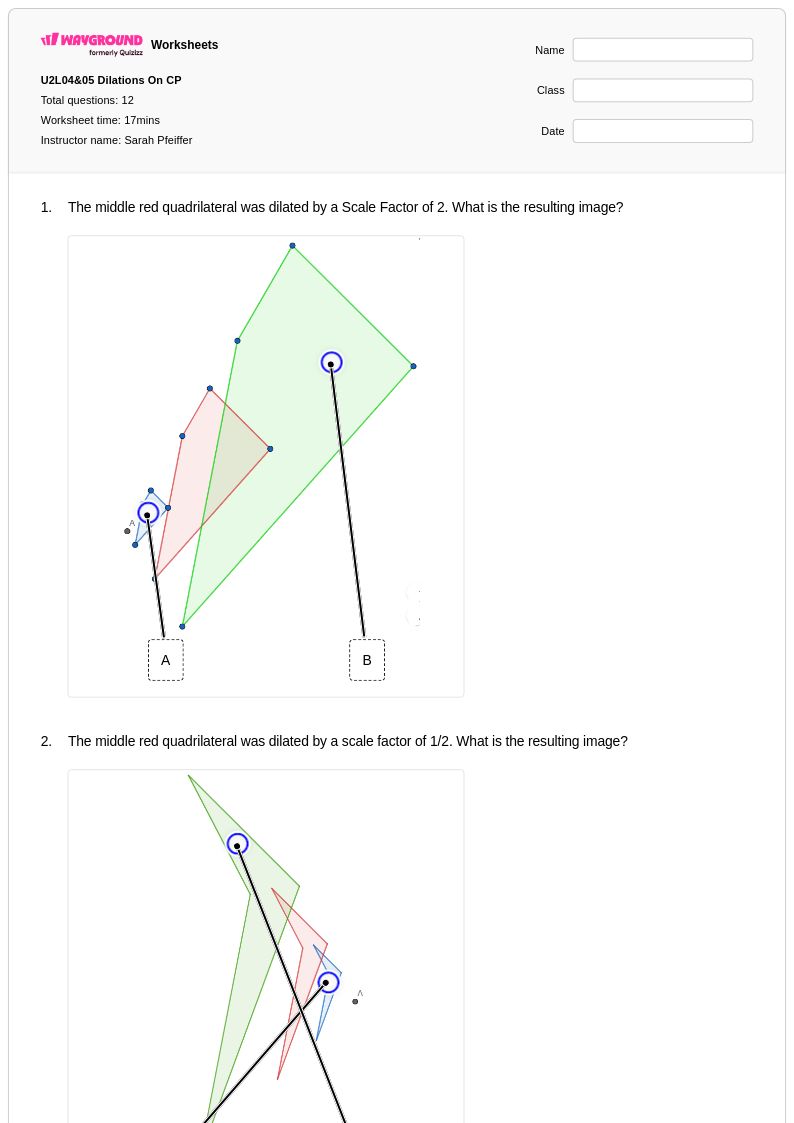
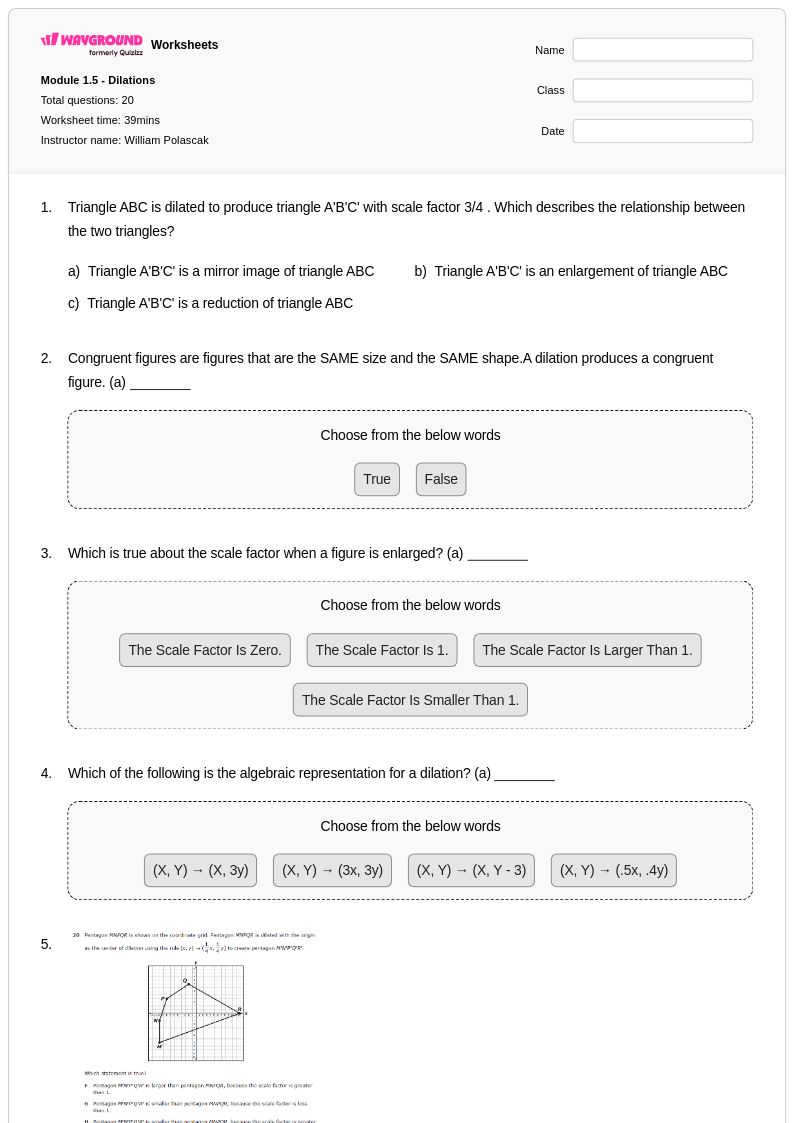
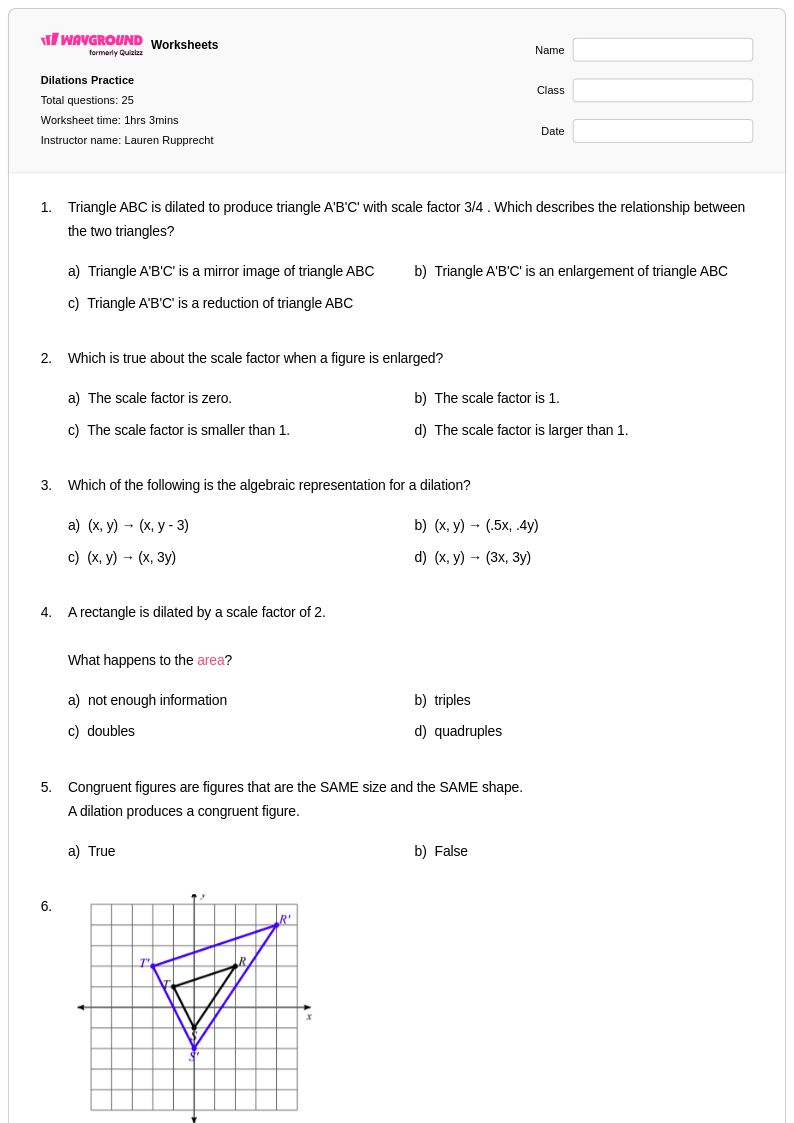
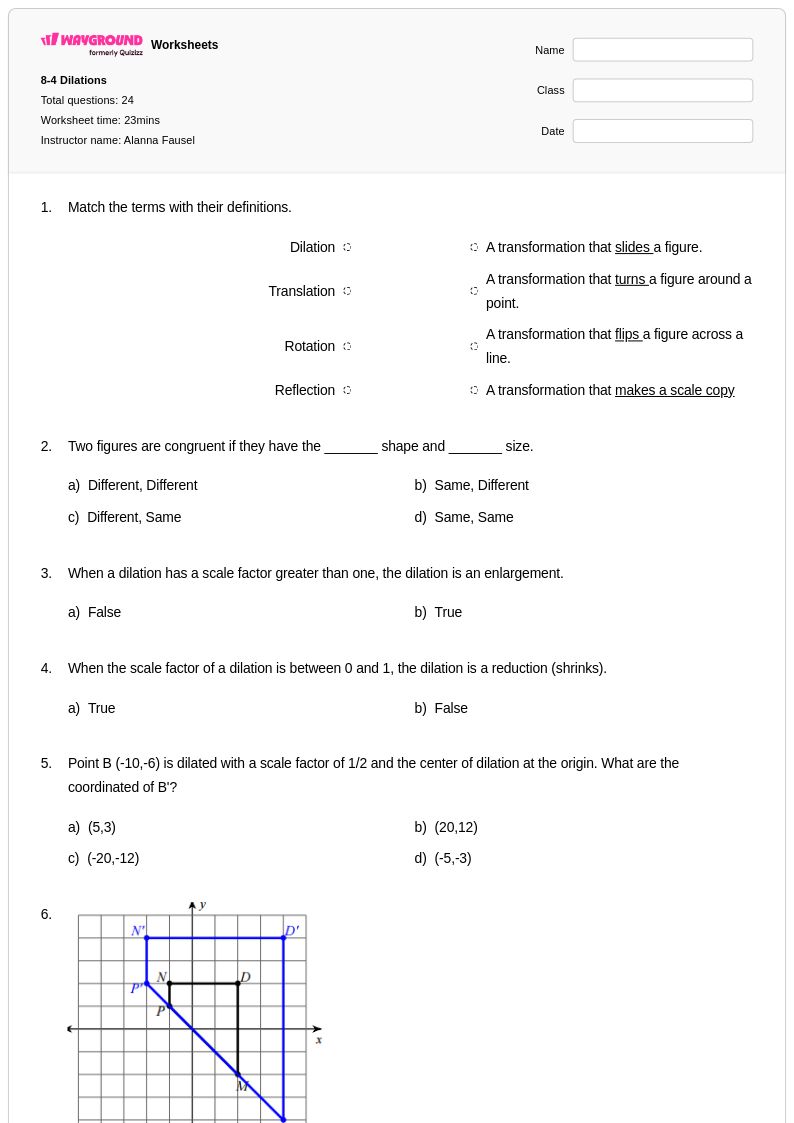
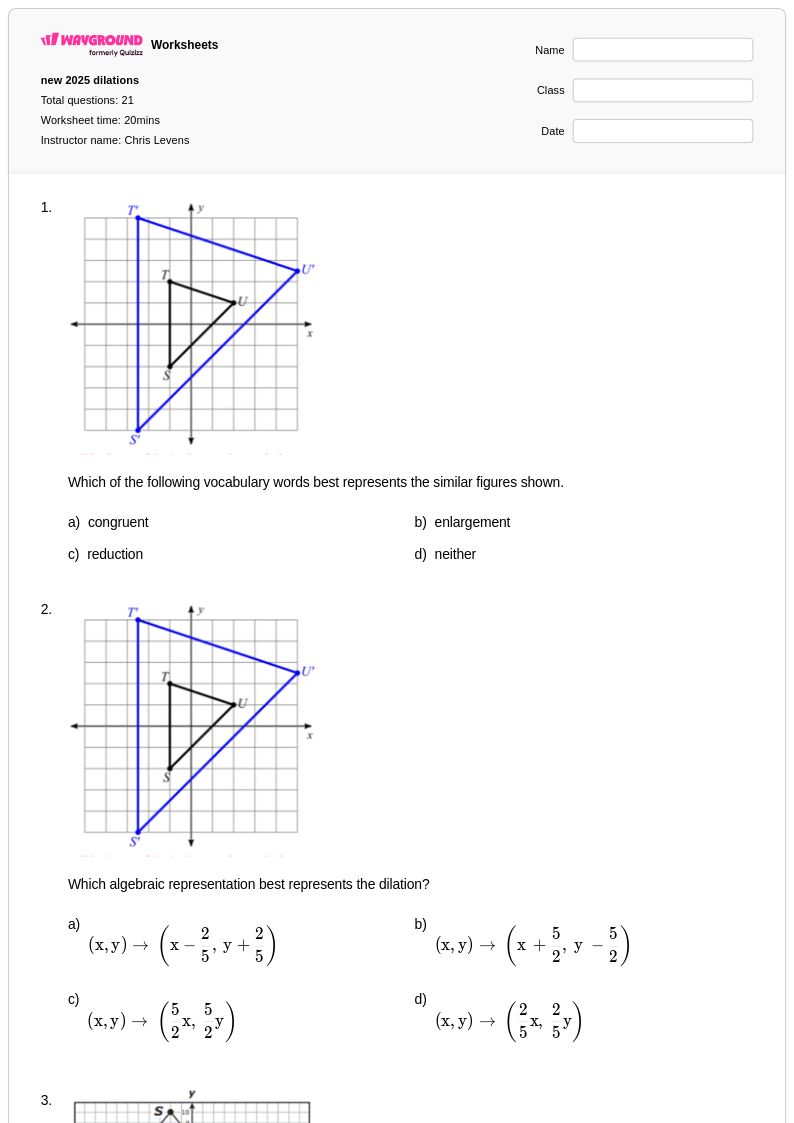
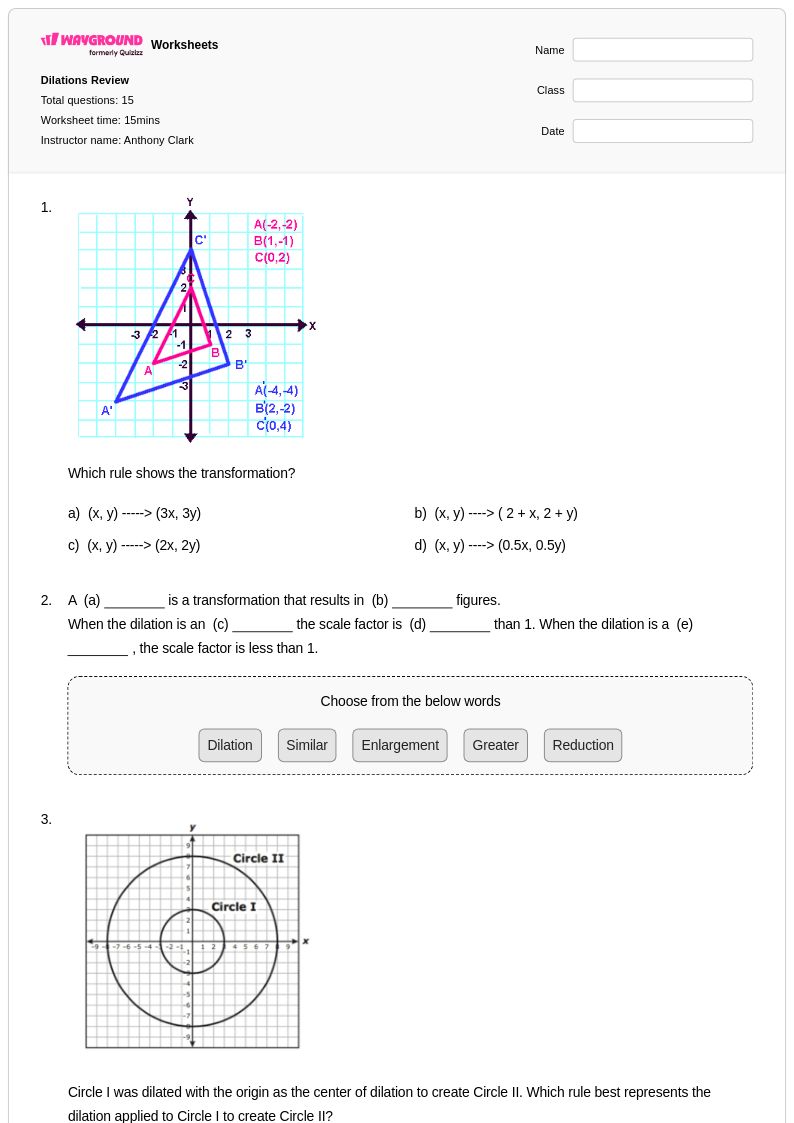
Year 8 dilations worksheets from Wayground provide free printable practice problems and answer keys to help students master scaling transformations and understand how figures change size while maintaining shape proportions.
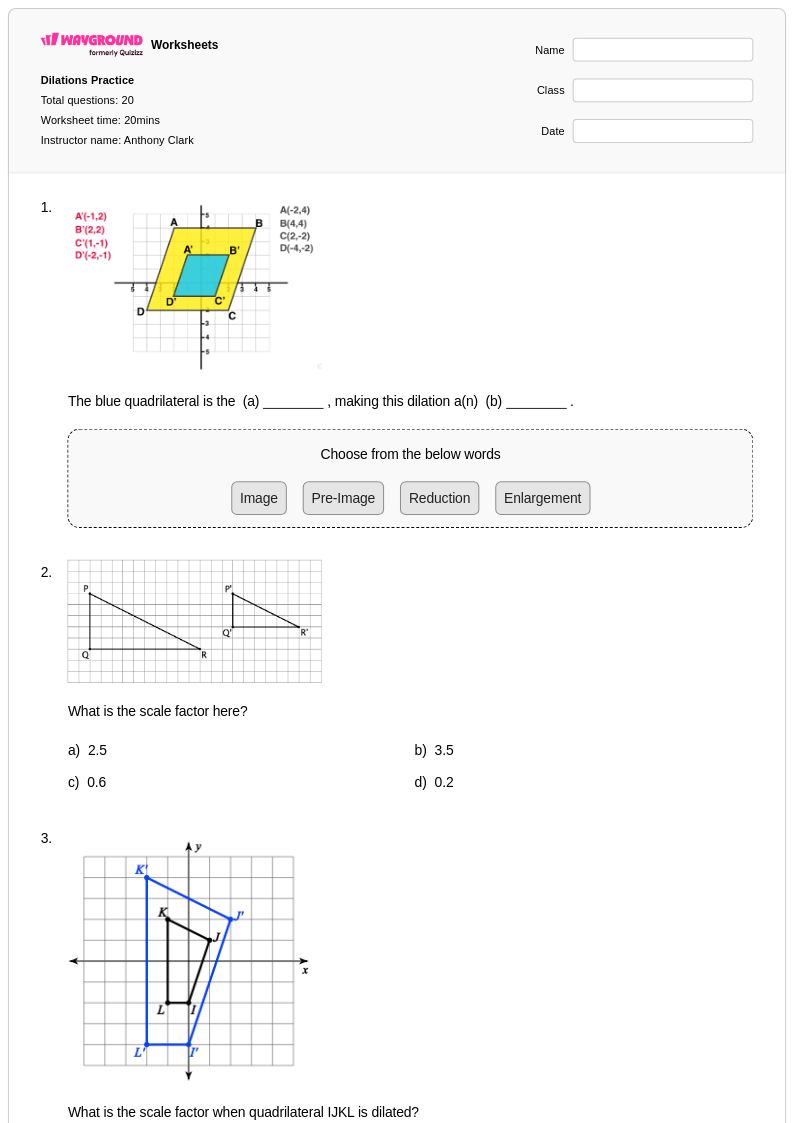
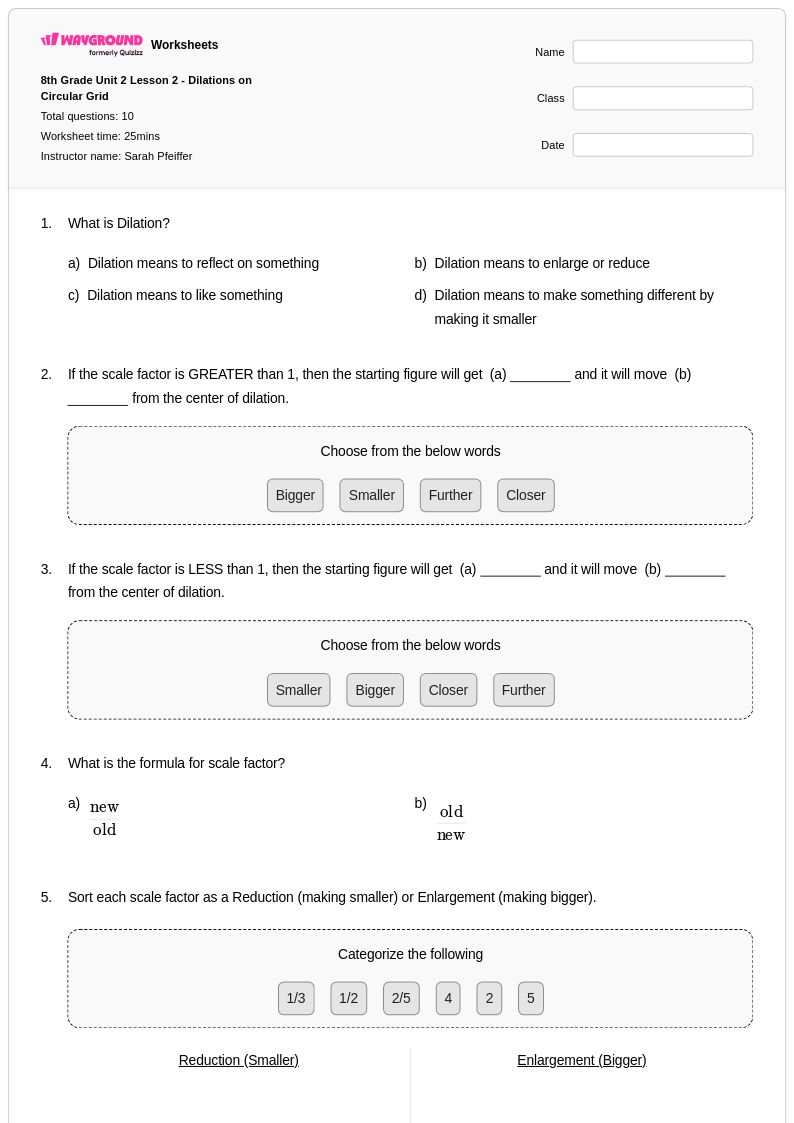
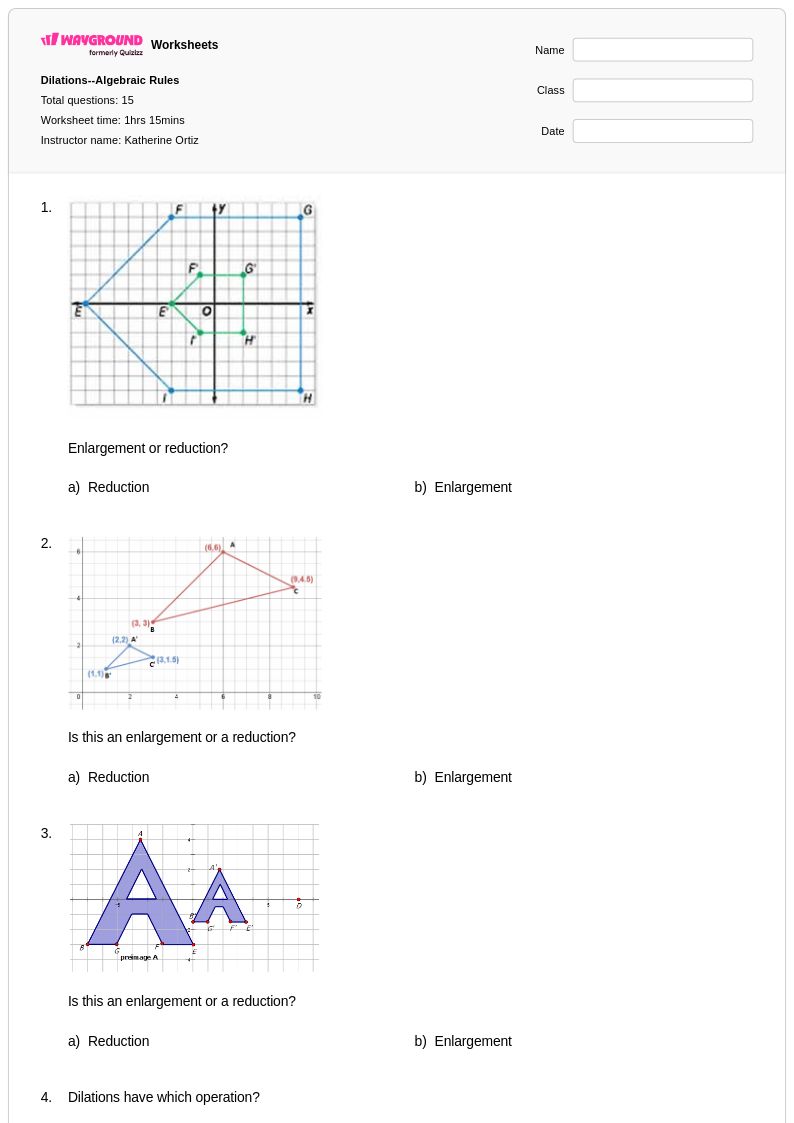
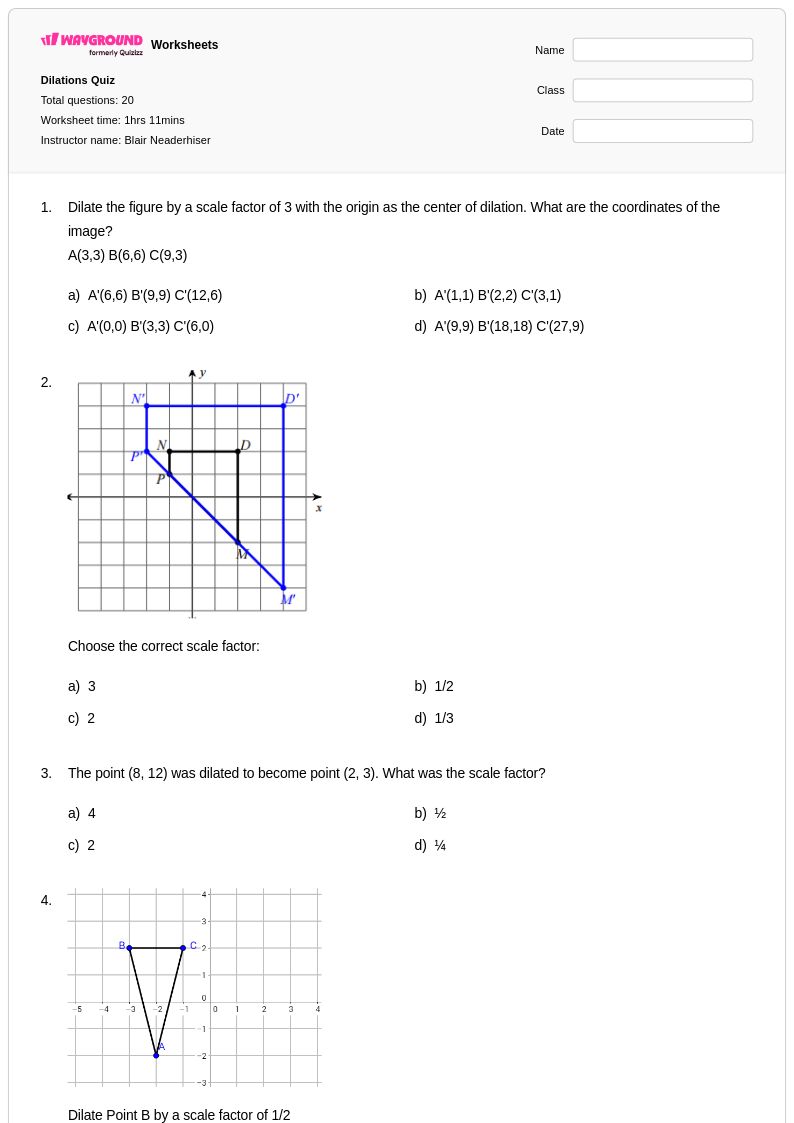
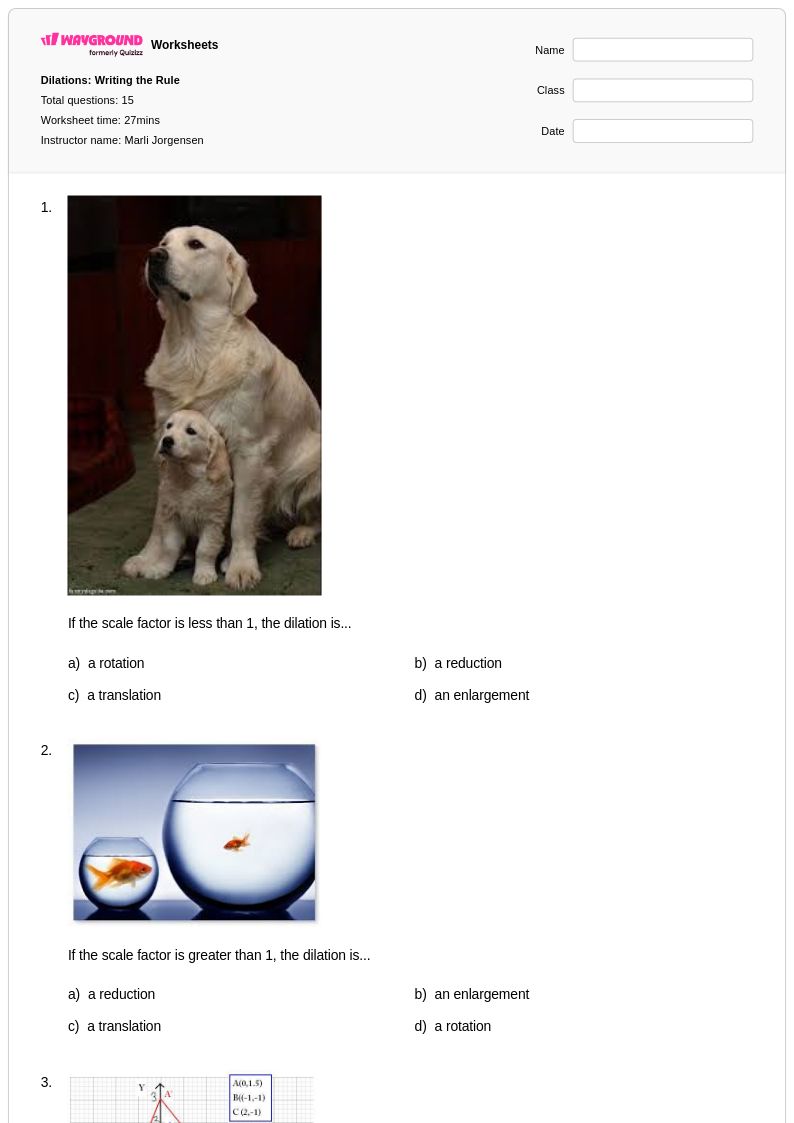
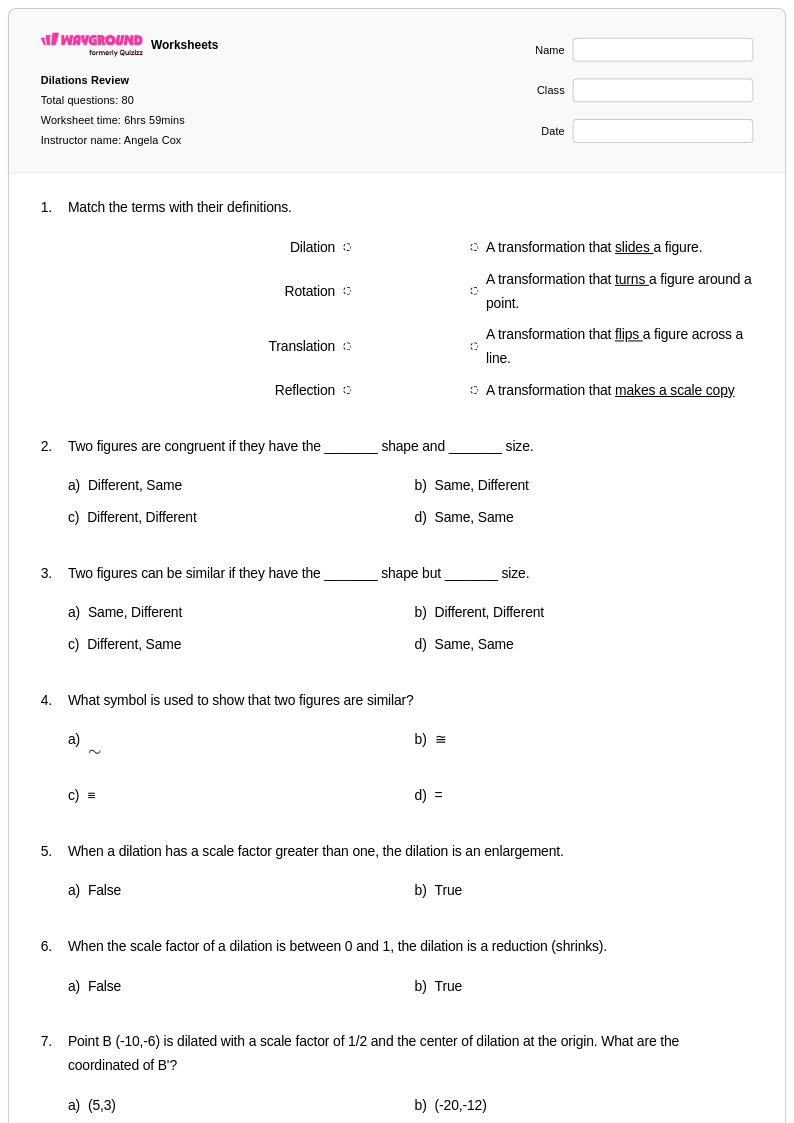
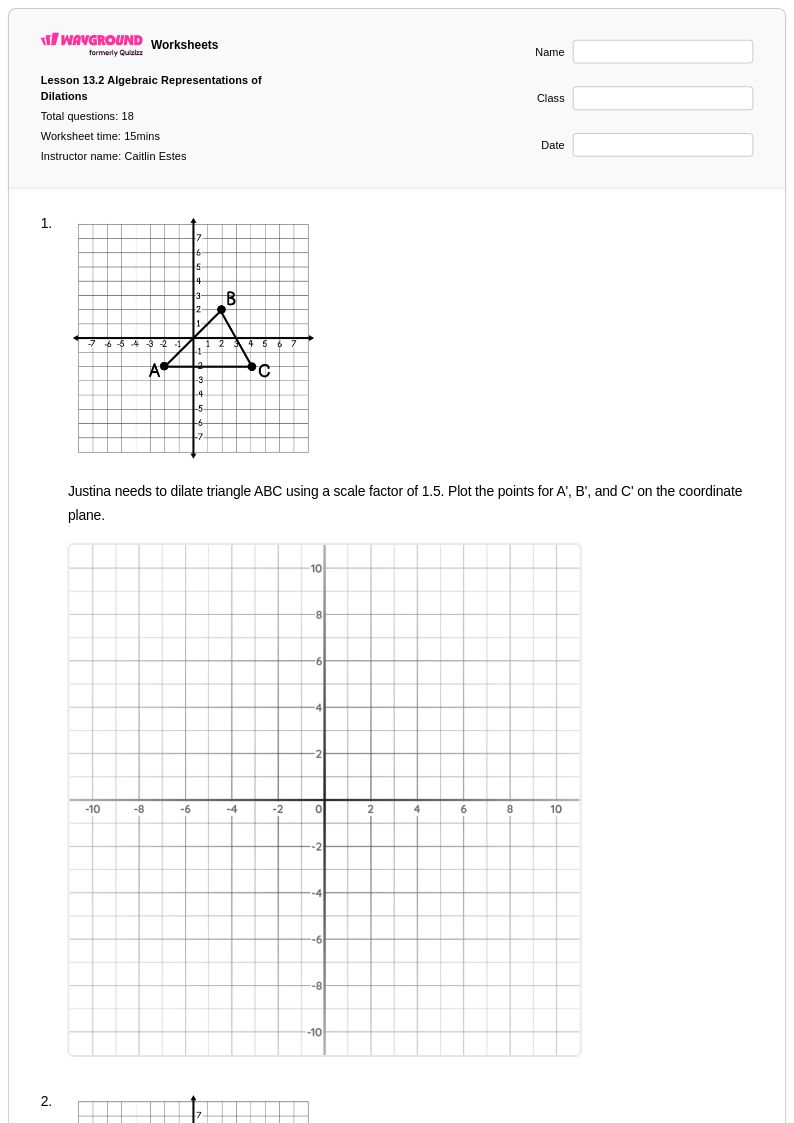
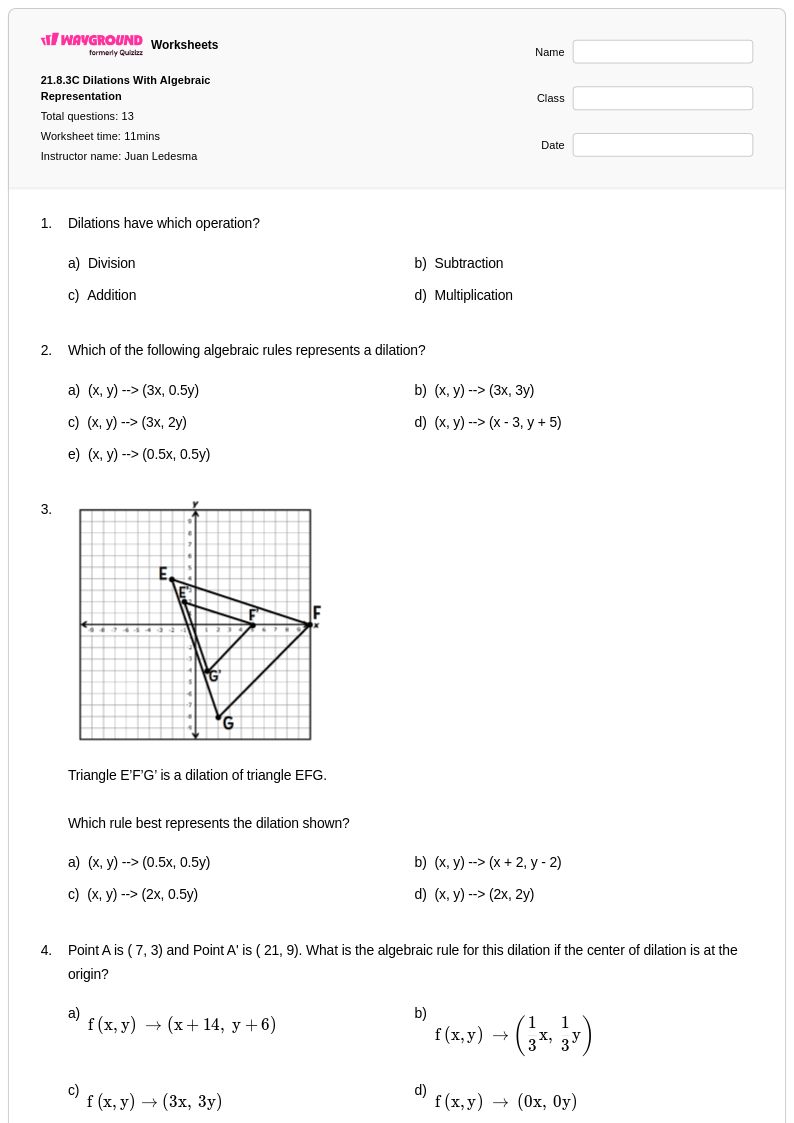
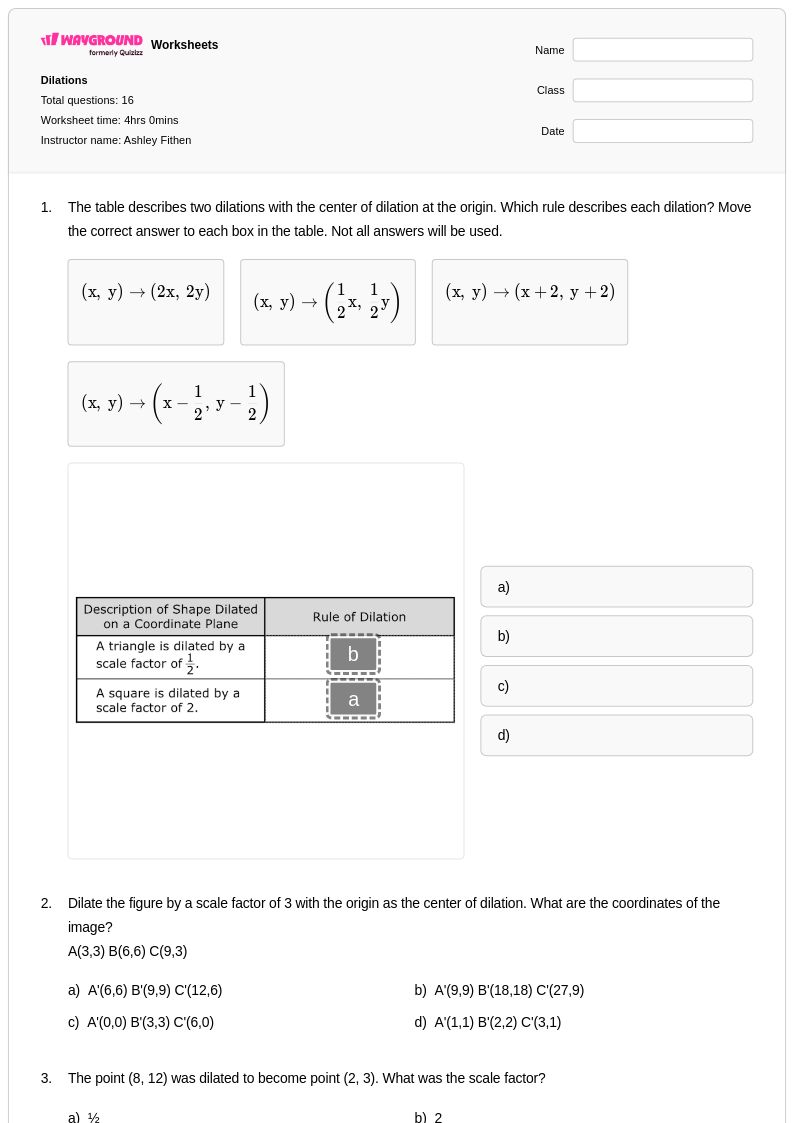
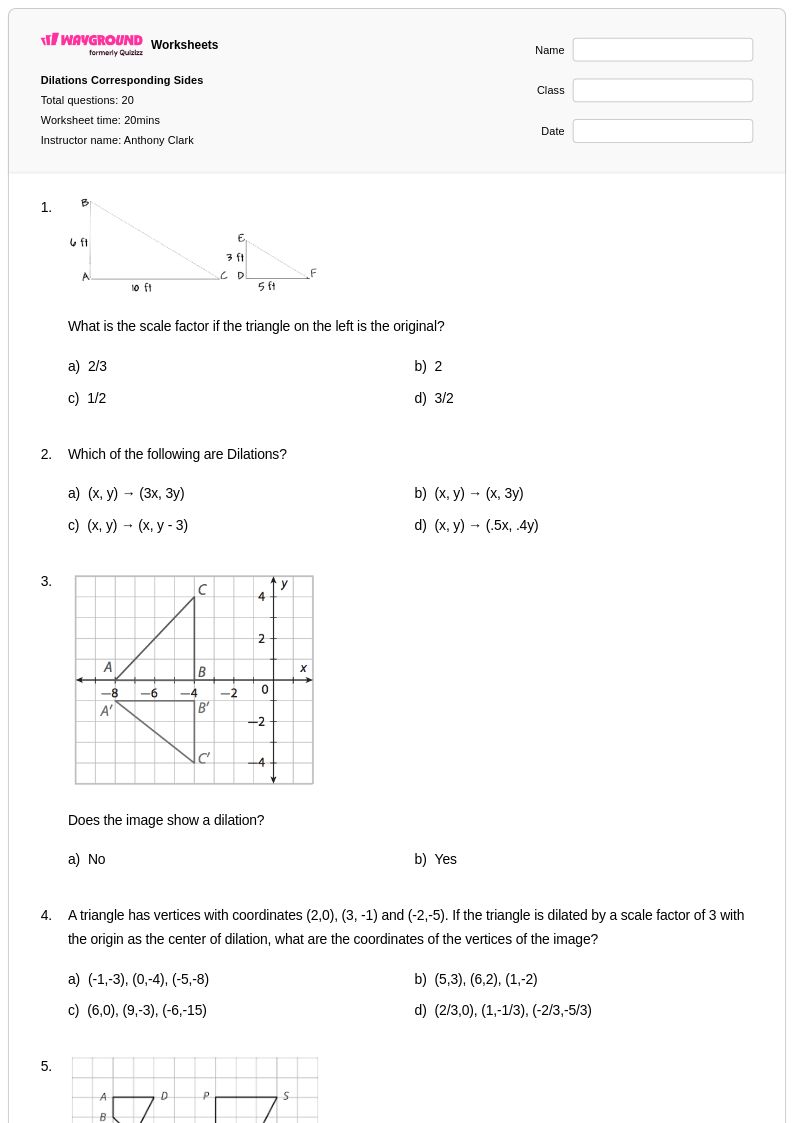
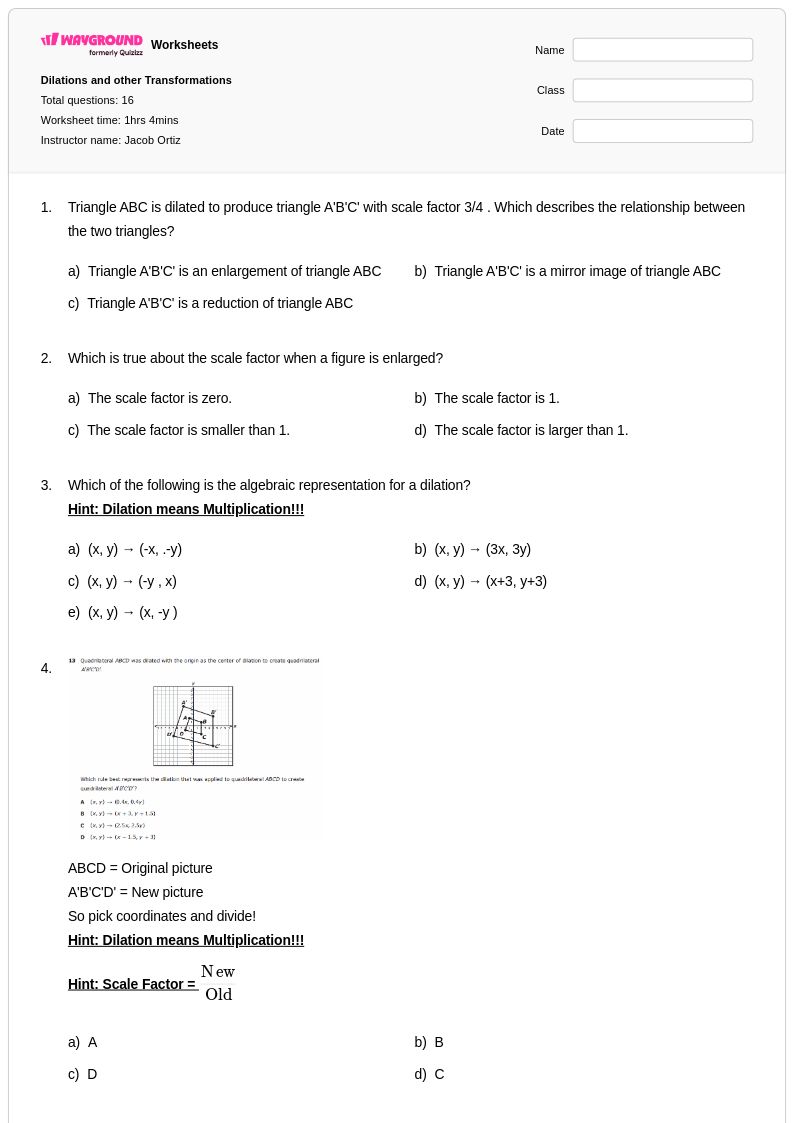
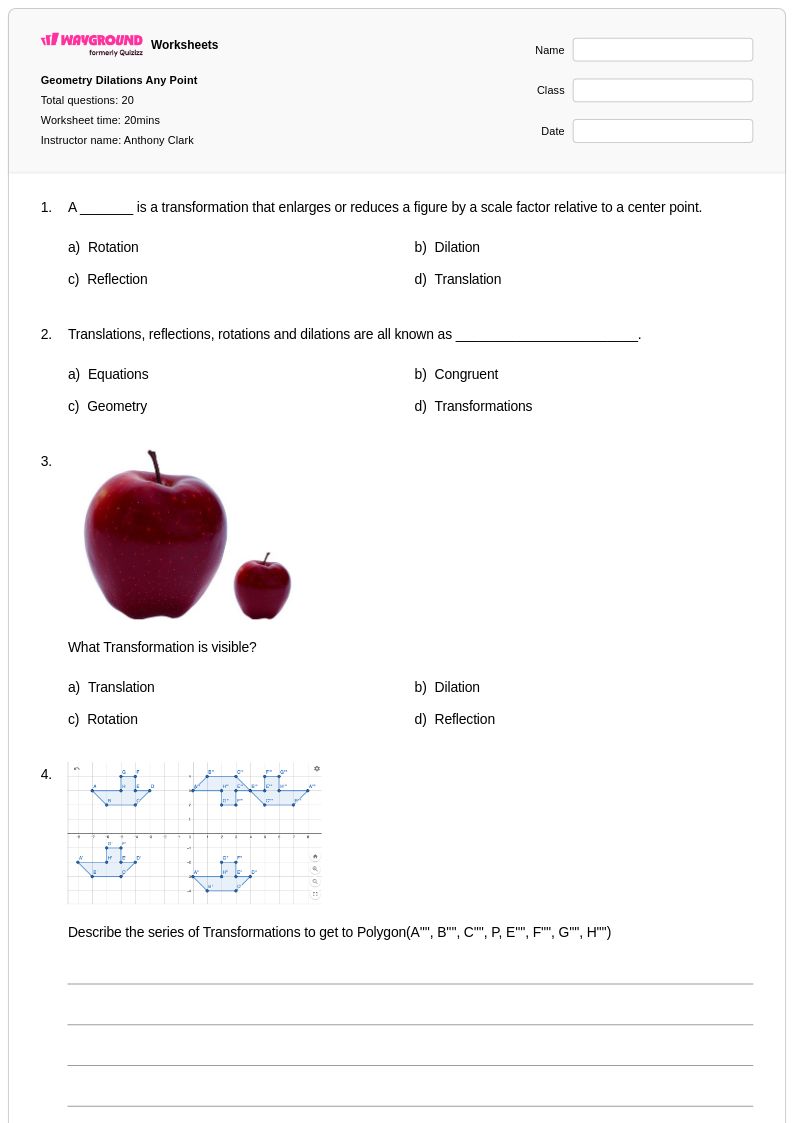
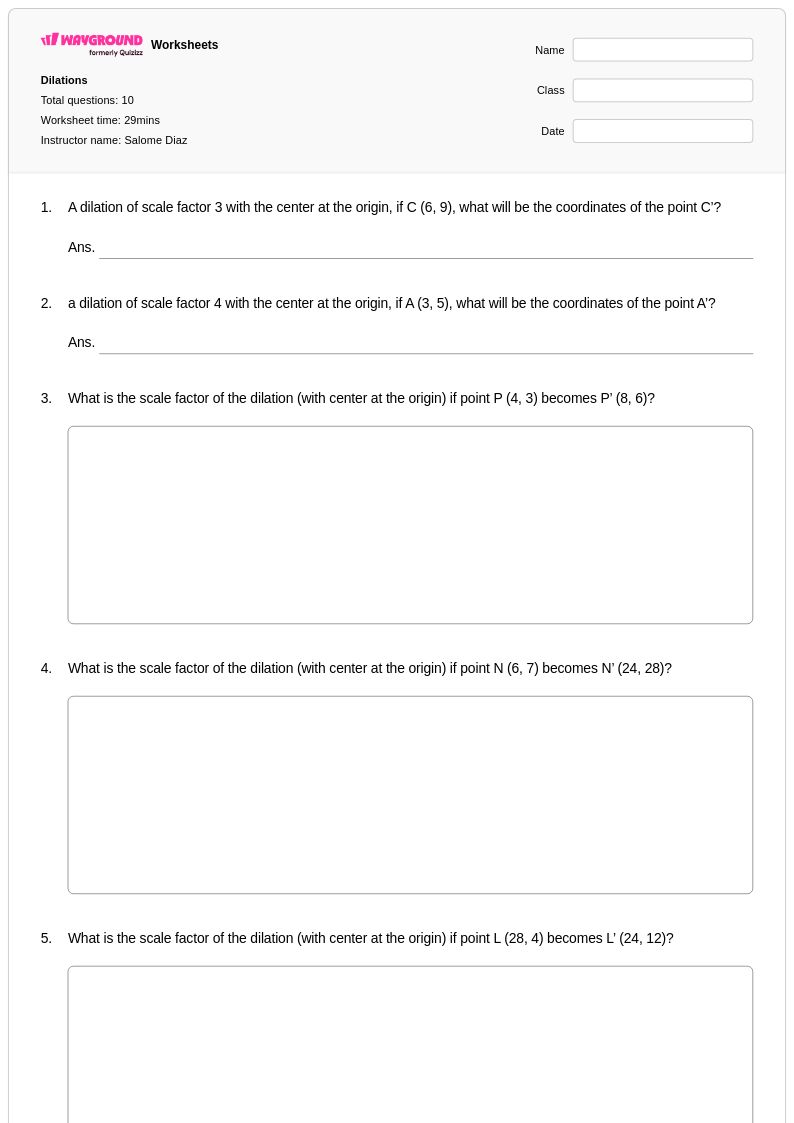
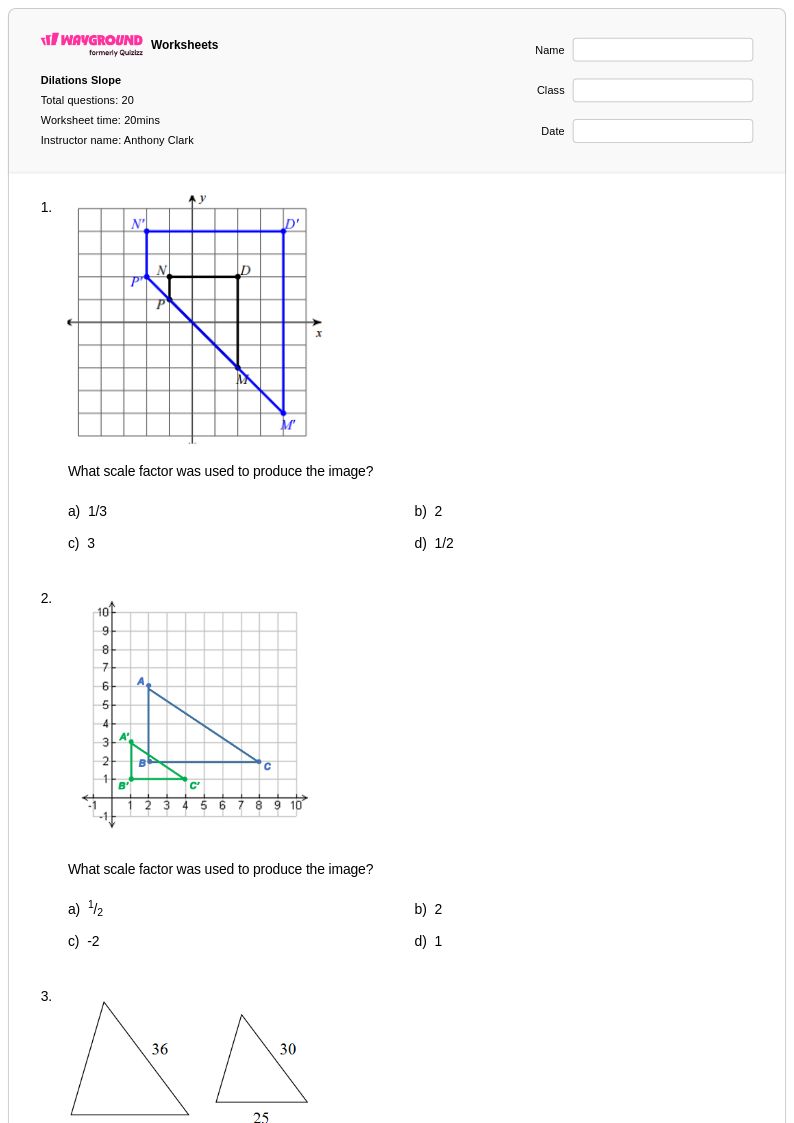
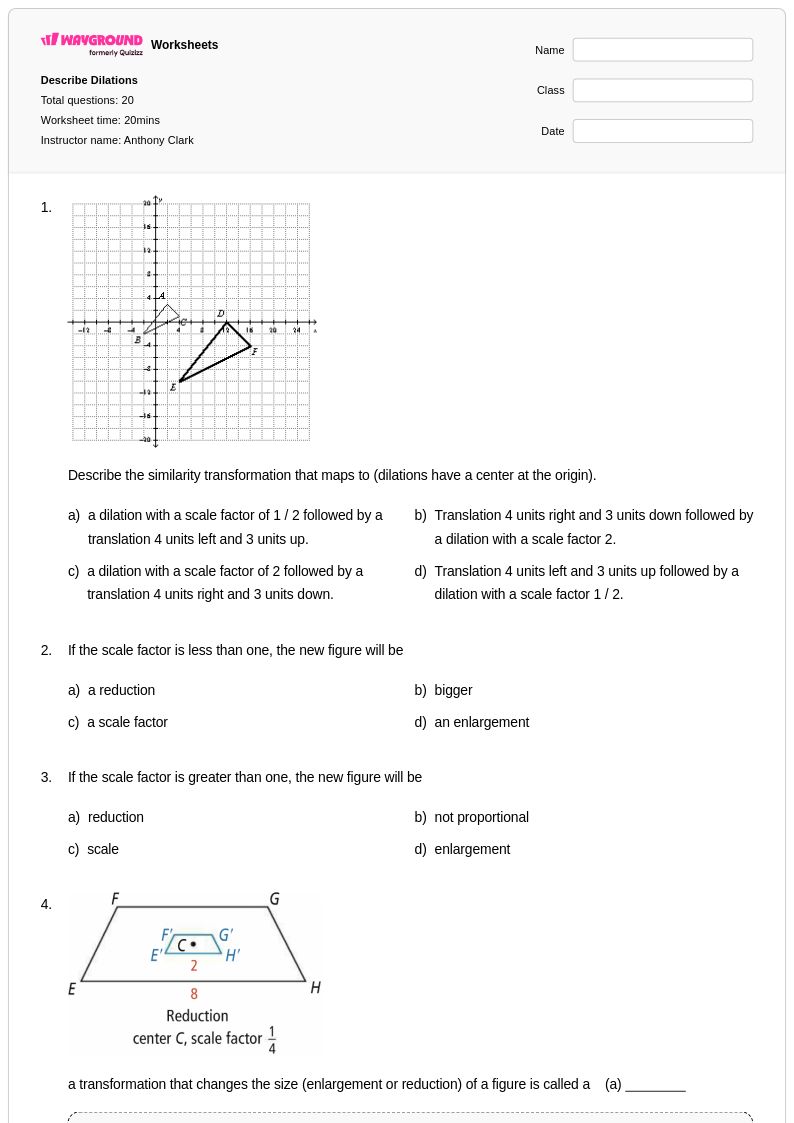
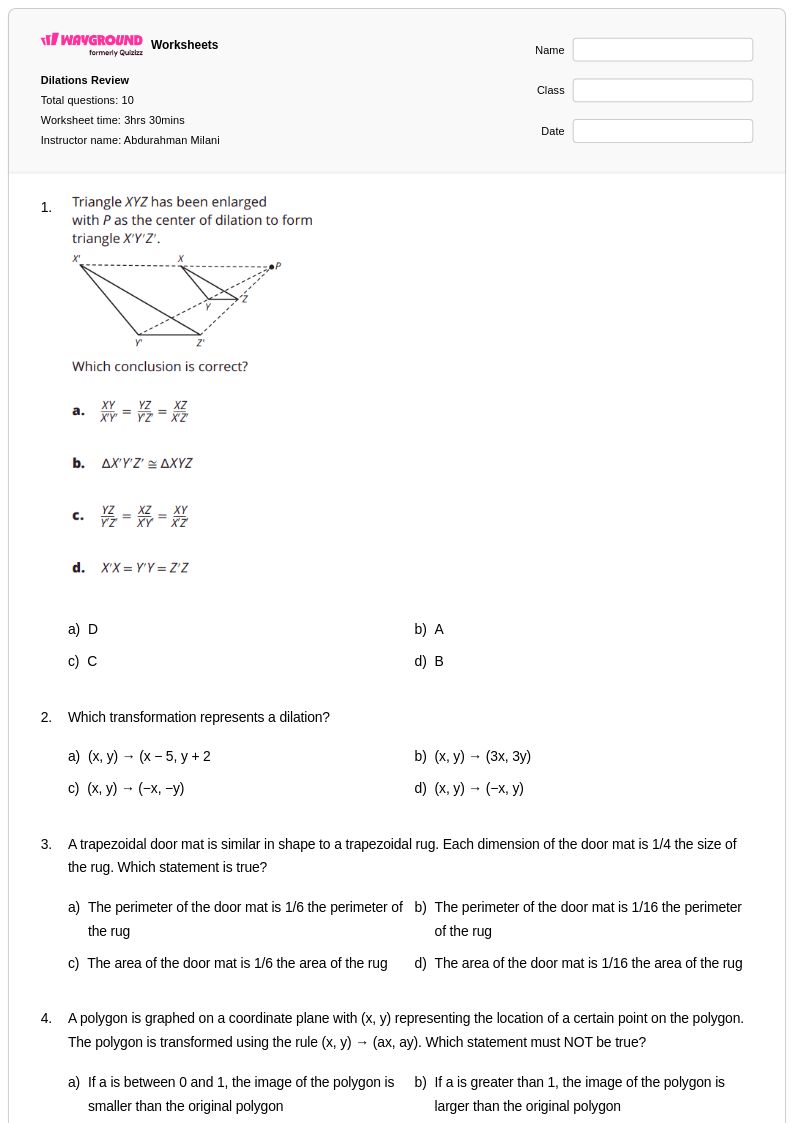
Dilations worksheets for Year 8 mathematics through Wayground (formerly Quizizz) provide comprehensive practice with scaling transformations that enlarge or reduce geometric figures while maintaining their shape and proportional relationships. These expertly designed worksheets strengthen students' understanding of scale factors, center points of dilation, and the coordinate plane applications of this essential transformation concept. Students engage with practice problems that challenge them to identify scale factors from given figures, perform dilations on coordinate grids, and determine whether transformations represent enlargements or reductions. The collection includes detailed answer keys that support both independent study and classroom instruction, with free printable pdf formats that make these valuable resources accessible for homework assignments, assessment preparation, and targeted skill development.
Wayground (formerly Quizizz) empowers educators with millions of teacher-created dilation worksheets that can be easily discovered through robust search and filtering capabilities aligned to mathematics standards. Teachers benefit from comprehensive differentiation tools that allow customization of worksheet difficulty levels, ensuring appropriate challenges for students across varying skill levels in geometric transformations. The platform's flexible format options include both printable pdf versions for traditional classroom use and digital formats for technology-integrated learning environments. These features streamline lesson planning while providing targeted resources for remediation of struggling learners and enrichment opportunities for advanced students, enabling educators to address the full spectrum of Year 8 dilations concepts from basic scale factor identification to complex coordinate plane transformations.
FAQs
How do I teach dilations in 8th grade math?
At 8th grade, dilations aren't just a standalone transformation — they're the mechanism for establishing similarity. Frame the teaching around that purpose: students should be able to describe a dilation (center, scale factor, direction) that maps one figure onto another, and then use that to argue the two figures are similar. Coordinate plane work is central here, so make sure students are fluent with multiplying coordinates by a scale factor relative to a non-origin center before moving to similarity proofs or slope connections.
What dilation skills should 8th graders be working on?
Core 8th grade dilation skills include performing dilations on a coordinate plane with centers other than the origin, identifying the scale factor and center from a figure and its image, and distinguishing enlargements from reductions. Beyond mechanics, 8th graders should be connecting dilations to similarity — recognizing that similar figures are related by a dilation and using that relationship to find missing side lengths. The Wayground Grade 8 worksheets cover this range, from basic scale factor identification to coordinate plane transformations.
What mistakes do 8th graders make with dilations?
The most common issue at this level is misidentifying the center of dilation — students assume it's the origin when it isn't, which throws off every coordinate calculation that follows. A second persistent error is confusing the scale factor with its reciprocal when working backwards from image to pre-image. Both errors are worth targeting directly: include problems where the center is clearly not the origin, and problems that ask students to find the original figure given the image and scale factor.
How do I use Wayground's Grade 8 dilations worksheets in my classroom?
These worksheets are available as printable PDFs and as digital assignments hosted on Wayground. The digital format is useful for formative assessment — you can see how students are performing across the class before moving on. Every worksheet includes a complete answer key, making them reliable for independent practice or test prep. For paper submissions, the Wayground for Teachers app lets you scan student work to grade it without re-entering answers manually.
How do dilations fit into the 8th grade Common Core geometry standards?
Common Core makes dilations foundational to 8th grade geometry because they're the tool students use to define and prove similarity. Students are expected to show that two figures are similar by describing the sequence of transformations — including dilation — that maps one to the other, and to use similar triangles to explain why the slope between any two points on a line is constant. That slope connection is the bridge between the geometry and the algebra students are doing simultaneously in 8th grade, which makes dilation fluency more consequential here than at any earlier grade.
How can I support struggling learners with 8th grade dilation concepts?
For students who find the coordinate calculations overwhelming, Wayground's extended time accommodation gives them space to work through multi-step problems without rushing. If the issue is reading comprehension rather than math, the Read Aloud feature handles question text so students can focus on the geometry. For students who need a cleaner visual layout, generating an alternate worksheet version with larger font or wider spacing can make a real difference on problems with dense coordinate grids.