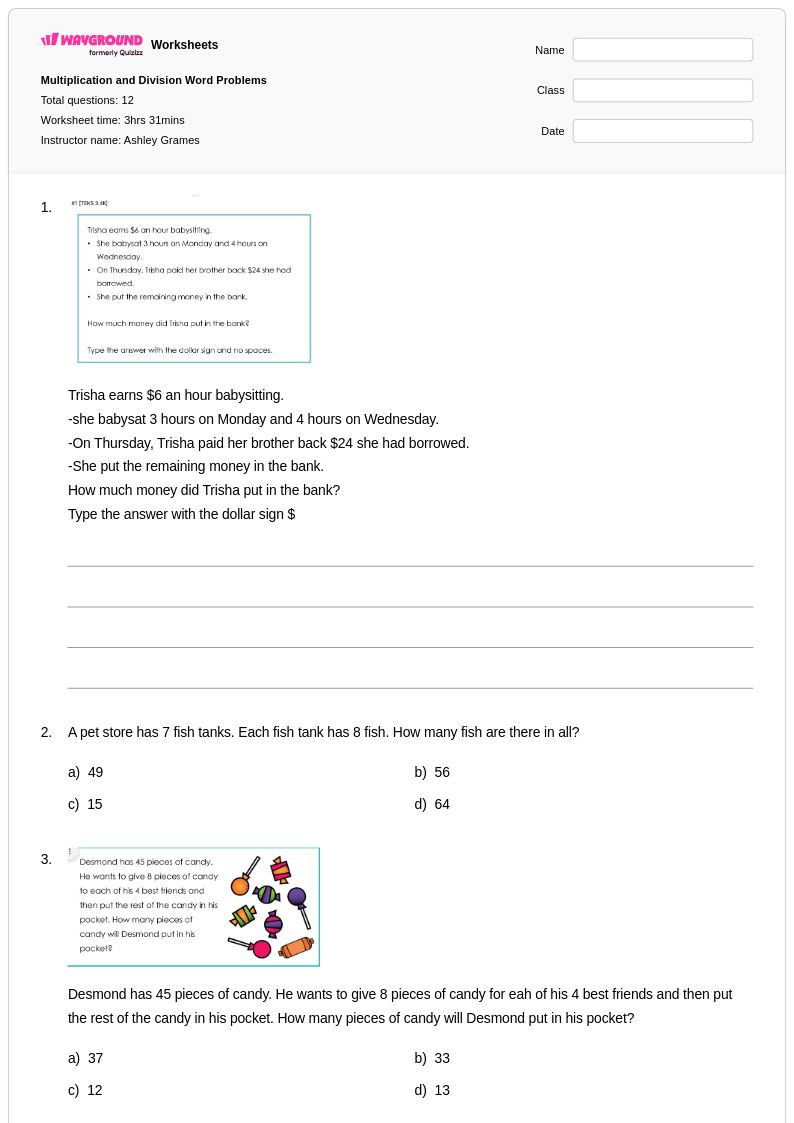
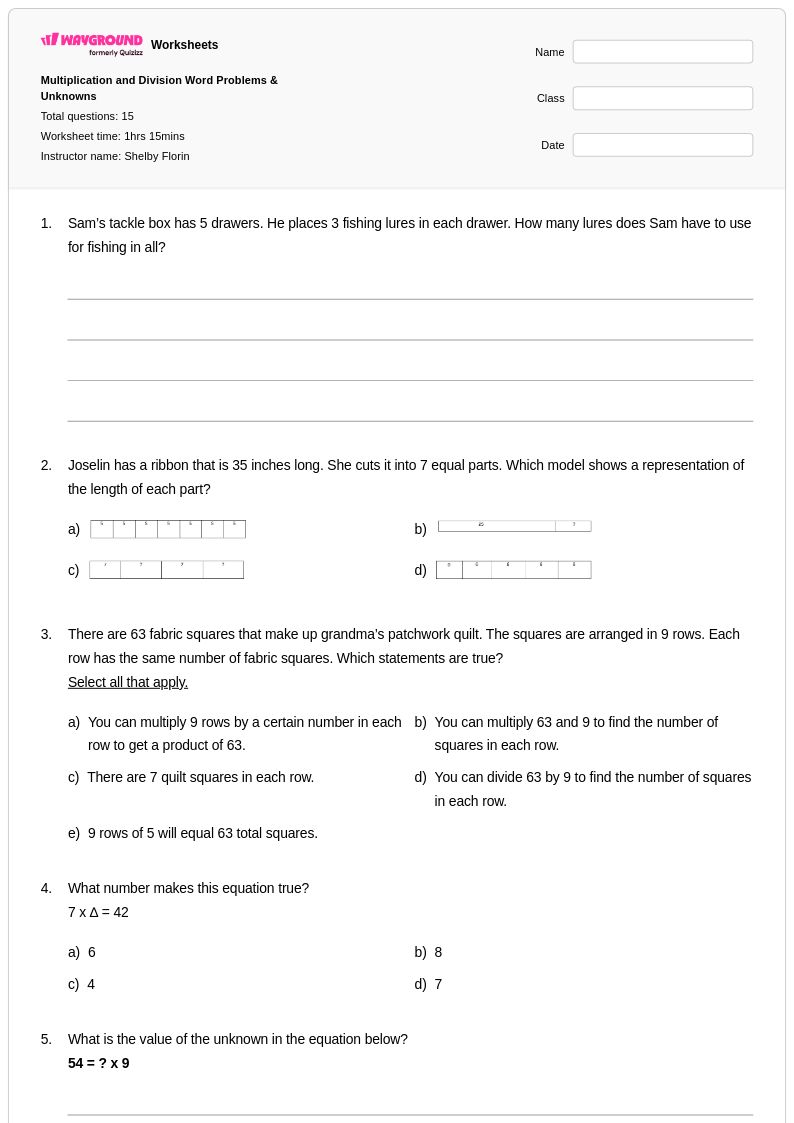
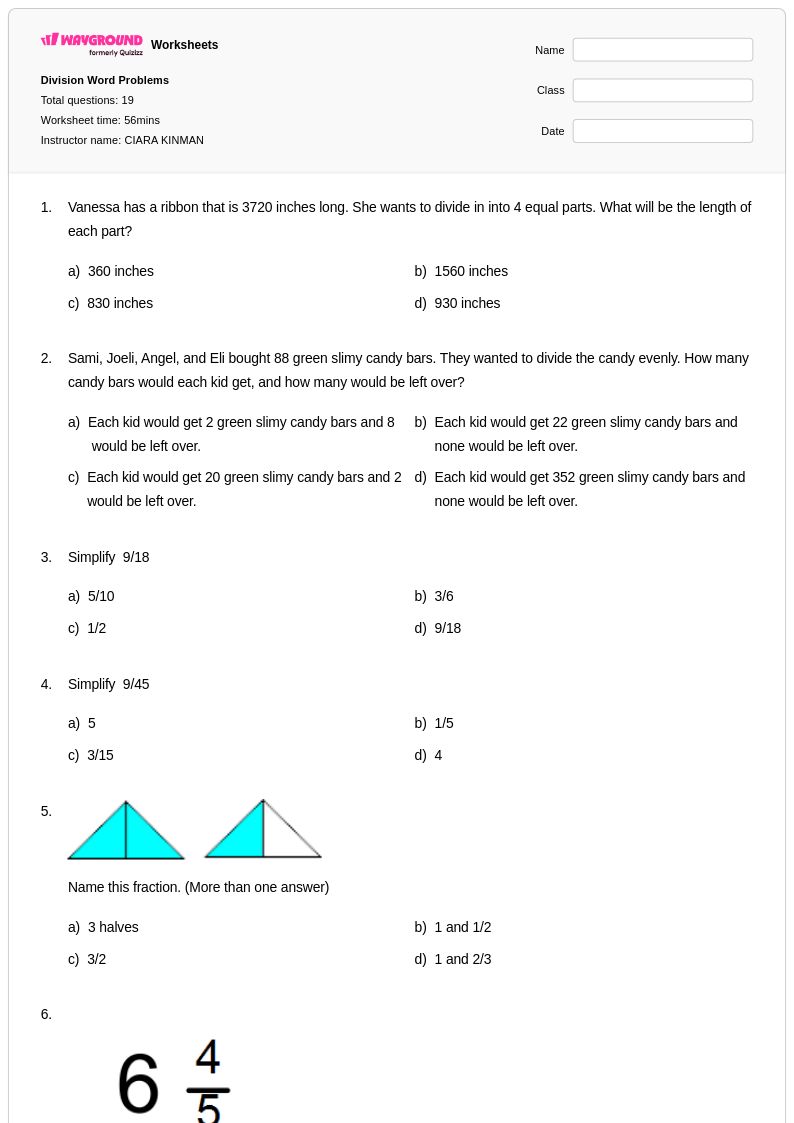
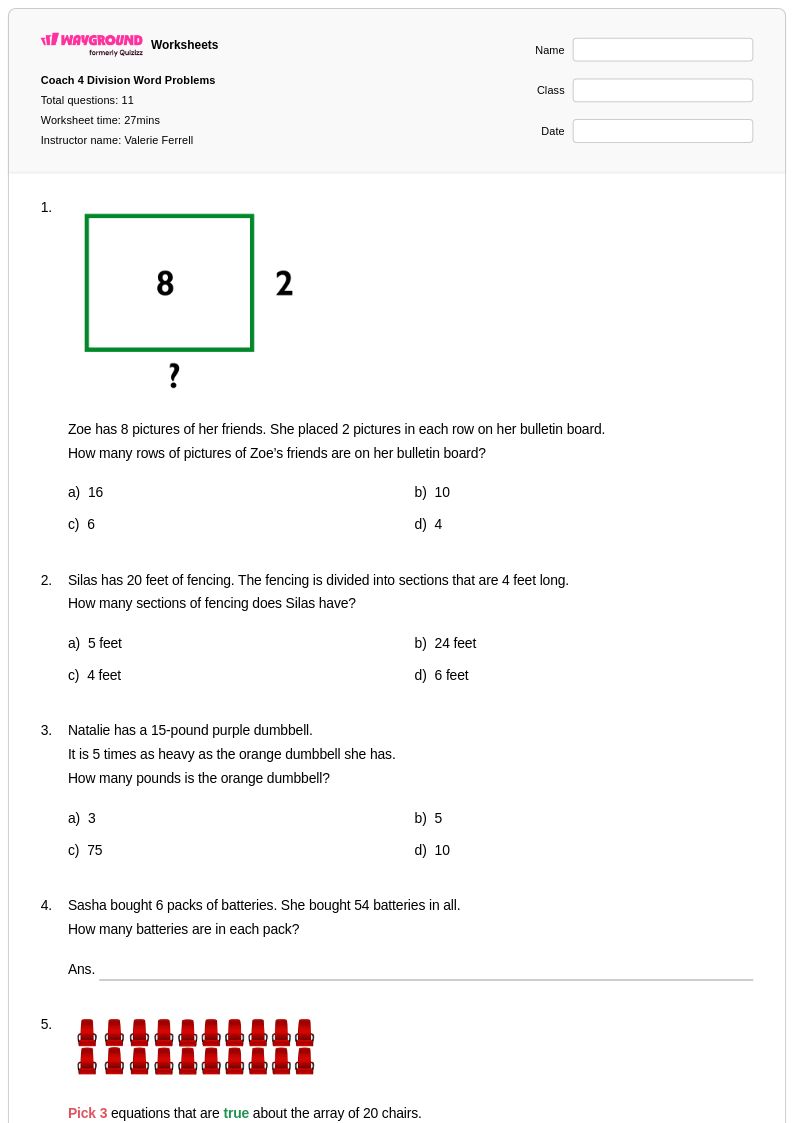
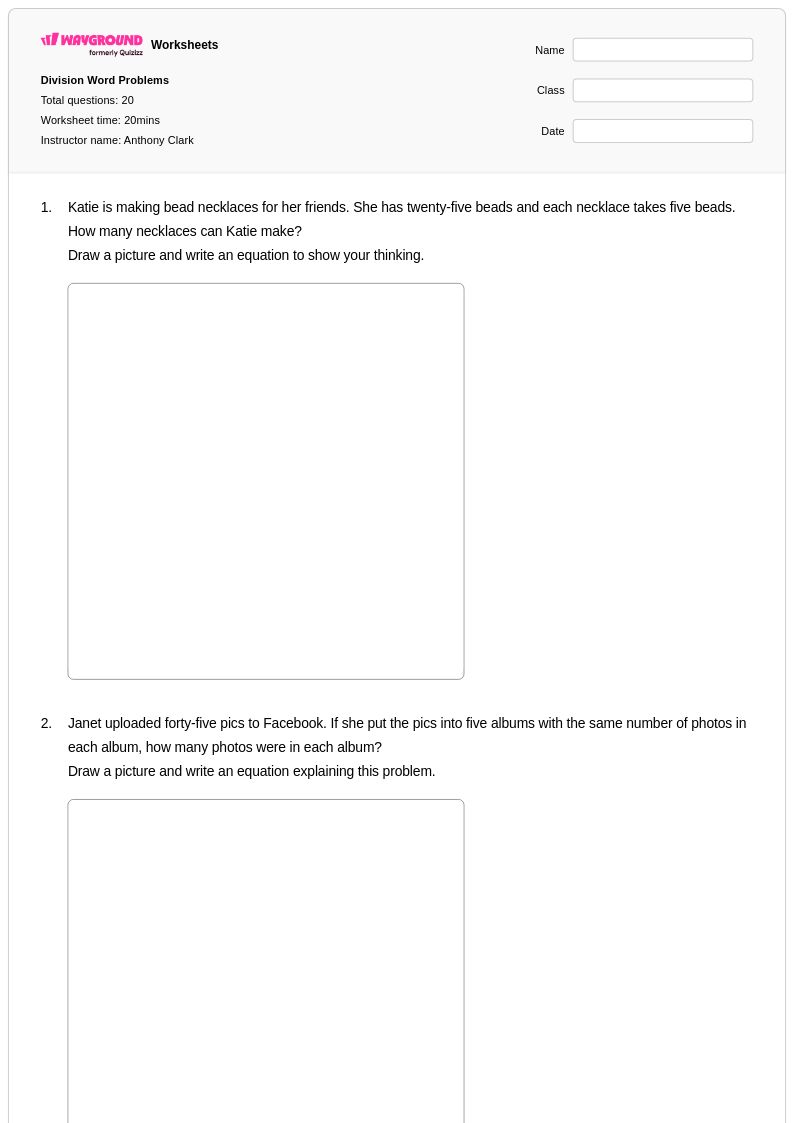
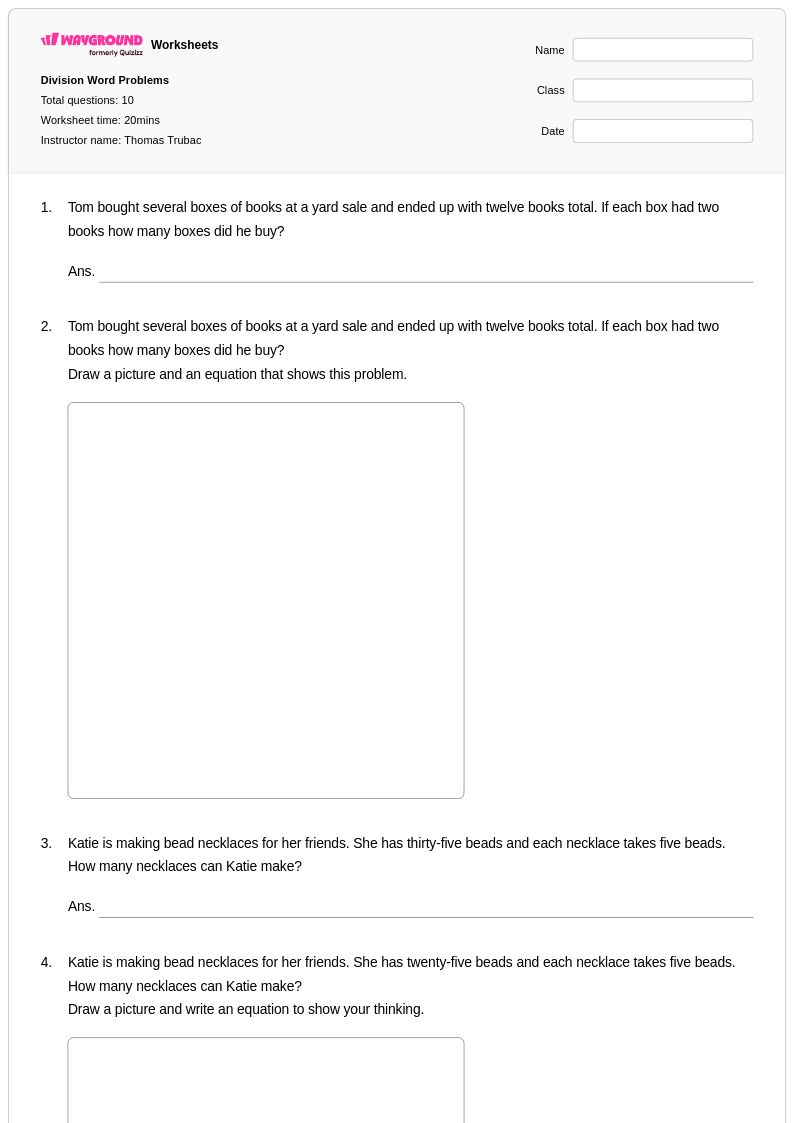
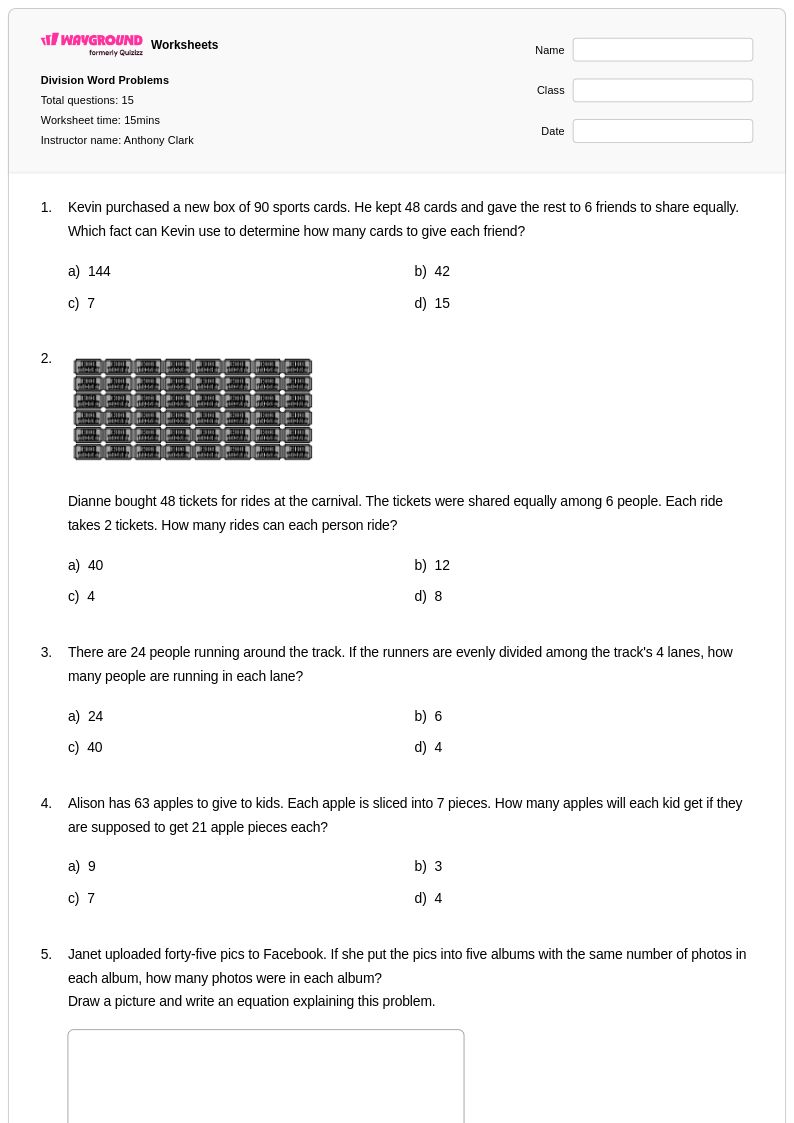
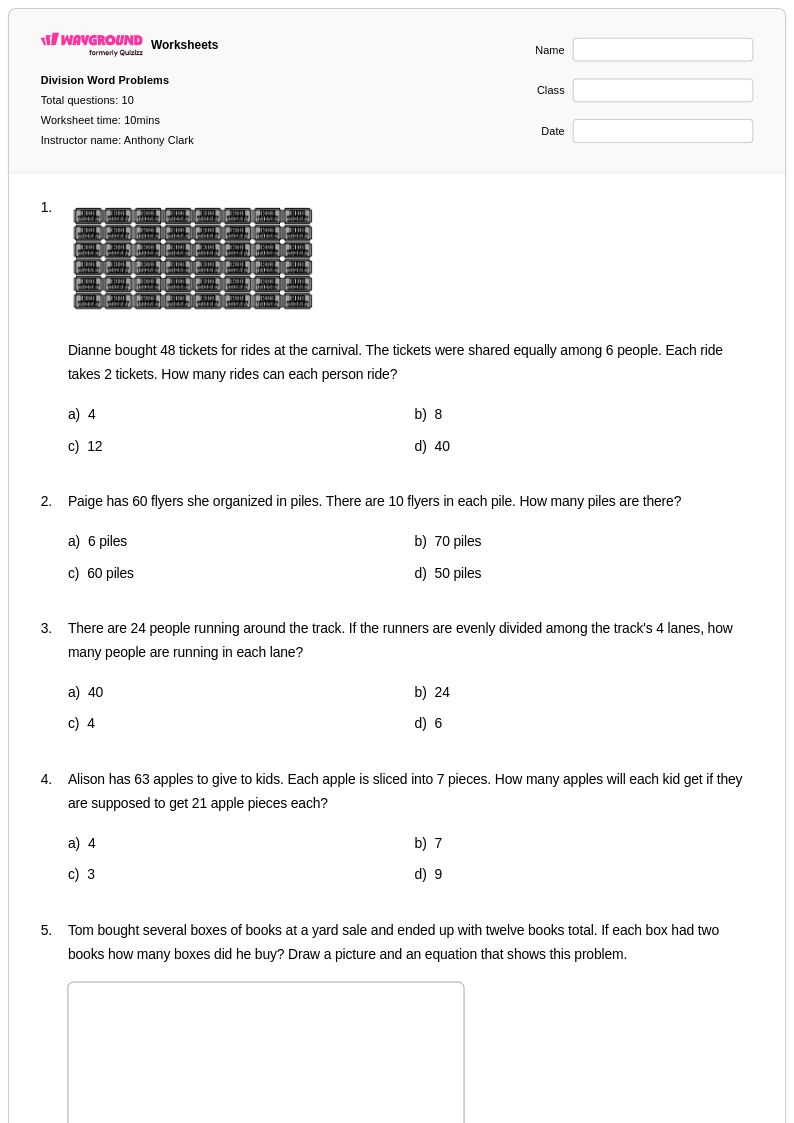
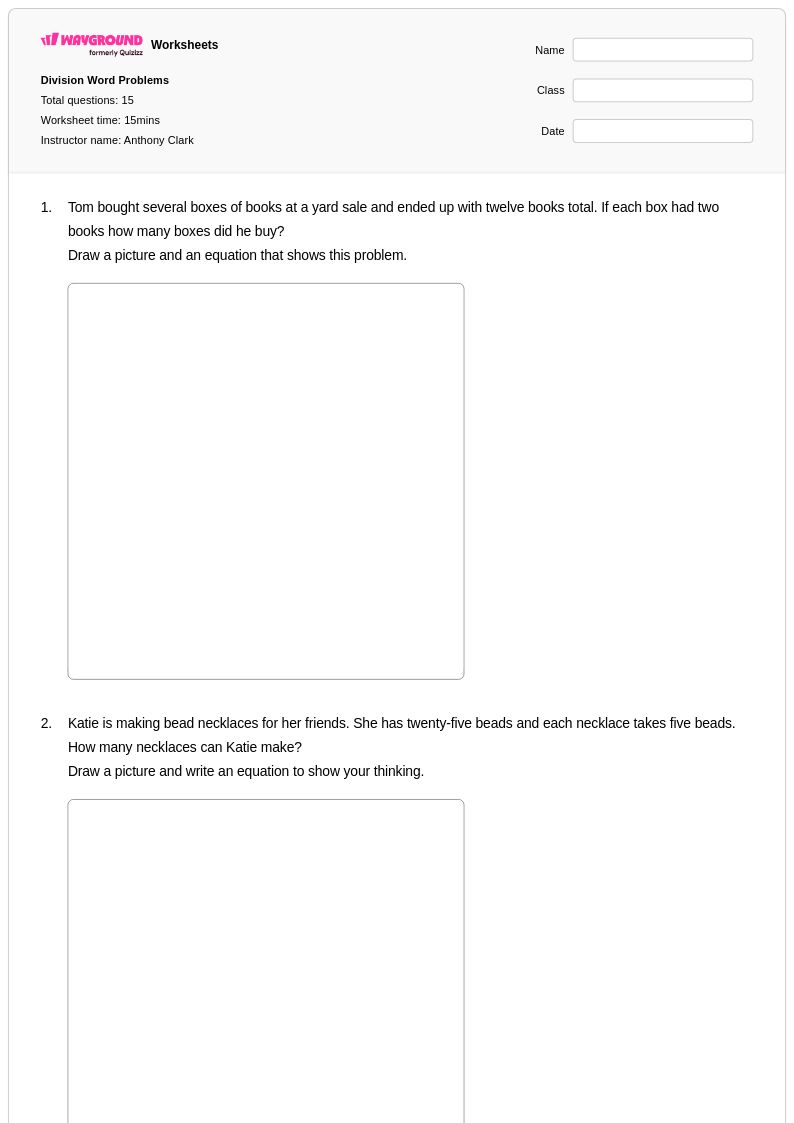
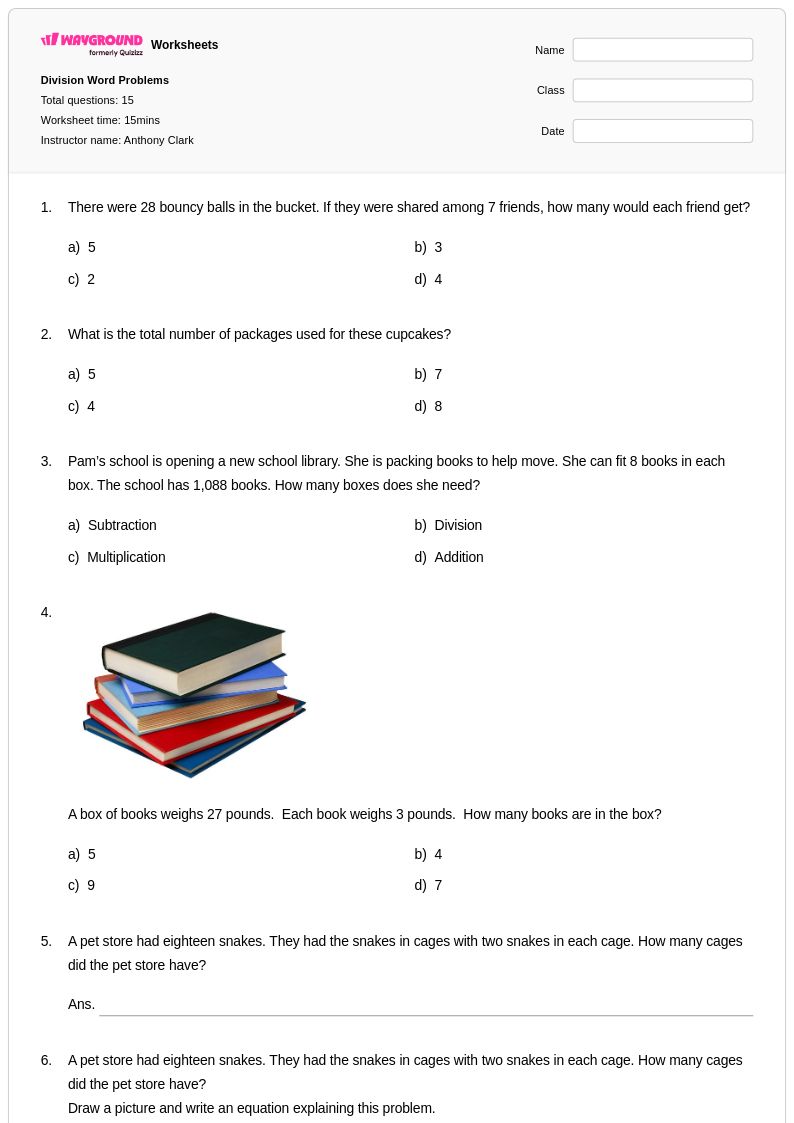
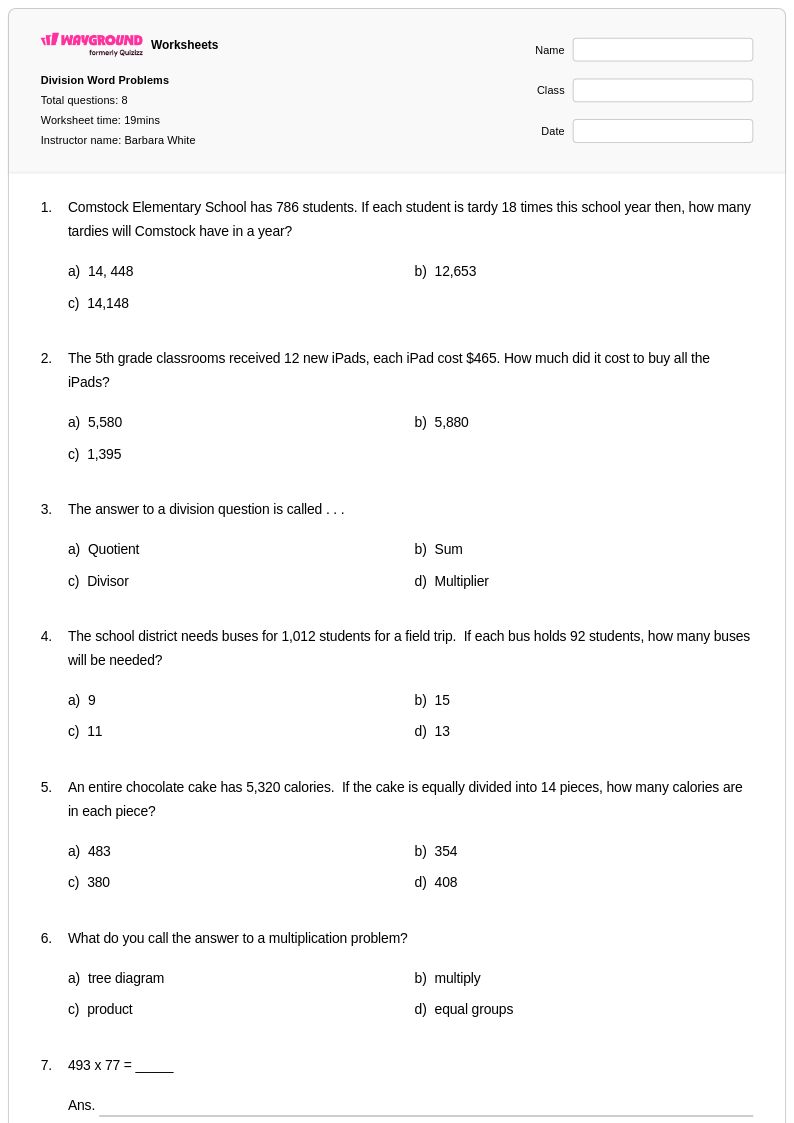
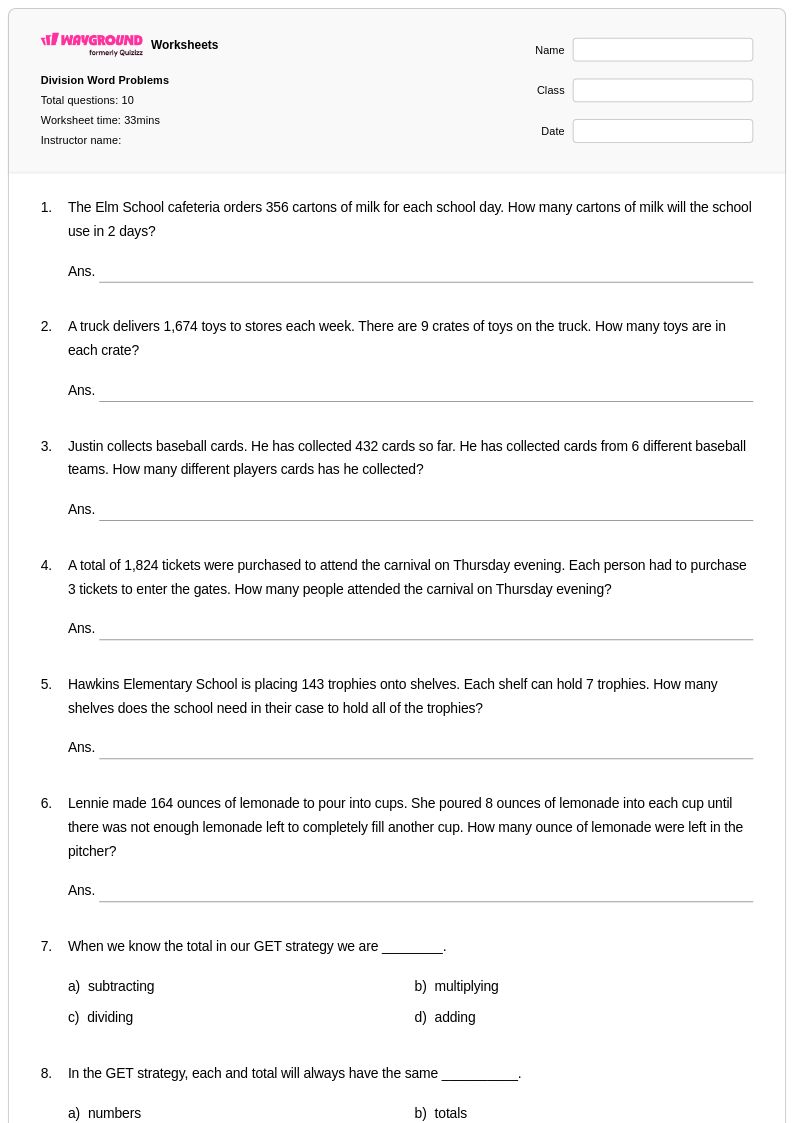
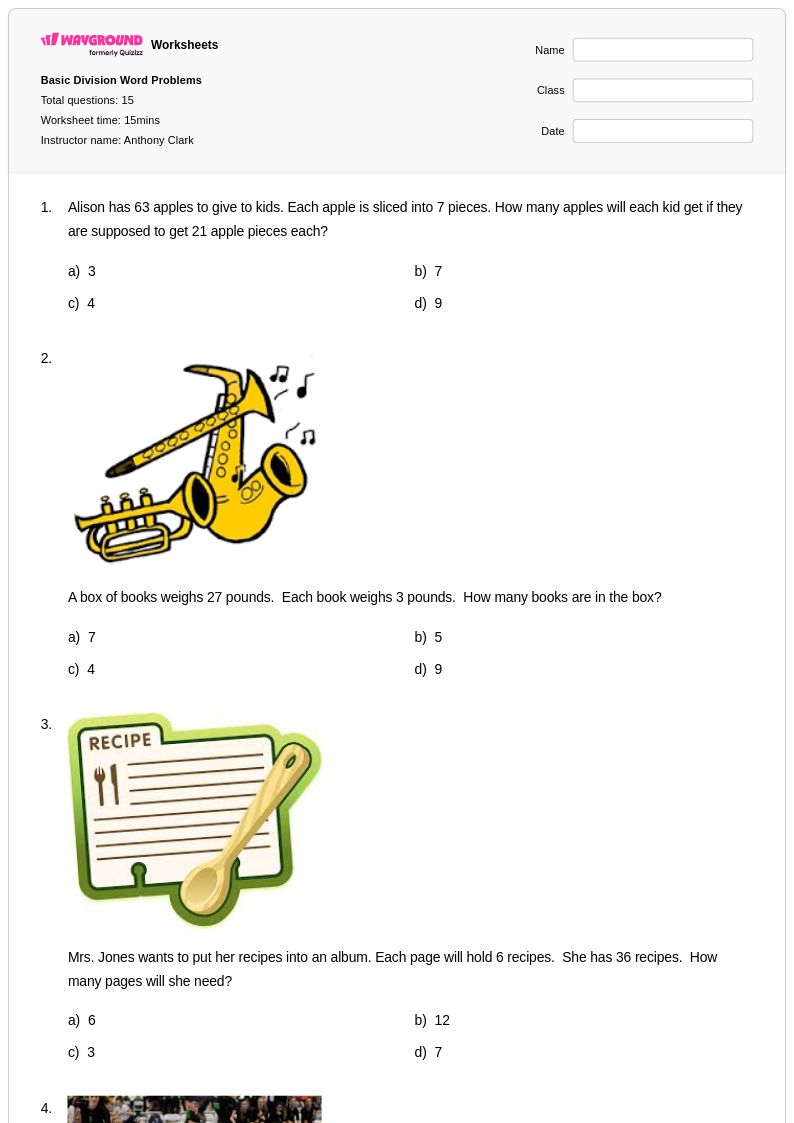
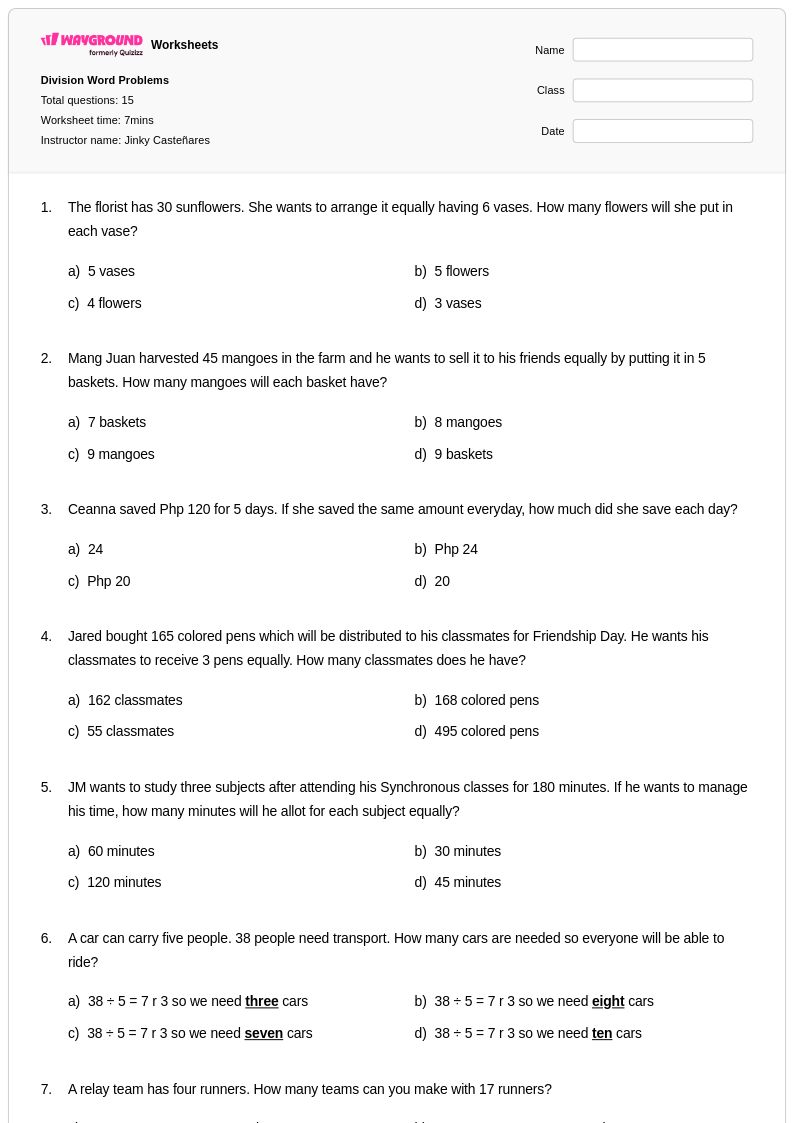
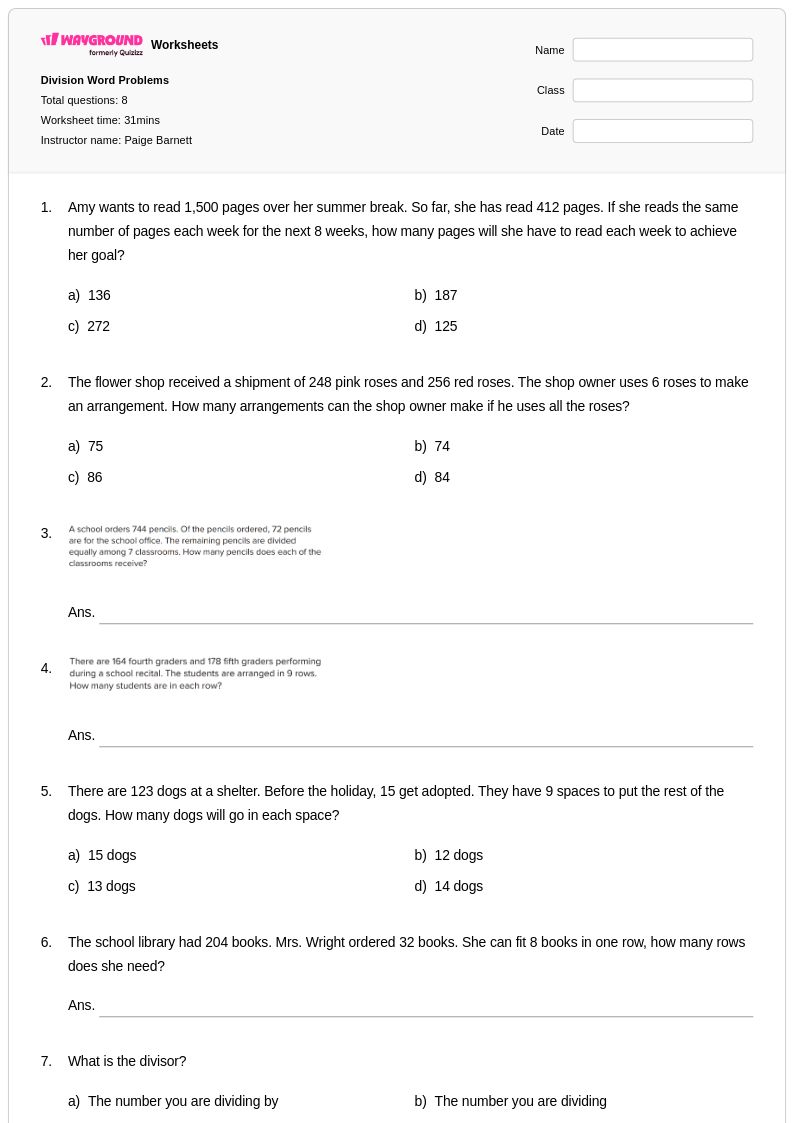
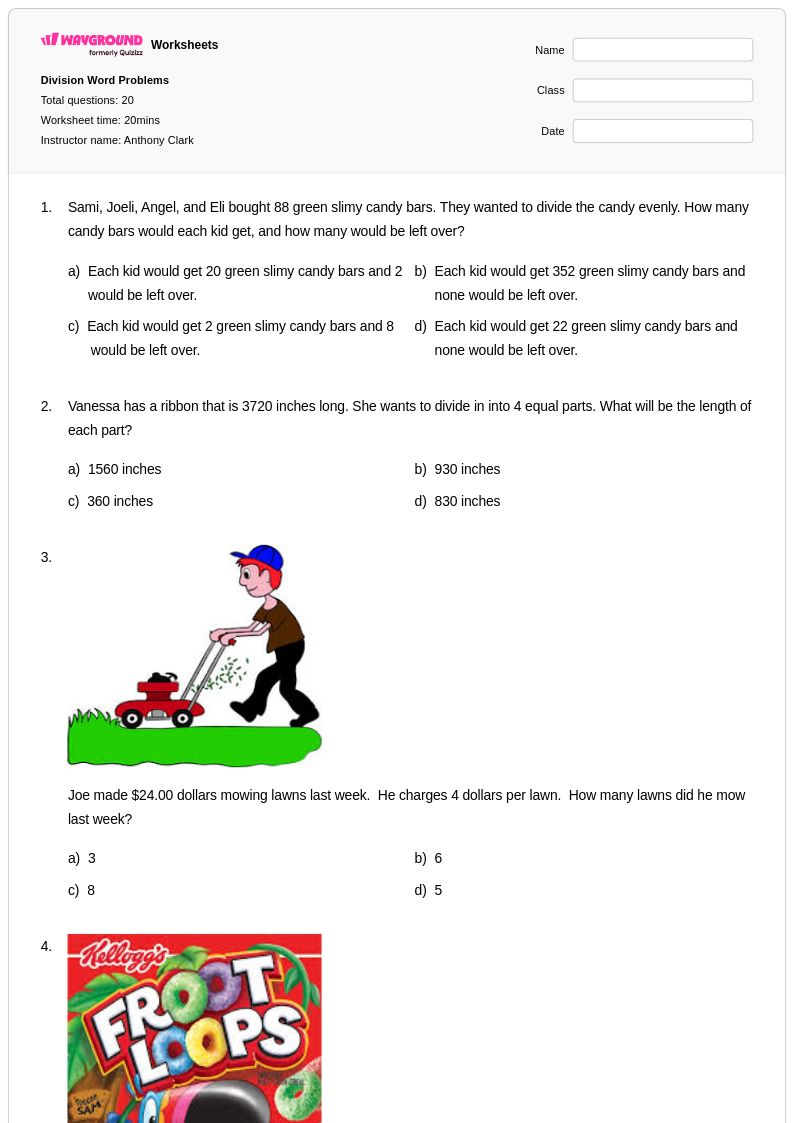
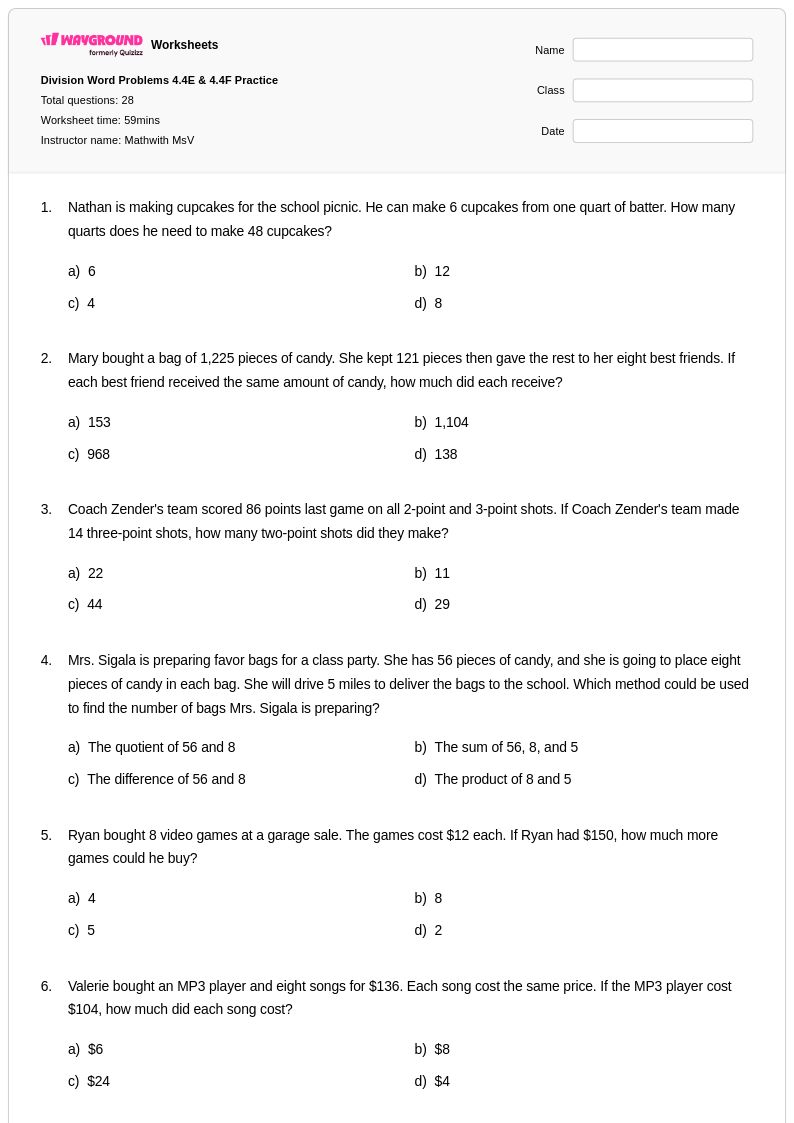
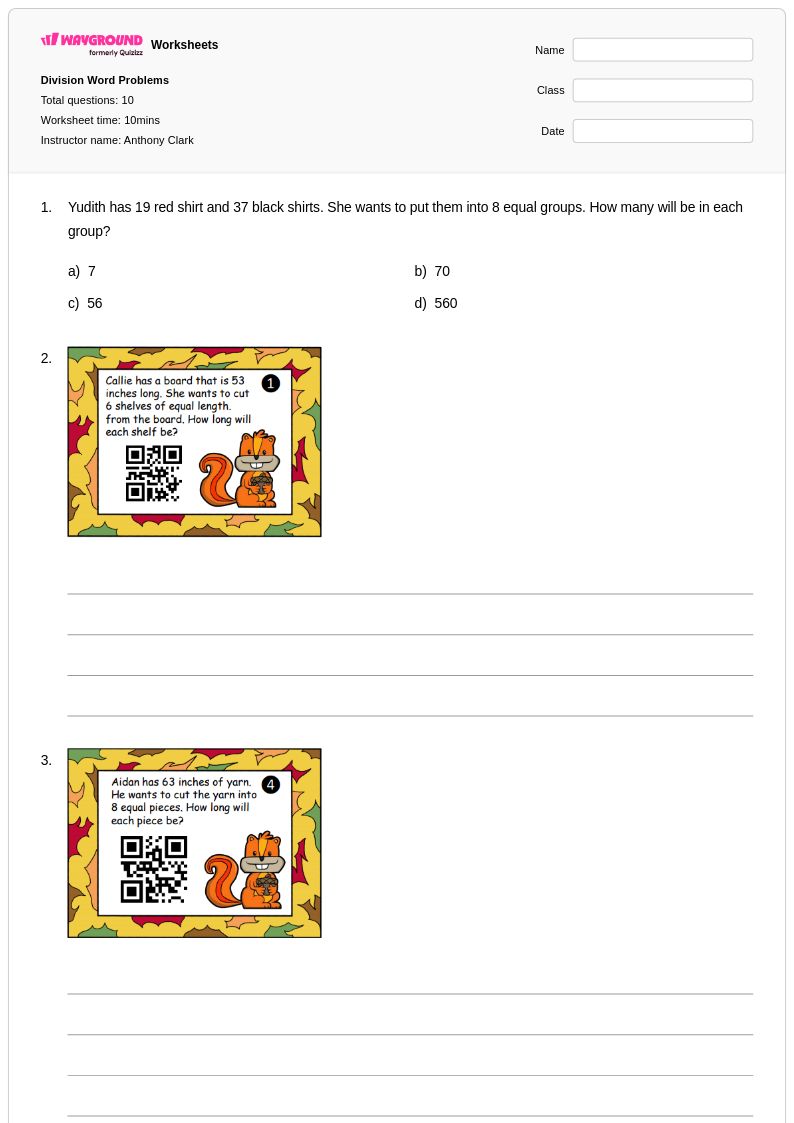
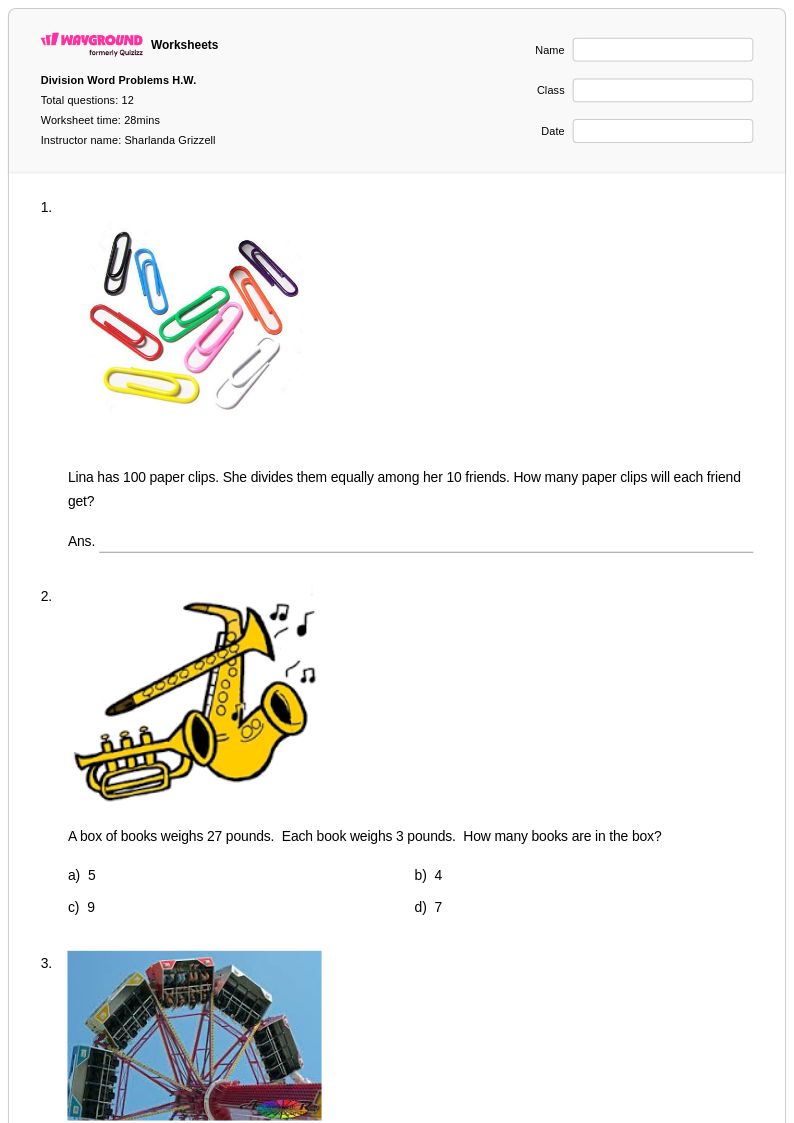
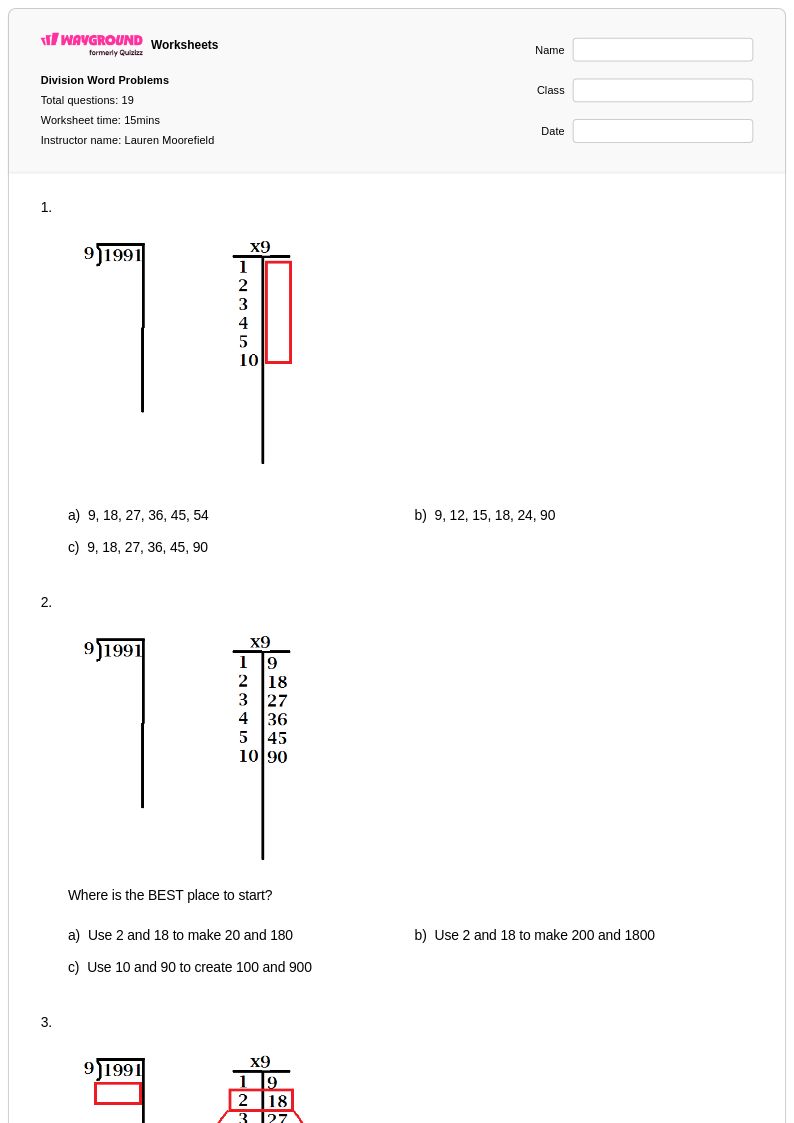
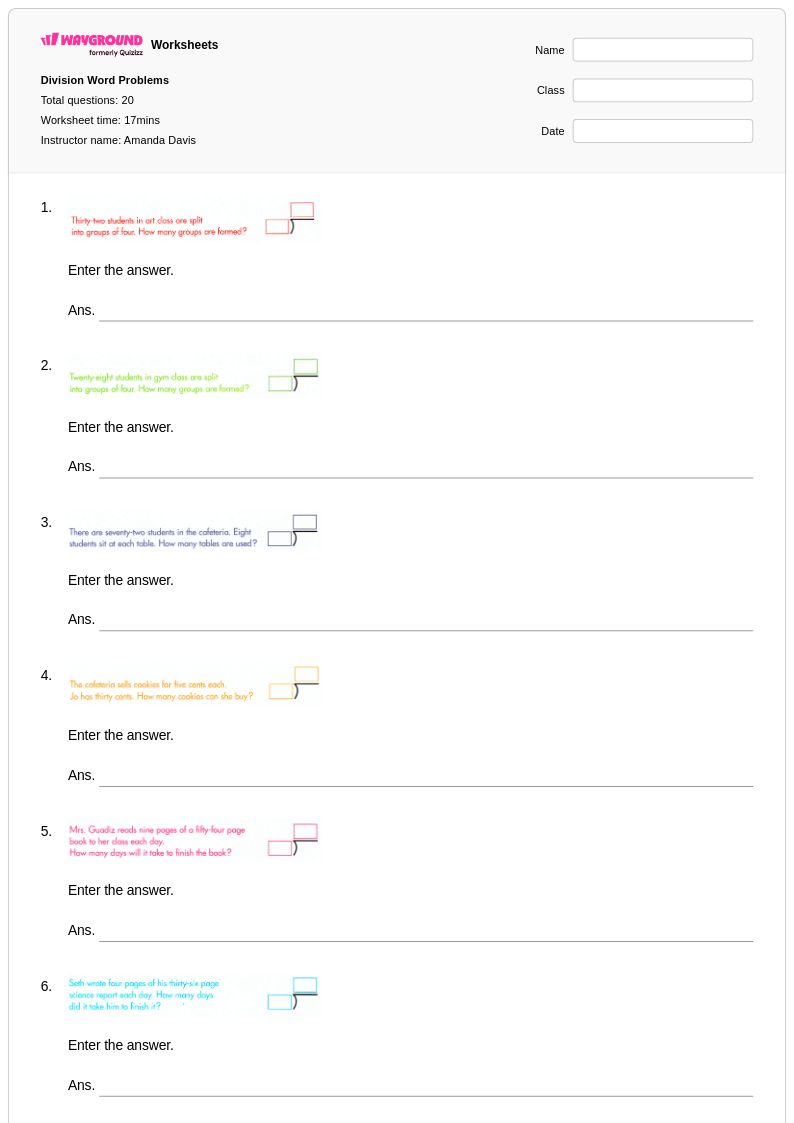
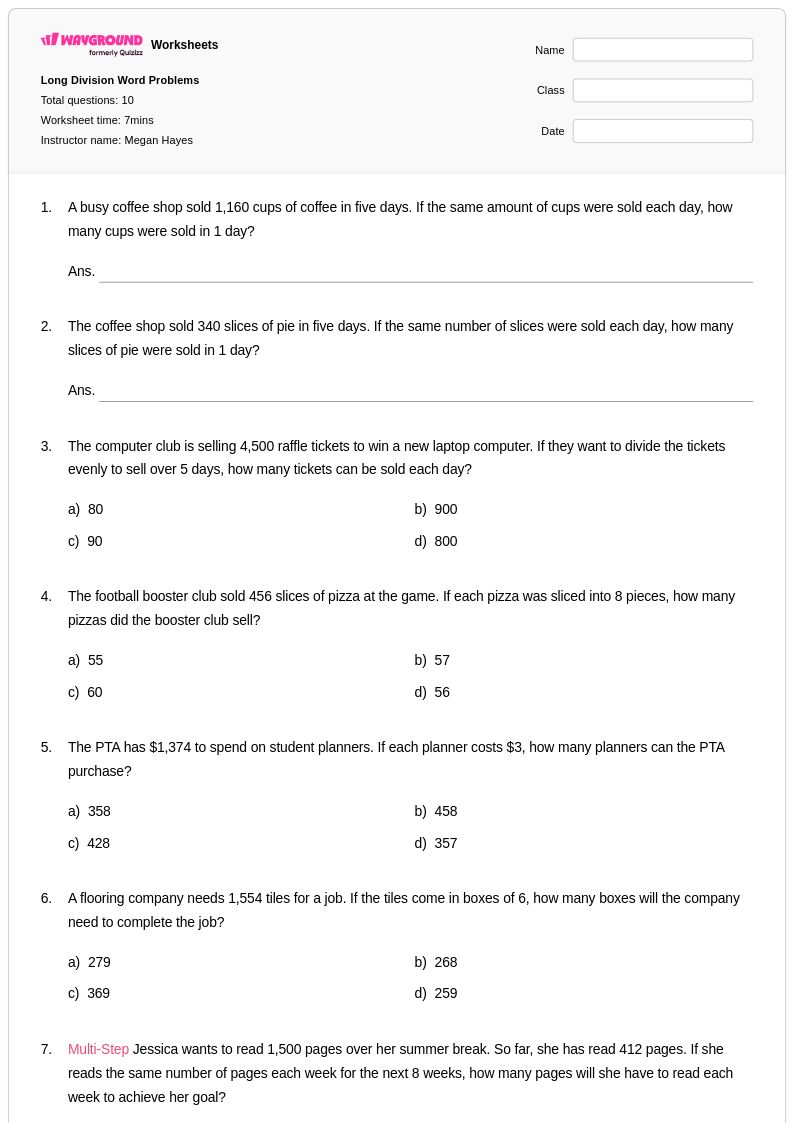
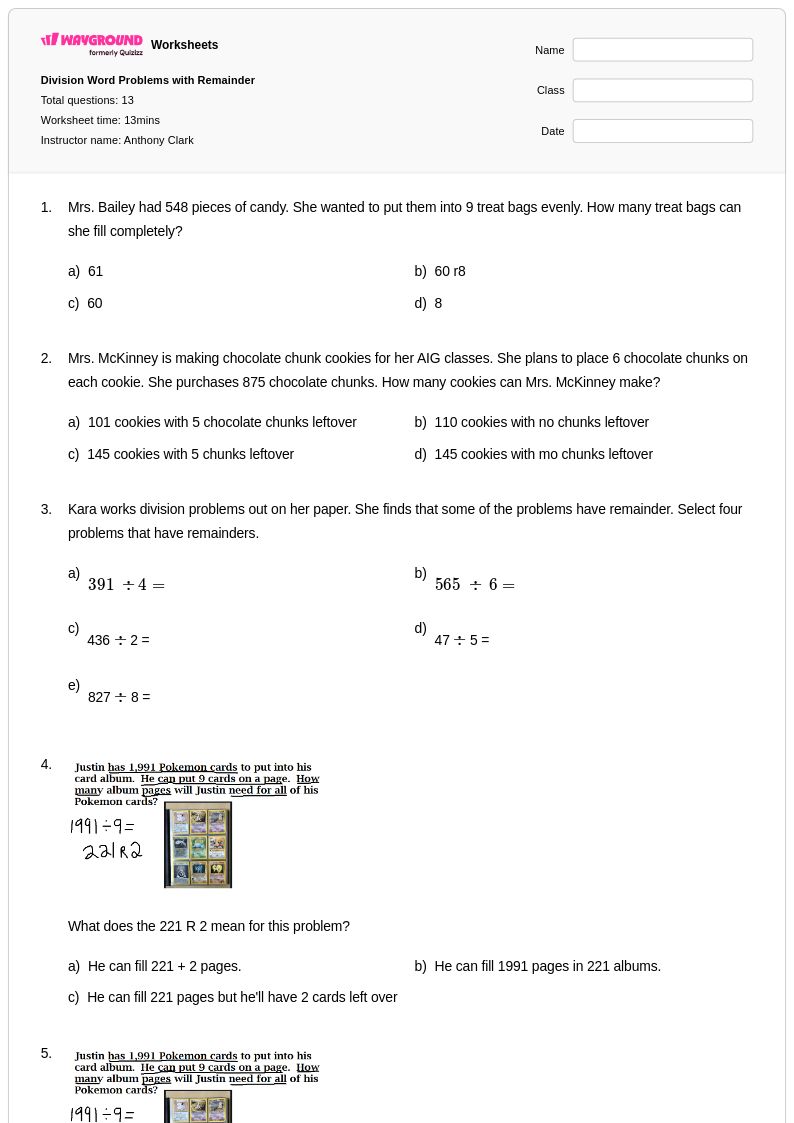
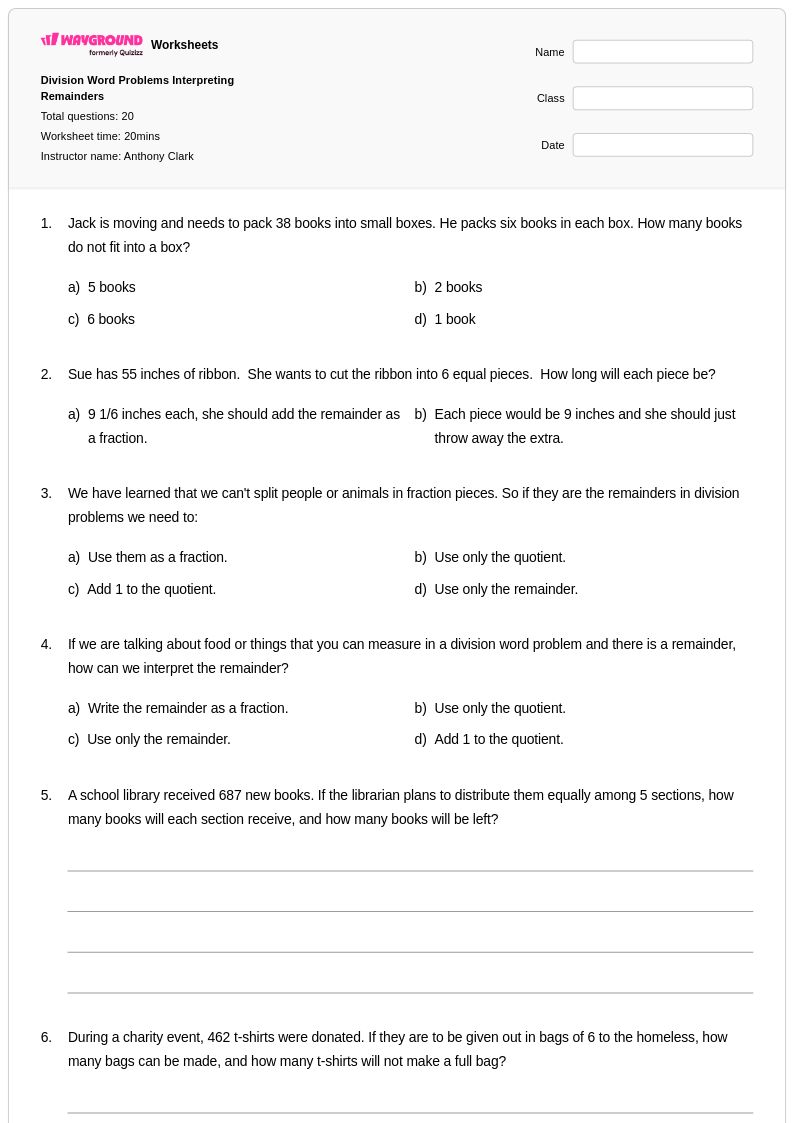
Enhance your students' mathematical reasoning with Wayground's free division word problems worksheets, featuring printable PDF practice problems and comprehensive answer keys to build problem-solving skills.
Explore printable Division Word Problems worksheets
Division word problems worksheets from Wayground (formerly Quizizz) provide students with essential practice in applying division concepts to real-world scenarios and mathematical reasoning challenges. These comprehensive worksheets strengthen critical thinking skills by requiring students to identify relevant information, determine appropriate operations, and solve multi-step problems involving division of whole numbers, decimals, and fractions. Each worksheet includes carefully crafted practice problems that progress from basic single-step division scenarios to more complex multi-step word problems, helping students develop fluency in mathematical problem-solving strategies. Teachers can access complete answer keys and utilize these free printables in both classroom instruction and independent practice sessions, ensuring students receive adequate support while building confidence in their division problem-solving abilities.
Wayground (formerly Quizizz) empowers educators with millions of teacher-created division word problem resources that feature robust search and filtering capabilities, enabling quick identification of materials aligned to specific curriculum standards and learning objectives. The platform's differentiation tools allow teachers to customize worksheets based on individual student needs, offering various complexity levels and problem types to support both remediation and enrichment activities. These versatile resources are available in printable pdf format and digital versions, providing flexibility for diverse classroom environments and instructional approaches. Teachers can efficiently plan targeted skill practice sessions, assess student understanding through formative evaluation, and provide additional support for students who need extra reinforcement in translating written scenarios into mathematical division operations.
FAQs
How do I teach division word problems?
Start by teaching students to read the problem twice: once for the story, once for the math. Have them identify what's being divided, how many groups (or how many in each group), and what the question is actually asking. A common scaffold is to have students underline the key numbers and circle the question before writing any equation. From there, move from single-step problems with whole numbers toward multi-step problems and problems involving decimals or fractions as students gain confidence.
What exercises help students practice division word problems?
The most effective practice moves students through increasing complexity: start with single-step equal-sharing scenarios, then introduce grouping problems, then multi-step problems where division is one of two operations needed. Mixing problem types on the same worksheet — rather than drilling one type at a time — builds the judgment students need to recognize when division applies.
What mistakes do students commonly make with division word problems?
Three errors come up repeatedly. First, students confuse the divisor and dividend — they know division is involved but set up the equation backwards. Second, they ignore remainders or don't interpret what a remainder means in context (e.g., do you round up, round down, or report it?). Third, in multi-step problems, students solve only the first step and stop, not recognizing the problem requires a second operation.
How do I use Wayground's division word problems worksheets in my class?
You can run these as a digital quiz hosted on Wayground or download the PDF and assign them on paper — same problems, either format. Every worksheet includes a complete answer key, so you're not building one from scratch. If you go the printable route, the Wayground for Teachers app lets you scan or photograph student submissions to grade them without manual re-entry.
Are division word problems aligned to Common Core standards?
Yes. Common Core introduces division conceptually in Grade 3 — equal groups, arrays, and the relationship between multiplication and division — then extends it in Grades 4 and 5 to multi-digit whole numbers, decimals, and fractions. Word problems are central to this progression because the standards explicitly require students to interpret division in real-world contexts, not just compute answers. These worksheets support that arc by ranging from single-step whole-number scenarios to more complex multi-step and decimal/fraction problems.
How can I differentiate division word problem practice for mixed-ability classes?
For students who struggle with reading load, Wayground's Read Aloud accommodation reads questions aloud so decoding doesn't block the math. For students who need more processing time, extended time can be set per student on digital assignments without other students being notified. At the worksheet level, you can also generate a version with a dyslexia-friendly font or adjusted font size — useful when the barrier is visual rather than mathematical.
What grade level are division word problems taught?
Division word problems are introduced in Grade 3 under Common Core, where students work with equal groups and simple sharing scenarios. The concept extends through Grades 4 and 5 as problems incorporate multi-digit numbers, decimals, and fractions. Wayground's division word problem worksheets span this full range, so you can find problems appropriate for wherever your students are in that progression.