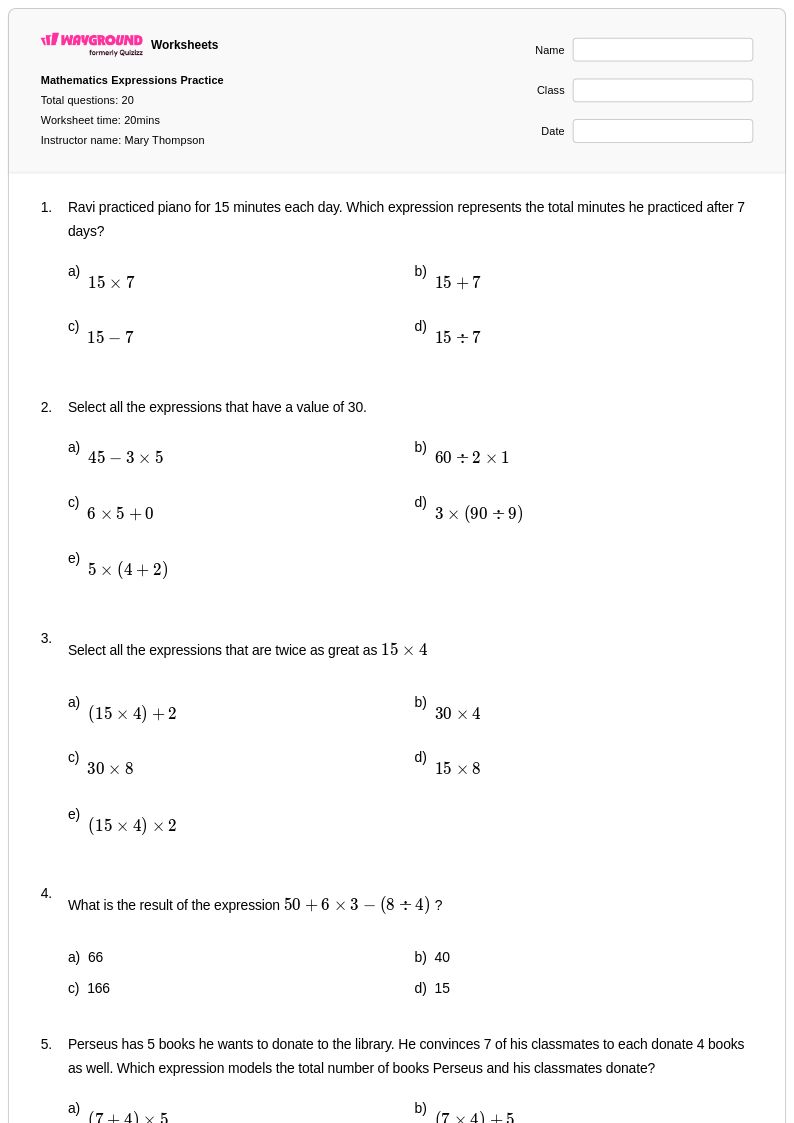
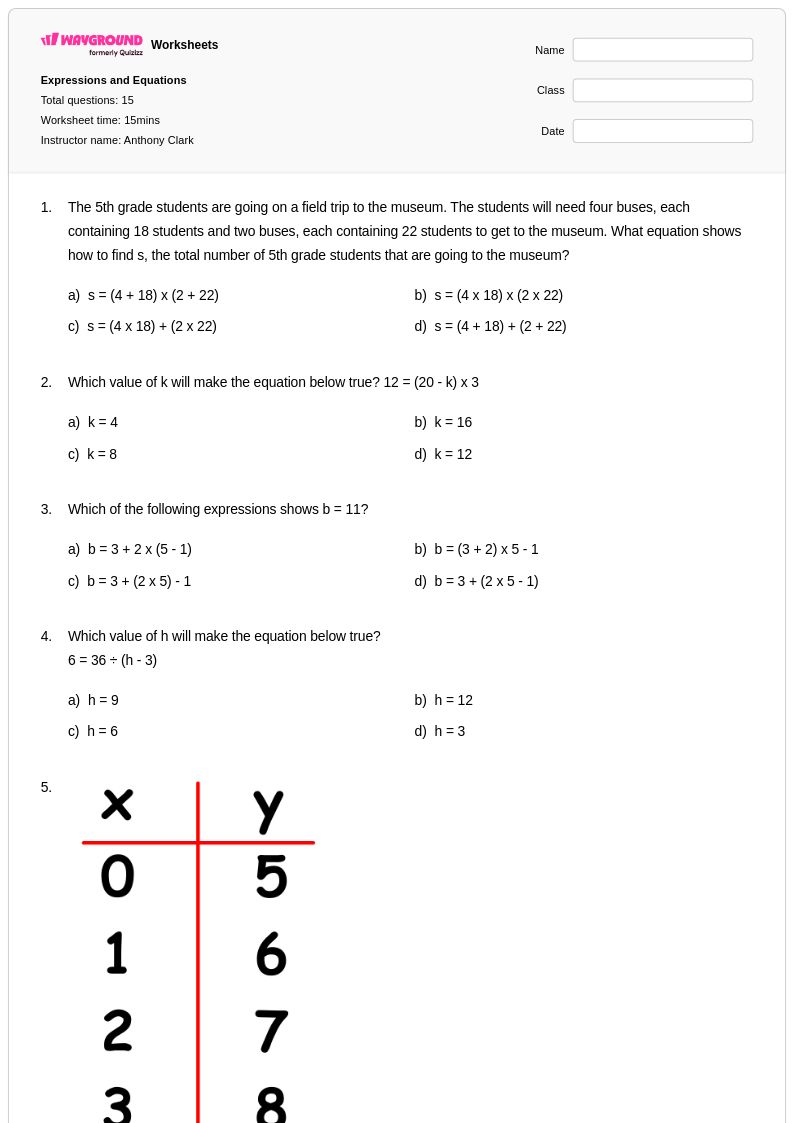
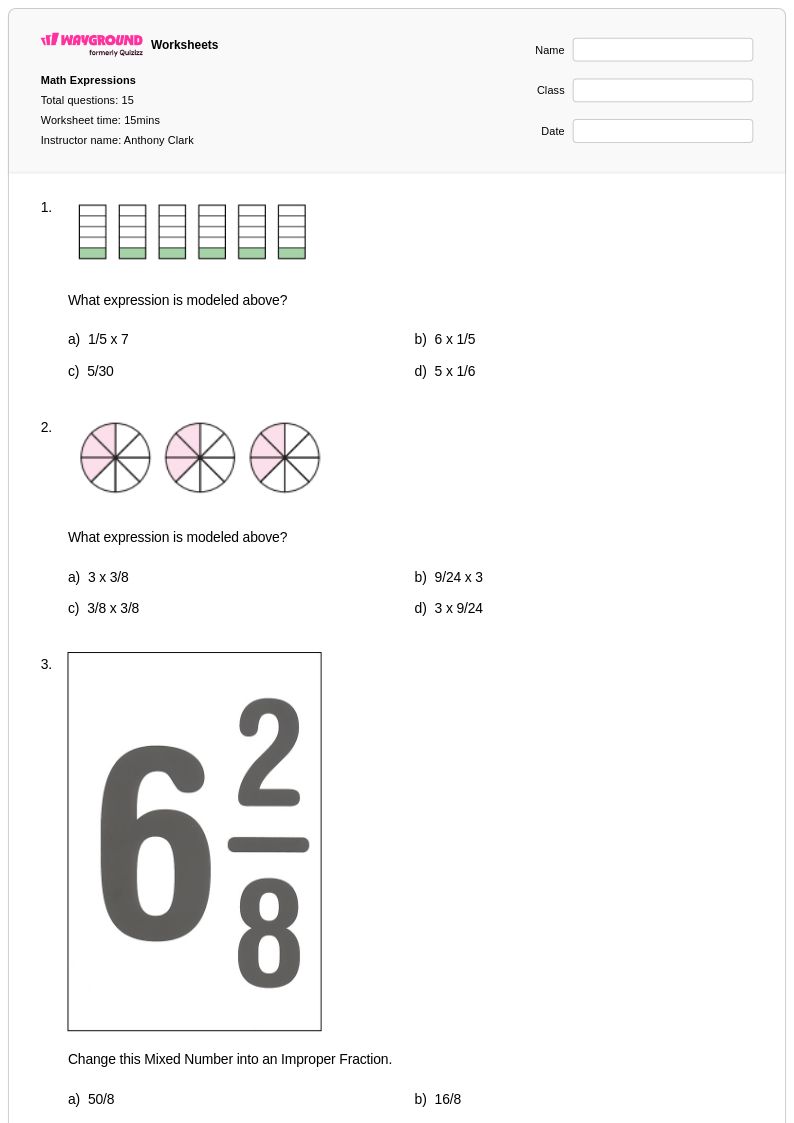
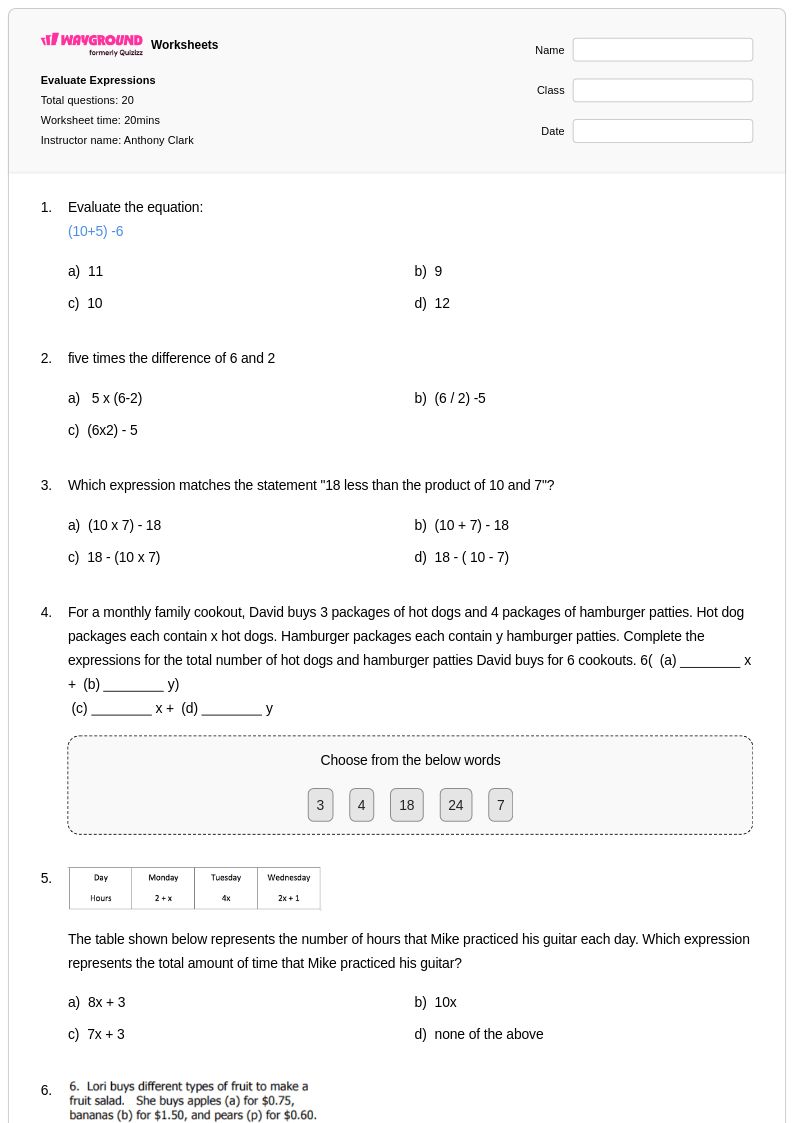
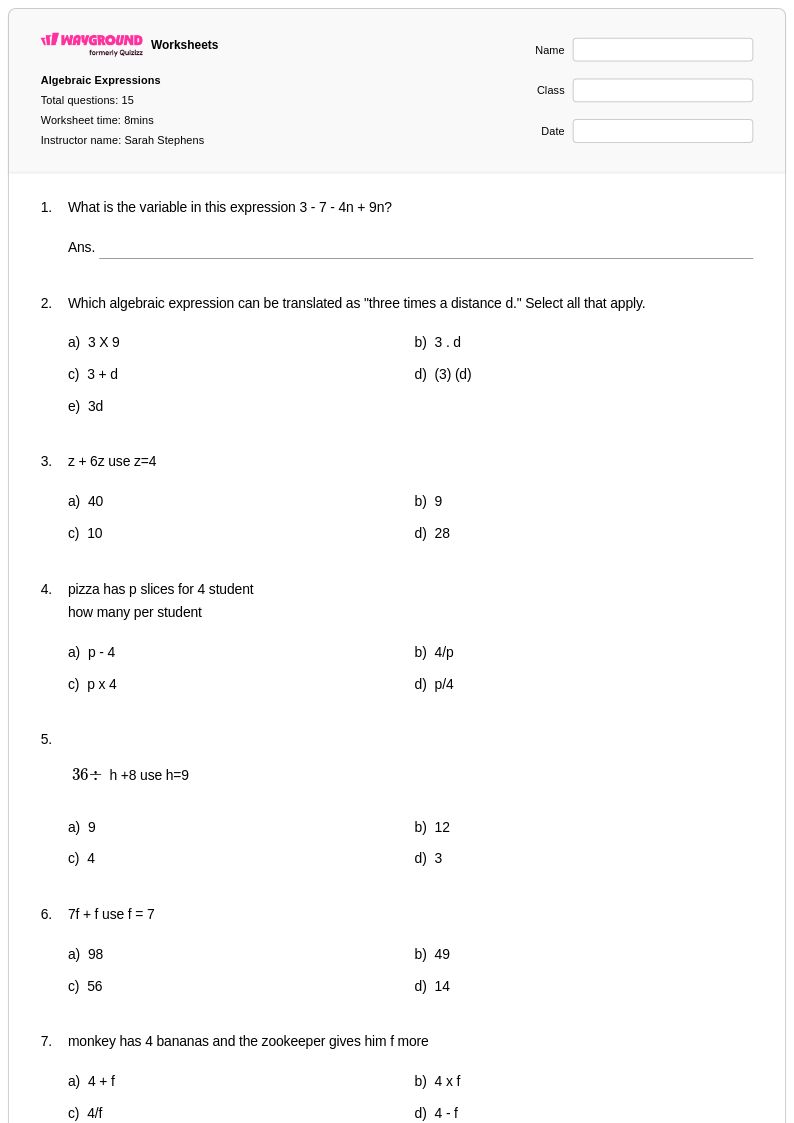
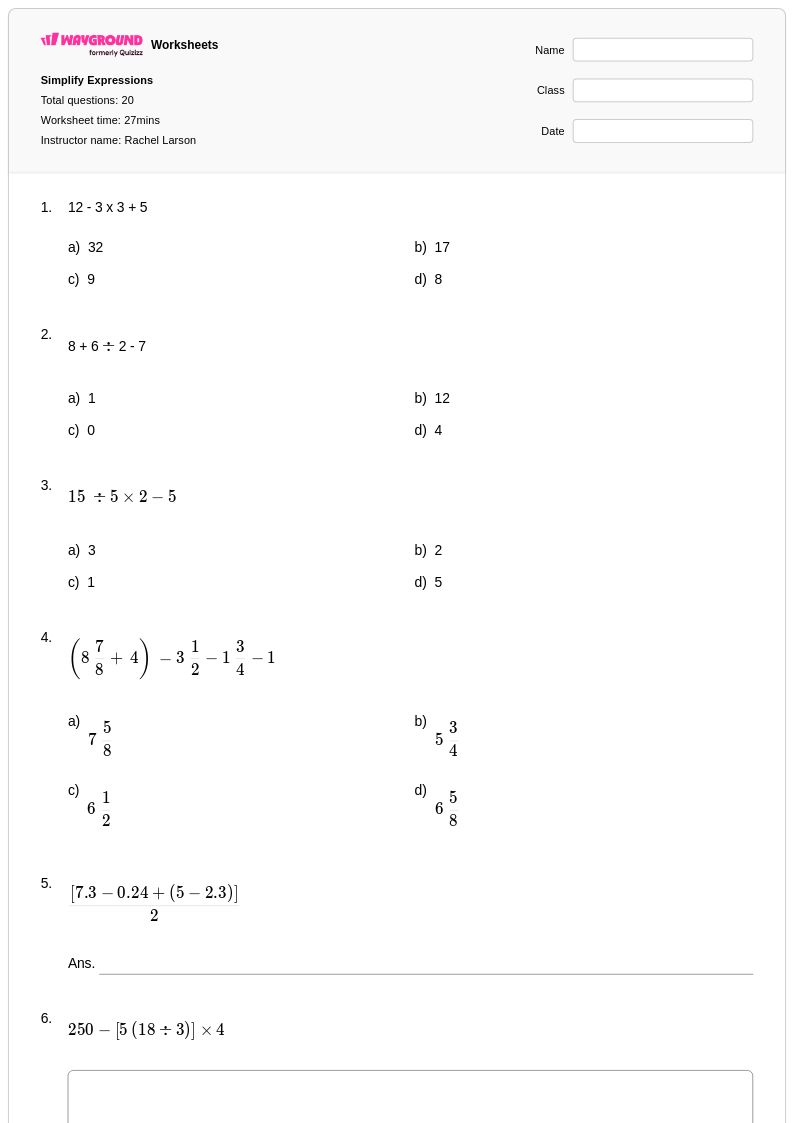
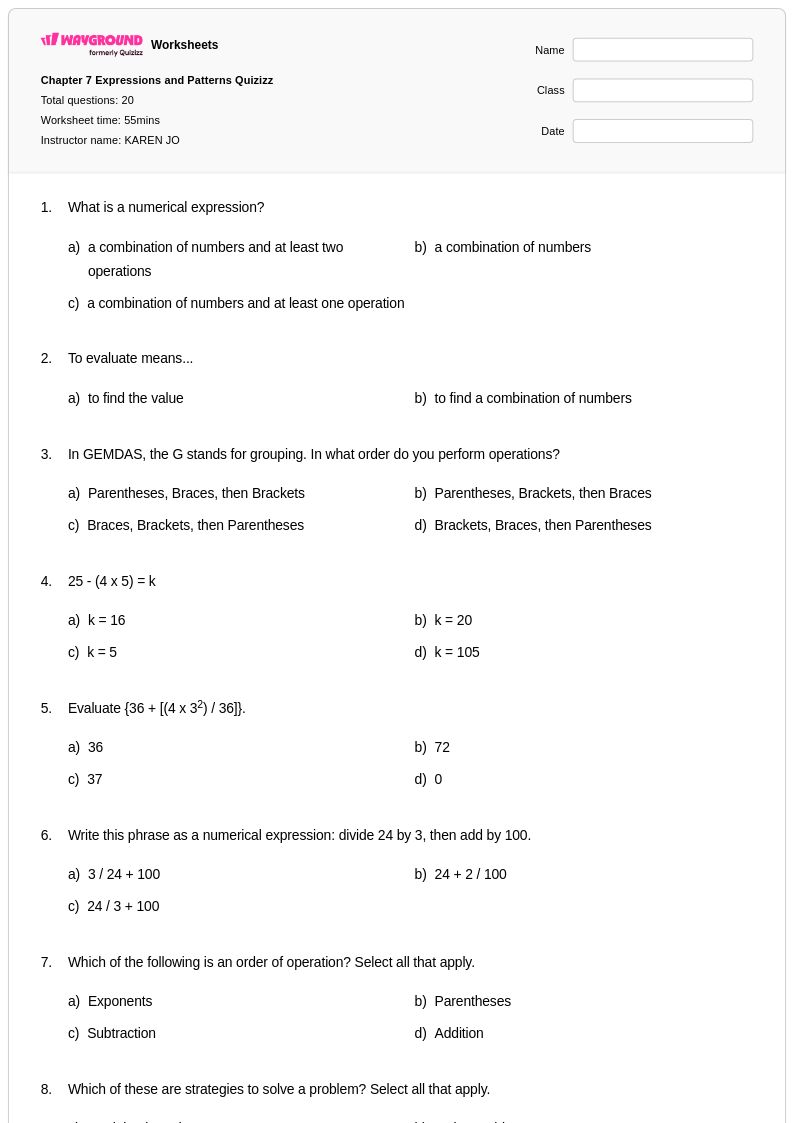
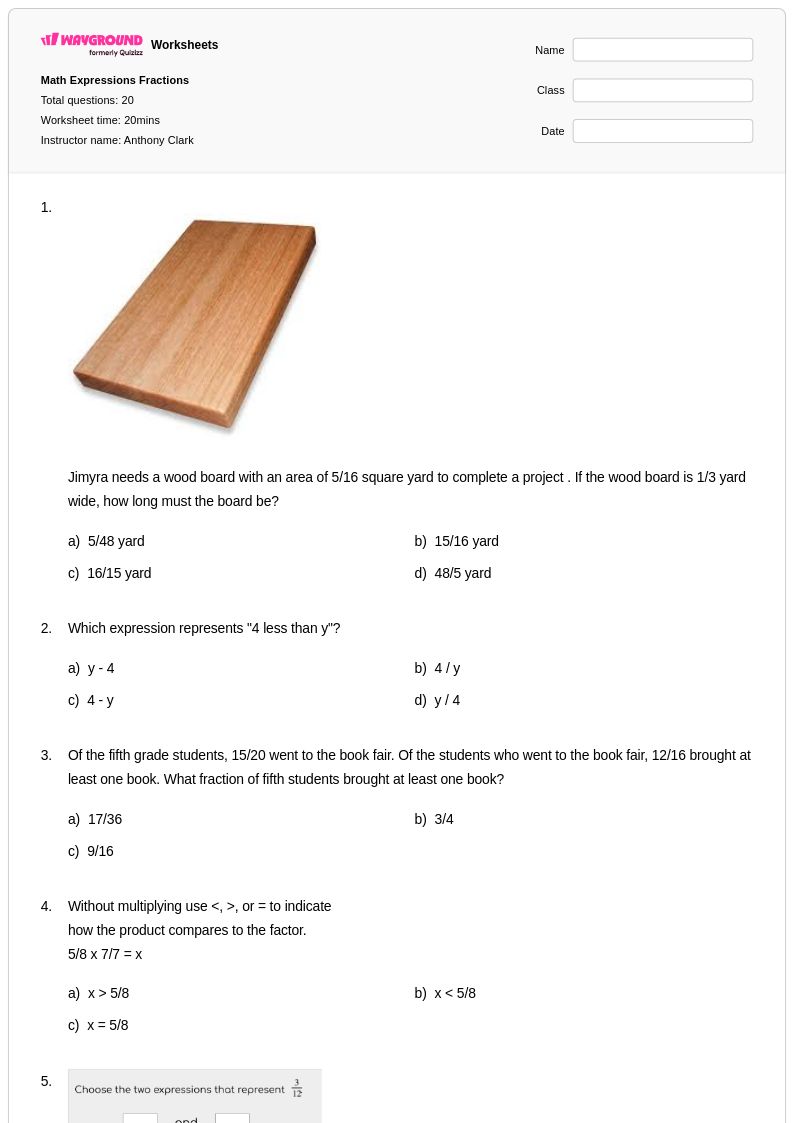
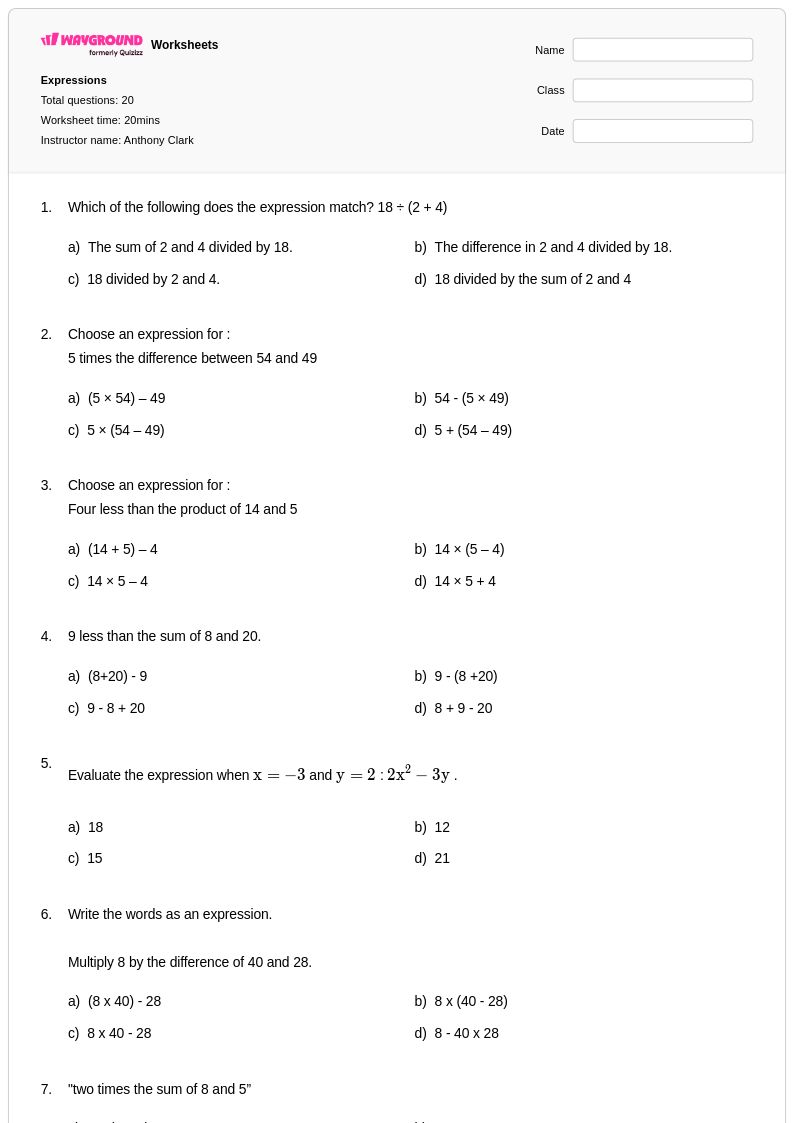
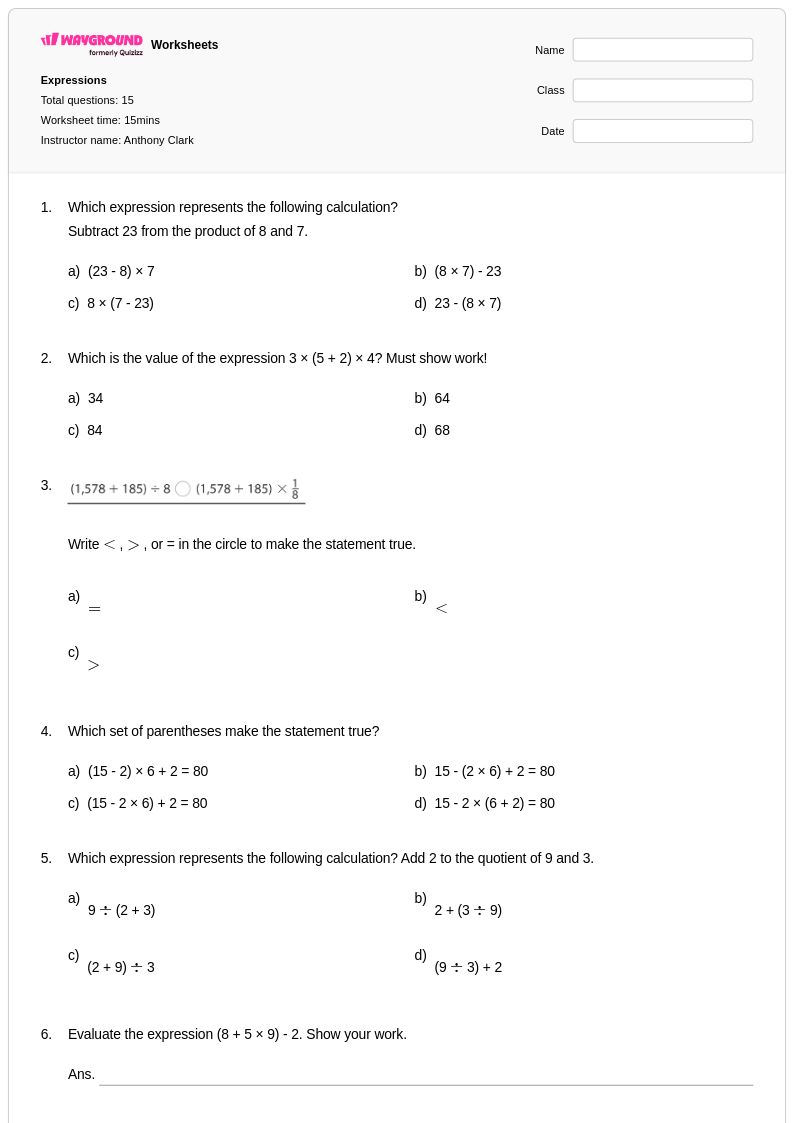
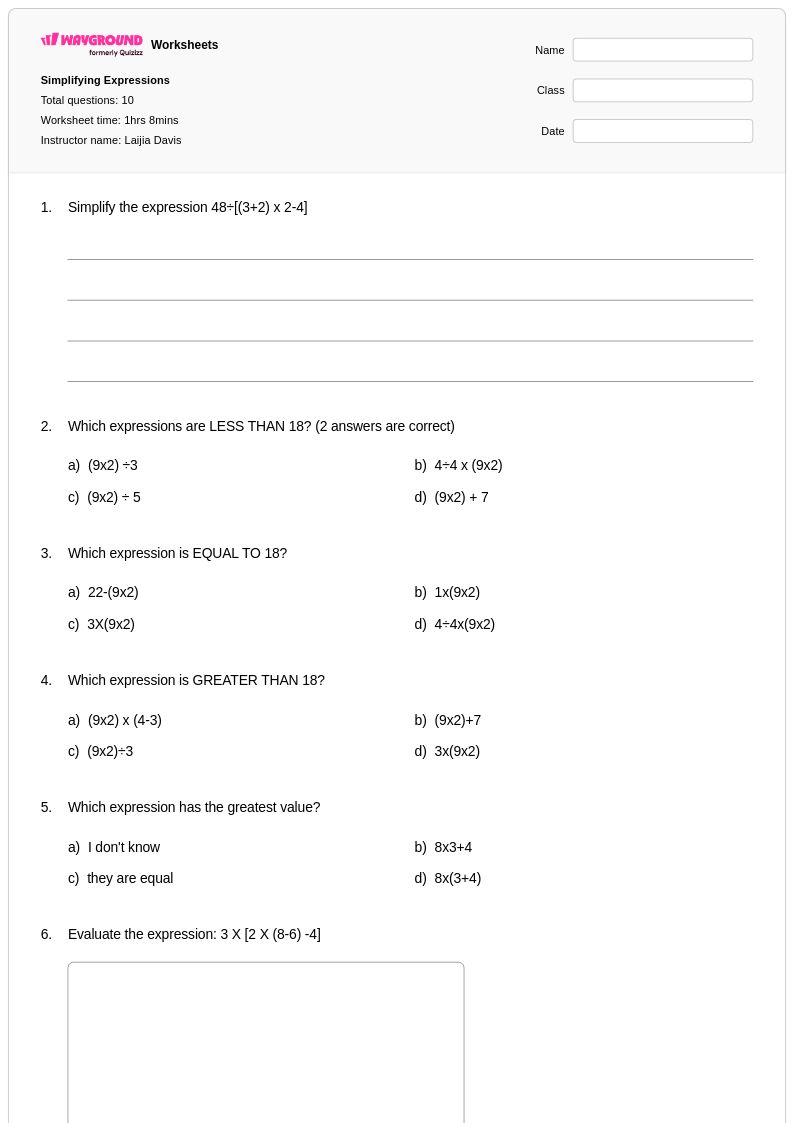
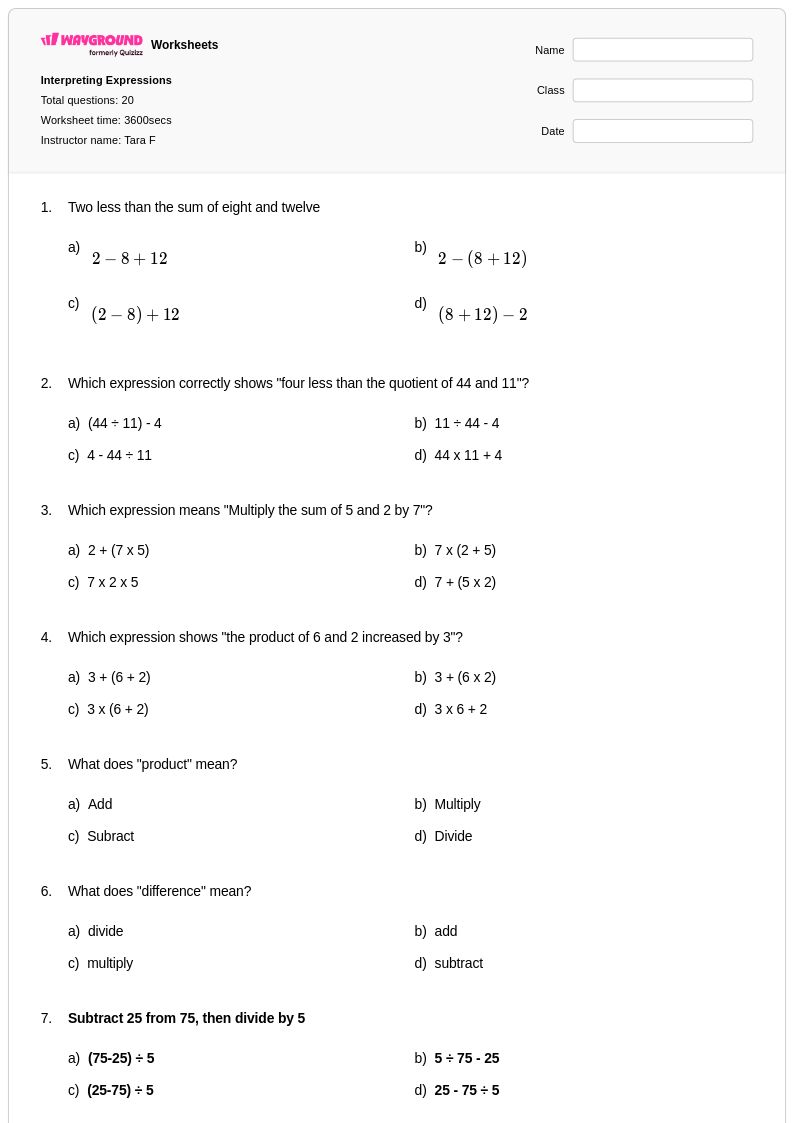
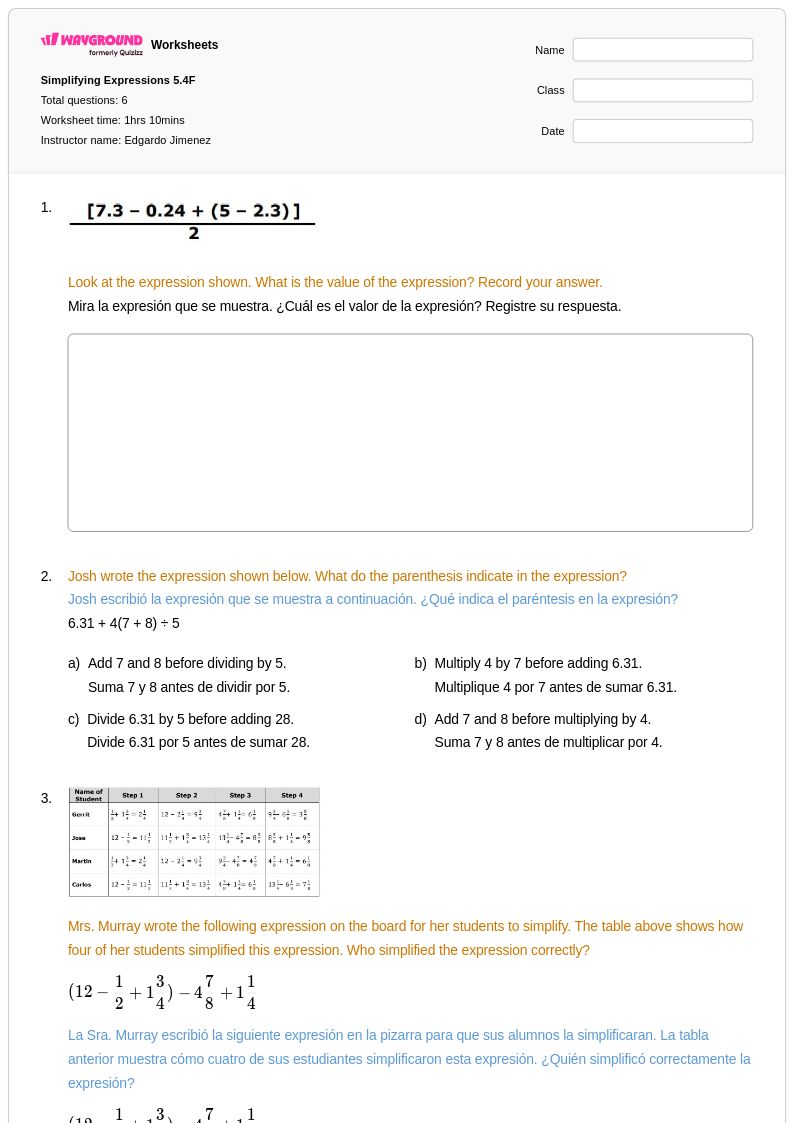
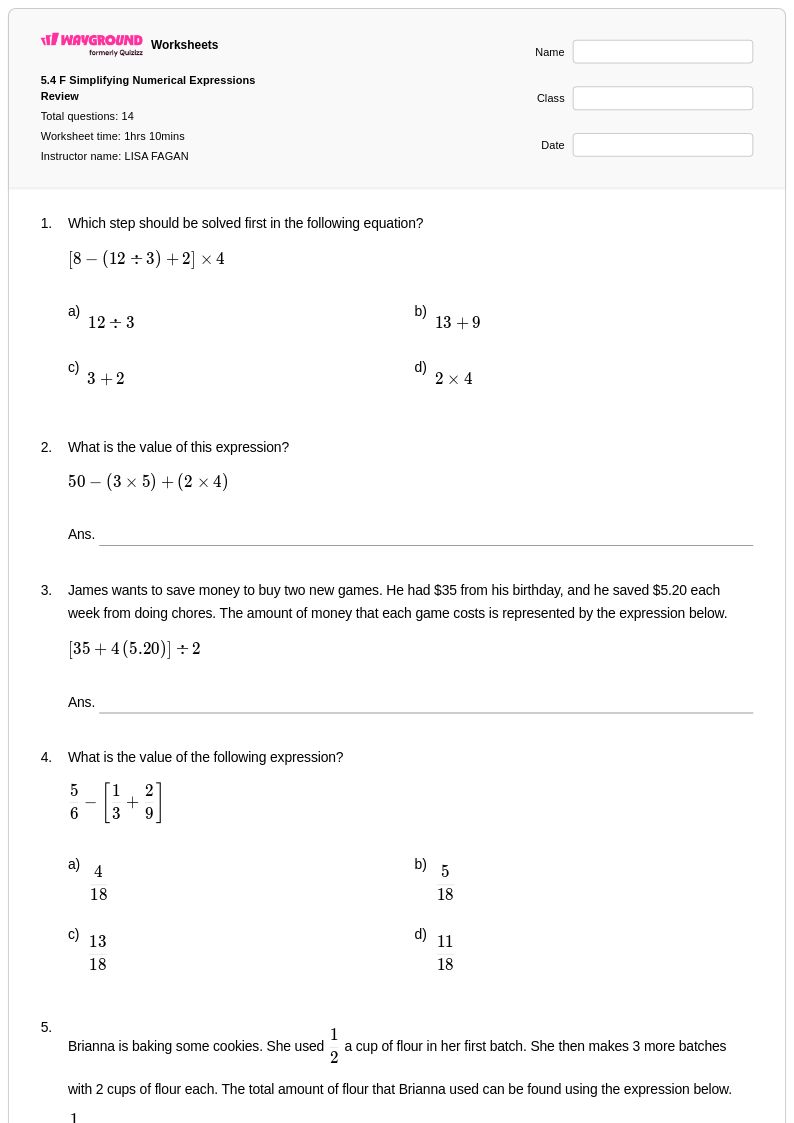
Year 5 algebra expressions worksheets from Wayground provide free printable PDF practice problems with answer keys to help students master writing, evaluating, and simplifying algebraic expressions.
Explore printable Expressions worksheets for Year 5
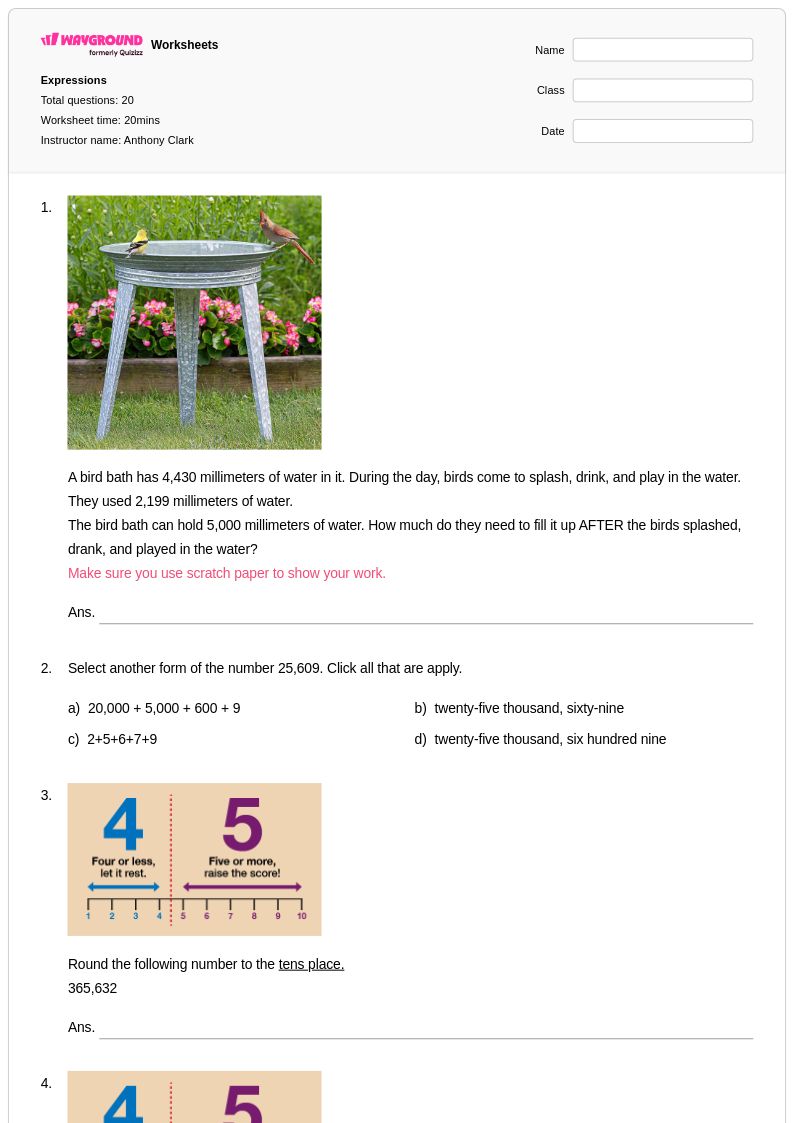
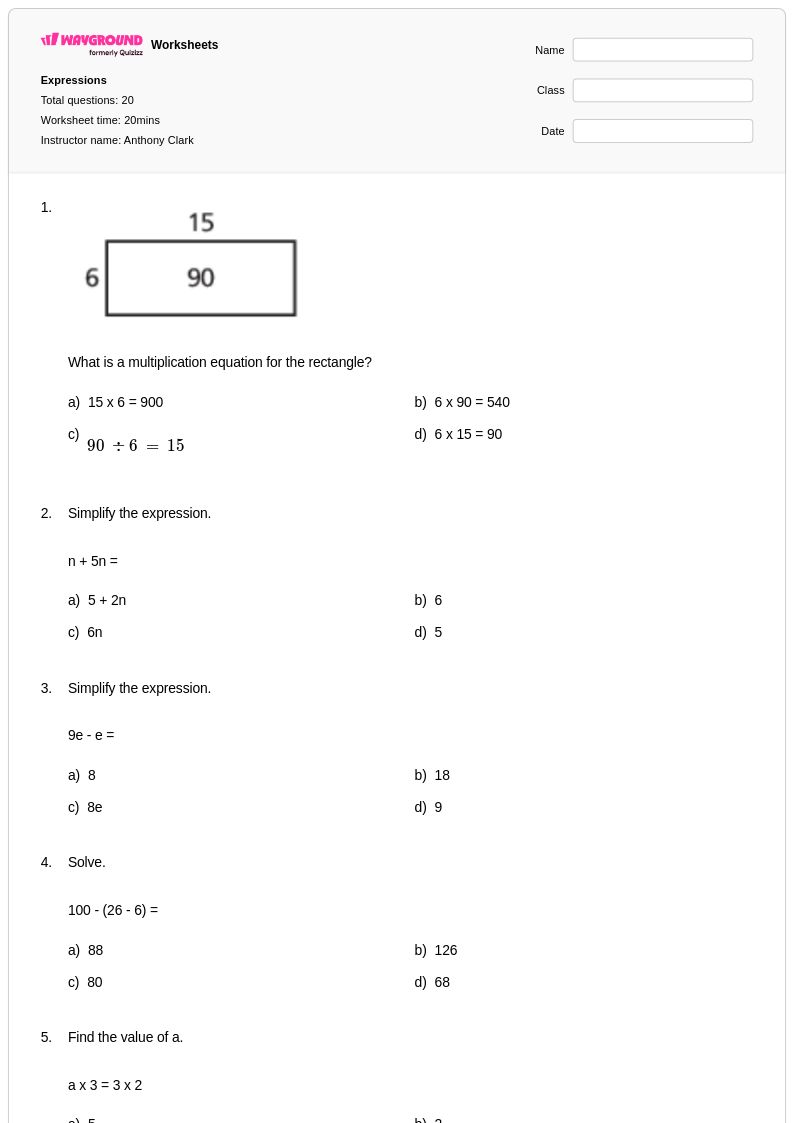
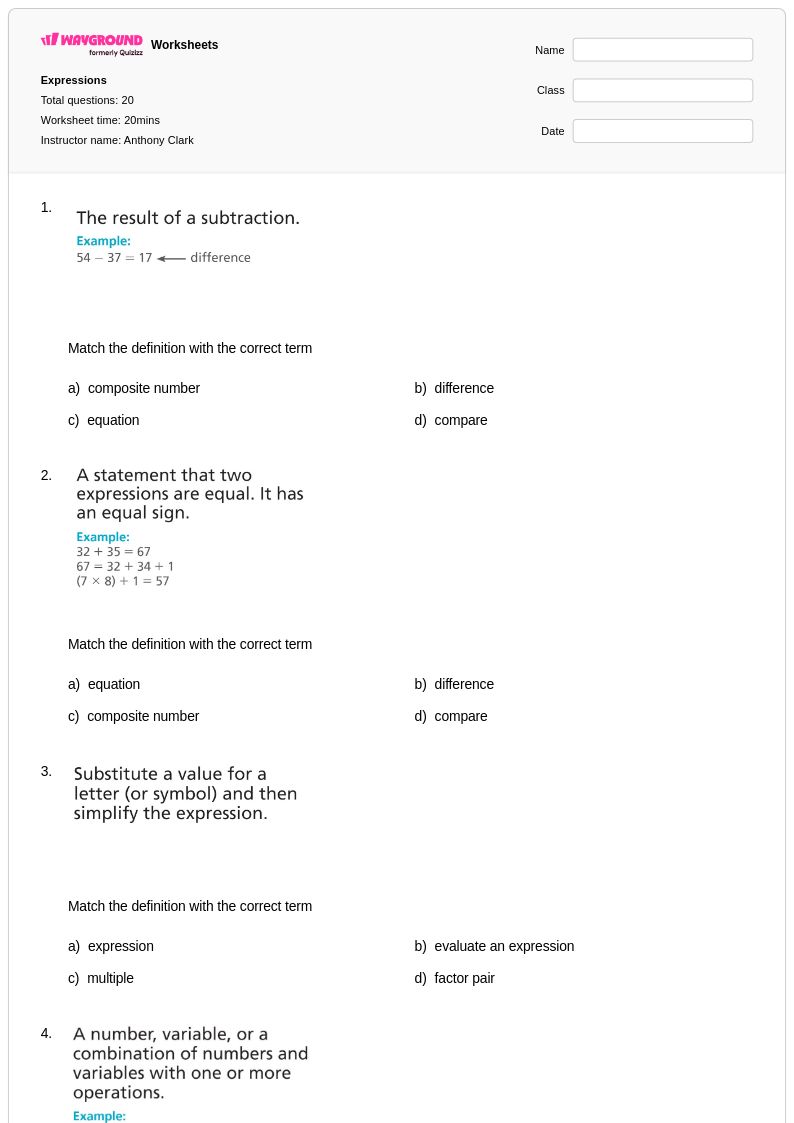
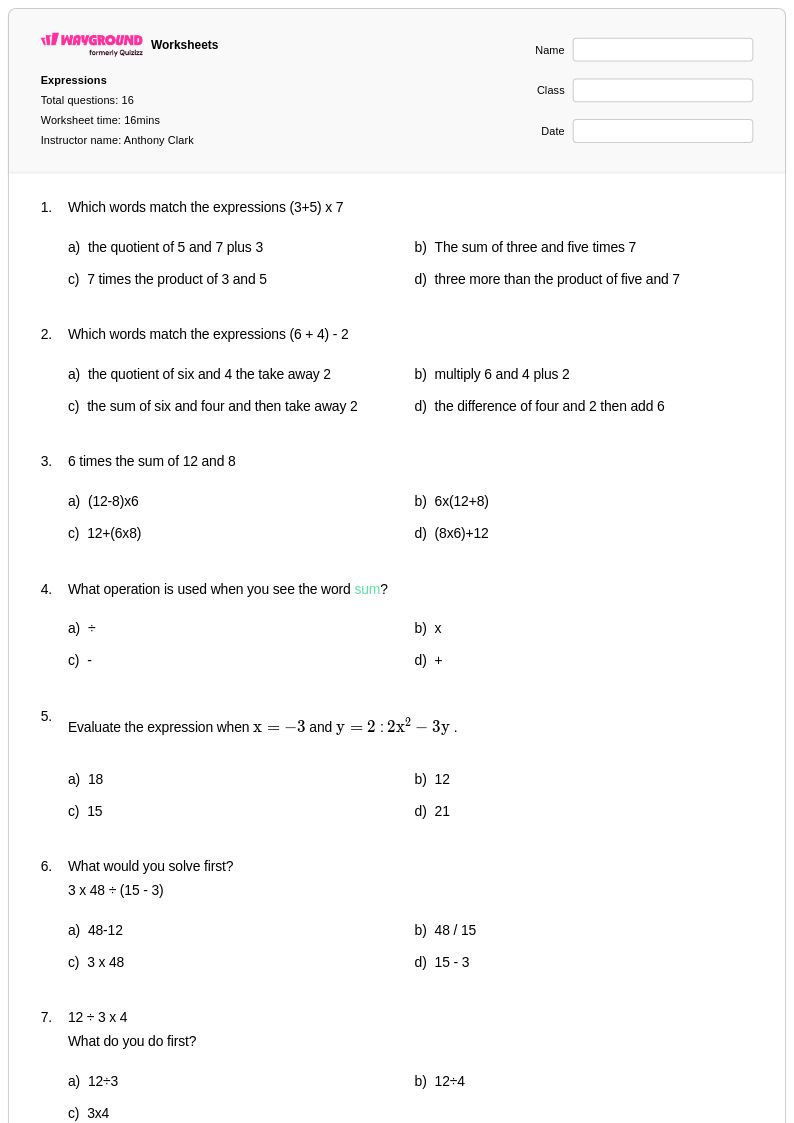
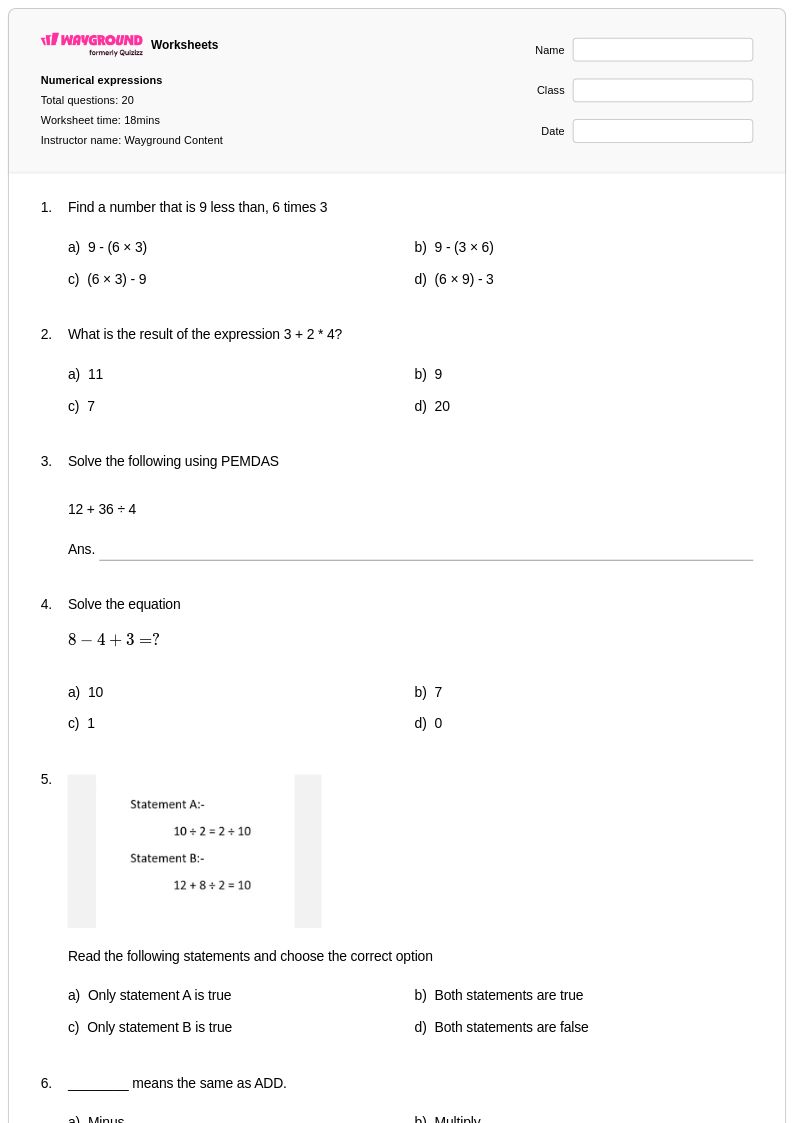
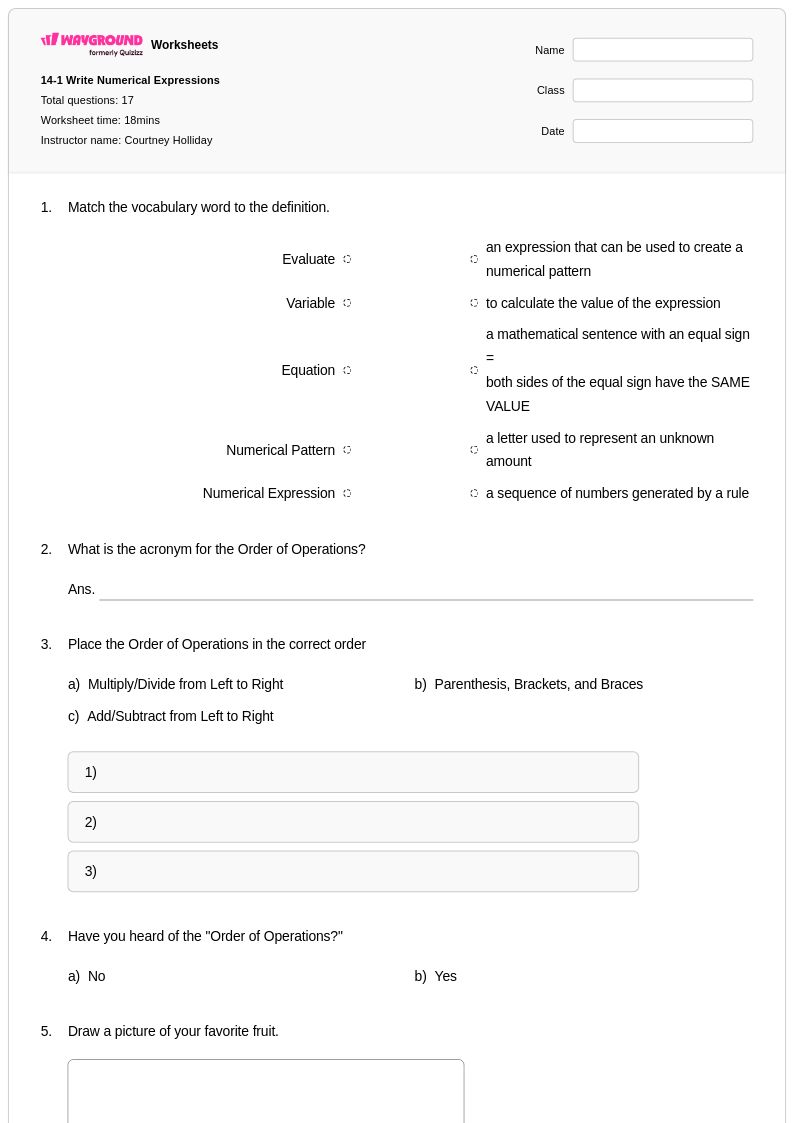
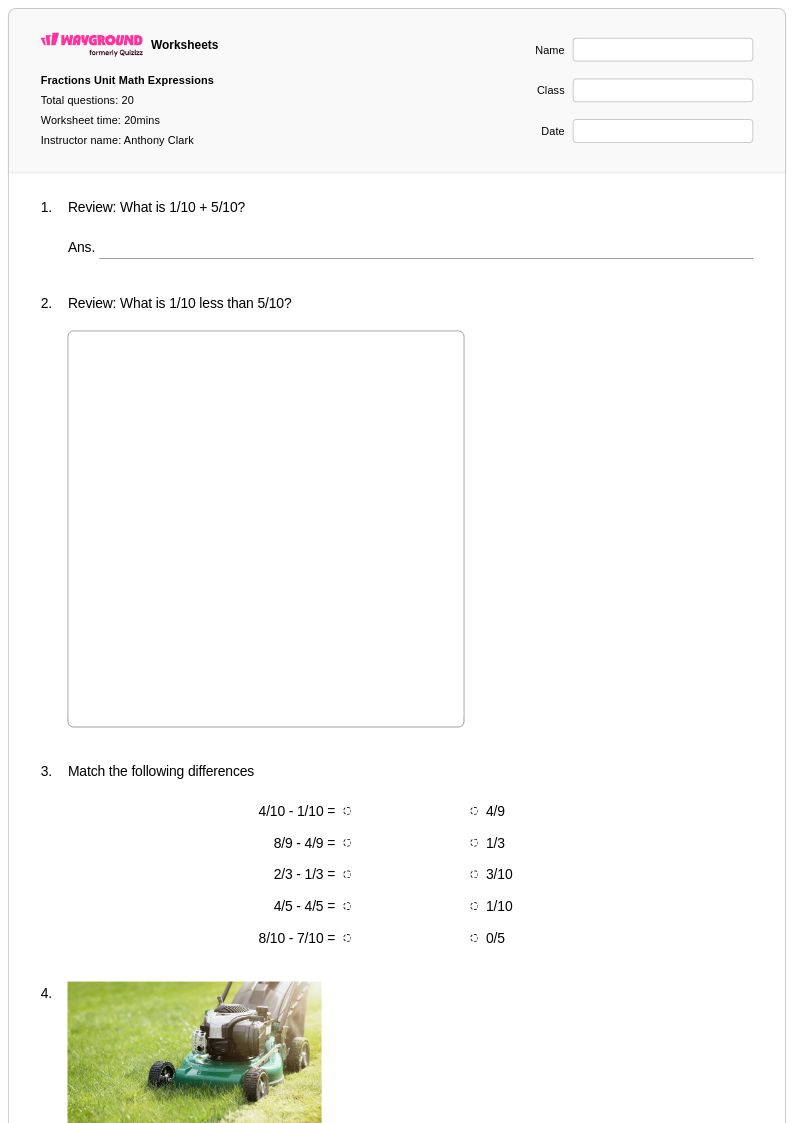
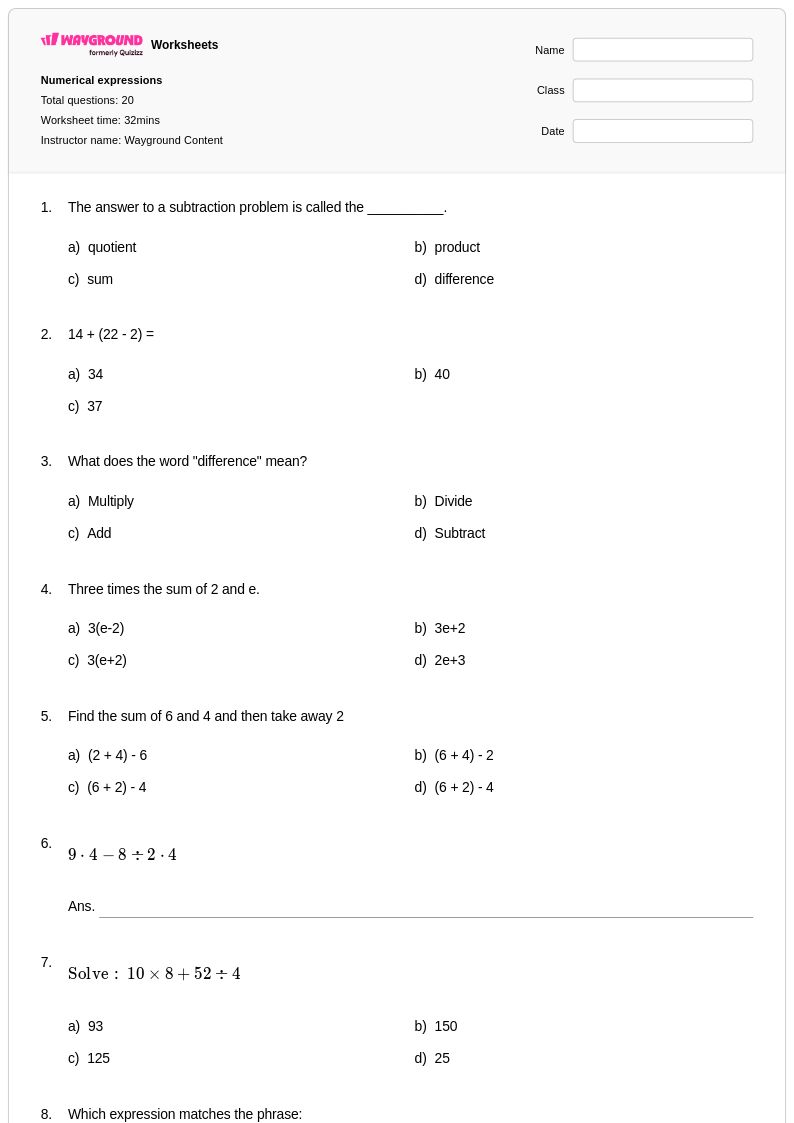
Year 5 expressions worksheets available through Wayground (formerly Quizizz) provide students with comprehensive practice in understanding and working with algebraic expressions at the elementary level. These carefully designed printables introduce fifth graders to the fundamental concepts of variables, coefficients, and mathematical relationships through age-appropriate problems that build essential algebraic thinking skills. Students develop proficiency in identifying parts of expressions, evaluating expressions with given values, and recognizing equivalent expressions through systematic practice problems that progress from basic variable recognition to more complex expression manipulation. Each worksheet includes a complete answer key and is available as a free pdf download, making it easy for educators to implement structured algebraic reasoning practice that strengthens students' mathematical foundation and prepares them for more advanced algebraic concepts in middle school.
Wayground (formerly Quizizz) empowers teachers with access to millions of educator-created Year 5 expressions resources that can be easily searched, filtered, and customized to meet diverse classroom needs. The platform's robust collection includes worksheets aligned to mathematics standards, offering teachers flexibility to select materials that match their specific curriculum requirements and student ability levels. Advanced differentiation tools allow educators to modify existing worksheets or create new variations, ensuring appropriate challenge levels for remediation, standard instruction, or enrichment activities. Teachers can seamlessly integrate these resources into their lesson planning by accessing both printable pdf formats for traditional classroom use and digital versions for technology-enhanced learning environments, providing comprehensive support for developing algebraic thinking skills through targeted skill practice and assessment opportunities.
FAQs
How do I teach equivalent expressions to 5th graders?
The most effective entry point is the properties students already know — commutative, associative, and distributive — and showing that applying them produces a different-looking expression with the same value. Have students evaluate both versions with a specific number to confirm they're equal before asking them to recognize equivalence abstractly. For example, verify that 3(x + 4) and 3x + 12 give the same result when x = 2, then generalize. That concrete check builds the intuition that "equivalent" means same value for every input, not just same appearance.
What expression skills are 5th graders expected to master?
By the end of Grade 5, students should be able to identify the parts of an expression (variable, coefficient, constant), evaluate expressions by substituting given values, and recognize or generate equivalent expressions — particularly using the distributive property. Wayground's Grade 5 worksheets cover all of these, with problems that move from basic variable recognition toward more complex manipulation.
What errors do 5th graders commonly make when working with expressions?
Two patterns show up most often. First, students misapply the distributive property — writing 3(x + 4) = 3x + 4 instead of 3x + 12, distributing to the first term only. Second, when evaluating, they ignore order of operations and work strictly left to right, so 2 + 3x with x = 4 becomes 5 × 4 = 20 instead of 2 + 12 = 14. Both errors are worth addressing explicitly before students move into 6th grade, where the same mistakes compound quickly.
How do Wayground's Grade 5 expressions worksheets work in the classroom?
Each worksheet includes a complete answer key, so it works well for independent practice or self-checking. You can assign it as a digital quiz through Wayground — students complete it on their devices and get immediate feedback — or download the PDF and print it for paper practice. Either way, the content is the same; the format just depends on your setup that day.
How does Common Core sequence expressions in Grade 5?
In Grade 5, Common Core asks students to write and interpret numerical expressions — translating phrases like "add 8 and 7, then double the result" into (8 + 7) × 2 — and to analyze patterns by writing two numerical patterns and identifying the relationship between them. This is the bridge between arithmetic and algebra: students aren't yet solving for variables, but they're learning to read and write expressions as meaningful mathematical statements. Grade 6 then introduces variables formally and builds on this structural understanding.
How can I differentiate expressions practice for my 5th grade class?
Wayground lets you generate alternate versions of a worksheet with adjusted font size or a dyslexia-friendly font, which helps students whose reading challenges slow down their math work. For students who need a lighter cognitive load on multiple-choice problems, the reduced answer choices accommodation narrows the options displayed for those students only — the rest of the class sees the standard version without any indication of the difference. This makes it practical to run one assignment across a mixed-ability class without creating entirely separate materials.