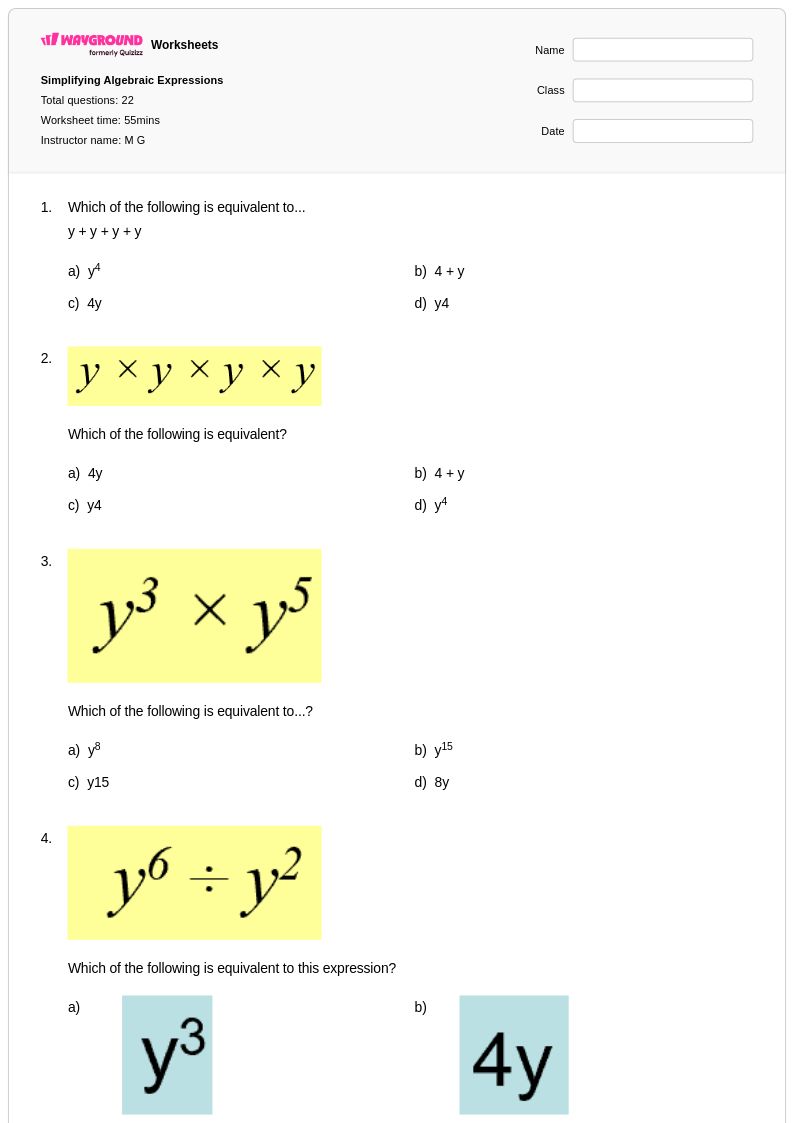
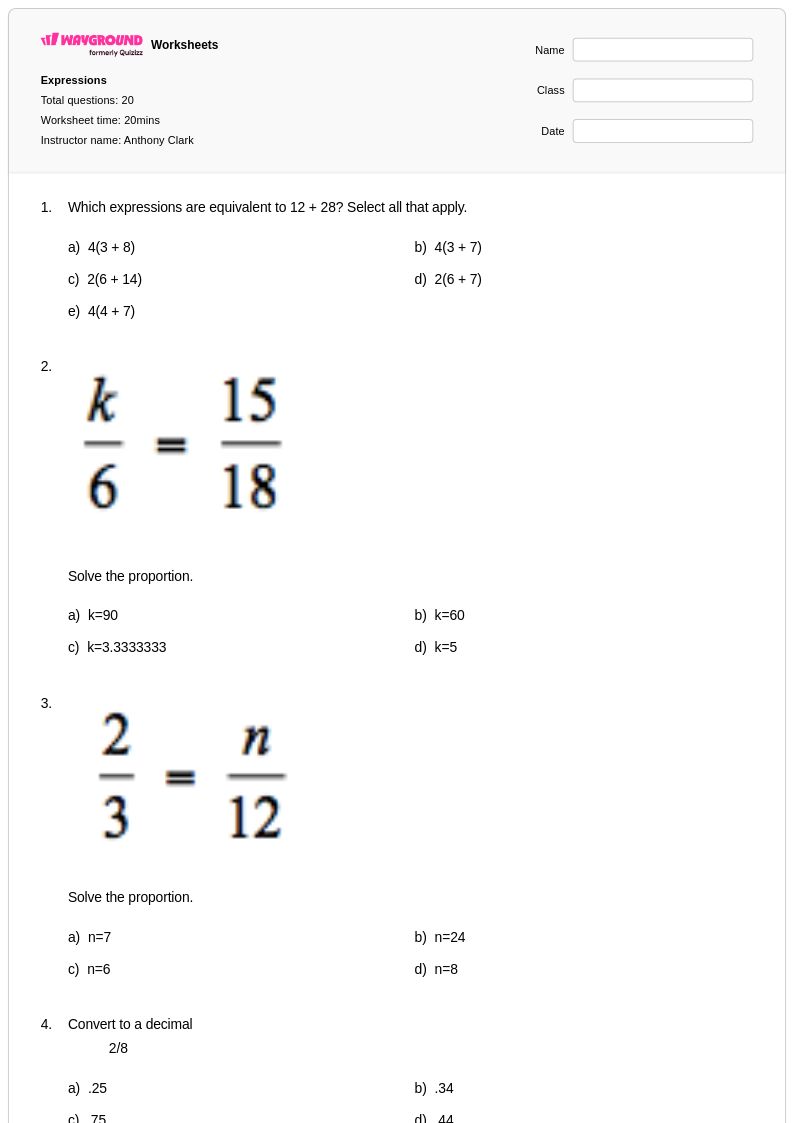
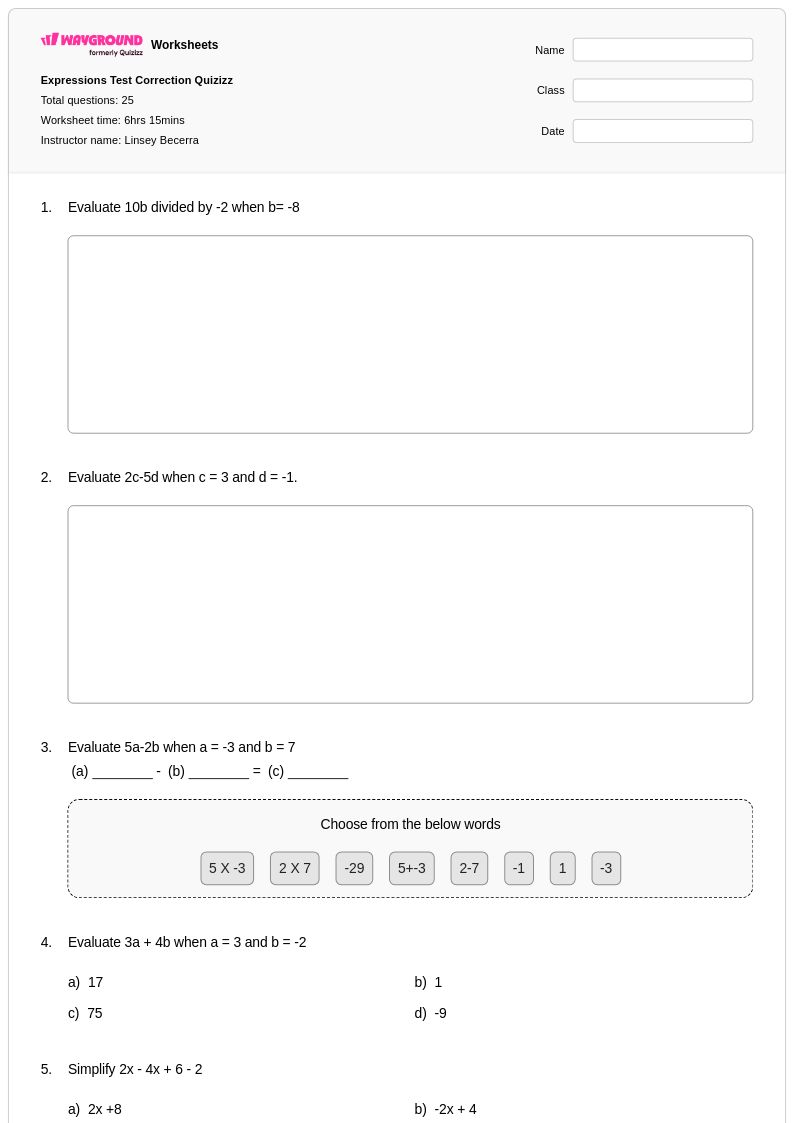
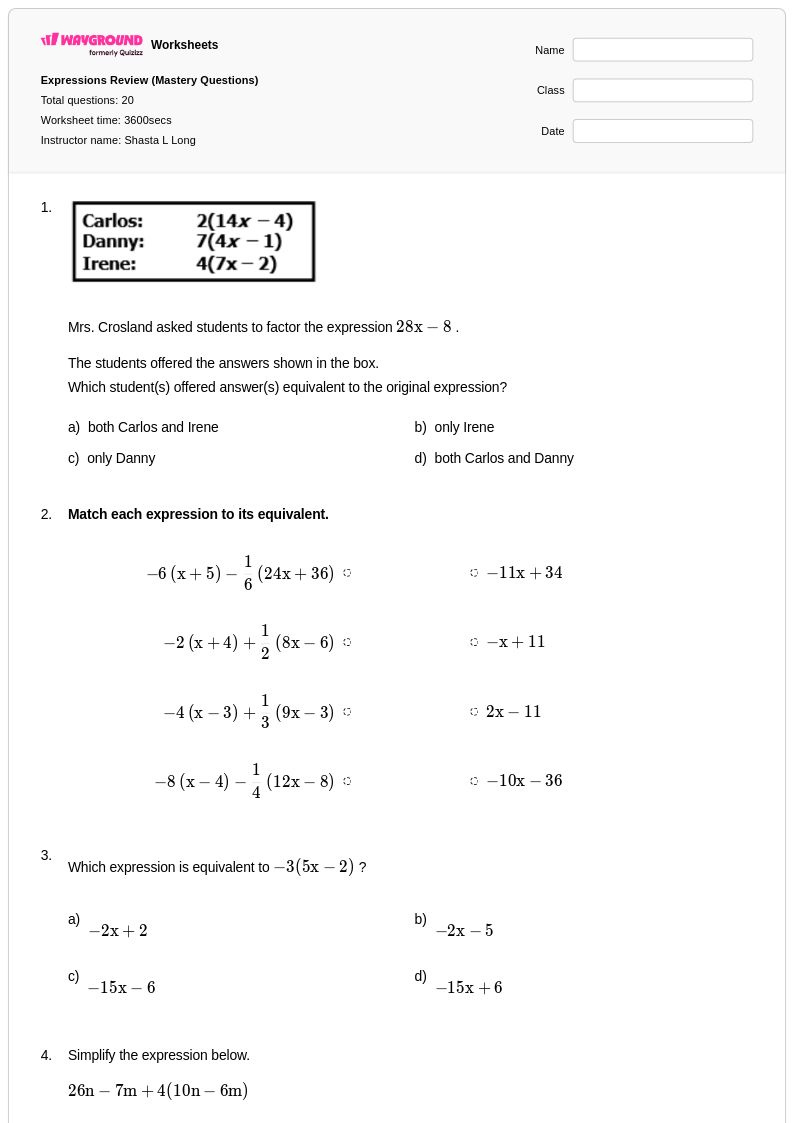
Year 7 algebra expressions worksheets from Wayground help students master variable manipulation and equation basics through comprehensive printables, practice problems, and answer keys in convenient PDF format.
Explore printable Expressions worksheets for Year 7
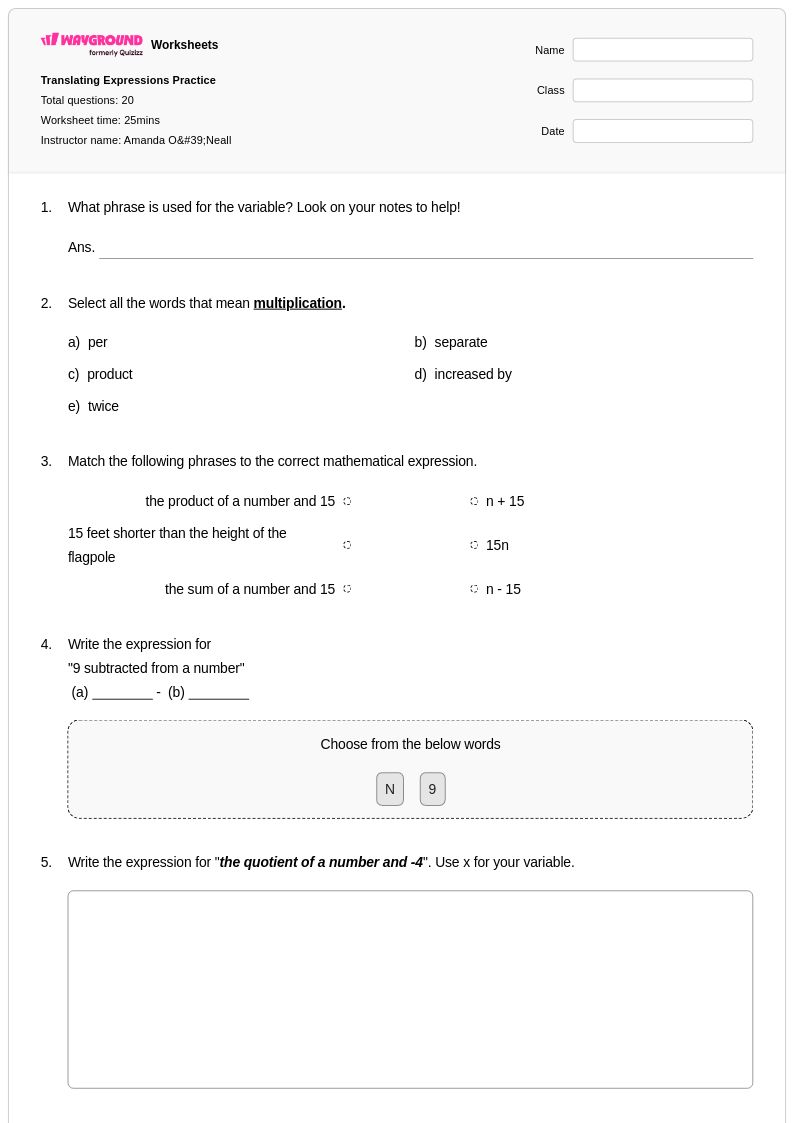
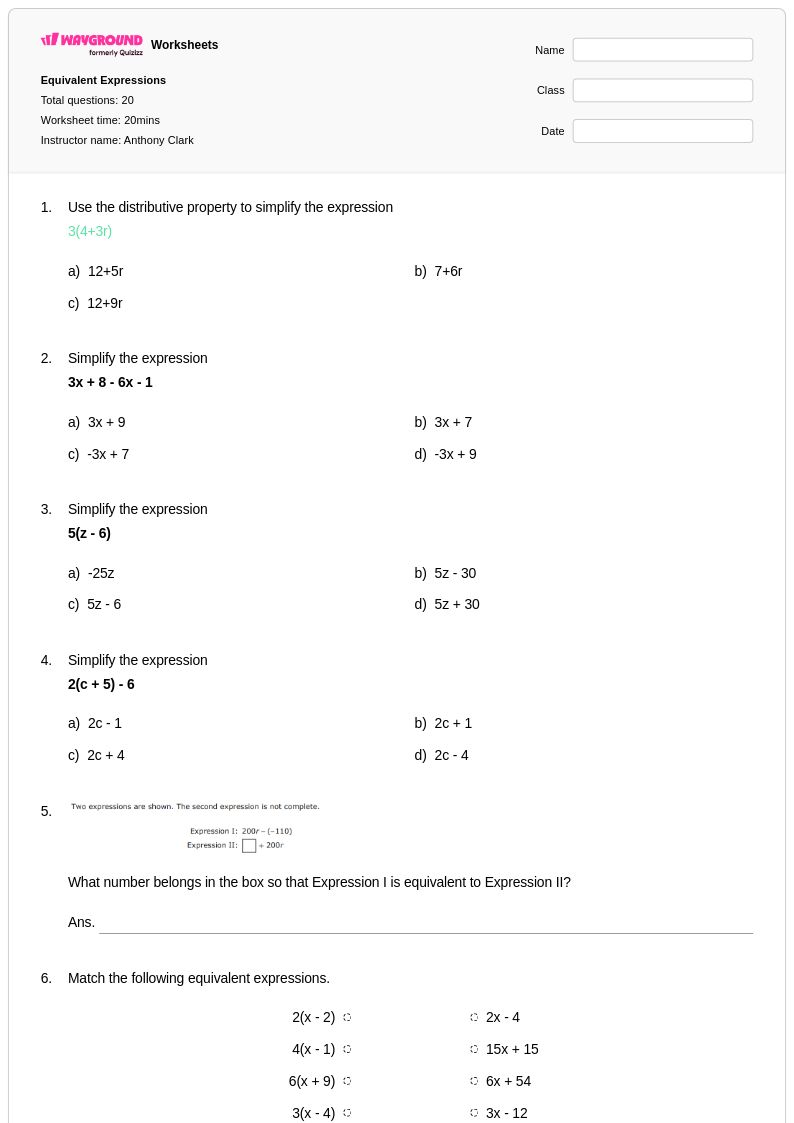
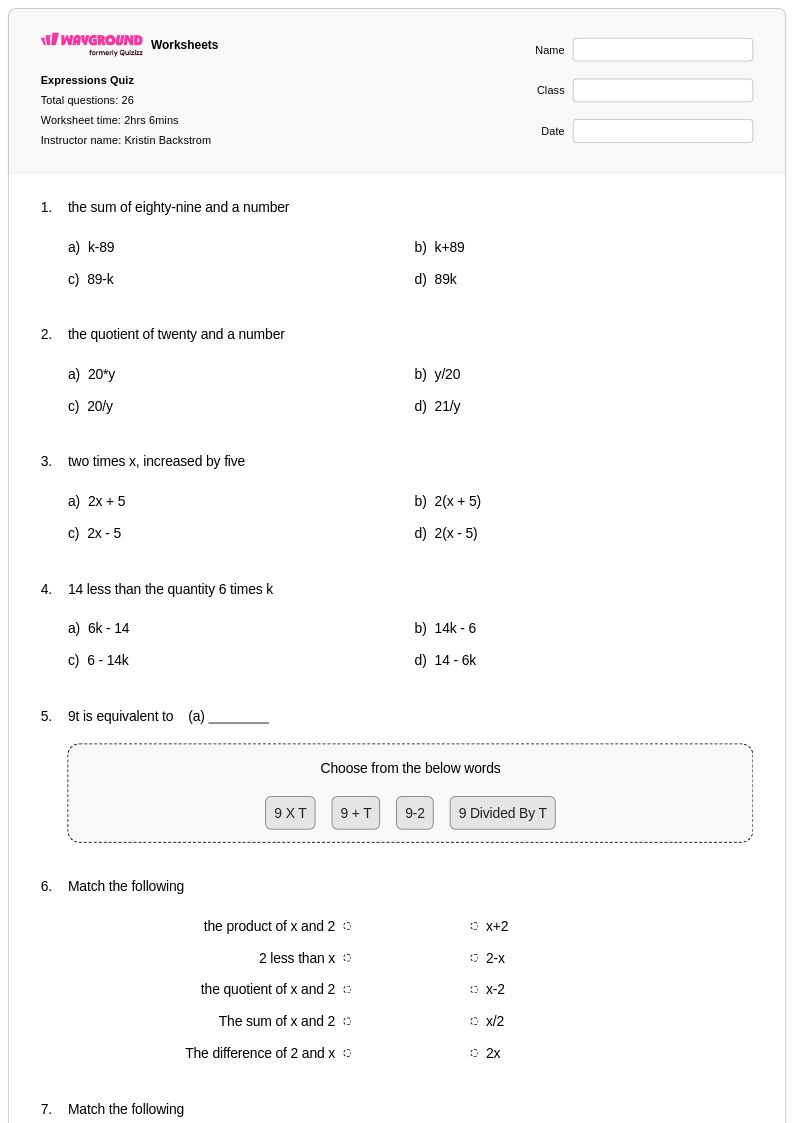
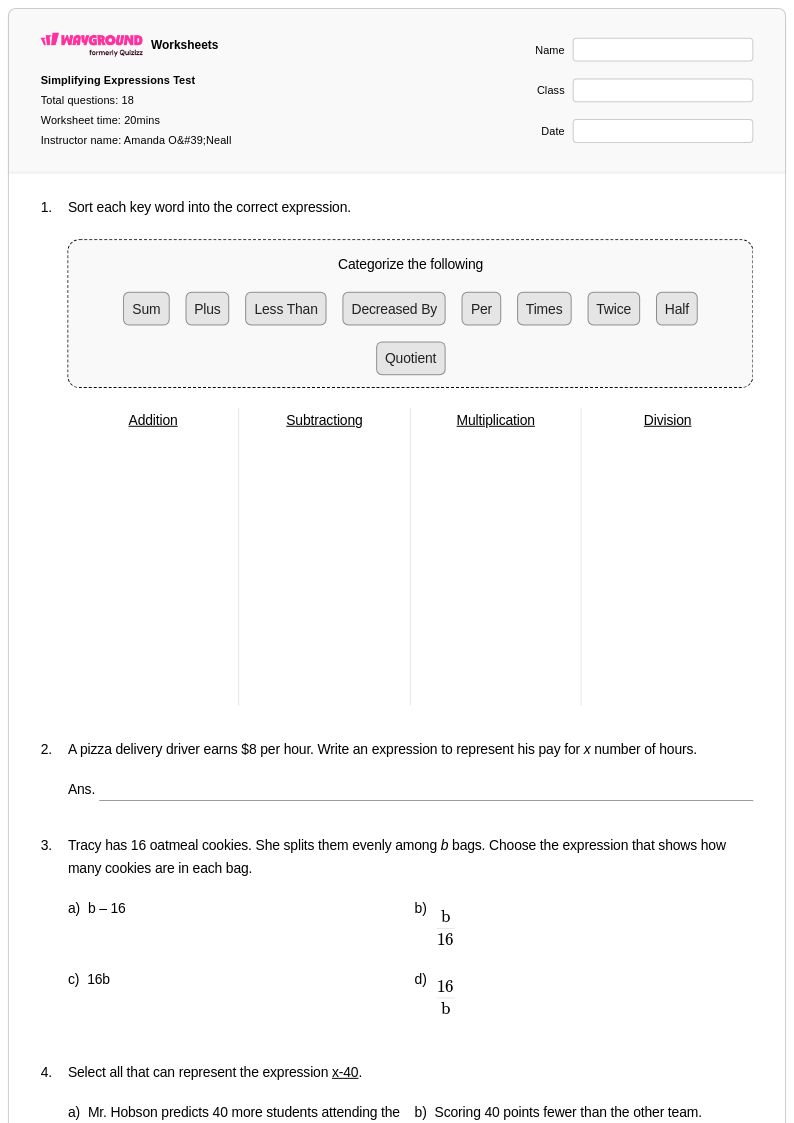
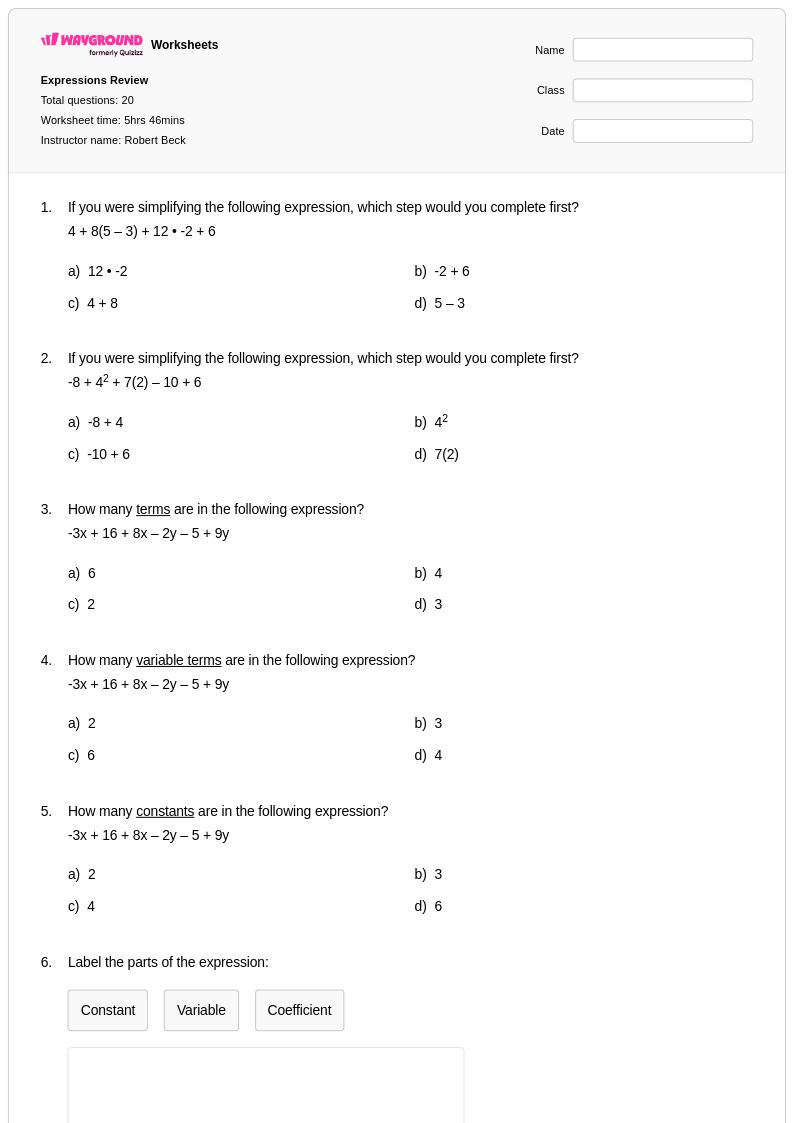
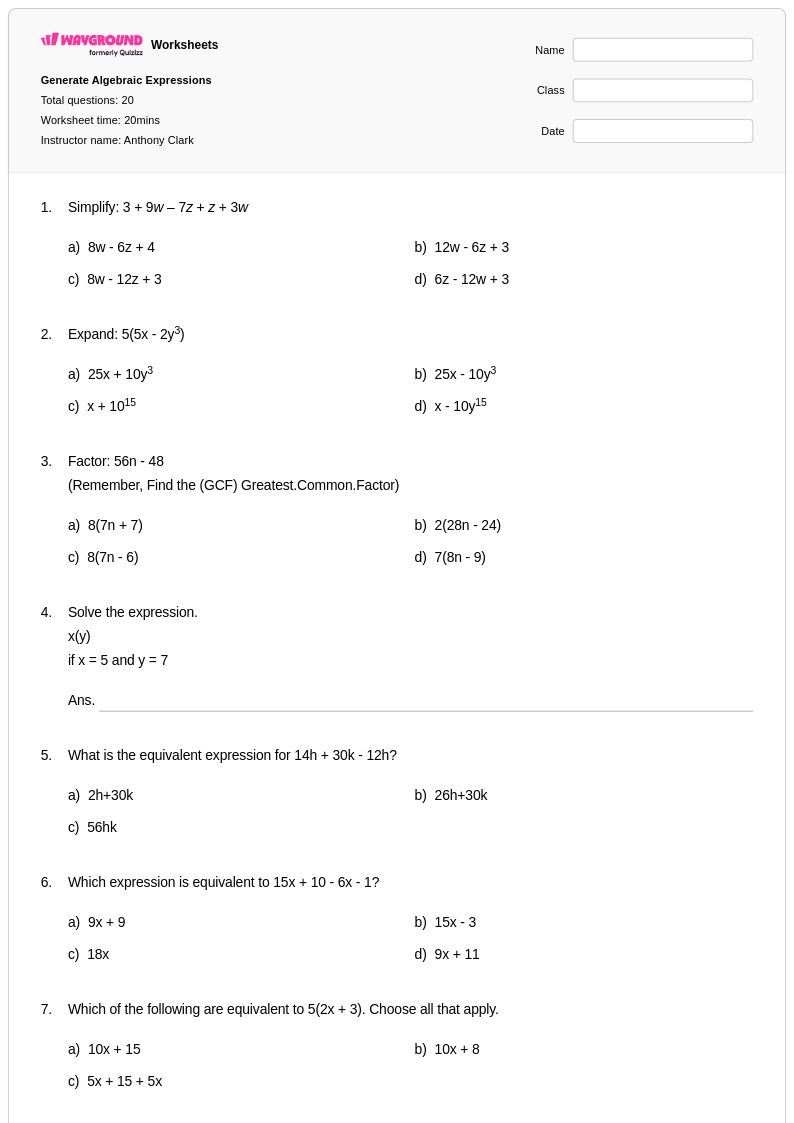
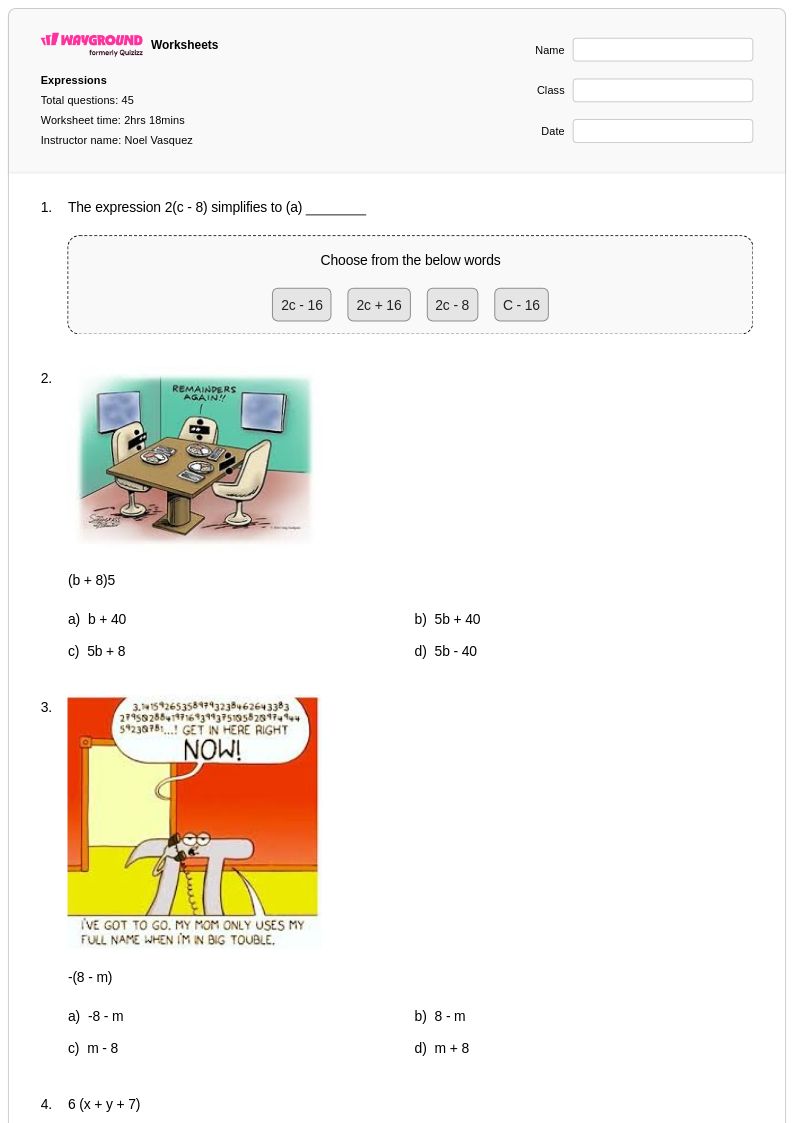
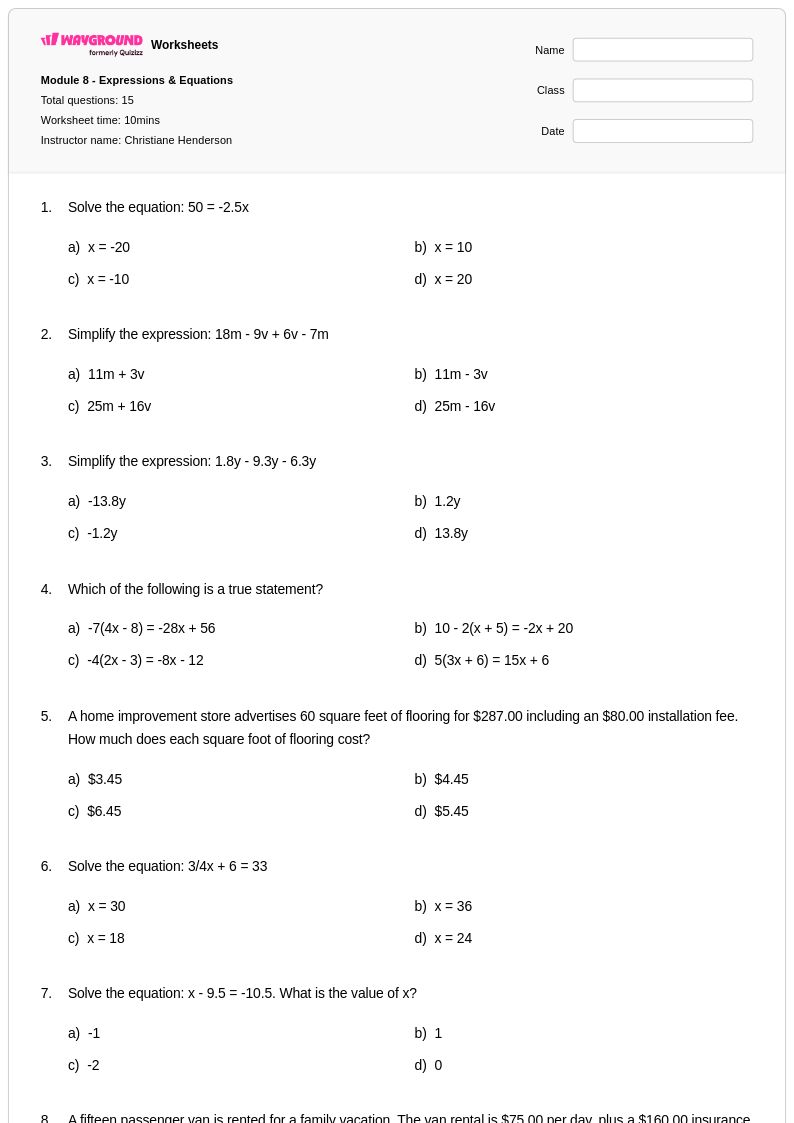
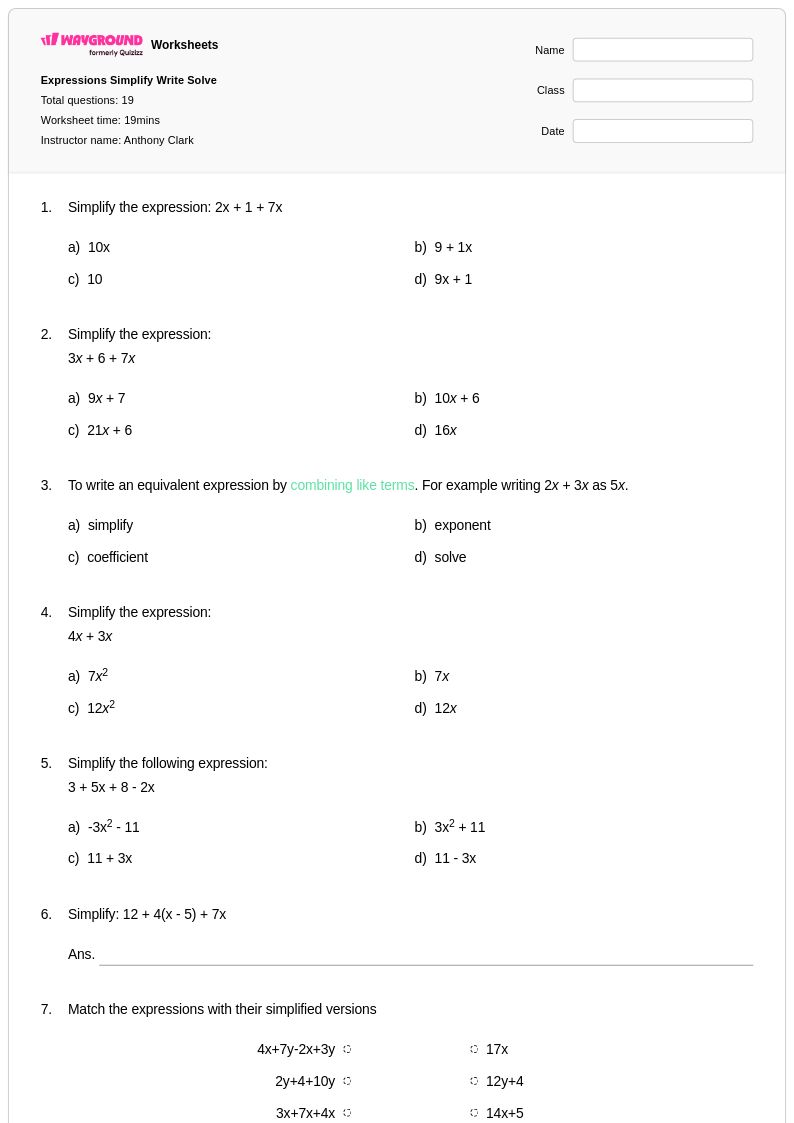
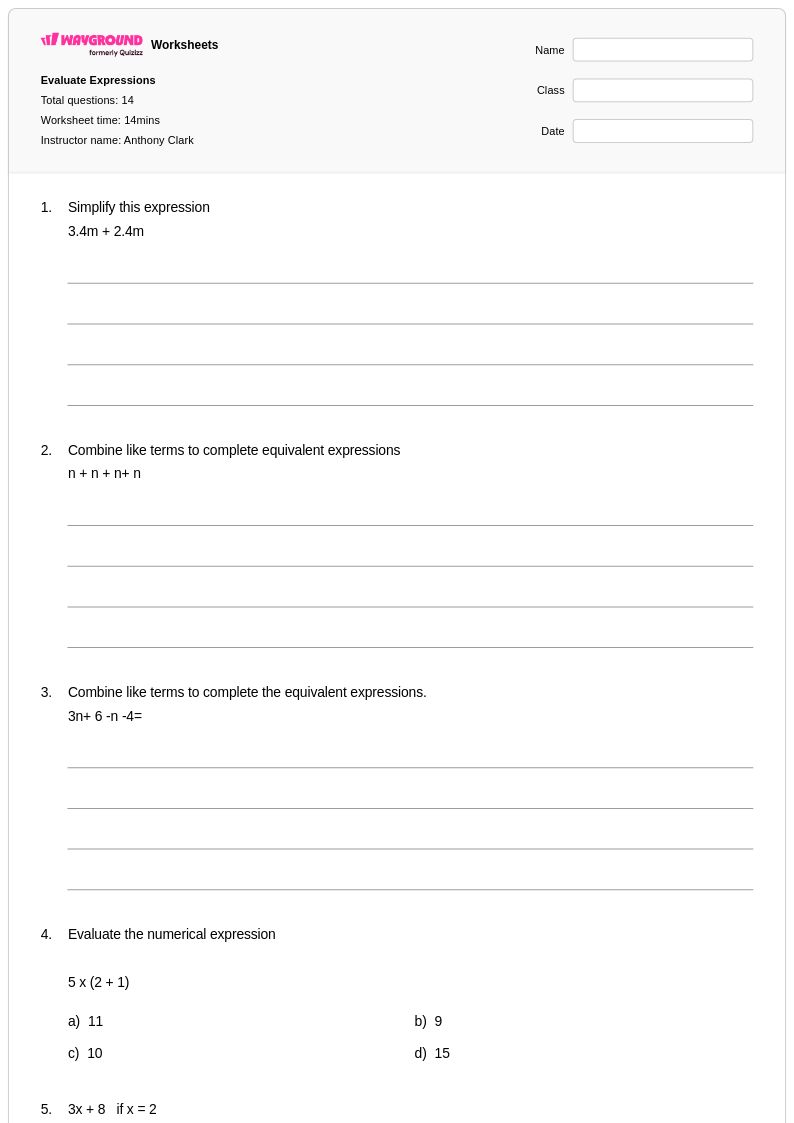
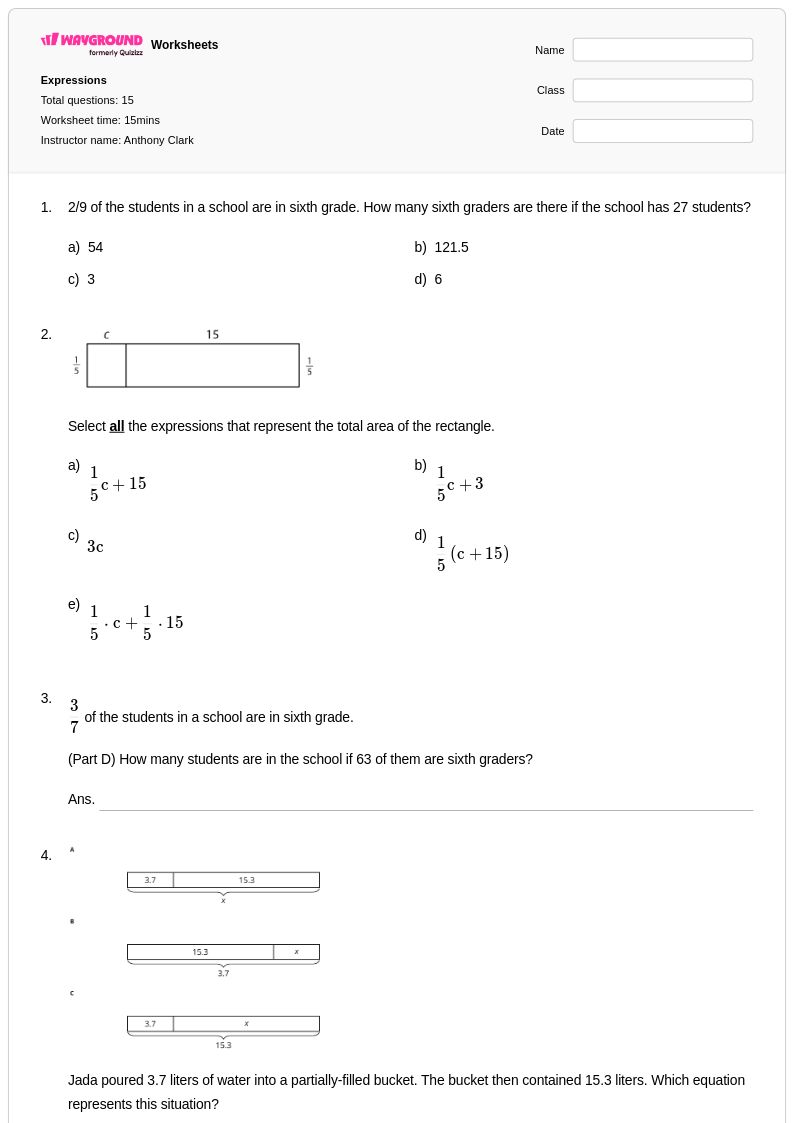
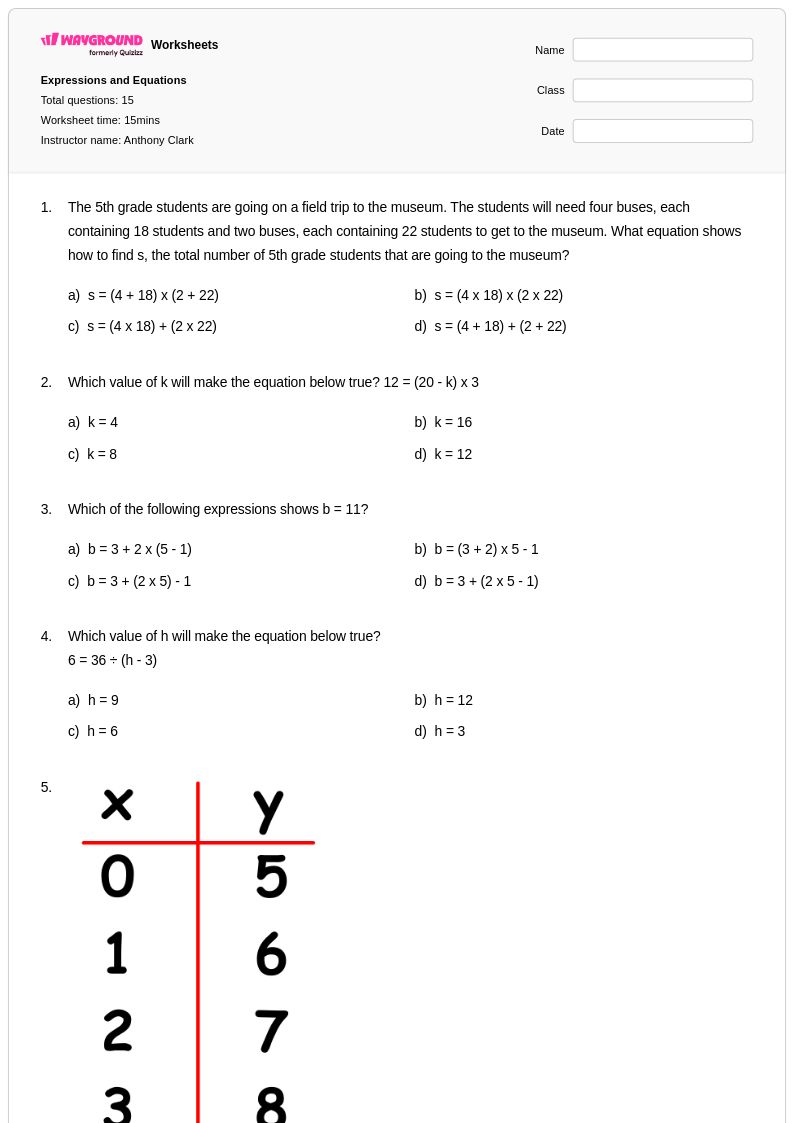
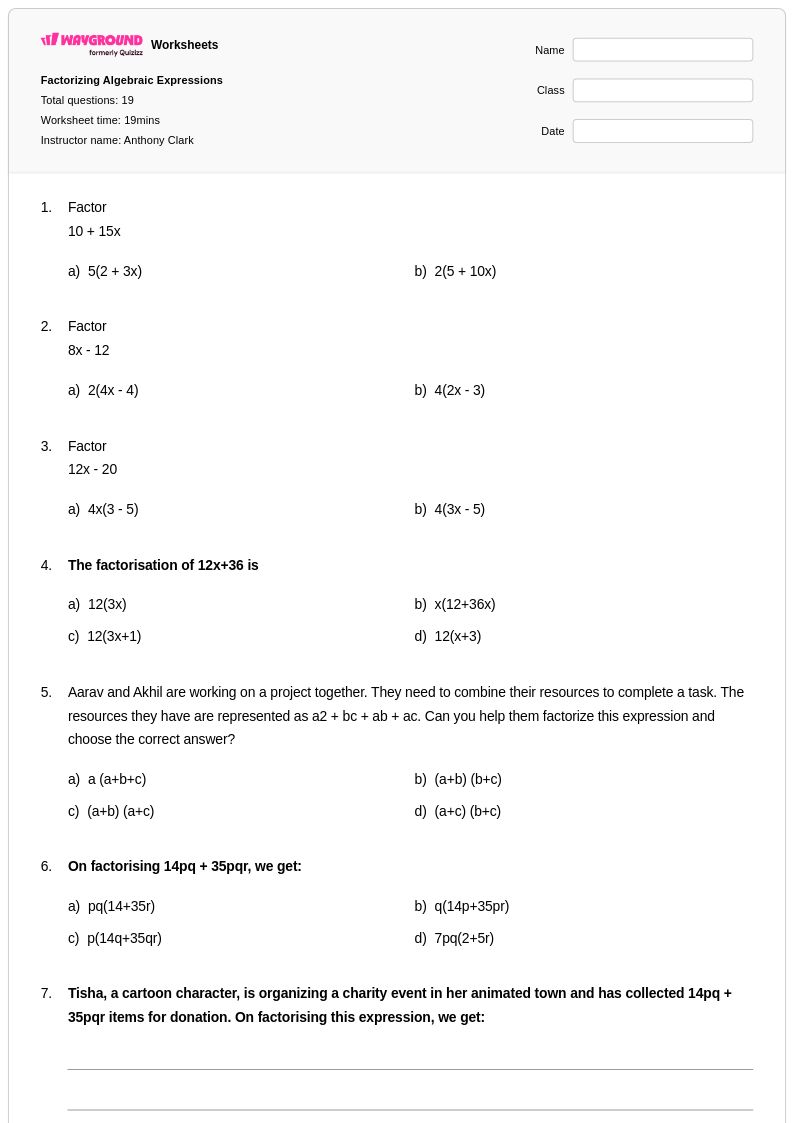
Year 7 expressions worksheets available through Wayground (formerly Quizizz) provide comprehensive practice opportunities for students developing foundational algebraic thinking skills. These carefully designed resources focus on building proficiency in writing, simplifying, and evaluating algebraic expressions using variables, coefficients, and constants. Students work through systematic practice problems that strengthen their ability to translate word phrases into mathematical expressions, combine like terms, and apply the distributive property with confidence. Each worksheet collection includes detailed answer keys that support independent learning and self-assessment, while the free printable pdf format ensures accessibility for both classroom instruction and home practice sessions.
Wayground (formerly Quizizz) empowers educators with millions of teacher-created expression worksheets that can be easily discovered through robust search and filtering capabilities aligned to mathematical standards. Teachers benefit from sophisticated differentiation tools that allow customization of problem difficulty levels, ensuring appropriate challenge for students across varying skill levels within Year 7 mathematics. The platform's flexibility supports diverse instructional approaches through both printable and digital formats, enabling seamless integration into lesson planning for initial skill introduction, targeted remediation sessions, and enrichment activities. These comprehensive worksheet collections streamline the process of identifying gaps in student understanding of algebraic expressions while providing the structured practice necessary for mastery of this critical mathematical concept.
FAQs
How do I teach simplifying algebraic expressions in 7th grade?
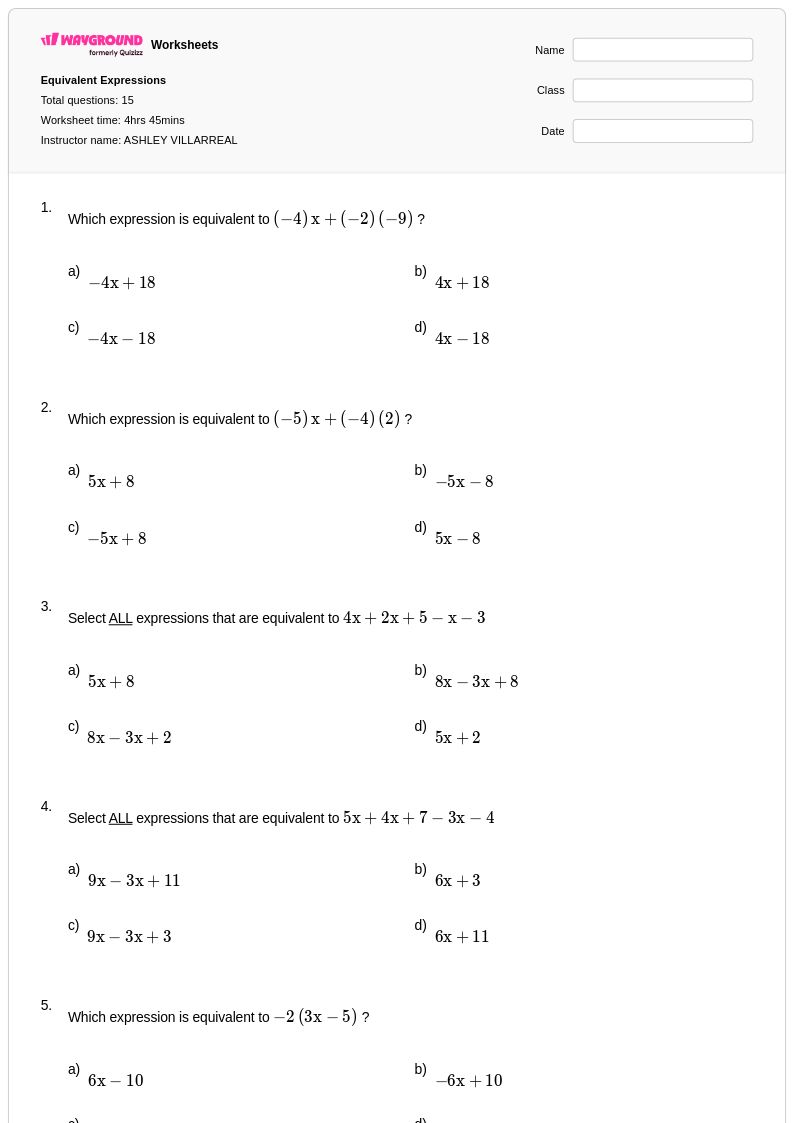
By 7th grade, students have seen variables before — the challenge is getting them to work fluently with rational number coefficients and negative terms, not just whole numbers. The distributive property is the central tool: make sure students can expand expressions like −2(3x − 5) correctly before asking them to combine like terms across a longer expression. A common classroom move is to have students underline like terms in the same color before combining — it slows them down just enough to avoid the careless errors that dominate at this level.
What expression skills should 7th graders be practicing?
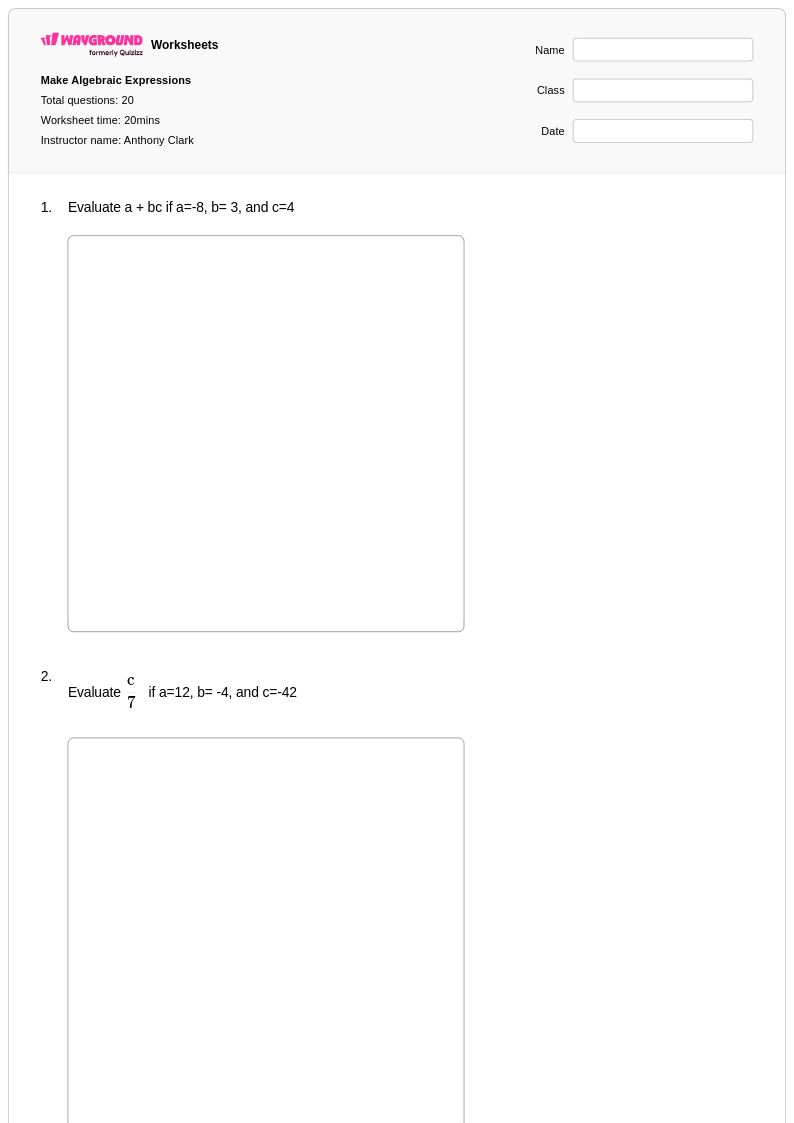
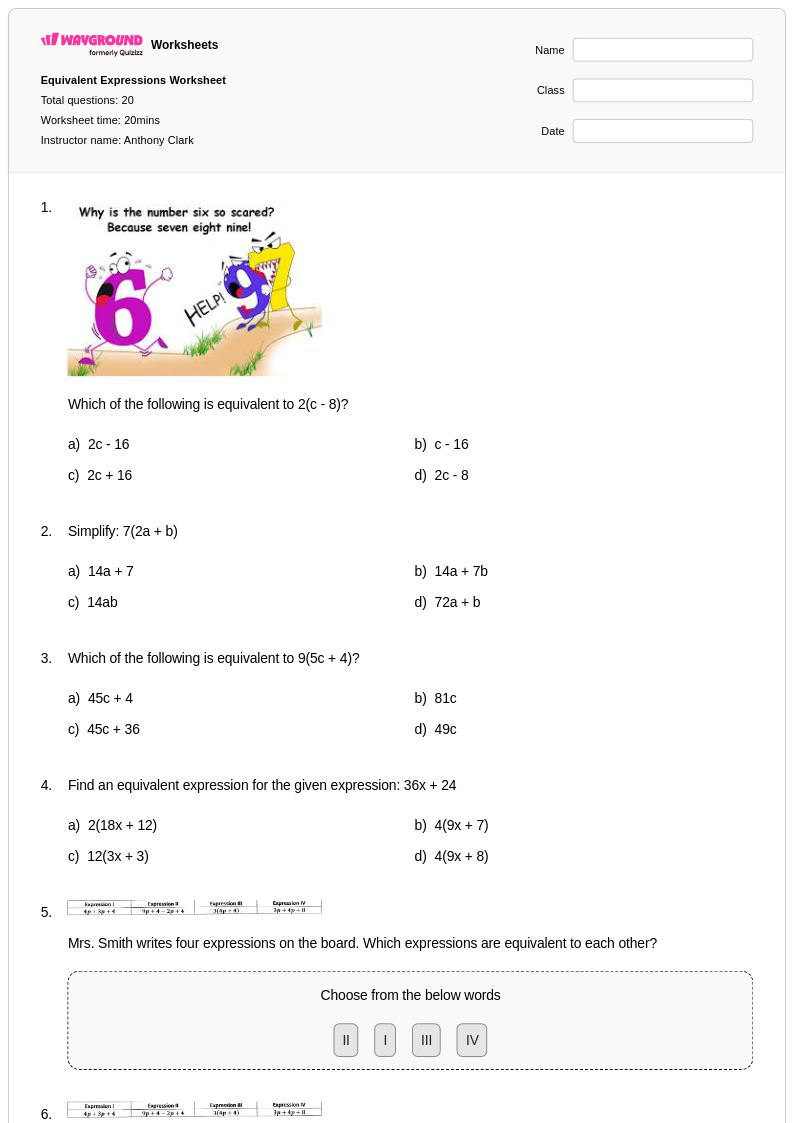
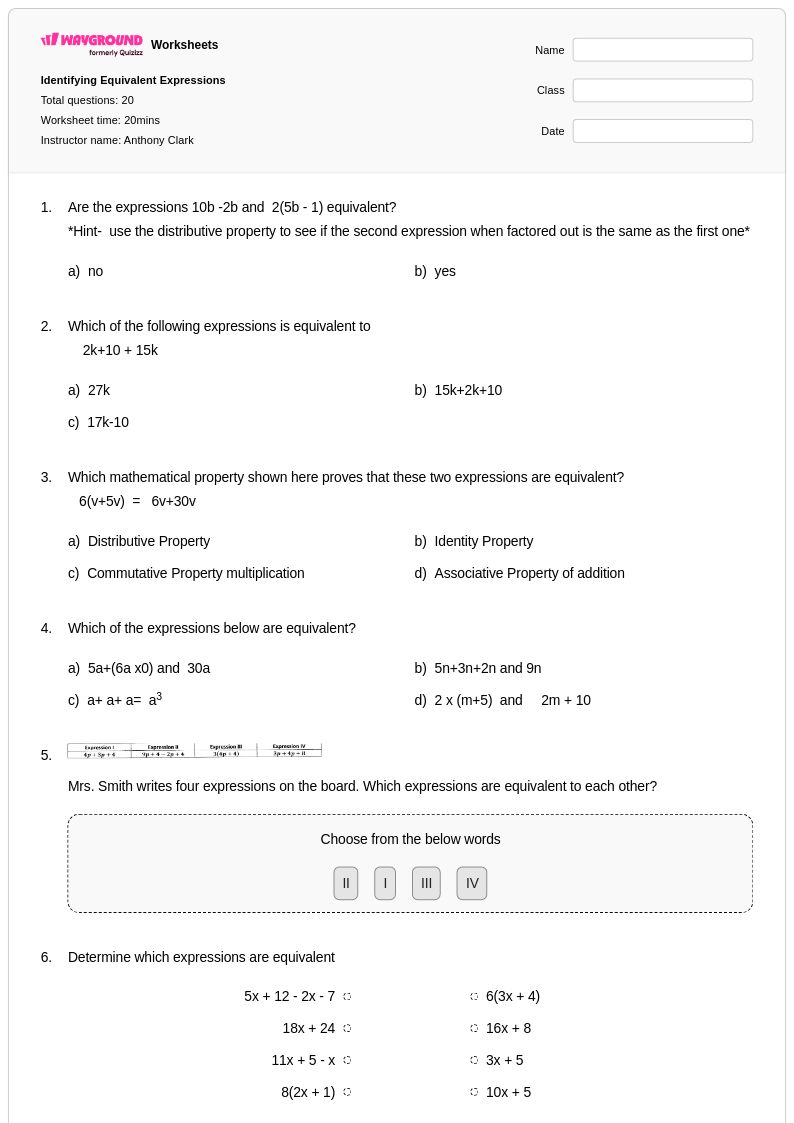
The core skills at Grade 7 are: writing expressions from word phrases (including those involving rational numbers), evaluating expressions with negative and fractional values, combining like terms, applying the distributive property, and recognizing equivalent expressions. Wayground's Grade 7 worksheets cover all of these, plus multiplying binomials for students ready to push further.
What are the most common mistakes 7th graders make with algebraic expressions?
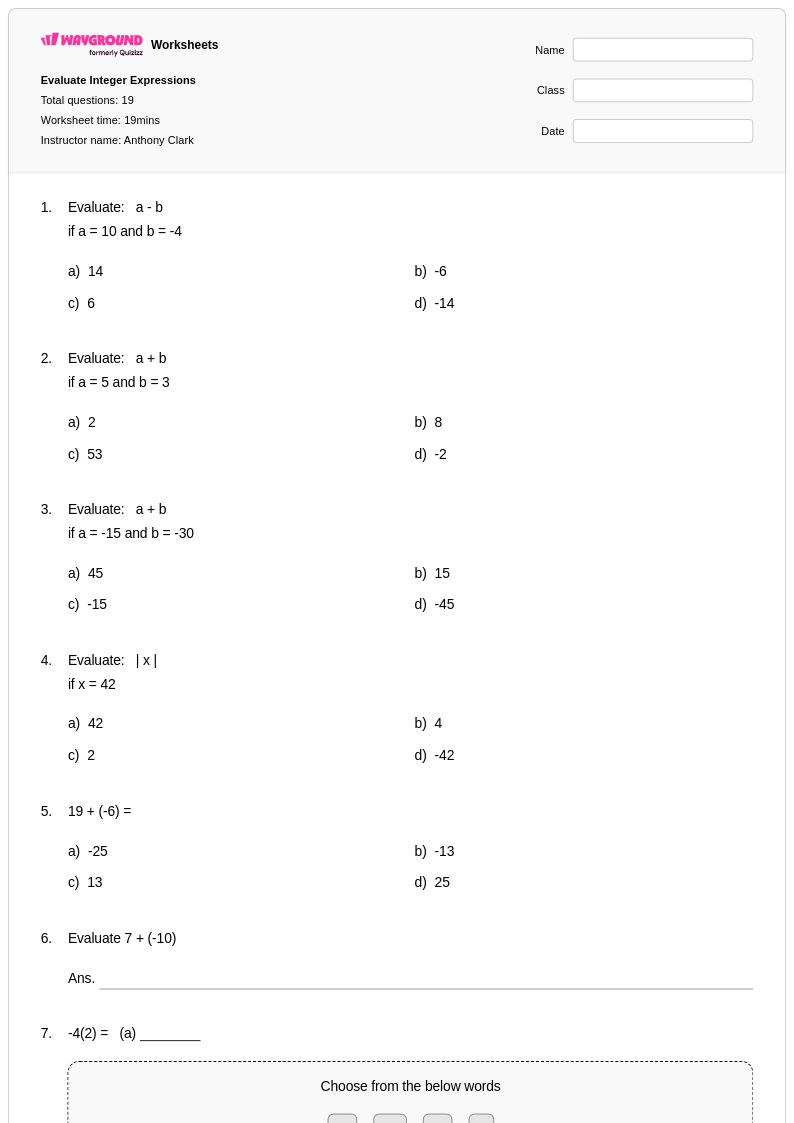
Three errors dominate. First, sign errors when distributing a negative: −3(x − 4) becomes −3x − 12 instead of −3x + 12. Second, combining unlike terms — adding 5x and 3x² because both have x in them. Third, when evaluating with negative inputs, students forget to apply the negative to the coefficient, so substituting x = −2 into 4x gives them 4(2) = 8 instead of −8. All three are worth isolating in practice before mixing problem types.
How do I use Wayground's Grade 7 expressions worksheets?
Each worksheet includes a complete answer key and is available as a printable PDF or as a digital quiz you can assign directly through Wayground. The digital format gives students immediate feedback as they work, which is especially useful when practicing multi-step problems like applying the distributive property — students can catch sign errors in real time rather than discovering them after the whole worksheet is done.
How does Common Core sequence expressions in Grade 7?
Common Core builds on the Grade 6 foundation — where students first formalized variables and equivalent expressions — by extending to rational number coefficients in Grade 7. Students are expected to apply properties of operations to add, subtract, factor, and expand linear expressions, and to understand that rewriting an expression in a different form can reveal something about the problem it represents. The progression then moves toward Grade 8, where expressions become the building blocks for linear equations, systems, and eventually functions.
How can I differentiate expressions practice for my 7th grade class?
Wayground's extended time accommodation is particularly useful at this level — multi-step expression problems with rational numbers take longer for students with processing challenges, and a few extra seconds per question removes the time pressure without changing the rigor. For students who need visual support, you can generate a version of the worksheet with larger font and wider spacing. Both accommodations are set per student, so the rest of the class works through the standard version without any disruption.
What is the difference between simplifying and evaluating an expression?
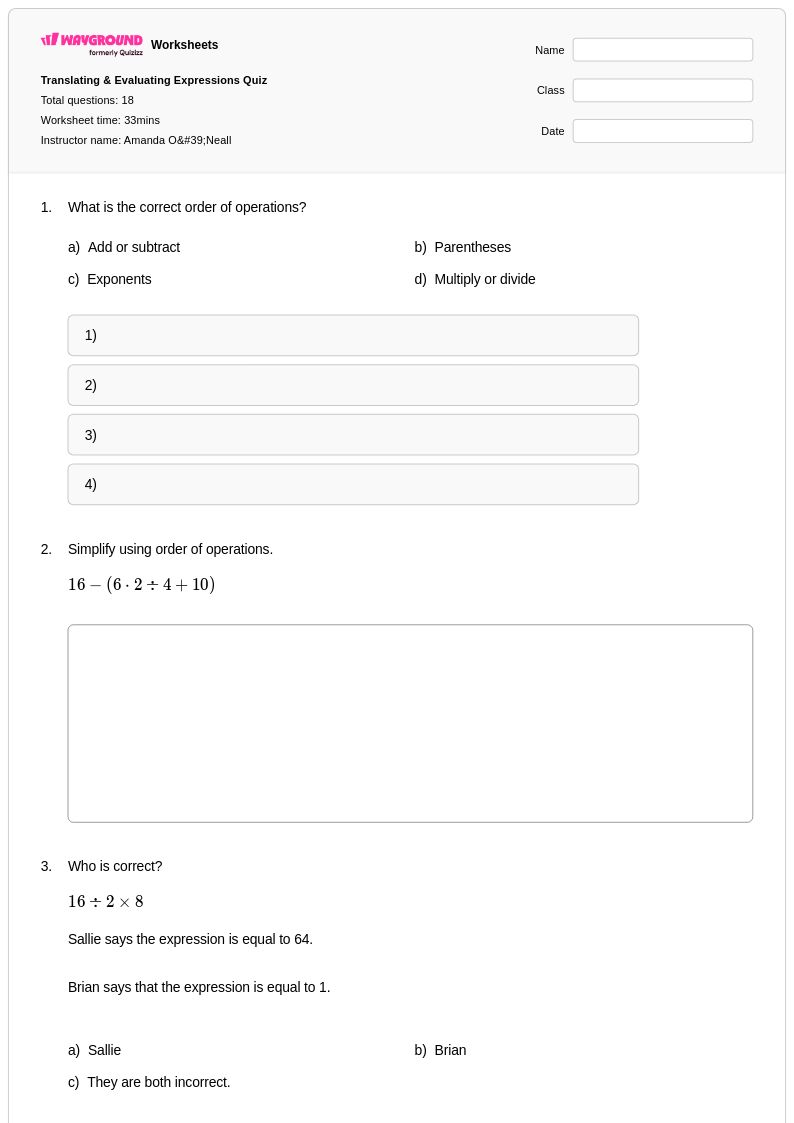
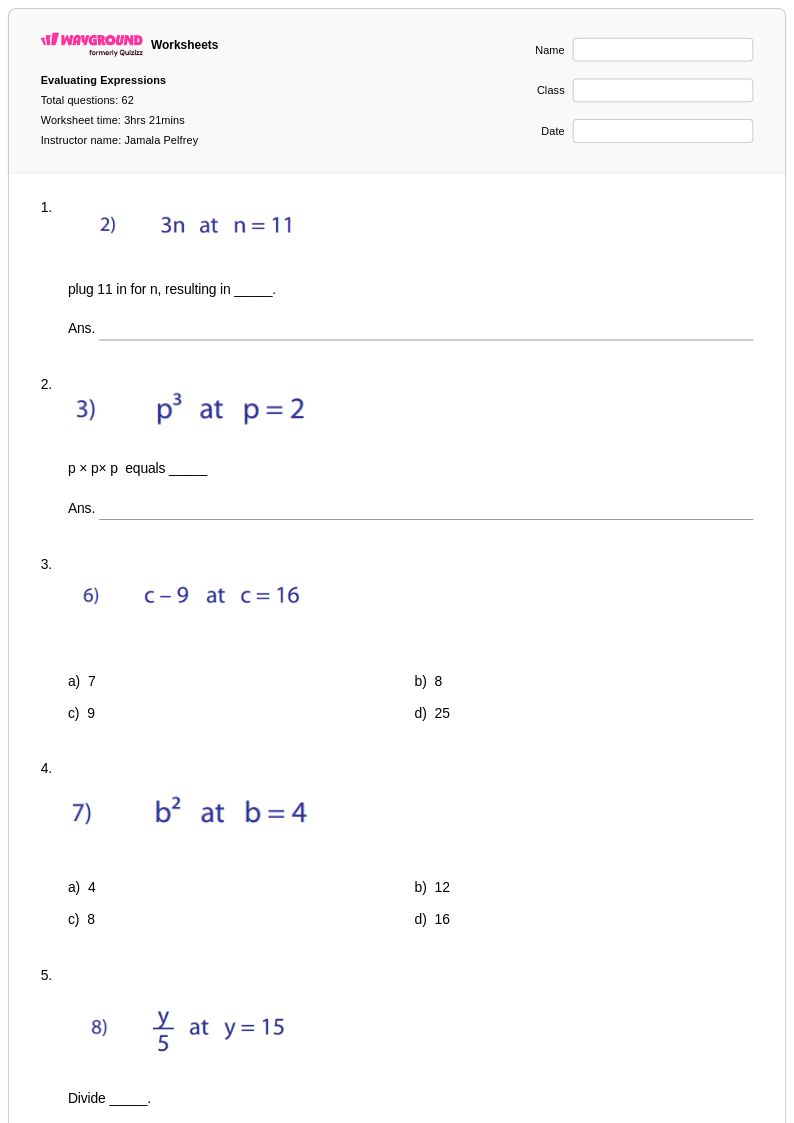
Simplifying means rewriting an expression in a more compact form — combining like terms or applying the distributive property — without substituting any values. Evaluating means substituting a specific value for the variable and computing a numerical result. Students often conflate the two, especially when a problem asks them to simplify first and then evaluate; keeping the steps visually separate on the worksheet helps.