Free Printable Direct Variation Worksheets for Year 7
Year 7 direct variation worksheets and printables help students master proportional relationships through engaging practice problems, featuring free PDF downloads with comprehensive answer keys.
Explore printable Direct Variation worksheets for Year 7
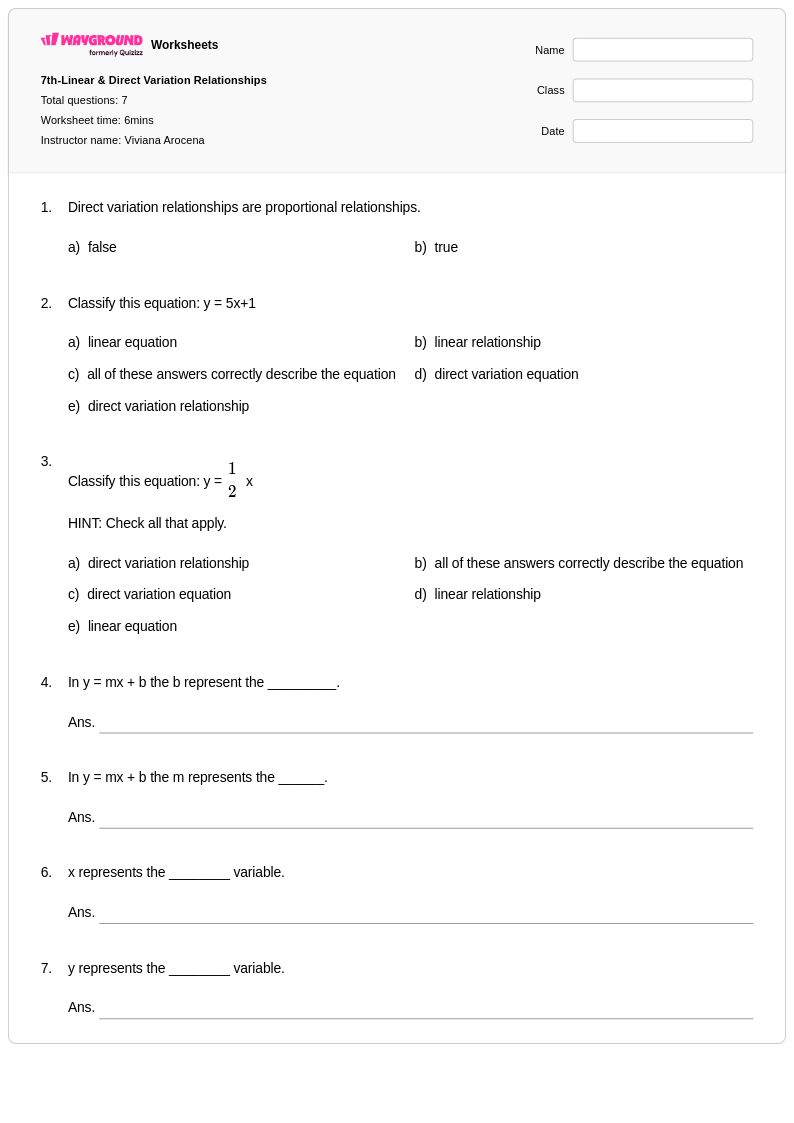
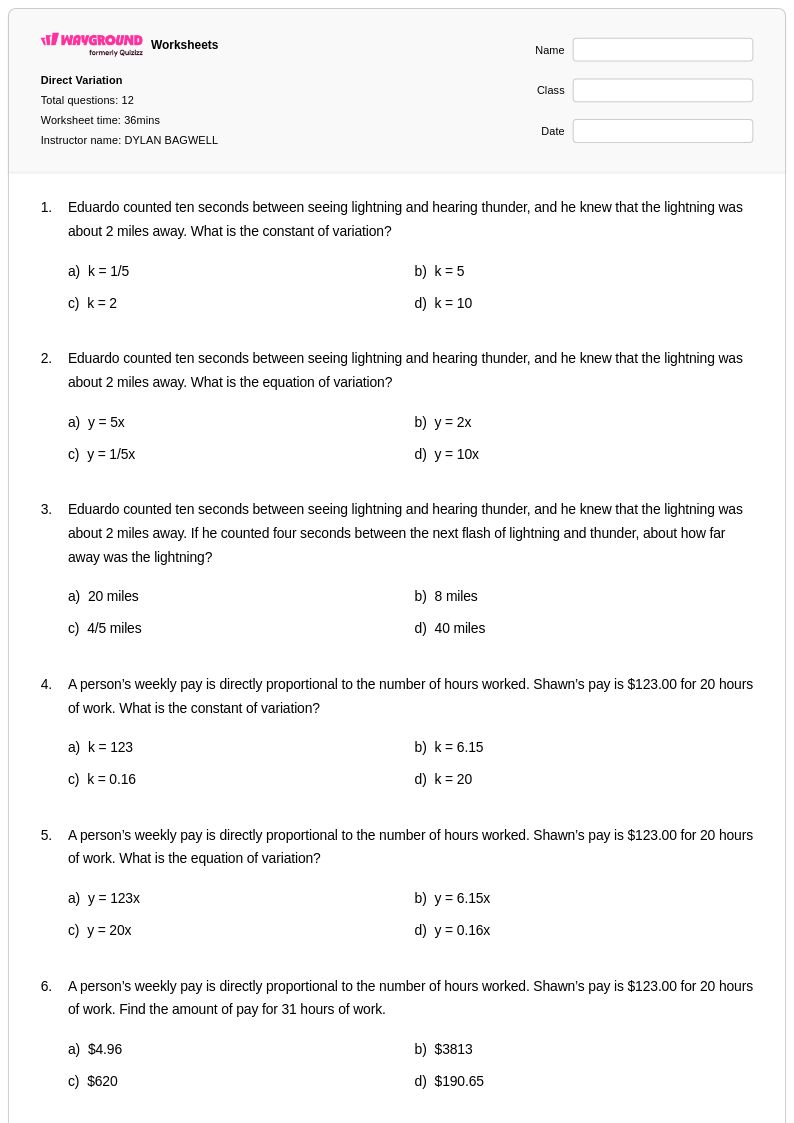
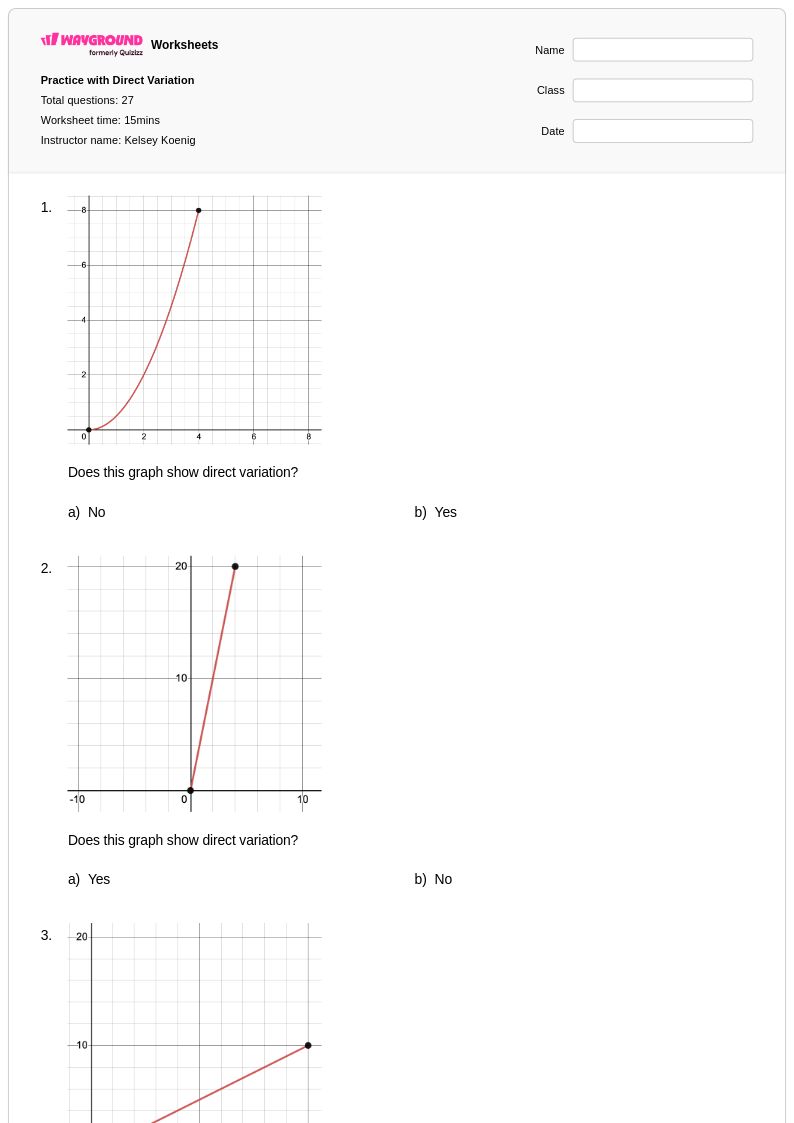
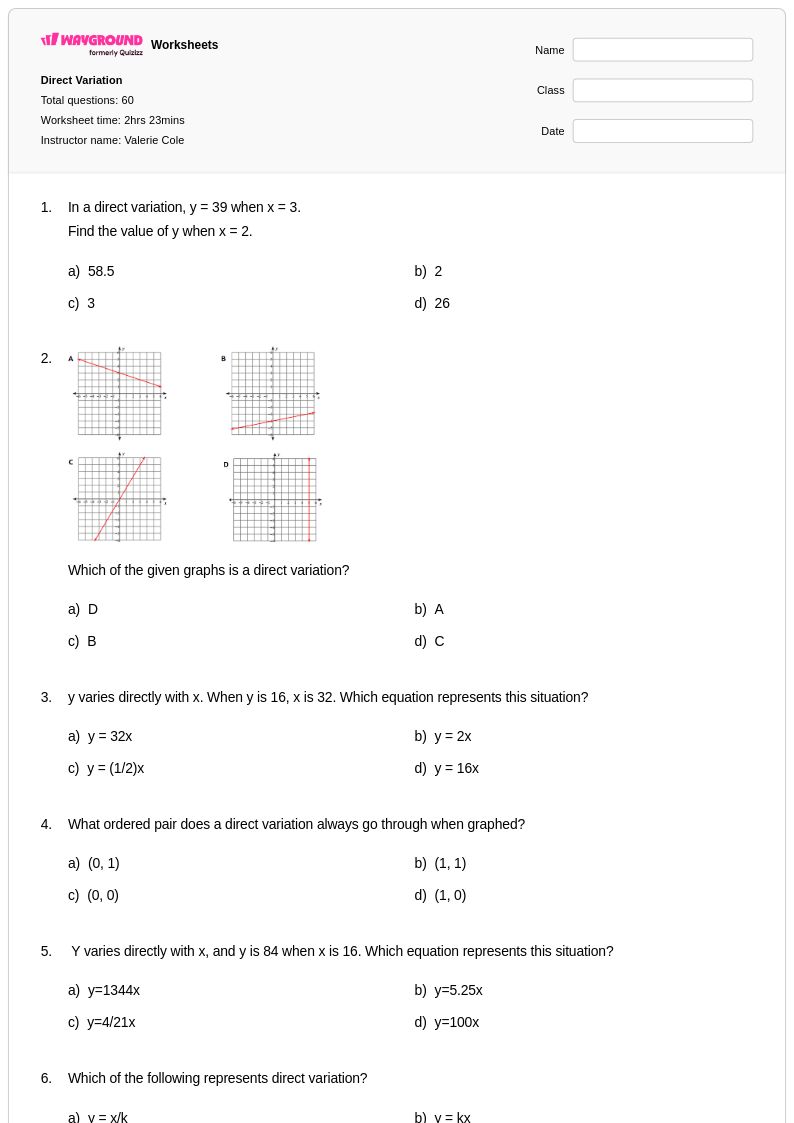
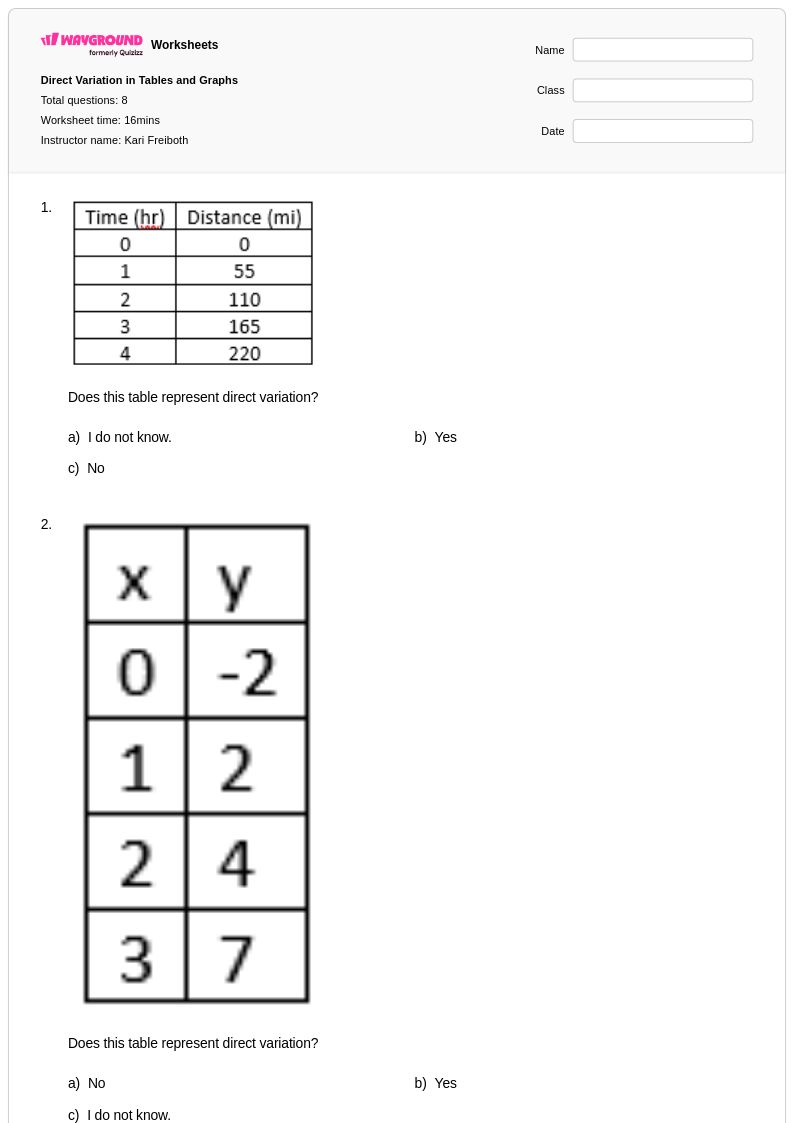
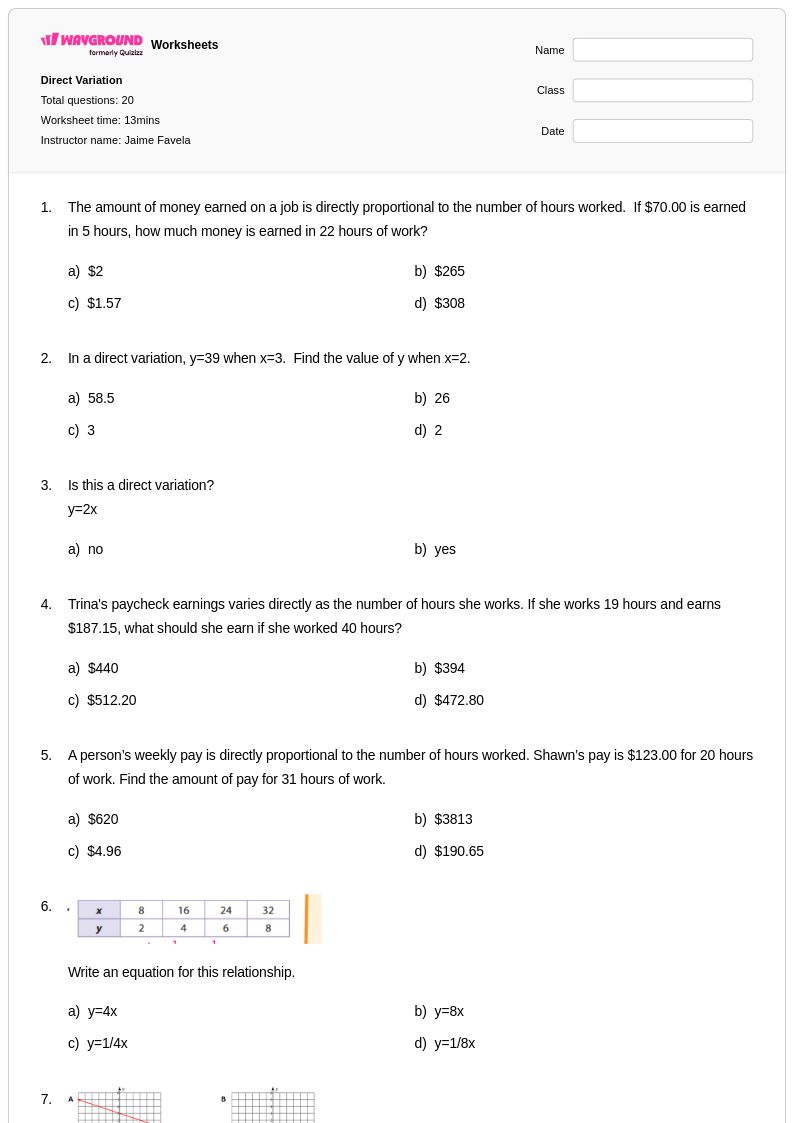
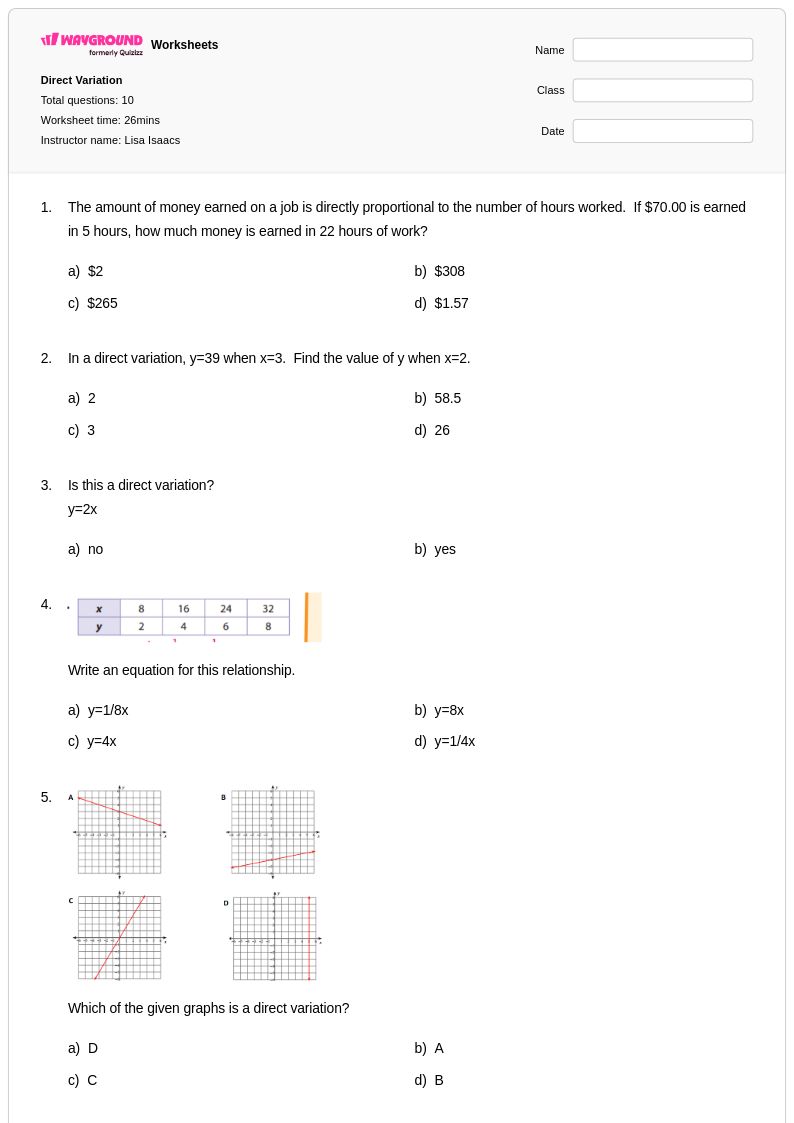
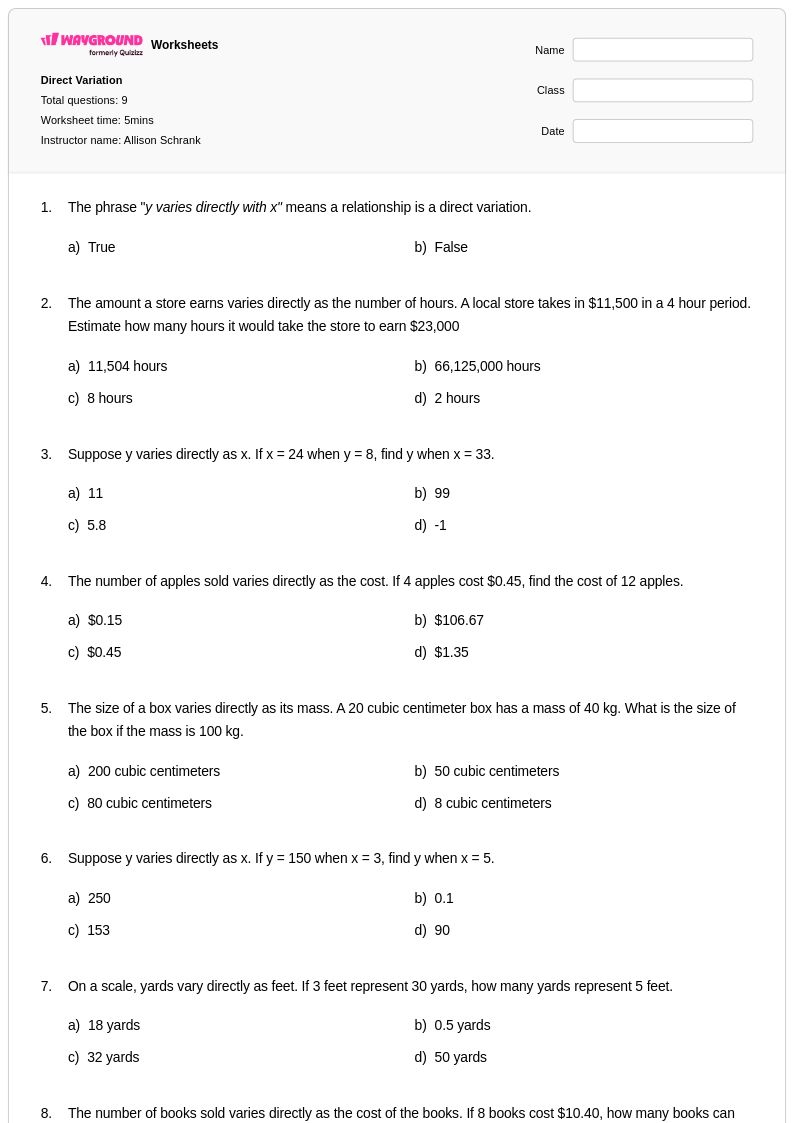
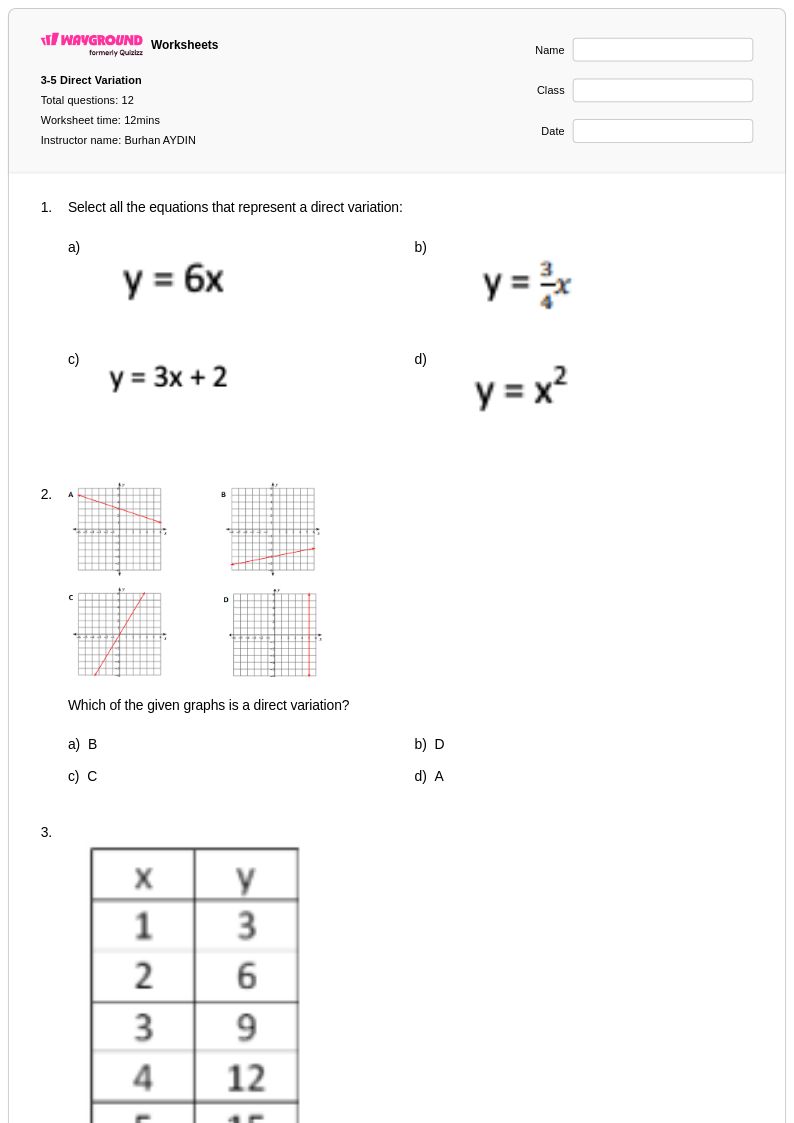
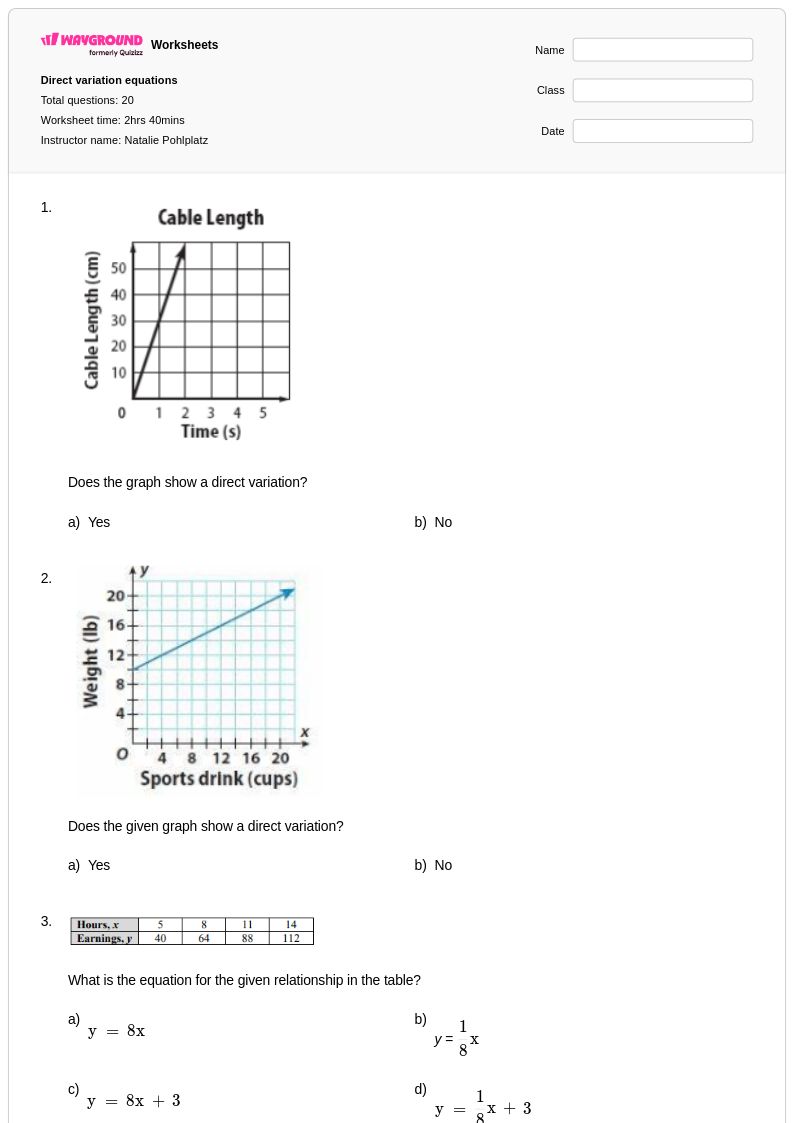
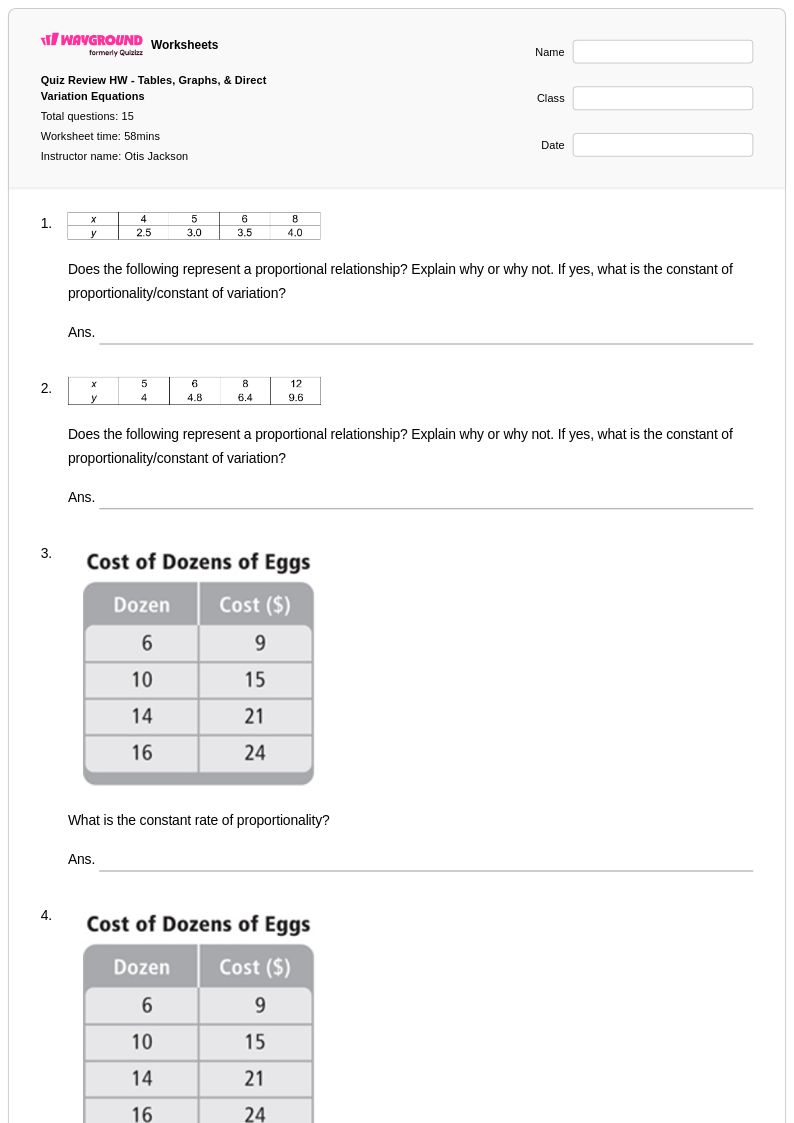
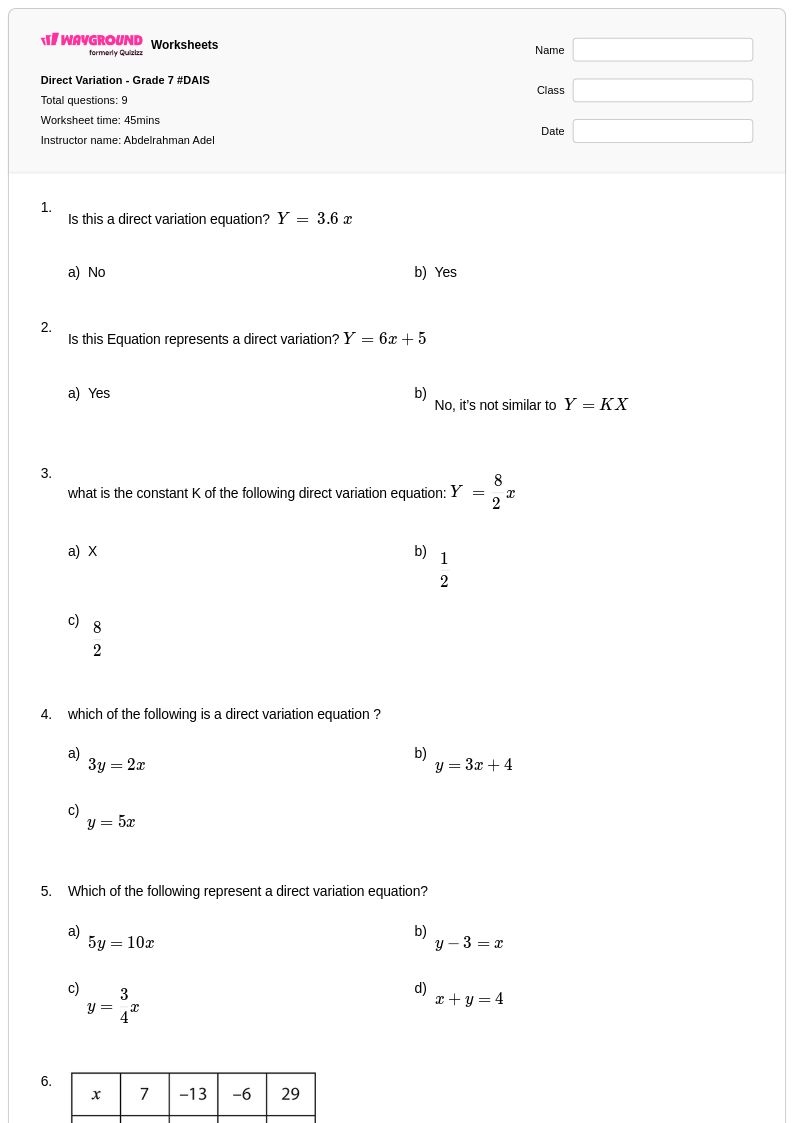
Direct variation worksheets for Year 7 students available through Wayground (formerly Quizizz) provide comprehensive practice with this fundamental algebraic concept where two variables maintain a constant ratio. These carefully designed resources help students master the identification and analysis of direct variation relationships, including recognizing proportional patterns, calculating constants of variation, and writing equations in the form y = kx. The worksheets strengthen essential skills such as interpreting tables and graphs to determine if variables vary directly, solving real-world problems involving direct variation, and understanding the graphical representation of these linear relationships that pass through the origin. Each worksheet comes with a complete answer key and is available as a free printable pdf, making it easy for students to work through practice problems systematically while building confidence with this critical algebraic foundation.
Wayground (formerly Quizizz) supports mathematics educators with an extensive collection of teacher-created direct variation resources that streamline lesson planning and differentiated instruction for Year 7 classrooms. The platform's millions of worksheets feature robust search and filtering capabilities that allow teachers to quickly locate materials aligned with specific learning standards and student needs. These versatile resources are available in both printable pdf format and interactive digital versions, enabling flexible customization for various learning environments and teaching styles. Teachers can effectively use these worksheets for initial skill practice, targeted remediation for struggling learners, and enrichment activities for advanced students, while the comprehensive answer keys facilitate efficient grading and immediate feedback to support student progress in mastering direct variation concepts.
FAQs
How do I teach direct variation in 7th grade?
By grade 7, students have worked with ratio tables and unit rates, so connect direct variation to what they already know: a constant ratio between two quantities. Introduce y = kx by having students calculate k from a table first, then work backward — given k, generate a table and graph. The graph passing through the origin is a key checkpoint: if a student's line has a y-intercept other than zero, something went wrong with their k calculation, and that's a productive error to catch in class.
What exercises help 7th graders practice direct variation?
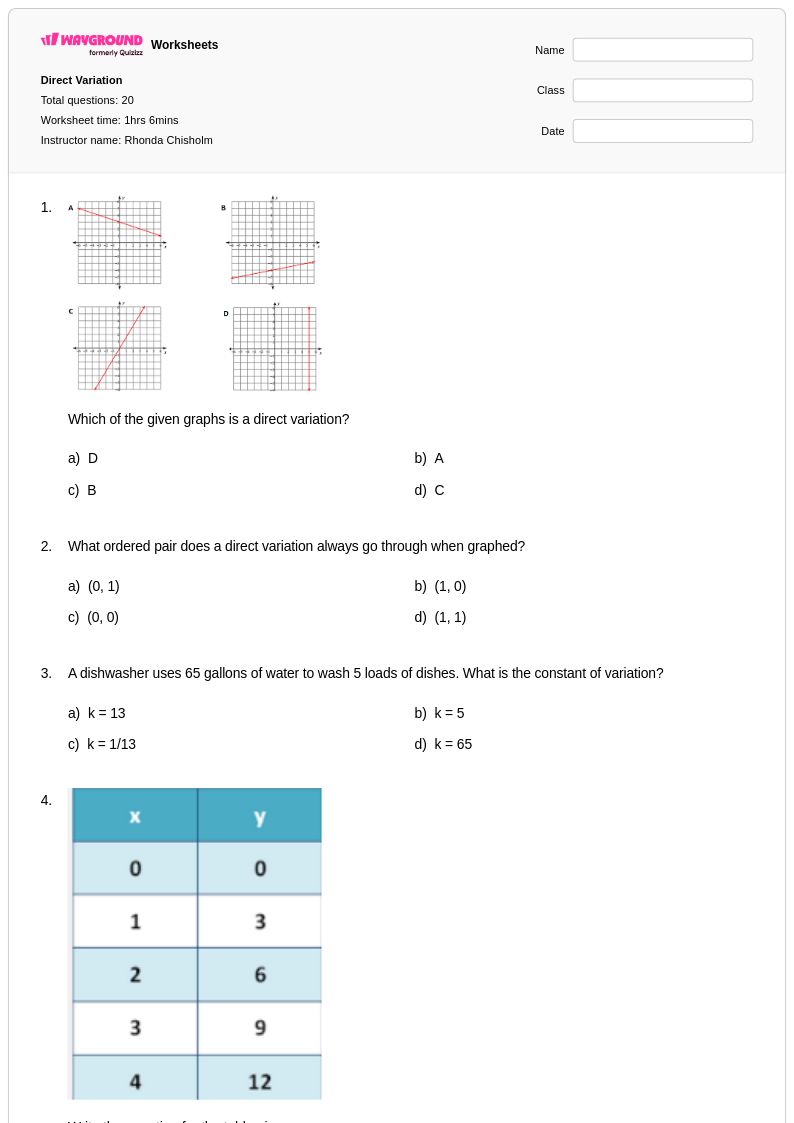
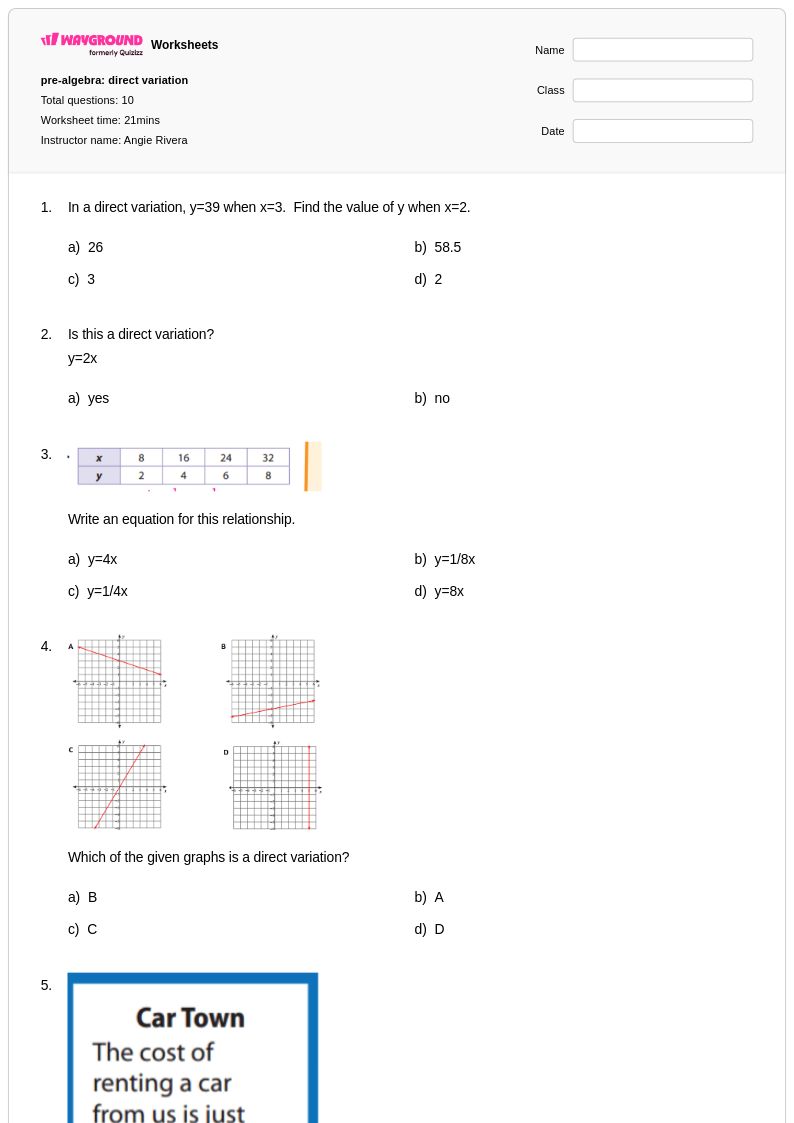
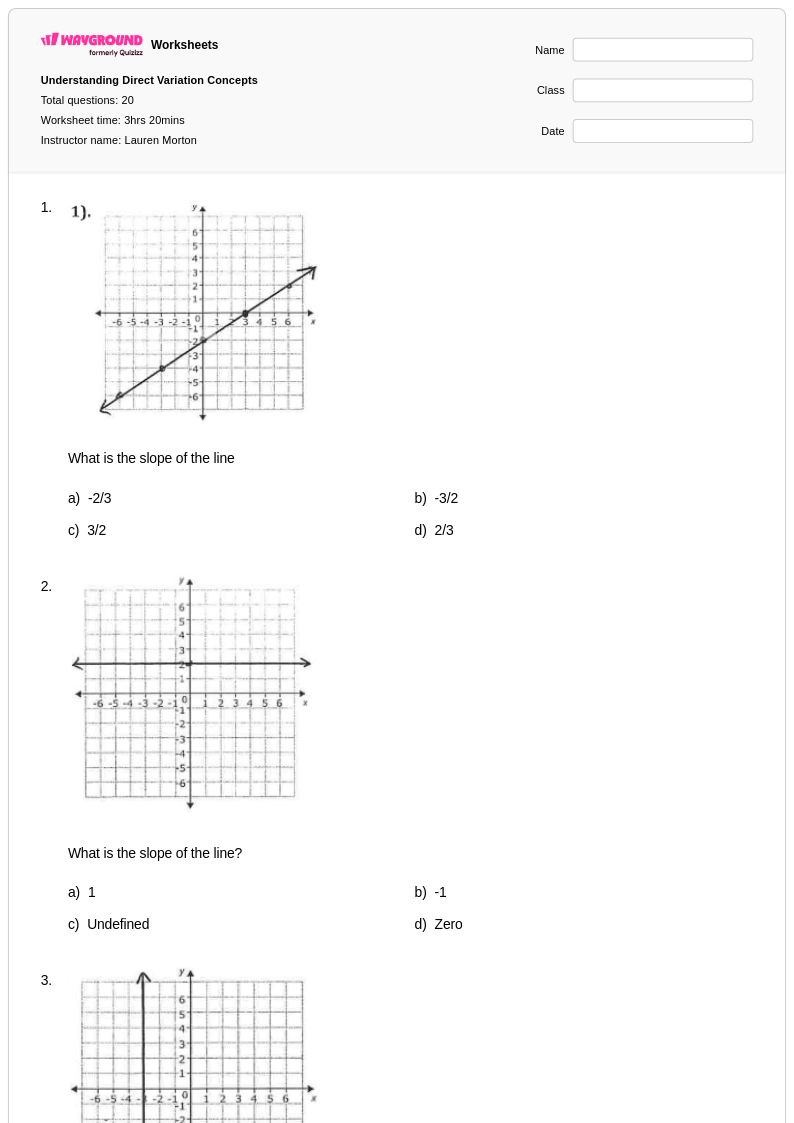
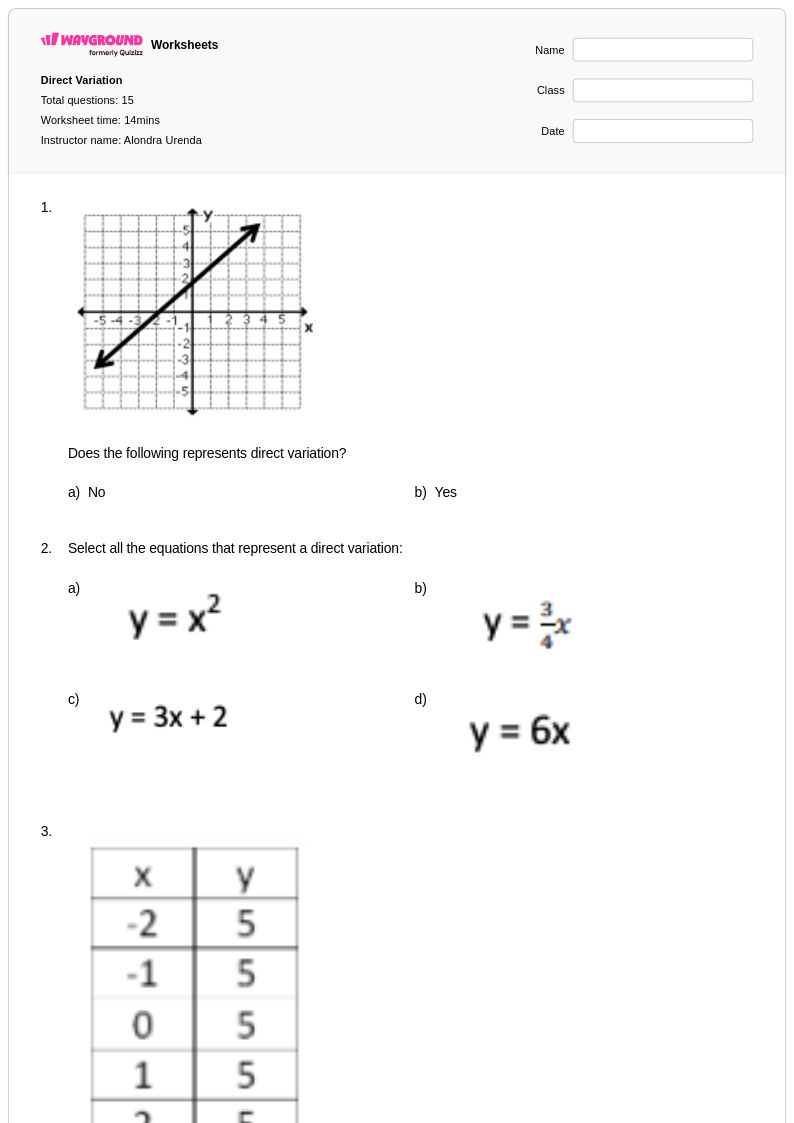
Three exercise types do the most work at this grade: determining whether a table represents direct variation (including non-examples), writing y = kx given a point or table, and interpreting graphs to identify k as the slope. Wayground's grade 7 worksheets also include real-world problems — speed, unit pricing, scaling — which help students see that direct variation isn't just an algebra exercise.
What errors do 7th graders commonly make with direct variation?
Two patterns show up most: students correctly identify k from one pair of values but then treat it as additive rather than multiplicative when solving for unknowns (writing y = k + x instead of y = kx). The second is graph misreading — they'll identify a proportional-looking line as direct variation without checking whether it passes through the origin. Both errors are worth addressing explicitly before moving to multi-step application problems.
How do I use Wayground's grade 7 direct variation worksheets?
Host the worksheet as a digital quiz on Wayground for immediate feedback during class, or print the PDF for independent or homework practice — both formats contain the same problems. Every worksheet comes with a complete answer key. For printed submissions, the Wayground for Teachers app lets you scan student work to grade it without re-entering everything by hand.
How does Common Core approach direct variation in 7th grade?
Common Core places proportional relationships at the center of 7th grade math. Students are expected to recognize that a proportional relationship between two quantities can be expressed as y = kx, identify k as the unit rate, and represent the relationship in tables, graphs, equations, and verbal descriptions. Direct variation is the algebraic name for exactly this structure, so grade 7 is the natural moment to formalize the concept. The work here sets up grade 8's treatment of linear functions, where students distinguish proportional relationships (direct variation) from non-proportional linear relationships.
How can I support diverse learners with direct variation practice in 7th grade?
For students who struggle to process dense problem text, Wayground's Read Aloud accommodation reads questions aloud during digital sessions — useful when the barrier is reading load rather than math understanding. For printed versions, you can generate an alternate worksheet with wider font spacing or a larger font size, which reduces visual crowding on problems that involve tables and equations side by side. Students who are ready to go further can work through the real-world application problems in the collection, which require setting up the equation from context rather than from a labeled table.