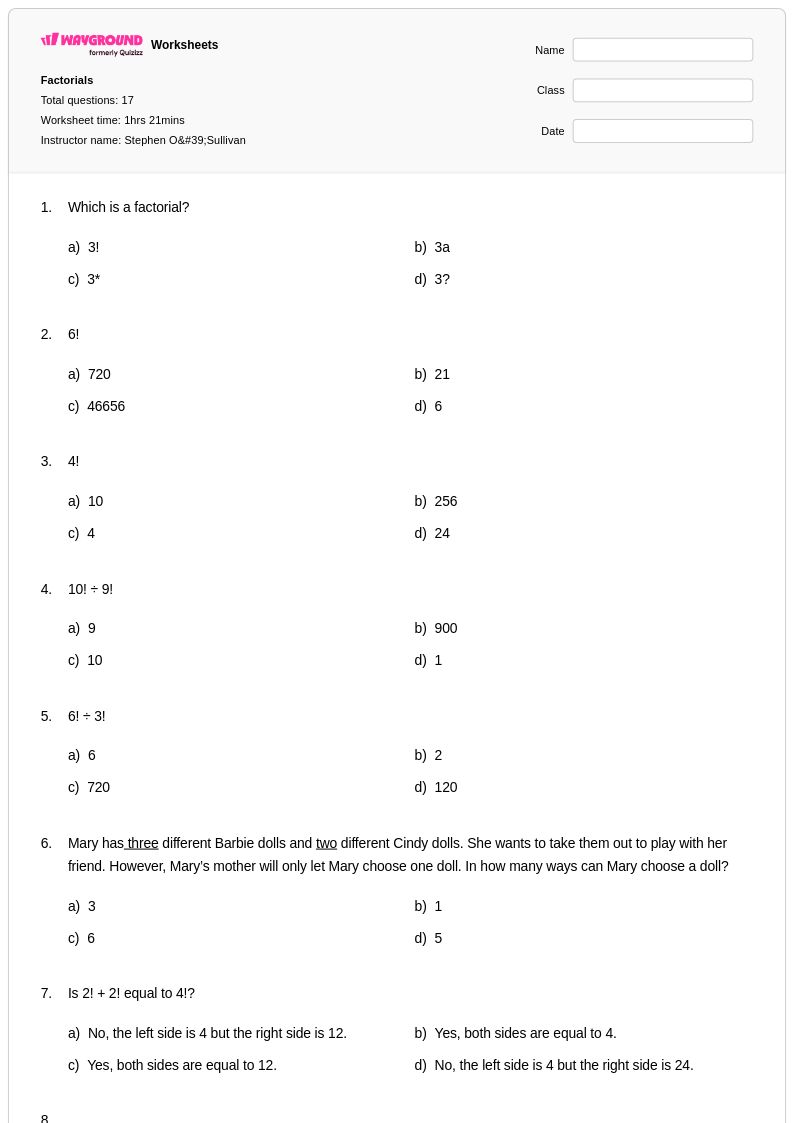
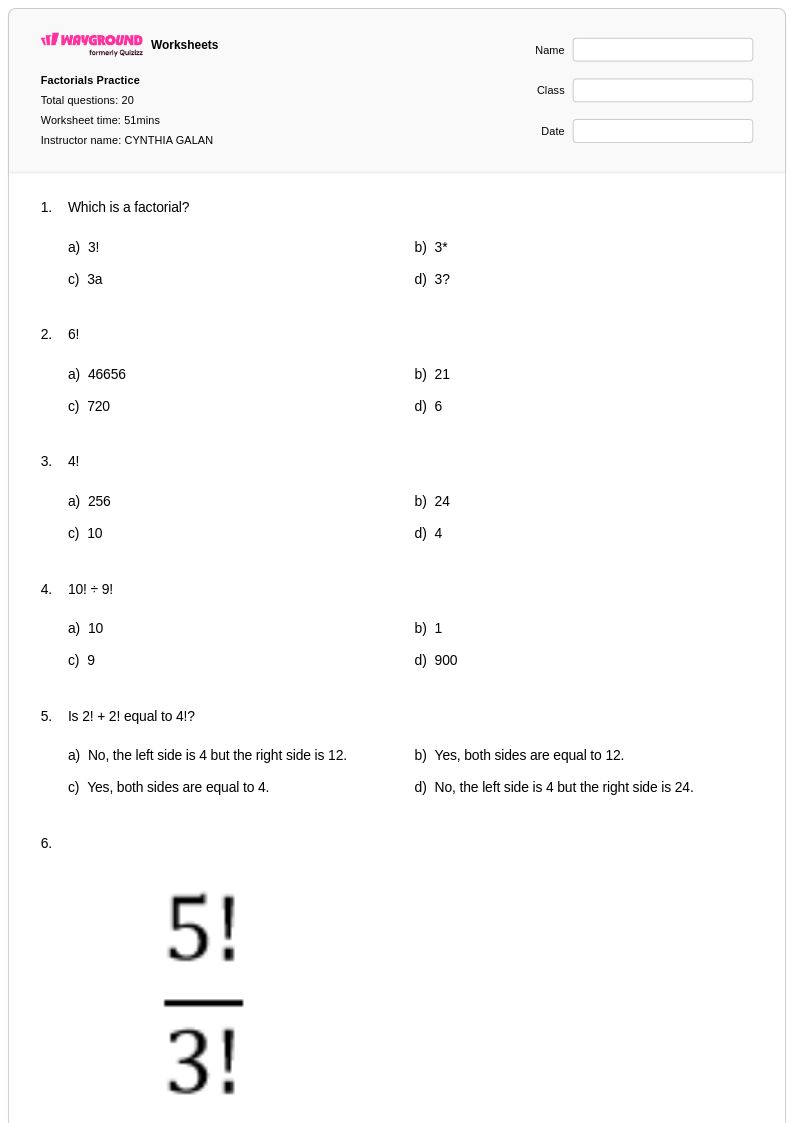
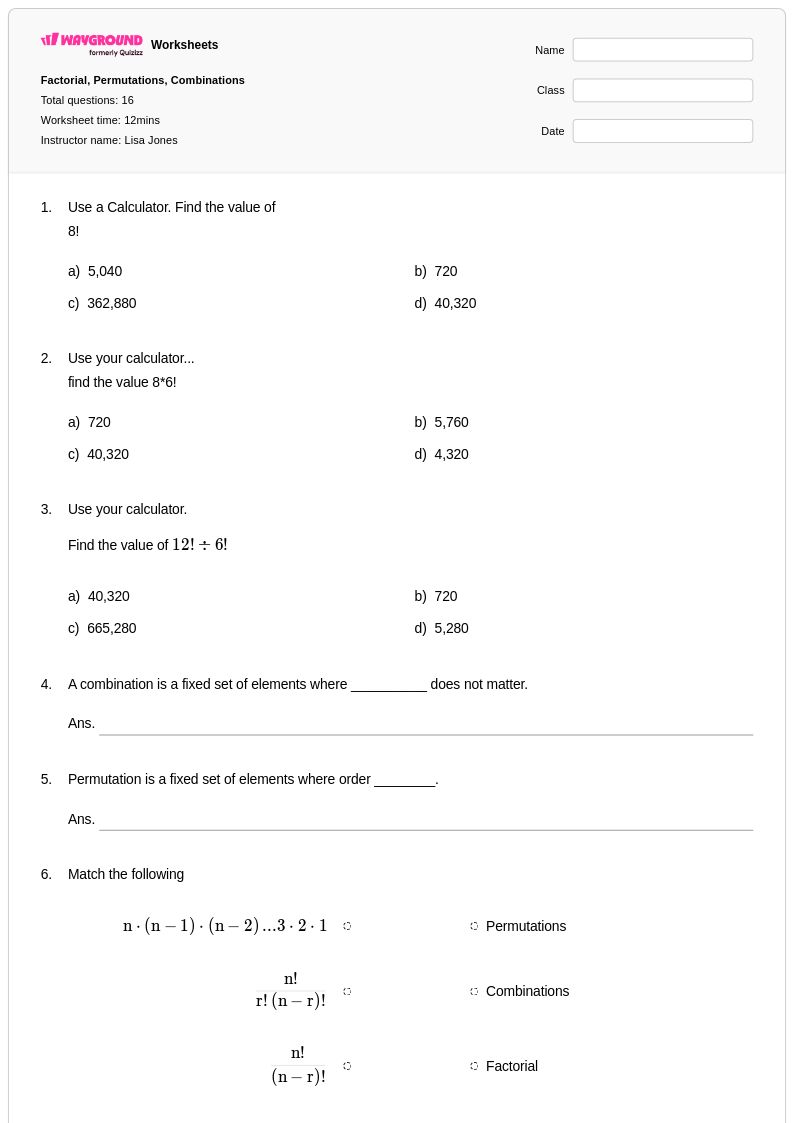
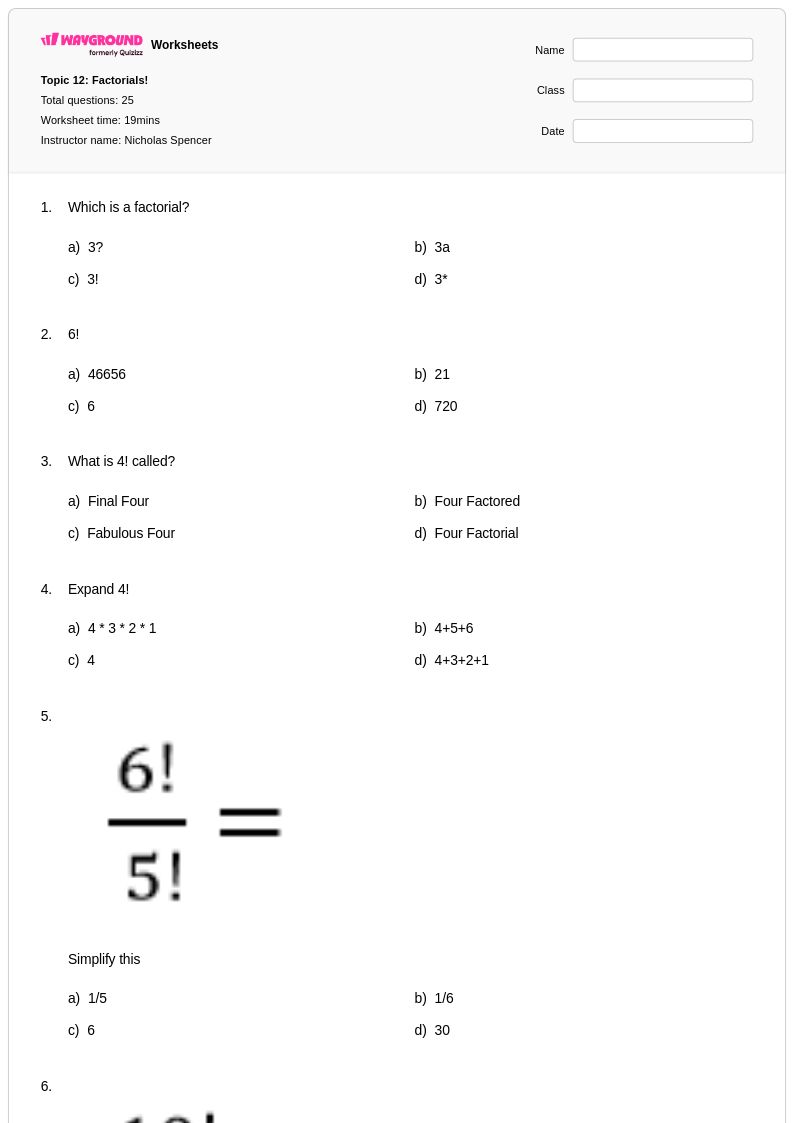
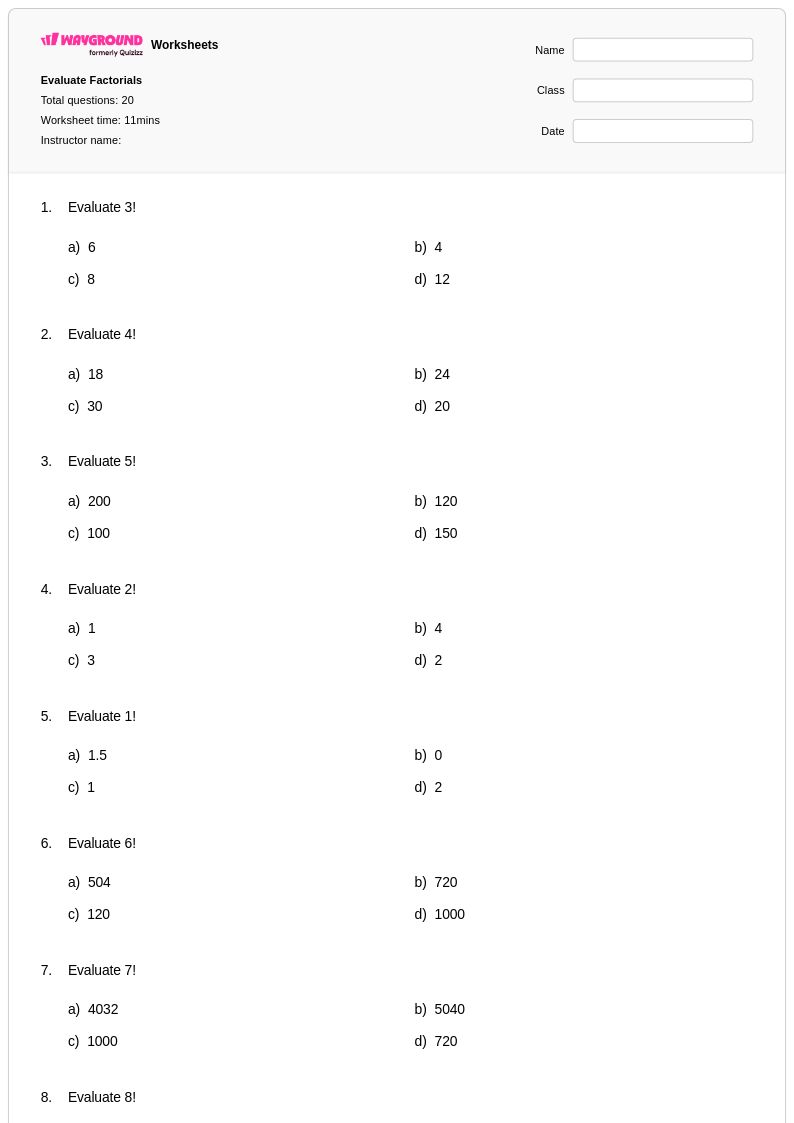
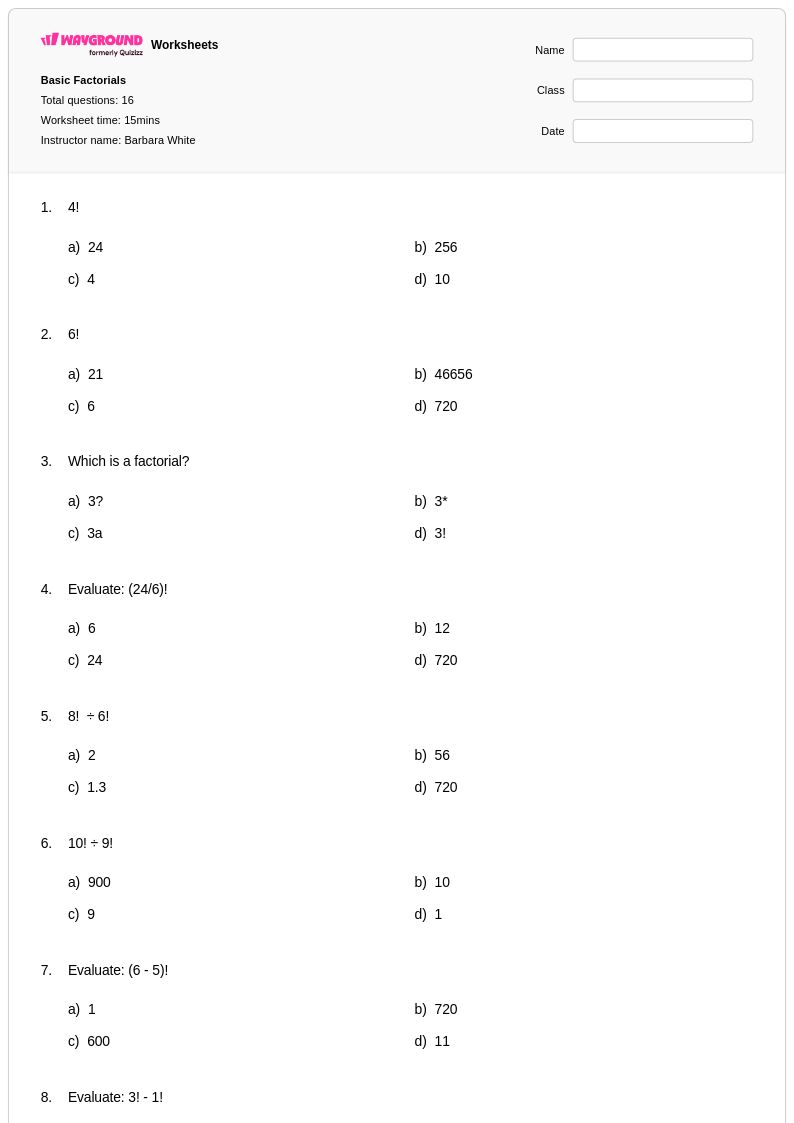
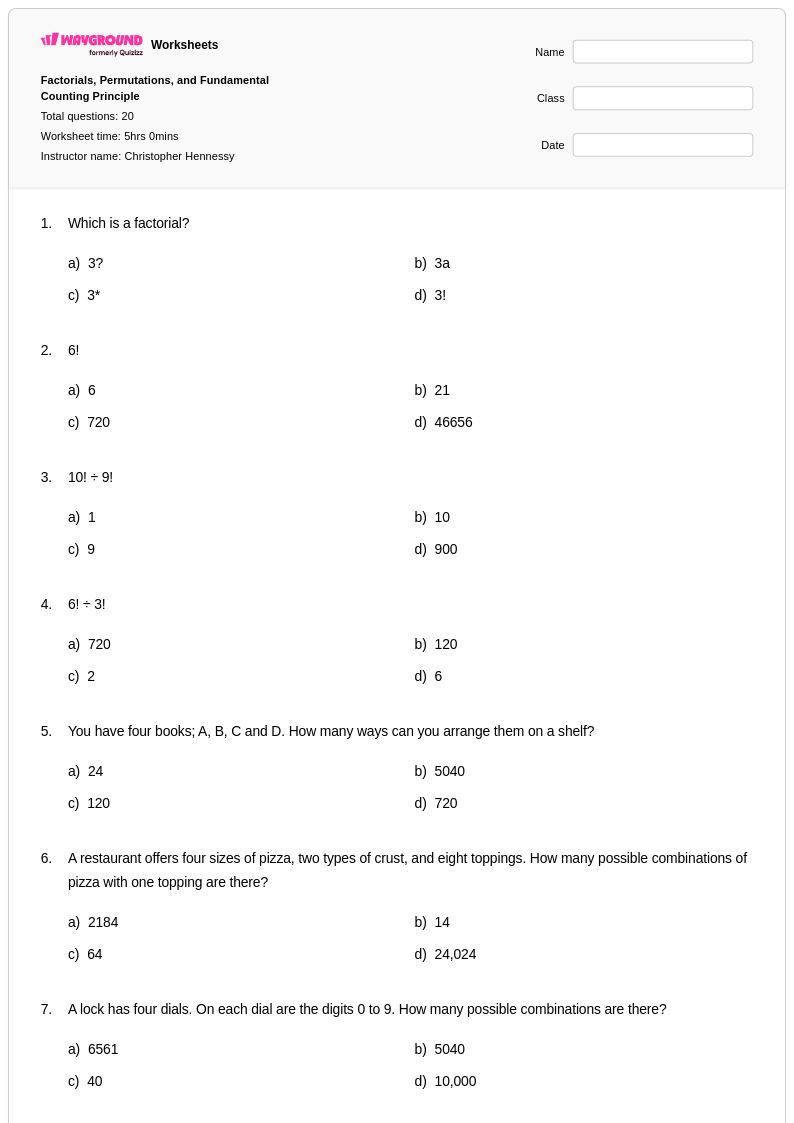
Year 9 factorial worksheets from Wayground offer free printable PDF practice problems with answer keys to help students master calculating factorials and understanding their applications in probability and statistics.
Explore printable Factorials worksheets for Year 9
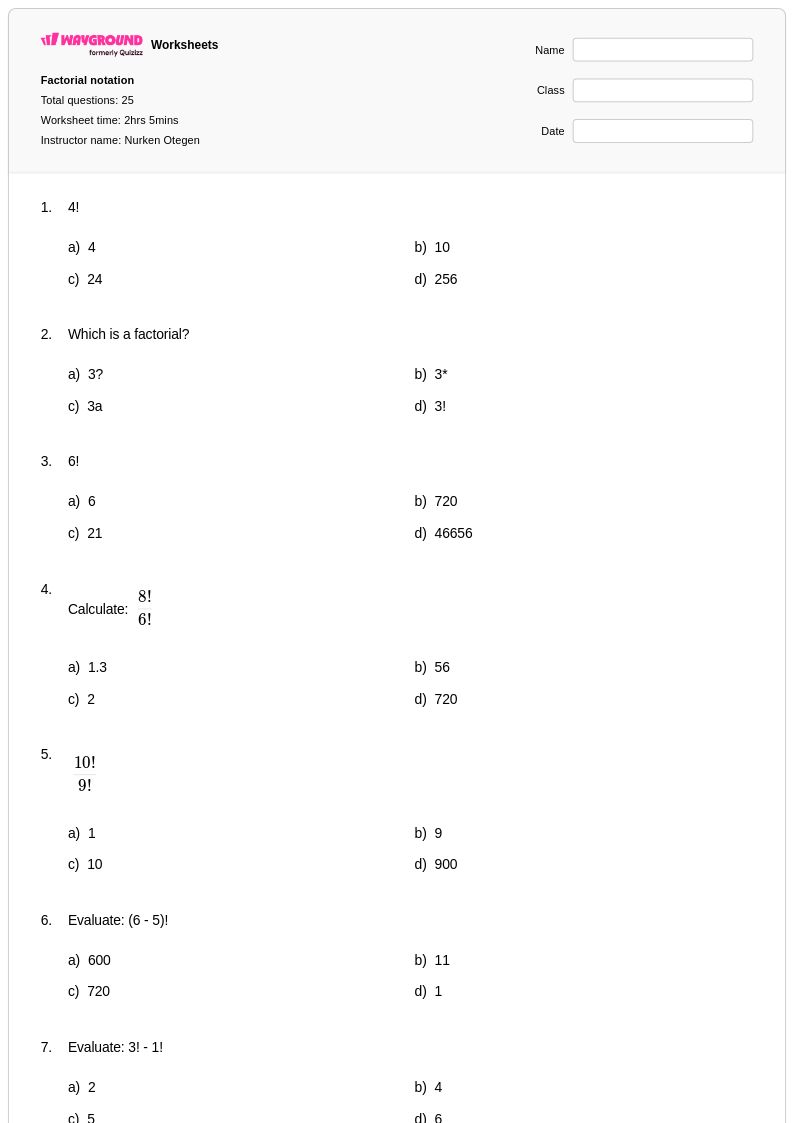
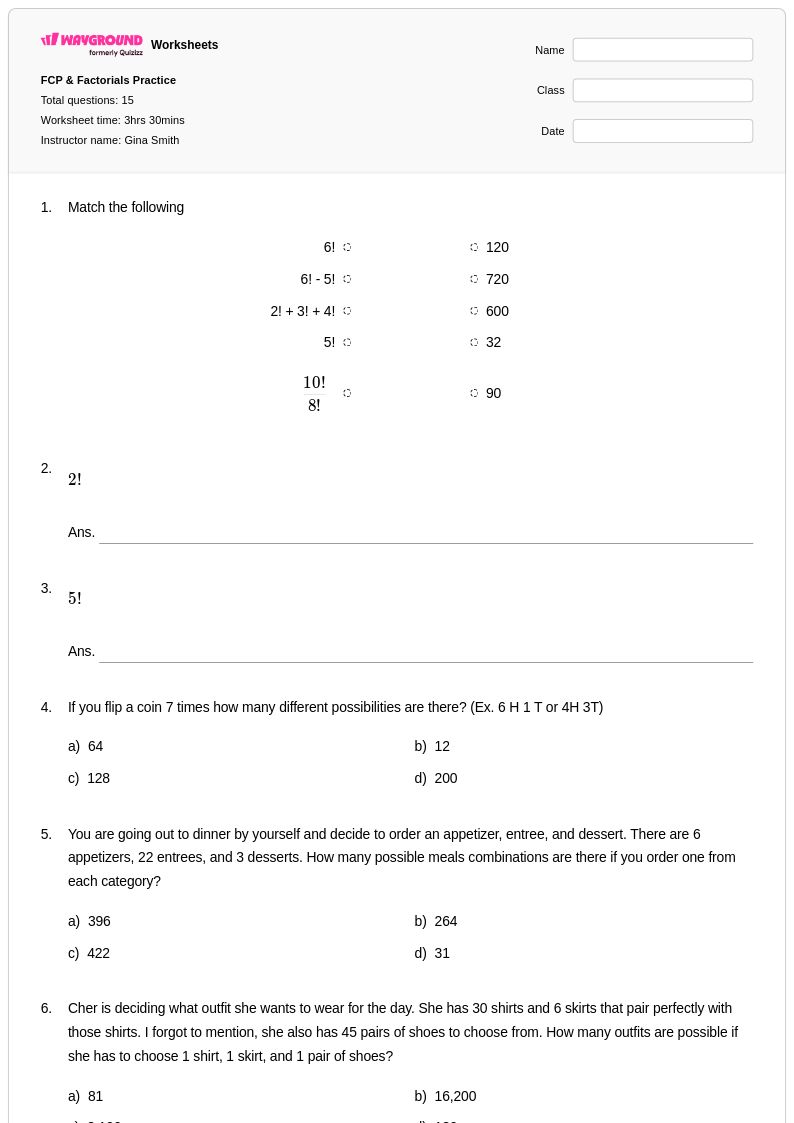
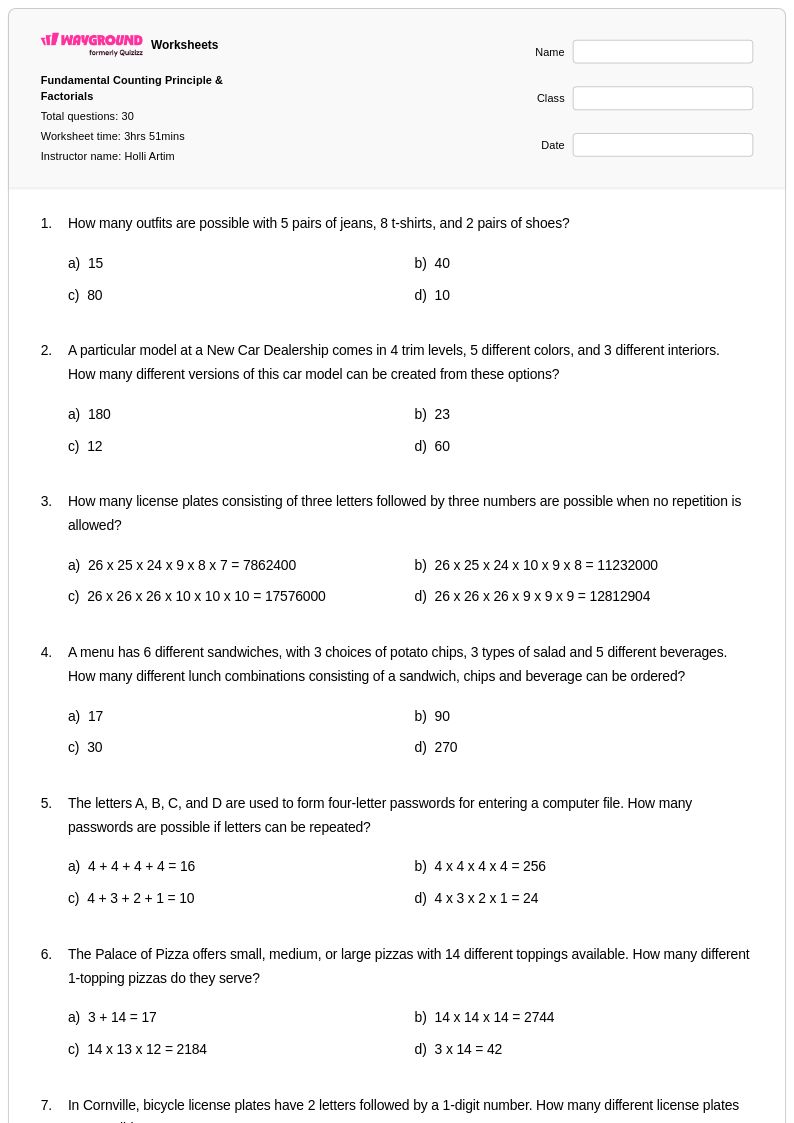
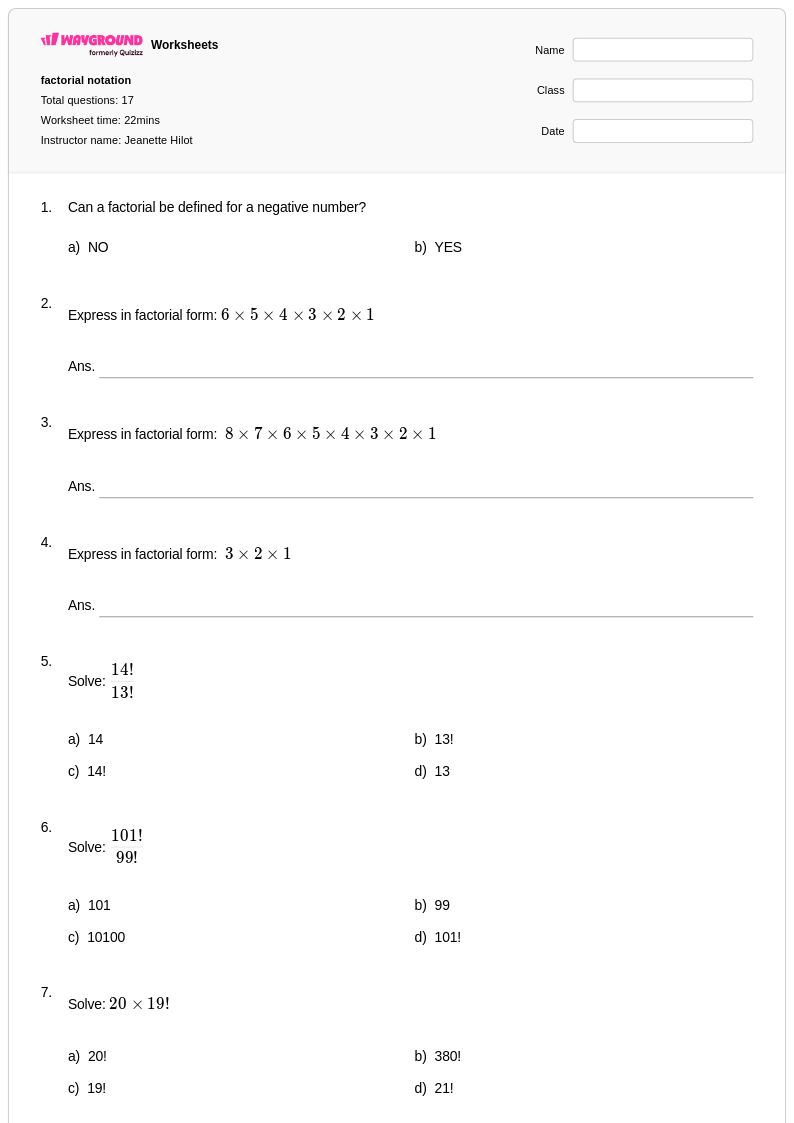
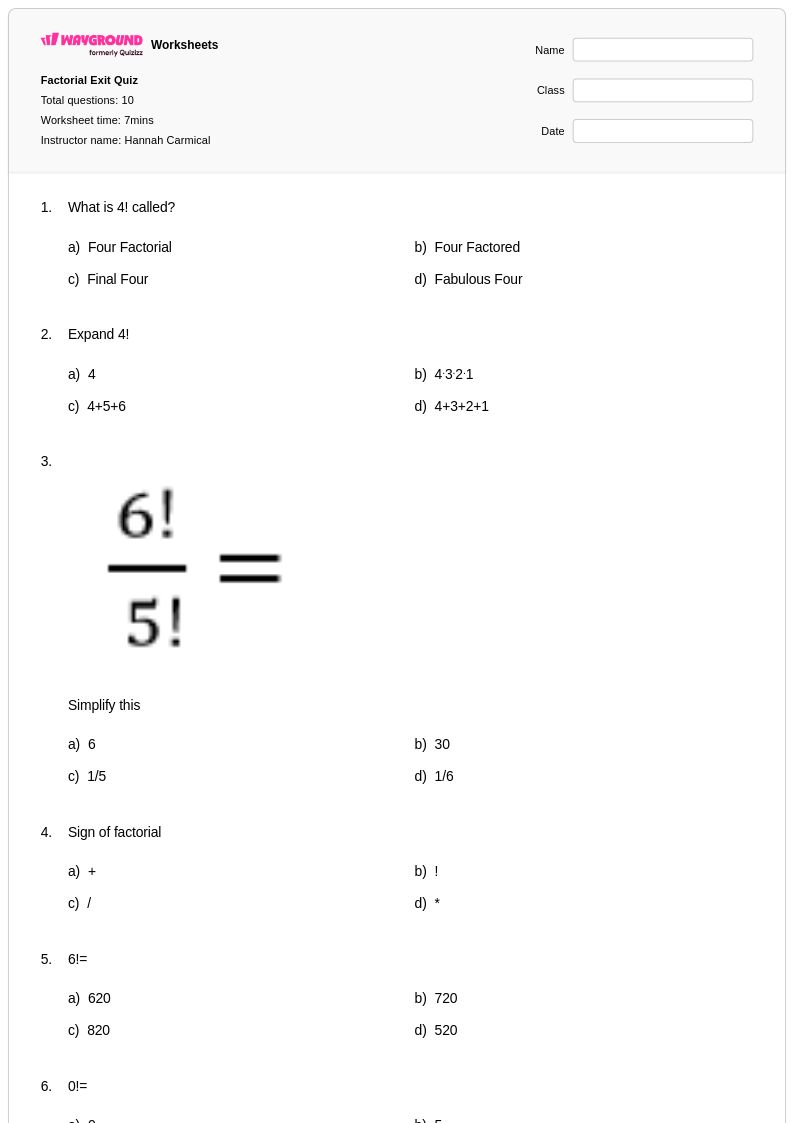
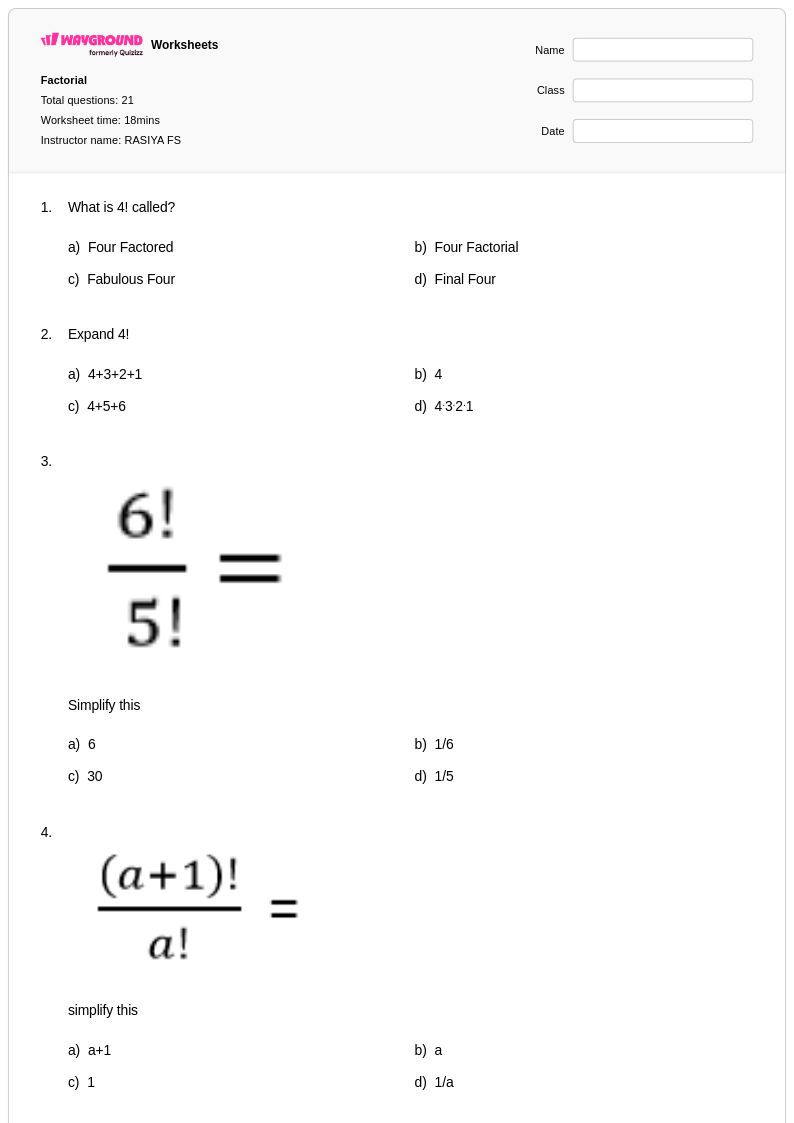
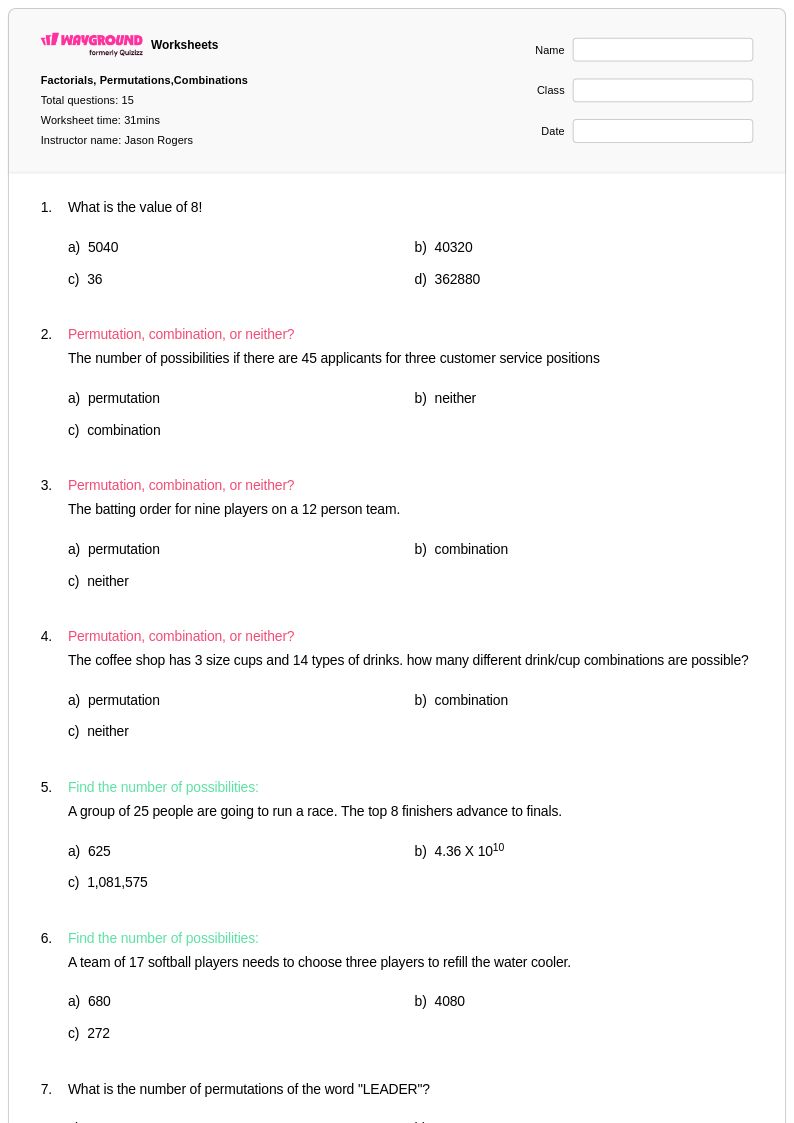
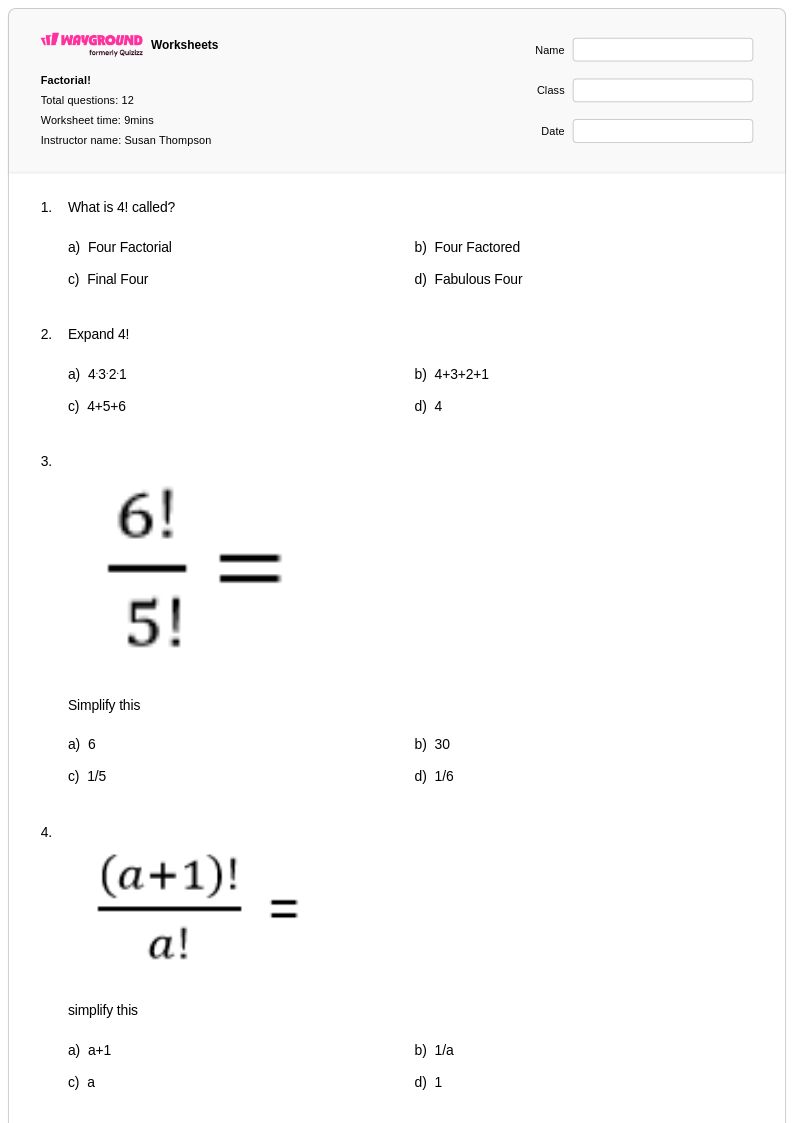
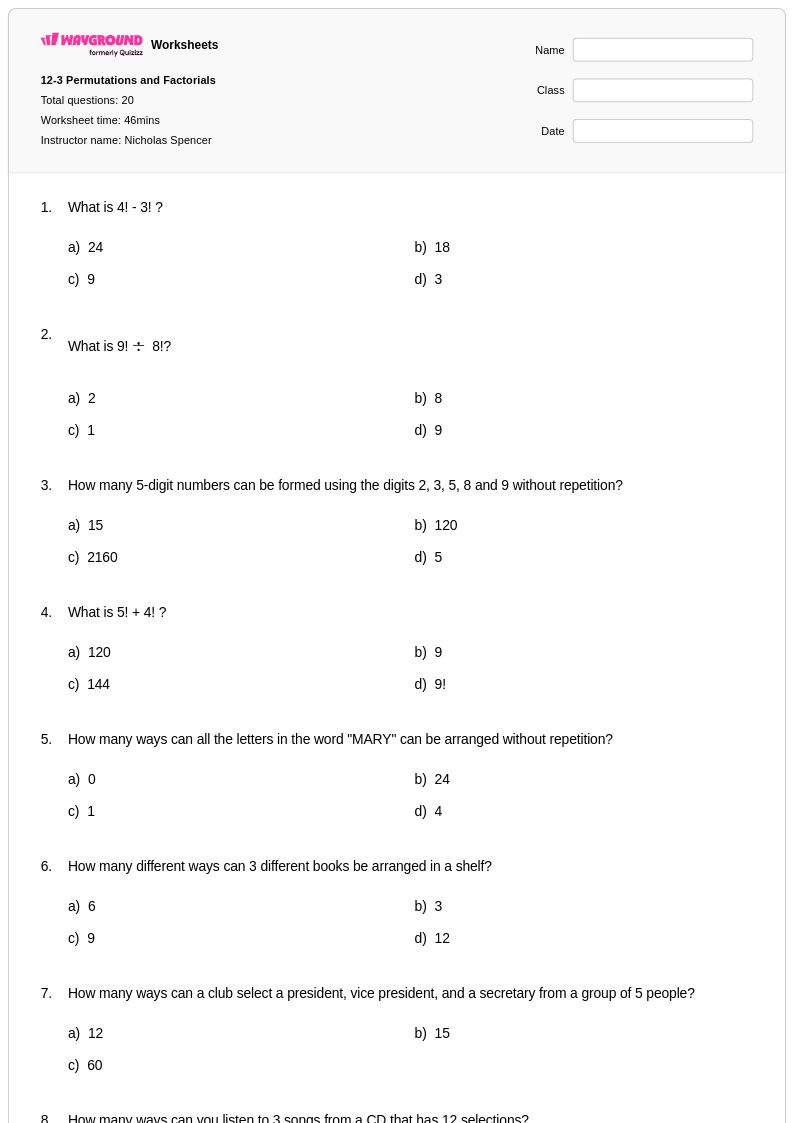
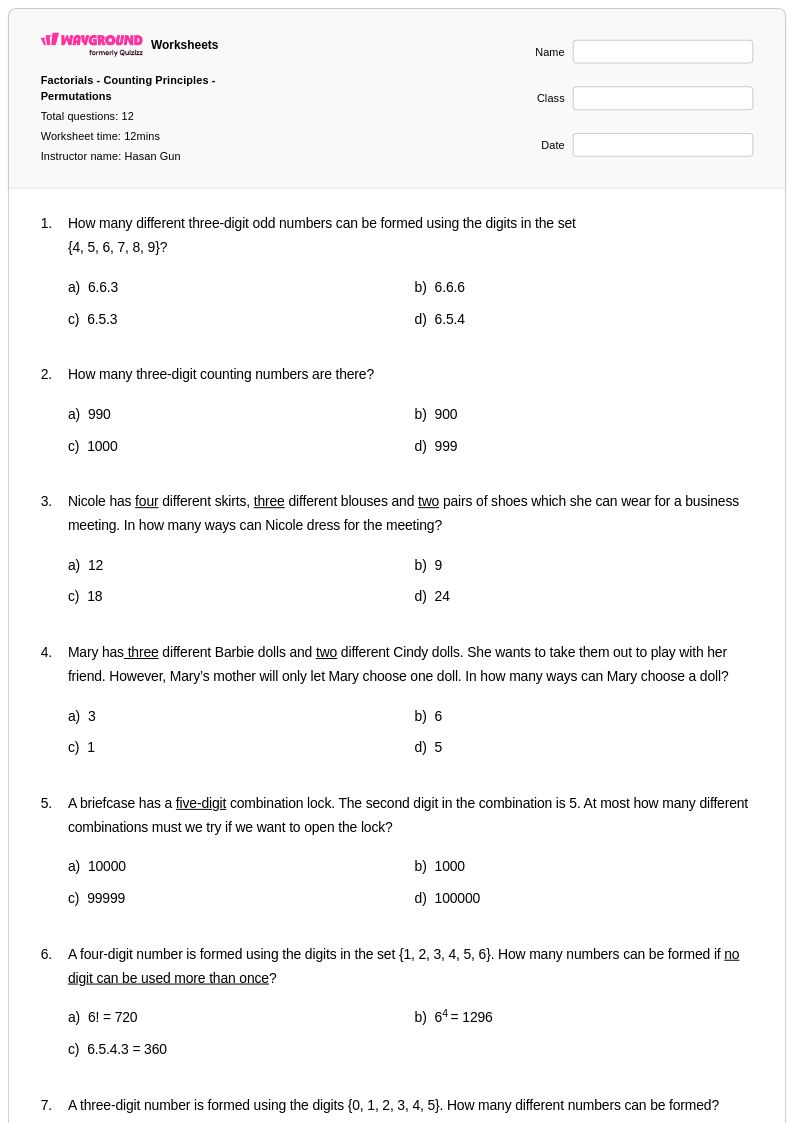
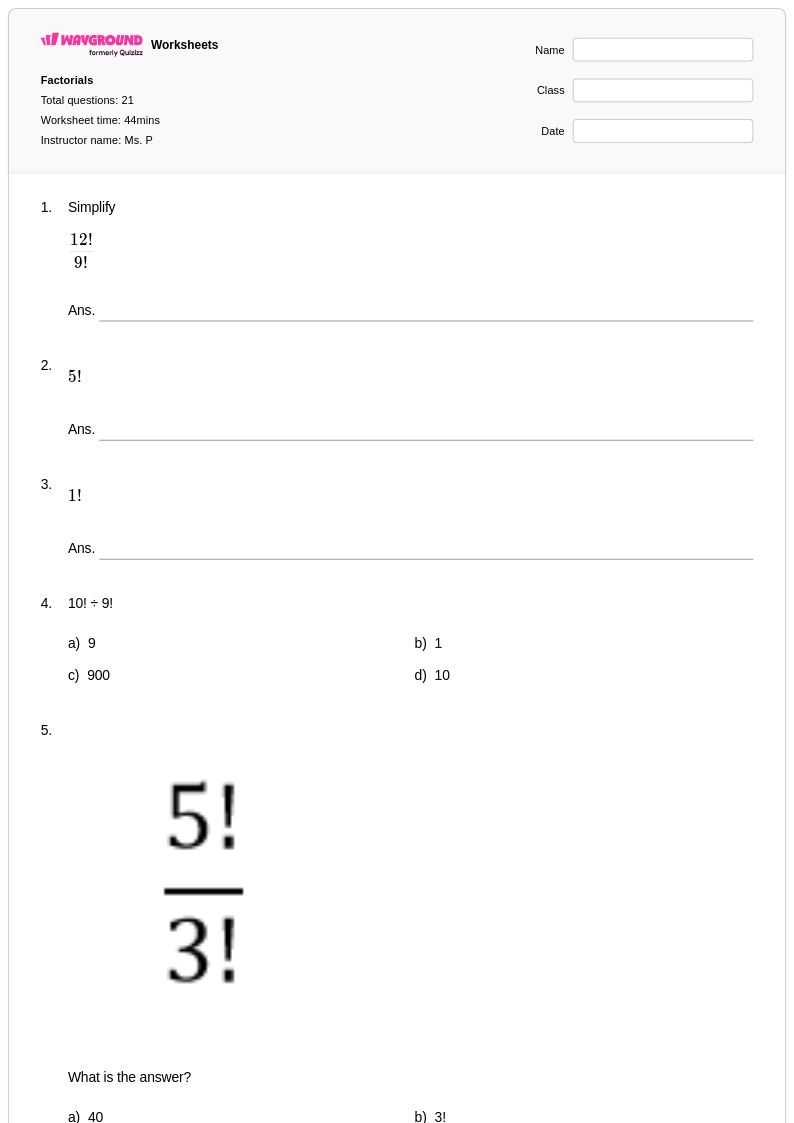
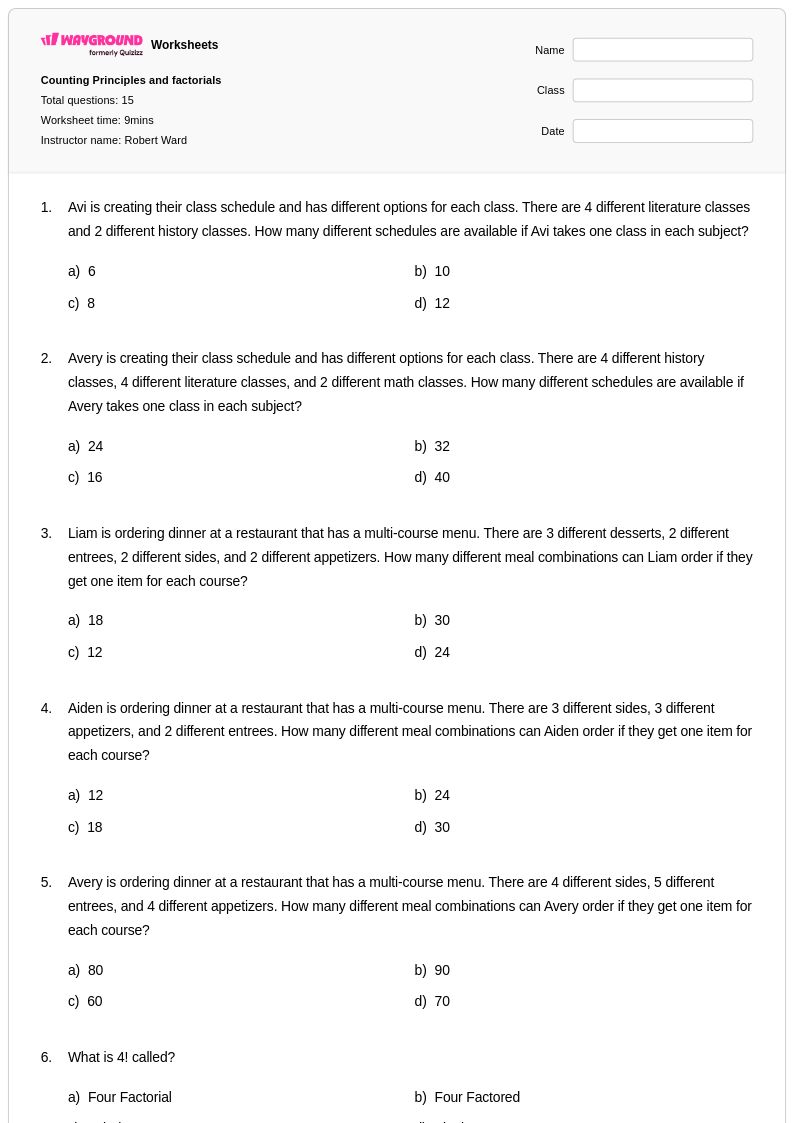
Factorials form a crucial foundation in Year 9 probability and statistics, representing the mathematical concept of calculating the number of ways to arrange objects in a specific order. Wayground's factorial worksheets provide comprehensive practice problems that guide students through computing factorials of various integers, understanding factorial notation, and applying factorial calculations to solve permutation problems. These carefully designed resources strengthen essential mathematical reasoning skills by helping students recognize patterns in factorial sequences, develop computational fluency with larger numbers, and connect factorial concepts to real-world scenarios involving arrangements and ordering. Each worksheet includes detailed answer keys and step-by-step solutions, making them valuable study tools available as free printables in convenient pdf format for both classroom instruction and independent practice.
Wayground's extensive collection of factorial worksheets draws from millions of teacher-created resources, ensuring educators have access to diverse, high-quality materials that align with Year 9 mathematics standards. The platform's robust search and filtering capabilities allow teachers to quickly locate worksheets targeting specific factorial concepts, from basic computational practice to advanced applications in probability theory. These resources support effective differentiation through customizable difficulty levels and flexible formatting options, enabling teachers to address varying student needs during instruction, remediation, and enrichment activities. Available in both printable and digital formats including downloadable pdf versions, these factorial worksheets seamlessly integrate into lesson planning while providing the computational practice students need to master this fundamental mathematical concept before progressing to more complex probability and statistics topics.
FAQs
How do I teach factorials in 9th grade?
At Grade 9, factorials should be taught as a tool within probability and combinatorics, not as a standalone topic. Students at this level are ready to work with permutation and combination formulas, binomial coefficients, and probability problems involving ordered arrangements — all of which require fluent factorial manipulation. Lead with a problem that demands the formula, let students see why the factorial structure appears, then build from there. Students who've seen factorials before will consolidate; students who haven't will pick it up quickly in context.
What factorial exercises are appropriate for 9th grade?
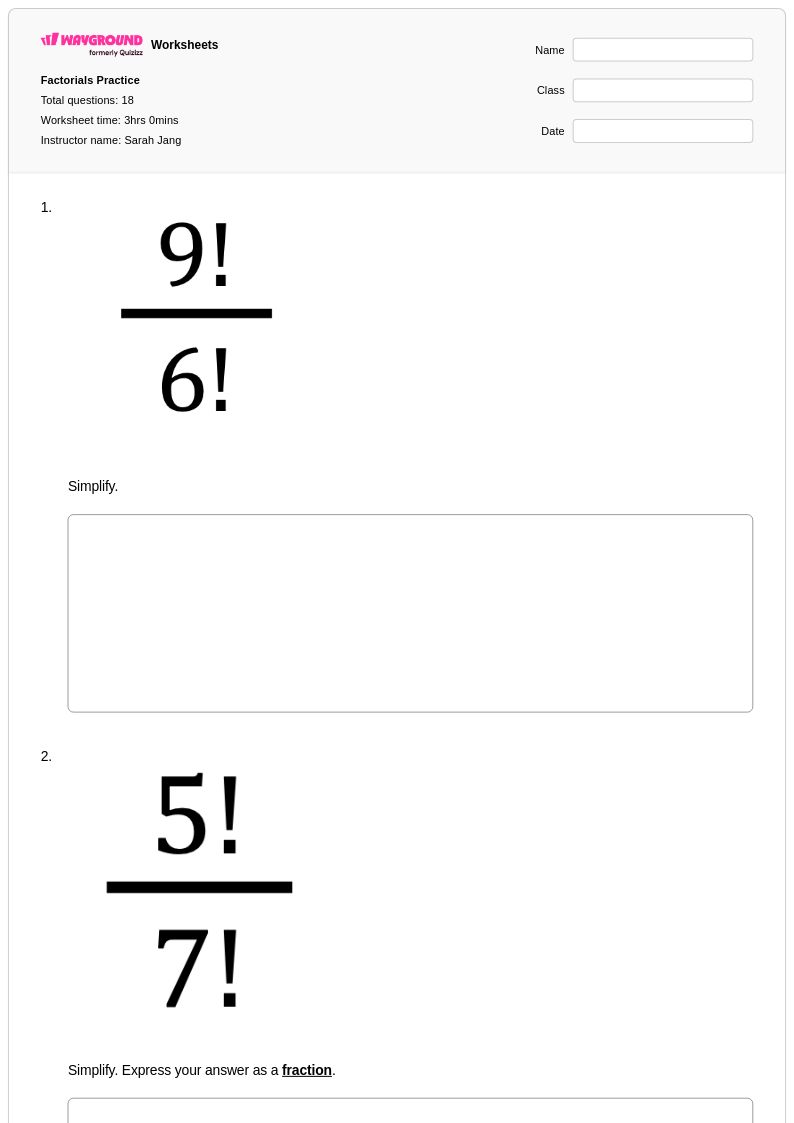
Grade 9 practice should go beyond computation into application and algebraic manipulation: simplifying expressions like (n+2)!/n!, evaluating permutation and combination formulas, and solving probability problems where students must set up the factorial expression themselves. Problems that require students to decide whether order matters — and therefore whether to use a permutation or combination — are especially valuable because they test conceptual understanding, not just arithmetic.
What mistakes do 9th graders commonly make with factorials?
The most common error at this level is misidentifying whether a problem calls for a permutation or a combination — students reach for the factorial formula but apply the wrong one. A related issue: when working with algebraic factorial expressions, students substitute specific numbers to check their work but then can't generalize back to the symbolic form. Also watch for errors with 0! in combination formulas, where C(n,n) = 1 requires students to accept that 0! = 1 in a non-trivial context.
How do I use Wayground's Grade 9 factorial worksheets?
You can assign these as a digital quiz on Wayground — useful for homework or independent practice where you want automatic scoring. Every worksheet includes a complete answer key, so paper-based use is equally practical: print the PDF, assign it in class or as homework, and use the Wayground for Teachers app to scan and grade submissions. The digital and print versions cover the same problems, so the choice comes down to your classroom setup.
How do factorials connect to the broader 9th grade math curriculum?
In Common Core-aligned high school progressions, probability and counting principles are a formal strand that builds on the informal counting work from middle school. Factorial fluency is the prerequisite for working with permutations, combinations, and eventually the binomial theorem. At Grade 9, the key transition is from computing factorials to using them inside formulas — students who can simplify factorial expressions quickly spend their cognitive effort on the probability reasoning, not the arithmetic.
How can I differentiate factorial practice for 9th graders with different skill levels?
Students who need reinforcement benefit from problems that isolate one skill at a time — simplify the expression, then separately apply the formula, rather than combining both in one problem. Students ready for enrichment can work on algebraic factorial identities or probability problems with multiple stages. On Wayground, the Read Aloud feature helps students who process word problems better by hearing them, and you can translate the worksheet for students whose first language isn't English — both accommodations apply to the same worksheet without creating a separate version.