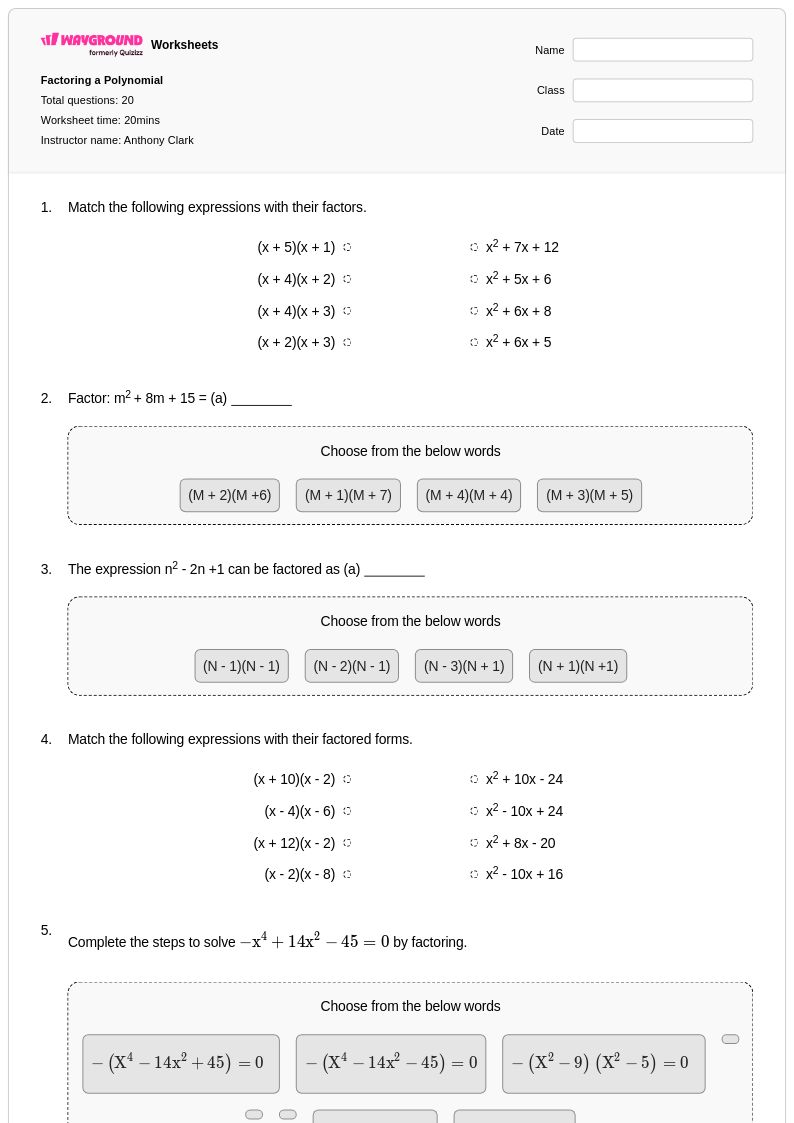
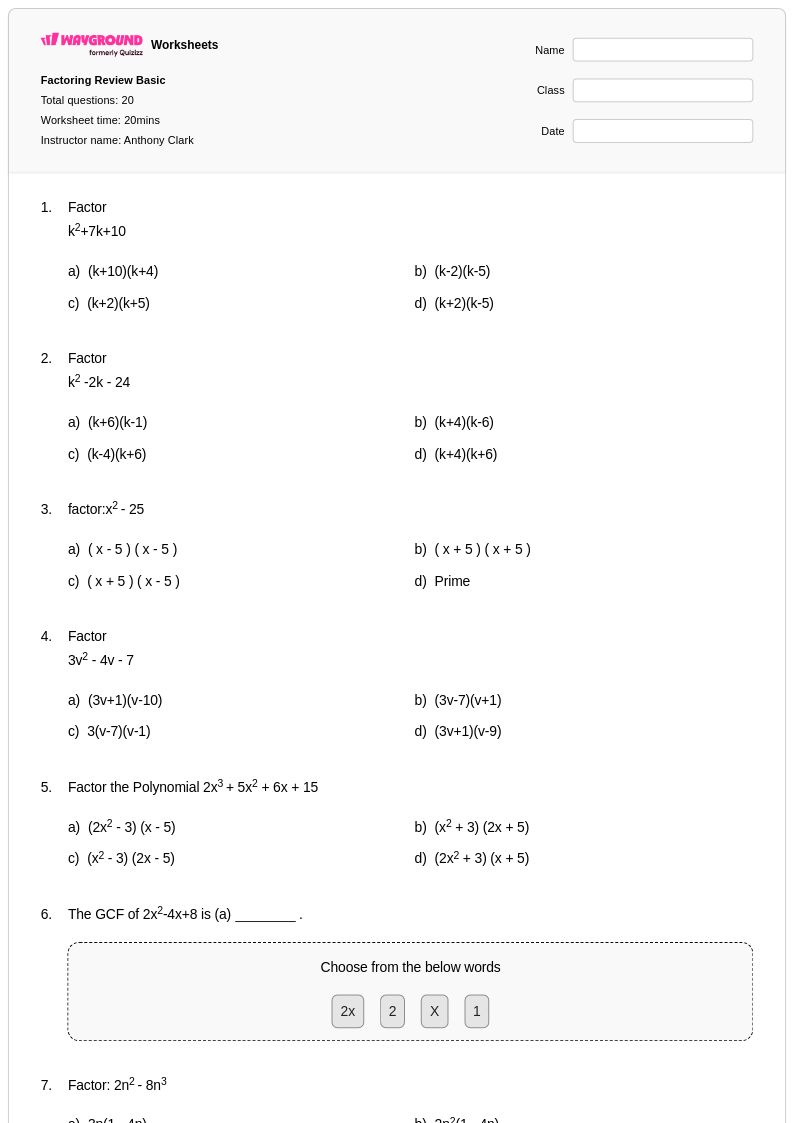
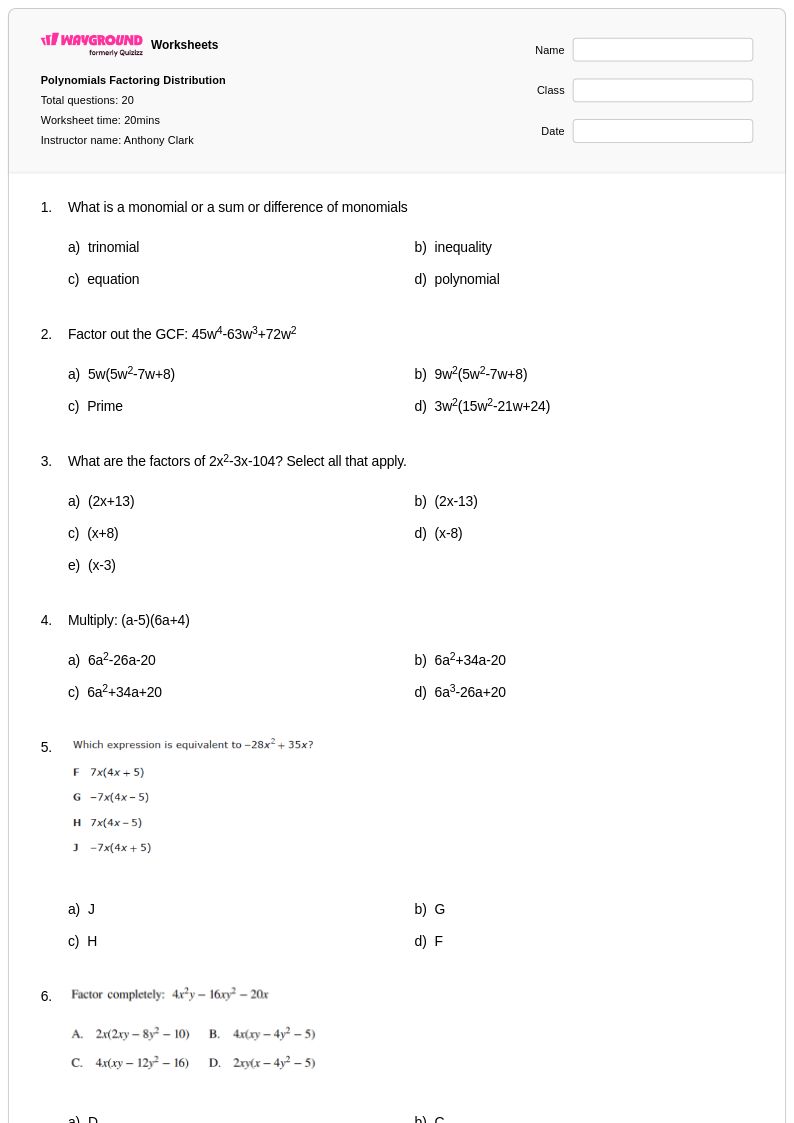
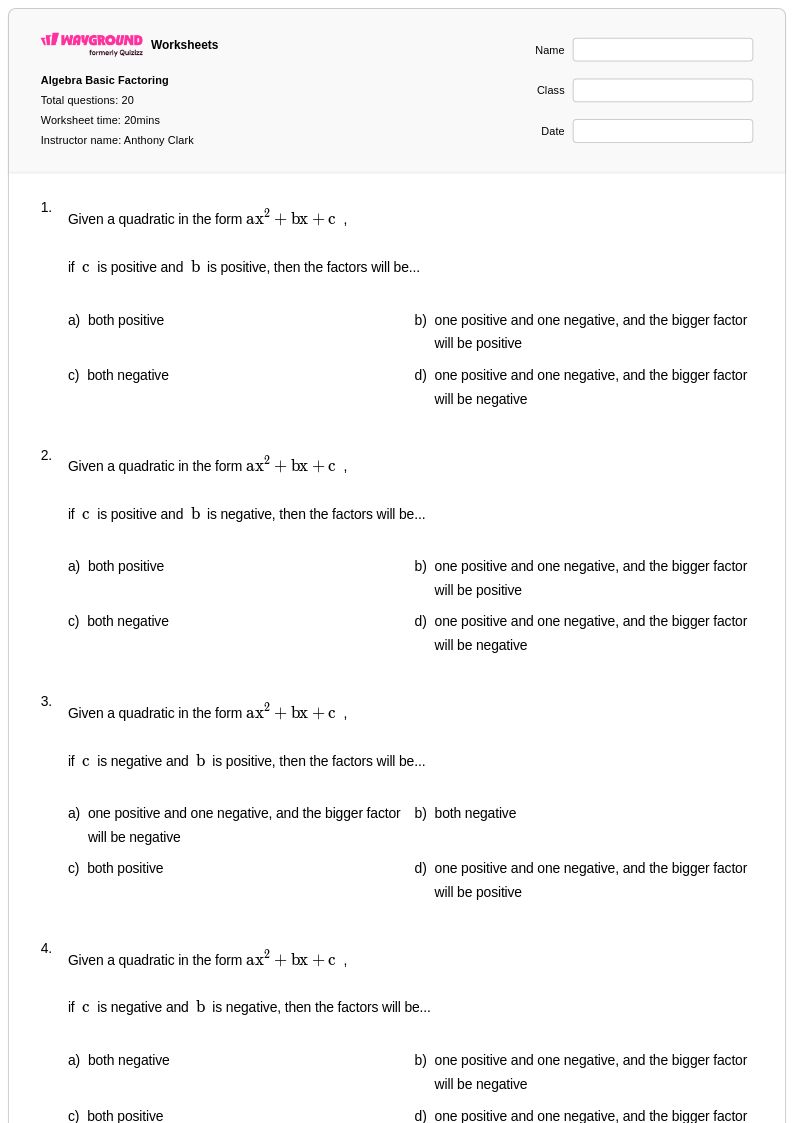
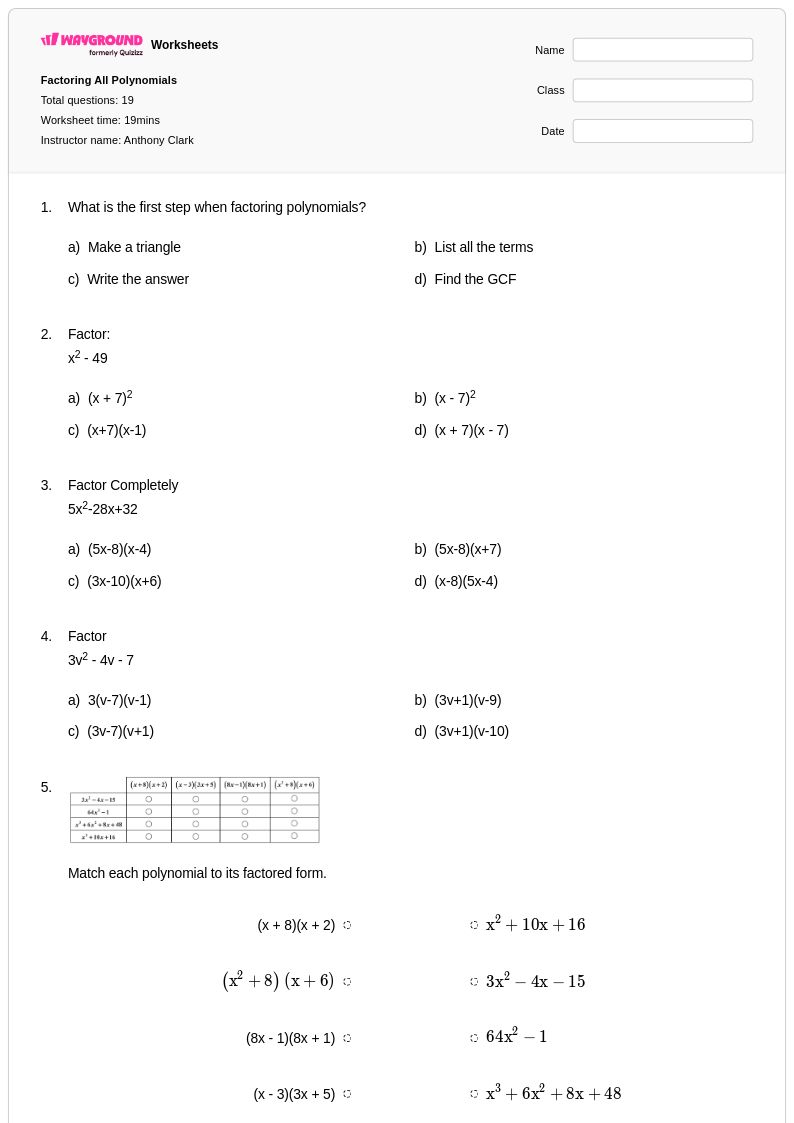
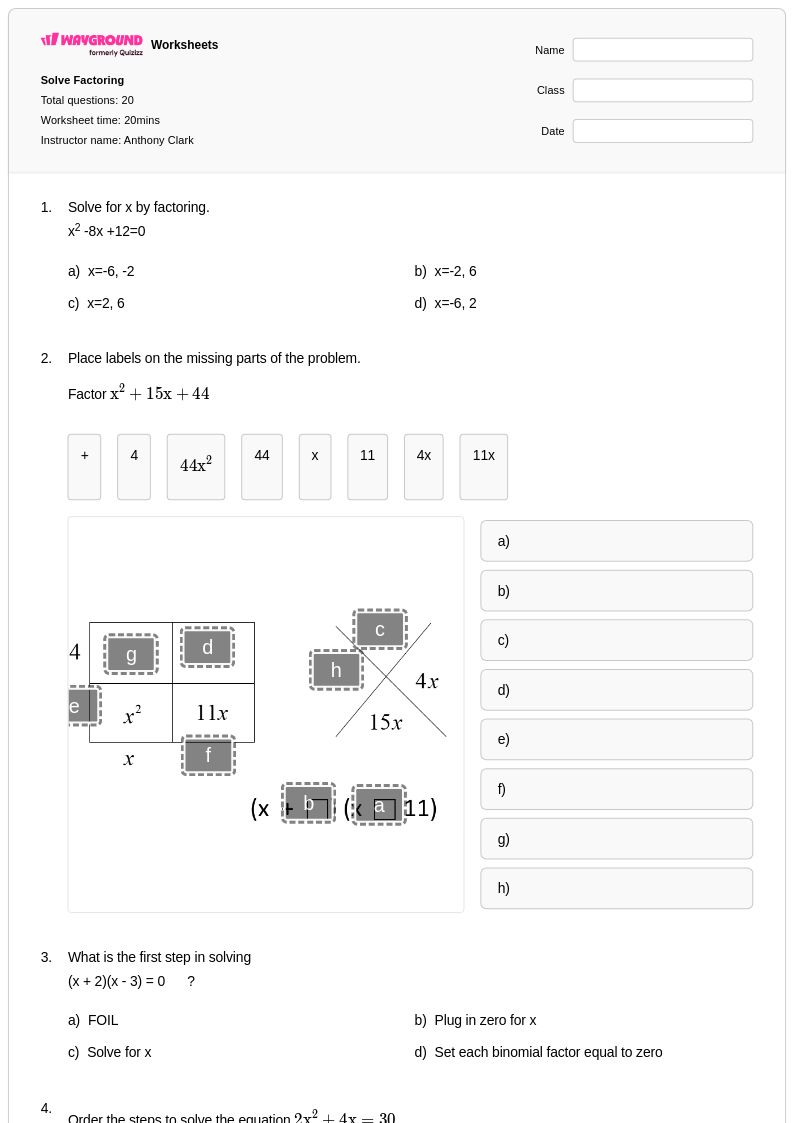
Year 9 algebra factoring worksheets from Wayground provide comprehensive printables with practice problems and answer keys to help students master polynomial factorization techniques through structured PDF exercises.
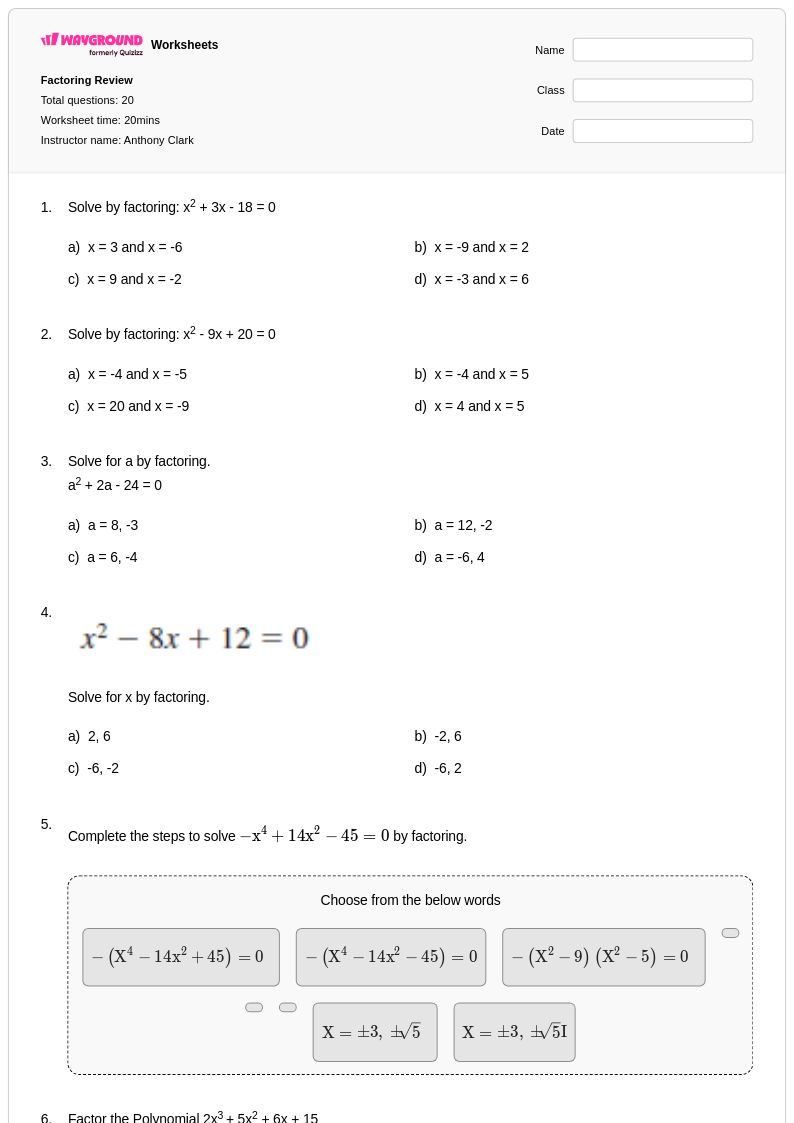
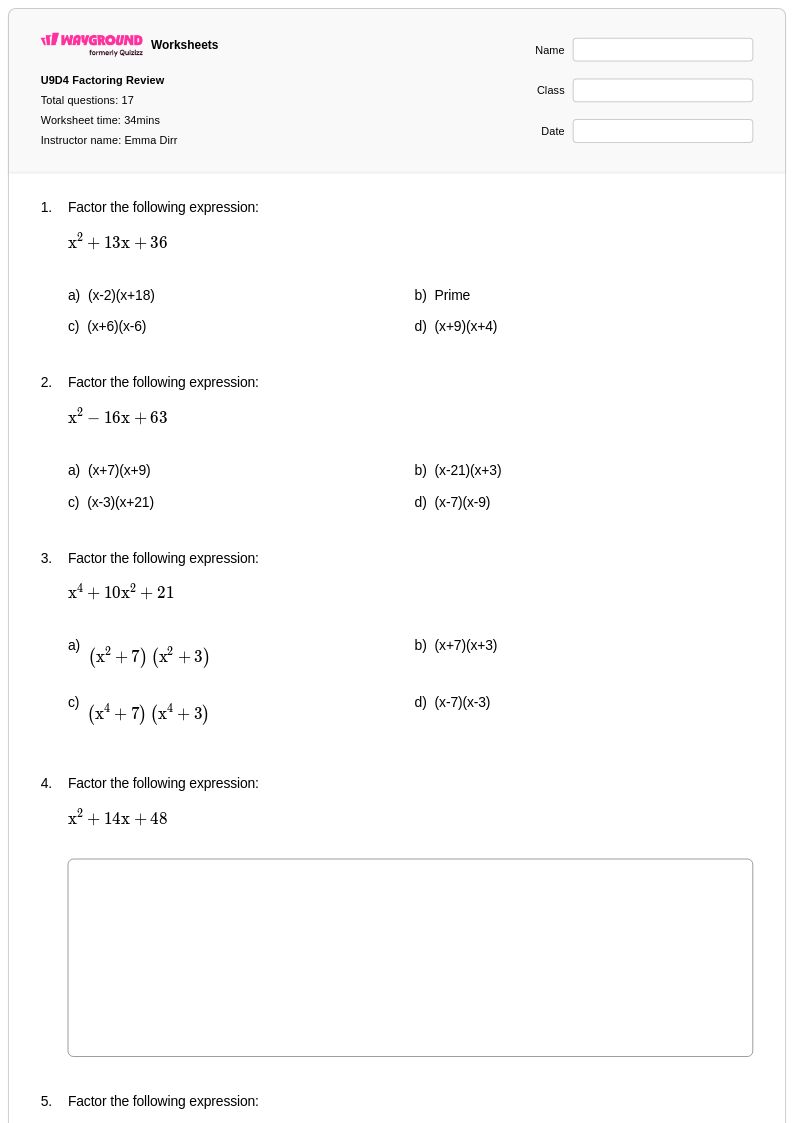
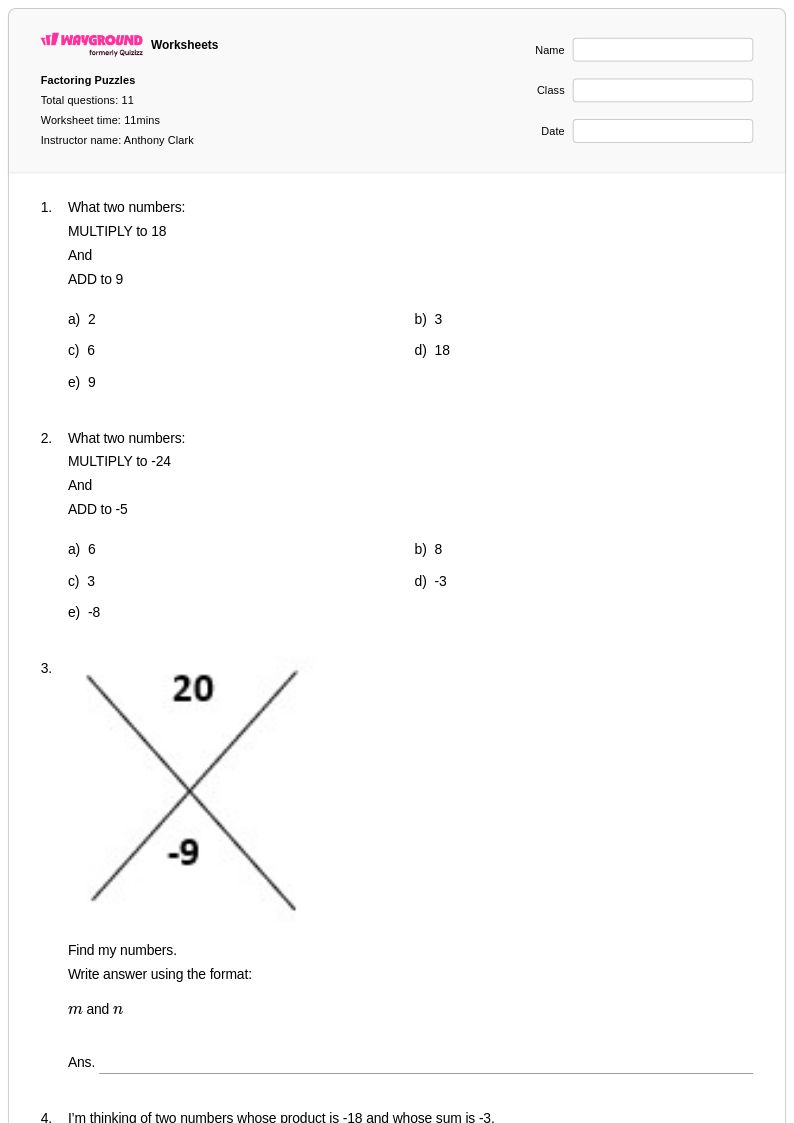
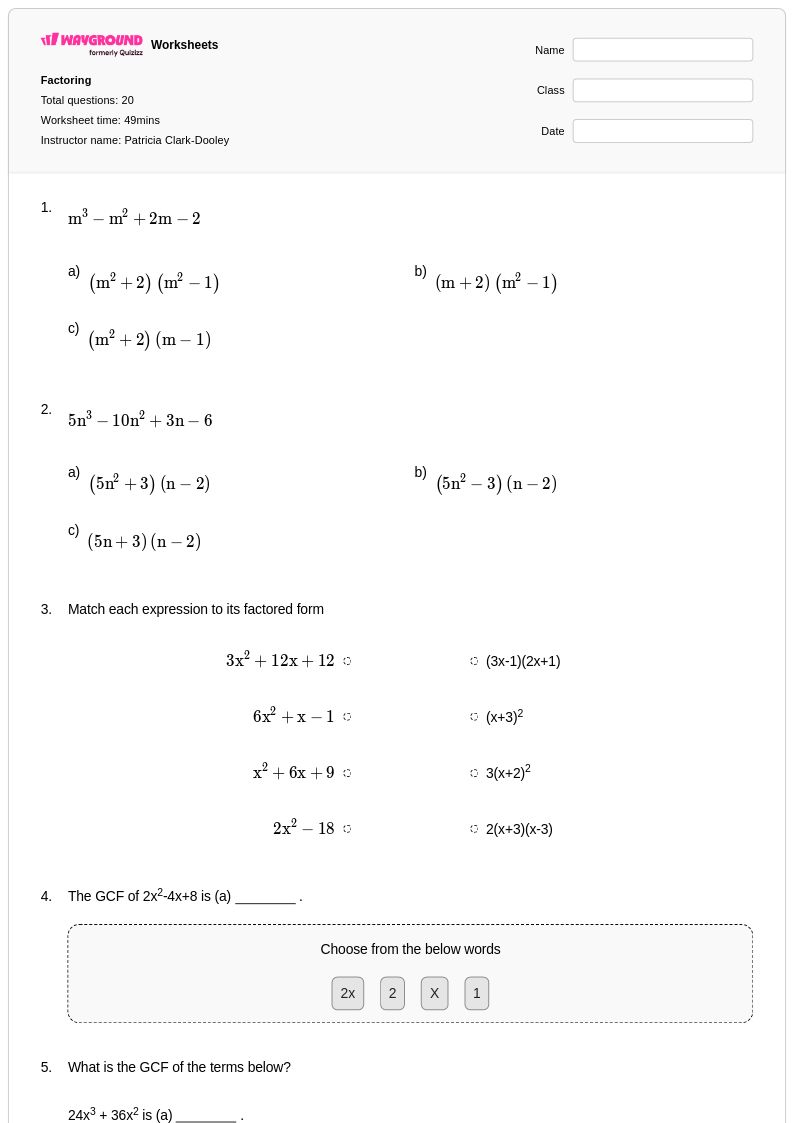
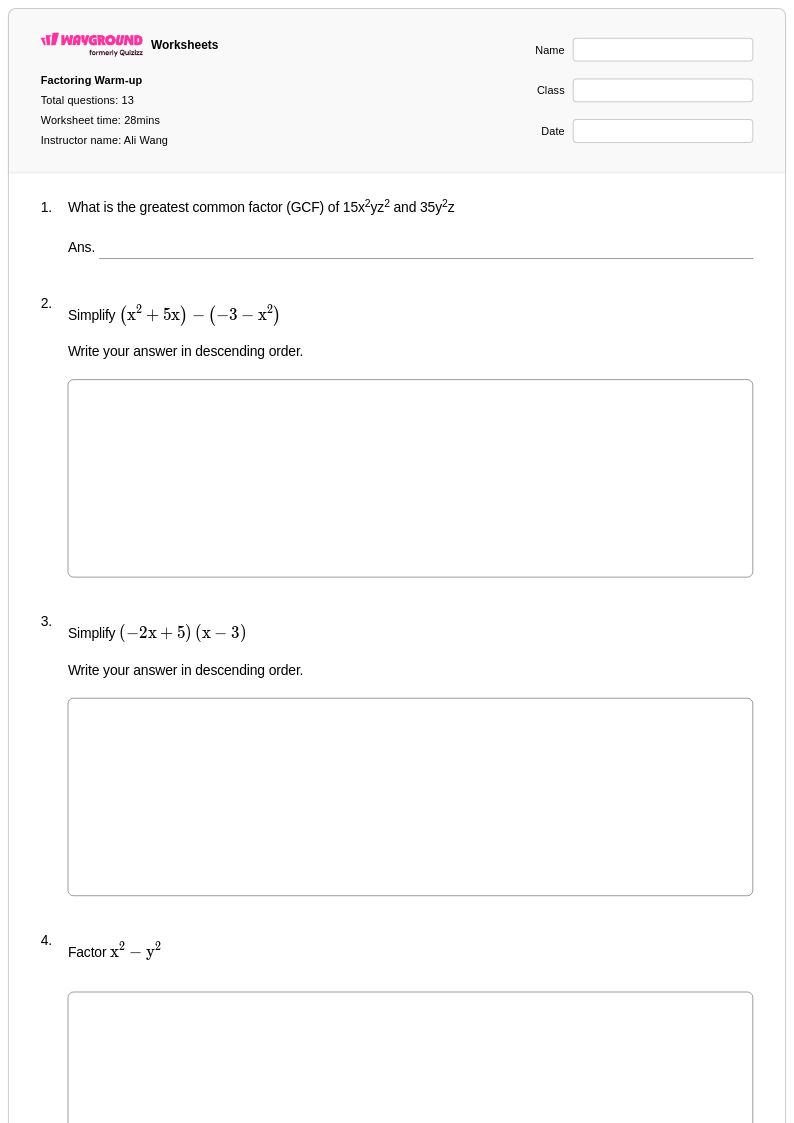
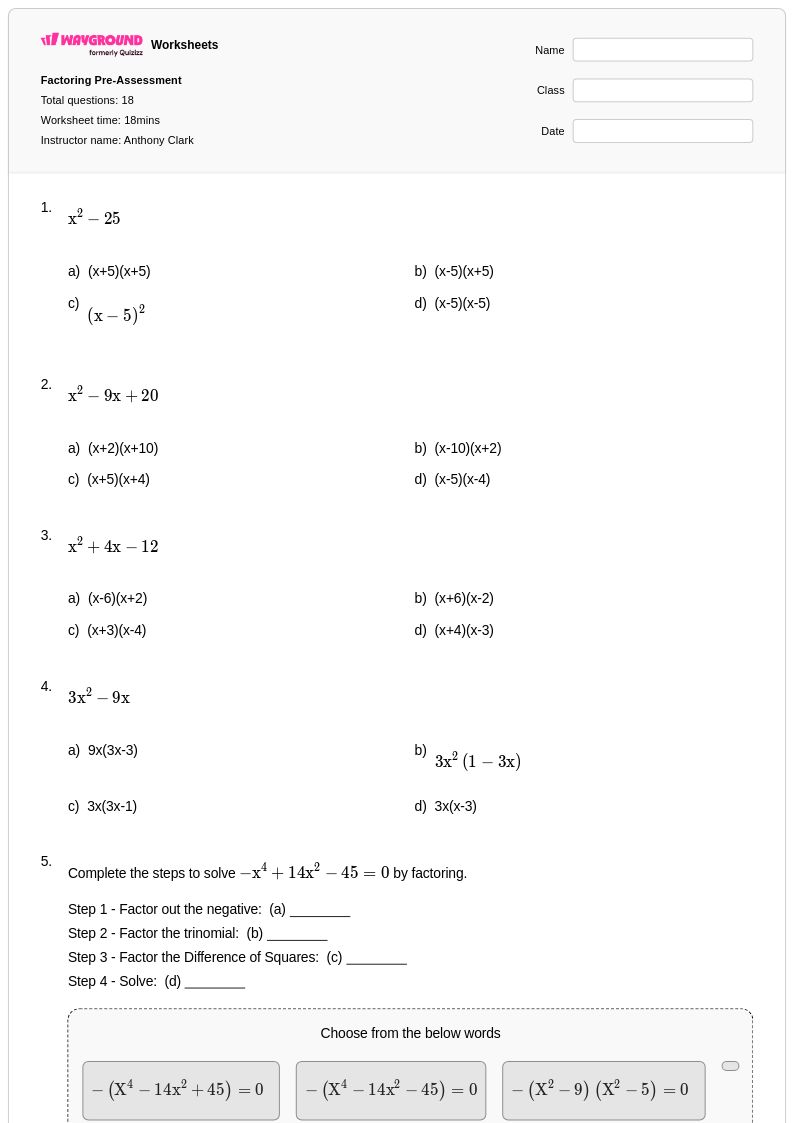
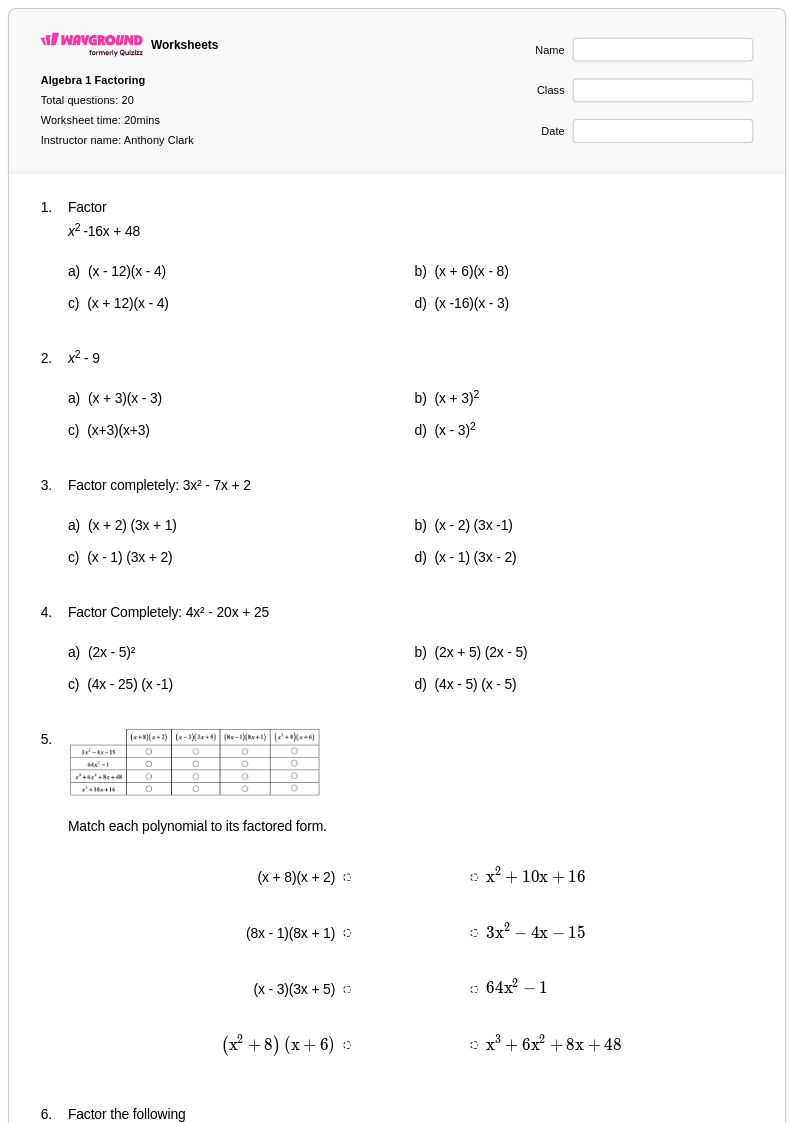
Factoring worksheets for Year 9 students available through Wayground (formerly Quizizz) provide comprehensive practice with essential algebraic techniques that form the foundation of advanced mathematical problem-solving. These carefully designed worksheets guide students through systematic approaches to factoring polynomials, including greatest common factor extraction, factoring by grouping, and working with quadratic expressions using methods such as factoring trinomials and difference of squares. Each worksheet collection strengthens critical algebraic reasoning skills while building confidence in pattern recognition and mathematical manipulation. Students benefit from structured practice problems that progress from basic factoring concepts to more complex polynomial expressions, with complete answer keys provided to support independent learning and self-assessment. These free printable resources serve as valuable tools for mastering the factoring techniques that are crucial for success in higher-level algebra courses.
Wayground (formerly Quizizz) empowers educators with millions of teacher-created factoring worksheet resources that streamline instruction and support diverse learning needs in Year 9 algebra classrooms. The platform's robust search and filtering capabilities allow teachers to quickly locate worksheets aligned with specific curriculum standards and learning objectives, while built-in differentiation tools enable customization for students at varying skill levels. Teachers can access these resources in both printable pdf formats for traditional classroom use and digital formats for interactive online learning environments. This flexibility supports comprehensive lesson planning by providing options for initial skill introduction, targeted remediation for struggling students, and enrichment activities for advanced learners. The extensive collection ensures that educators have access to varied practice problems and assessment materials that reinforce factoring concepts through multiple approaches, helping students develop mastery of these fundamental algebraic skills through consistent, well-structured practice opportunities.
FAQs
How do I teach factoring in 9th grade algebra?
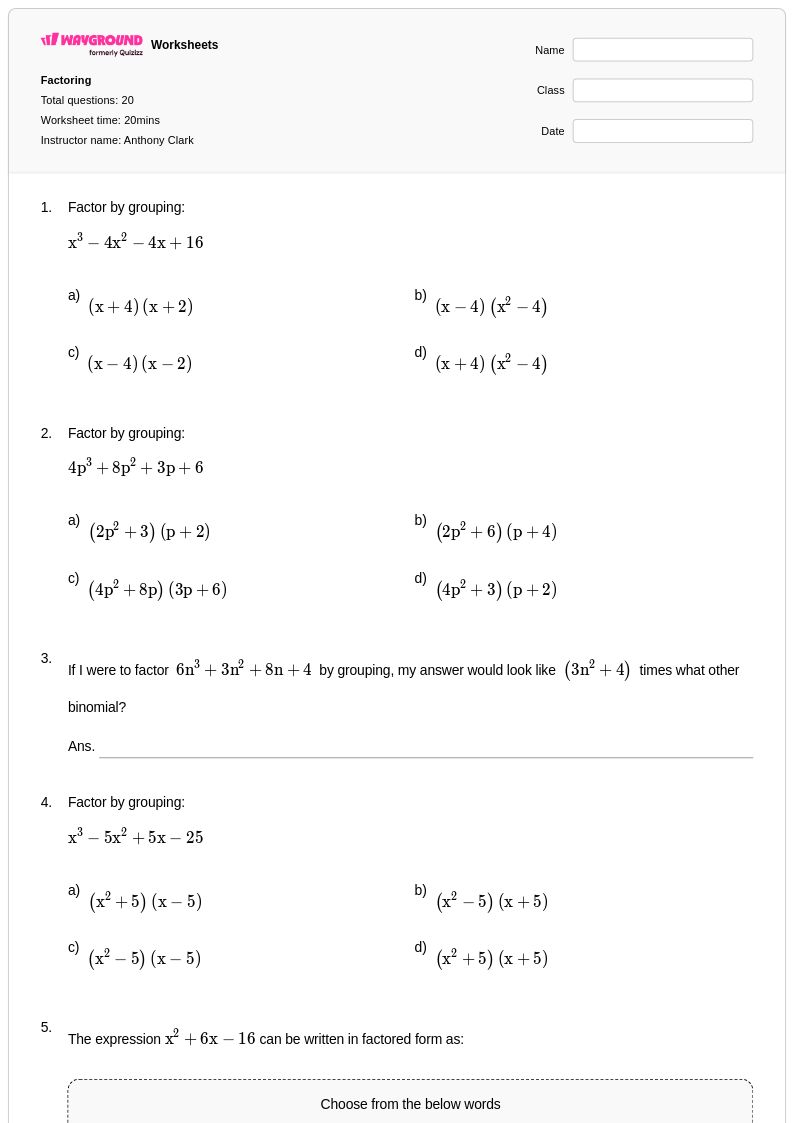
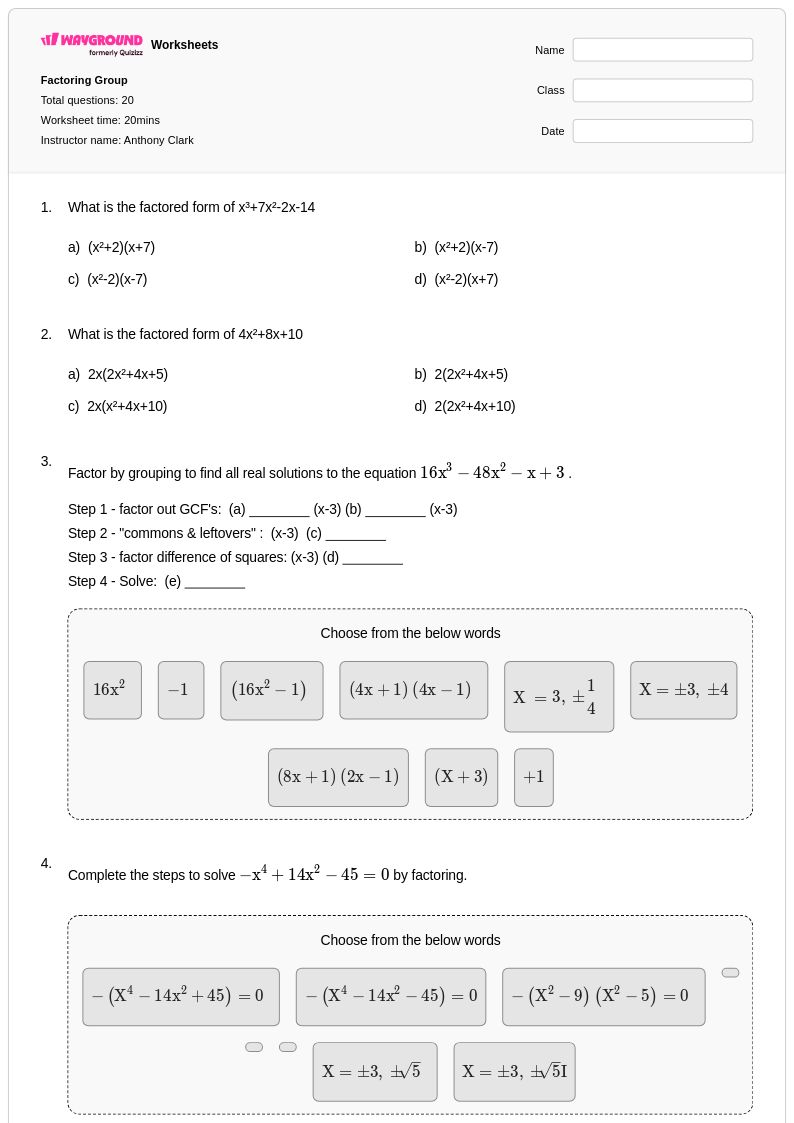
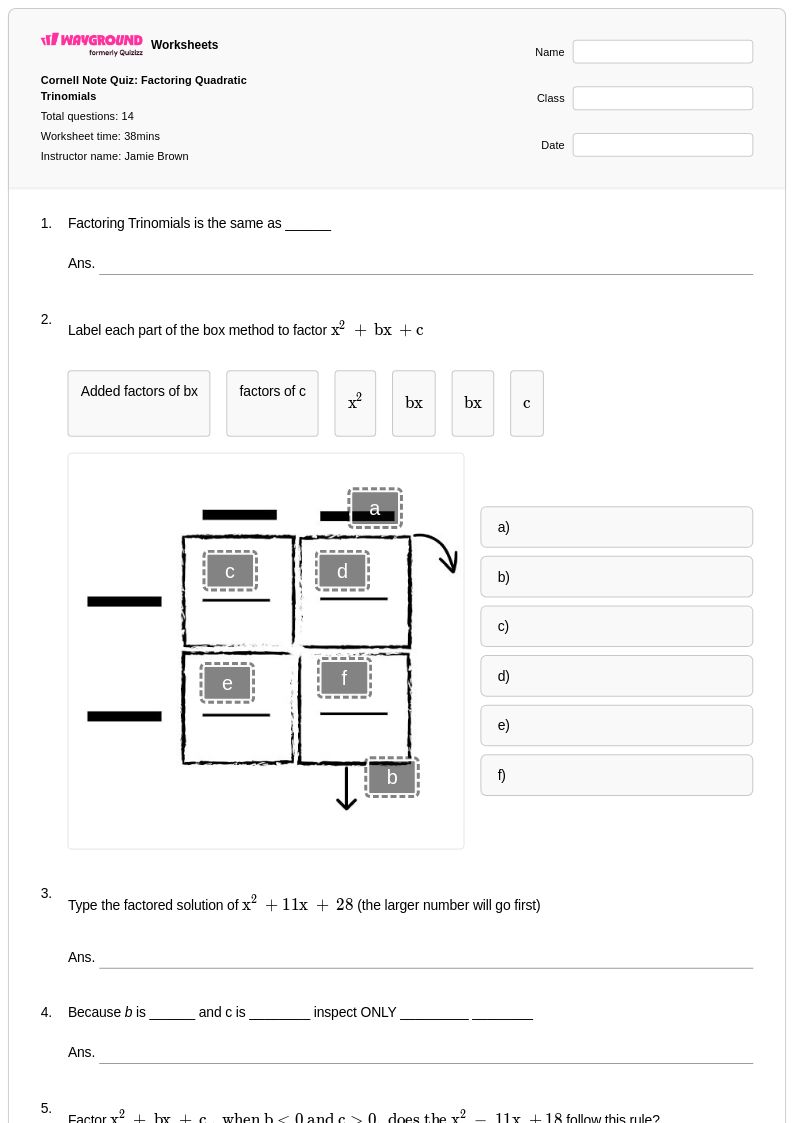
By Grade 9, factoring should be taught as a problem-solving tool, not just a manipulation skill. Students need to recognize which method applies — GCF, difference of squares, trinomial factoring, or grouping — before they execute any steps. A useful classroom routine: present a polynomial and ask students to identify its structure first, then choose a method. This builds the pattern recognition that separates students who factor fluently from those who apply procedures randomly.
What factoring methods should 9th graders be able to use?
A solid Grade 9 factoring toolkit includes: GCF extraction, factoring trinomials (both with leading coefficient 1 and using the AC method), difference of squares, and factoring by grouping for four-term polynomials. Students should also be able to combine these — for example, factoring out a GCF first, then recognizing the remaining expression as a difference of squares.
What misconceptions do 9th graders have about factoring?
Two misconceptions show up repeatedly. First, students treat factoring as optional — they'll solve a quadratic by other means rather than factor because they're not confident the expression is factorable. Second, students often stop too early, declaring something factored when a factor can still be broken down further. Both come from weak pattern recognition; targeted practice with mixed-type problems (where students must first decide what kind of expression they're looking at) addresses both.
How do I use Wayground's Grade 9 factoring worksheets in my classroom?
The worksheets are available as printable PDFs with complete answer keys included — useful for independent practice, test prep, or homework where students self-check. For schools reducing screen time, paper-based practice with these PDFs keeps the rigor off-screen. Alternatively, host any worksheet as a digital quiz on Wayground if you want students working online with immediate feedback.
How does factoring fit into the Common Core high school algebra progression?
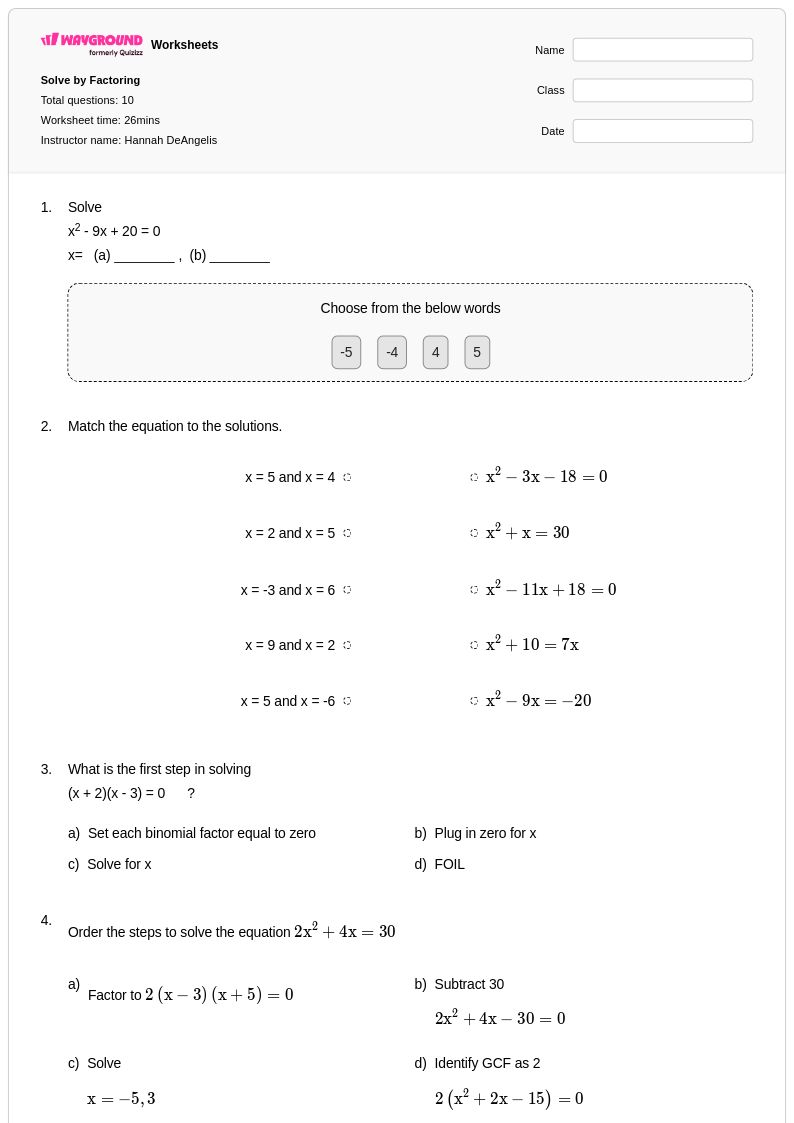
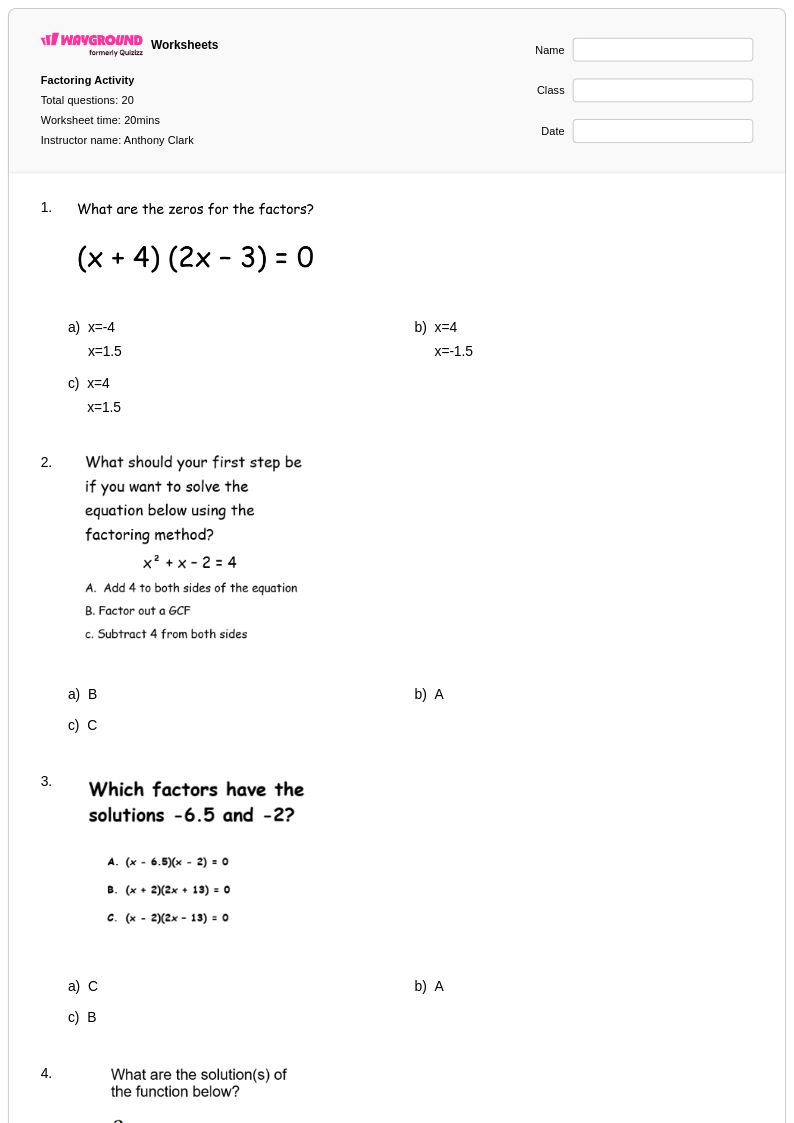
Common Core's high school algebra strand treats factoring as a prerequisite for solving polynomial equations and understanding the structure of expressions. At Grade 9, the expectation is that students can factor quadratics fluently and use factoring to solve equations — specifically, recognizing that if (x − 3)(x + 2) = 0, then x must be 3 or −2. Factoring by grouping and the AC method extend that fluency to more complex polynomials students encounter in later algebra and precalculus work.
What is the AC method for factoring trinomials?
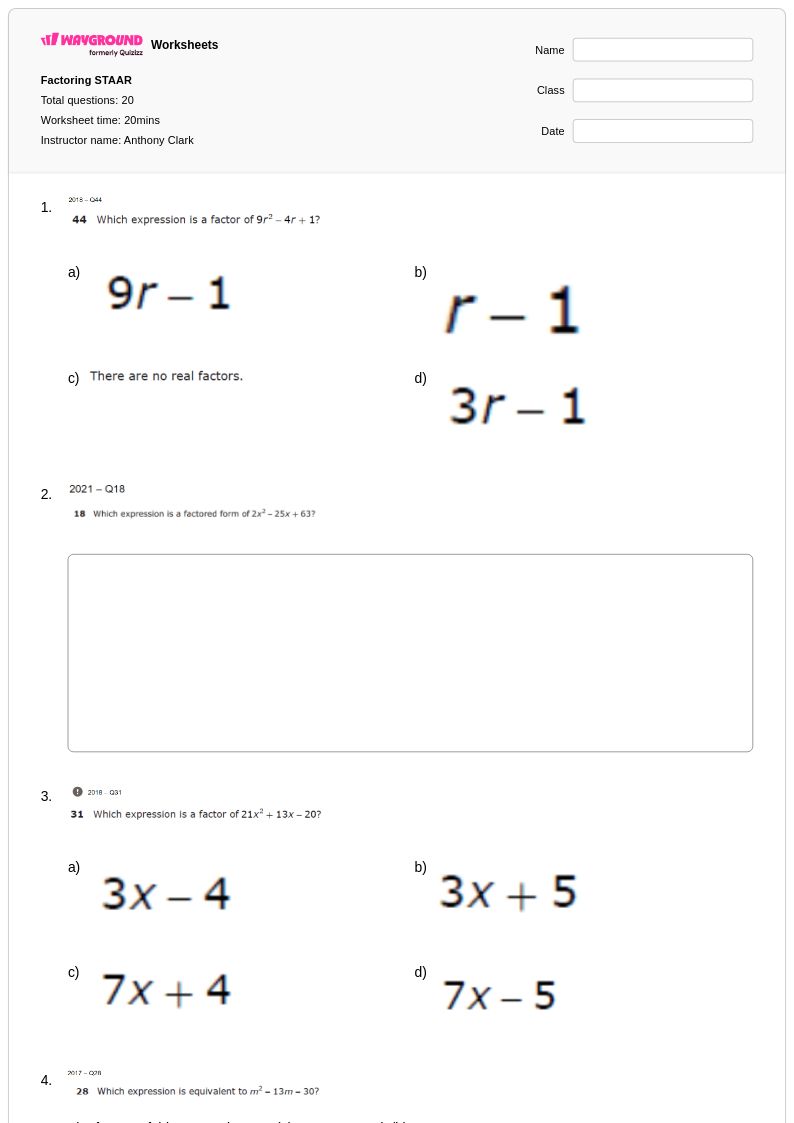
The AC method factors trinomials of the form ax² + bx + c by multiplying a and c, finding two numbers that multiply to ac and add to b, then using those numbers to rewrite the middle term and factor by grouping. It's the go-to method when the leading coefficient isn't 1 and trial-and-error becomes impractical. For Grade 9 students, it's worth practicing until the "find two numbers" step feels automatic — that's where most of the time gets lost.
How can I differentiate factoring practice for 9th graders at different skill levels?
For students still shaky on the basics, Wayground's reduced answer choices accommodation helps them focus on method selection without being overwhelmed by open-ended recall. For students who are ready to go further, the same worksheet collection includes multi-step problems that require combining techniques. You can also create an alternate worksheet version with a dyslexia-friendly font or translated into another language for students who need it — without rebuilding the problem set from scratch.