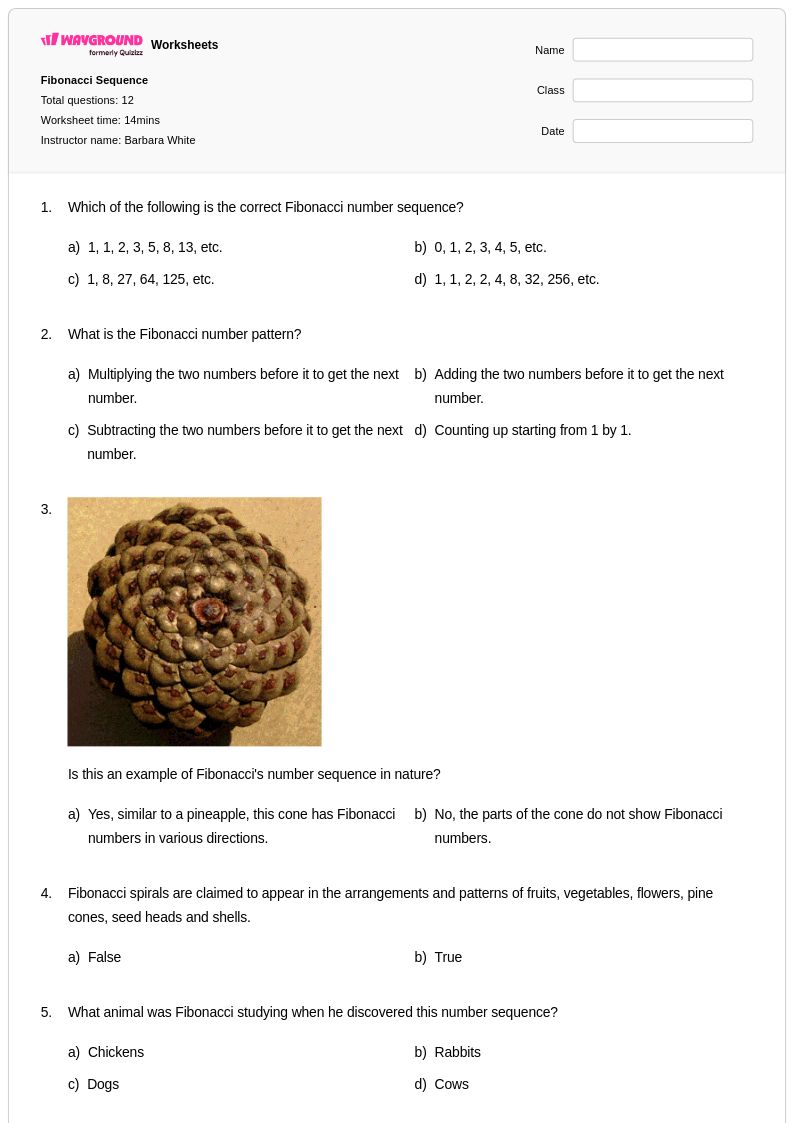
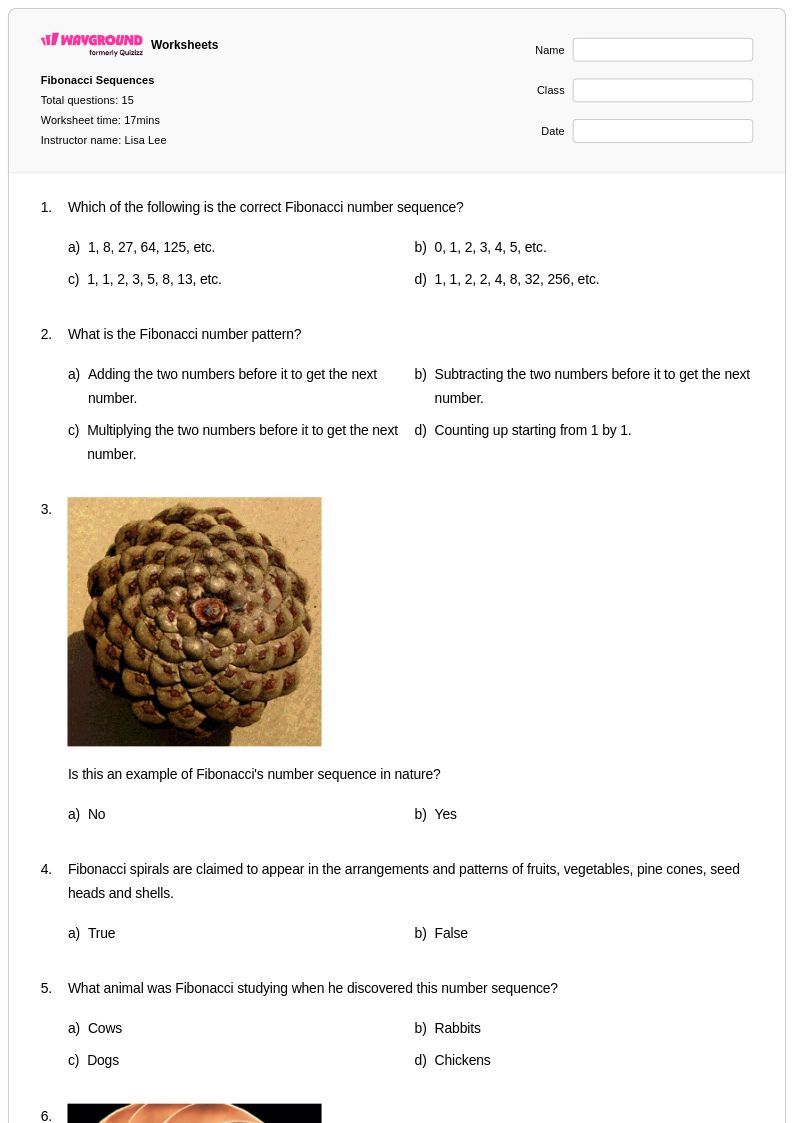
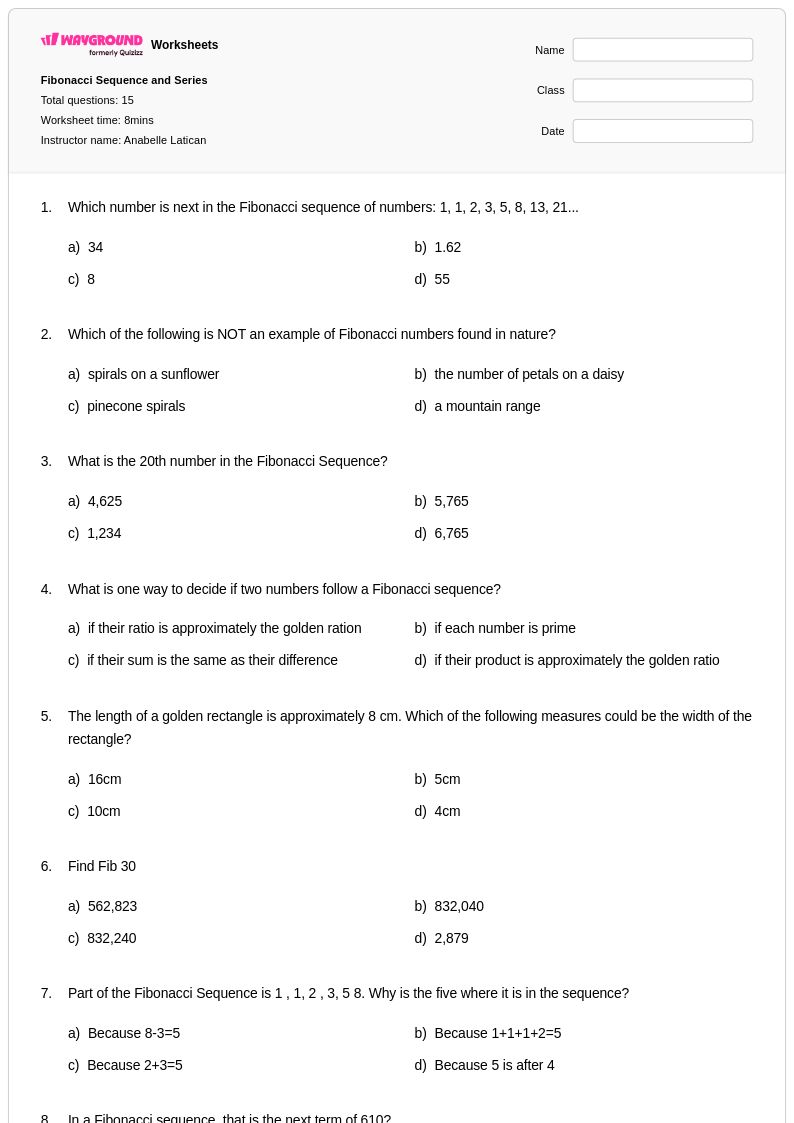
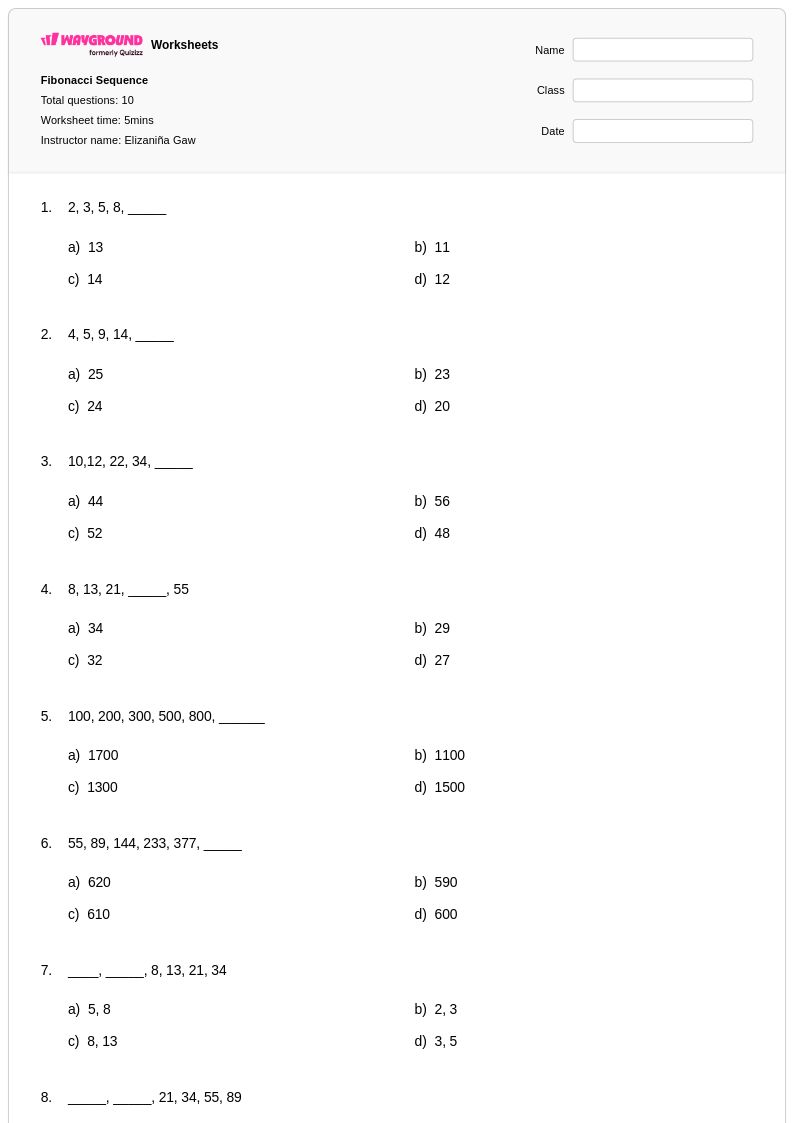
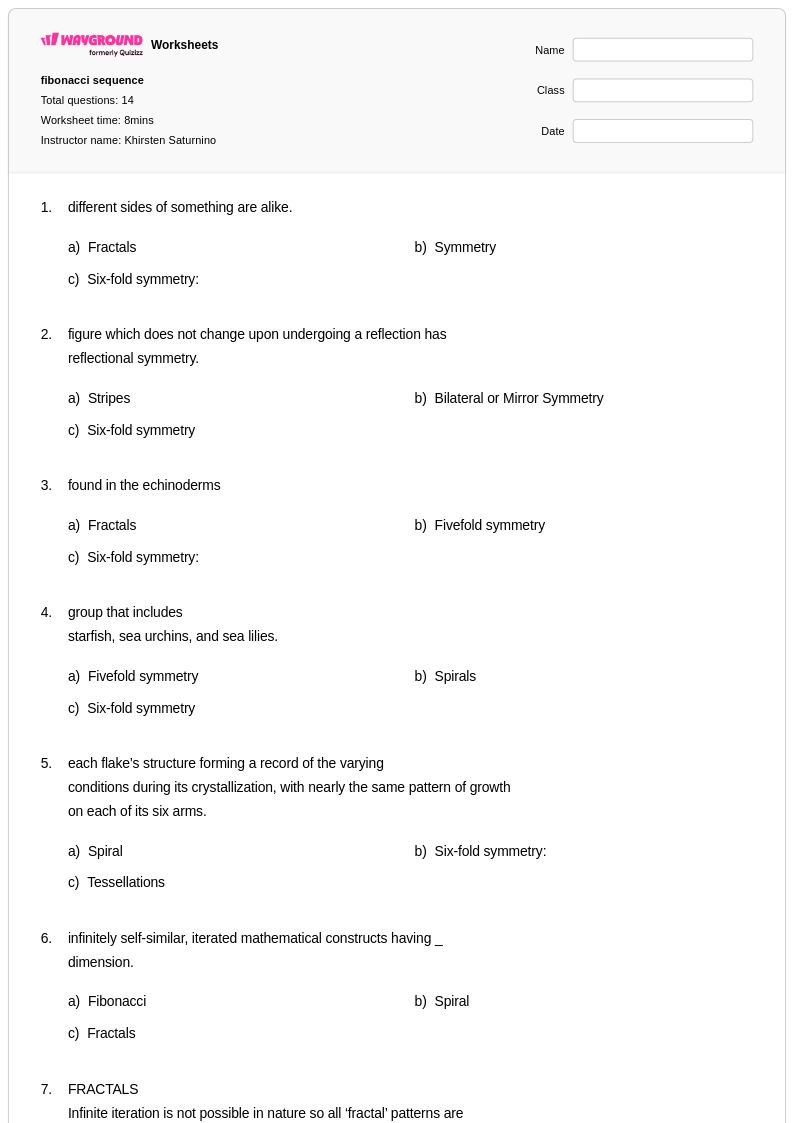
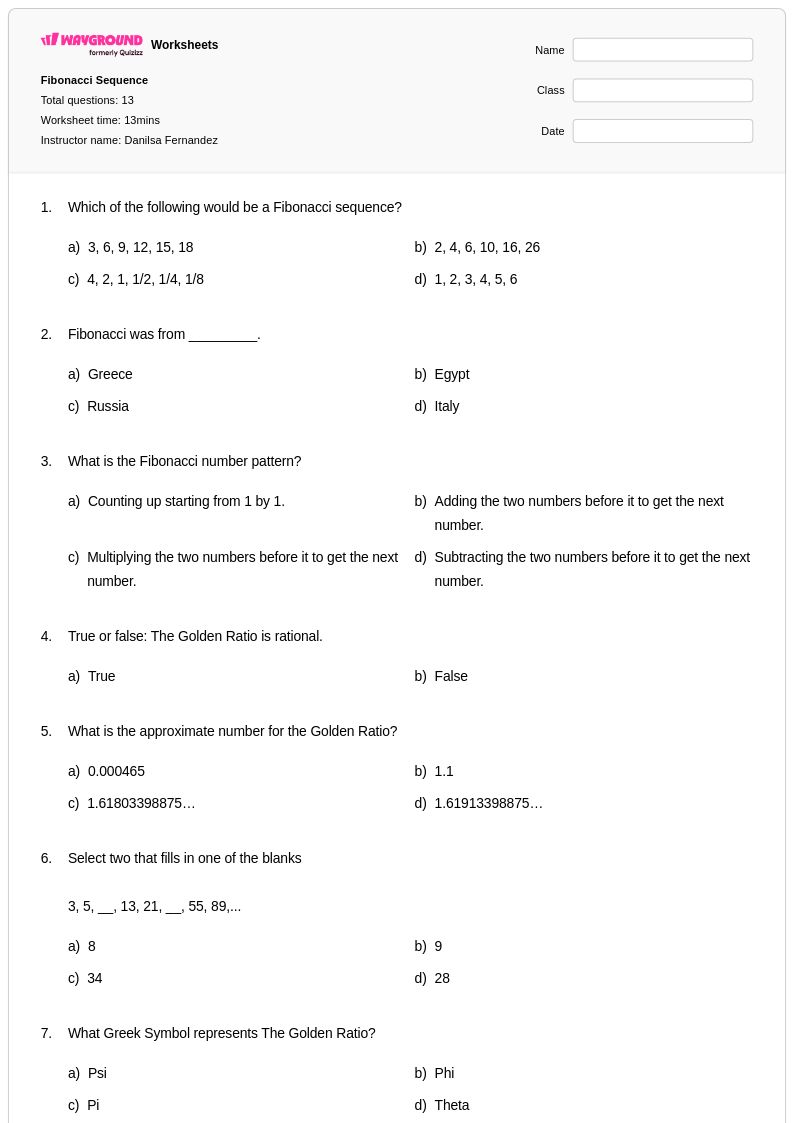
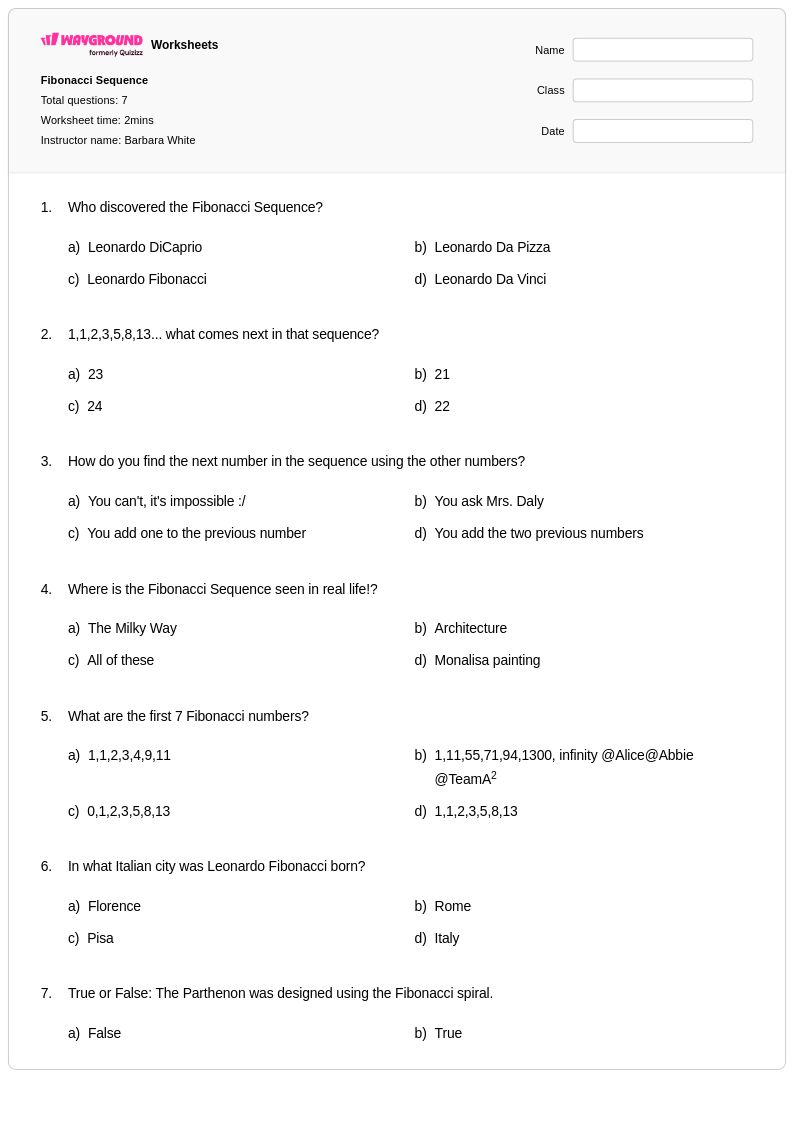
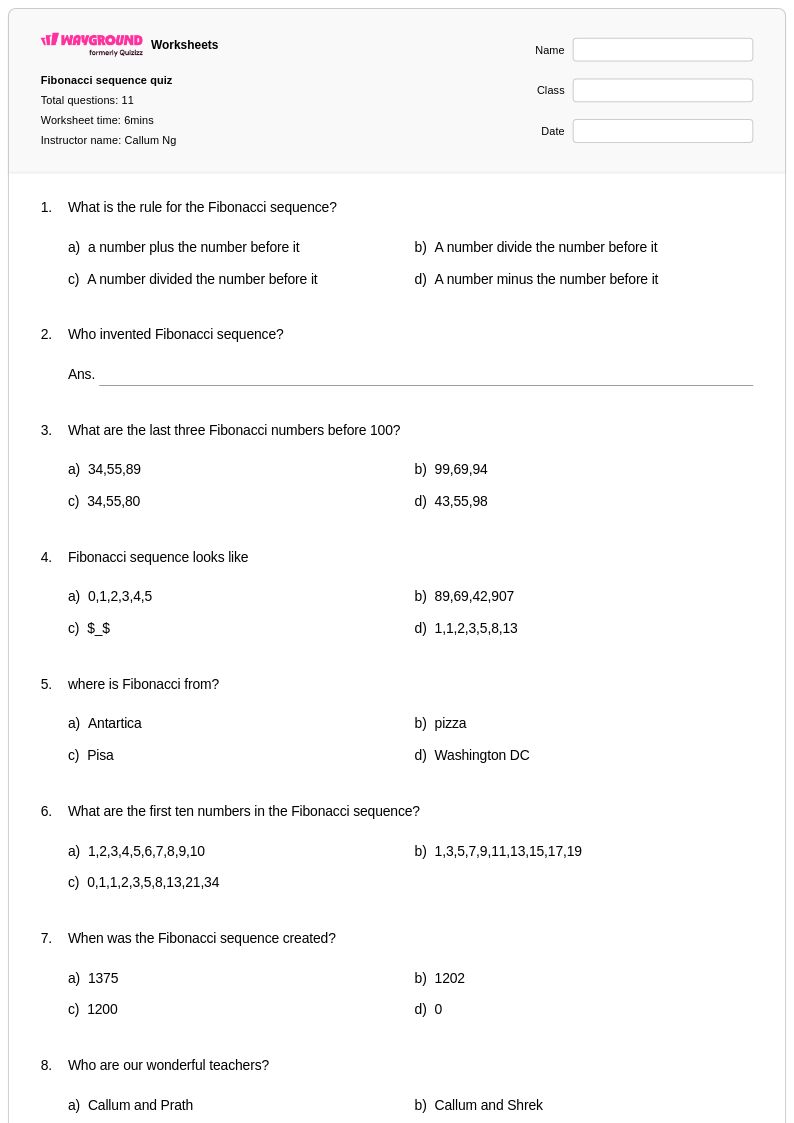
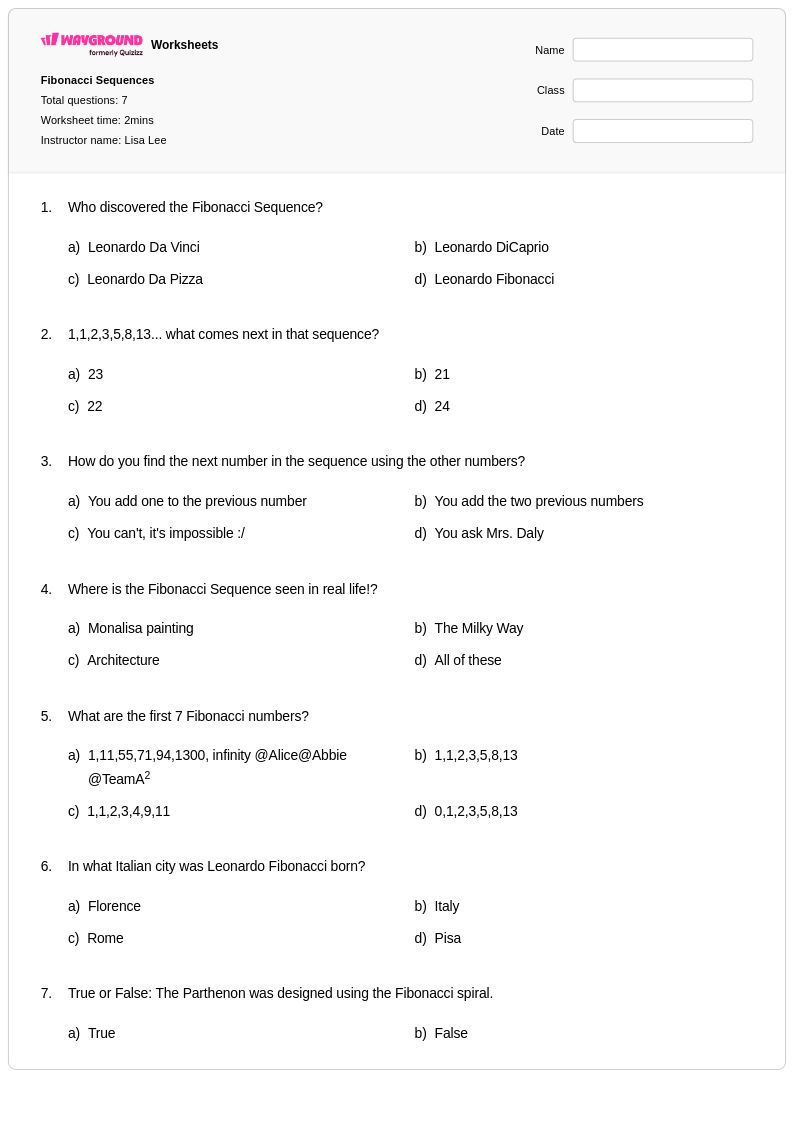
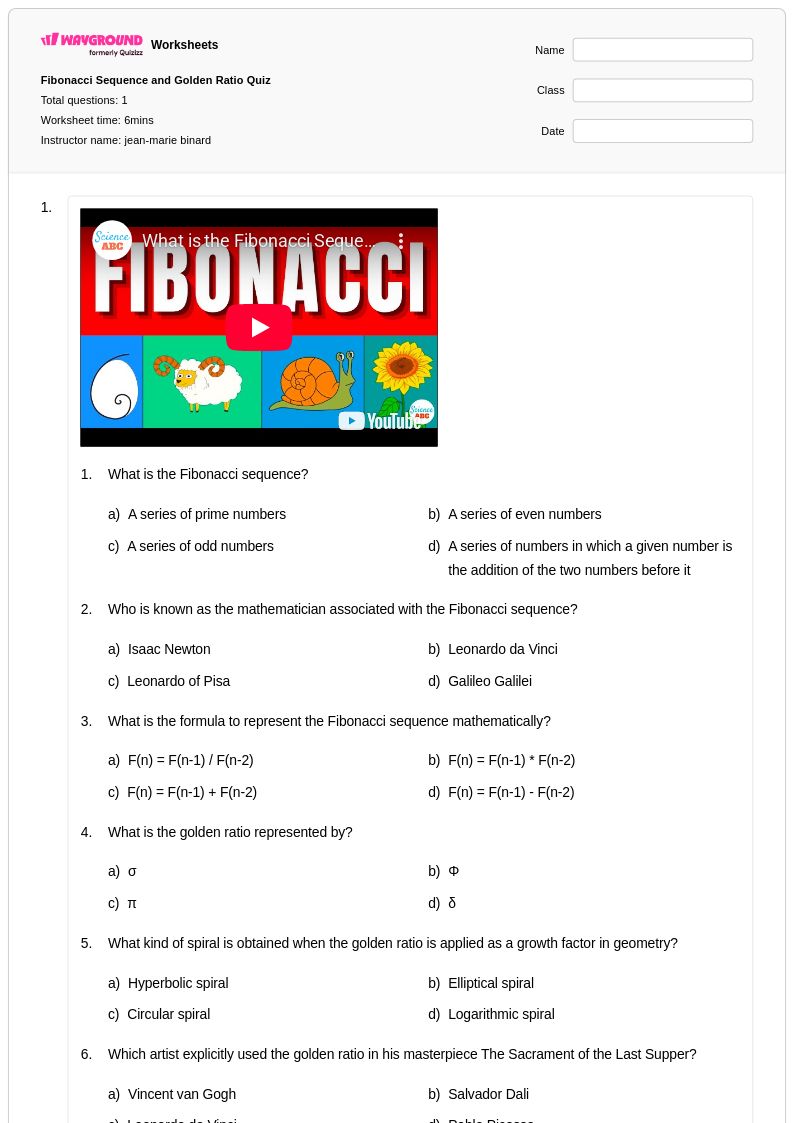
Explore Wayground's free Fibonacci Sequence worksheets and printables featuring practice problems that help students master this fascinating mathematical pattern, complete with detailed answer keys and downloadable PDFs.
Fibonacci sequence worksheets available through Wayground (formerly Quizizz) provide students with comprehensive practice in understanding and working with one of mathematics' most fascinating numerical patterns. These educational resources focus on developing critical skills including pattern recognition, recursive thinking, and the ability to identify the mathematical relationships that govern the Fibonacci sequence where each term equals the sum of the two preceding terms. Students engage with practice problems that range from basic sequence generation and term identification to more advanced applications involving the golden ratio, spiral patterns in nature, and mathematical proofs. Each worksheet comes with a complete answer key, ensuring students can verify their work and teachers can efficiently assess understanding, while the free printable pdf format makes these resources easily accessible for classroom use, homework assignments, and independent study sessions.
Wayground (formerly Quizizz) empowers educators with an extensive collection of millions of teacher-created Fibonacci sequence worksheets that support diverse instructional needs and learning objectives. The platform's robust search and filtering capabilities allow teachers to quickly locate resources that align with specific curriculum standards and match their students' skill levels, while built-in differentiation tools enable customization for learners requiring additional support or enrichment opportunities. These worksheets are available in both printable pdf formats for traditional paper-and-pencil work and digital formats for interactive online learning, providing flexibility for various teaching environments and student preferences. Teachers utilize these comprehensive resources for lesson planning, targeted remediation of conceptual gaps, extension activities for advanced learners, and regular skill practice that reinforces understanding of this fundamental mathematical sequence and its real-world applications.
FAQs
How do I teach the Fibonacci sequence?
Start with the rule before the numbers: ask students to add any two consecutive terms and see what they get. Once they've discovered the pattern themselves, extend it — have them generate the sequence from scratch, then look for it in pinecones, sunflower seeds, or shell spirals. That concrete-to-abstract move (pattern → rule → real-world appearance) tends to stick better than presenting the sequence as a memorization task.
What exercises help students practice the Fibonacci sequence?
The most effective practice moves through three levels: filling in missing terms, explaining why a given number does or doesn't belong in the sequence, and extending the sequence beyond familiar territory. Wayground's Fibonacci worksheets cover this range — from basic term identification to applications involving the golden ratio and spiral patterns — so students aren't just drilling the same skill repeatedly.
What mistakes do students commonly make with the Fibonacci sequence?
Two errors come up constantly. First, students add the last term to a fixed number (often 1) instead of to the previous term — they've memorized the start of the sequence but missed the recursive rule. Second, they struggle with the sequence's two starting values: some versions begin 0, 1, 1, 2... and others begin 1, 1, 2, 3... and students treat any discrepancy as an error. Clarifying that both are valid conventions, and drilling the rule rather than the list, clears up most confusion.
How do I use Wayground's Fibonacci sequence worksheets in my class?
You can run these as a digital quiz hosted on Wayground — students complete it on any device and results come back to you automatically — or download the PDF and hand it out as a paper assignment. Every worksheet includes a complete answer key, so paper submissions are easy to review. If you're grading printed work, the Wayground for Teachers app lets you scan or capture student responses to grade them directly from your phone.
Is the Fibonacci sequence part of Common Core math standards?
The Fibonacci sequence isn't a named Common Core standard, but it sits squarely within Common Core's emphasis on recognizing and extending numerical patterns — work that begins in early grades with simple rules and builds toward understanding recursive relationships and algebraic thinking in middle school. Using Fibonacci as a context gives students a compelling reason to practice the underlying skills Common Core does require: identifying rules, justifying predictions, and connecting patterns to real-world phenomena.
How can I differentiate Fibonacci sequence practice for mixed-ability students?
For students who need more support, Wayground's reduced answer choices accommodation lowers the cognitive load on multiple-choice questions, and the read-aloud feature helps students who struggle to parse written problem setups independently. For the worksheet itself, you can generate an alternate version with larger font size or a dyslexia-friendly font without changing the math content — same problems, more accessible format.
Where does the Fibonacci sequence appear in the real world?
It shows up in the spiral arrangement of seeds in a sunflower, the branching of trees, the chambers of a nautilus shell, and the petal counts of many flowers. These aren't coincidences — they reflect how natural growth processes that add the previous two stages produce Fibonacci numbers. Connecting the sequence to these examples is one of the most effective ways to make the math feel worth learning.