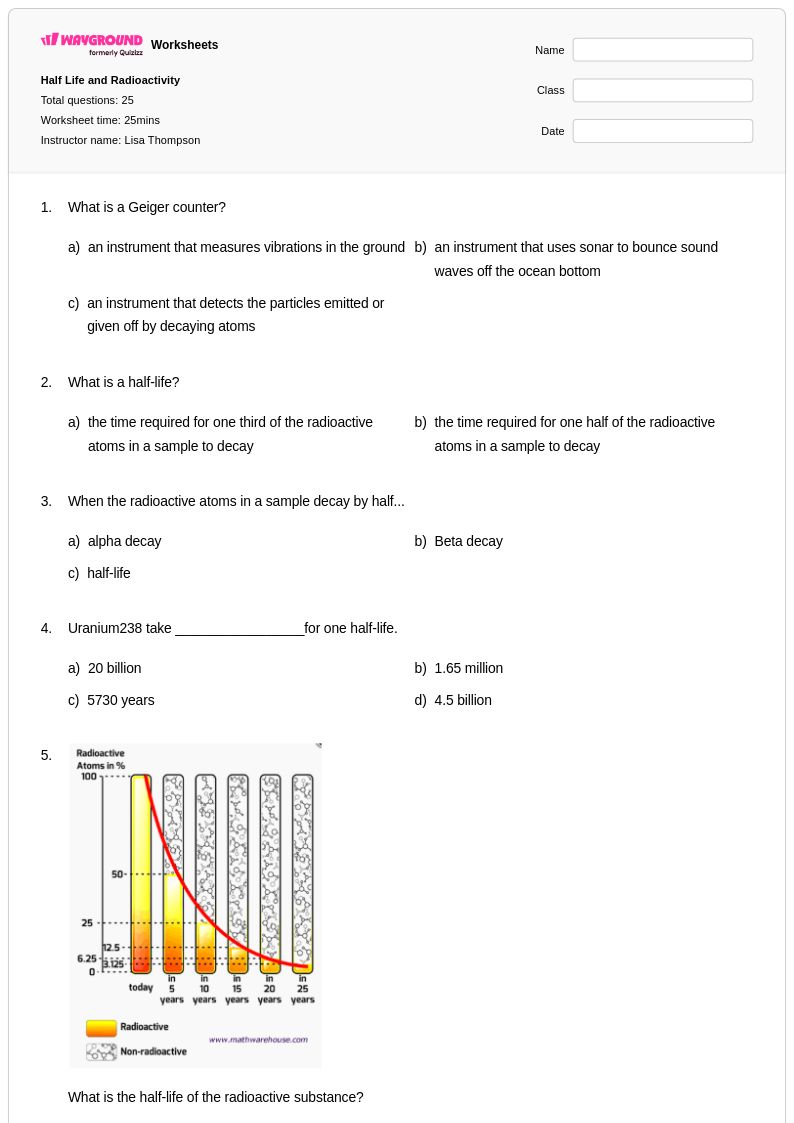
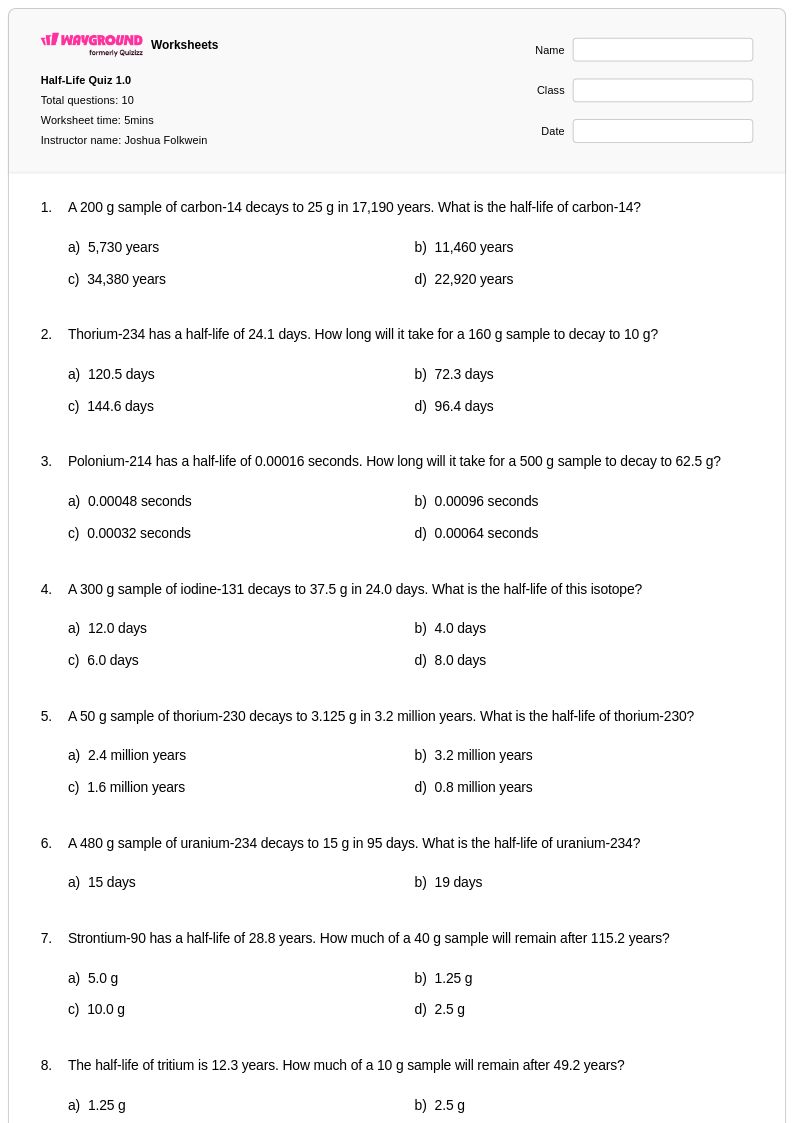
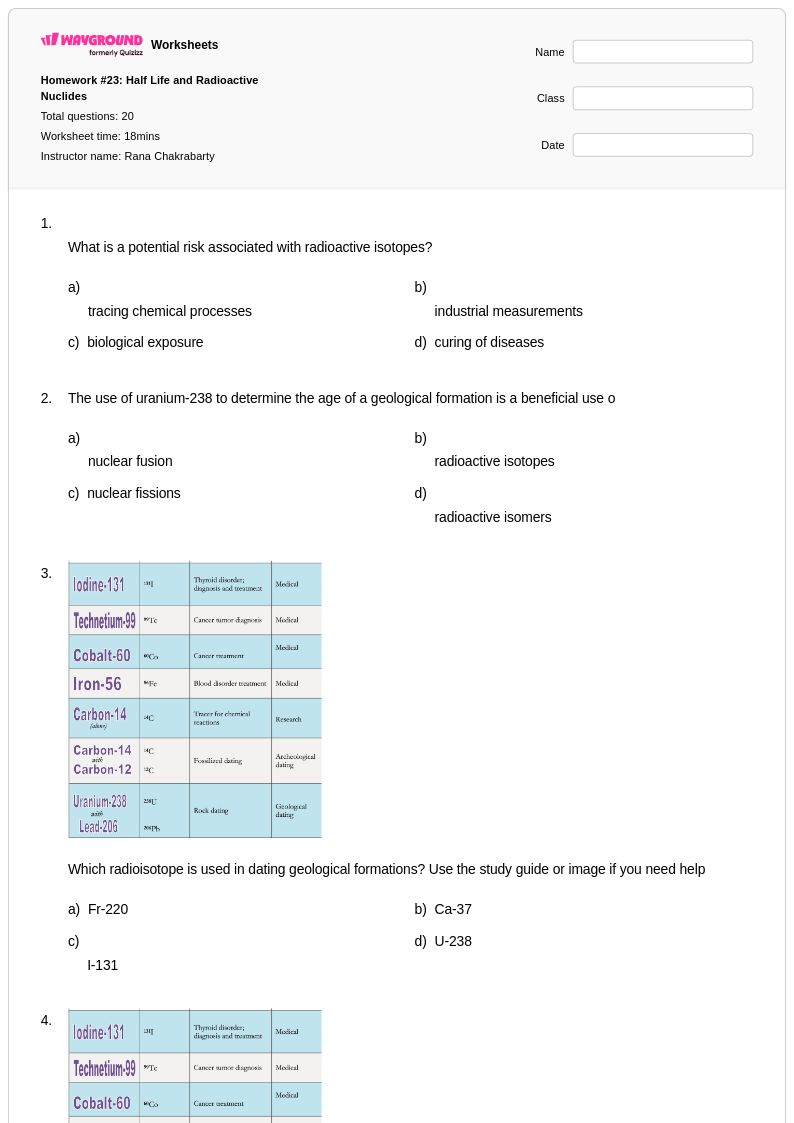
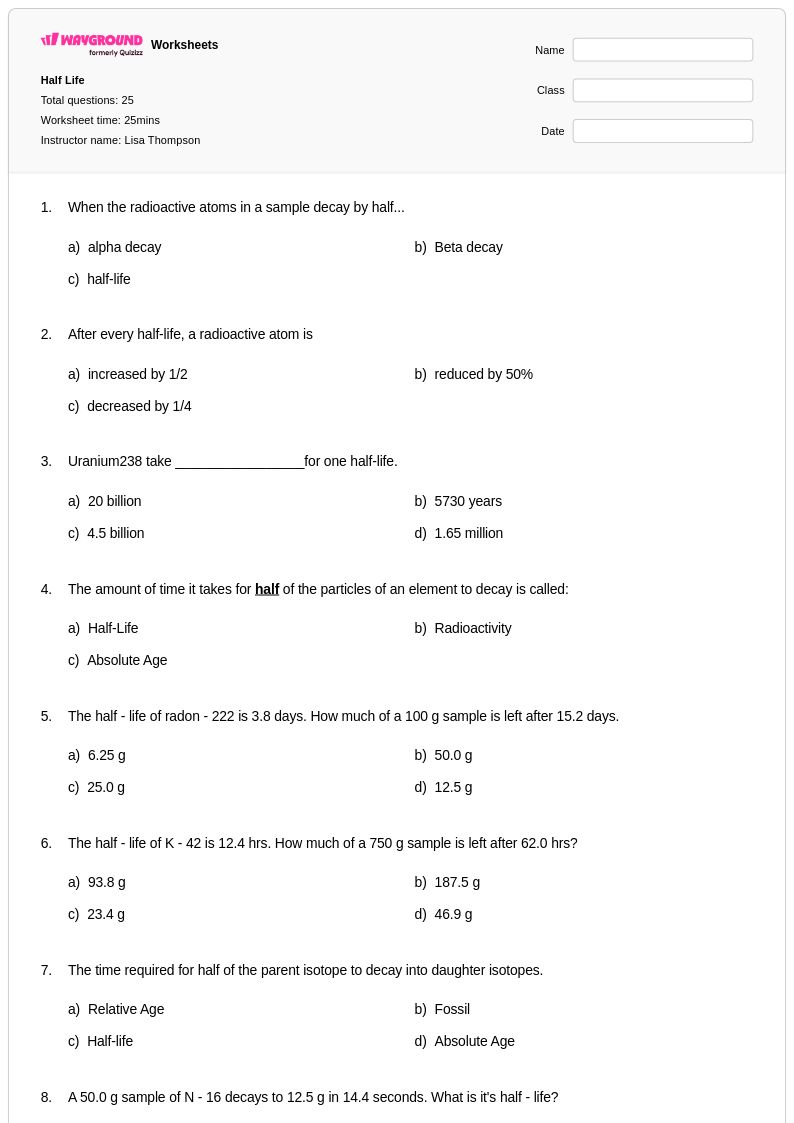
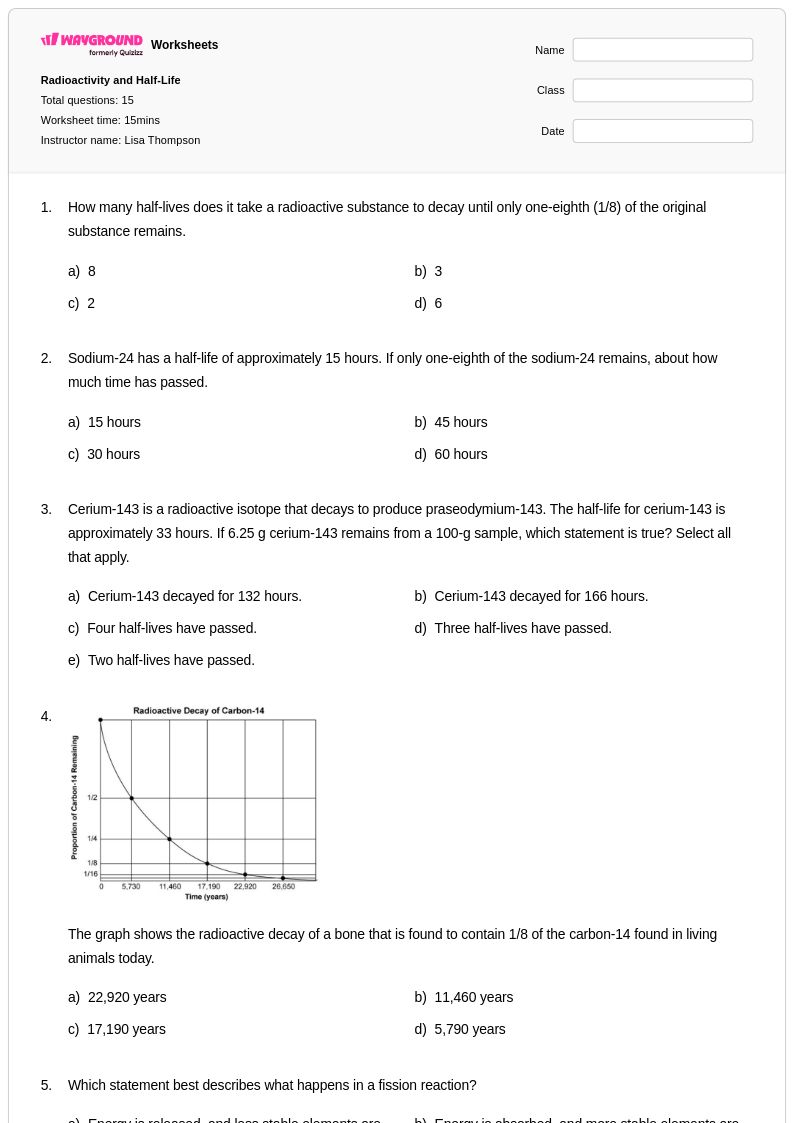
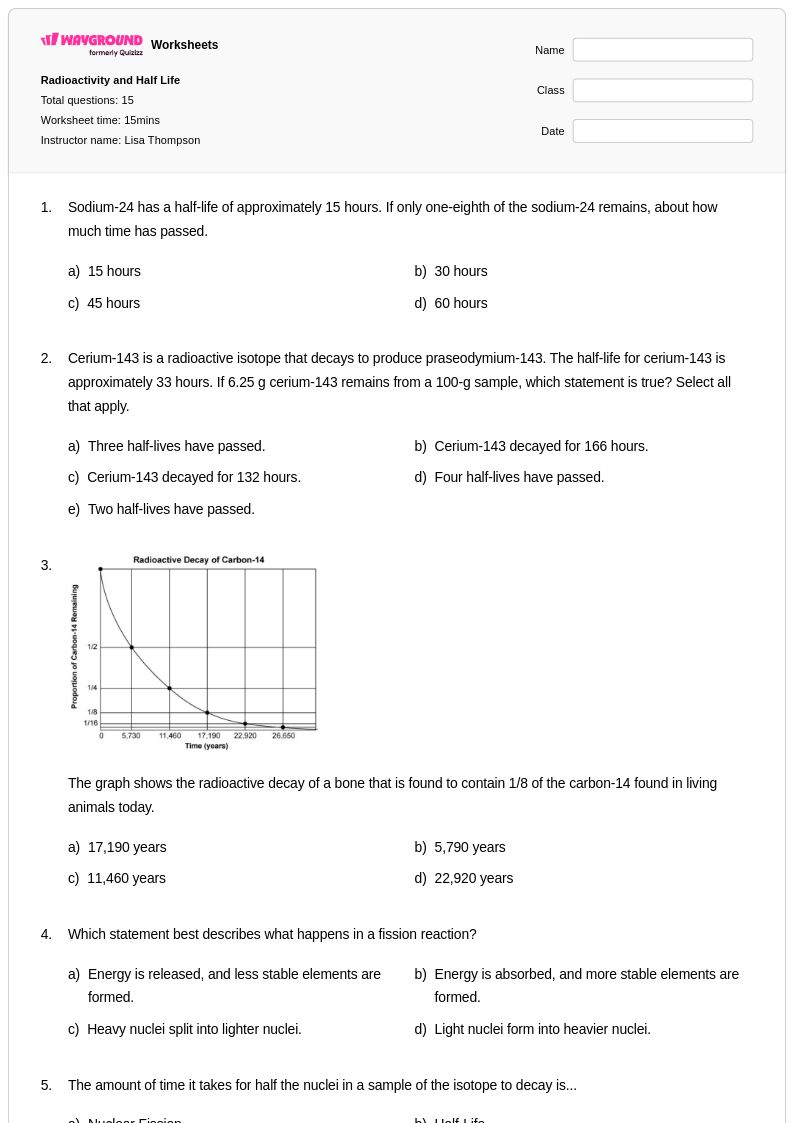
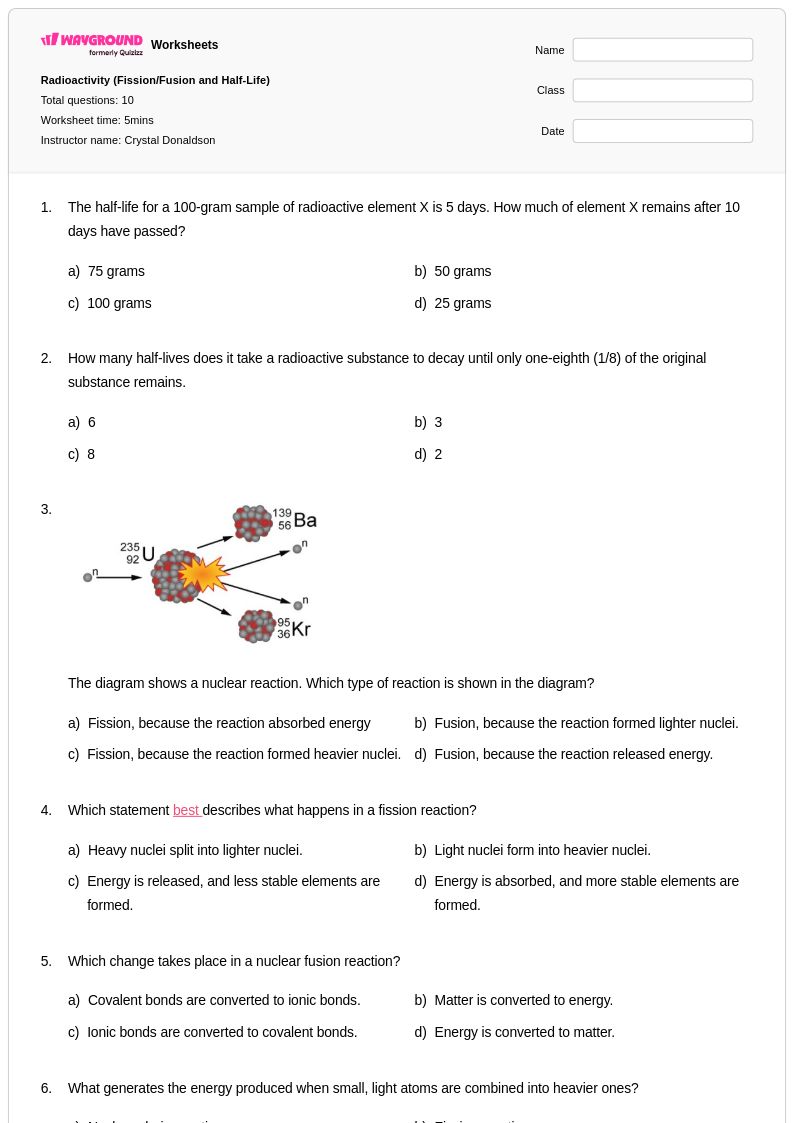
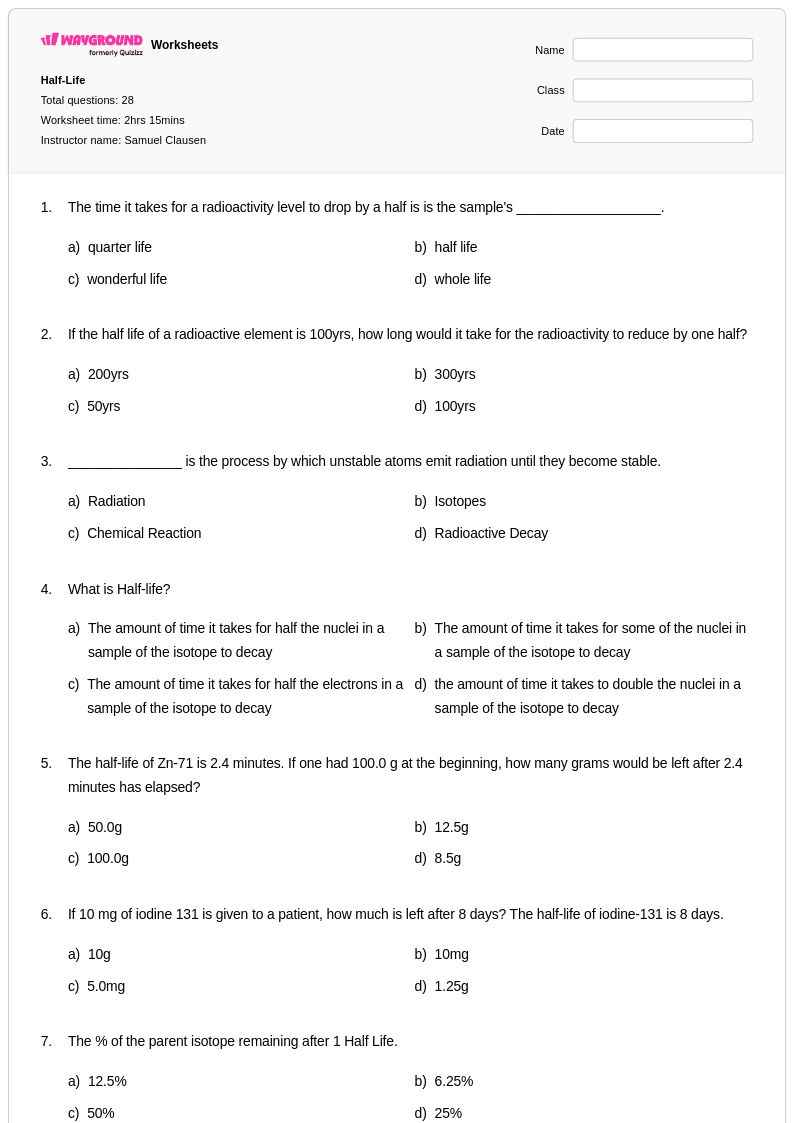
Year 9 half-life worksheets from Wayground provide comprehensive printables and practice problems with answer keys to help students master radioactive decay calculations and understand how isotopes break down over time.
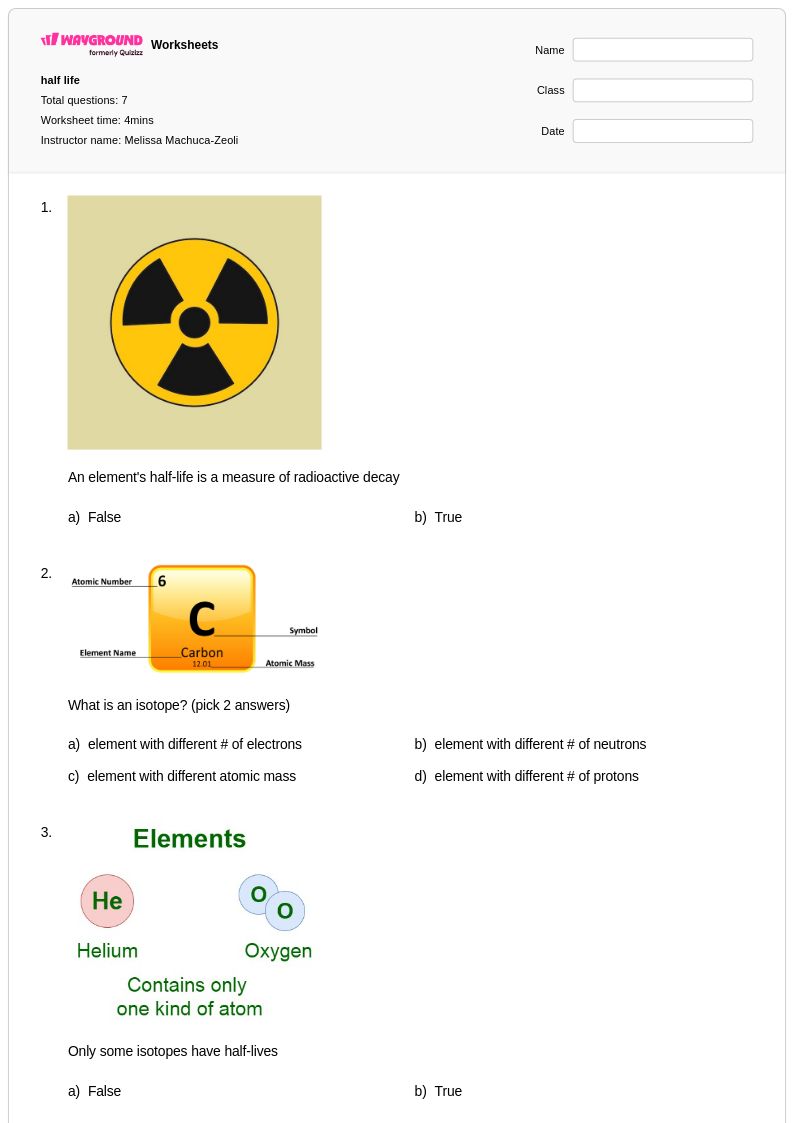
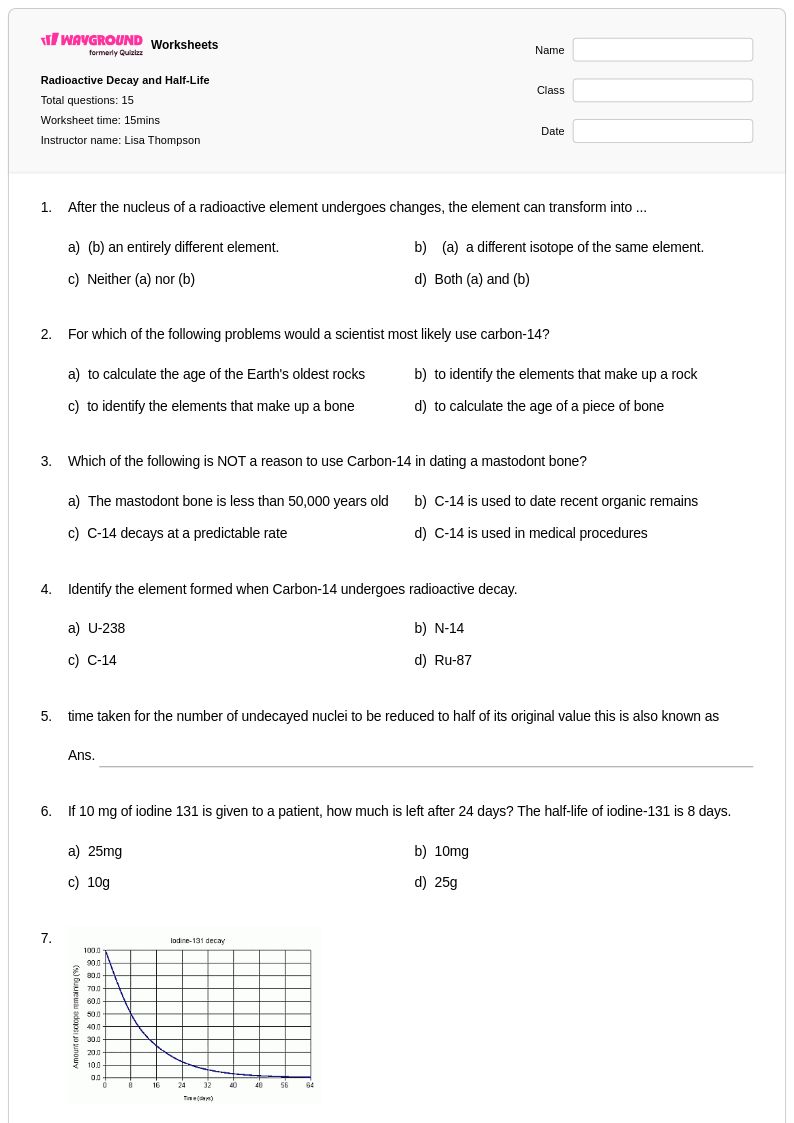
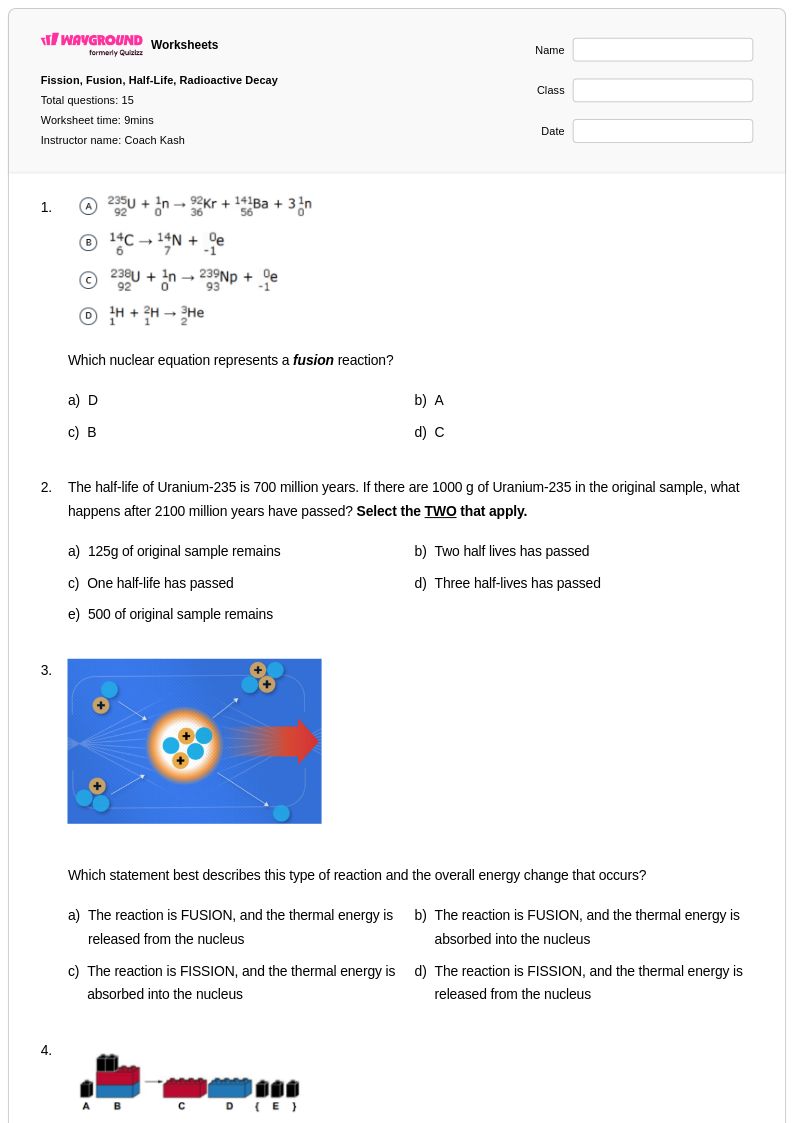
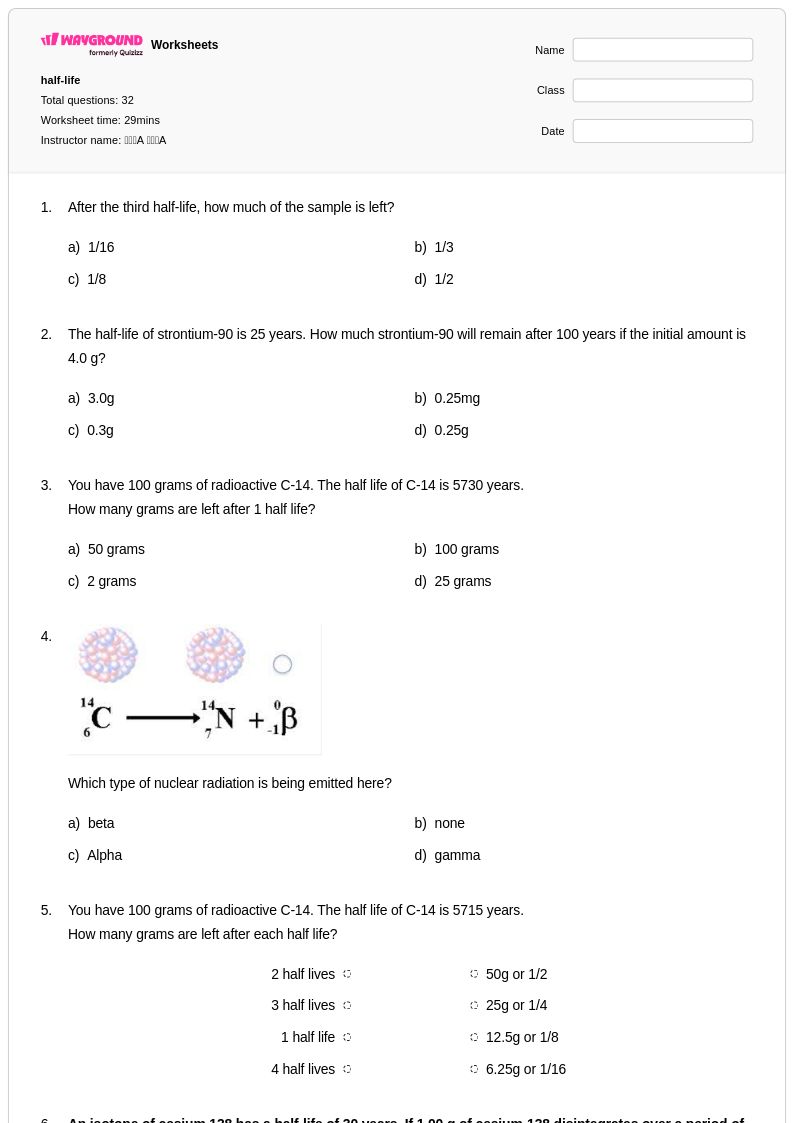
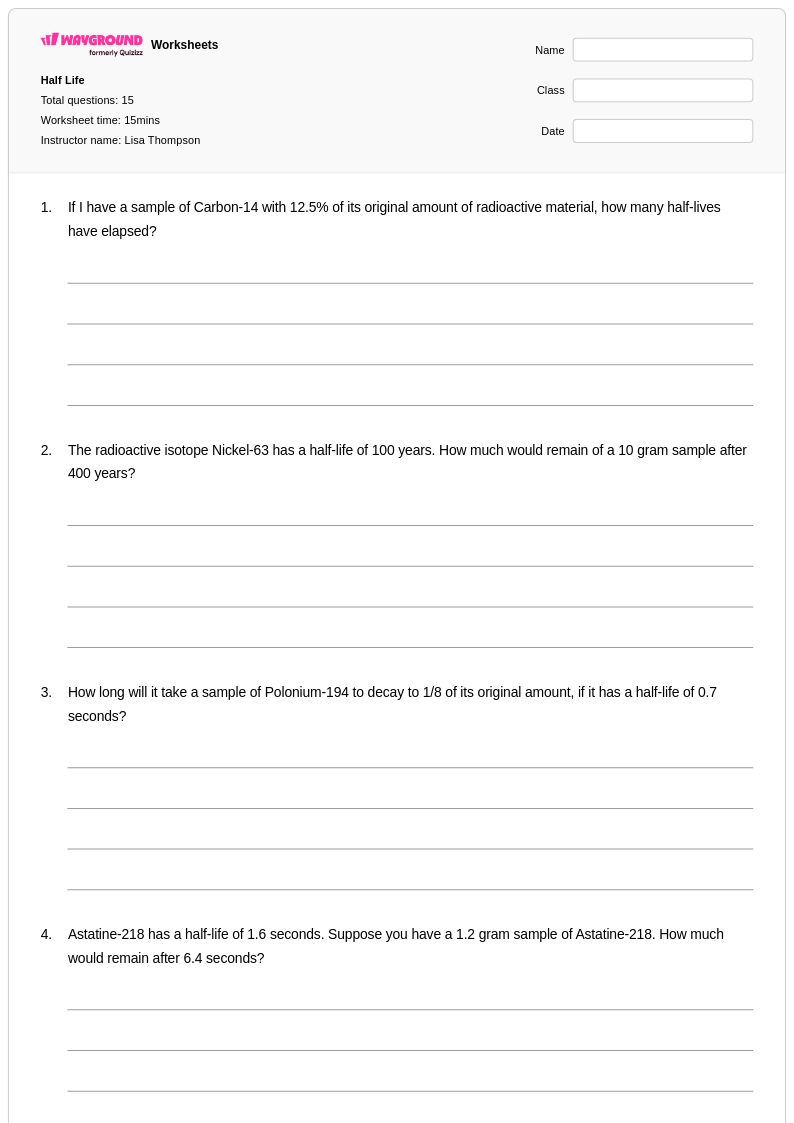
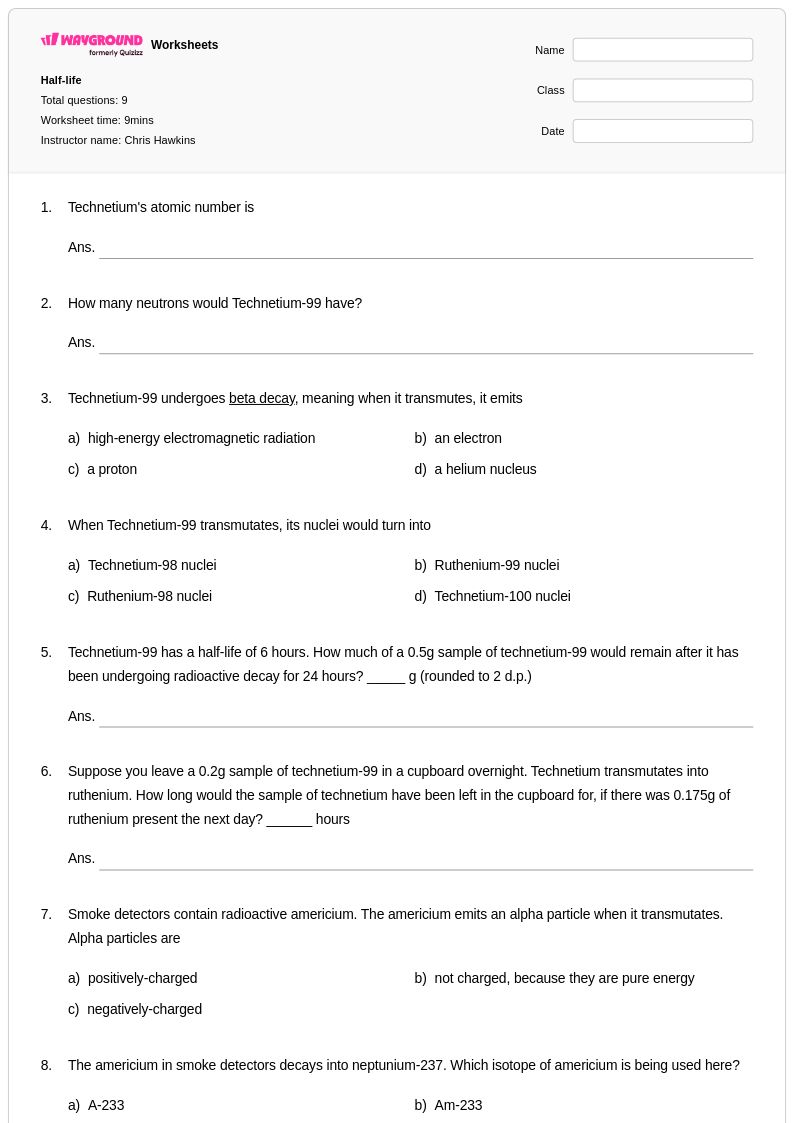
Half-life worksheets for Year 9 students available through Wayground (formerly Quizizz) provide comprehensive practice with radioactive decay concepts and exponential mathematics applications. These carefully crafted resources help students master the fundamental physics principle that describes how unstable atomic nuclei decay at predictable rates over time. The worksheets strengthen critical analytical skills by guiding students through calculations involving decay constants, remaining quantities of radioactive materials, and time-based predictions. Each practice problem set includes detailed answer key materials that support independent learning and self-assessment, while the free printable format ensures accessibility for diverse classroom environments and homework assignments.
Wayground (formerly Quizizz) empowers educators with millions of teacher-created half-life worksheet resources that streamline lesson planning and enhance student comprehension of nuclear physics concepts. The platform's robust search and filtering capabilities allow teachers to quickly locate materials aligned with specific curriculum standards and learning objectives, while built-in differentiation tools enable customization for varying student ability levels. These versatile worksheet collections are available in both printable pdf format and interactive digital versions, making them ideal for traditional classroom instruction, remote learning scenarios, and blended educational approaches. Teachers can efficiently implement these resources for targeted skill practice, remediation support for struggling learners, and enrichment opportunities for advanced students exploring nuclear science applications.
FAQs
How do I teach half-life to high school students?
Start by grounding half-life in a concrete context — carbon-14 dating or nuclear medicine — before introducing the mathematical model. Help students see that each half-life interval reduces the remaining quantity by exactly half, which builds intuition before they tackle exponential decay equations. Once students understand the concept qualitatively, move into calculations involving decay rates, remaining quantities, and elapsed time. Connecting the math to real isotopes and applications significantly improves retention and engagement.
What practice problems help students get better at half-life calculations?
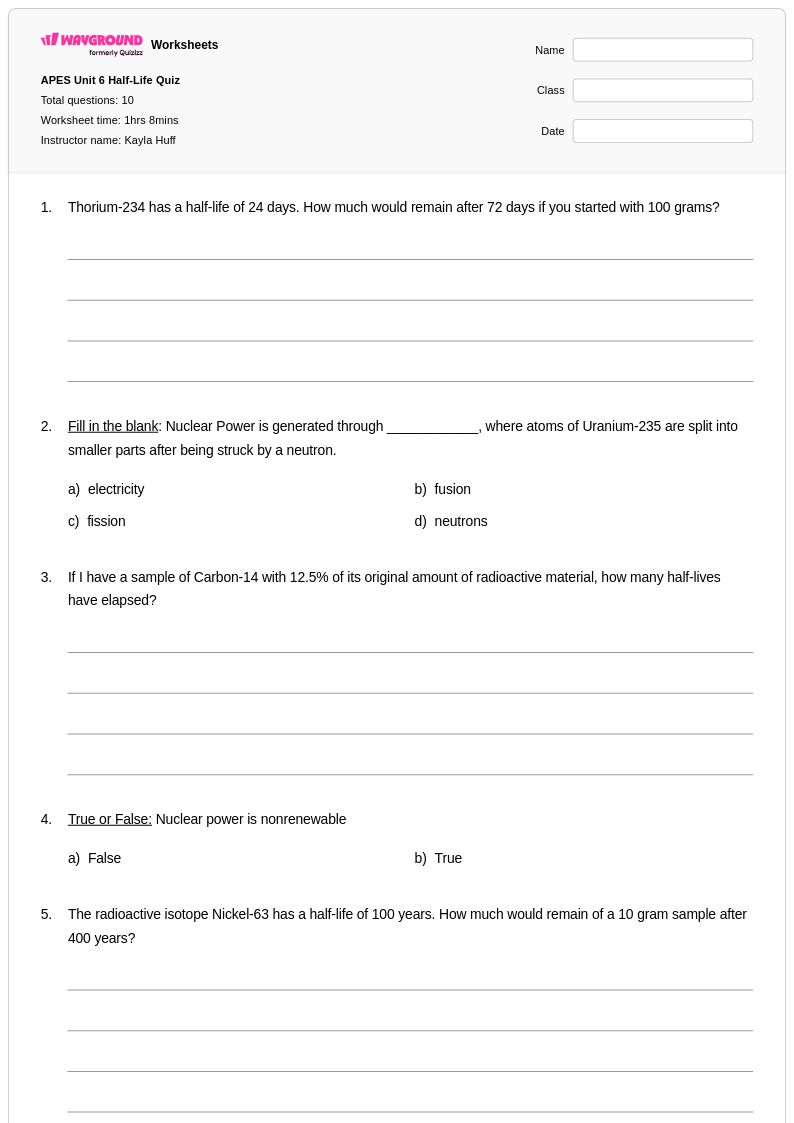
Effective half-life practice should progress from straightforward problems — such as determining how much of a substance remains after a set number of half-lives — to more complex tasks like solving for elapsed time or decay rate when given a remaining quantity. Students also benefit from interpreting decay curves and working backward from graph data to identify the half-life of an unknown isotope. Mixing calculation-based and interpretation-based problems ensures students develop both procedural fluency and conceptual understanding.
What mistakes do students commonly make when solving half-life problems?
The most common error is confusing the number of half-lives with total elapsed time — students often divide the remaining quantity by the half-life period rather than determining how many intervals have passed. Another frequent mistake is misapplying the exponential decay formula, particularly when solving for time rather than remaining quantity, which requires logarithms that many students are not yet comfortable using. Students also tend to misread decay curve graphs, either misidentifying the half-life period or incorrectly extrapolating beyond the given data.
How do I differentiate half-life instruction for students at different skill levels?
For students still building foundational skills, focus on whole-number half-life intervals and visual decay charts before introducing the exponential formula. More advanced students can work with fractional half-lives, solve for unknown variables algebraically, and analyze real isotope data. On Wayground, teachers can apply accommodations such as reduced answer choices for students who need less cognitive load, extended time for those who require it, and read-aloud support for students with reading barriers — each configured individually without affecting the rest of the class.
How can I use Wayground's half-life worksheets in my classroom?
Wayground's half-life worksheets are available as printable PDFs for traditional classroom use and in digital formats for technology-integrated environments, making them suitable for in-class practice, homework, or assessment prep. Teachers can also host the worksheets as a quiz directly on Wayground, enabling automatic grading and real-time insight into student performance. The included answer keys provide step-by-step solutions, which makes these resources equally useful for independent student review and teacher-led remediation.
How does half-life connect to exponential functions in math class?
Half-life is one of the most tangible real-world applications of exponential decay, making it a natural bridge between science and mathematics curricula. The decay formula N(t) = N₀ × (1/2)^(t/T) is a direct application of exponential functions, and solving for elapsed time introduces students to logarithmic operations in a meaningful context. Teachers covering exponential functions can use half-life problems to demonstrate why the base and exponent structure matters, reinforcing math concepts while giving students a concrete scientific application.