Free Printable Equivalent Resistance Worksheets for Year 9
Master Year 9 equivalent resistance concepts with Wayground's comprehensive collection of free physics worksheets, featuring printable PDFs with practice problems and complete answer keys to strengthen circuit analysis skills.
Explore printable Equivalent Resistance worksheets for Year 9
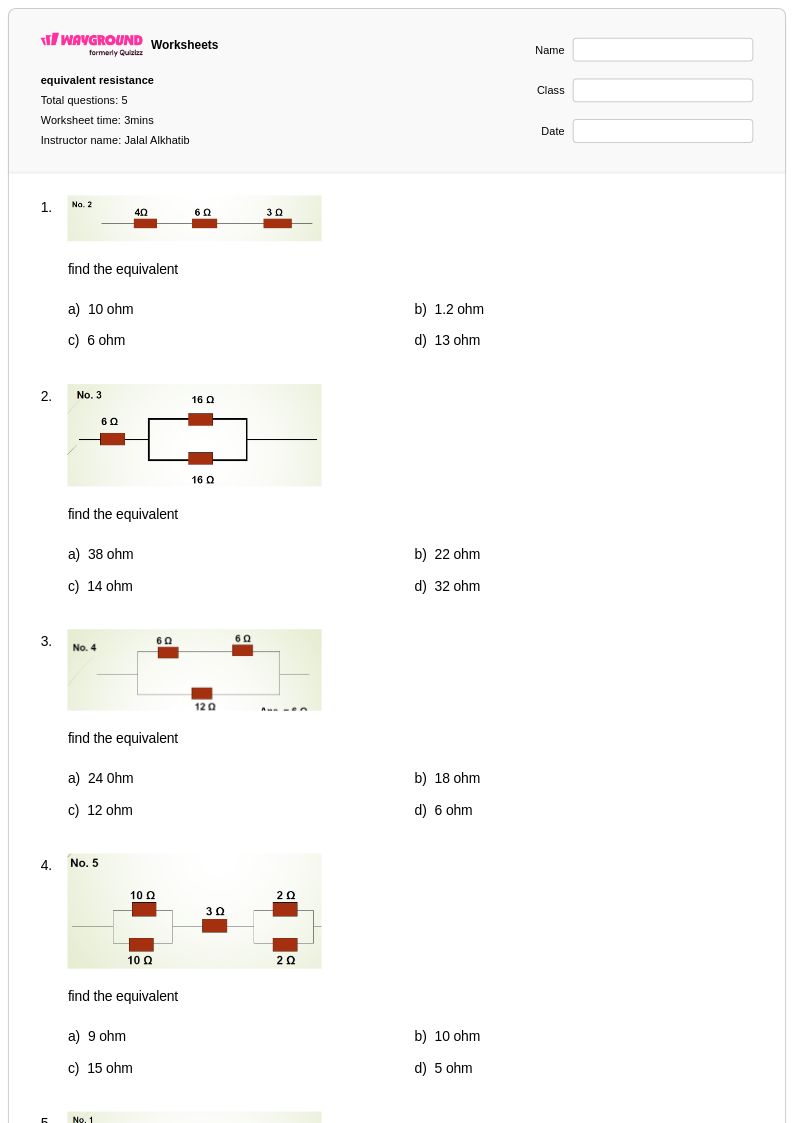
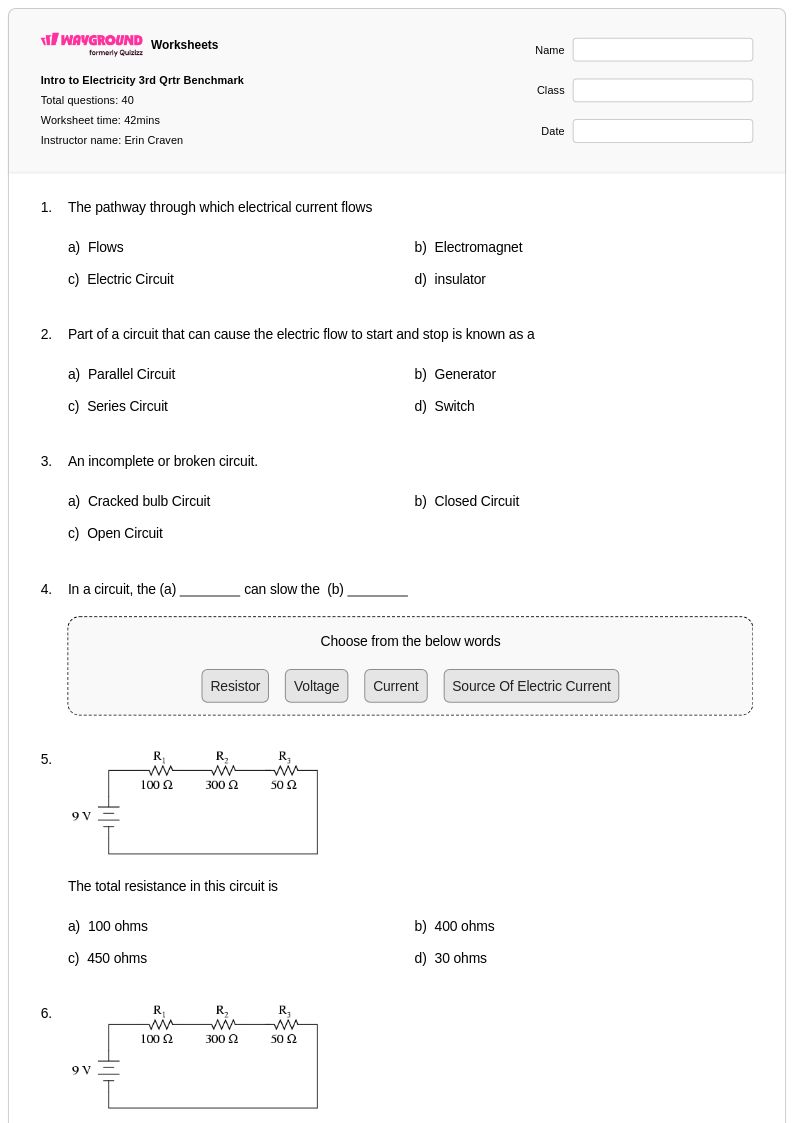
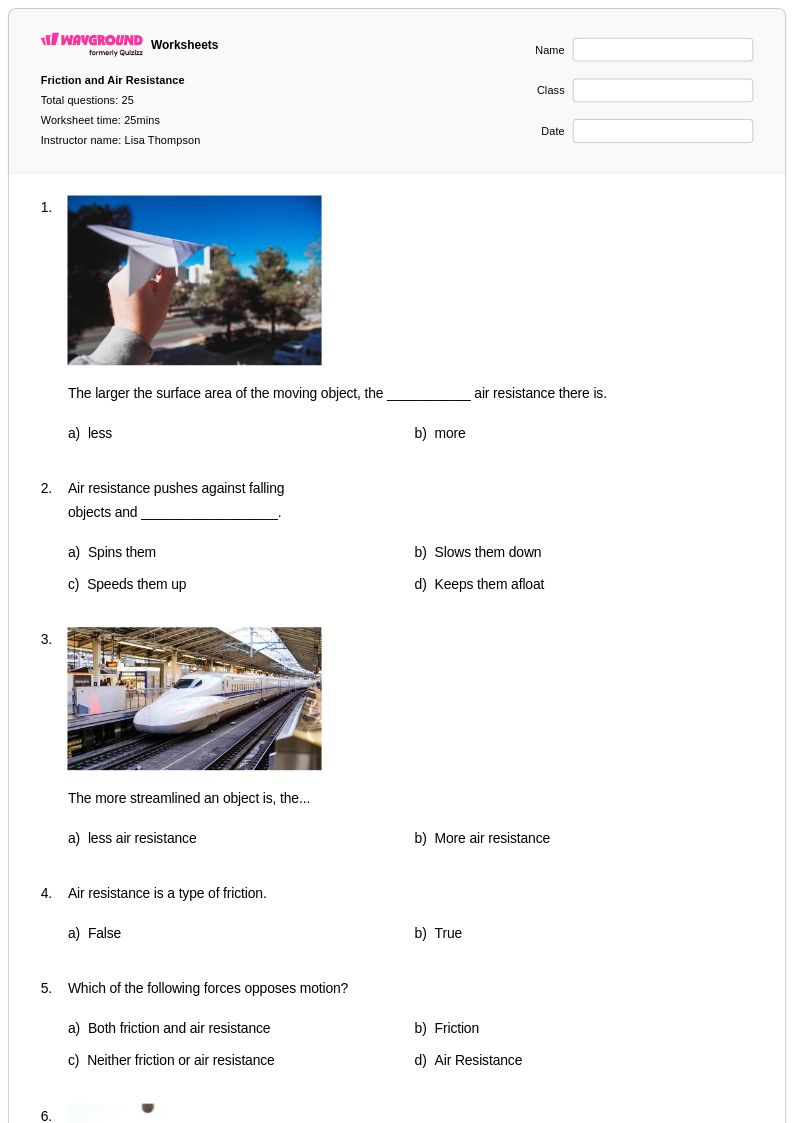
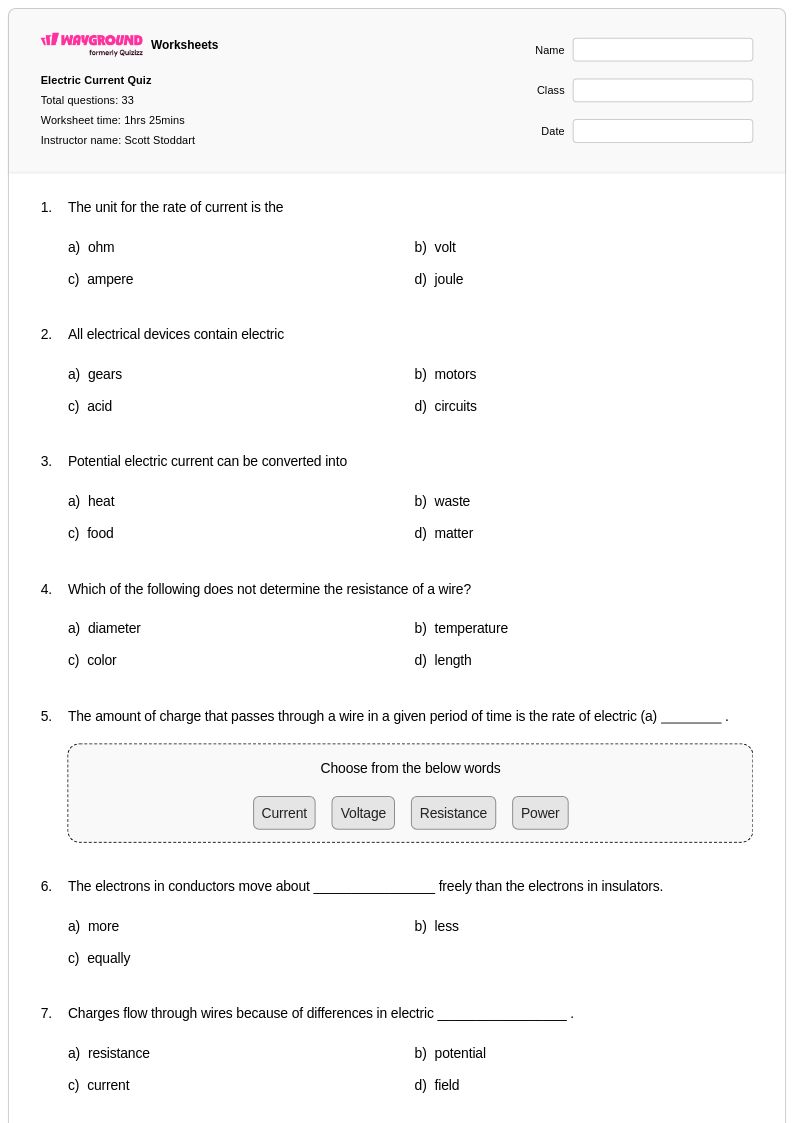
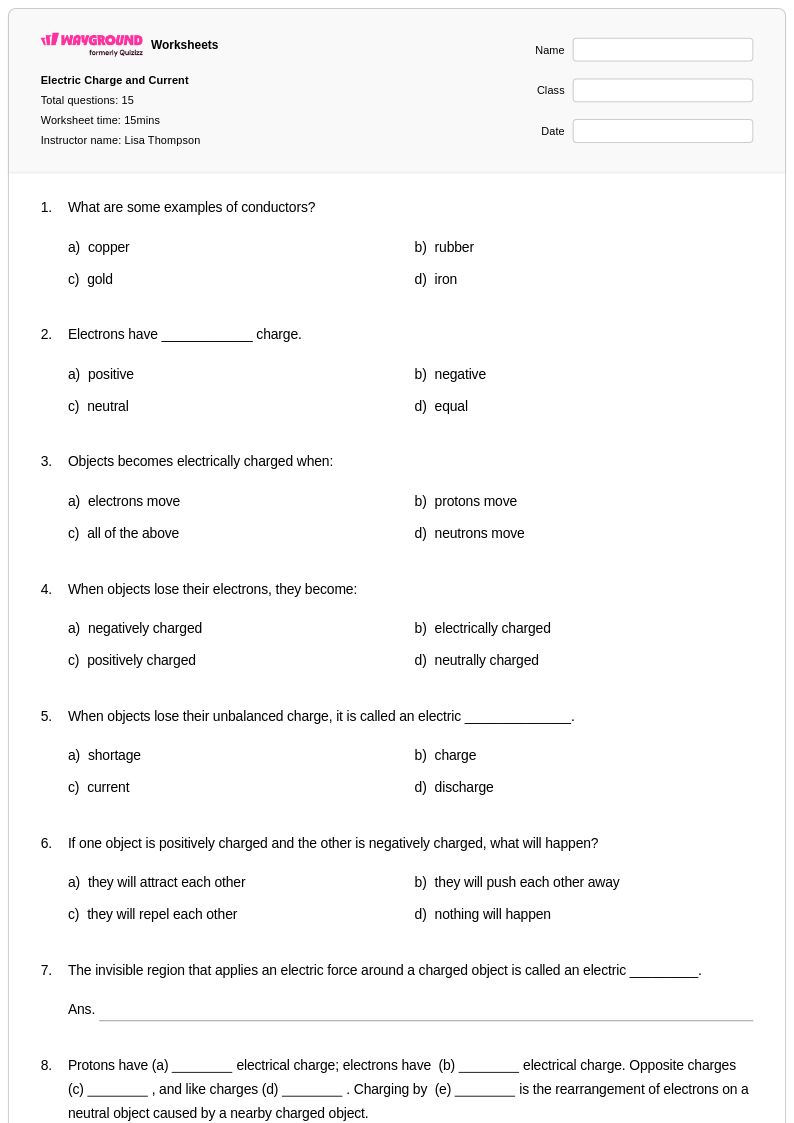
Equivalent resistance worksheets for Year 9 physics provide comprehensive practice with one of the most fundamental concepts in electrical circuit analysis. These expertly designed resources help students master the mathematical principles behind combining resistors in series and parallel configurations, strengthening their problem-solving abilities through systematic calculation methods. The worksheets feature carefully scaffolded practice problems that guide students from basic series resistance calculations to complex mixed circuits, with each printable resource including detailed answer keys to support independent learning. Students work through real-world scenarios involving household electrical systems and electronic devices, developing proficiency in applying Ohm's law and resistance formulas while building confidence with circuit diagrams and electrical schematics. These free pdf resources serve as essential tools for reinforcing classroom instruction and preparing students for advanced physics coursework.
Wayground (formerly Quizizz) empowers educators with an extensive collection of millions of teacher-created equivalent resistance worksheets specifically aligned to Year 9 physics standards and curriculum requirements. The platform's advanced search and filtering capabilities allow teachers to quickly locate resources that match their specific instructional needs, whether targeting remediation for struggling students or providing enrichment challenges for advanced learners. Each worksheet collection offers flexible customization options, enabling educators to modify difficulty levels, adjust problem types, and incorporate school-specific examples while maintaining rigorous academic standards. Available in both printable pdf format and interactive digital versions, these differentiated resources support diverse learning environments and teaching styles, making lesson planning more efficient while ensuring students receive targeted practice with circuit analysis concepts. Teachers can seamlessly integrate these materials into their instruction for skill-building exercises, formative assessments, or homework assignments that reinforce mathematical reasoning in physics contexts.
FAQs
How do I teach equivalent resistance to students who struggle with series vs. parallel circuits?
Start by building conceptual understanding before introducing formulas. Use physical analogies: series resistors are like speed bumps on a single road (resistance adds up), while parallel resistors are like additional lanes on a highway (each new path reduces total resistance). Once students grasp the conceptual difference, introduce the formulas systematically — R_total = R1 + R2 for series, and 1/R_total = 1/R1 + 1/R2 for parallel. Reinforce each configuration separately with practice problems before moving to combination circuits.
What exercises help students practice calculating equivalent resistance?
The most effective practice progression moves from simple to complex: begin with two-resistor series circuits, then two-resistor parallel circuits, then multi-resistor versions of each, and finally combination circuits that require students to identify and solve sub-networks step by step. Problems that include circuit diagrams alongside numerical values are especially useful because they train students to read and interpret circuit topology, not just apply formulas. Equivalent resistance worksheets that include step-by-step answer keys allow students to check their reasoning at each stage, not just the final answer.
What mistakes do students commonly make when calculating equivalent resistance?
The most frequent error is applying the wrong formula to the wrong circuit configuration — students often add resistor values directly even in parallel circuits. A second common mistake is mishandling the reciprocal calculation for parallel circuits: students forget to take the reciprocal of the sum, reporting 1/R_total as their final answer instead of R_total. In combination circuits, students frequently fail to correctly identify which resistors are in series and which are in parallel before calculating, which compounds errors through the rest of the problem.
How do I use equivalent resistance worksheets in my physics class?
Equivalent resistance worksheets work well as guided practice after direct instruction, as independent review before assessments, or as homework assignments to reinforce circuit analysis skills. On Wayground, these worksheets are available as printable PDFs for traditional classroom use and in digital formats for technology-integrated environments, including the option to host them as an interactive quiz. The included answer keys make them practical for self-paced work, stations, or sub-lesson coverage without requiring additional teacher preparation.
How do I differentiate equivalent resistance instruction for students at different skill levels?
For struggling students, isolate one circuit type at a time and provide partially completed worked examples before assigning independent problems. For advanced students, introduce combination circuits earlier and require students to derive equivalent resistance formulas from first principles using Kirchhoff's laws. On Wayground, teachers can adjust problem complexity and modify circuit diagrams within worksheets to match different proficiency levels, and digital sessions support individual accommodations such as extended time and reduced answer choices for students who need additional support.
How does understanding equivalent resistance connect to broader physics concepts?
Equivalent resistance is the foundation for applying Ohm's law (V = IR) to real-world multi-resistor circuits, which means students cannot accurately calculate current or voltage distribution in a circuit until they can find the total resistance. It also directly supports understanding of power dissipation (P = I²R) and connects to practical applications like household wiring, fuse ratings, and electronic component design. Treating equivalent resistance as a standalone calculation skill, rather than anchoring it in these broader applications, often leaves students unable to transfer the skill to novel circuit problems.