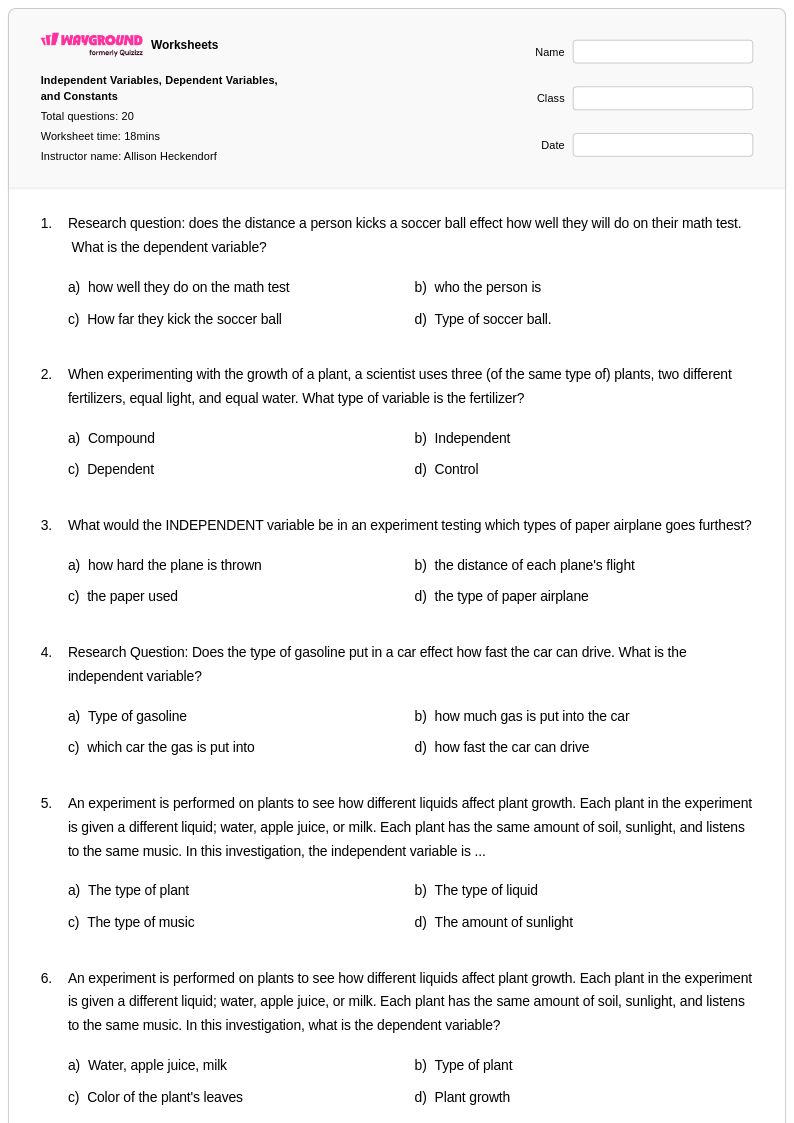
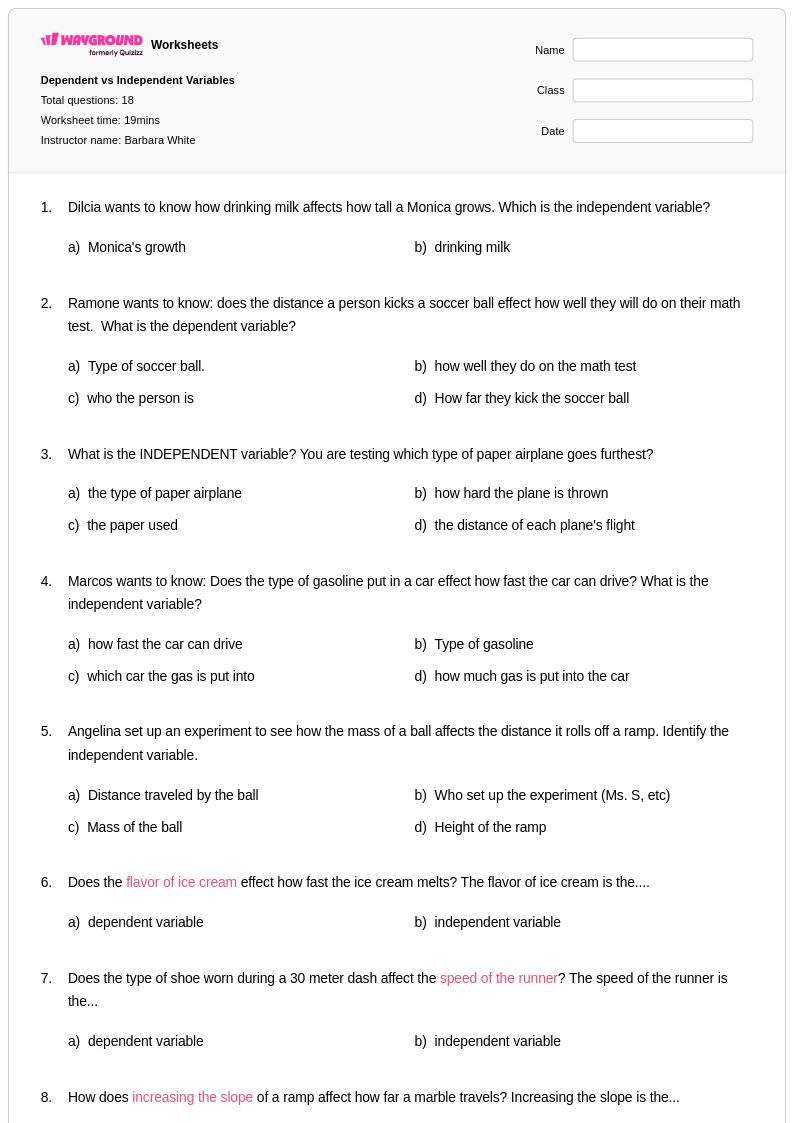
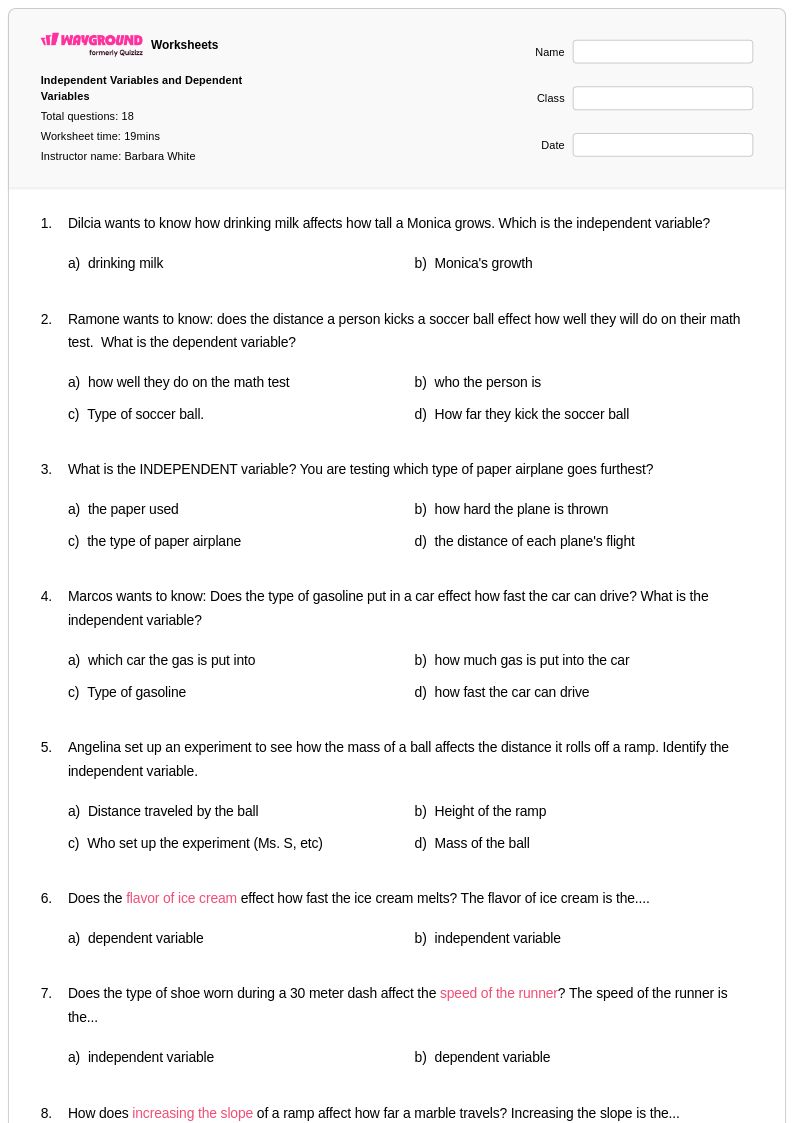
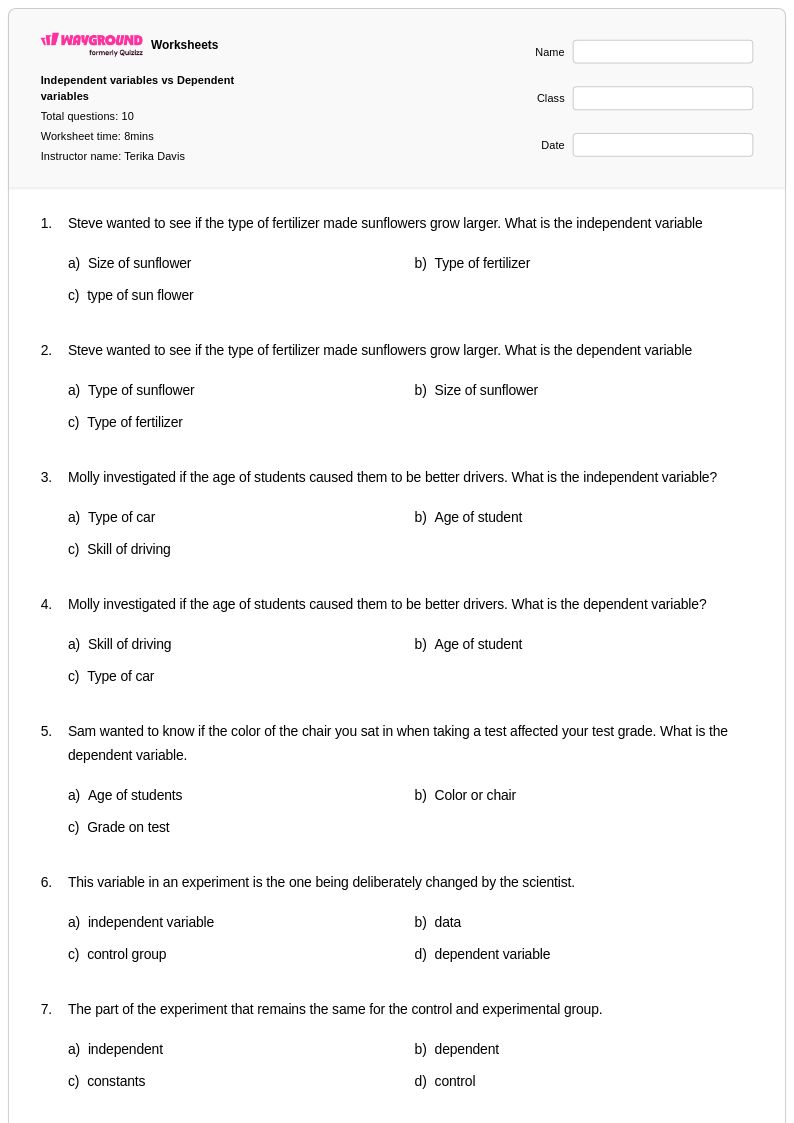
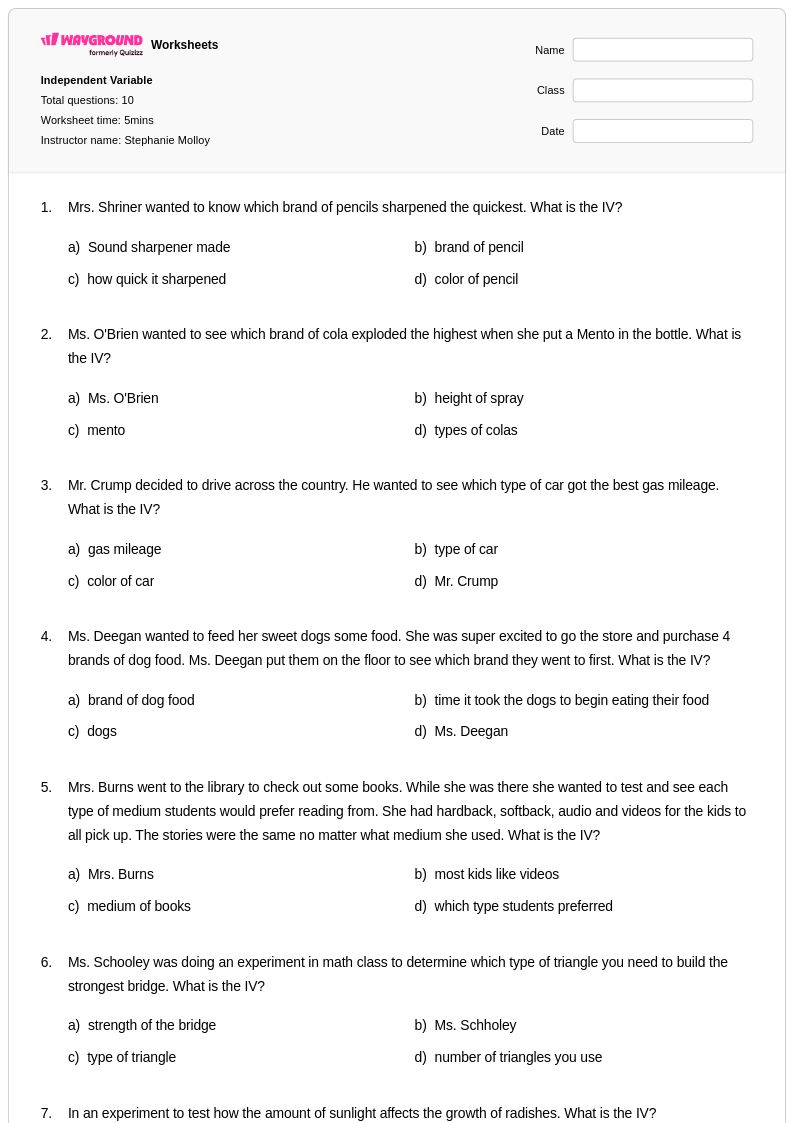
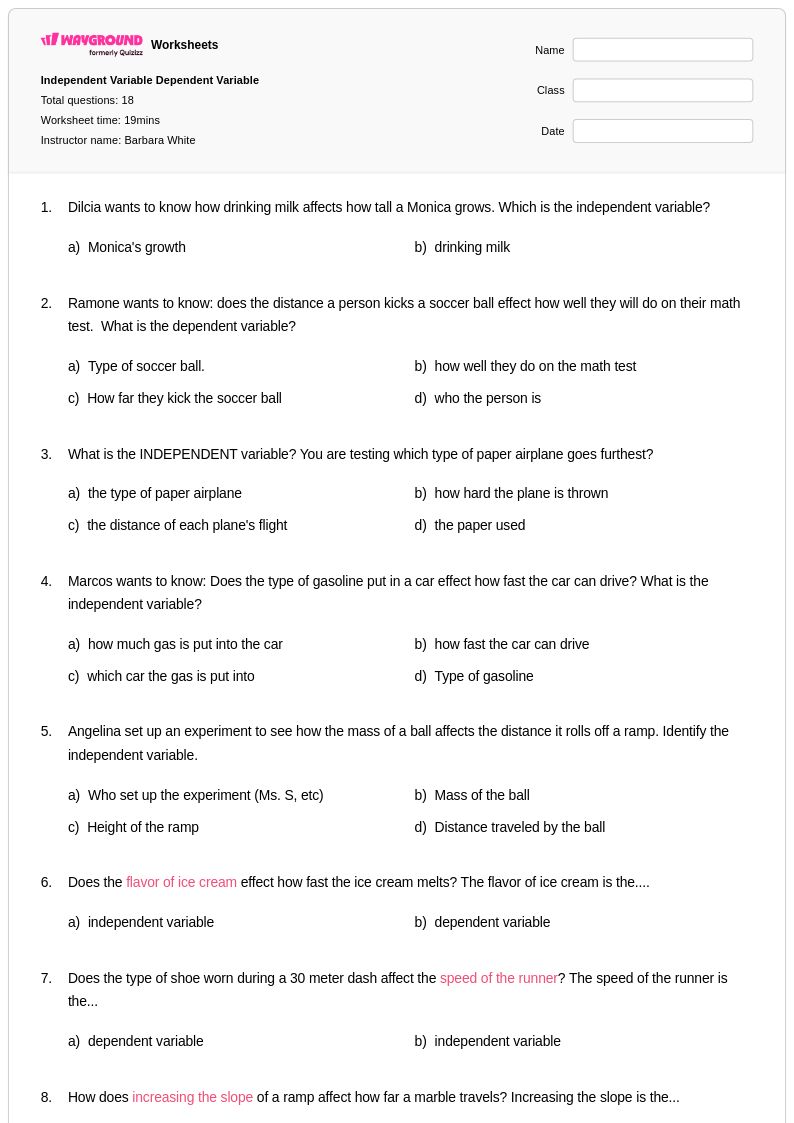
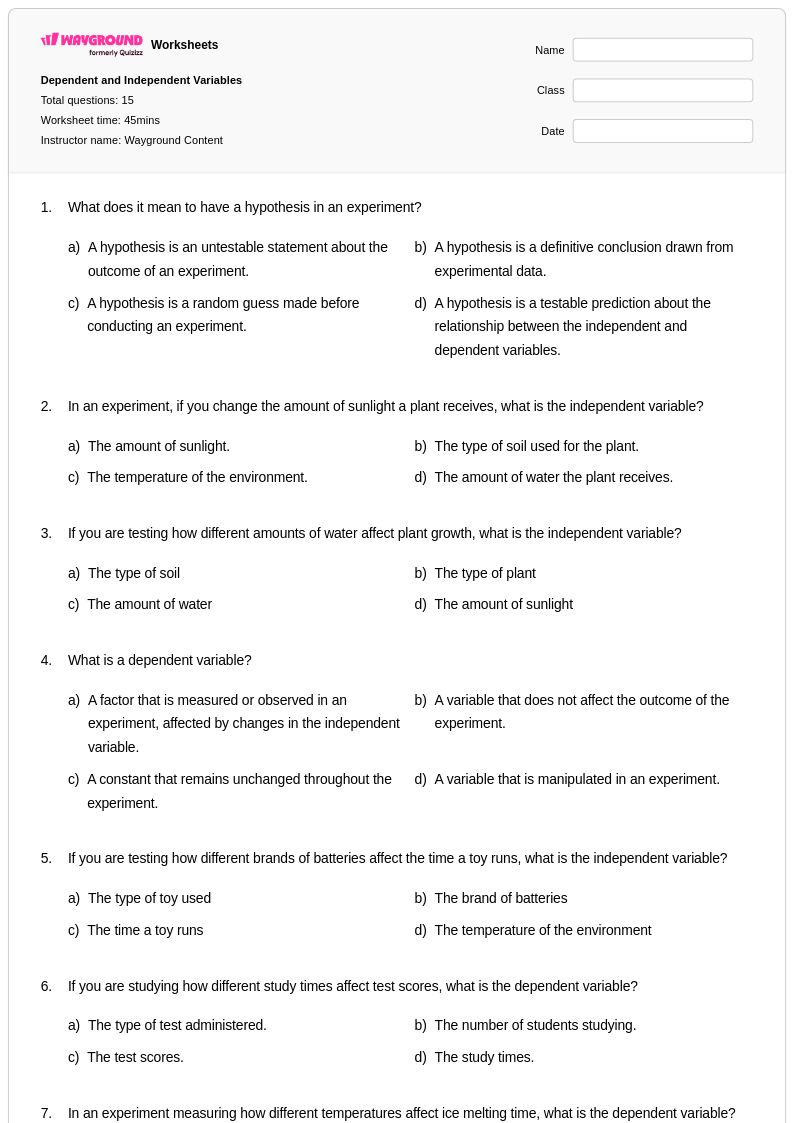
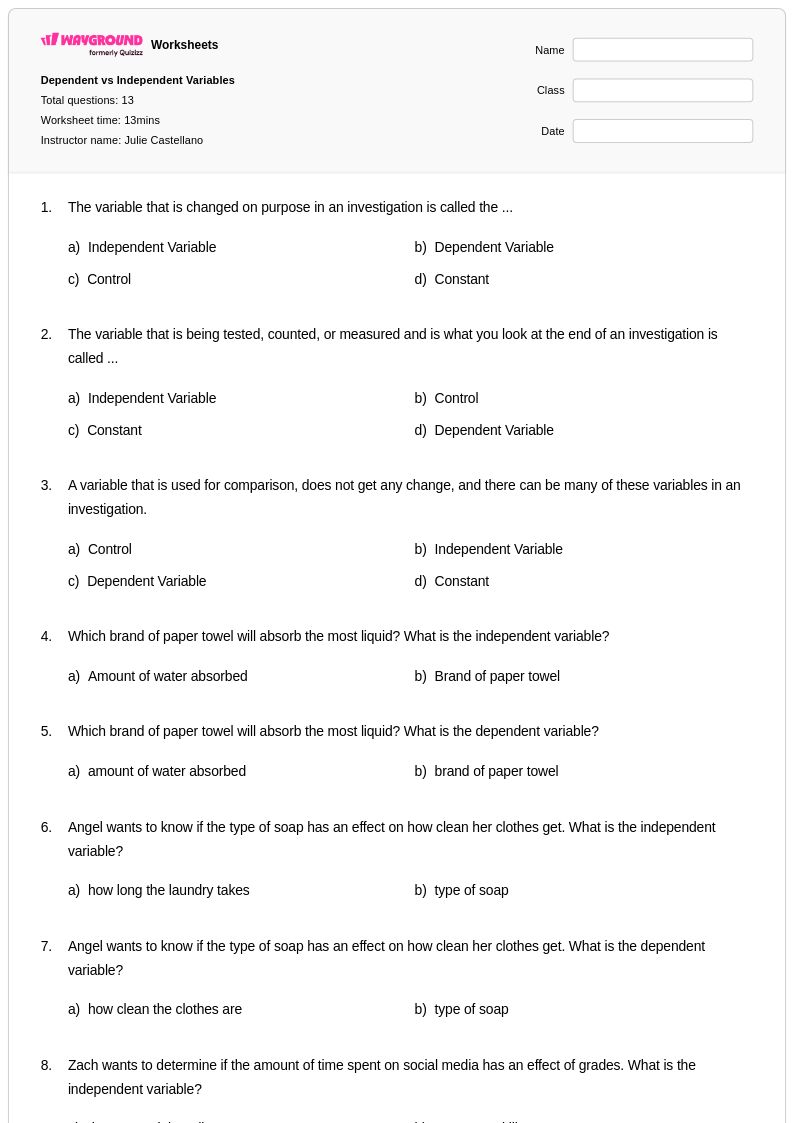
Explore Wayground's free independent variable worksheets and printables that help students master identifying and manipulating variables in scientific experiments through engaging practice problems with comprehensive answer keys.
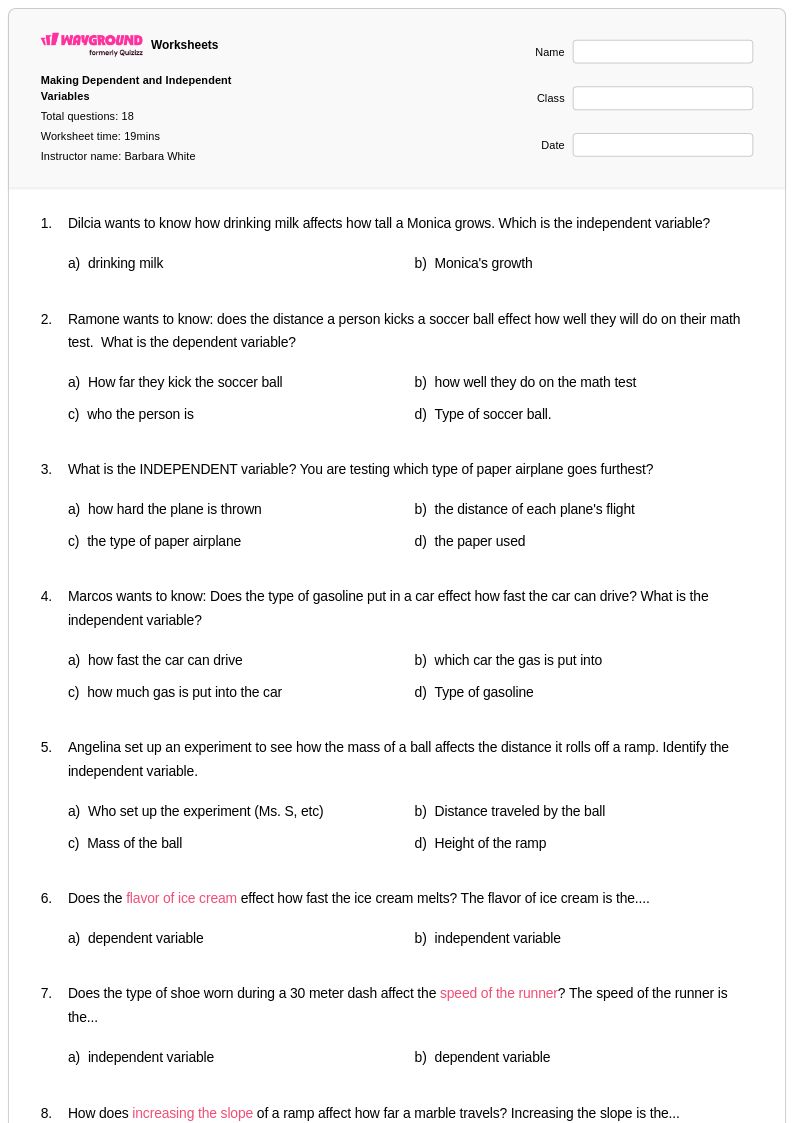
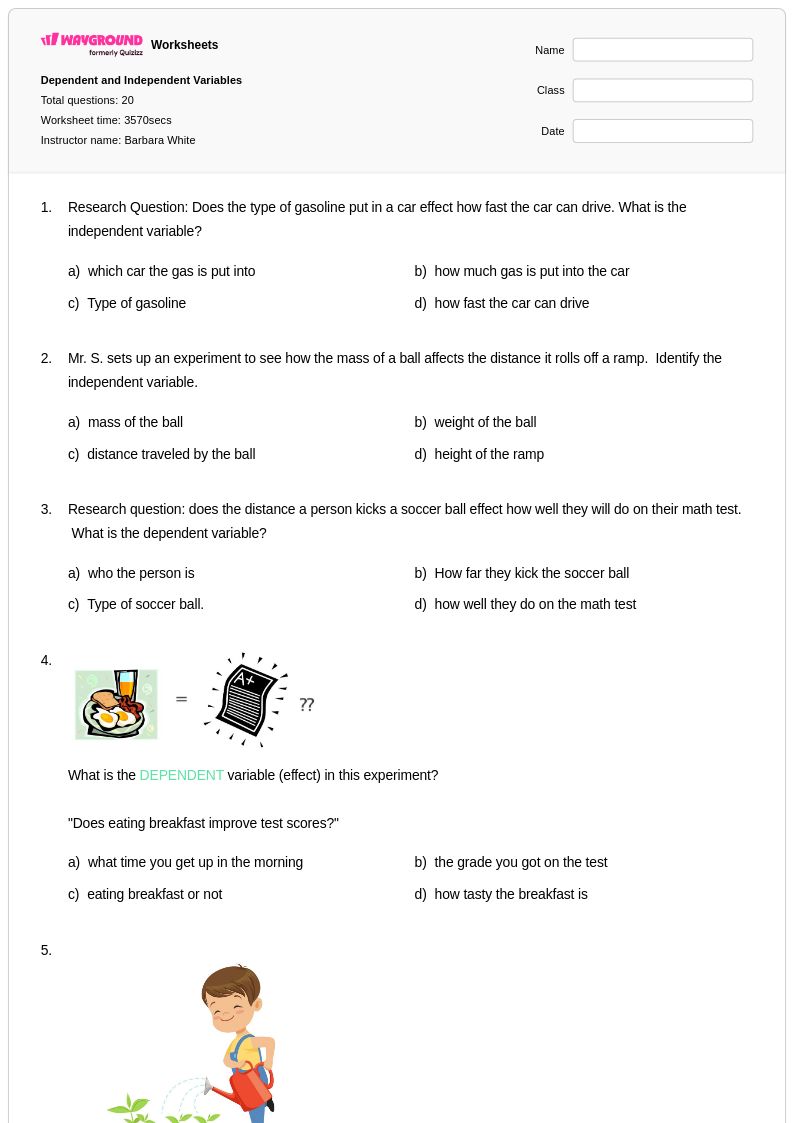
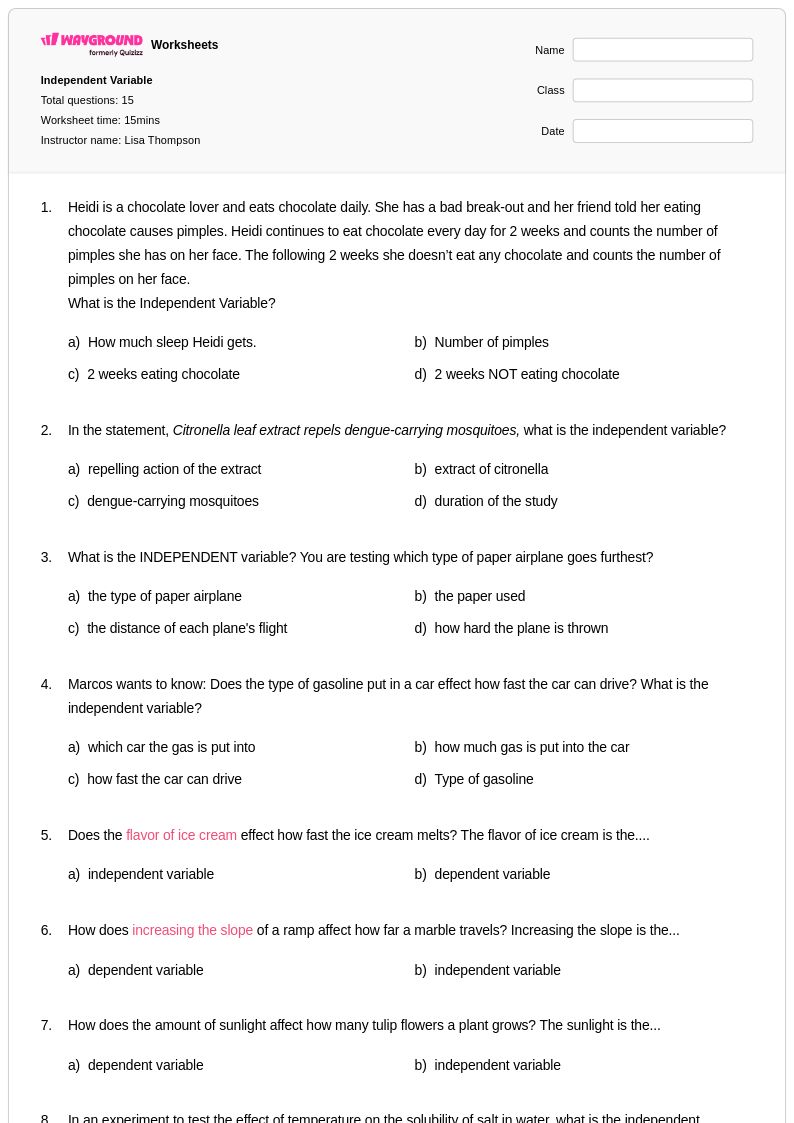
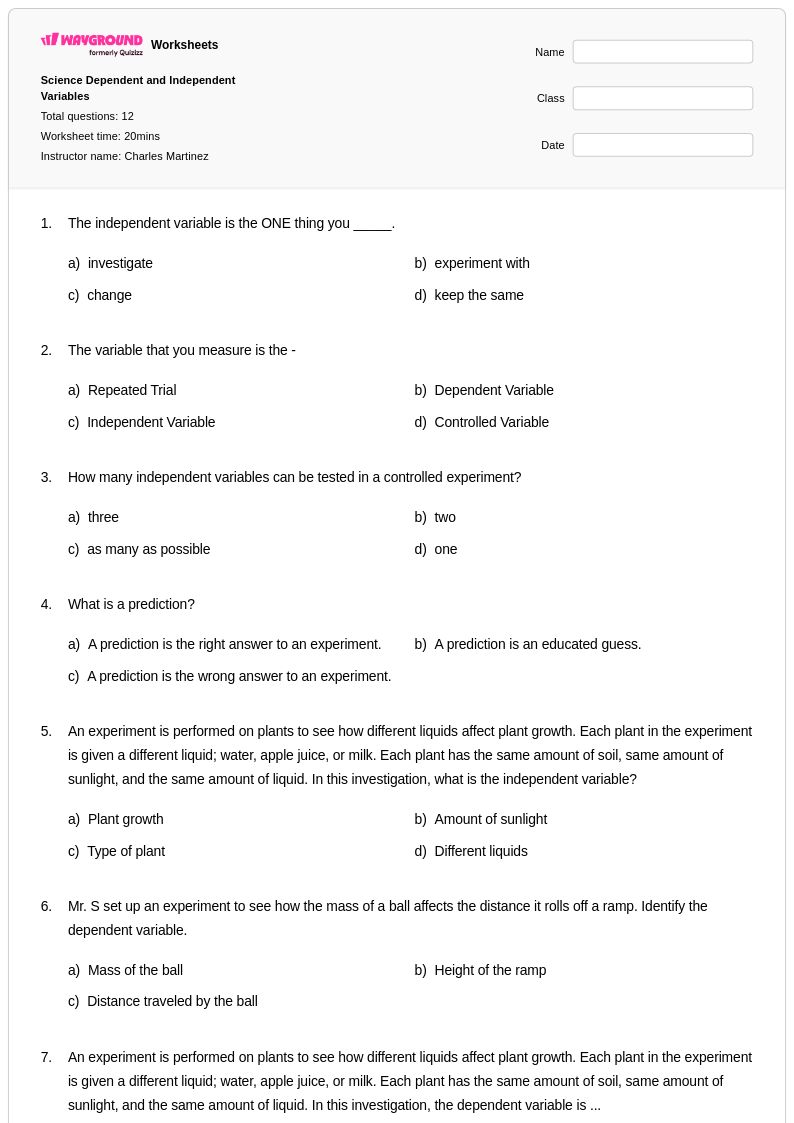
Independent variable worksheets available through Wayground (formerly Quizizz) provide students with essential practice in identifying and manipulating the variables that researchers deliberately change in scientific investigations. These comprehensive worksheets strengthen critical thinking skills by guiding students through the process of distinguishing independent variables from dependent variables and constants across diverse experimental scenarios. Students engage with practice problems that span multiple scientific disciplines, from biology and chemistry to physics and earth science, developing their ability to design controlled experiments and analyze research methodologies. Each worksheet includes detailed answer keys that help educators assess student understanding while providing clear explanations for complex concepts, and the materials are available as free printable pdf resources that can be seamlessly integrated into classroom instruction or assigned as homework practice.
Wayground (formerly Quizizz) empowers educators with millions of teacher-created independent variable worksheets that can be easily located through robust search and filtering capabilities, allowing instructors to find materials perfectly aligned with their specific curriculum standards and learning objectives. The platform's differentiation tools enable teachers to customize worksheet difficulty levels and content focus, ensuring that both struggling learners and advanced students receive appropriately challenging material for skill development. These resources are available in both printable pdf formats for traditional paper-and-pencil activities and digital formats for interactive online learning, providing maximum flexibility for diverse classroom environments. Teachers utilize these worksheet collections for targeted remediation of experimental design concepts, enrichment activities for gifted students, and regular skill practice that reinforces the fundamental scientific thinking processes essential for success in advanced science coursework and research applications.
FAQs
How do I teach students to identify the independent variable in an experiment?
Start by defining the independent variable as the one factor a researcher deliberately changes while keeping all other conditions constant. Use relatable scenarios first — for example, changing the amount of sunlight a plant receives — before moving to more complex experimental designs. Consistently asking students 'What did the scientist choose to change?' helps build the habit of isolating the manipulated variable from dependent variables and constants.
What exercises help students practice identifying independent variables?
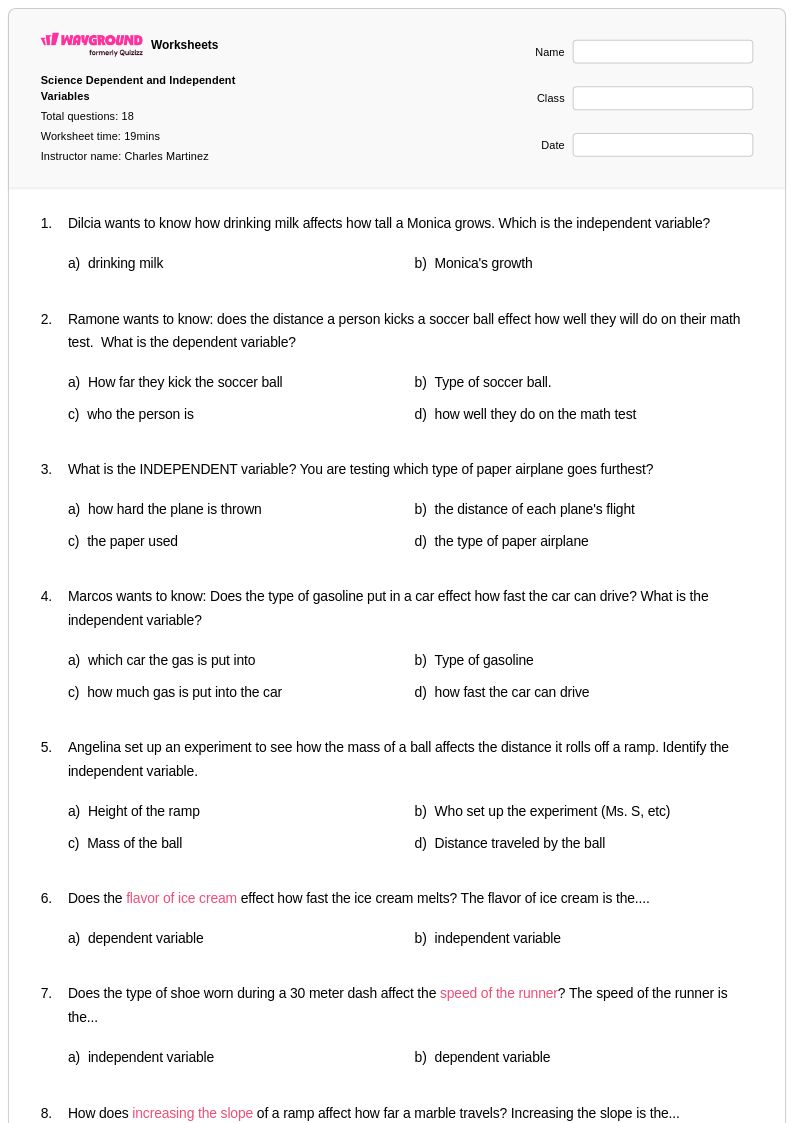
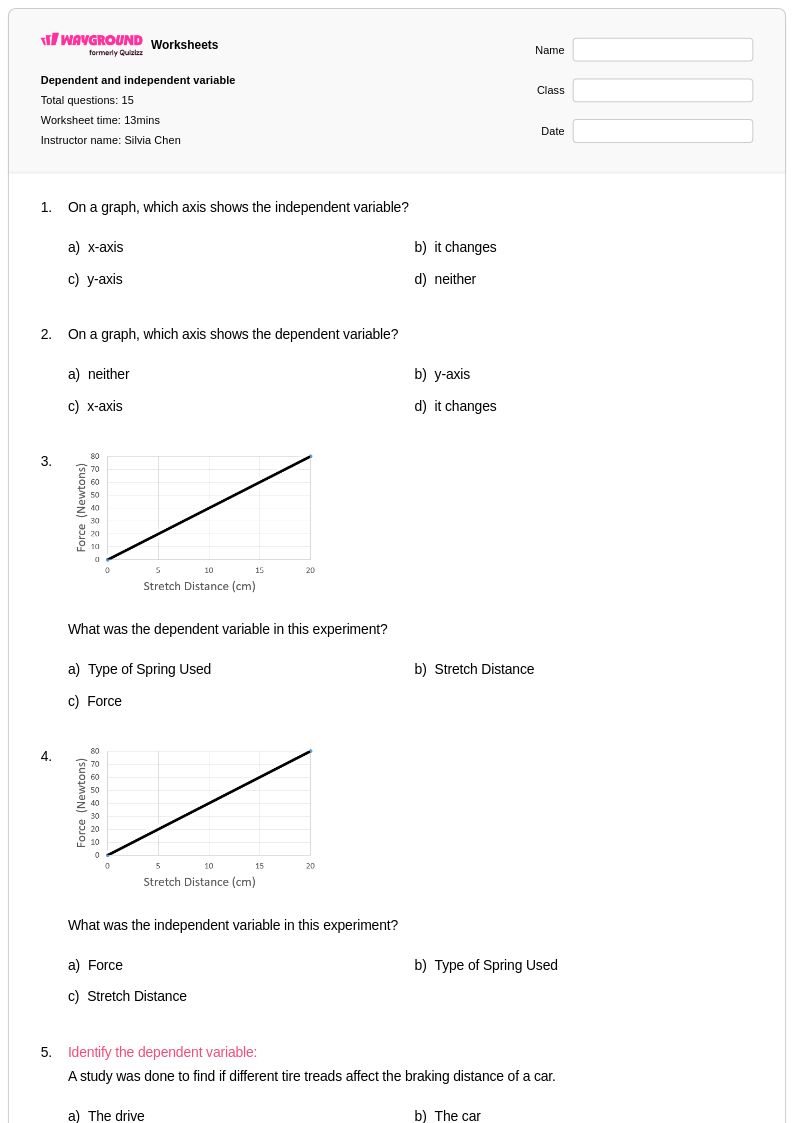
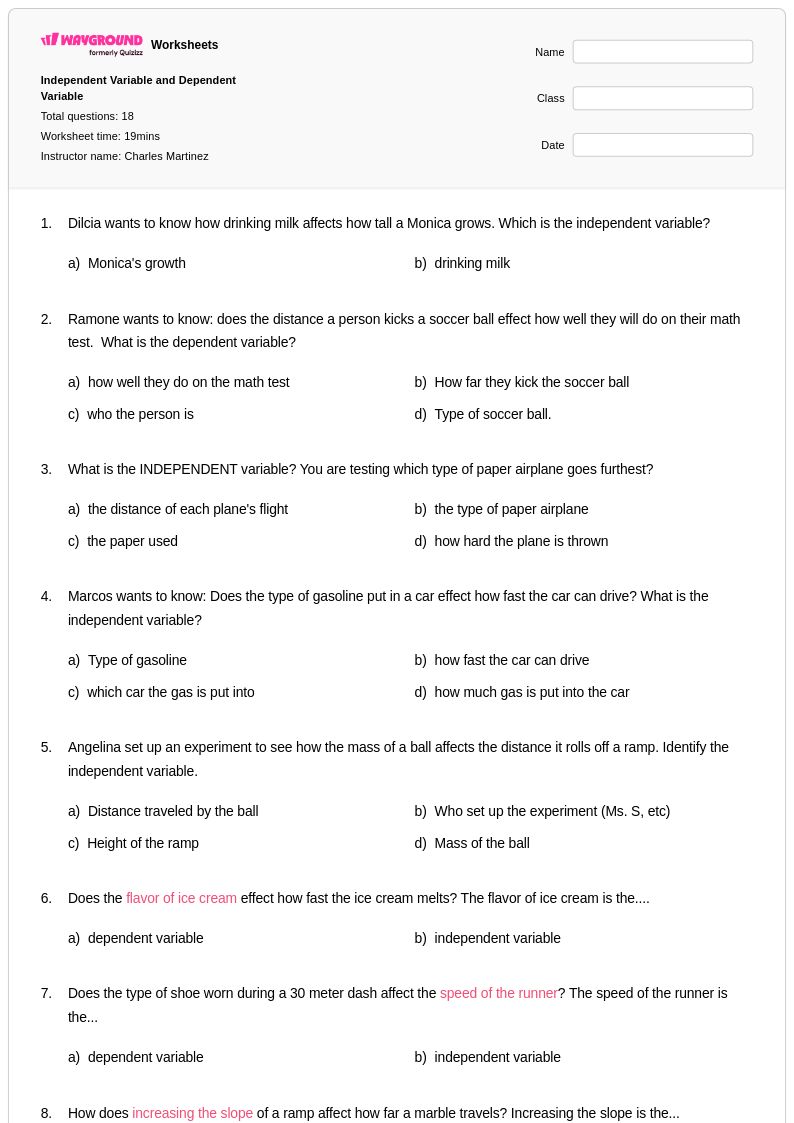
Worksheets that present brief experimental descriptions and ask students to label the independent variable, dependent variable, and constants are among the most effective practice formats. Spanning multiple scientific disciplines — biology, chemistry, physics, and earth science — ensures students learn to apply the concept across contexts rather than memorizing one example. Practice problems that also ask students to design their own controlled experiments deepen understanding beyond simple identification.
What mistakes do students commonly make when identifying independent variables?
The most frequent error is confusing the independent variable with the dependent variable — students often label the outcome being measured as the variable that was changed. Another common mistake is identifying multiple independent variables in a single experiment, which reflects a misunderstanding of controlled experimental design. Targeted practice with side-by-side comparisons of independent and dependent variables in the same scenario helps students correct both misconceptions.
How can I use independent variable worksheets to support students with different learning needs?
Wayground allows teachers to apply student-level accommodations directly to worksheet sessions, including Read Aloud for students who benefit from audio support and reduced answer choices to lower cognitive load for struggling learners. Extended time can be configured per student so that pacing differences are addressed without disrupting the rest of the class. These accommodations are saved and reusable across future sessions, making differentiation manageable for ongoing practice with experimental design concepts.
How do I use Wayground's independent variable worksheets in my classroom?
Wayground's independent variable worksheets are available as printable PDFs for traditional paper-and-pencil use and in digital formats for technology-integrated classrooms, making them easy to deploy in any setting. Teachers can also host a worksheet as a live quiz on Wayground, giving students an interactive experience while capturing real-time performance data. Each worksheet includes a complete answer key, so assessing student understanding and providing feedback requires minimal additional preparation.
How do independent variable worksheets support scientific thinking skills beyond memorization?
Well-designed independent variable worksheets push students to analyze experimental scenarios rather than recall a definition, which builds genuine scientific reasoning. When students must distinguish the manipulated variable from constants and the dependent variable across diverse experimental contexts, they develop the ability to evaluate research design — a foundational skill for advanced science coursework. This kind of structured practice bridges the gap between understanding a vocabulary term and applying it to novel experimental situations.