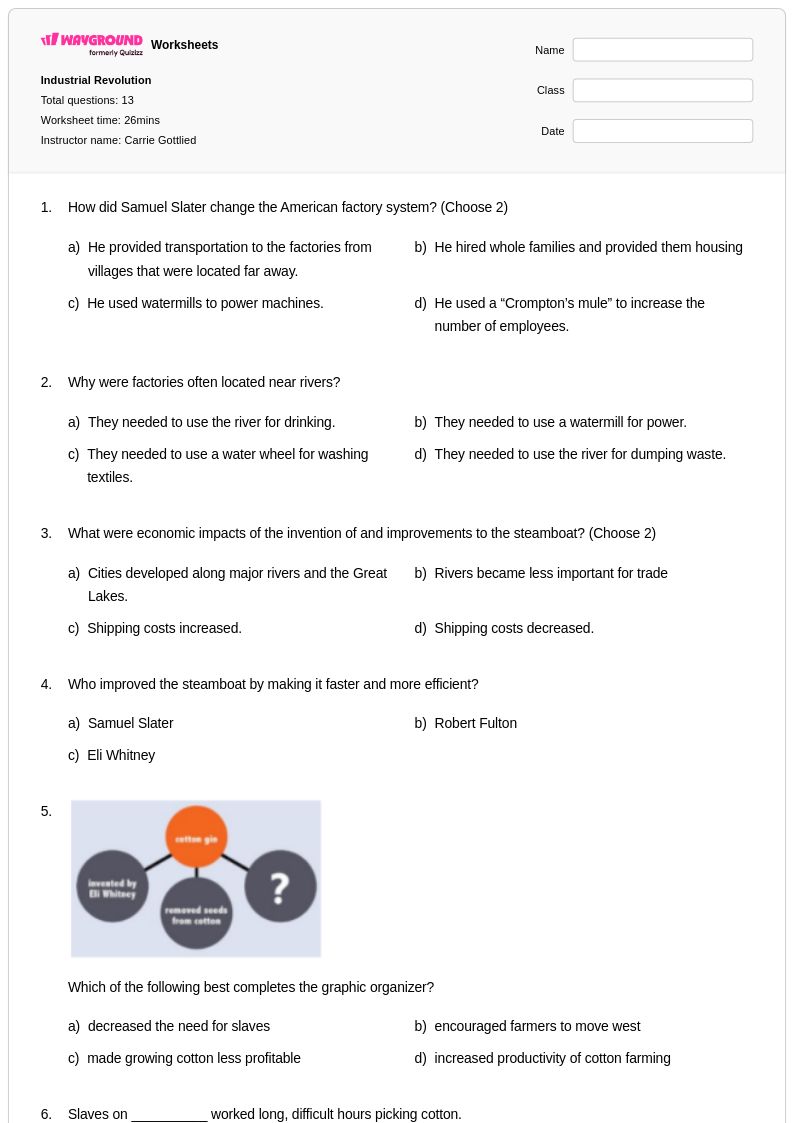
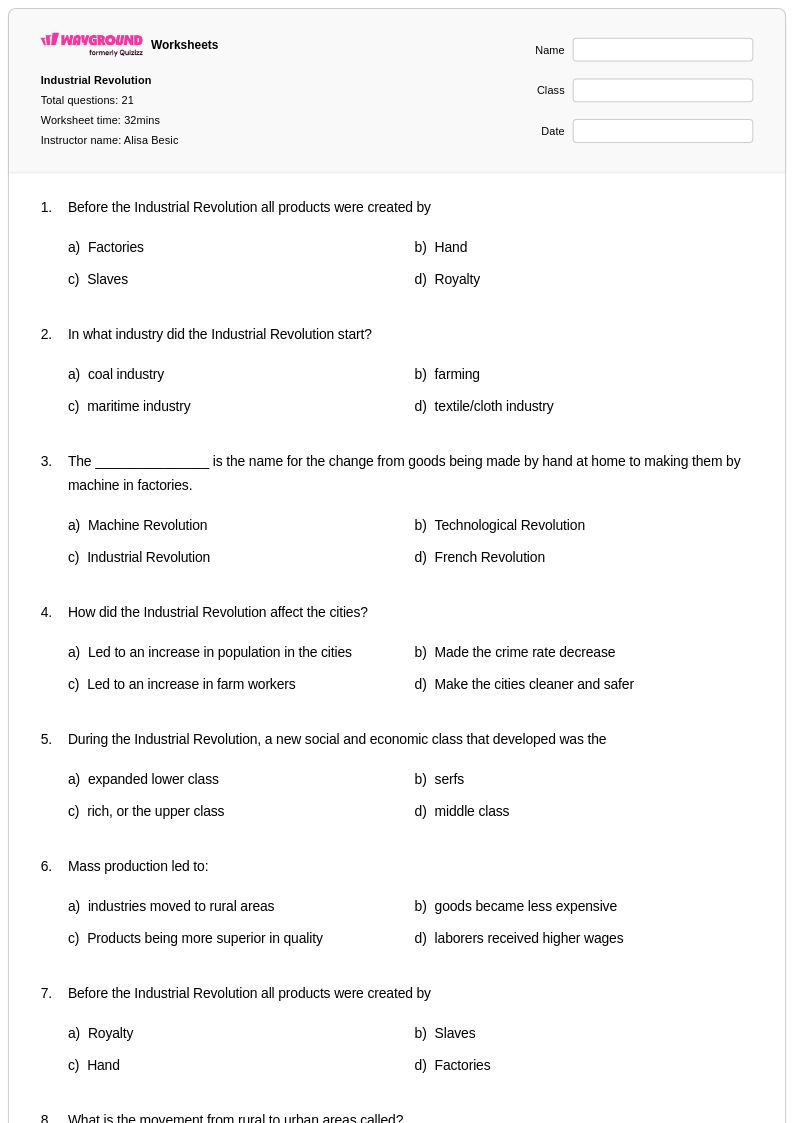
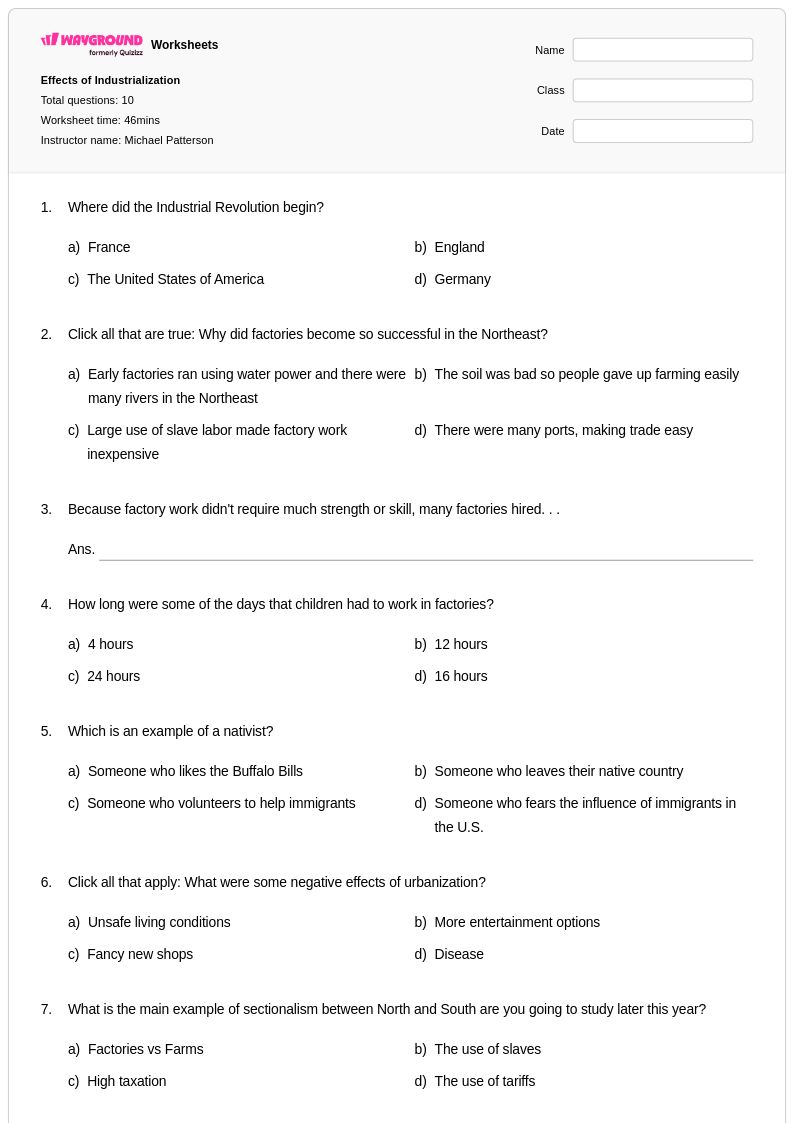
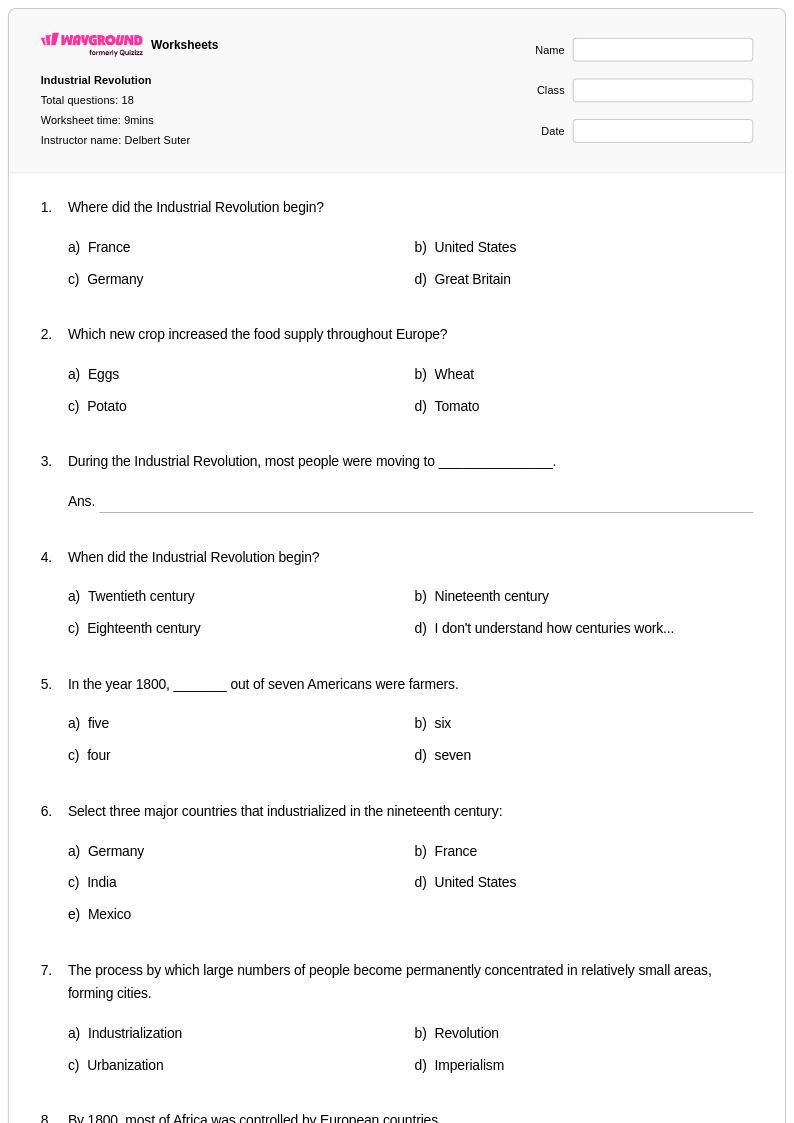
Explore Wayground's free Industrial Revolution Impact worksheets and printables that help students analyze how industrialization transformed society, economics, and daily life through engaging practice problems with comprehensive answer keys.
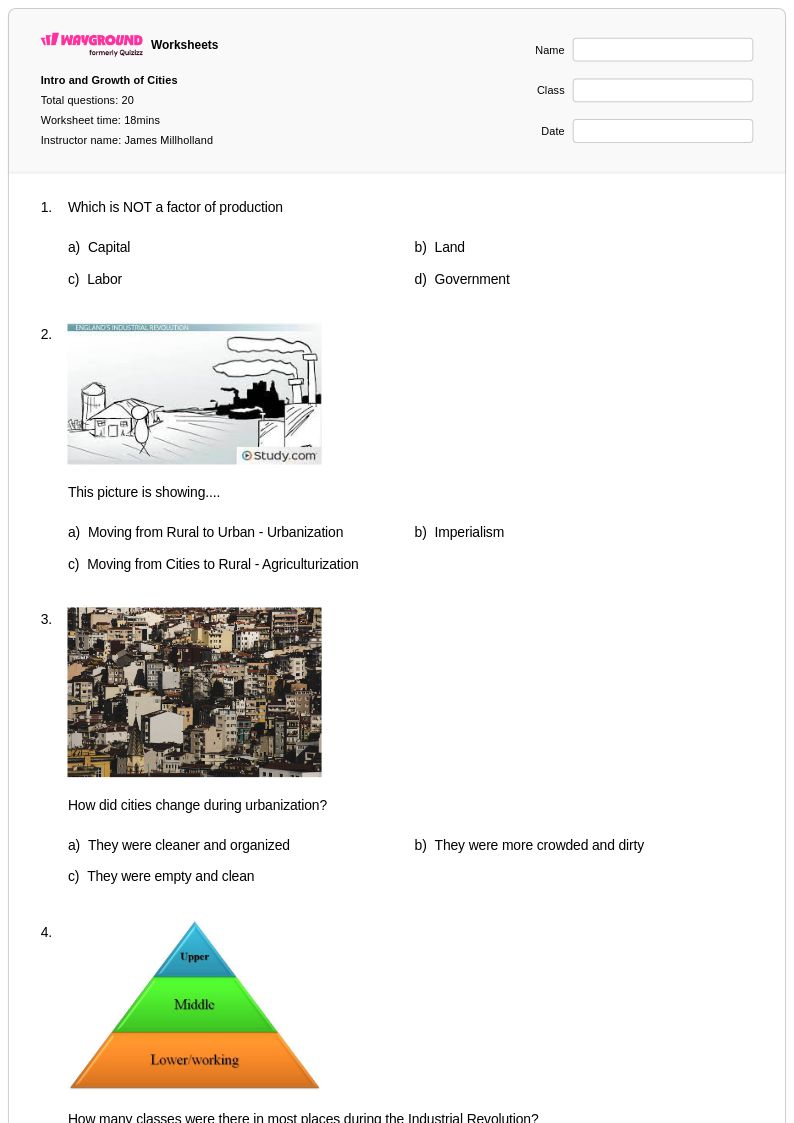
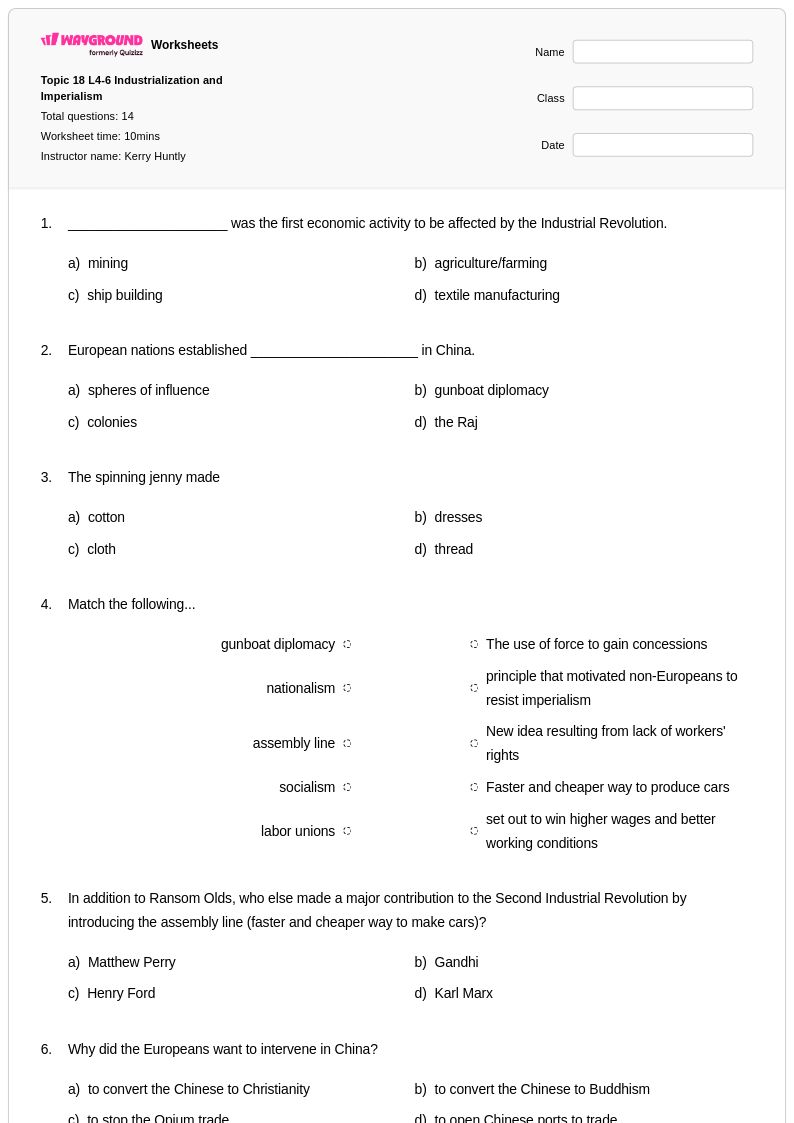
Industrial Revolution: Impact worksheets available through Wayground (formerly Quizizz) provide comprehensive educational resources that examine the far-reaching consequences of industrialization on society, economy, and daily life. These carefully crafted materials help students develop critical thinking skills as they analyze how the Industrial Revolution transformed labor systems, urbanization patterns, social class structures, and technological advancement. The worksheets feature a variety of practice problems that challenge learners to evaluate primary sources, interpret historical data, and draw connections between industrial changes and their lasting effects on modern civilization. Each resource includes detailed answer keys that support both independent study and classroom instruction, while the free printables offer educators flexible options for incorporating historical analysis into their curriculum without additional costs.
Wayground (formerly Quizizz) empowers teachers with access to millions of educator-created resources specifically designed to explore the Industrial Revolution's transformative impact on human society. The platform's robust search and filtering capabilities enable instructors to quickly locate materials that align with curriculum standards and match their students' specific learning needs. Teachers benefit from comprehensive differentiation tools that allow them to customize worksheet difficulty levels, modify content focus areas, and adapt assignments for diverse learners requiring remediation or enrichment opportunities. These Industrial Revolution: Impact resources are available in both printable pdf formats for traditional classroom use and digital formats for modern learning environments, giving educators the flexibility to seamlessly integrate historical skill practice into their lesson planning while ensuring students gain deep understanding of this pivotal period's lasting consequences.
FAQs
How do I teach the impact of the Industrial Revolution in a history class?
Teaching the impact of the Industrial Revolution is most effective when students examine specific cause-and-effect relationships across social, economic, and technological domains. Start by anchoring instruction in concrete examples — the shift from agrarian to wage labor, the rise of factory towns, and the emergence of a distinct working class. Pairing primary source analysis with structured graphic organizers helps students move beyond memorization toward genuine historical reasoning. Building lessons around thematic categories like urbanization, social class, and technological change gives students a framework for connecting events across time.
What are good practice exercises for analyzing the Industrial Revolution's effects on society?
Effective practice exercises for this topic ask students to interpret historical data, evaluate primary sources, and draw connections between industrialization and its long-term consequences. Document analysis tasks work especially well — students can examine factory records, urban population charts, or firsthand accounts from workers to build evidence-based arguments. Exercises that require students to compare pre- and post-industrial life across dimensions like labor, family structure, and urban growth reinforce analytical depth. Structured written responses and data interpretation questions are particularly strong formats for assessing whether students understand the breadth of industrialization's impact.
What misconceptions do students commonly have about the Industrial Revolution's impact?
A common misconception is that industrialization was uniformly positive — students often focus on technological progress while overlooking the harsh labor conditions, child labor, and urban poverty that accompanied it. Many students also assume the Industrial Revolution's effects were immediate and evenly distributed, when in reality its consequences unfolded unevenly across regions, classes, and time. Another frequent error is treating the Industrial Revolution as an isolated British phenomenon, missing its global ripple effects on trade, colonialism, and labor systems worldwide. Addressing these gaps directly in instruction and practice materials builds more nuanced historical thinking.
How can I use Industrial Revolution Impact worksheets in my classroom?
Industrial Revolution Impact worksheets on Wayground are available as printable PDFs for traditional classroom use and in digital formats for technology-integrated learning environments, making them adaptable to virtually any instructional setting. Teachers can assign them as guided in-class activities, independent practice, homework, or formative assessments depending on where students are in the unit. Digital versions can be hosted as a quiz directly on Wayground, enabling real-time progress tracking and immediate feedback. The included answer keys support both teacher-led correction and self-directed student review.
How do I differentiate Industrial Revolution worksheets for students with different learning needs?
Wayground includes built-in accommodation tools that allow teachers to support diverse learners without creating entirely separate materials. For students who need additional accessibility support, teachers can enable Read Aloud so questions and content are read to students, or adjust font size and display themes through Reading Mode. Reduced answer choices can lower cognitive load for students who struggle with complex multiple-choice questions. These settings can be assigned to individual students, meaning the rest of the class receives the standard experience without any disruption to workflow.
How does the Industrial Revolution connect to topics students study later in history?
The Industrial Revolution is a foundational unit because its consequences extend directly into topics like imperialism, progressive-era reform, labor movements, and 20th-century economic systems. Students who understand industrialization's impact on class structure and urbanization are better equipped to analyze why progressive reform movements emerged and why labor unions became politically significant. Connecting this unit explicitly to later topics — through recurring themes like inequality, technology, and globalization — helps students build a coherent historical narrative rather than treating each unit as isolated content.