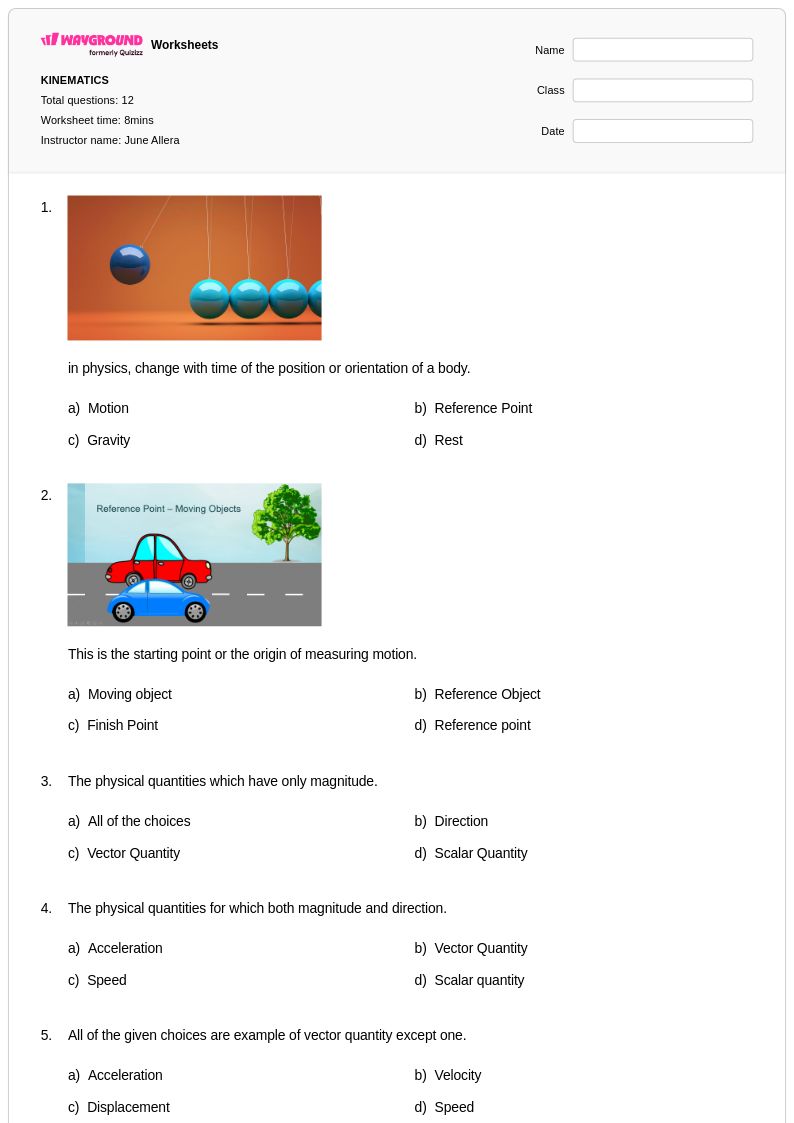
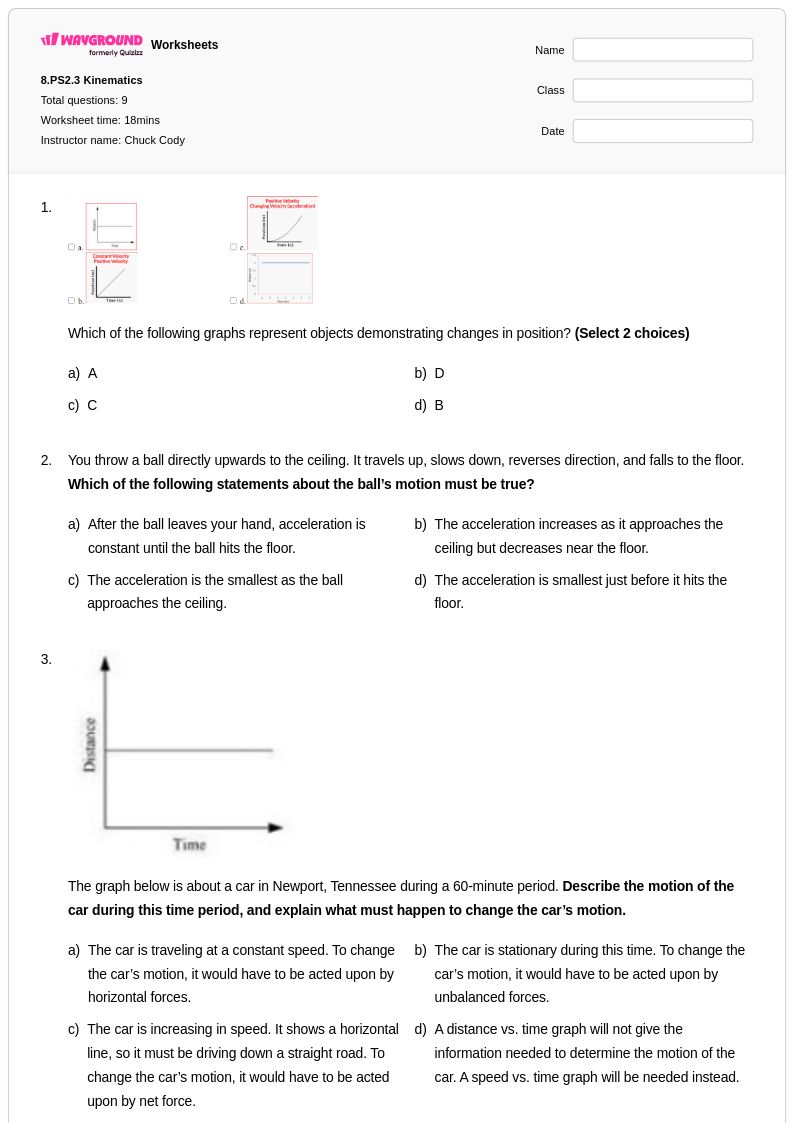
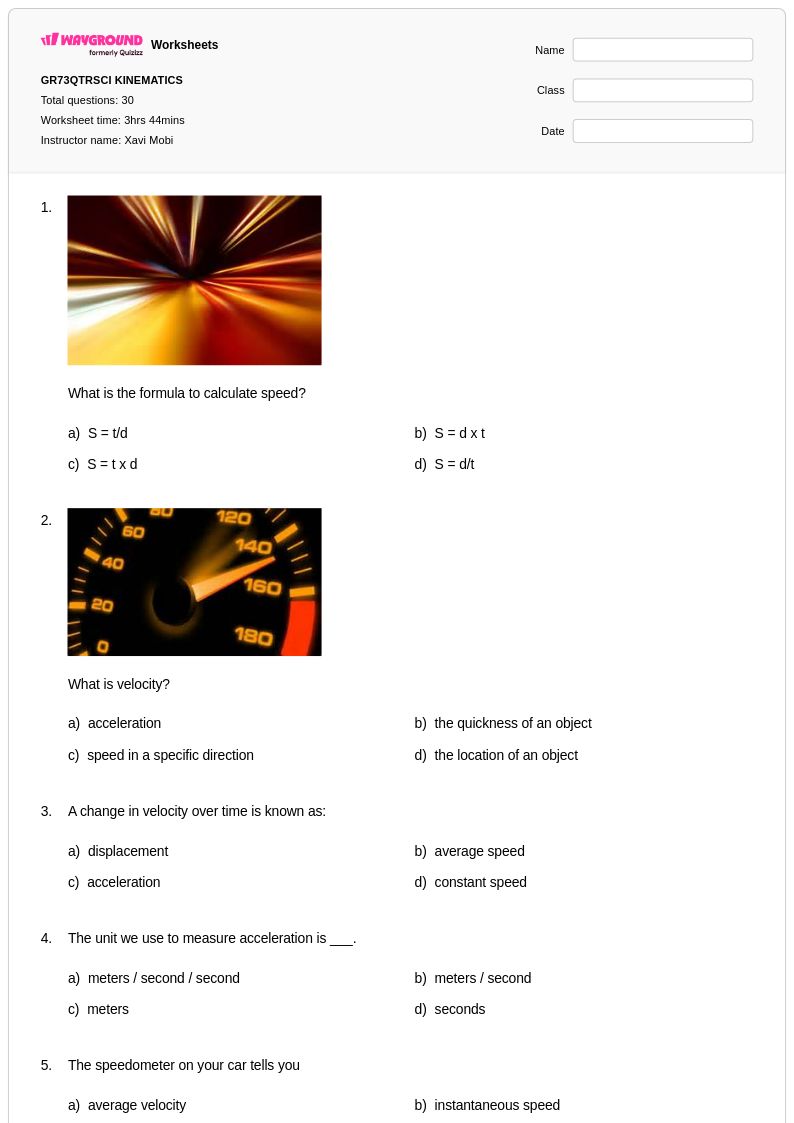
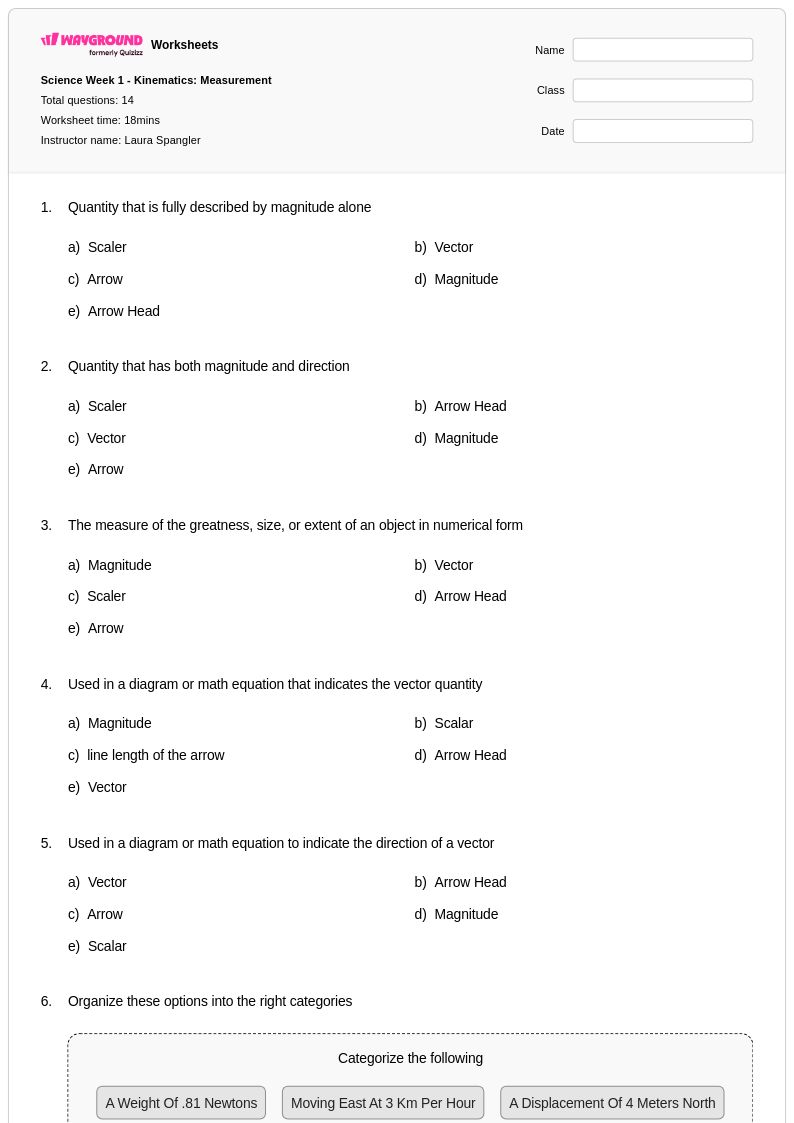
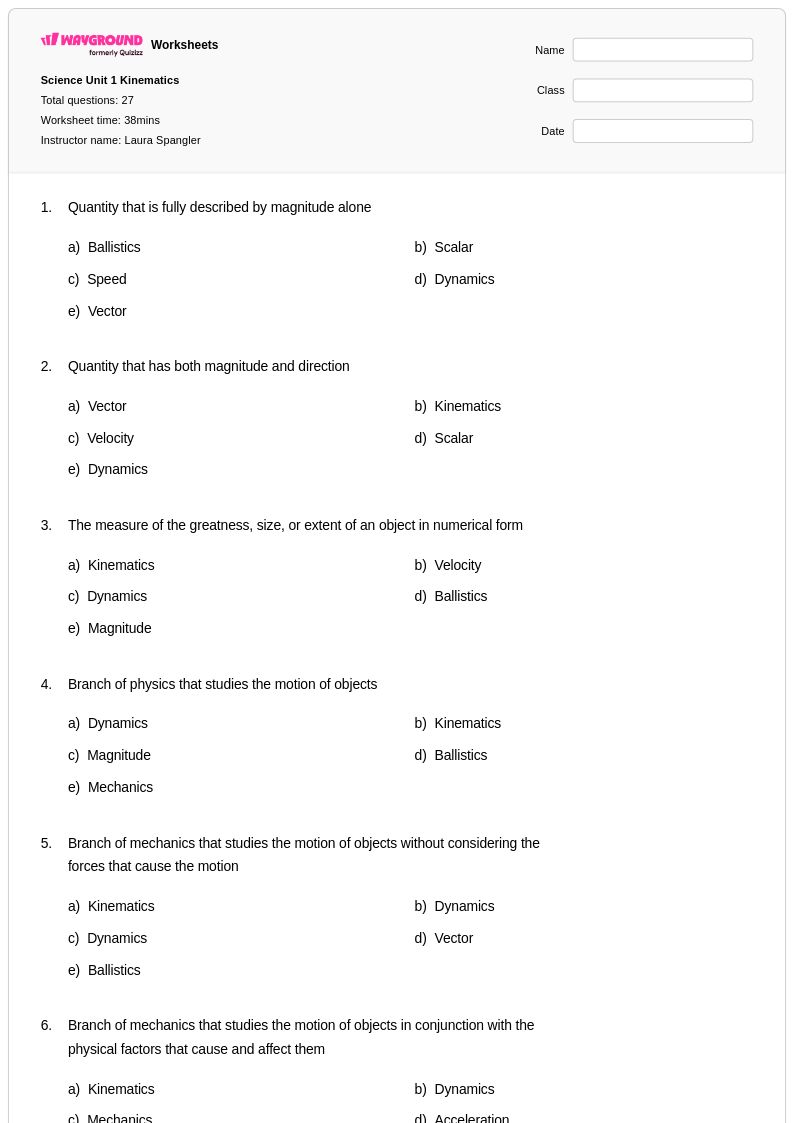
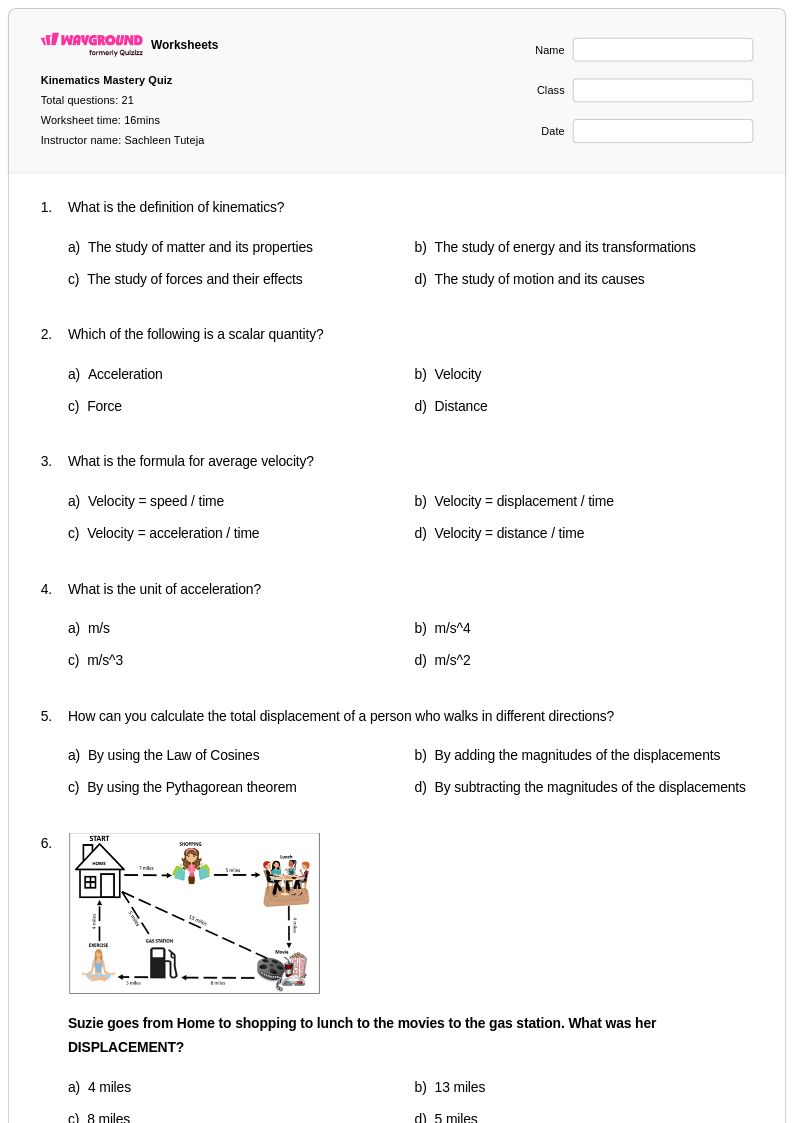
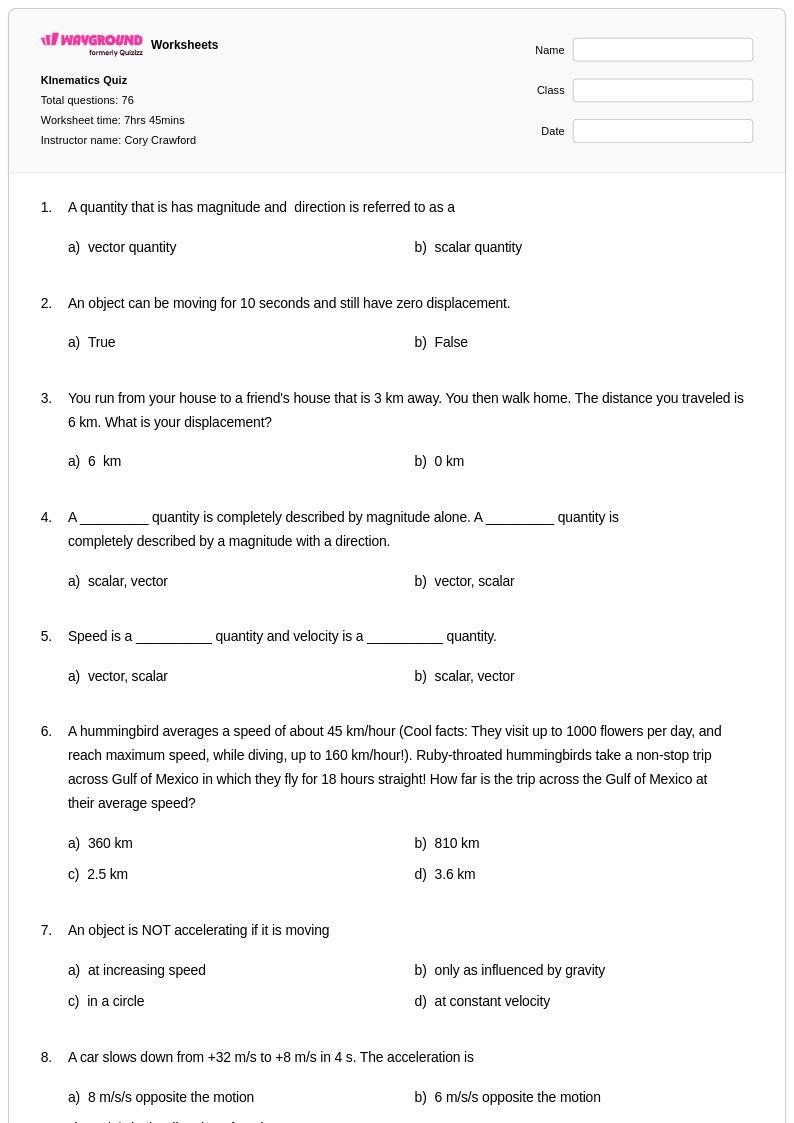
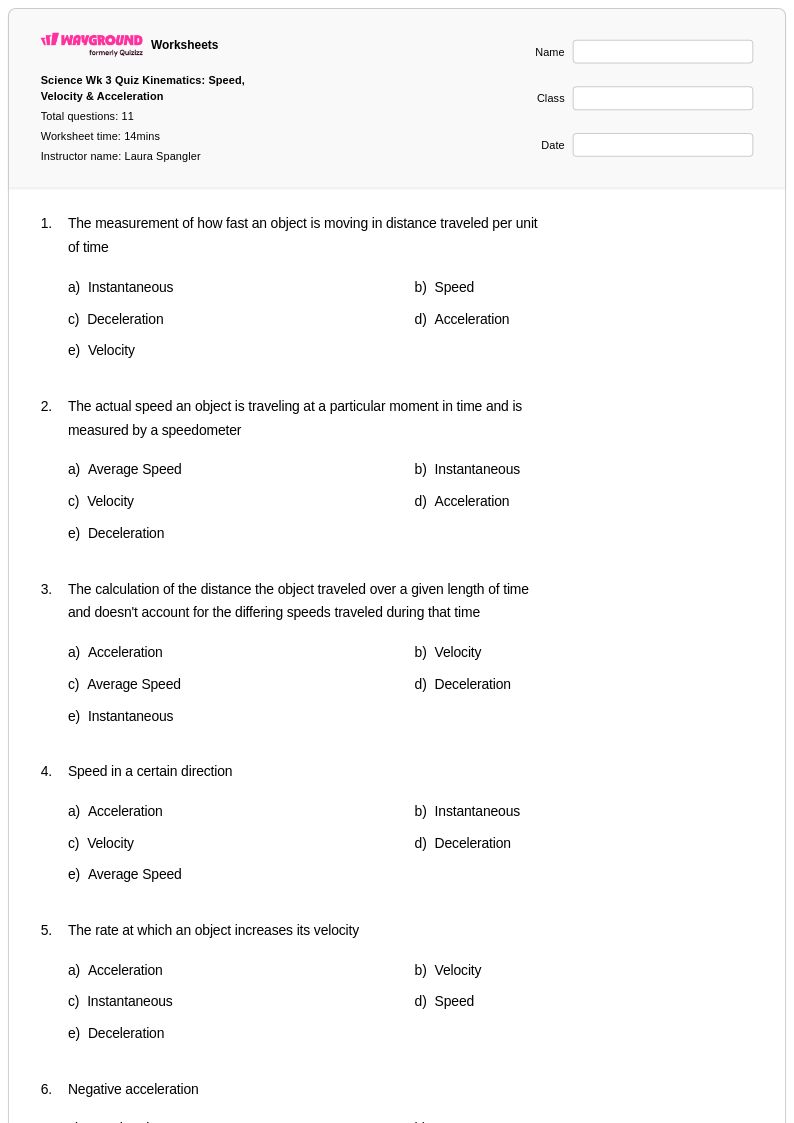
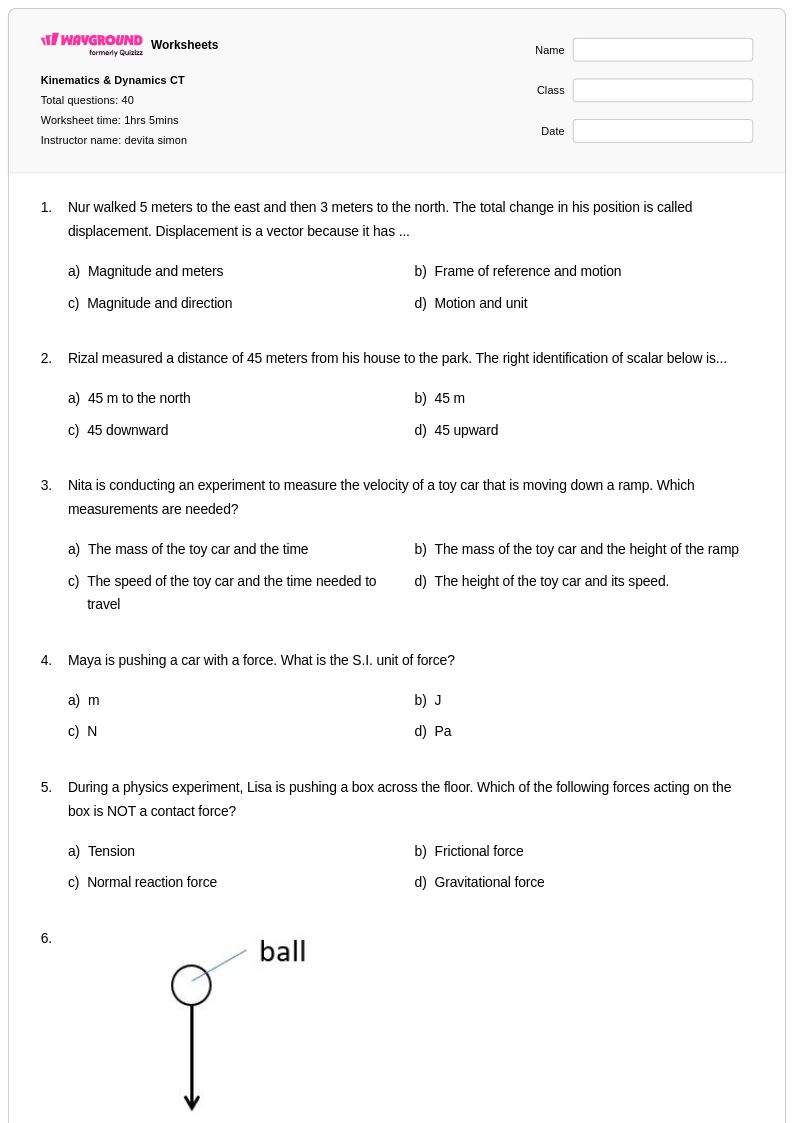
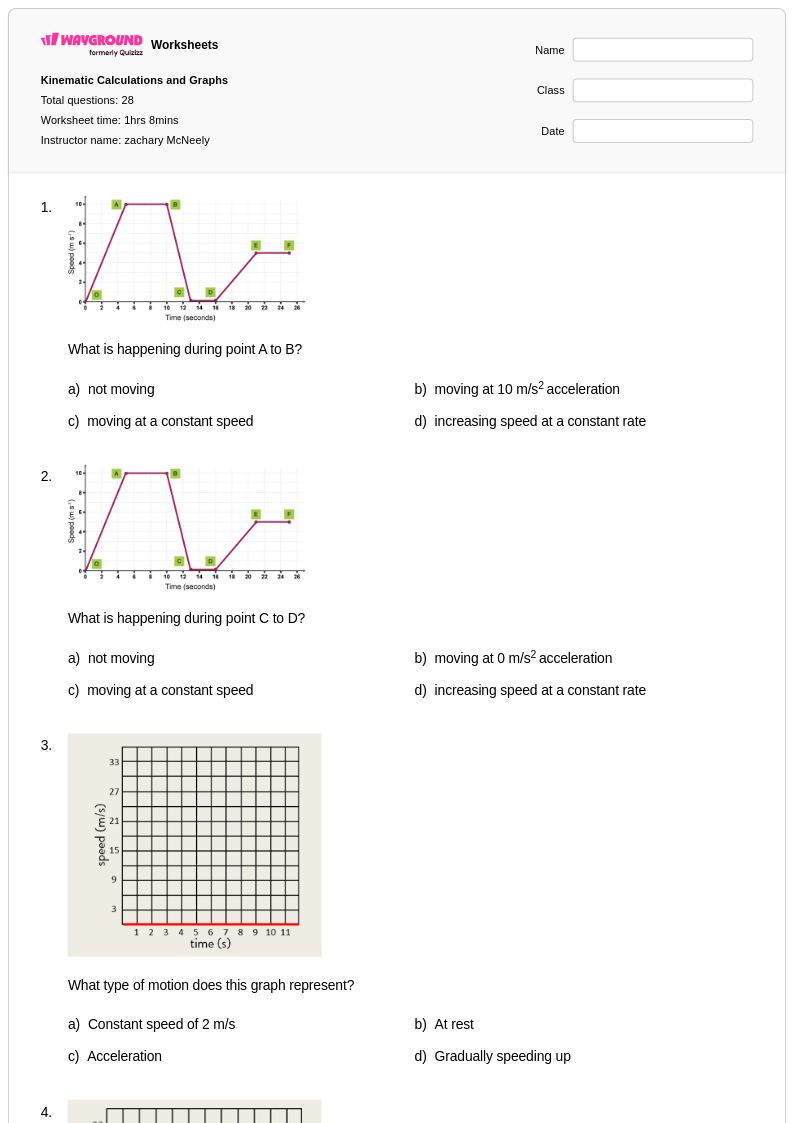
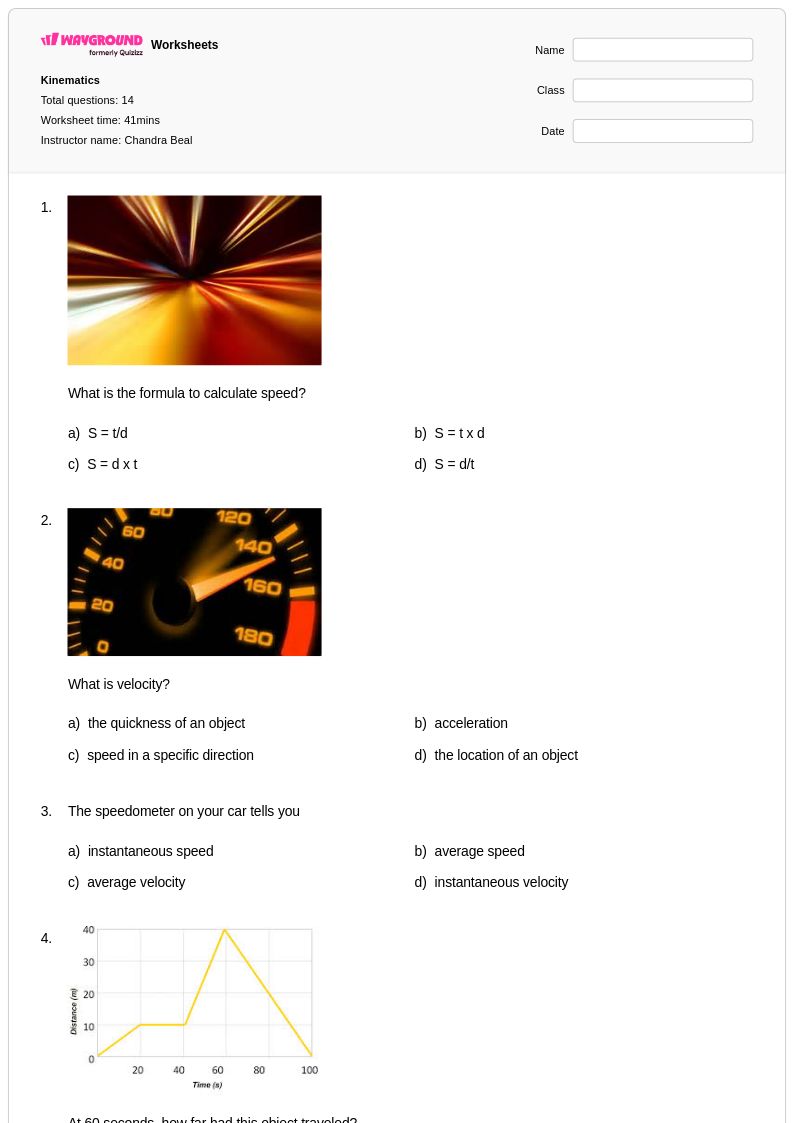
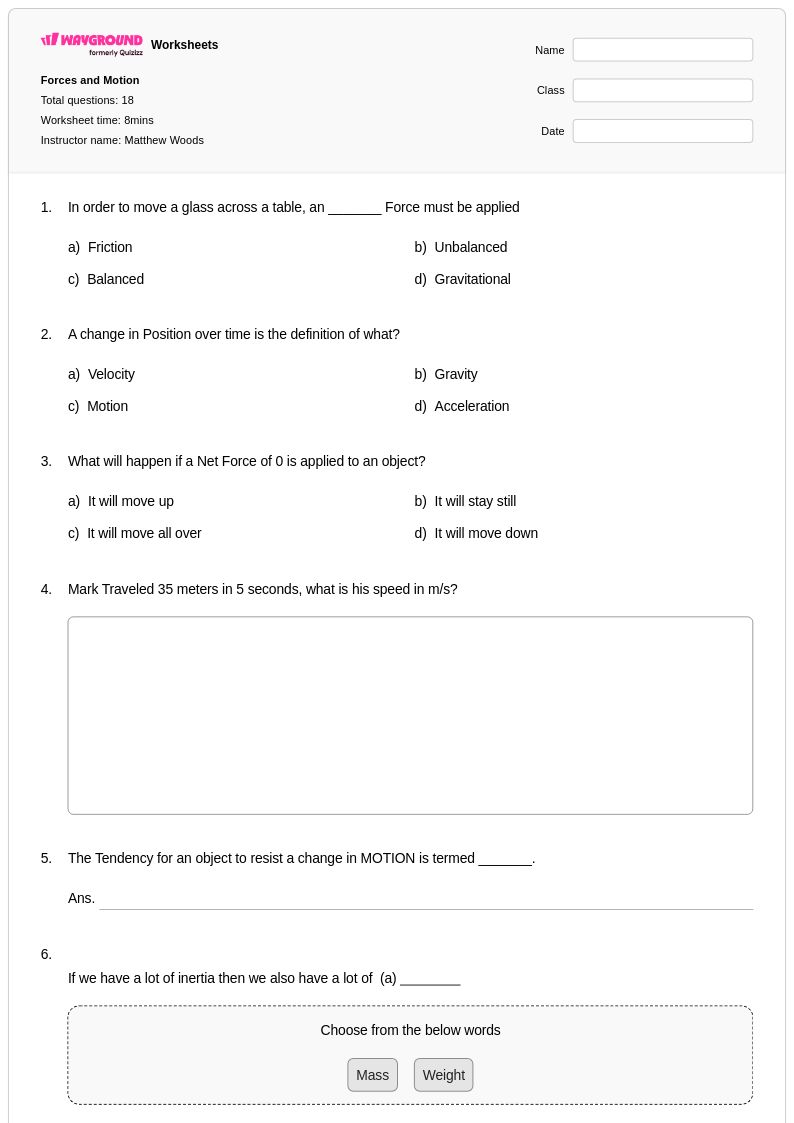
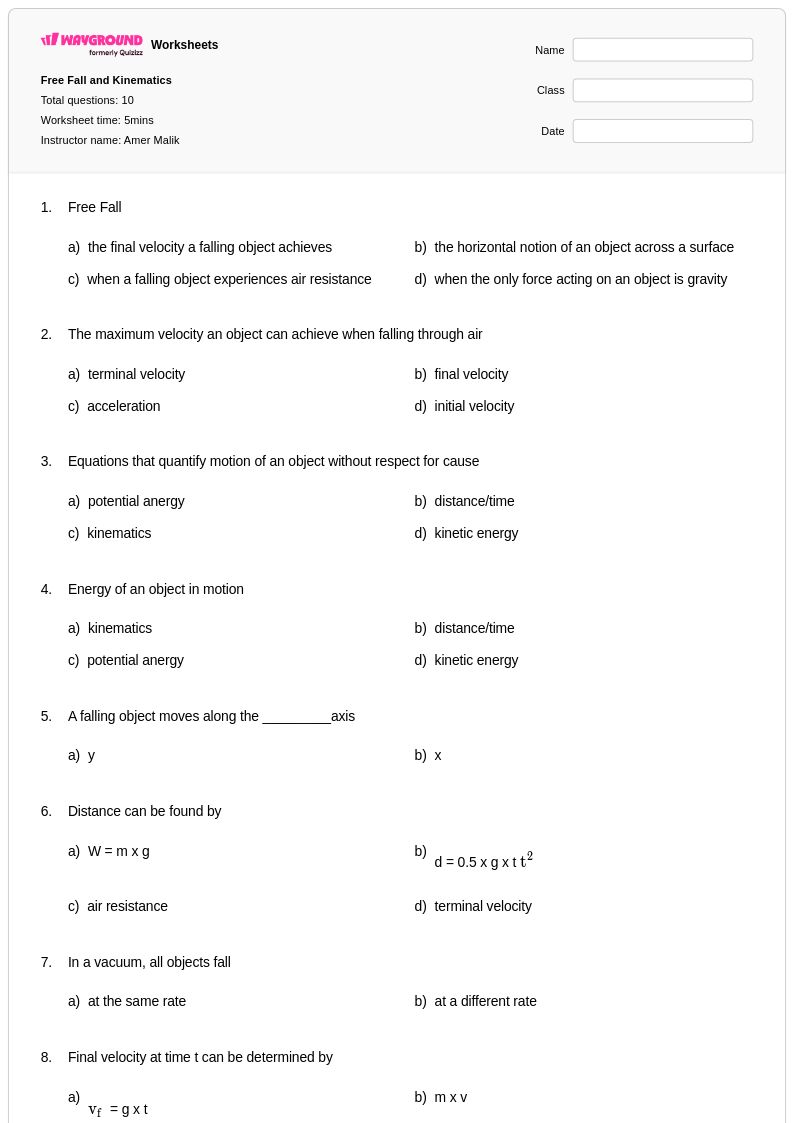
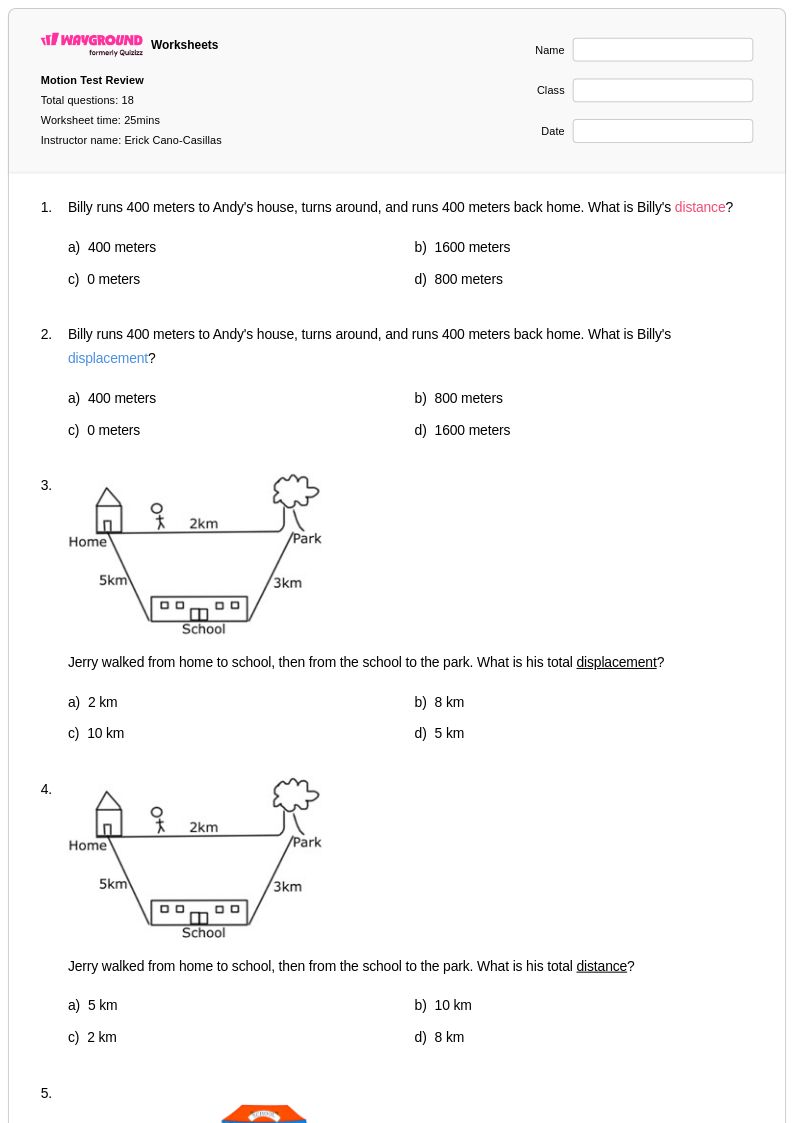
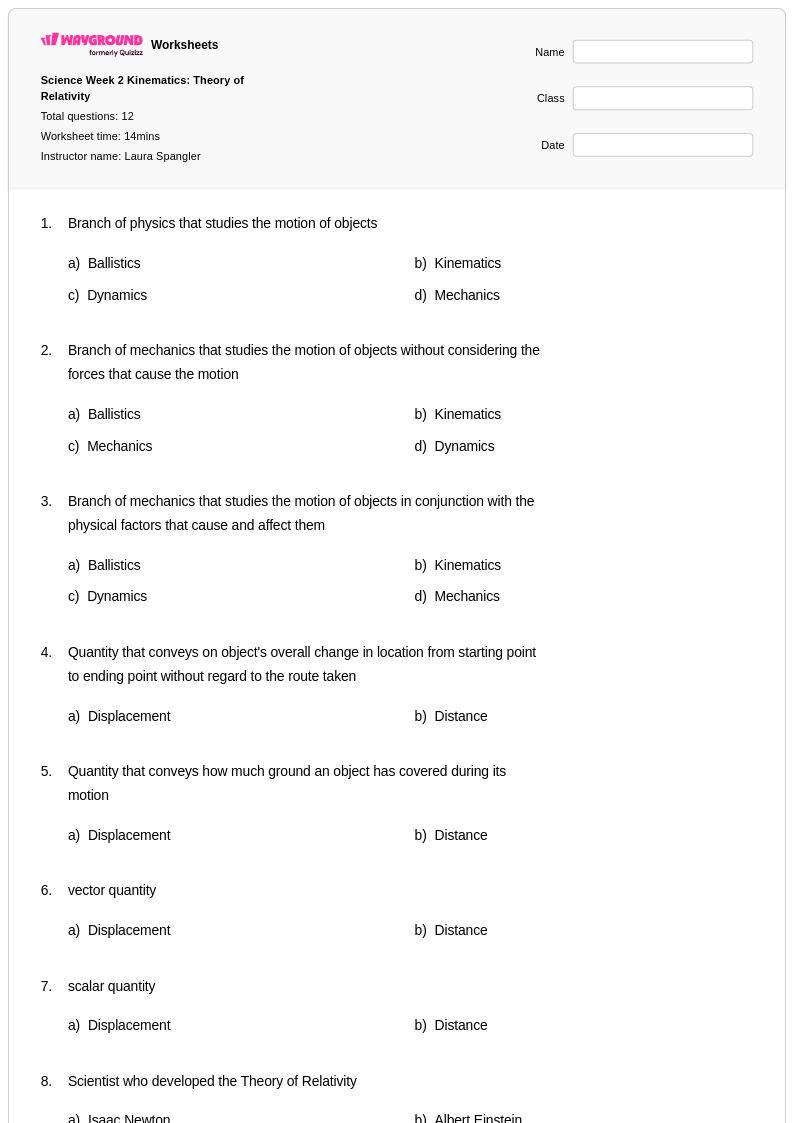
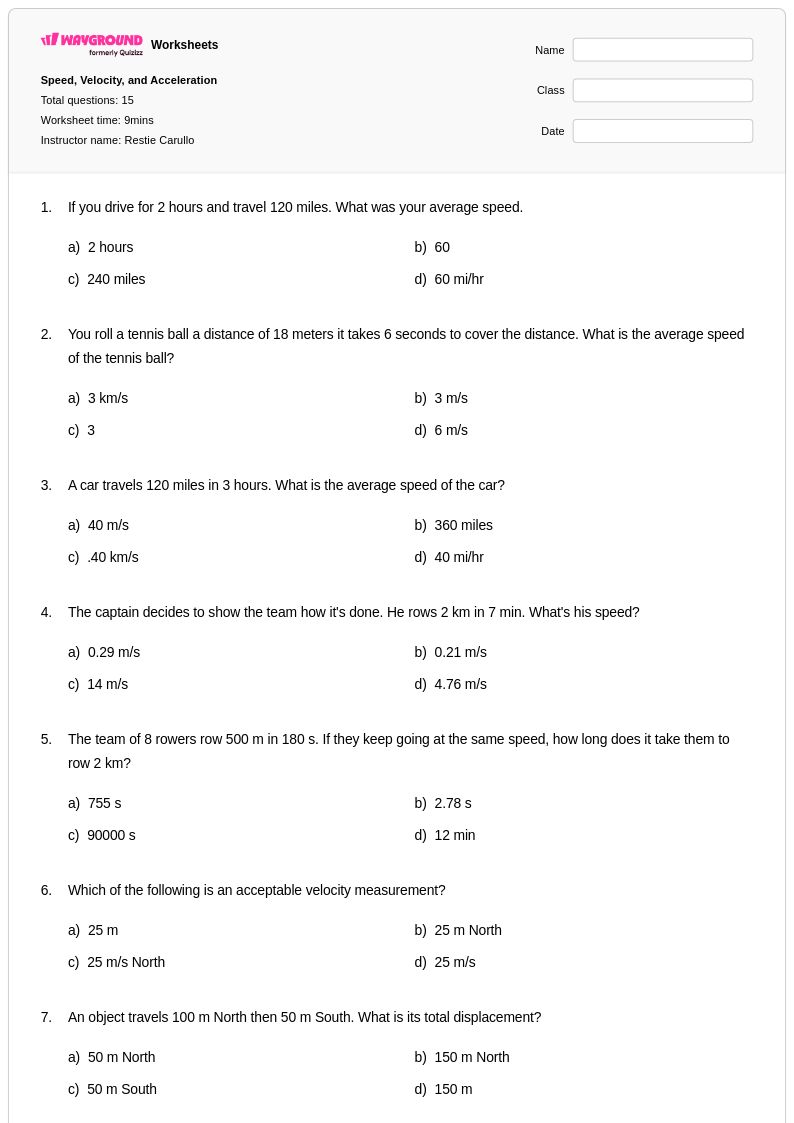
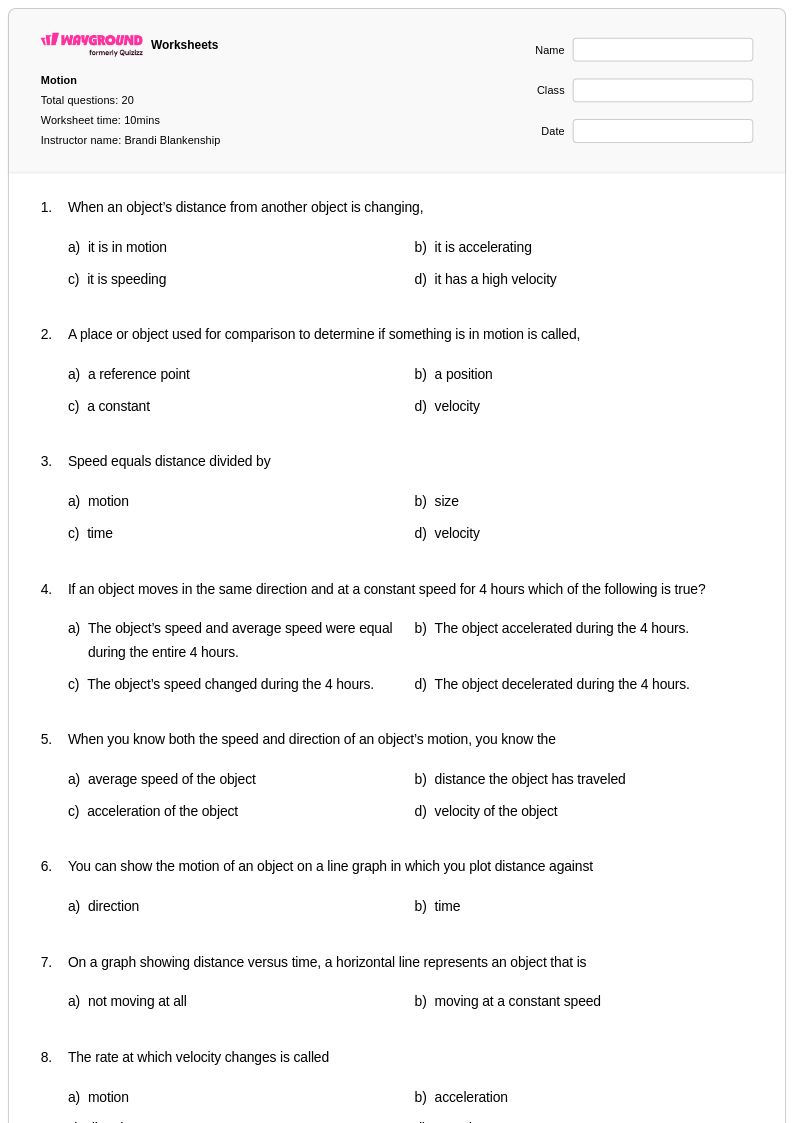
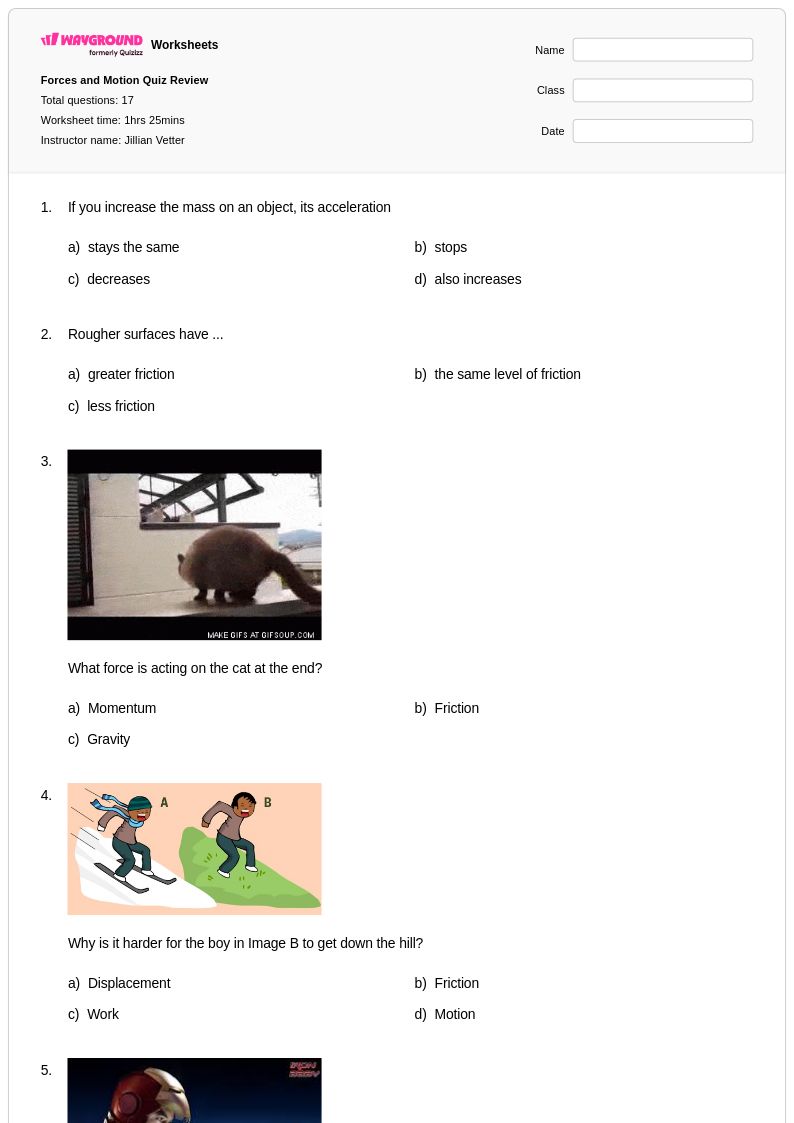
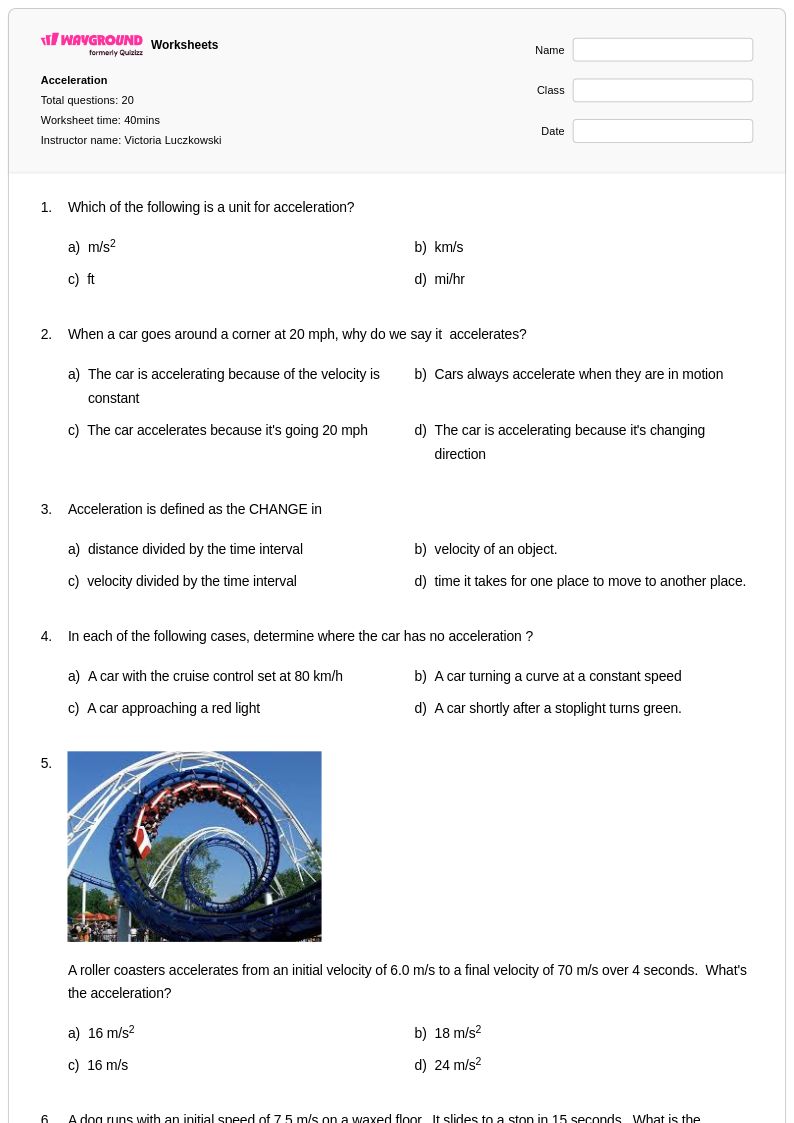
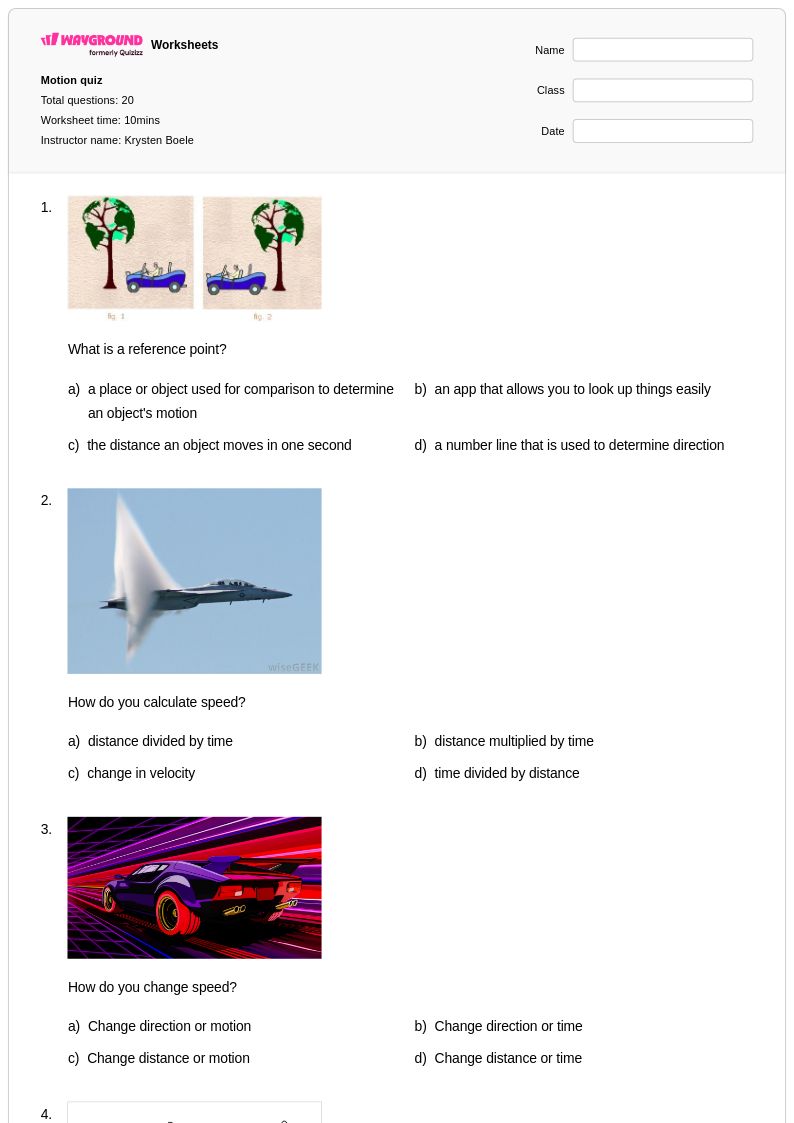
Explore Year 7 kinematics worksheets and printables from Wayground that help students master motion, velocity, and acceleration through engaging practice problems with complete answer keys.
Explore printable Kinematics worksheets for Year 7
Year 7 kinematics worksheets available through Wayground (formerly Quizizz) provide comprehensive coverage of motion concepts that form the foundation of physics education at the middle school level. These carefully crafted resources help students master essential skills including calculating velocity and acceleration, interpreting distance-time and velocity-time graphs, distinguishing between scalar and vector quantities, and applying kinematic equations to solve real-world problems. Each worksheet collection includes detailed answer keys that enable both independent student practice and efficient teacher assessment, while the free printable format ensures accessibility for diverse classroom environments. The practice problems progress systematically from basic motion vocabulary to more complex scenarios involving changing velocities and multi-step calculations, allowing students to build confidence while developing critical thinking skills in physics problem-solving.
Wayground (formerly Quizizz) empowers educators with an extensive library of millions of teacher-created kinematics resources that streamline lesson planning and differentiated instruction for Year 7 physics concepts. The platform's robust search and filtering capabilities allow teachers to quickly locate worksheets aligned with specific curriculum standards, while built-in customization tools enable educators to modify content difficulty levels and problem types to meet individual student needs. These versatile materials are available in both printable pdf formats for traditional classroom use and digital versions that support interactive learning environments, making them ideal for remediation sessions with struggling learners, enrichment activities for advanced students, and regular skill practice across diverse learning contexts. The comprehensive nature of these worksheet collections ensures that teachers have immediate access to high-quality materials that support effective kinematics instruction while saving valuable preparation time.
FAQs
How do I teach kinematics to high school physics students?
Start by grounding students in scalar vs. vector quantities before introducing displacement, velocity, and acceleration as related concepts. Use position-time and velocity-time graphs early so students build intuition visually before working with kinematic equations algebraically. Progressively move from one-dimensional motion to two-dimensional scenarios, and introduce projectile motion only after students are confident applying the core equations in simpler contexts.
What types of practice problems help students get better at kinematics?
Effective kinematics practice should span multiple representations: numerical equation-solving, graph interpretation, and real-world scenario analysis. Students benefit most from problems that require them to select the correct kinematic equation based on the given and unknown variables, rather than applying a memorized formula by rote. Mixing one-dimensional free-fall problems with two-dimensional projectile problems builds the flexibility students need for assessments.
What mistakes do students commonly make when solving kinematics problems?
The most frequent error is sign convention confusion — students often treat displacement, velocity, and acceleration as positive by default rather than assigning direction consistently. Another common mistake is misidentifying which variable is unknown, leading students to choose the wrong kinematic equation. Students also frequently confuse average velocity with instantaneous velocity, particularly when reading motion graphs.
How do I use kinematics worksheets in my physics class?
Kinematics worksheets work well as structured practice after direct instruction, as homework assignments, or as formative assessment checkpoints before a unit exam. On Wayground, these worksheets are available as printable PDFs for traditional classroom use and in digital formats for technology-integrated environments, including the option to host them as a quiz directly on the platform. The included answer keys allow for efficient self-assessment or peer review without additional teacher preparation.
How can I differentiate kinematics instruction for students at different skill levels?
For struggling students, focus first on single-variable problems with clear diagrams before introducing multi-step scenarios. On Wayground, teachers can apply accommodations such as read aloud support, reduced answer choices, and extended time to individual students without affecting the rest of the class. High-achieving students can be challenged with complex projectile motion and two-dimensional analysis problems that require synthesizing multiple kinematic relationships.
What is the best way to help students interpret motion graphs in kinematics?
Students should practice moving between position-time, velocity-time, and acceleration-time graphs for the same motion scenario so they understand how the graphs are mathematically related. Emphasize that the slope of a position-time graph gives velocity, and the slope of a velocity-time graph gives acceleration — these relationships are where graphical analysis connects directly to the kinematic equations. Having students sketch graphs from verbal descriptions, and vice versa, builds the bidirectional fluency they need for both coursework and standardized assessments.