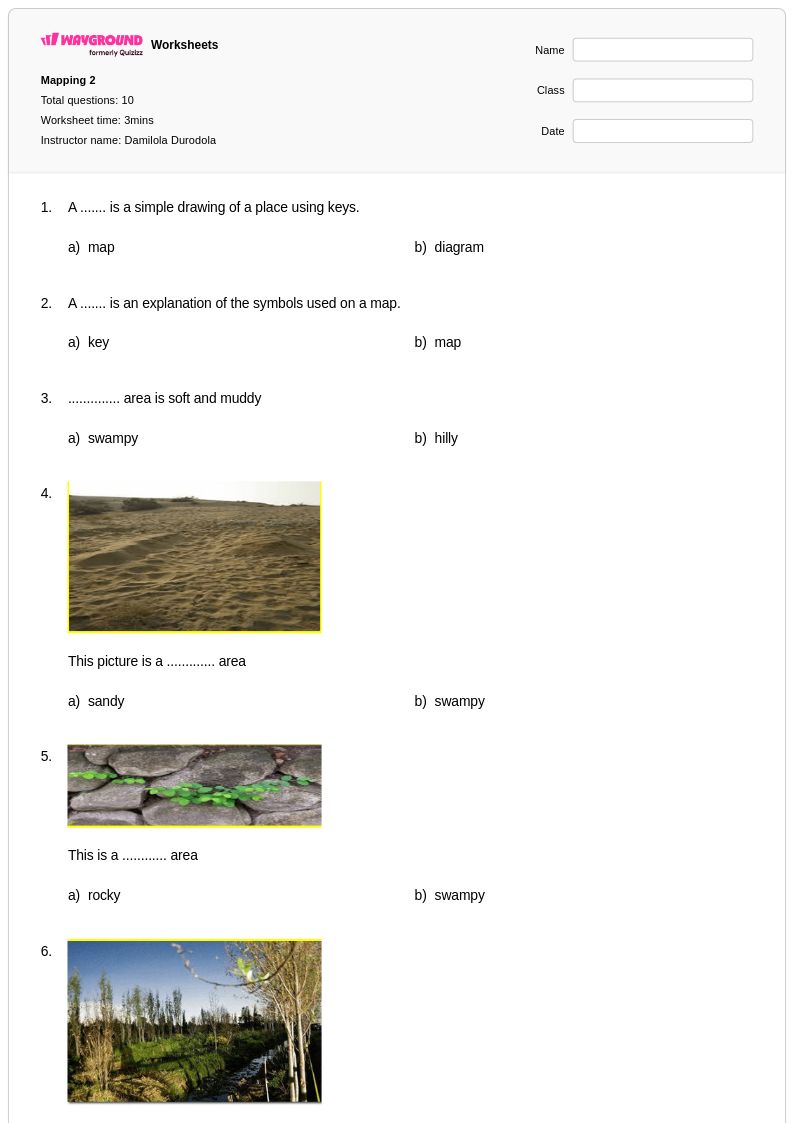
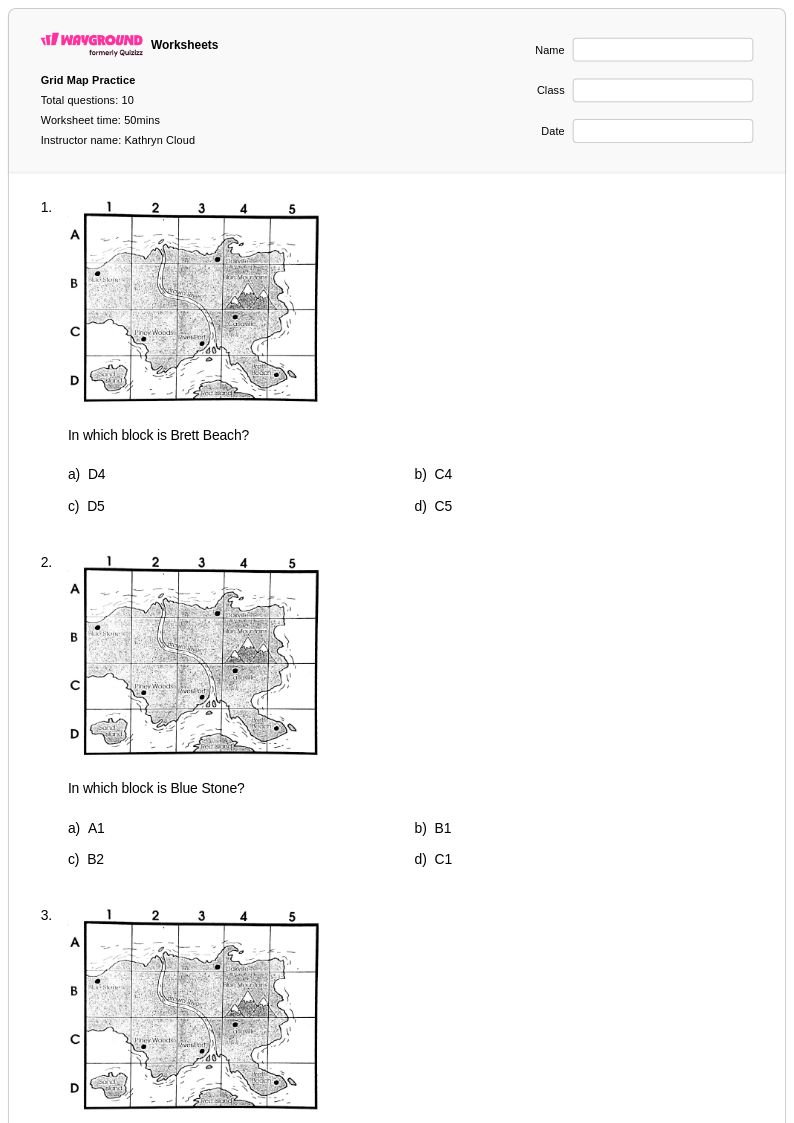
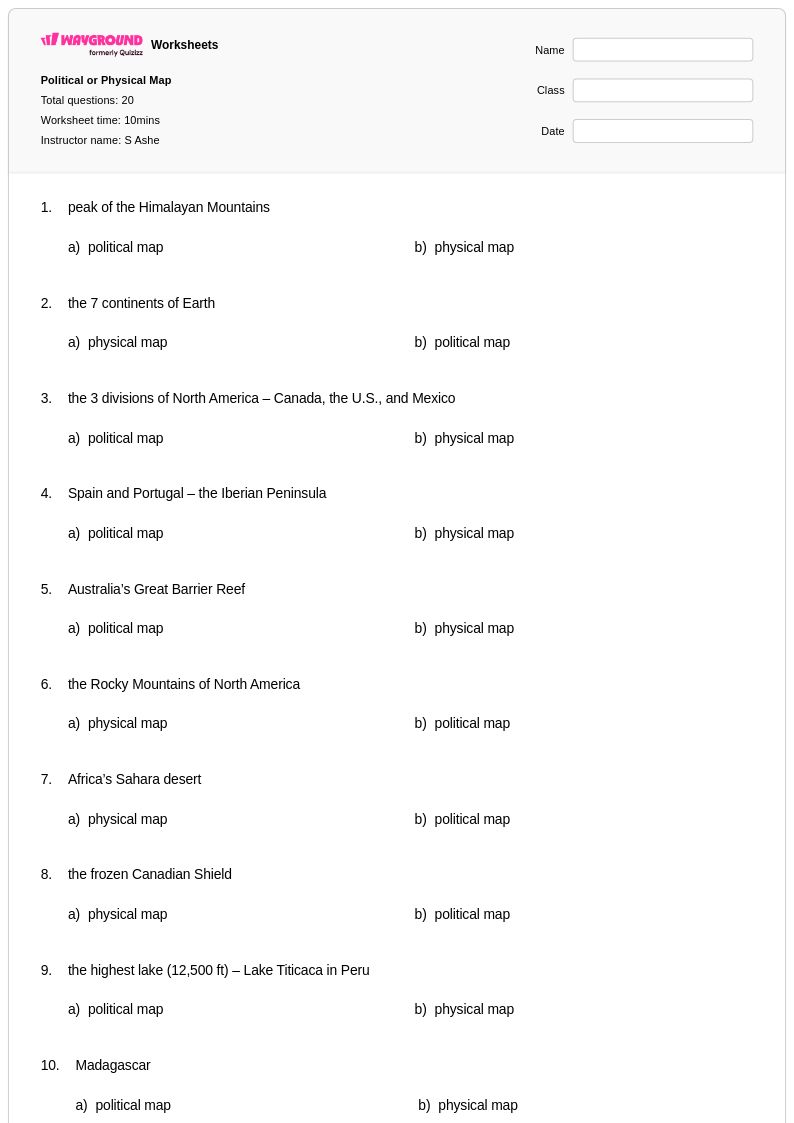
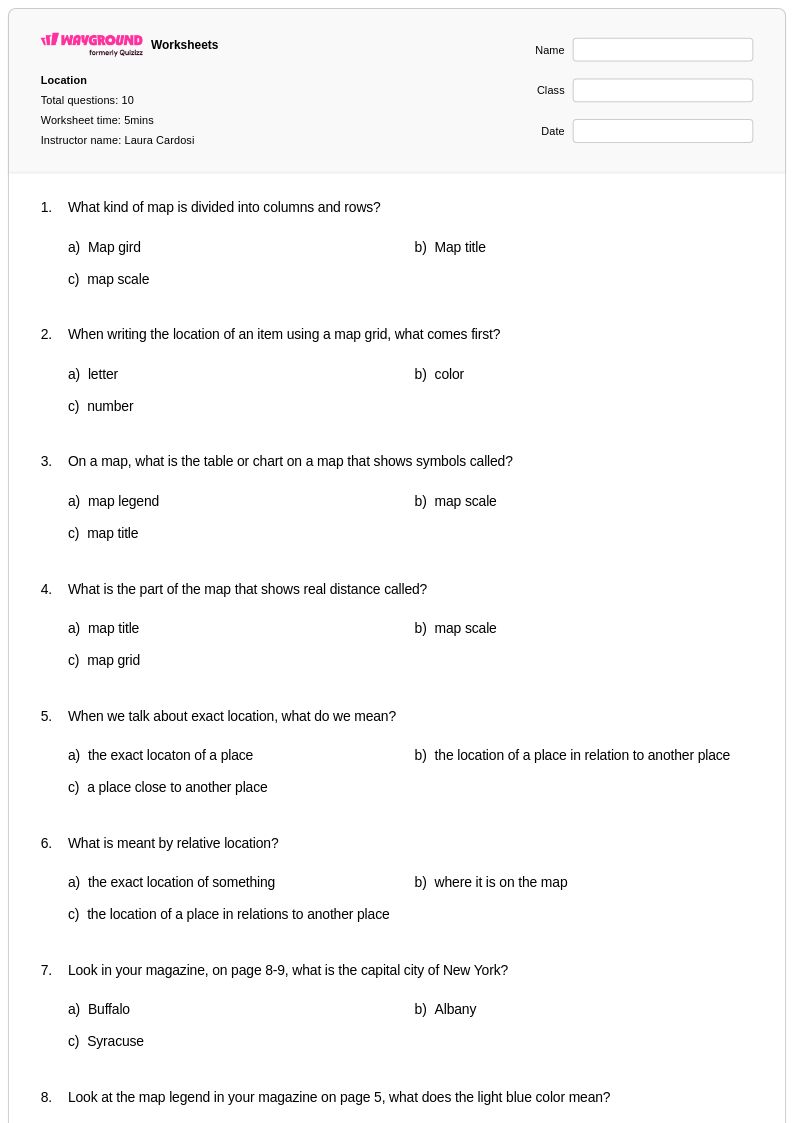
Free Printable Mapping Skills Worksheets for Year 2
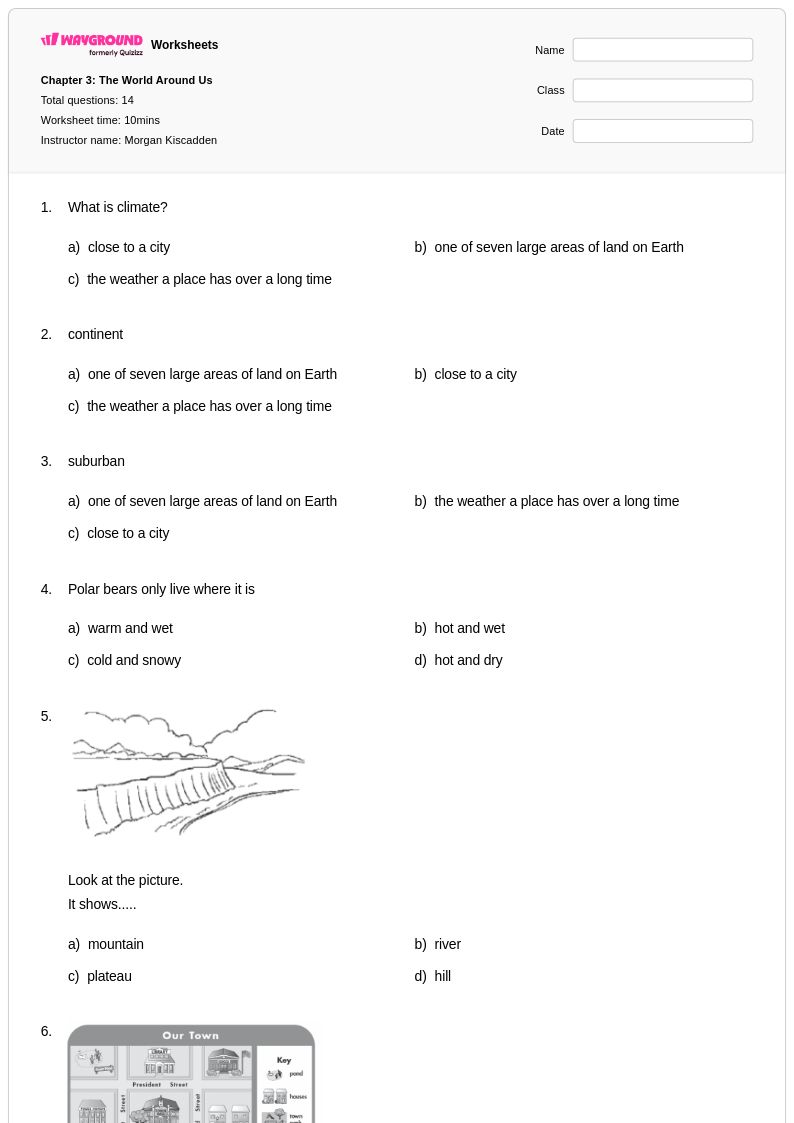
Year 2 mapping skills worksheets and printables help young students learn to read maps, understand symbols, and develop essential geography skills through engaging practice problems with complete answer keys.
Explore printable Mapping Skills worksheets for Year 2
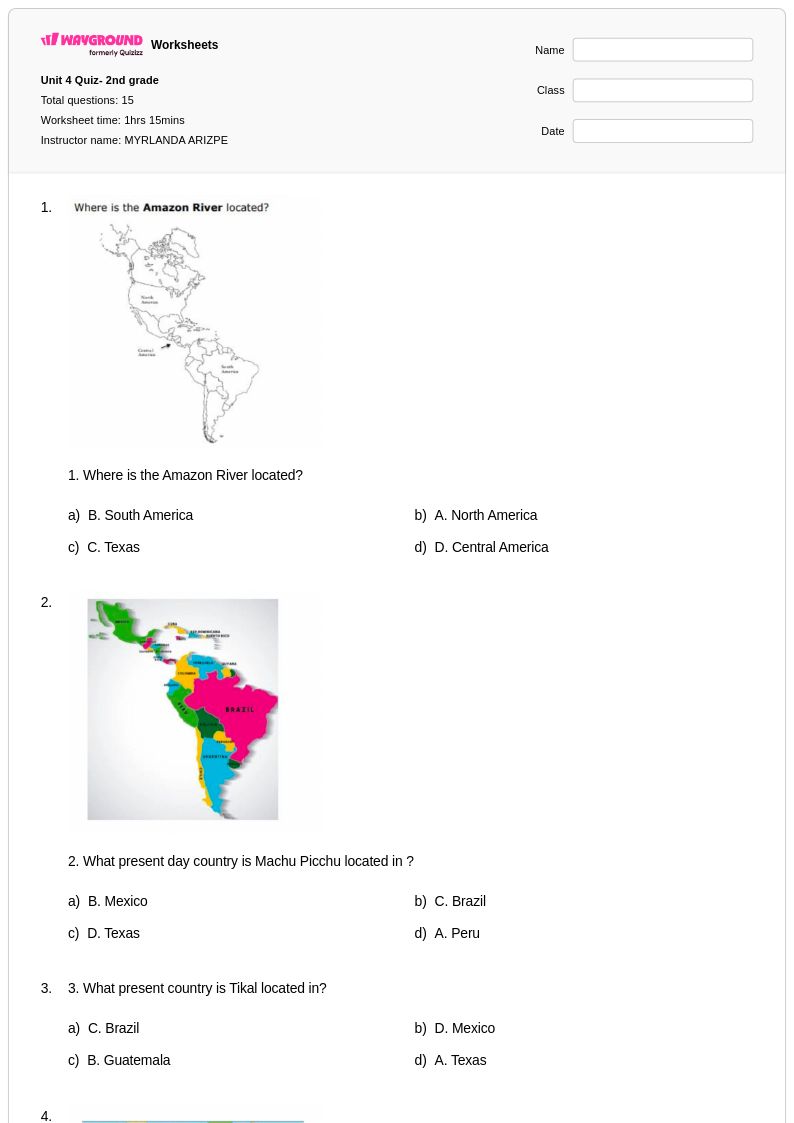
Year 2 mapping skills worksheets available through Wayground (formerly Quizizz) provide young learners with essential foundational experiences in geographic literacy and spatial reasoning. These carefully designed educational resources help second-grade students develop critical abilities including reading simple maps, understanding basic directional concepts, identifying key map elements like legends and symbols, and recognizing the relationship between real places and their map representations. The comprehensive collection includes free printables with answer keys that support systematic skill development, from recognizing cardinal directions to interpreting basic map symbols and understanding scale concepts appropriate for emerging readers. Each pdf worksheet incorporates age-appropriate practice problems that build confidence while strengthening students' ability to navigate and interpret visual geographic information.
Wayground (formerly Quizizz) empowers educators with millions of teacher-created mapping skills resources specifically curated for Year 2 instruction, featuring robust search and filtering capabilities that align with state geography standards and developmental benchmarks. Teachers can easily differentiate instruction through flexible customization options, adapting worksheets to meet diverse learning needs while maintaining academic rigor and engagement. The platform's extensive collection is available in both printable and digital formats, including downloadable pdf versions that seamlessly integrate into lesson planning workflows for classroom instruction, homework assignments, remediation activities, and enrichment opportunities. These comprehensive tools enable educators to provide consistent skill practice while supporting individual student growth in spatial thinking and geographic awareness through structured, standards-aligned learning experiences.
FAQs
How do I teach map reading and mapping skills to students?
Effective mapping skills instruction begins with foundational concepts: map symbols and legends, cardinal and intermediate directions, and basic scale interpretation. From there, teachers build toward coordinate systems, grid references, and reading topographic or thematic maps. Anchoring each concept in real-world examples, such as reading a local transit map before moving to political or physical maps, helps students connect abstract cartographic ideas to practical spatial reasoning.
What exercises help students practice mapping skills?
Strong mapping practice exercises include labeling map symbols and legends, calculating real-world distances using scale bars, plotting and identifying coordinates on grid maps, and interpreting contour lines on topographic maps. Varied task types, from basic map reading to comparative analysis across political and thematic maps, ensure students develop both foundational literacy and more complex spatial analysis skills.
What common mistakes do students make when reading maps?
One of the most frequent errors is misapplying map scale, where students confuse the ratio or fail to convert units accurately when calculating distances. Students also commonly misread compass directions by defaulting to cardinal directions and ignoring intermediate ones, or misinterpret contour lines by assuming closer lines mean lower elevation rather than steeper terrain. Addressing these misconceptions explicitly during instruction, before independent practice, significantly reduces persistent errors.
How do I differentiate mapping skills instruction for students at different levels?
For students still building foundational skills, start with single-concept exercises such as identifying symbols on a legend or plotting points on a simple coordinate grid before introducing multi-step tasks. More advanced learners can engage with complex topographic analysis, GIS concepts, or cross-referencing multiple map types. On Wayground, teachers can apply accommodations such as reduced answer choices or read-aloud support to individual students, allowing the same worksheet to serve a range of learners without disrupting the rest of the class.
How do I use Wayground's mapping skills worksheets in my classroom?
Wayground's mapping skills worksheets are available as both printable PDFs and in digital formats, making them suitable for traditional classroom use, homework assignments, and technology-integrated learning environments. Teachers can also host worksheets as a quiz directly on Wayground, giving students an interactive experience while automatically collecting results. Each worksheet includes a detailed answer key, so teachers can use them for guided practice, independent work, or remediation without additional preparation.
How do I help students understand map scale and distance calculations?
Students often struggle with scale because it requires connecting a symbolic ratio to a physical measurement, a two-step abstraction. Teaching scale through a consistent process, identify the scale bar or ratio, measure the map distance, then apply the conversion, reduces errors. Providing structured practice problems that progress from simple bar scale readings to ratio-based calculations helps students internalize the process before applying it independently on assessments.