Free Printable Osmosis and Tonicity Worksheets for Year 12
Year 12 Biology worksheets on osmosis and tonicity provide comprehensive printables and practice problems with answer keys to help students master water movement across cell membranes and solution concentrations.
Explore printable Osmosis and Tonicity worksheets for Year 12
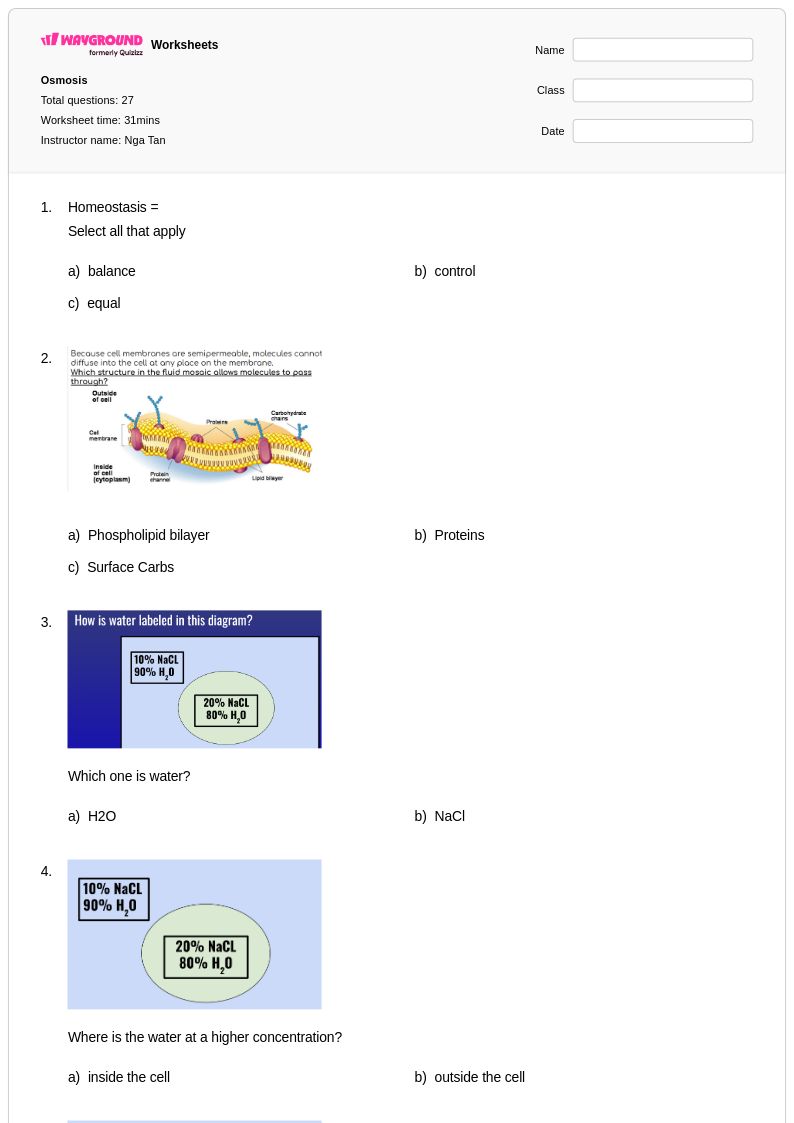
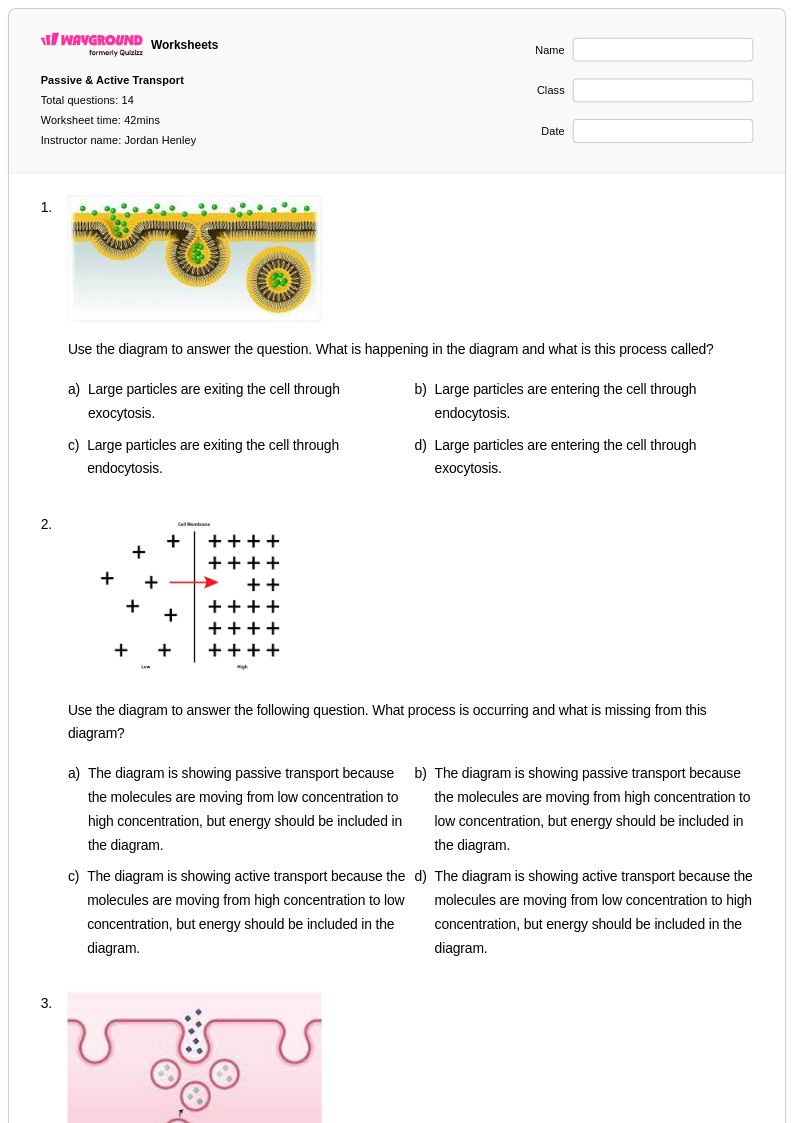
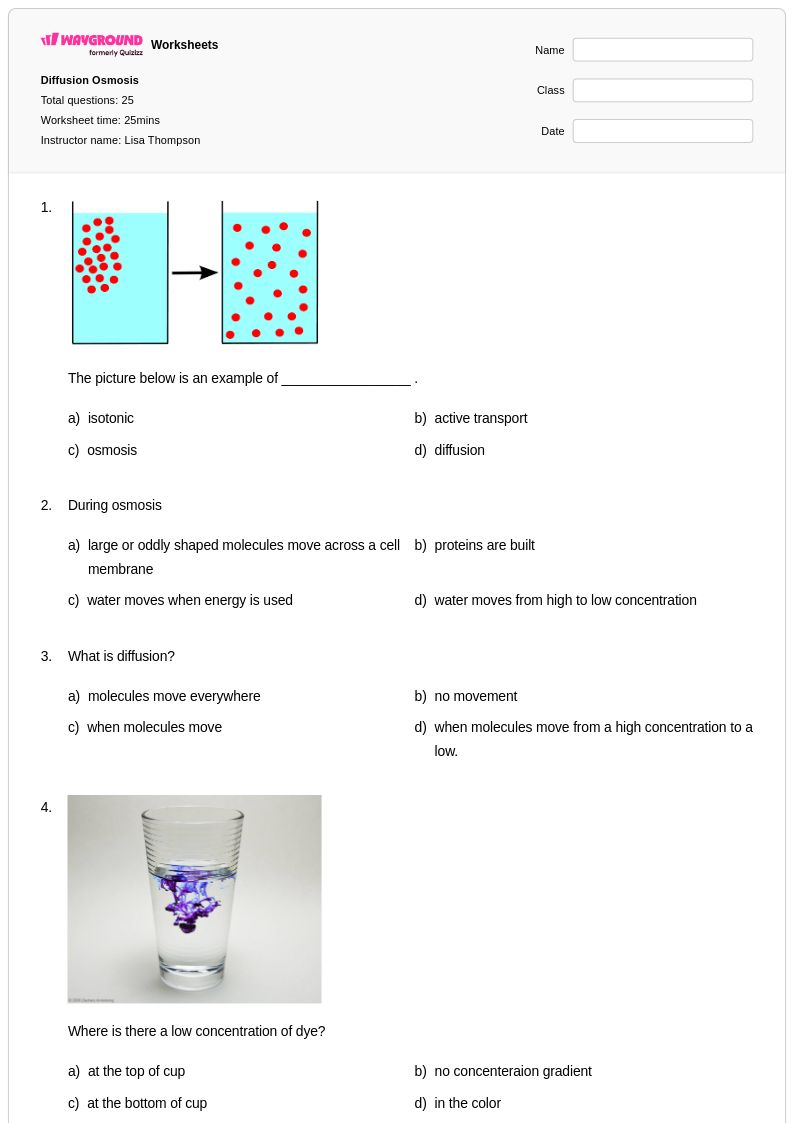
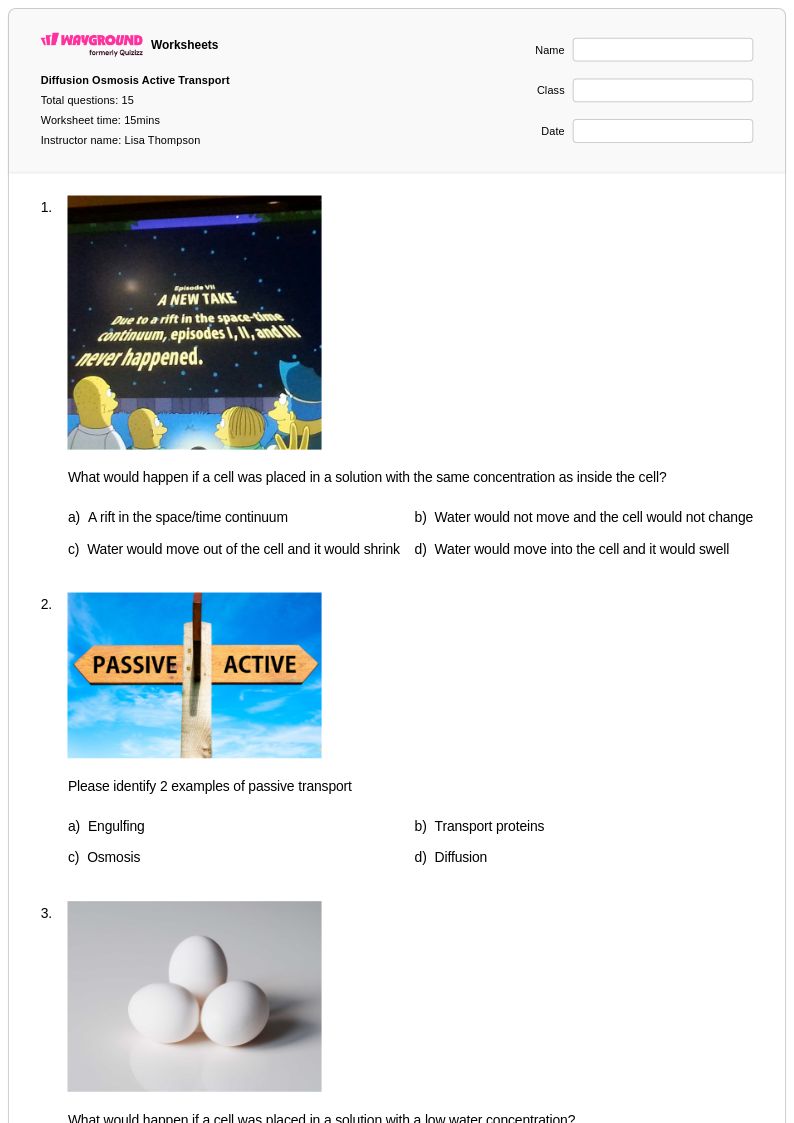
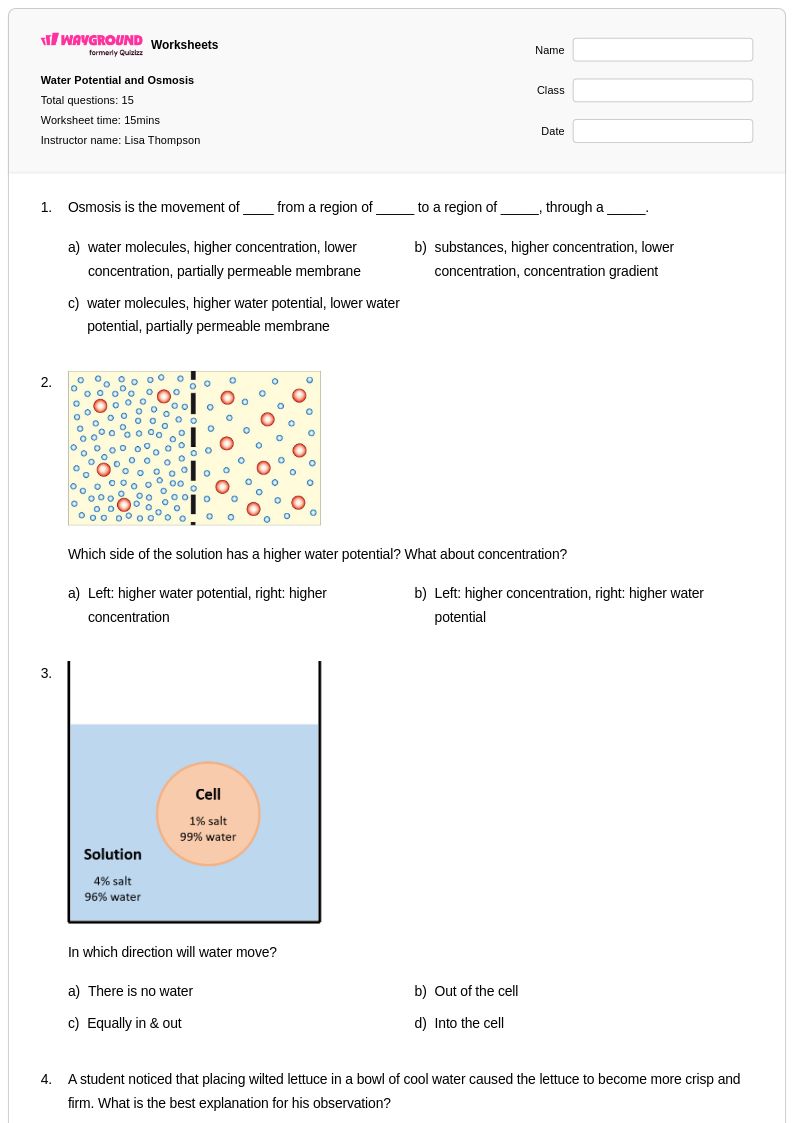
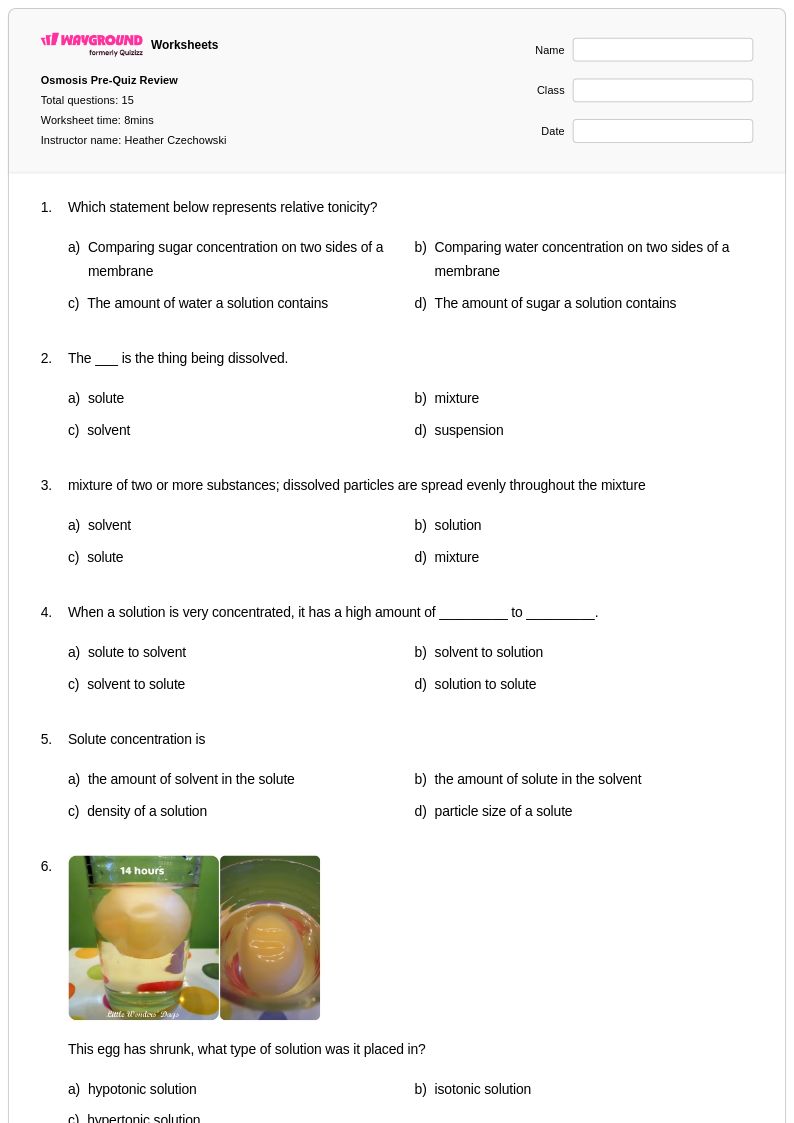
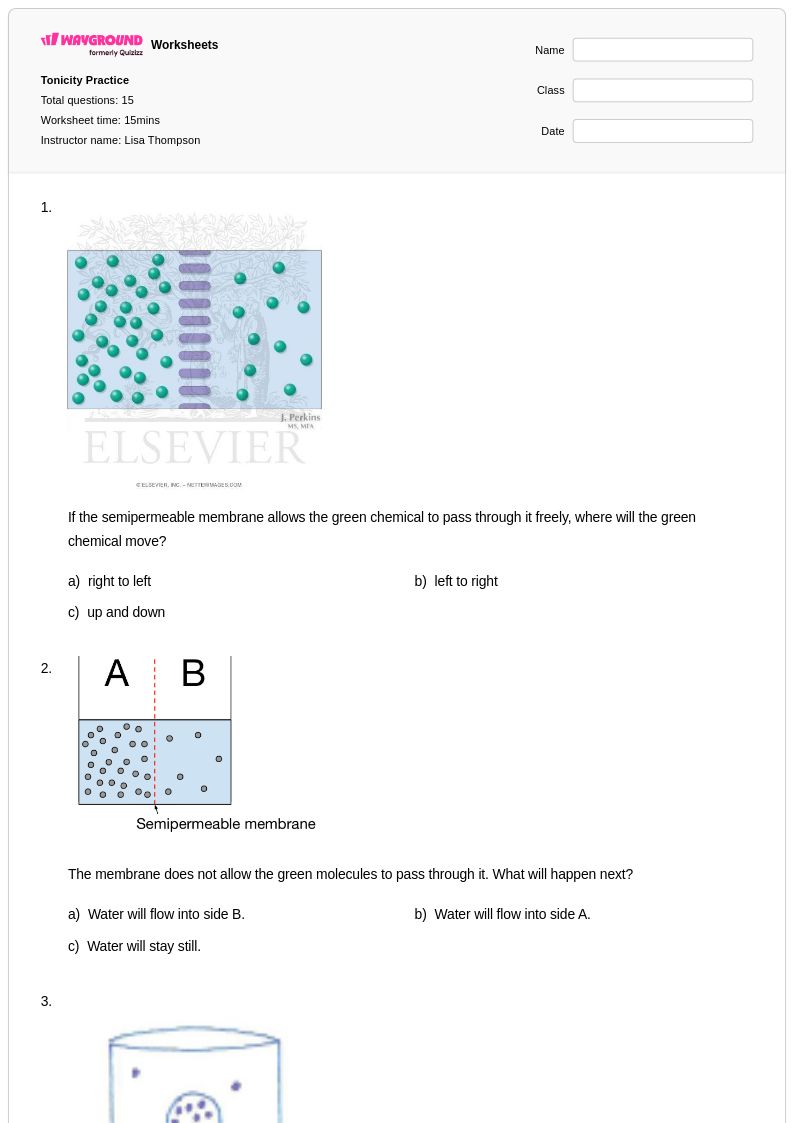
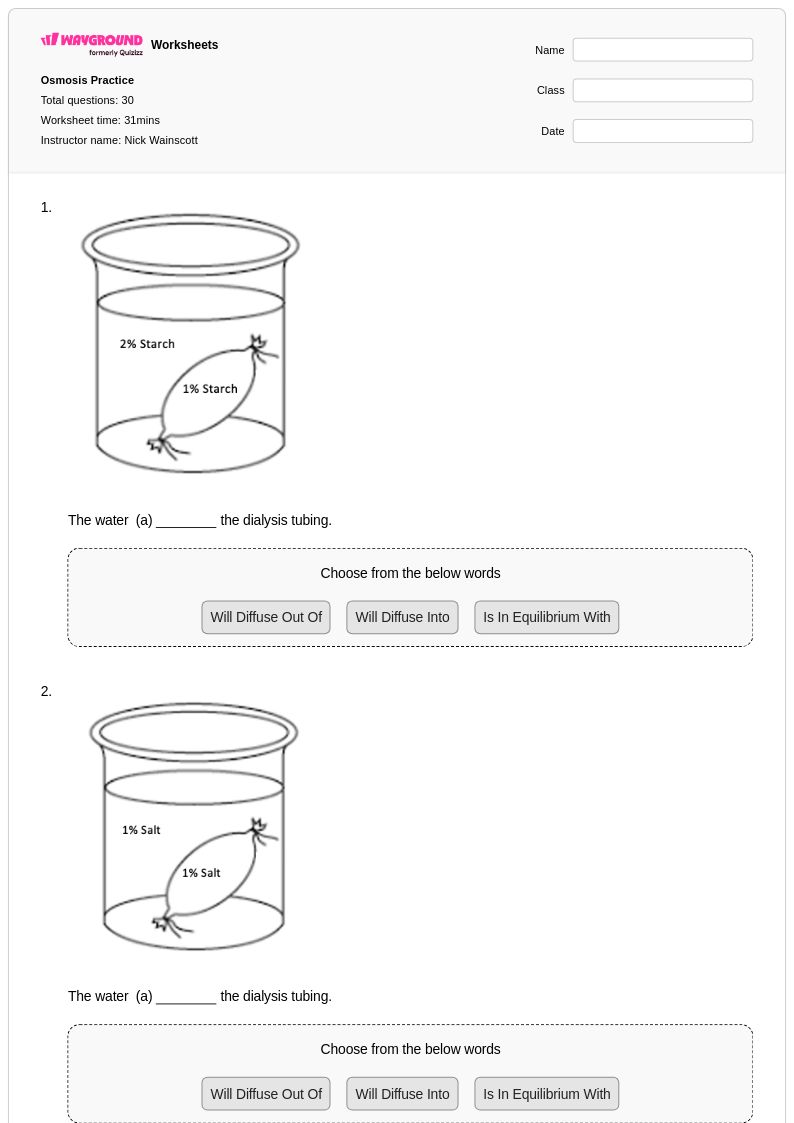
Osmosis and tonicity worksheets for Year 12 students available through Wayground (formerly Quizizz) provide comprehensive practice with these fundamental cellular transport concepts that form the cornerstone of advanced biology understanding. These expertly crafted resources strengthen students' ability to analyze water movement across semipermeable membranes, predict cellular responses in hypotonic, isotonic, and hypertonic solutions, and calculate solute concentrations using osmolarity principles. The collection includes detailed practice problems that challenge students to interpret osmotic pressure data, diagram cell volume changes in various solutions, and explain the physiological implications of osmotic imbalances in living organisms. Each worksheet comes with a complete answer key and is available as free printable pdf resources, allowing students to master complex topics like turgor pressure in plant cells, hemolysis and crenation in animal cells, and the role of aquaporins in facilitated water transport.
Wayground (formerly Quizizz) empowers educators with millions of teacher-created osmosis and tonicity worksheets that undergo rigorous quality review and align with advanced biology standards. The platform's sophisticated search and filtering capabilities enable teachers to locate resources that match specific learning objectives, from basic concentration gradient concepts to advanced applications in medical and agricultural contexts. These differentiation tools support diverse classroom needs by offering worksheets at varying complexity levels, while flexible customization options allow educators to modify problems, adjust difficulty, or incorporate laboratory data from their own experiments. Available in both printable and digital formats including downloadable pdf versions, these resources facilitate seamless lesson planning, targeted remediation for students struggling with membrane transport concepts, and enrichment activities for advanced learners exploring topics like reverse osmosis and dialysis applications in biotechnology.
FAQs
How do I teach osmosis and tonicity to biology students?
Start by grounding students in the concept of concentration gradients before introducing osmosis as a specific case of passive transport across semipermeable membranes. Use visual diagrams comparing hypertonic, hypotonic, and isotonic solutions alongside concrete examples like red blood cells crenating in saltwater or plant cells becoming turgid. Connecting tonicity to real cellular outcomes — shrinkage, swelling, or equilibrium — helps students move from abstract definitions to applied reasoning before they tackle quantitative problems involving molarity.
What practice problems help students understand osmosis and tonicity?
Effective practice problems ask students to predict what happens to plant and animal cells placed in solutions of varying concentrations, then explain the direction of water movement using osmotic principles. Scenario-based problems that require students to identify whether a solution is hypertonic, hypotonic, or isotonic relative to a cell — and describe the resulting cell response — build the analytical skills needed for more advanced topics like osmotic pressure and molarity calculations. Worksheets that progress from vocabulary reinforcement to complex concentration gradient problems provide structured scaffolding across skill levels.
What mistakes do students commonly make when learning osmosis and tonicity?
The most common misconception is that water moves toward areas of lower concentration rather than toward higher solute concentration, which causes students to predict the direction of osmosis incorrectly. Students also frequently confuse the terms hypertonic and hypotonic, especially when asked to describe a solution relative to a cell rather than in absolute terms. A related error is assuming that isotonic solutions cause no cellular change at all, when in fact water continues to move in both directions — just at equal rates.
How do I differentiate osmosis and tonicity instruction for students at different levels?
For students who need foundational support, begin with vocabulary-focused worksheets that define osmosis, tonicity, and semipermeable membranes with labeled diagrams before introducing prediction tasks. Advanced students benefit from quantitative problems that incorporate molarity and osmotic pressure calculations, as well as multi-step scenarios comparing cellular responses across different solution types. On Wayground, teachers can further support individual learners using built-in accommodations such as read aloud, extended time, and reduced answer choices — settings that can be applied per student without disrupting the rest of the class.
How can I use Wayground's osmosis and tonicity worksheets in my classroom?
Wayground's osmosis and tonicity worksheets are available as printable PDFs for traditional classroom use and in digital formats for technology-integrated learning environments, including the option to host them as a quiz directly on Wayground. Teachers can use them for guided instruction, independent practice, remediation, or enrichment depending on where students are in the learning sequence. Answer keys are included with each worksheet, allowing for immediate feedback whether students are working independently or in a teacher-led setting.
How does osmosis relate to tonicity in biological systems?
Osmosis describes the movement of water across a semipermeable membrane from an area of lower solute concentration to higher solute concentration, while tonicity describes the relative solute concentration of a solution compared to the fluid inside a cell. Tonicity determines the direction and magnitude of osmotic movement — a hypertonic solution draws water out of a cell, a hypotonic solution causes water to move in, and an isotonic solution results in no net water movement. Understanding this relationship is foundational for explaining cellular responses in both plant and animal systems.