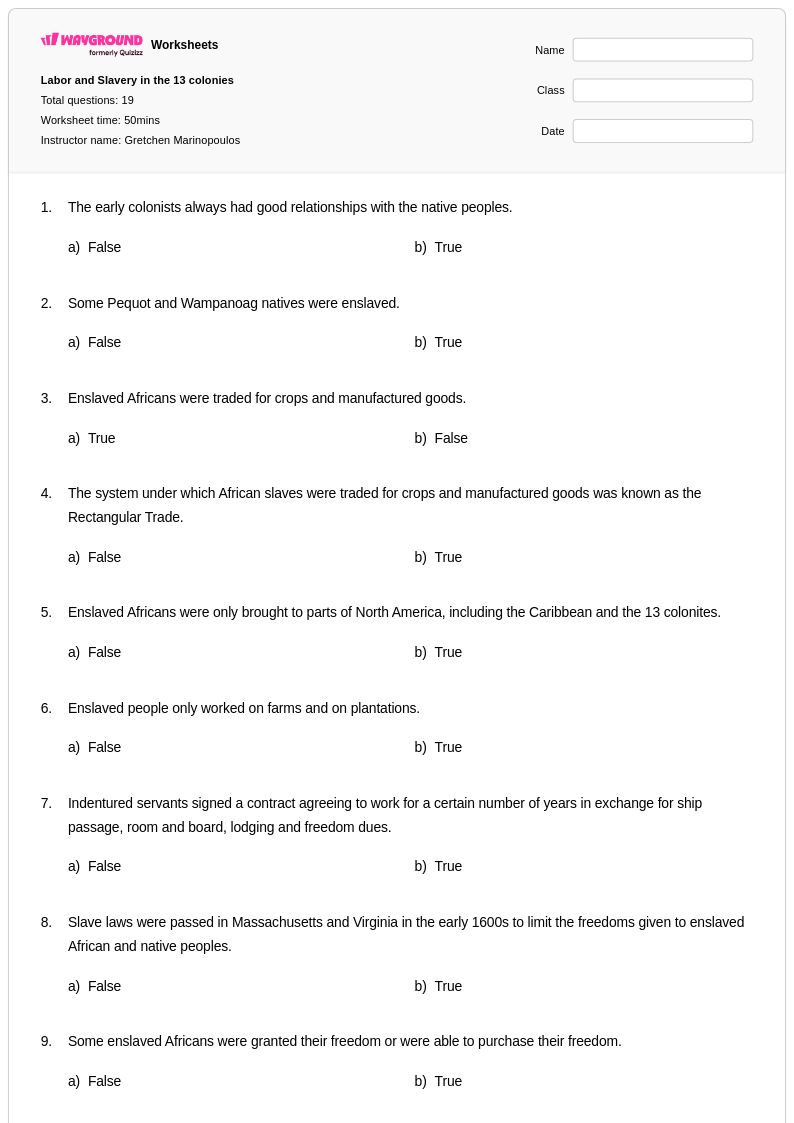
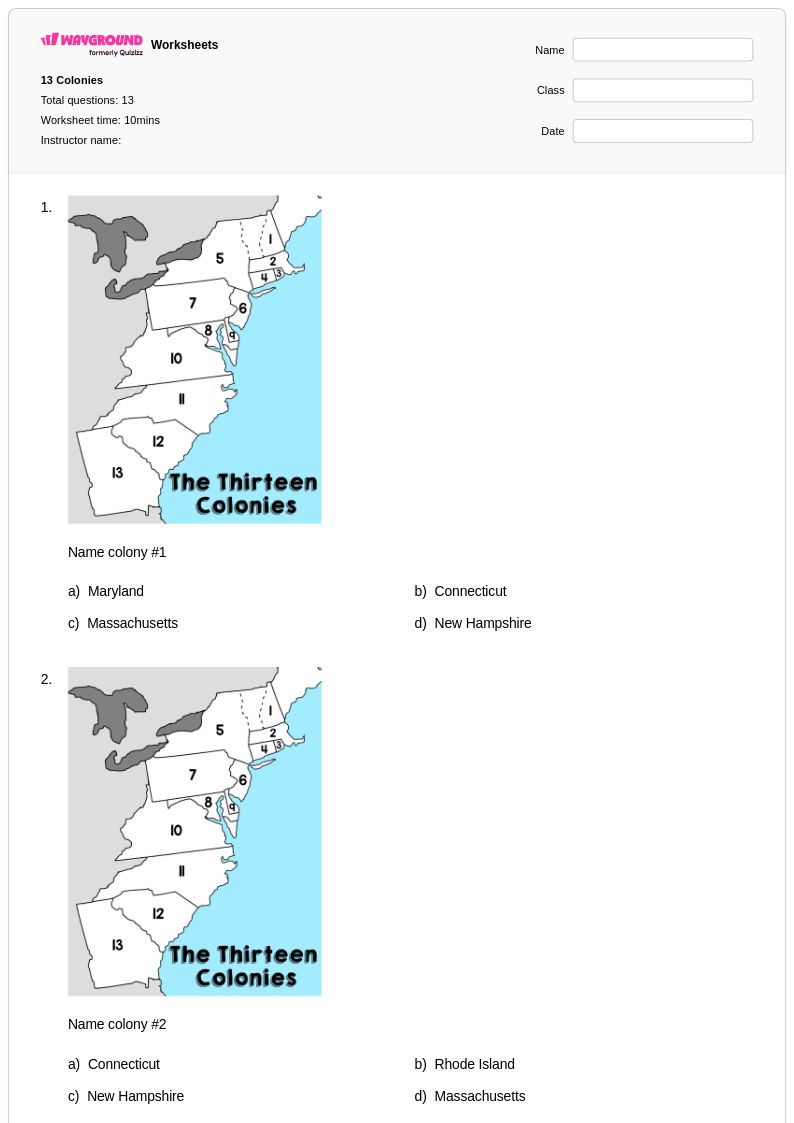
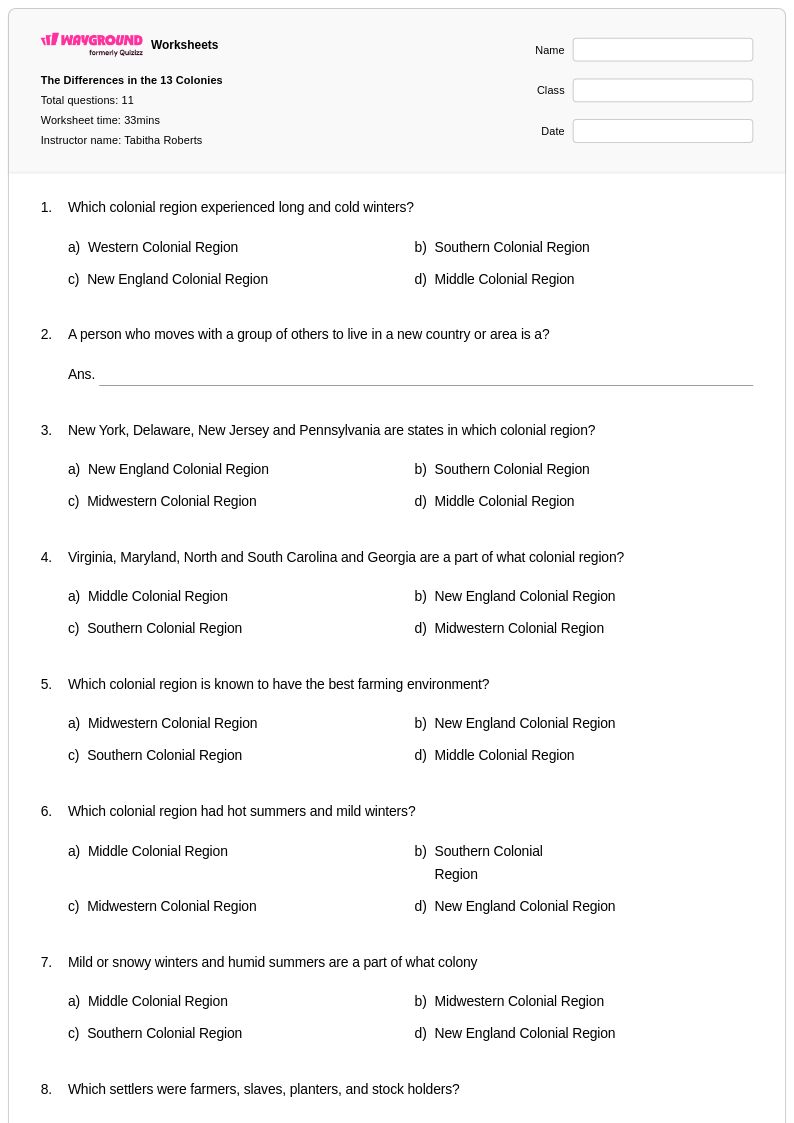
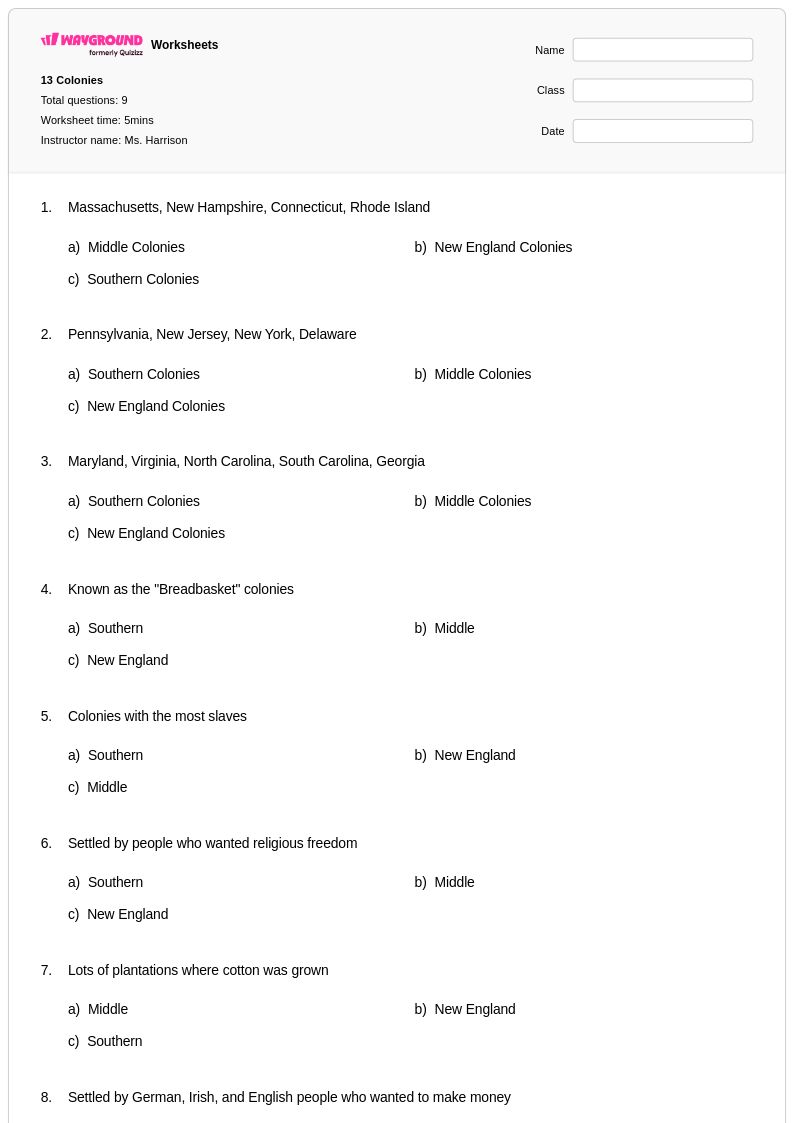
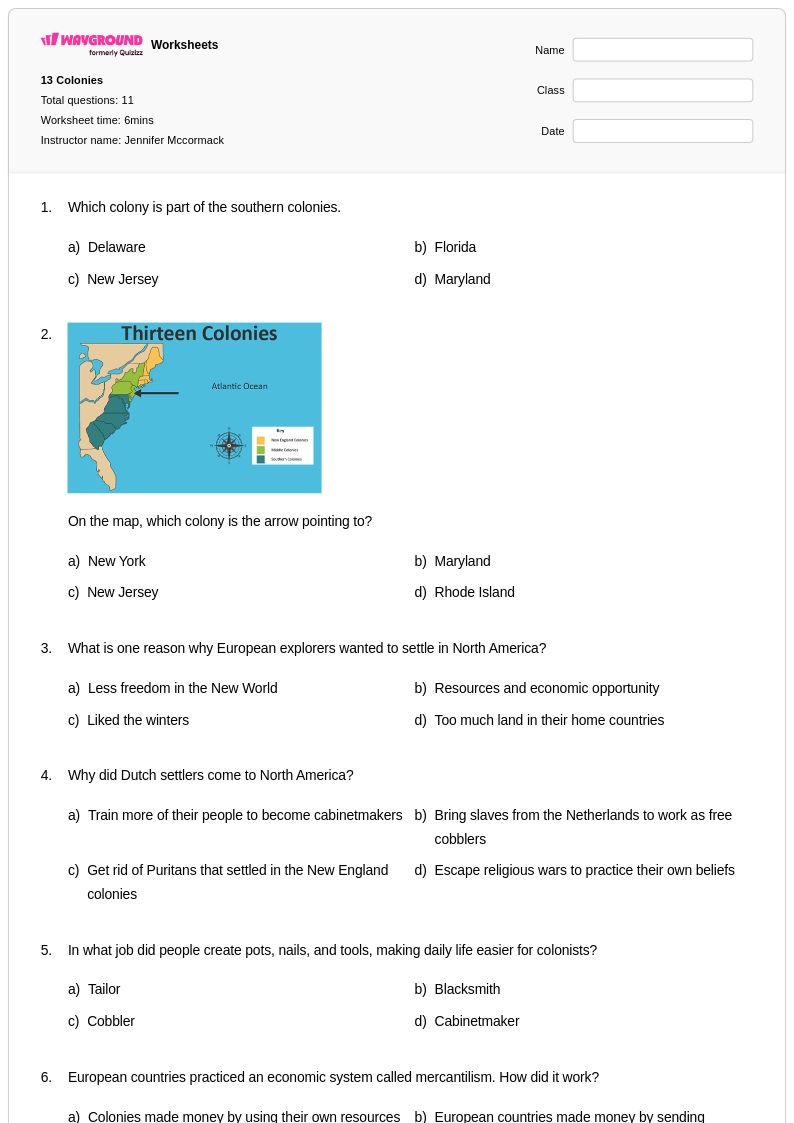
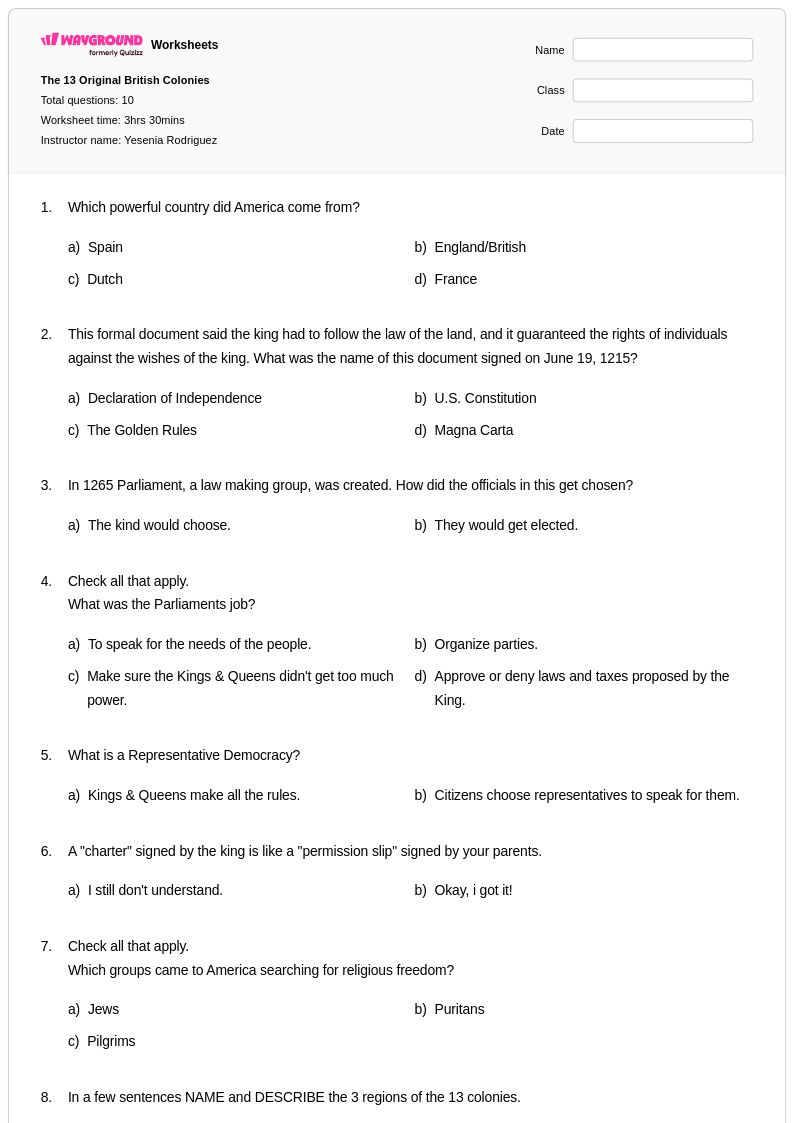
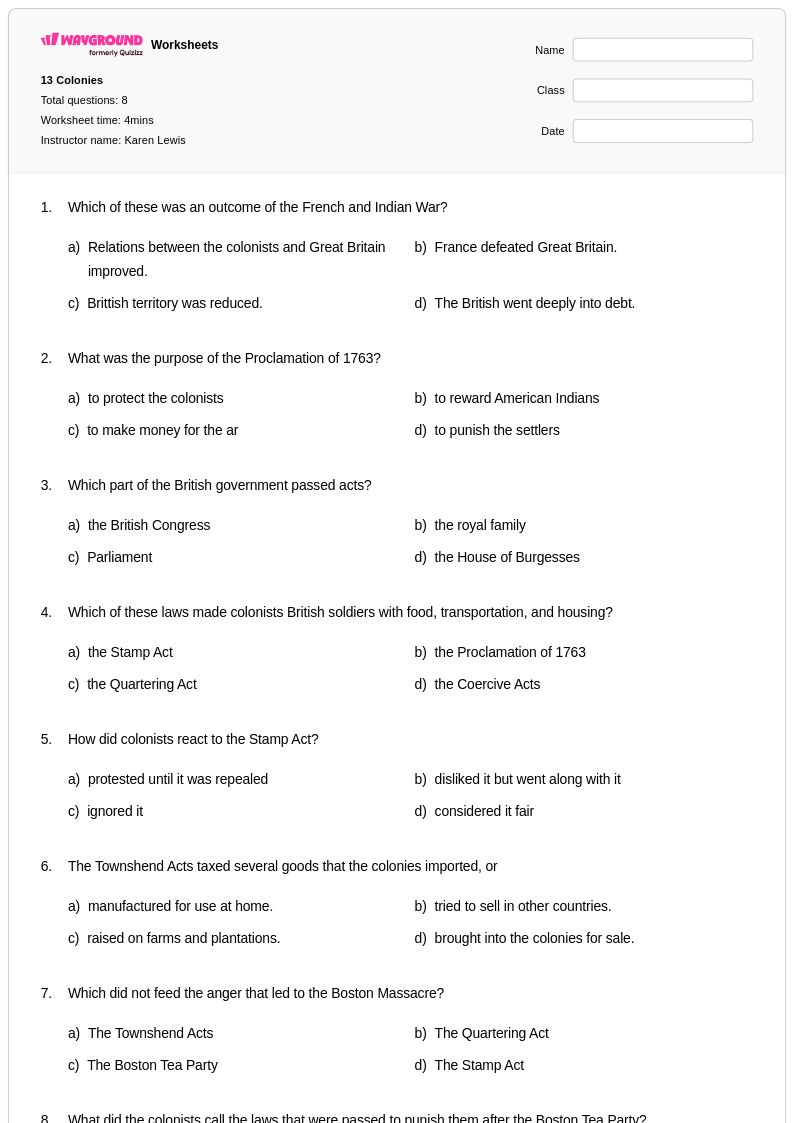
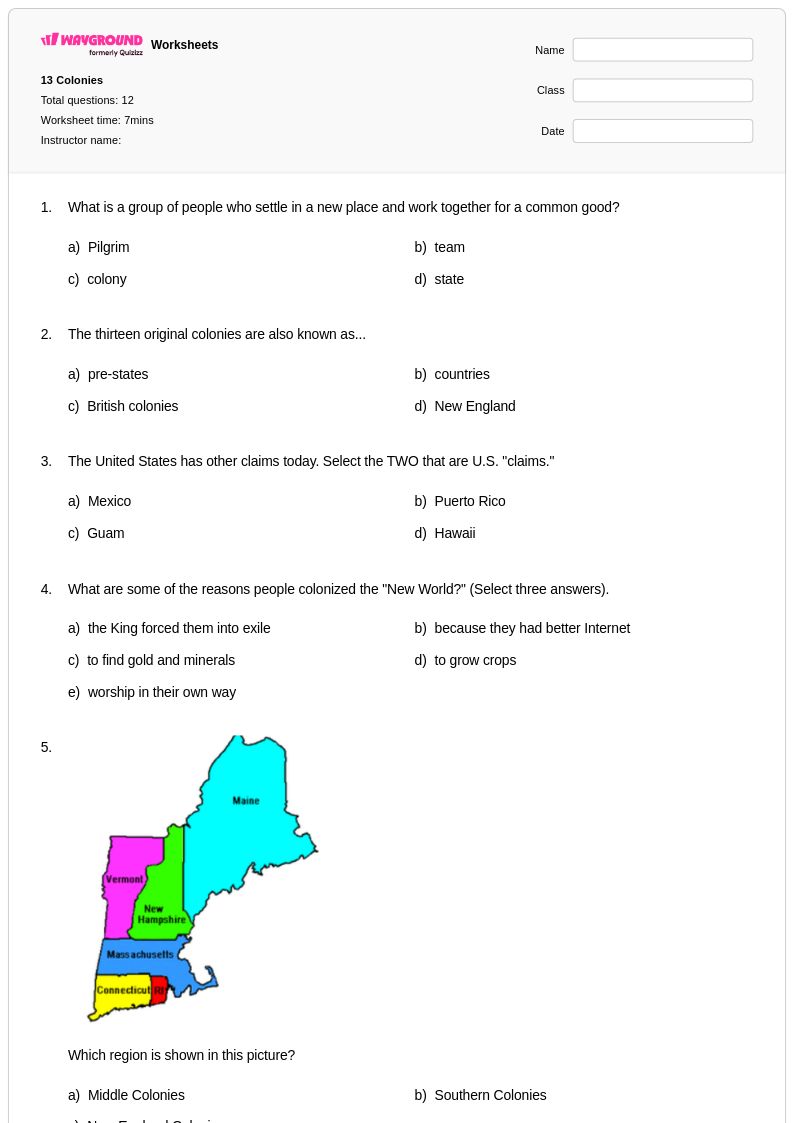
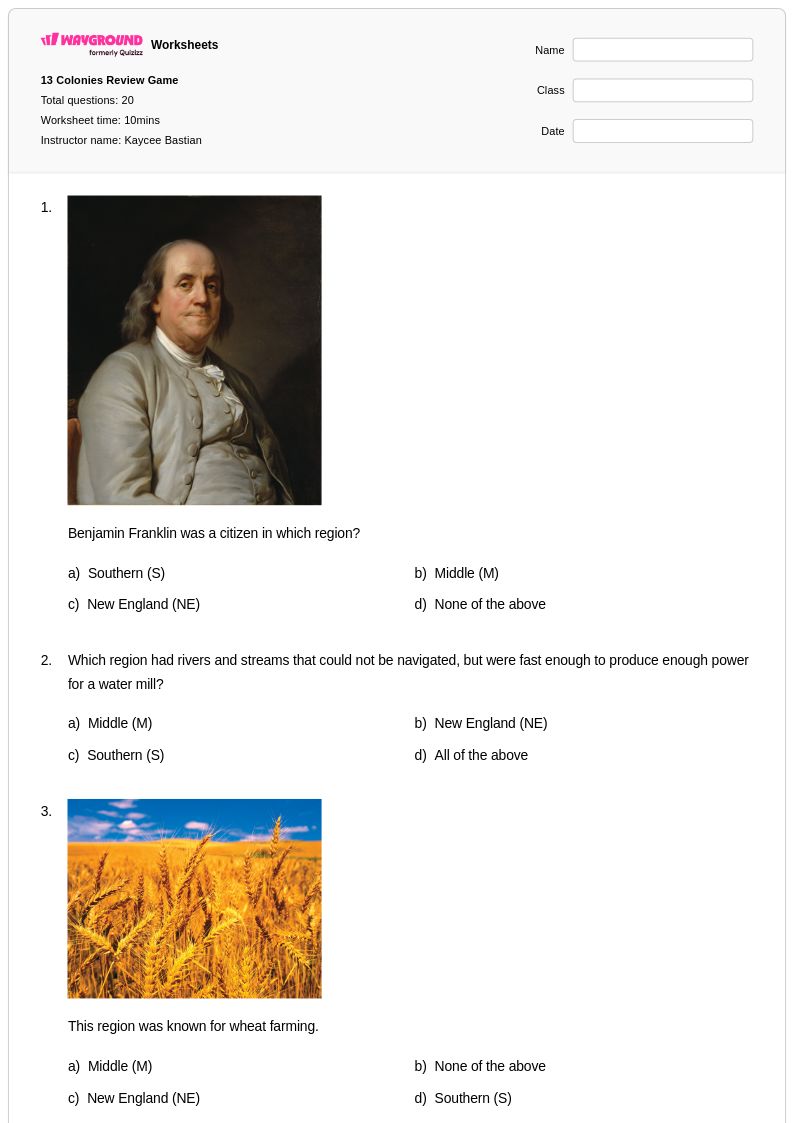
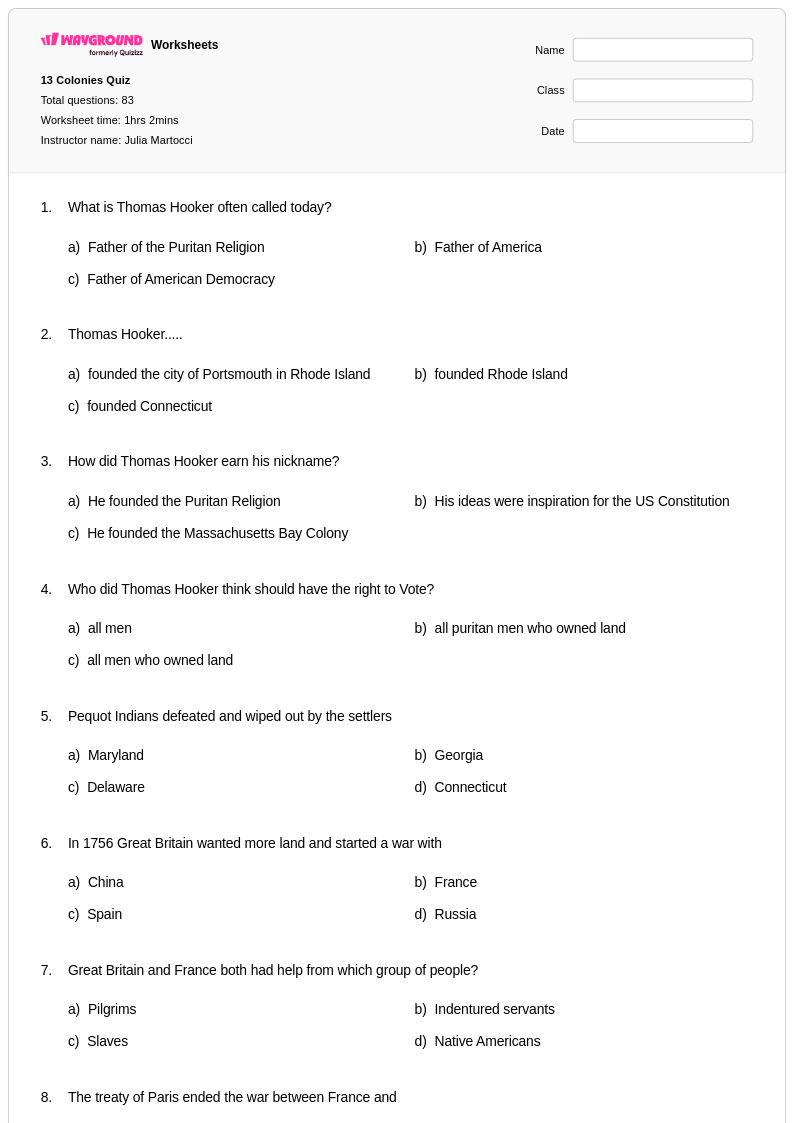
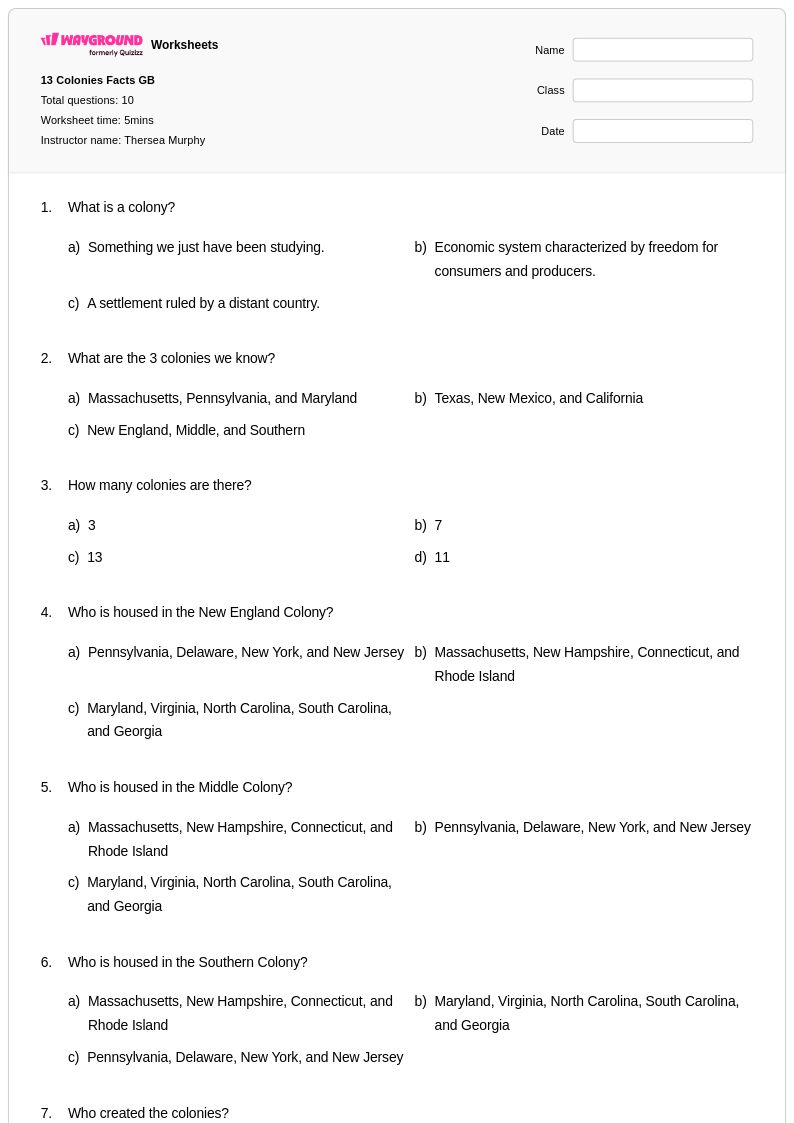
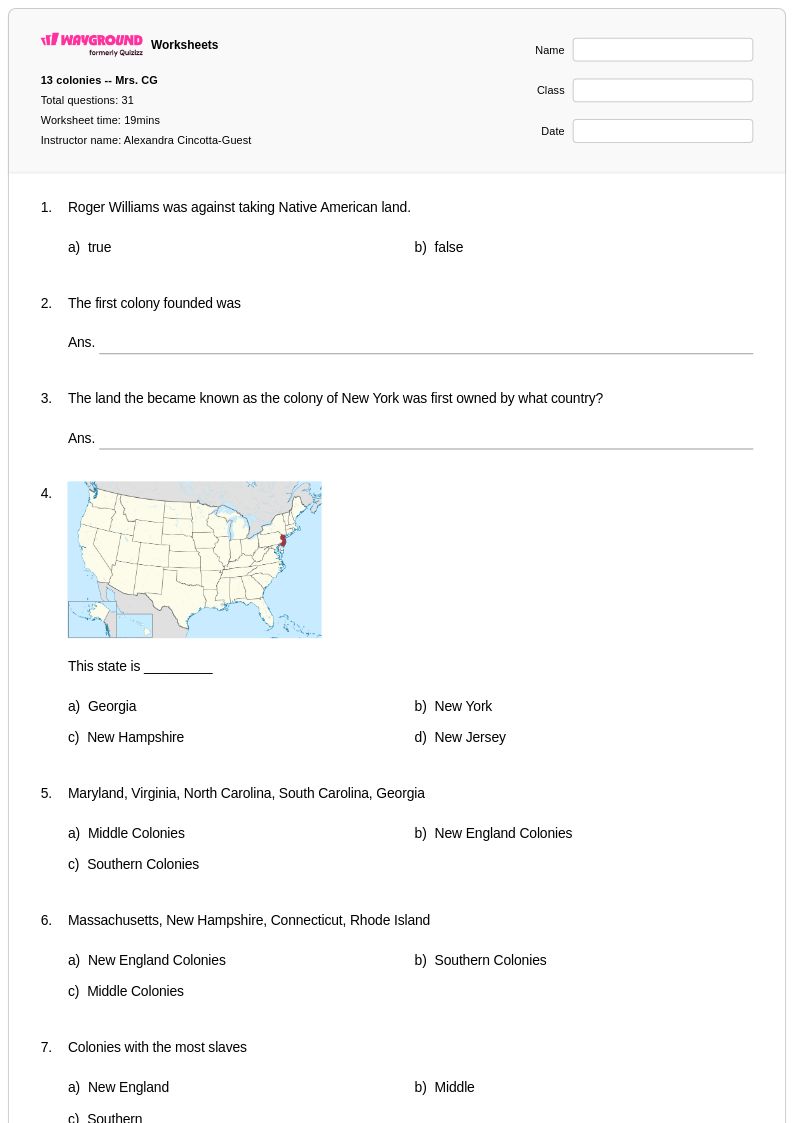
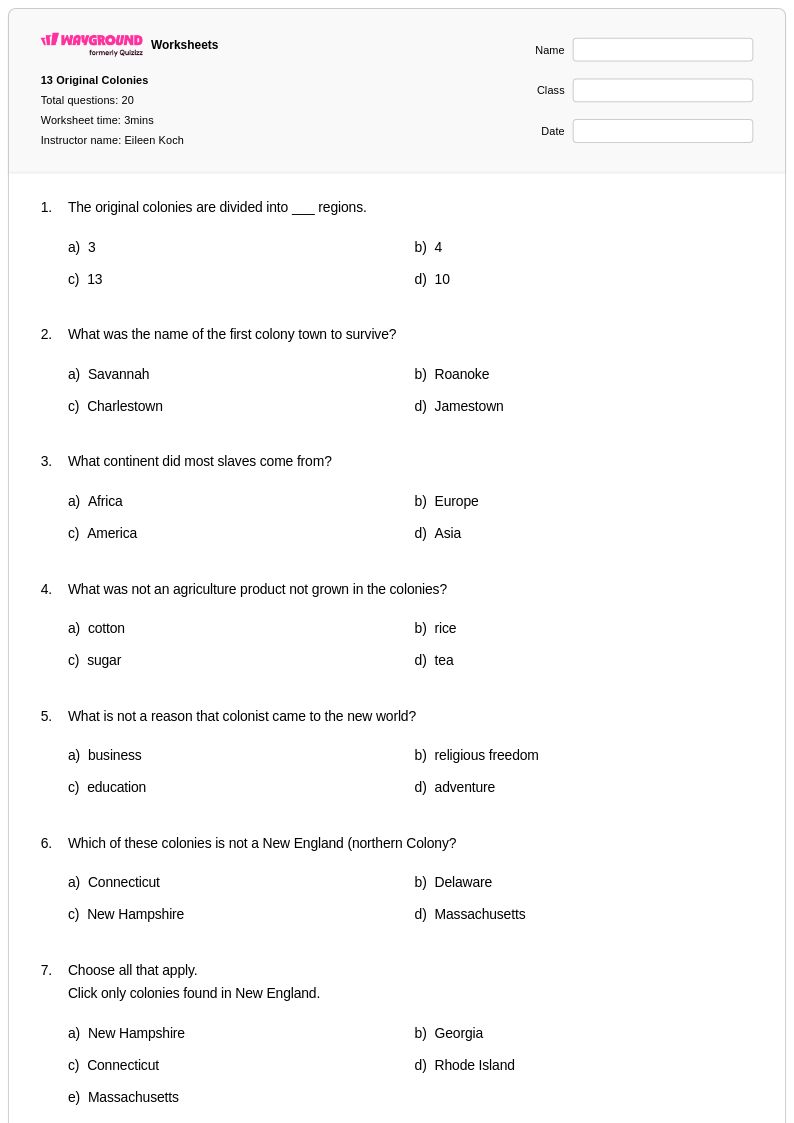
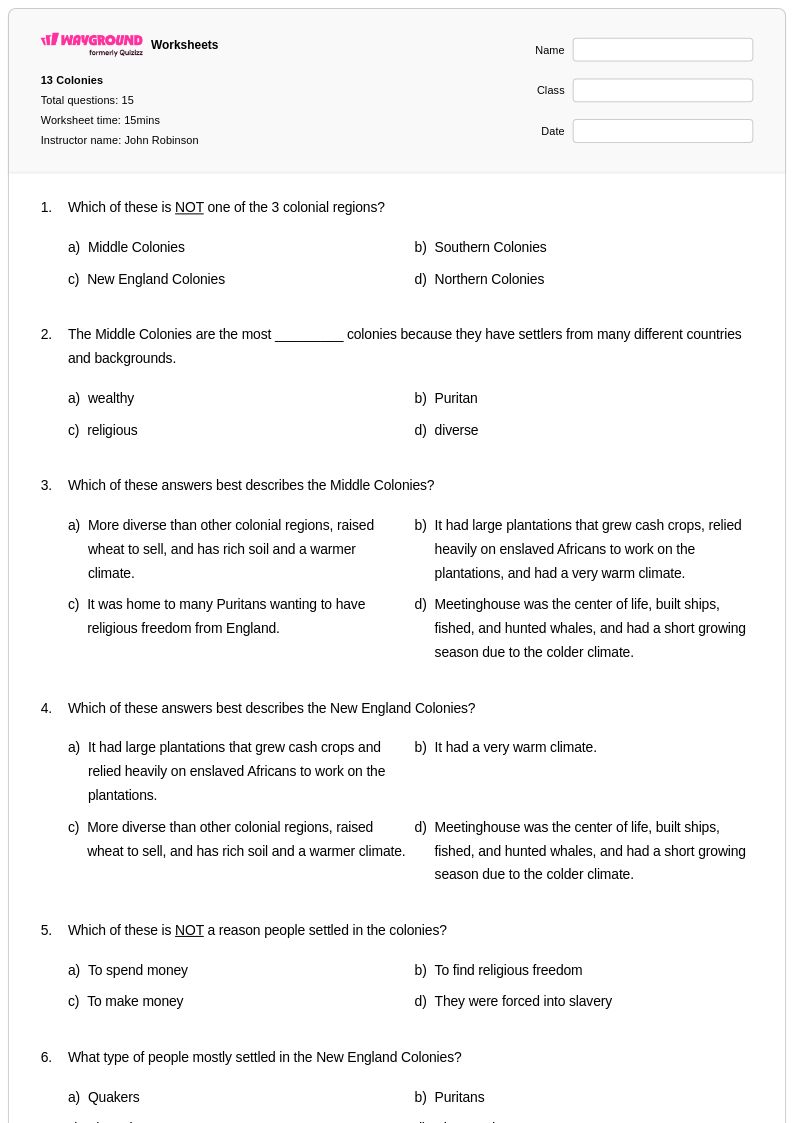
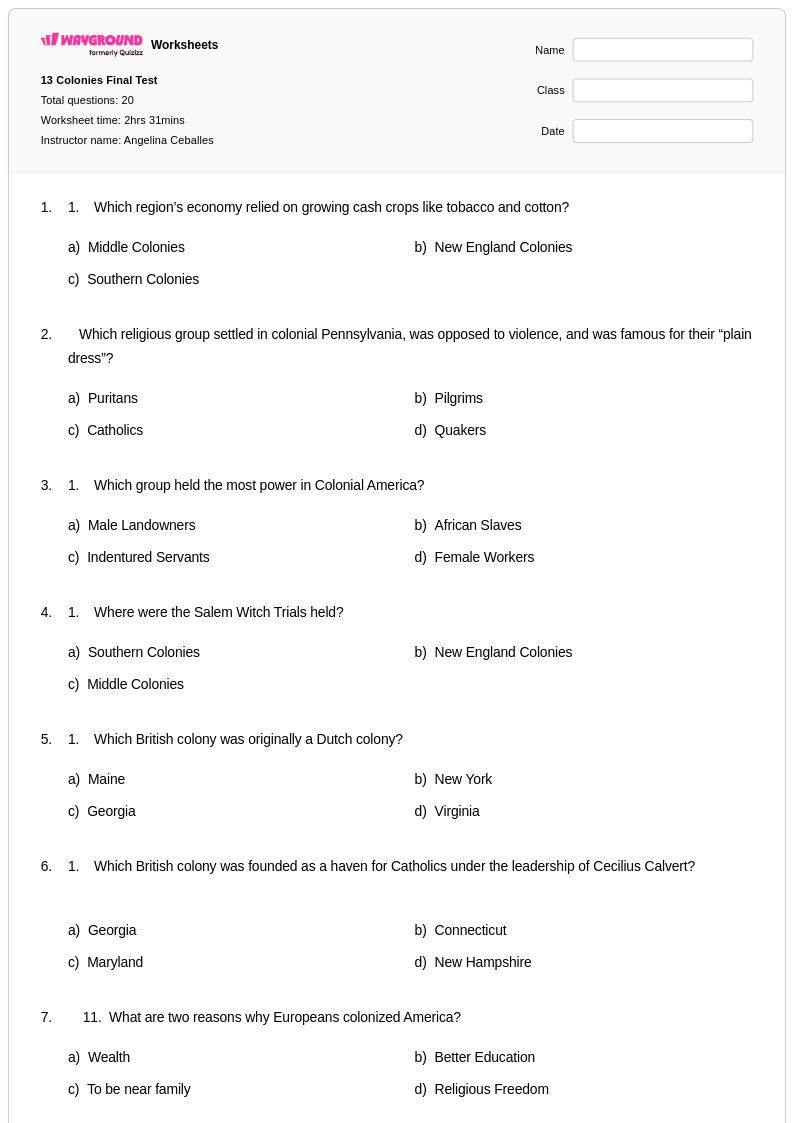
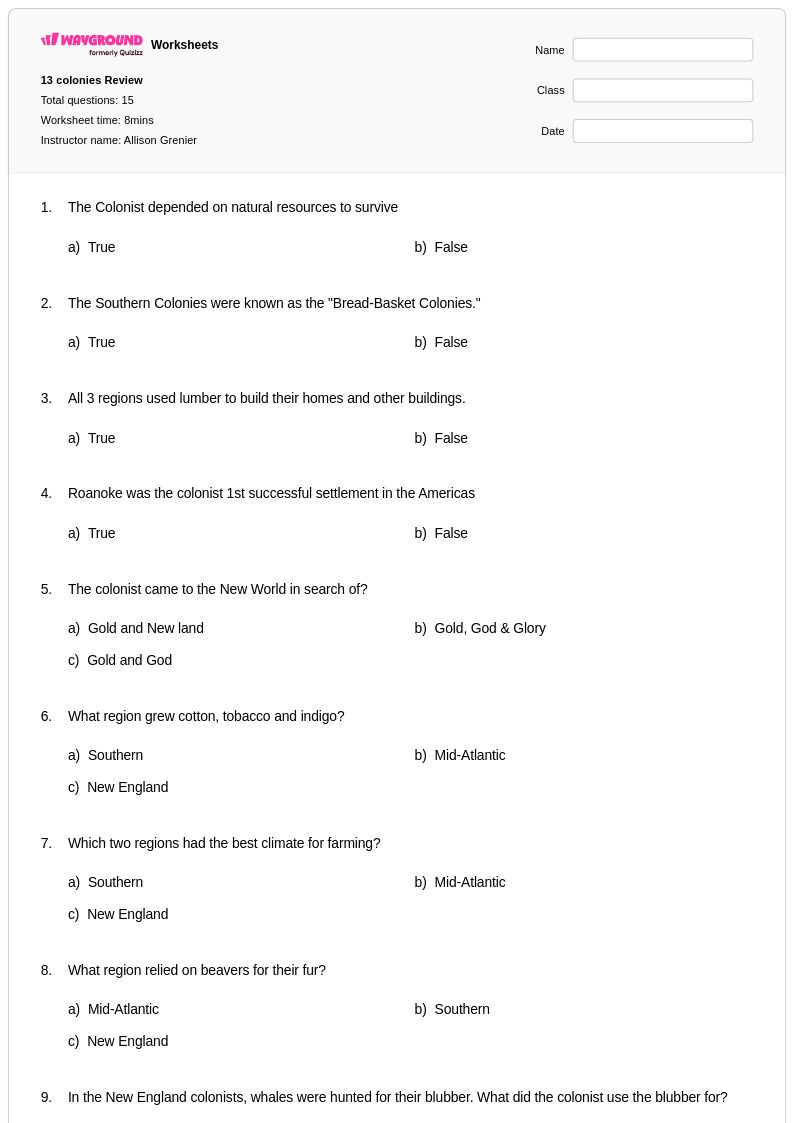
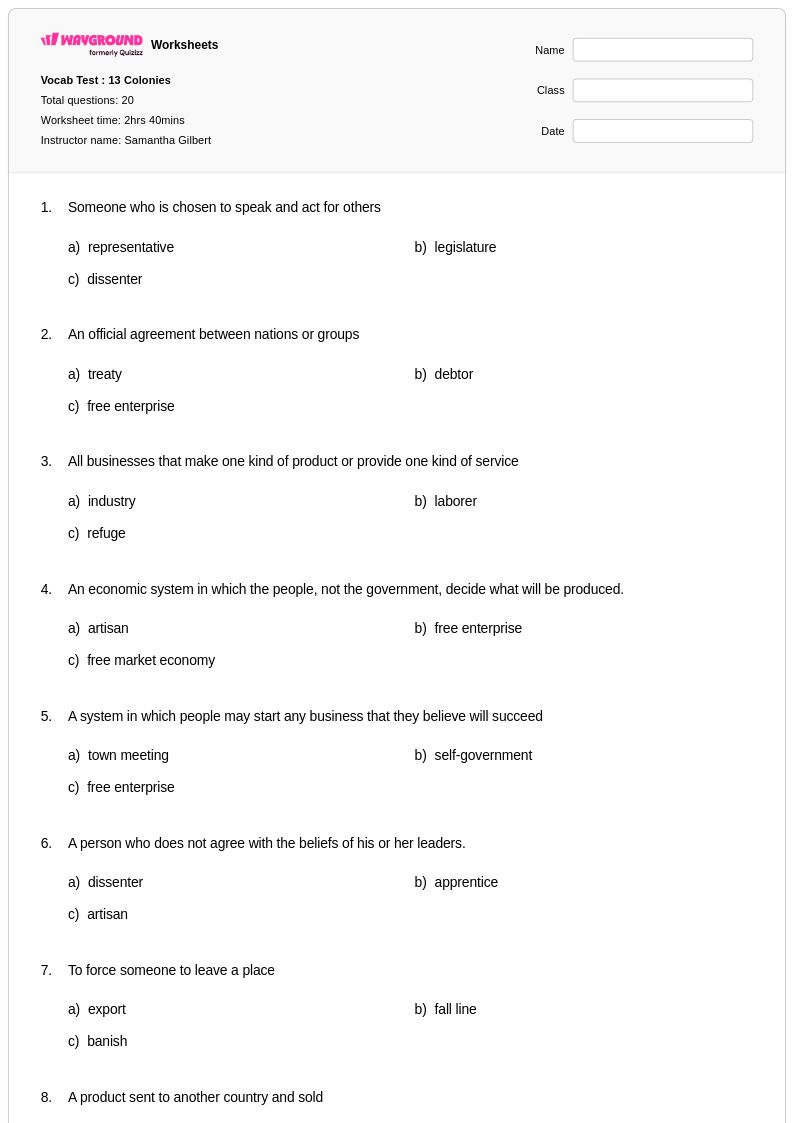
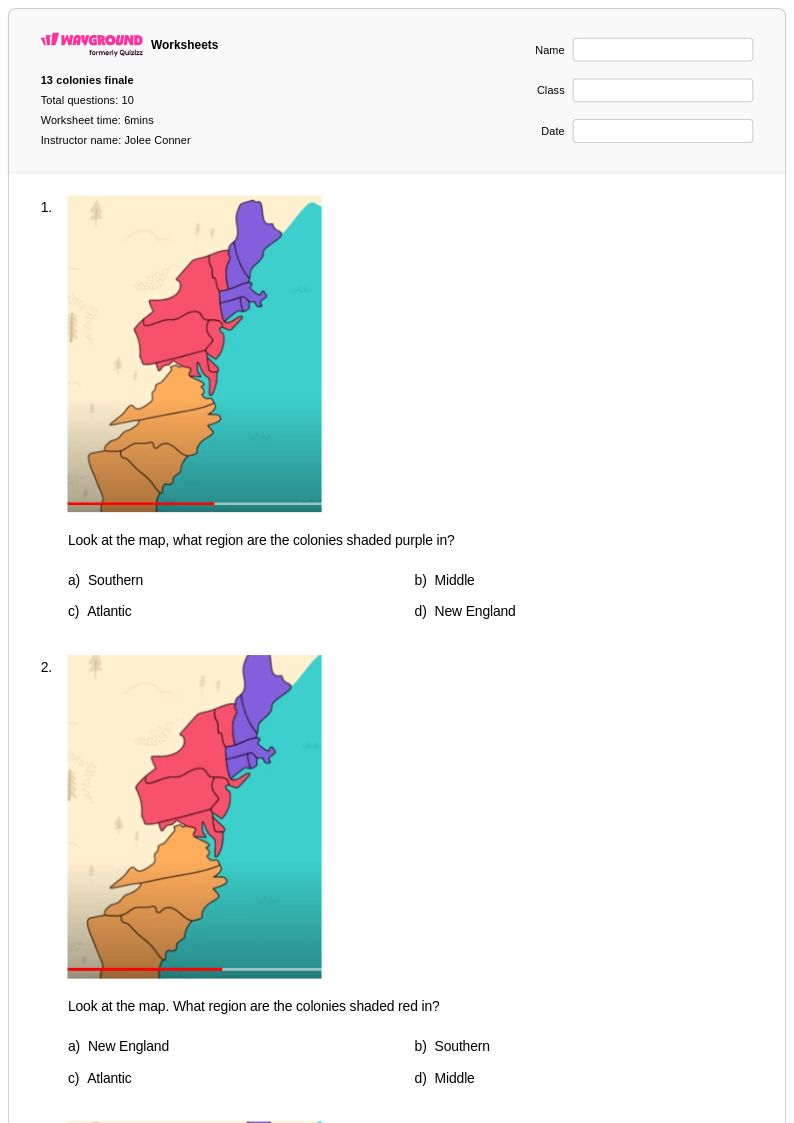
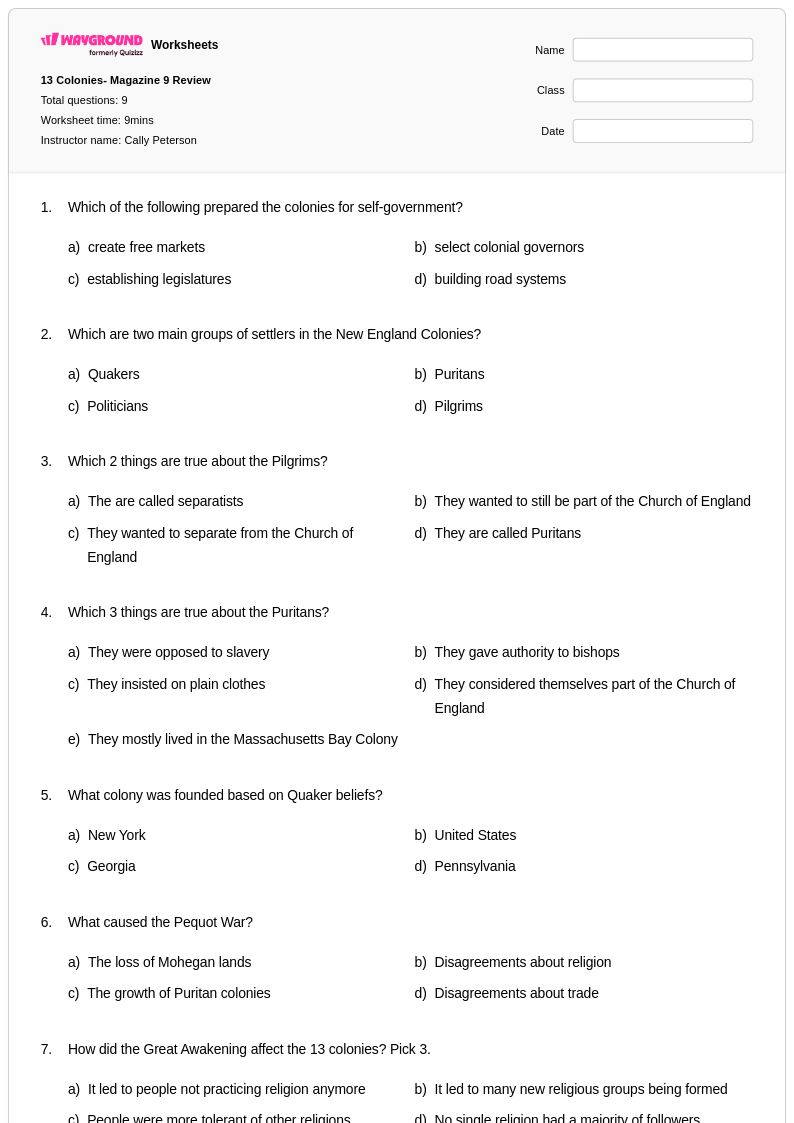
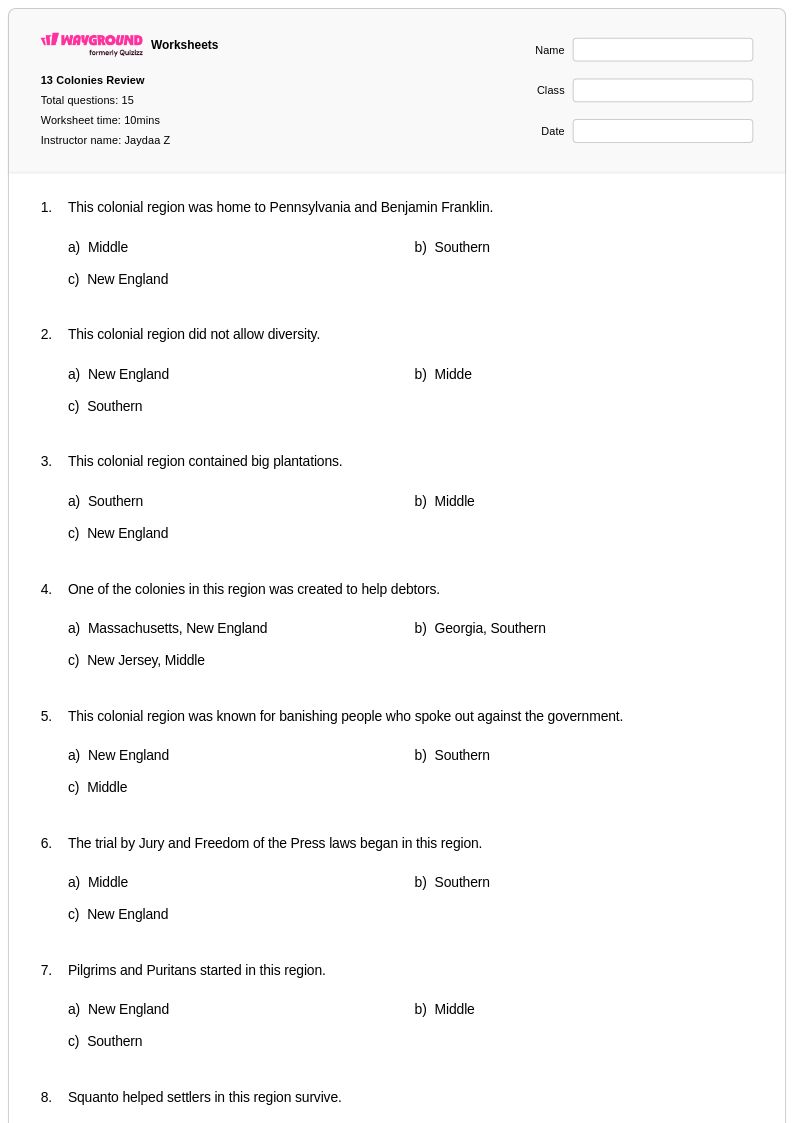
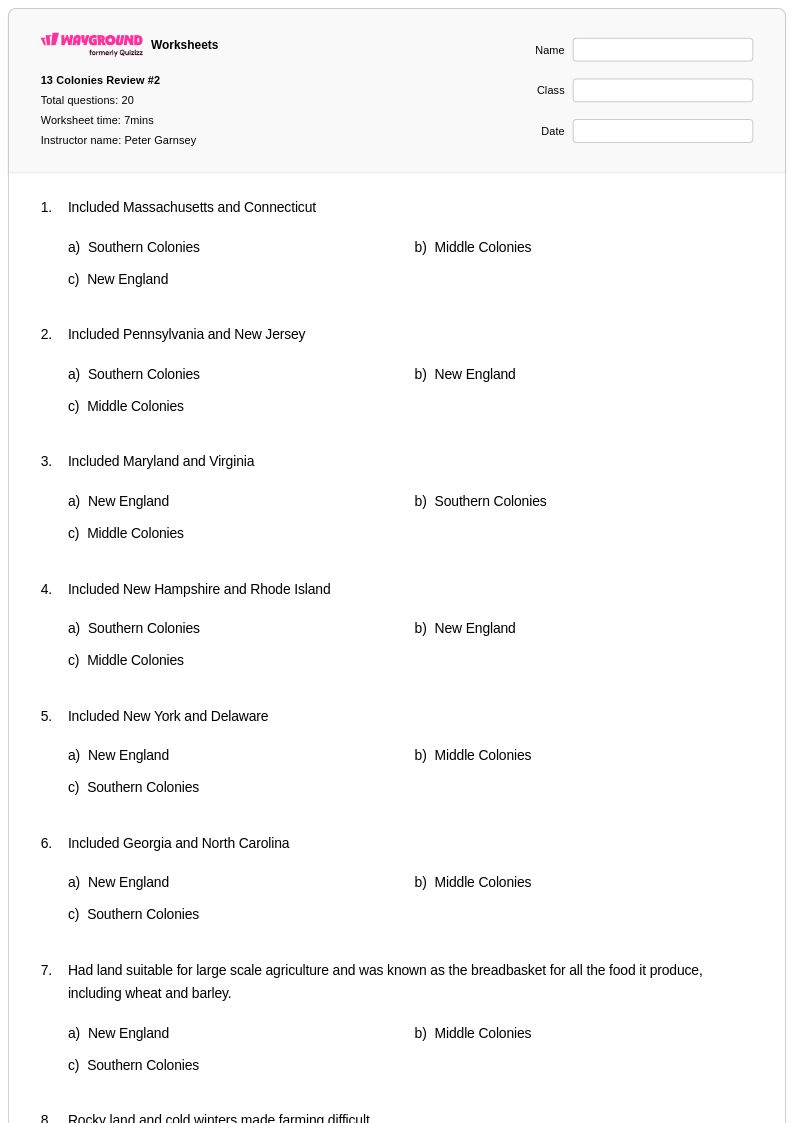
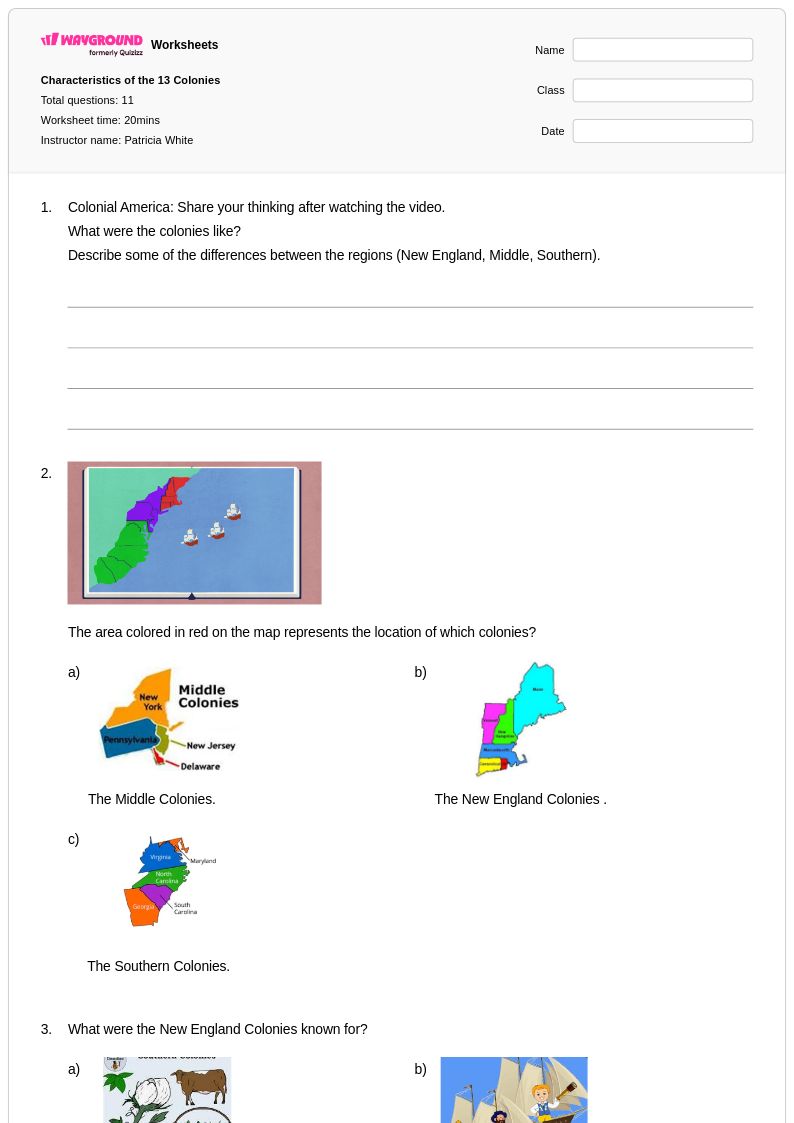
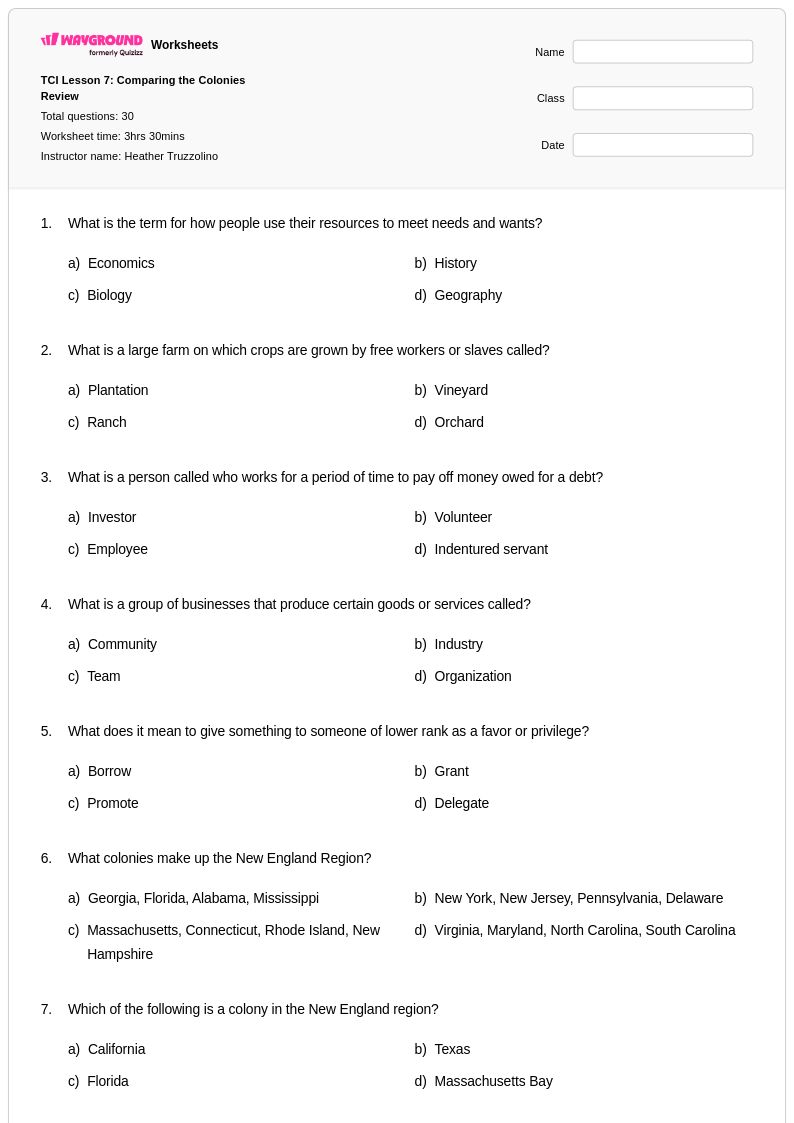
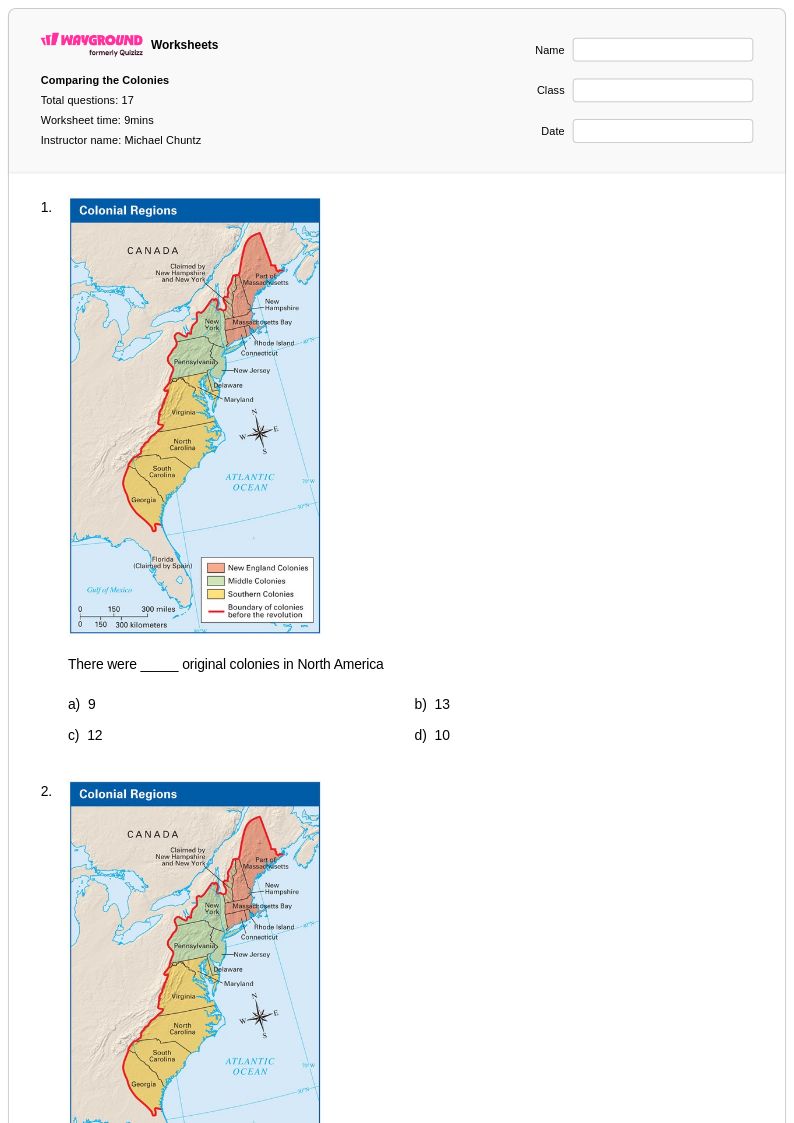
Explore Wayground's free Class 5 printable worksheets and practice problems covering the 13 Colonies, helping students master early American settlement history through engaging activities with comprehensive answer keys and downloadable PDFs.
Explore printable 13 Colonies worksheets for Class 5
Class 5 students exploring the 13 Colonies develop essential foundational knowledge about America's colonial origins through comprehensive worksheets that examine the establishment, development, and characteristics of early settlements from Jamestown to Georgia. These educational resources strengthen critical thinking skills as students analyze primary sources, compare and contrast different colonial regions, and understand the economic, social, and political factors that shaped colonial life. The worksheets feature varied practice problems that challenge students to identify key historical figures, examine cause-and-effect relationships in colonial expansion, and connect geographic factors to settlement patterns. Each worksheet collection includes detailed answer keys to support independent learning and comes in convenient pdf format, making these free printables easily accessible for classroom use and homework assignments.
Wayground, formerly Quizizz, empowers educators with millions of teacher-created resources specifically designed for 13 Colonies instruction, offering robust search and filtering capabilities that help teachers quickly locate materials aligned with state social studies standards and curriculum objectives. The platform's differentiation tools enable instructors to customize worksheets for diverse learning needs, whether providing additional scaffolding for struggling students or creating enrichment activities for advanced learners. Teachers benefit from flexible formatting options that include both printable pdf versions for traditional classroom use and digital formats for interactive learning experiences. These comprehensive worksheet collections support effective lesson planning by providing ready-to-use materials for skill practice, targeted remediation of specific historical concepts, and enrichment opportunities that deepen students' understanding of colonial American history and its lasting impact on the development of the United States.
FAQs
How do I teach the 13 Colonies to middle school students?
Teaching the 13 Colonies is most effective when students understand regional groupings first — New England, Middle, and Southern colonies — before examining individual settlements. Build lessons around the economic, religious, and geographic factors that drove each region's development, using primary sources like colonial charters alongside structured note-taking activities. Connecting colonial governance structures to later Revolutionary-era grievances helps students see the period as a foundation, not an isolated unit.
What activities help students practice comparing the three colonial regions?
Comparison charts and graphic organizers are highly effective for helping students distinguish New England, Middle, and Southern colonies across categories like economy, religion, climate, and government. Worksheet activities that ask students to classify colonies by region or match characteristics to specific settlements reinforce these distinctions through repetition. Practice problems that require written explanations — not just identification — push students to articulate the reasons behind regional differences rather than simply memorizing them.
What mistakes do students commonly make when learning about the 13 Colonies?
One of the most common errors is treating the 13 Colonies as a uniform bloc rather than three distinct regions with different economic systems, social structures, and motivations for settlement. Students also frequently confuse the chronology of colonial founding, conflating Virginia's 1607 establishment with later Puritan settlements in New England. Another persistent misconception is overstating religious motivation as the primary driver of colonization, when economic factors were equally or more significant for many colonies, particularly in the South.
How do I use 13 Colonies worksheets as a formative assessment?
13 Colonies worksheets work well as exit tickets, bell-ringers, or mid-unit checks when targeted at specific skills — such as identifying colonial governance structures or explaining the role of the triangular trade. Because these worksheets include complete answer keys, teachers can quickly score responses and identify patterns in student misunderstanding before moving into the Revolutionary period. Assigning a short worksheet after each regional unit helps teachers gauge whether students can differentiate the colonies before moving to comparative analysis.
How do I use Wayground's 13 Colonies worksheets in my classroom?
Wayground's 13 Colonies worksheets are available as printable PDFs for traditional classroom use and in digital formats for technology-integrated environments, giving teachers flexibility depending on their setup. Teachers can also host worksheets as a quiz directly on Wayground, enabling real-time student responses and automatic scoring. Wayground's accommodation tools — including read aloud, extended time, and reduced answer choices — allow teachers to assign differentiated settings to individual students while the rest of the class works with default settings, making it straightforward to support diverse learners within the same assignment.
How do I differentiate 13 Colonies instruction for struggling readers?
For students who struggle with dense social studies text, breaking colonial content into region-by-region segments reduces cognitive load and makes comparisons more manageable. On Wayground, teachers can enable the Read Aloud feature for individual students so question text and content is read to them, and adjustable font sizes and themes in Reading Mode can improve text accessibility. Reducing answer choices for selected students is another option that lowers the difficulty floor without changing the underlying learning objective.