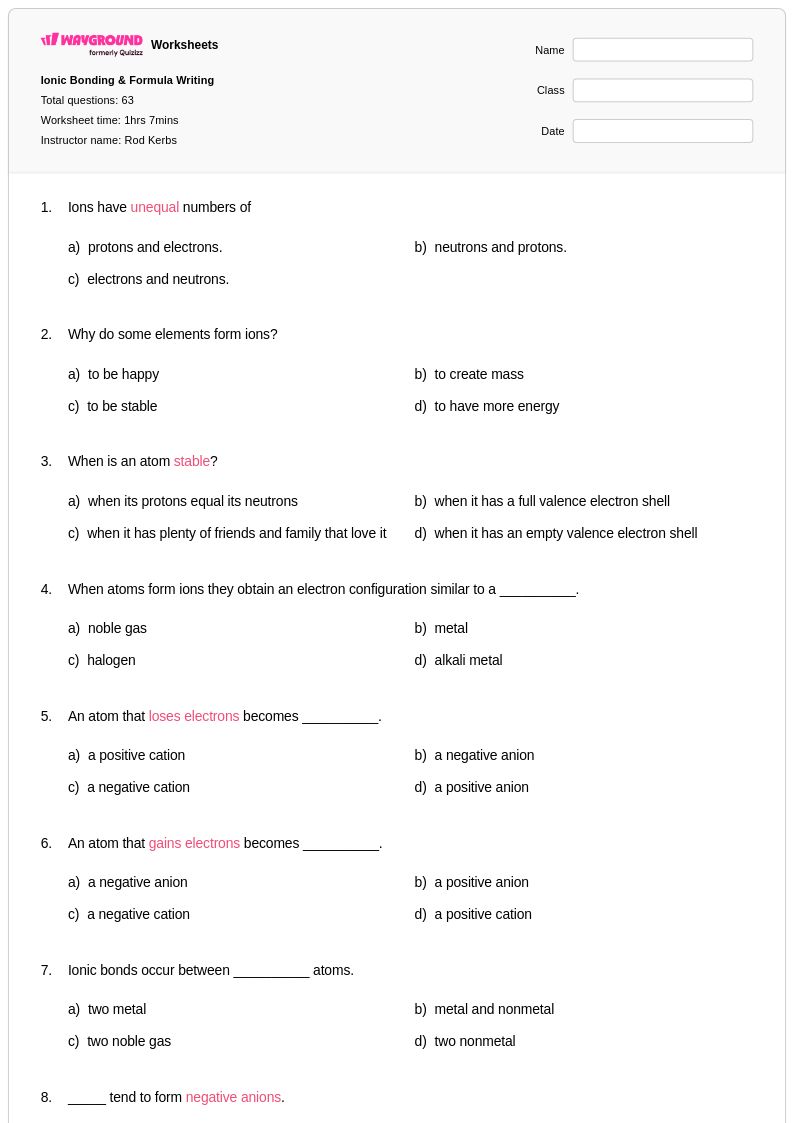
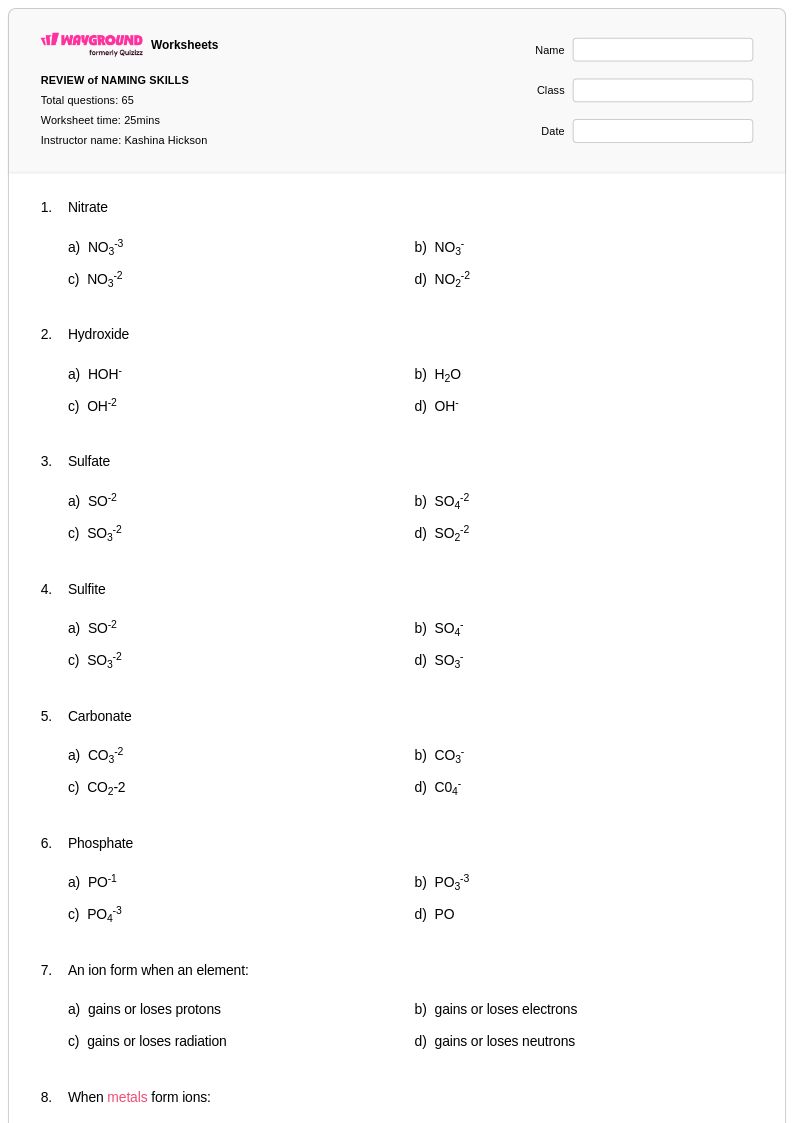
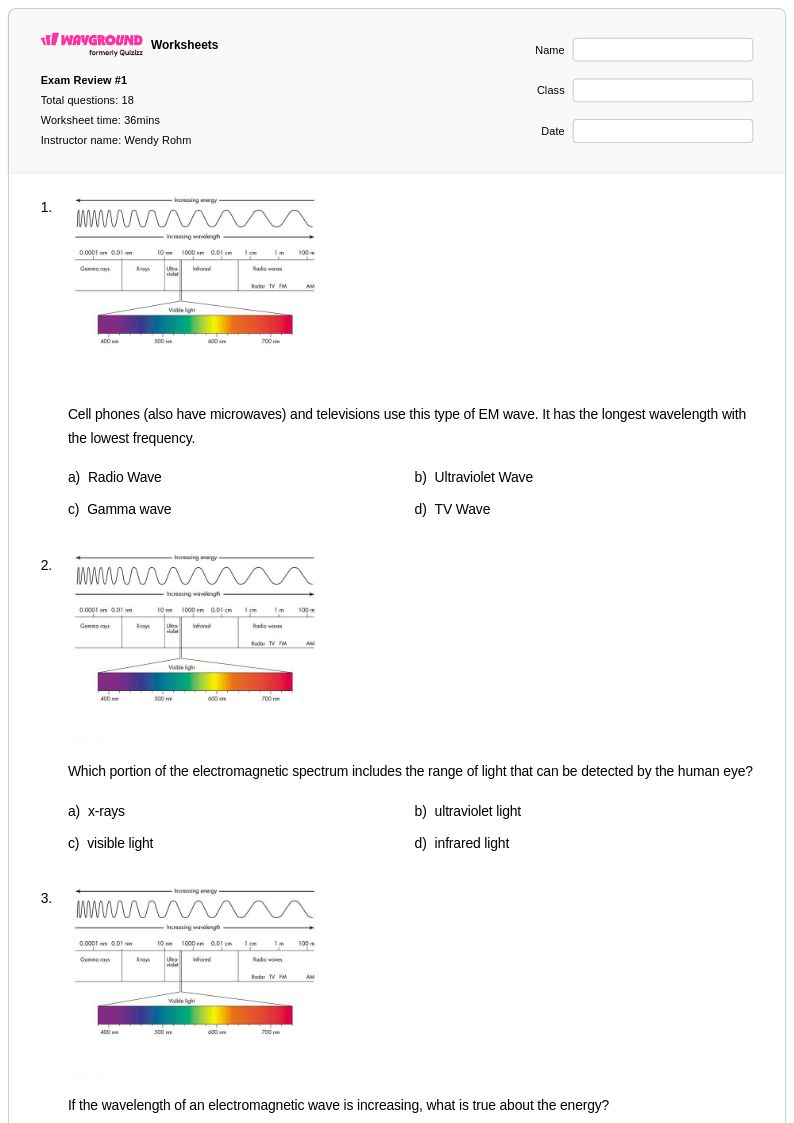
Discover Class 6 anions worksheets from Wayground with free printables and practice problems that help students master negative ions, their properties, and chemical behavior through engaging PDF exercises with complete answer keys.
Class 6 anion worksheets available through Wayground (formerly Quizizz) provide students with comprehensive practice in understanding negatively charged ions and their fundamental role in chemical compounds. These expertly designed worksheets strengthen essential chemistry skills including identifying common anions, understanding ionic charges, recognizing anion symbols and formulas, and predicting how anions combine with cations to form stable compounds. Students work through carefully structured practice problems that build conceptual understanding of how atoms gain electrons to become anions, while developing proficiency in writing chemical formulas and naming ionic compounds. Each worksheet includes a detailed answer key to support independent learning and comes in convenient pdf format as free printables that teachers can easily distribute for classroom instruction or homework assignments.
Wayground (formerly Quizizz) empowers educators with millions of teacher-created anion worksheet resources that feature robust search and filtering capabilities to locate materials perfectly suited for Class 6 chemistry instruction. The platform's standards-aligned content ensures worksheets meet curriculum requirements while offering powerful differentiation tools that allow teachers to modify difficulty levels and customize problems for diverse learning needs. Teachers can seamlessly access both printable pdf versions for traditional classroom use and digital formats for technology-enhanced learning environments, making lesson planning efficient and flexible. These comprehensive worksheet collections serve multiple instructional purposes, from initial skill introduction and guided practice to targeted remediation for struggling students and enrichment activities for advanced learners, ensuring every sixth-grade student develops a solid foundation in anion concepts essential for future chemistry success.
FAQs
How do I teach anions to chemistry students?
Start by establishing what an anion is at the atomic level: an atom or molecule that has gained one or more electrons, resulting in a net negative charge. From there, connect anion formation to periodic table trends, showing students why nonmetals in Groups 16 and 17 readily gain electrons to achieve stable electron configurations. Using common anions like chloride, sulfate, and nitrate as anchors helps students build recognition before moving into more complex ionic bonding concepts.
What exercises help students practice identifying anions?
Effective practice exercises include naming common polyatomic anions from their formulas, predicting the charge an atom will carry when it becomes an anion, and completing ionic compound formulas by pairing anions with cations. Lewis dot structure diagrams that show electron gain are particularly useful because they make the abstract process of anion formation visually concrete. Progressive problem sets that move from simple monatomic anions to polyatomic ones build fluency systematically.
What mistakes do students commonly make when working with anions?
One of the most frequent errors is confusing anion charge with the number of electrons gained rather than the resulting total charge state. Students also often misremember the formulas and charges of common polyatomic anions like sulfate (SO4²⁻) and nitrate (NO3⁻), treating them as interchangeable. Another common misconception is assuming anion size decreases as nuclear charge increases, when in fact anions are larger than their parent neutral atoms because the added electrons increase electron-electron repulsion.
How can I use anion worksheets to differentiate instruction in my chemistry class?
For students who need additional support, reduce the number of anions students must recall at once and pair written problems with reference charts. Wayground allows teachers to apply accommodations at the individual student level, including reduced answer choices to lower cognitive load and a Read Aloud feature for students who benefit from audio support. These settings can be saved and reused across sessions, so differentiation does not require rebuilding configurations for each assignment.
How do I use Wayground's anion worksheets in my classroom?
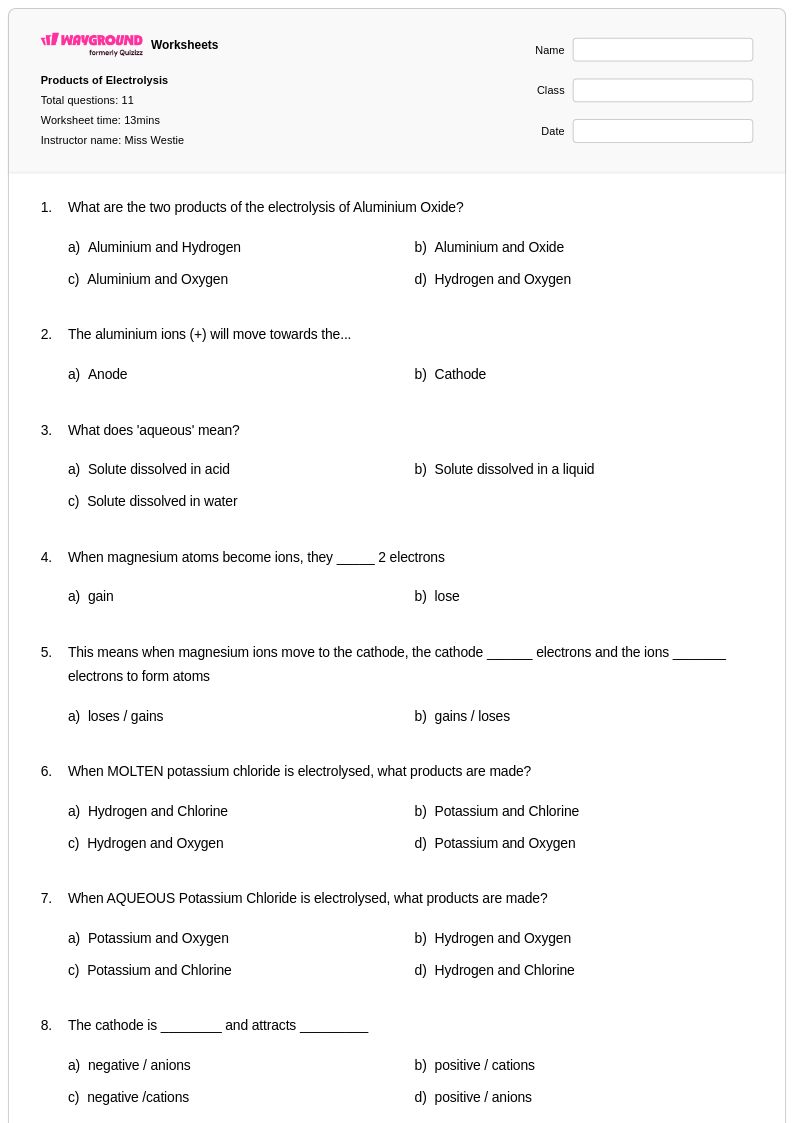
Wayground's anion worksheets are available as printable PDFs for traditional classroom use and in digital formats for technology-integrated learning environments, including the option to host them as a quiz directly on the platform. Teachers can distribute materials for guided practice, independent study, or formative assessment depending on the instructional goal. Complete answer keys are included with each worksheet, allowing students to self-check their understanding of anion nomenclature, Lewis dot structures, and ionic bonding.
How do anion worksheets support student understanding of ionic bonding?
Anion worksheets build the foundational knowledge that ionic bonding requires by training students to predict anion formation, assign correct charges, and write accurate chemical formulas. Because ionic compounds are defined by the electrostatic attraction between cations and anions, students who cannot reliably identify and name anions will struggle to balance ionic formulas or predict compound properties. Structured practice with progressively complex anions closes this gap before students encounter full ionic compound units.

![fun facts [science] - Printable Anions Worksheets Class 6 - Quizizz](https://quizizz-static.s3.amazonaws.com/_media/worksheets-new/6207cbe50defc9001e827120-fun-facts-science)