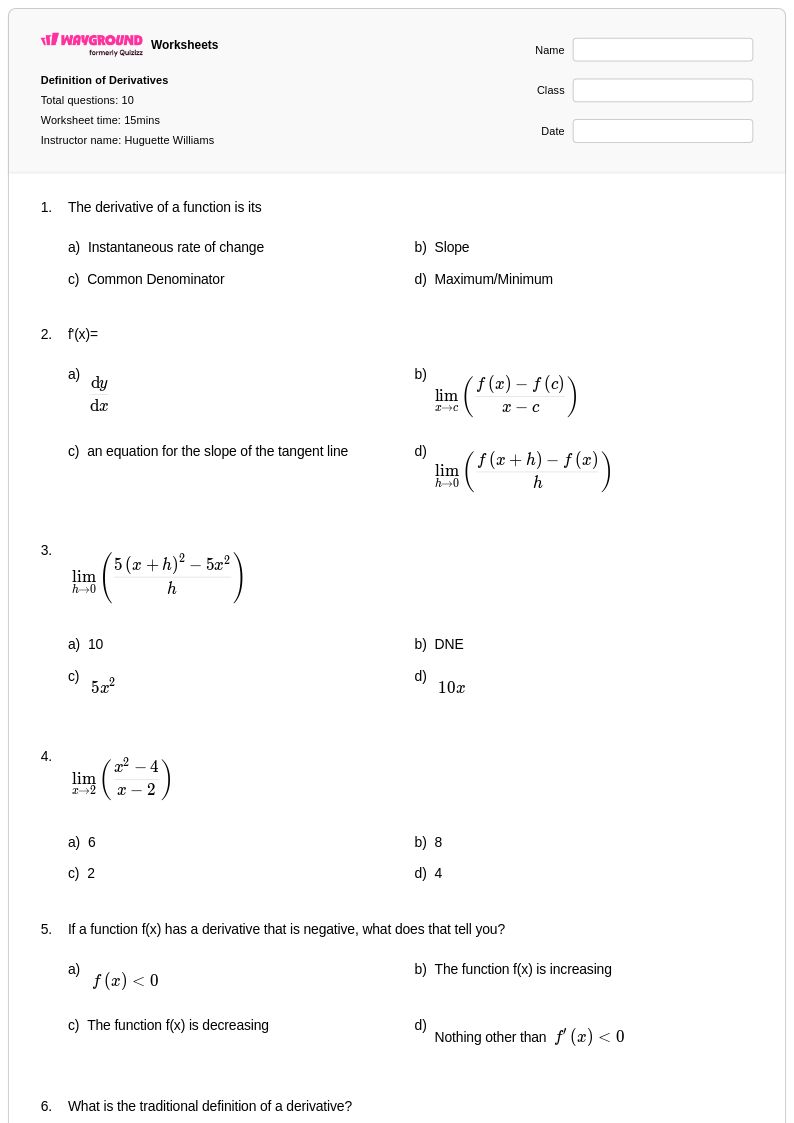
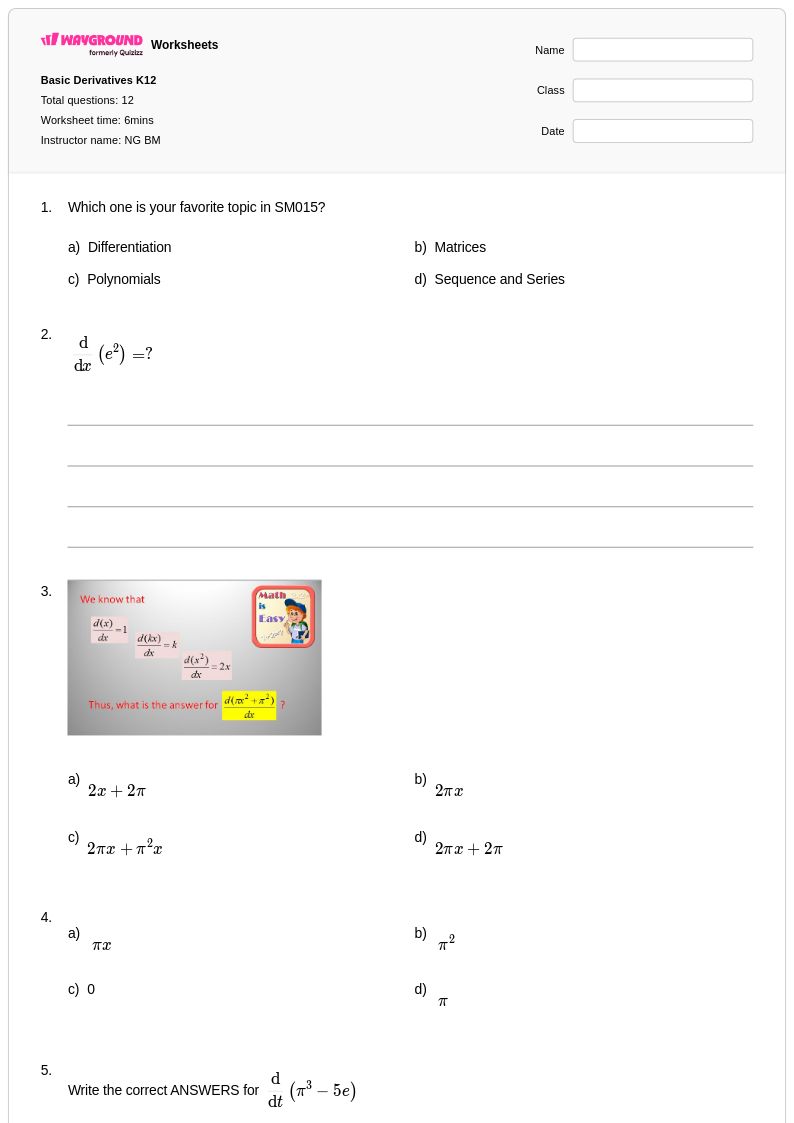
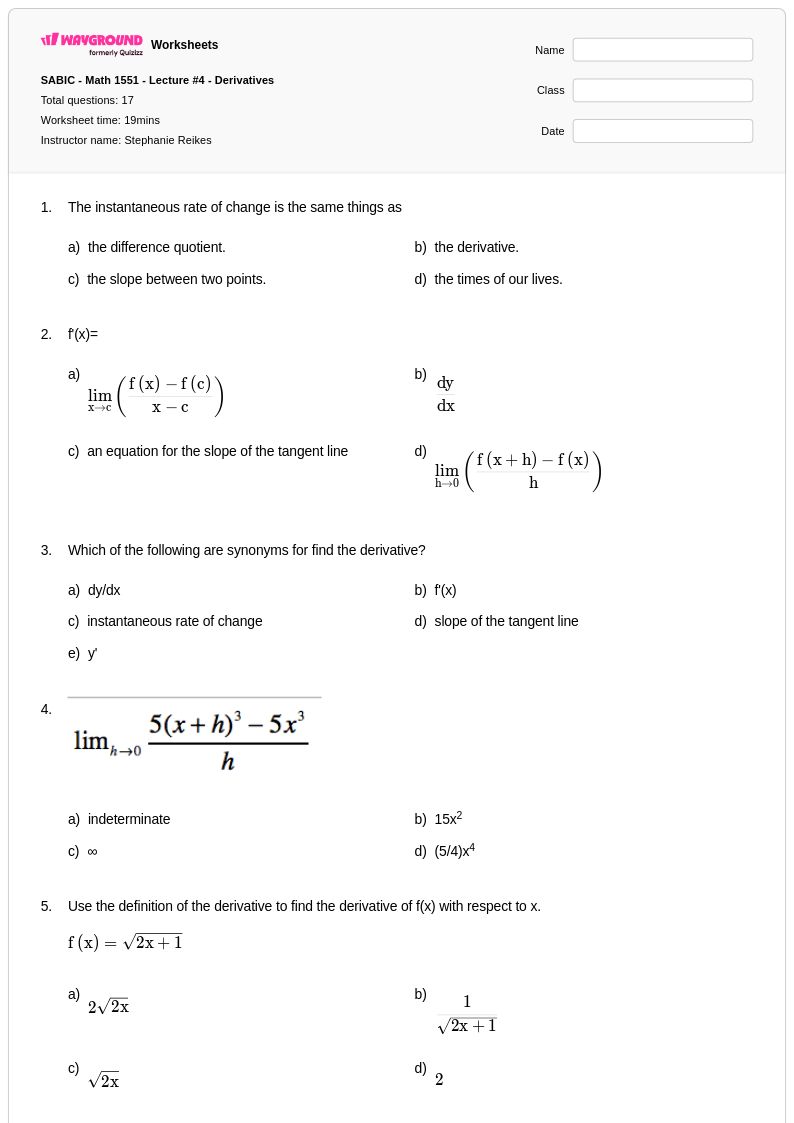
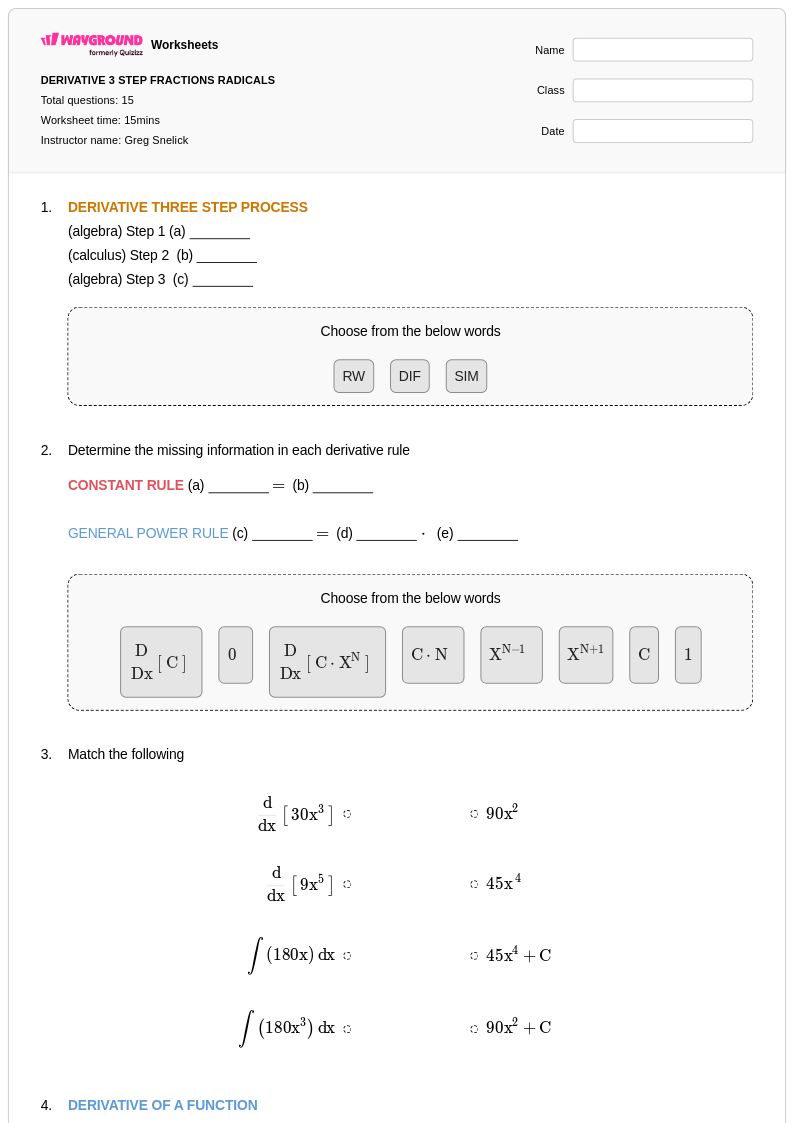
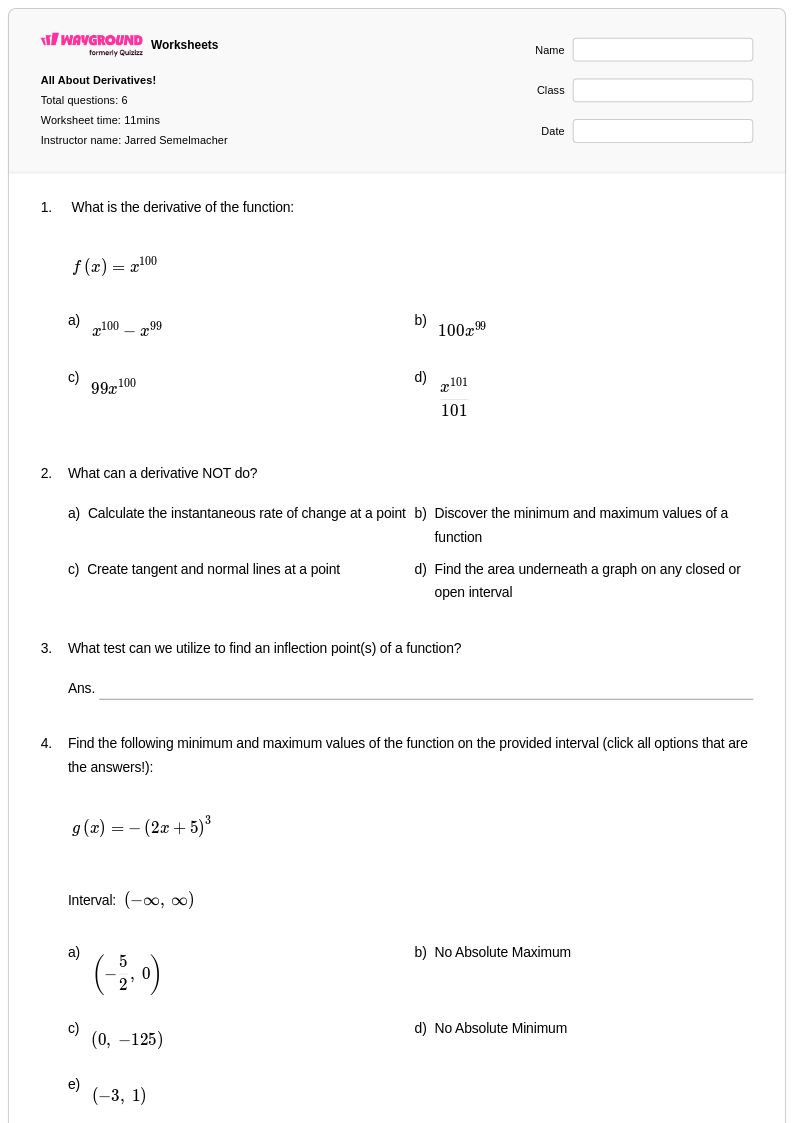
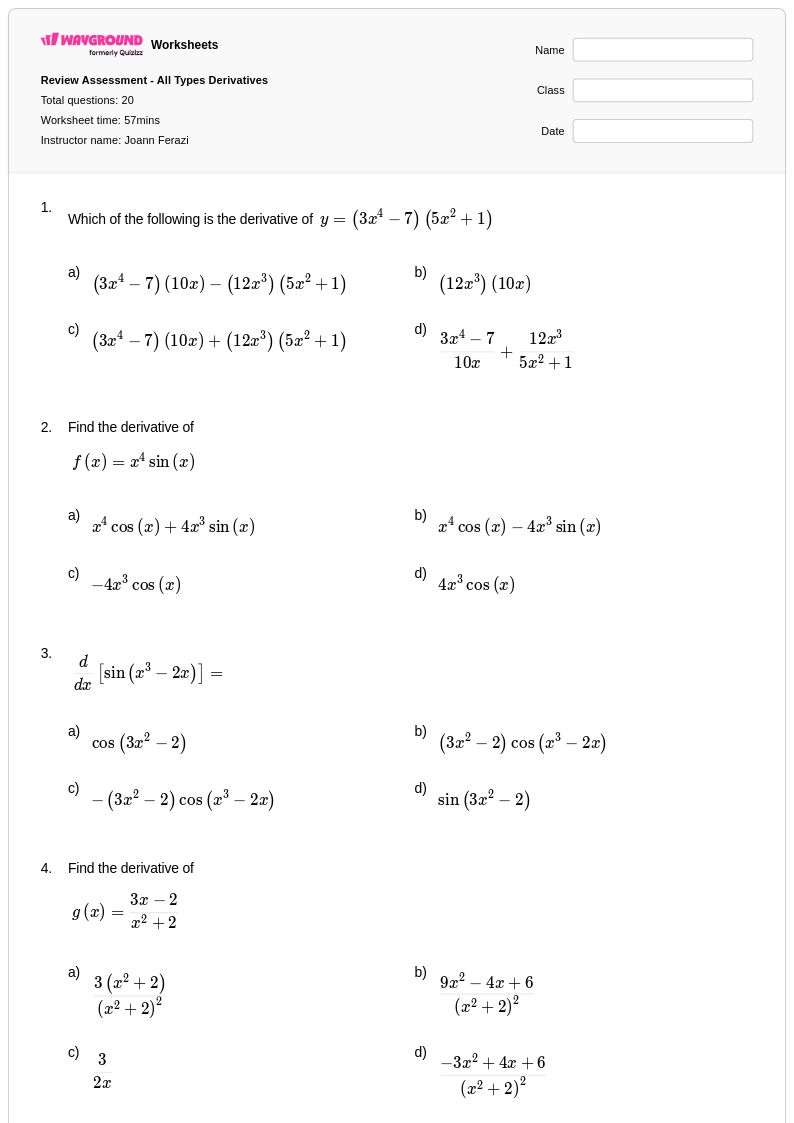
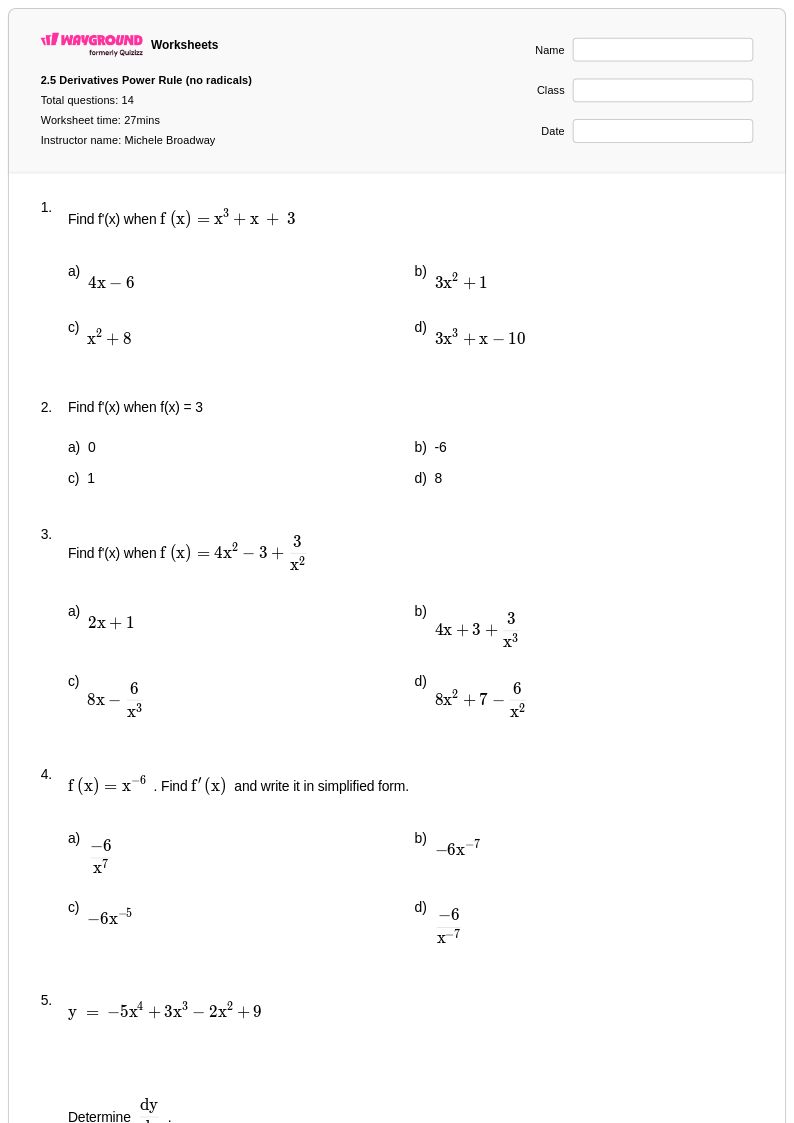
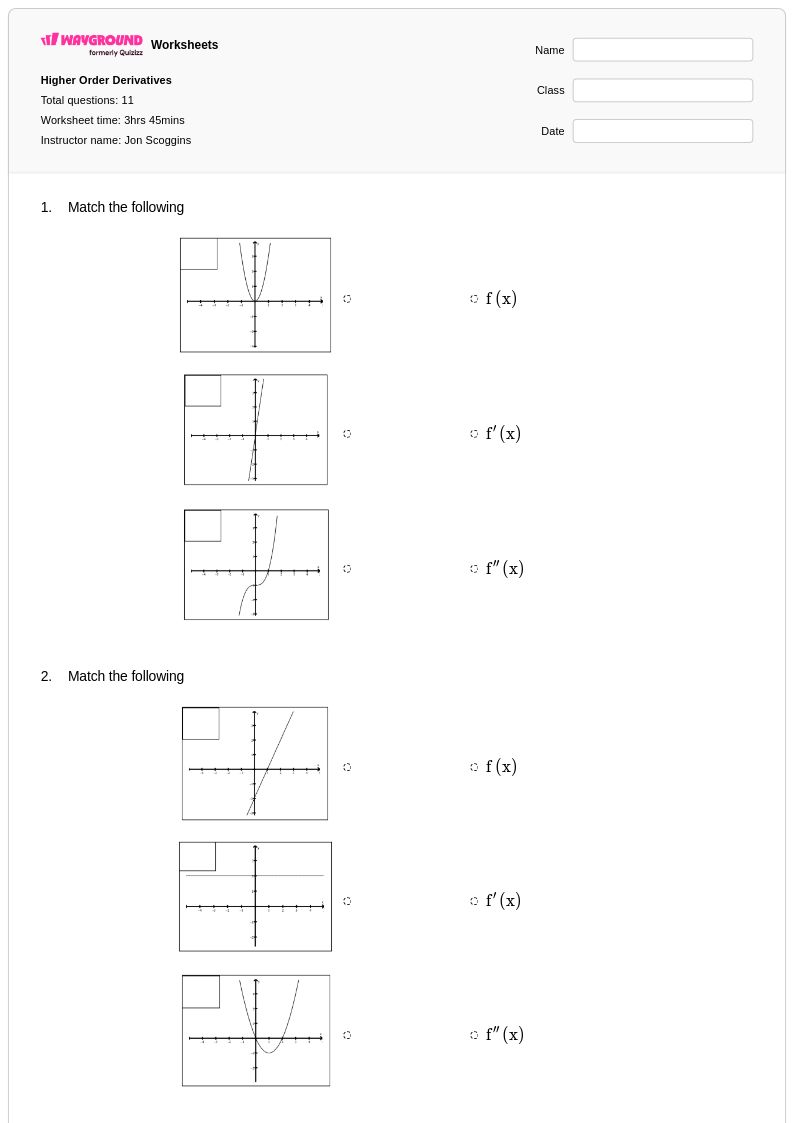
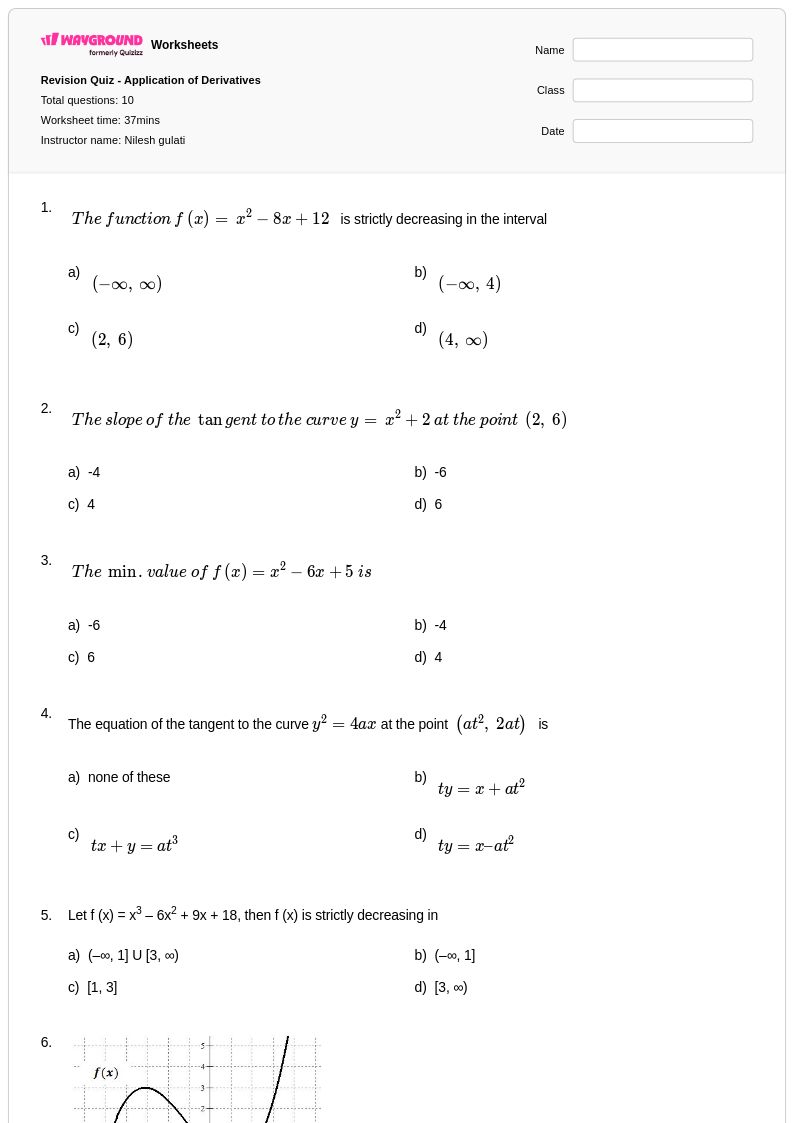
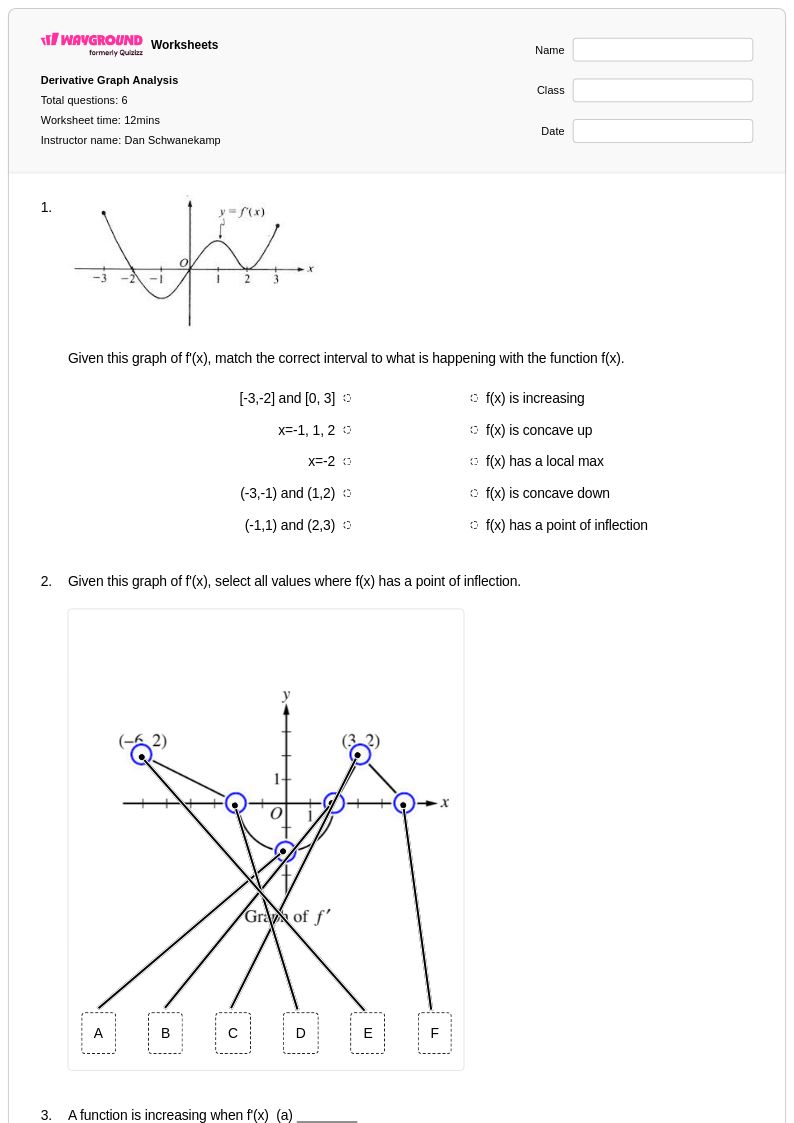
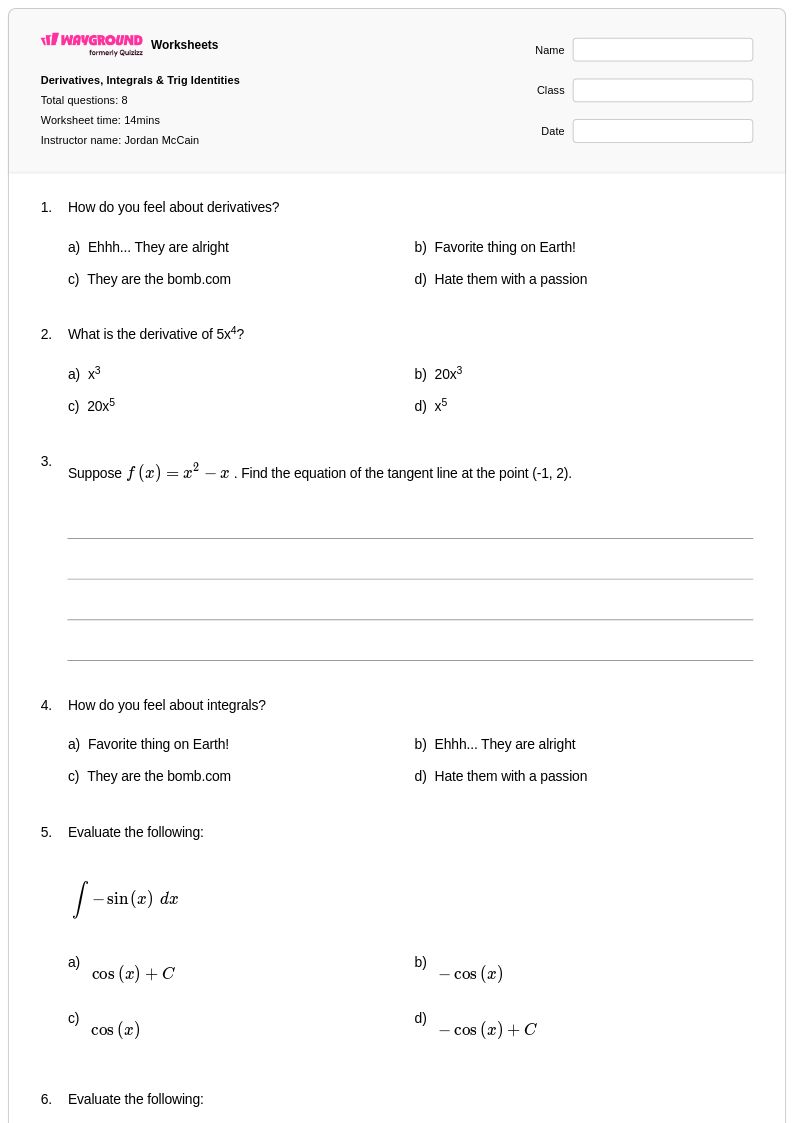
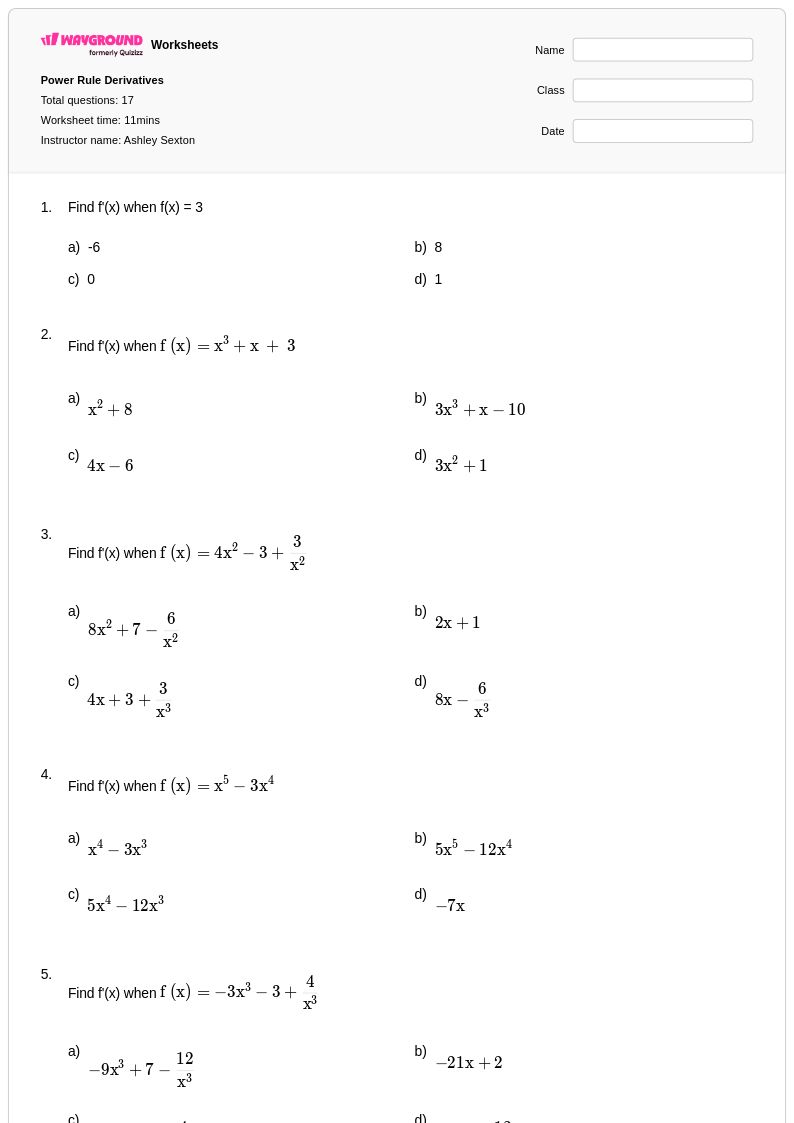
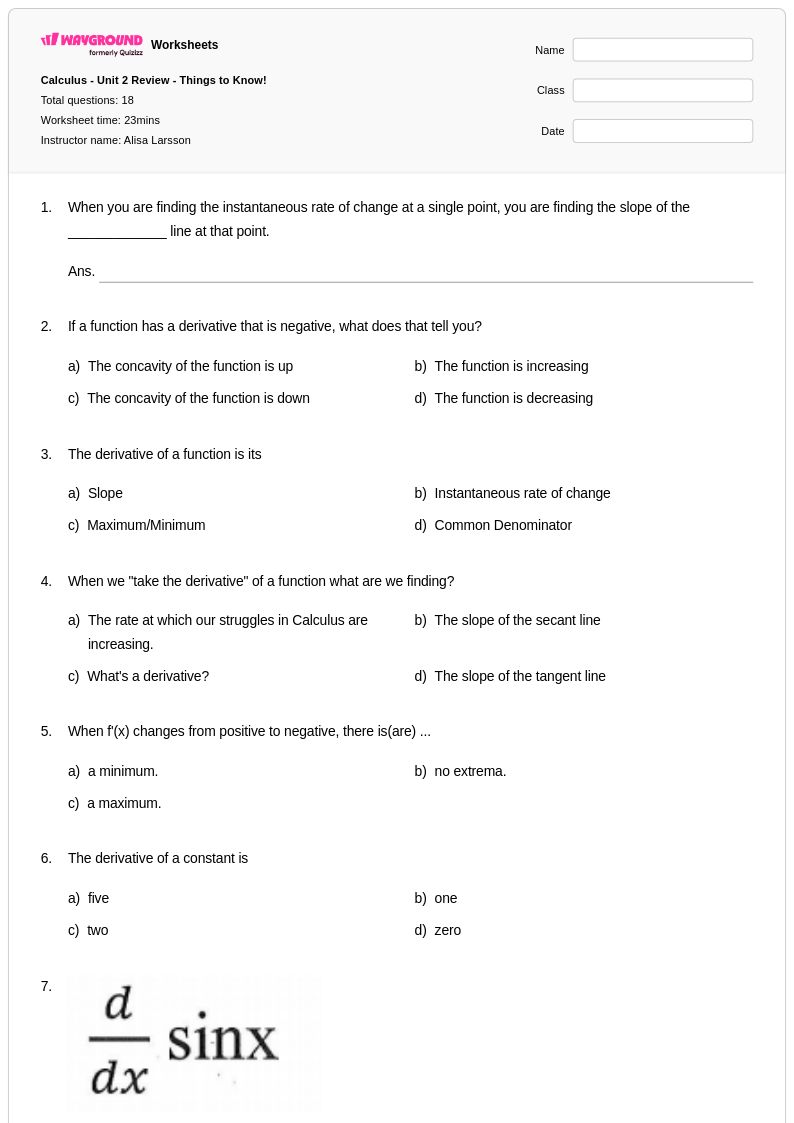
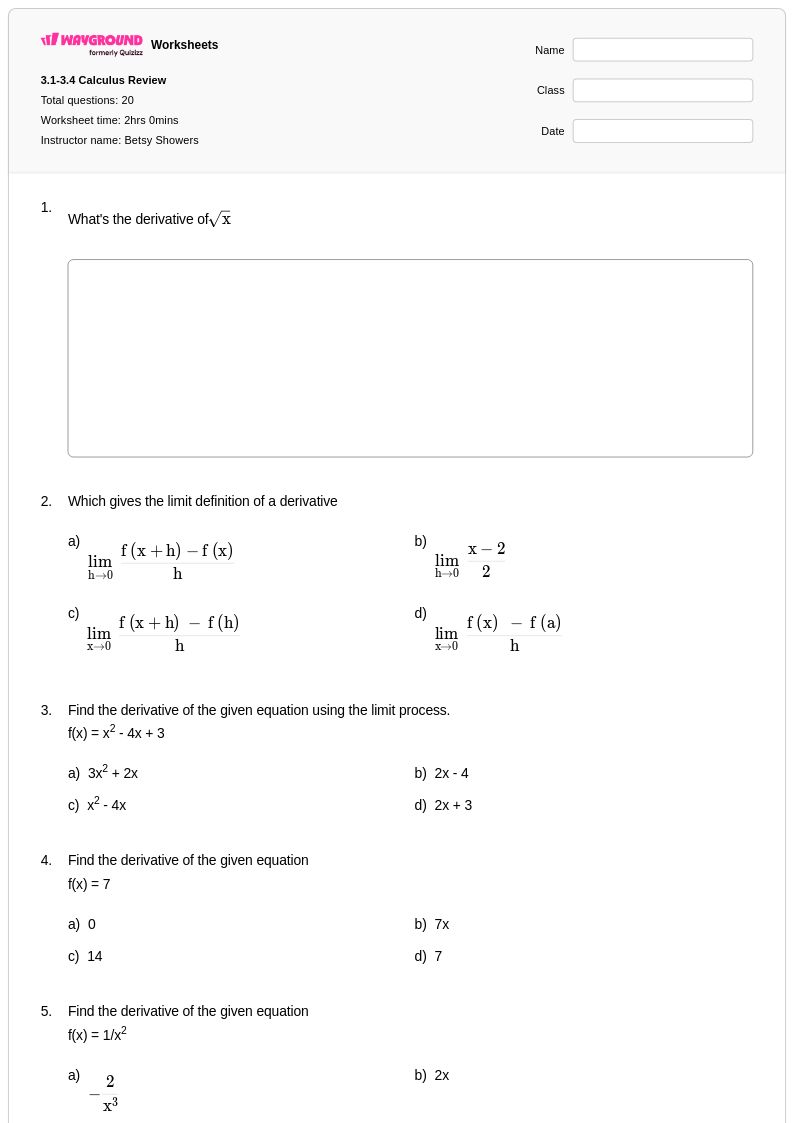
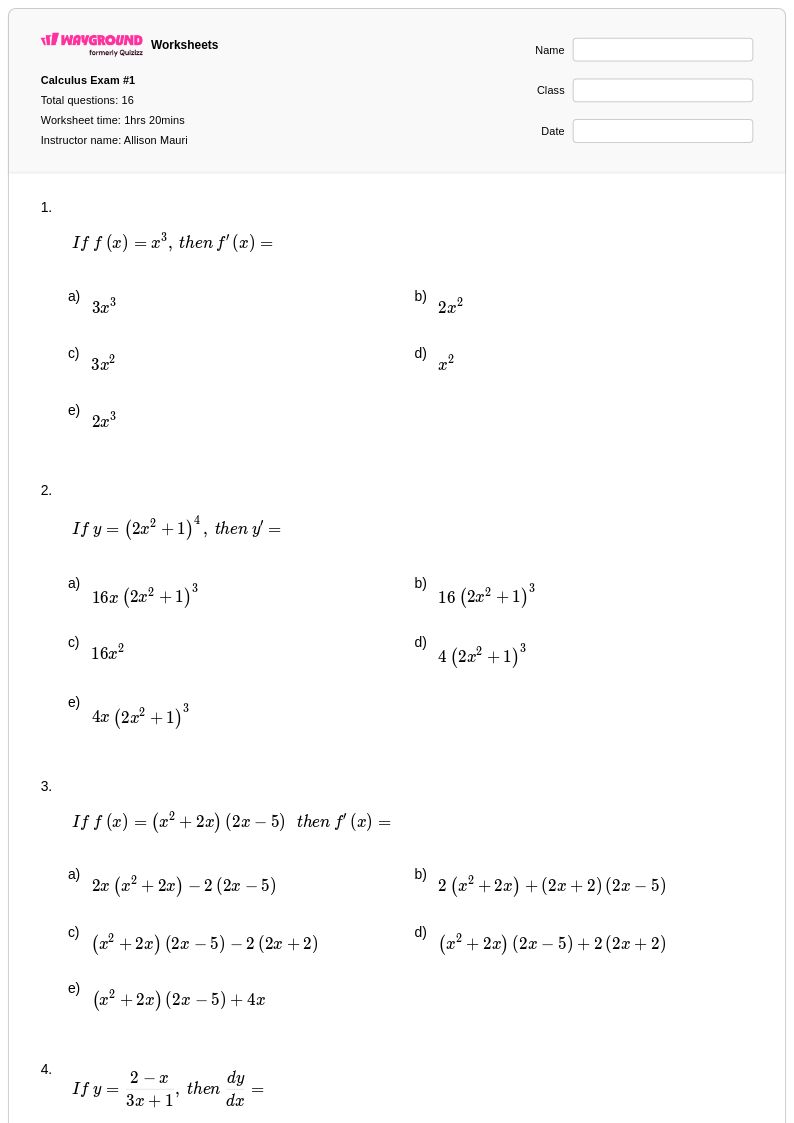
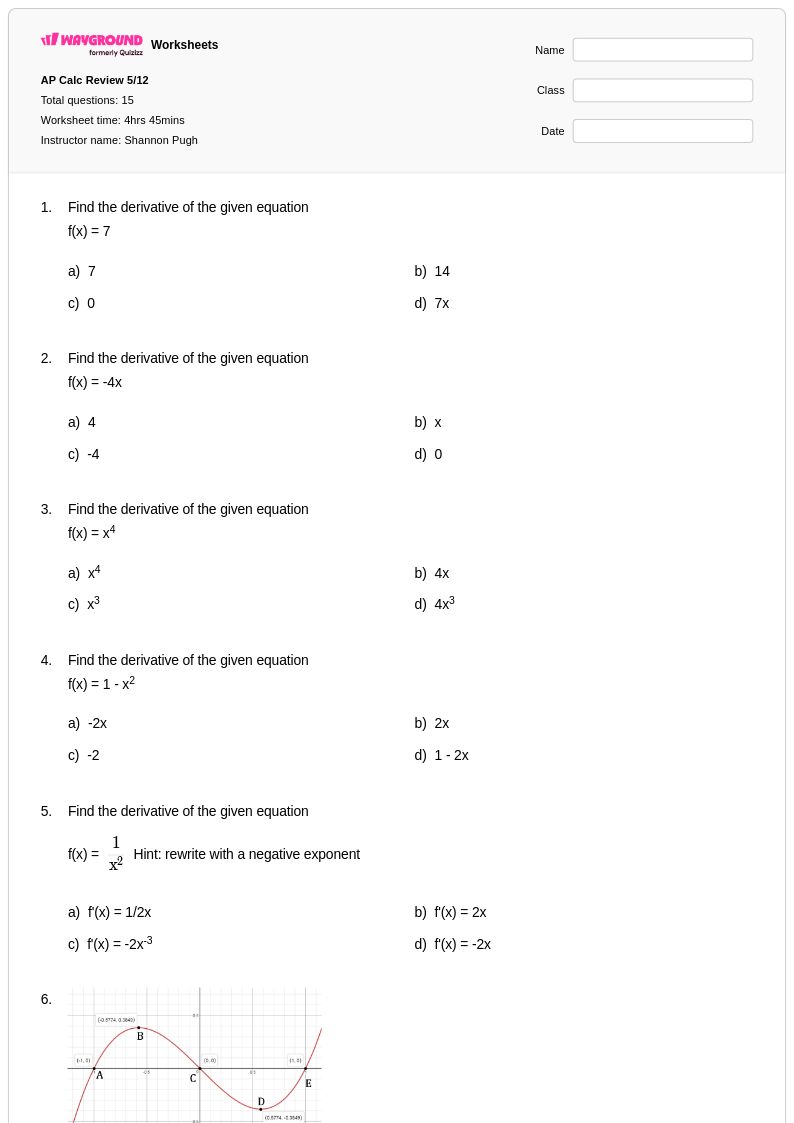
Free printable derivatives worksheets with answer keys help students master calculus concepts through comprehensive practice problems and step-by-step solutions available as downloadable PDFs from Wayground.
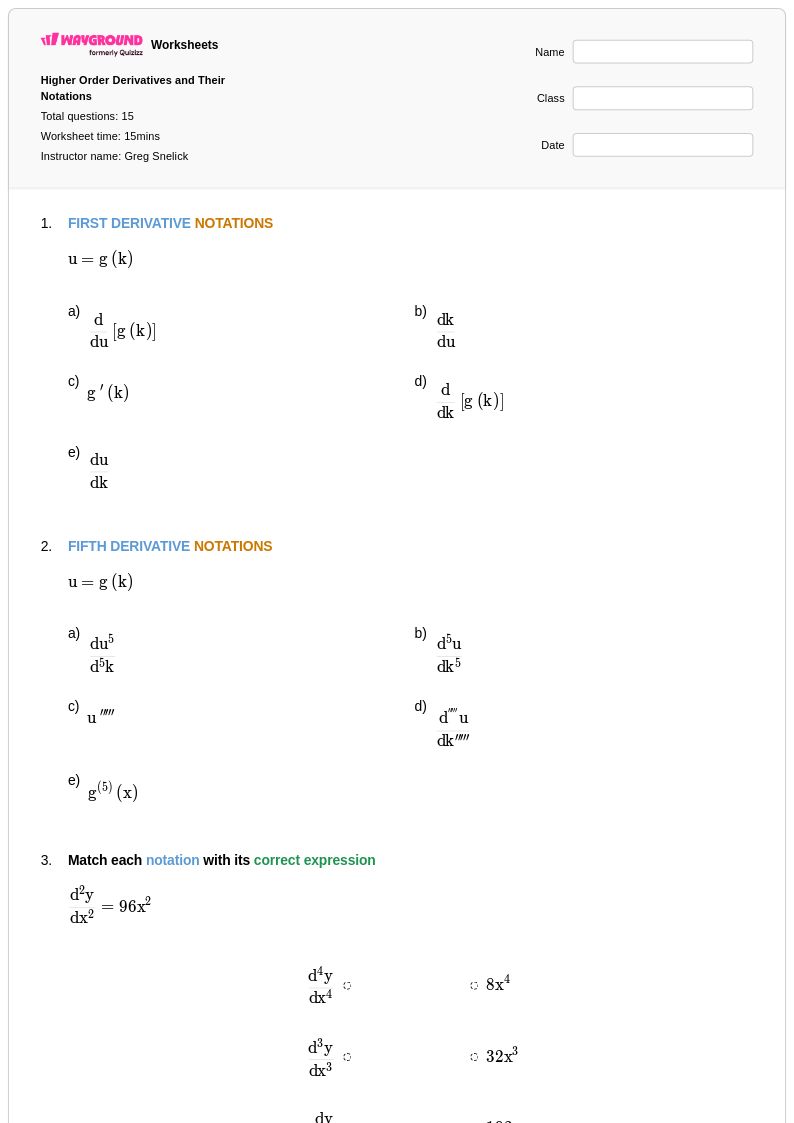
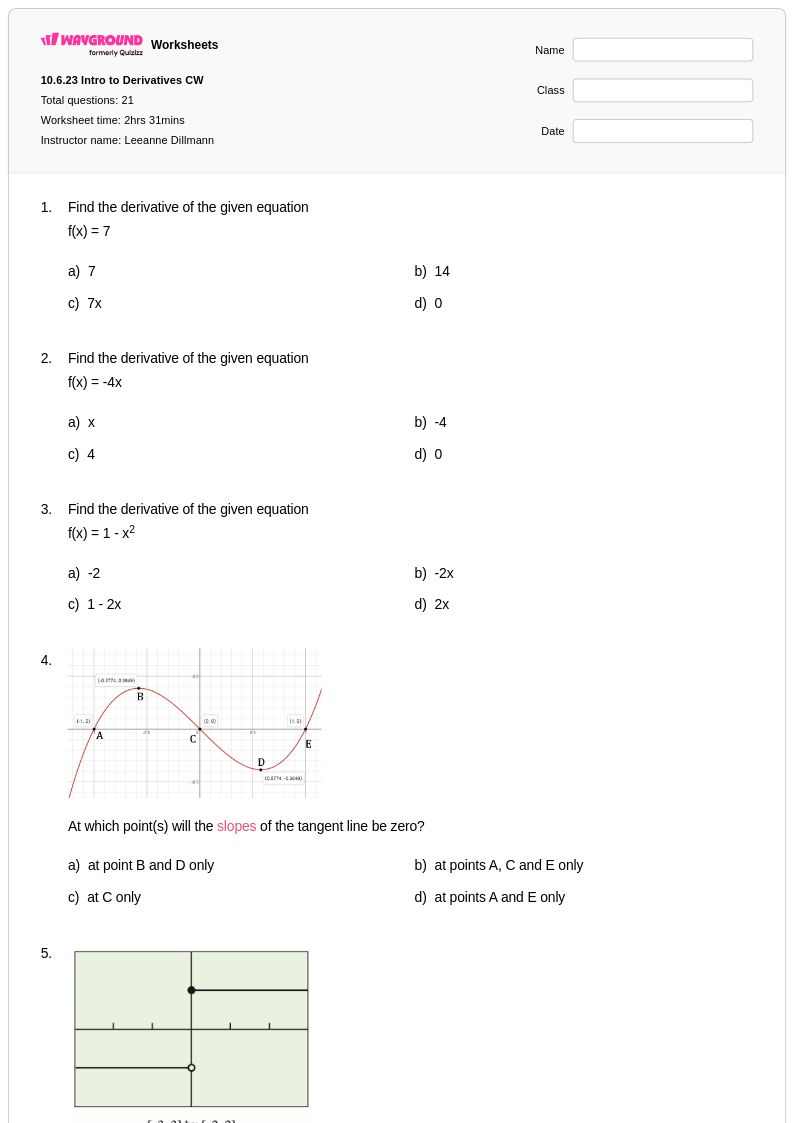
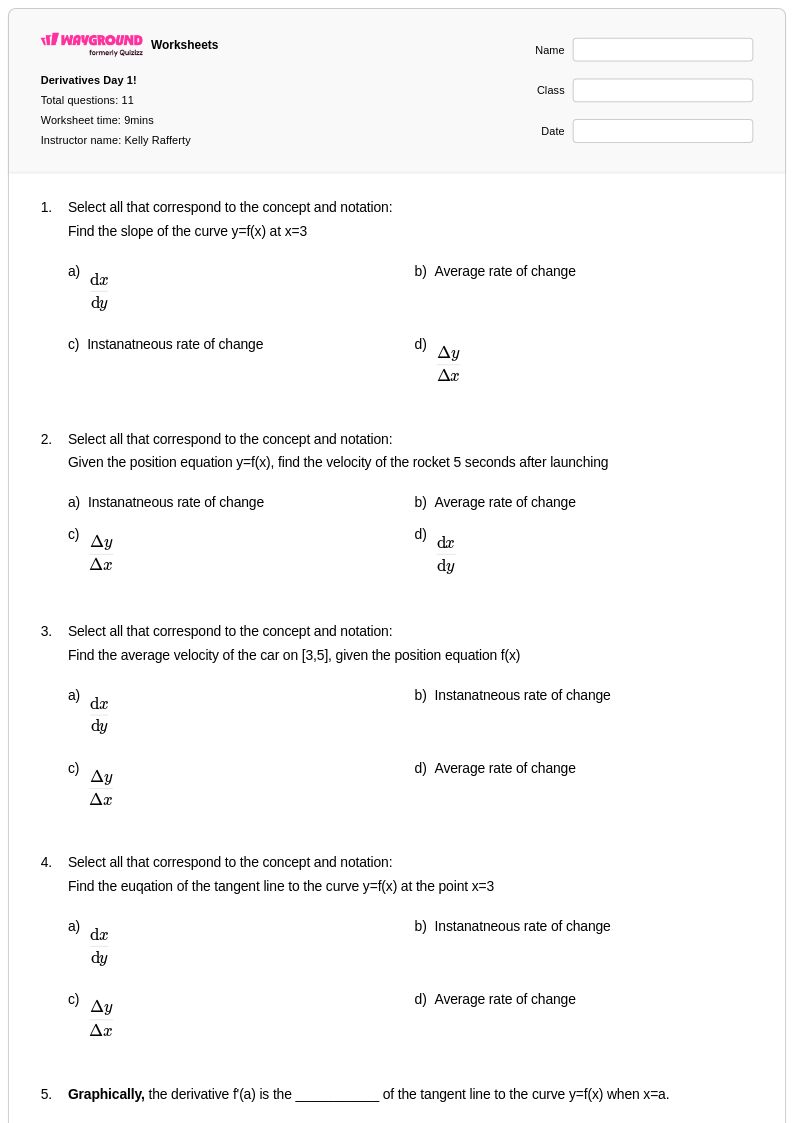
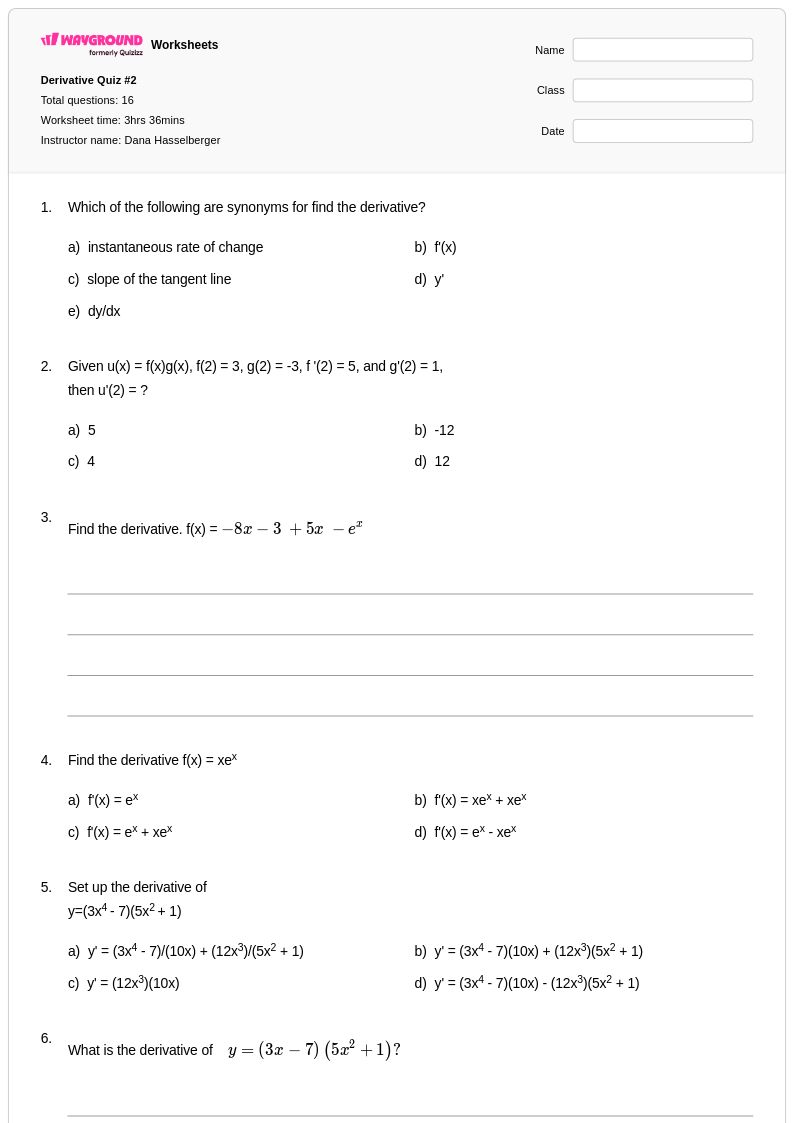
Derivatives worksheets available through Wayground (formerly Quizizz) provide comprehensive practice materials that strengthen students' understanding of fundamental calculus concepts including limits, differentiation rules, and rate of change applications. These expertly crafted resources cover essential derivative techniques such as the power rule, product rule, quotient rule, and chain rule, while also incorporating real-world applications like optimization problems and related rates. Each worksheet collection includes detailed answer keys and step-by-step solutions that help students master the computational and conceptual aspects of derivatives, with free printable pdf formats making these practice problems easily accessible for both classroom instruction and independent study.
Wayground (formerly Quizizz) supports mathematics educators with millions of teacher-created derivative worksheets that feature robust search and filtering capabilities, allowing instructors to quickly locate materials aligned with specific learning standards and curriculum requirements. The platform's differentiation tools enable teachers to customize worksheets for various skill levels, from introductory derivative concepts to advanced applications, while flexible formatting options provide both printable and digital versions to accommodate diverse classroom needs. These comprehensive resources streamline lesson planning and assessment preparation, making it simple for educators to provide targeted remediation for struggling students, enrichment activities for advanced learners, and consistent skill practice opportunities that reinforce derivative mastery across all ability levels.
FAQs
How do I teach derivatives to students new to calculus?
Start with the concept before the mechanics. Students need to understand that a derivative measures instantaneous rate of change, the slope of a curve at a single point, before they can make sense of why the power rule works. A common entry point is average rate of change from algebra, then shrinking the interval until it becomes instantaneous. Once that intuition is in place, differentiation rules (power, product, quotient, chain) become procedures with meaning rather than steps to memorize.
What exercises help students practice differentiation rules?
The most effective practice sequences rules in isolation first, then mixes them. Start with pure power rule problems, move to product and quotient rule, then introduce chain rule with composite functions. Once students are solid on each rule individually, give them problems that require identifying which rule applies — that recognition step is where most students stall. Optimization and related rates problems are the right capstone: they force students to connect differentiation to a real question rather than just executing a procedure.
What mistakes do students commonly make when finding derivatives?
Three errors come up constantly. First, misapplying the chain rule — students differentiate the outer function correctly but forget to multiply by the derivative of the inner function. Second, confusing the product rule with simple exponent rules (treating f·g as if it differentiates term by term). Third, sign errors in the quotient rule, especially when the numerator requires the product rule itself. Targeted practice that isolates each rule, then deliberately mixes them, is the most reliable way to surface and correct these patterns.
How do I use Wayground's derivatives worksheets in my class?
You can run any worksheet as a digital quiz on Wayground, students complete it on their devices and you see results in real time, or download it as a printable PDF for paper-based practice. Every worksheet includes a complete answer key, so students working independently can self-check. If you go the print route, the Wayground for Teachers app lets you scan or capture student work to grade submissions without re-entering everything manually.
How are derivatives sequenced in the high school math curriculum?
Under Common Core's progression, derivatives sit at the end of the secondary math sequence, building directly on students' work with functions, limits, and average rates of change from algebra and precalculus. The typical path moves from understanding slope as a rate of change, to the limit definition of the derivative, to differentiation rules for polynomial and then transcendental functions, and finally to applications like optimization and curve analysis. Mastery here is the gateway to integral calculus and the AP Calculus curriculum.
How can I differentiate derivatives practice for mixed-ability classes?
Derivatives span a wide skill range, so differentiation matters here. For students who struggle with notation or reading multi-step problems, Wayground's Read Aloud accommodation and dyslexia-friendly font option reduce barriers that aren't about the math itself. For ability-level differentiation, you can create alternate worksheet versions at different complexity levels — polynomial-only problems for students still building fluency, composite and implicit differentiation problems for students ready for more. Both versions can run simultaneously in the same class session.
What is the difference between the power rule, product rule, quotient rule, and chain rule?
Each rule handles a different function structure. The power rule applies when differentiating a single term like xⁿ. The product rule is for two functions multiplied together. The quotient rule handles one function divided by another. The chain rule applies when one function is composed inside another — f(g(x)). In practice, many problems require combining rules: a quotient where the numerator is itself a composite function, for example, needs both the quotient rule and the chain rule in the same problem.