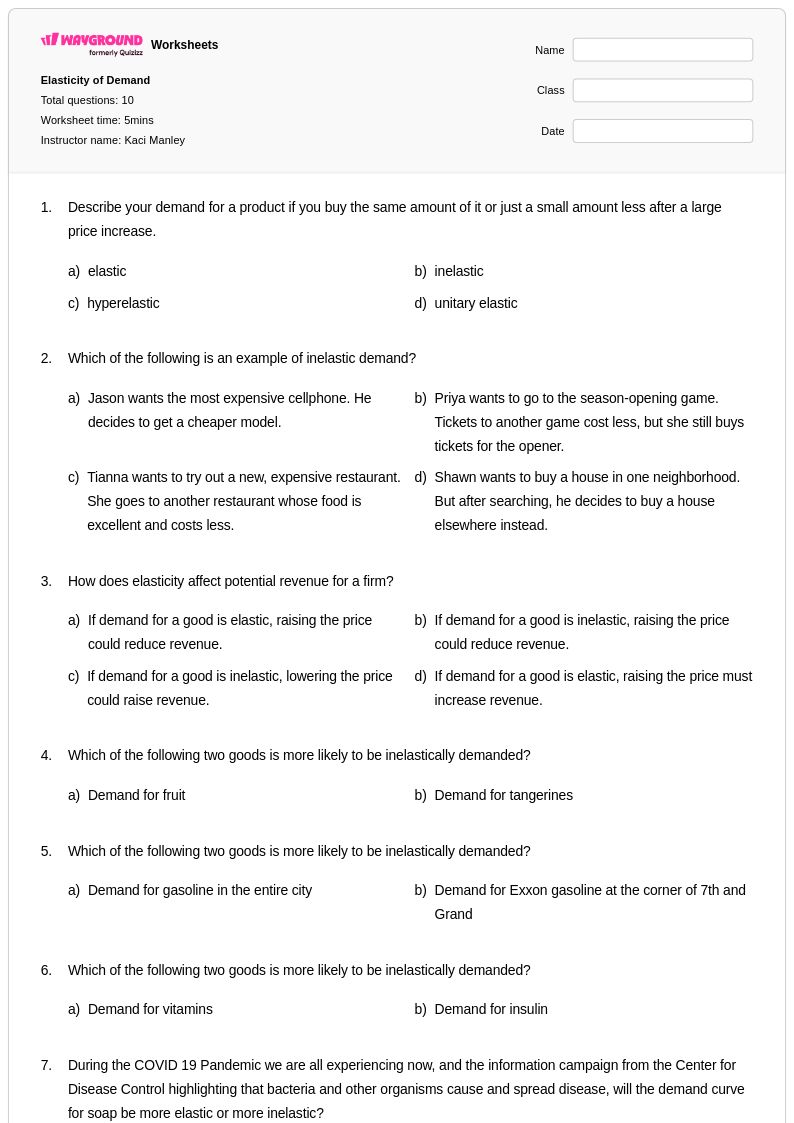
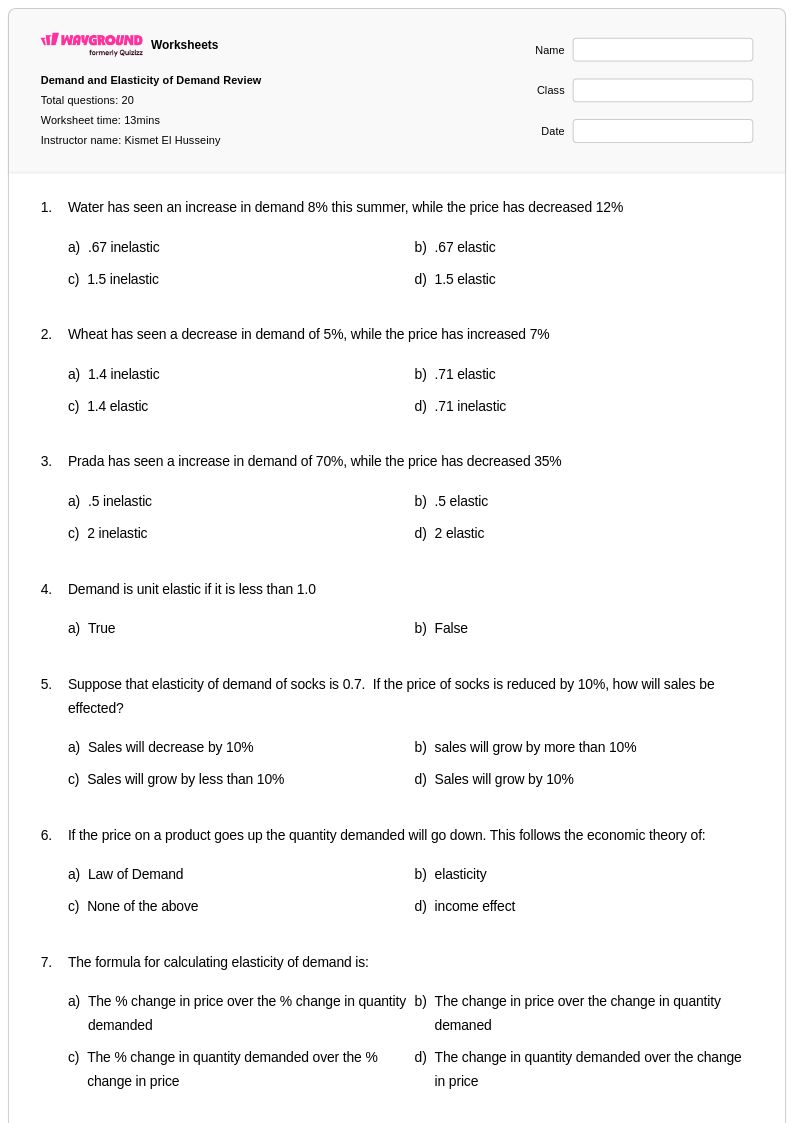
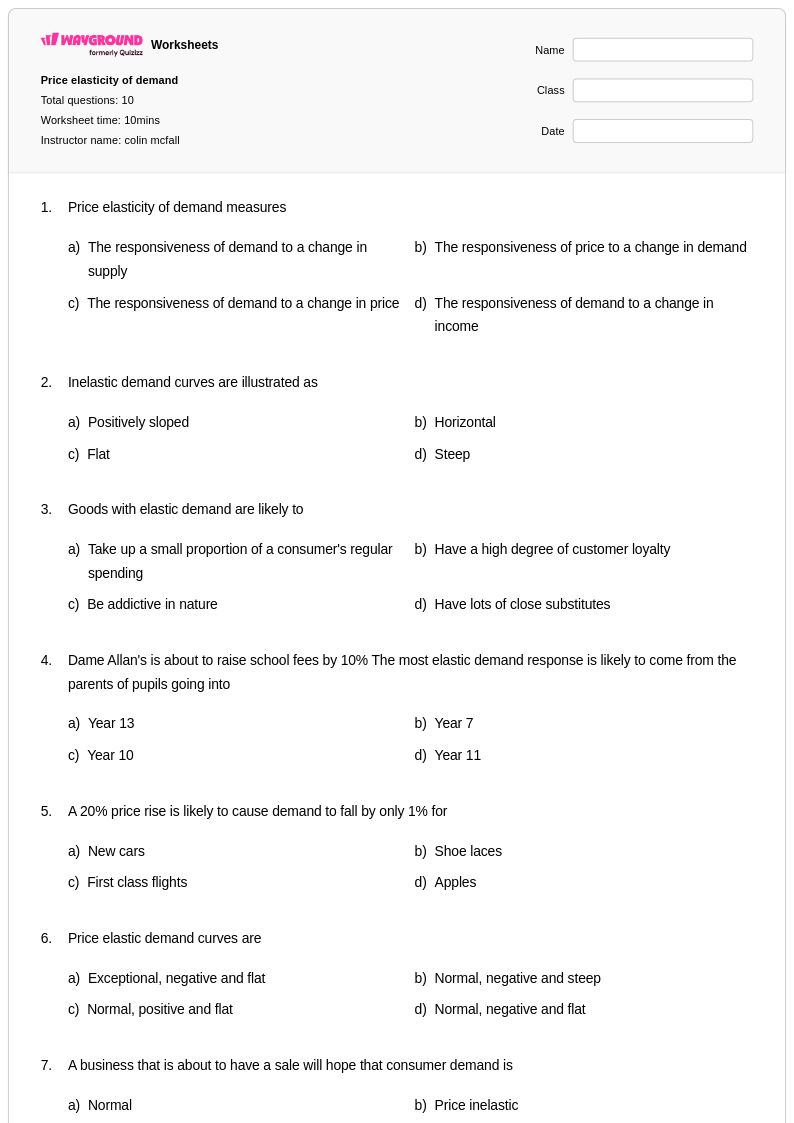
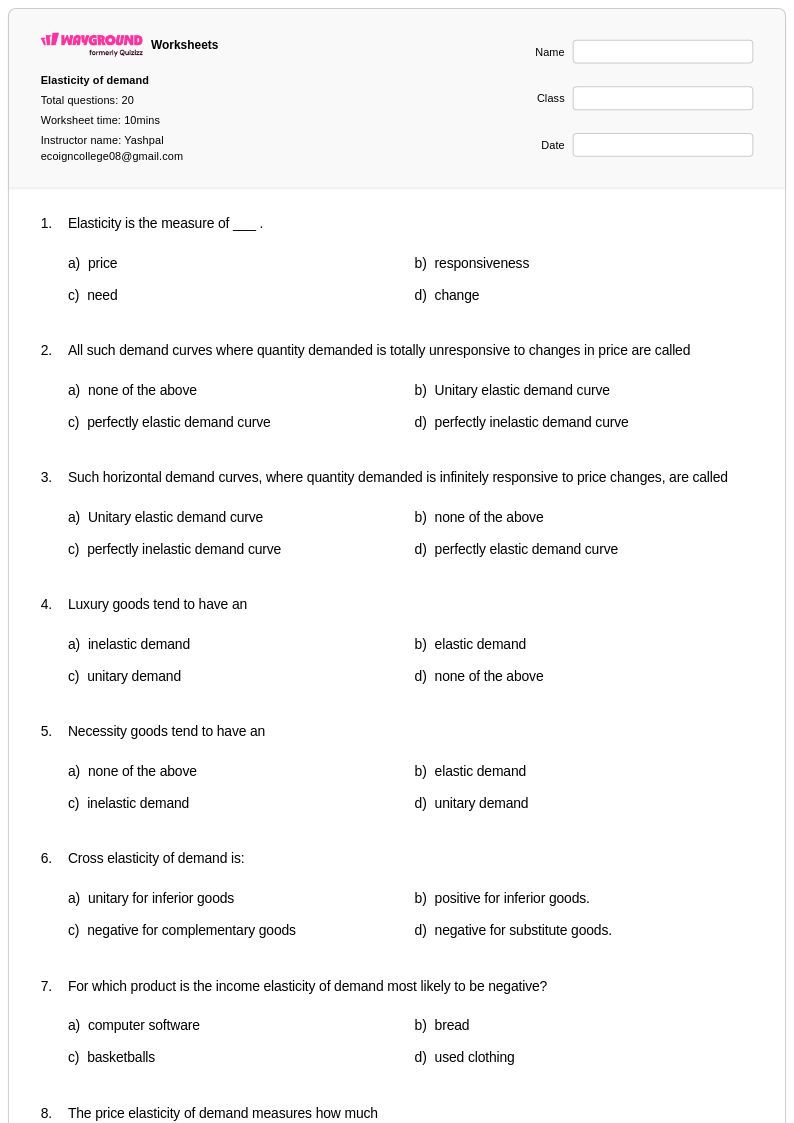
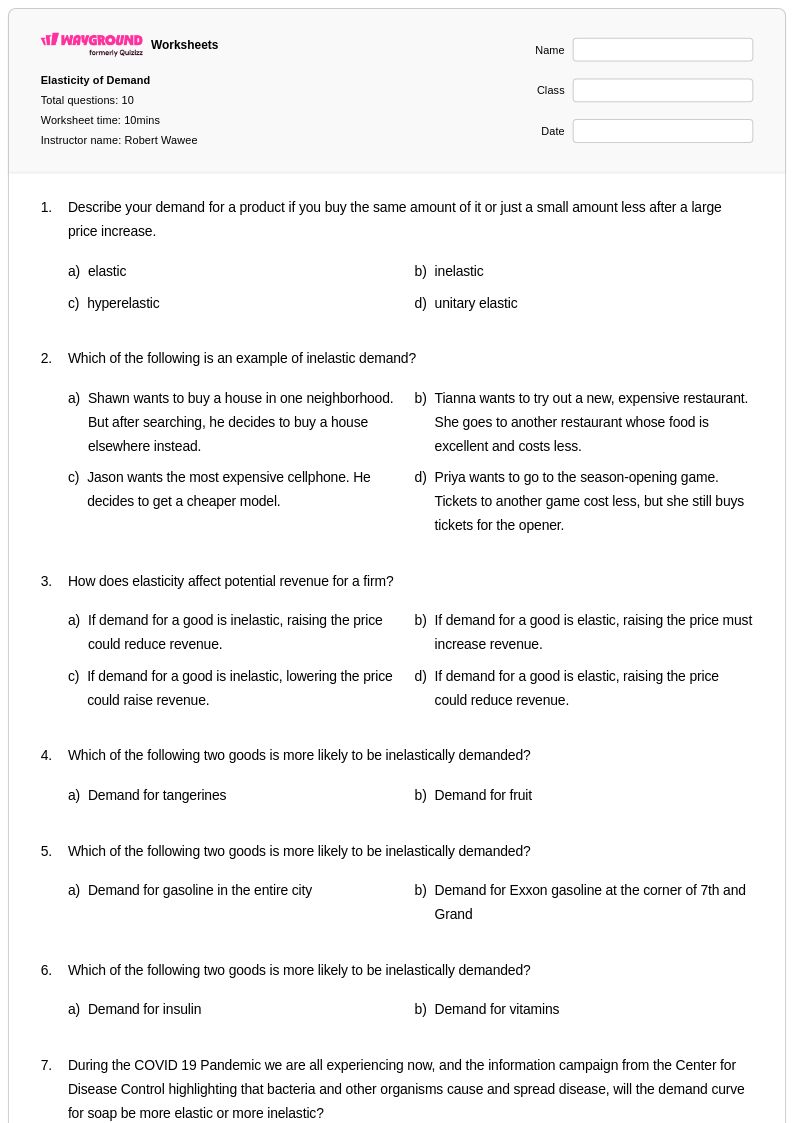
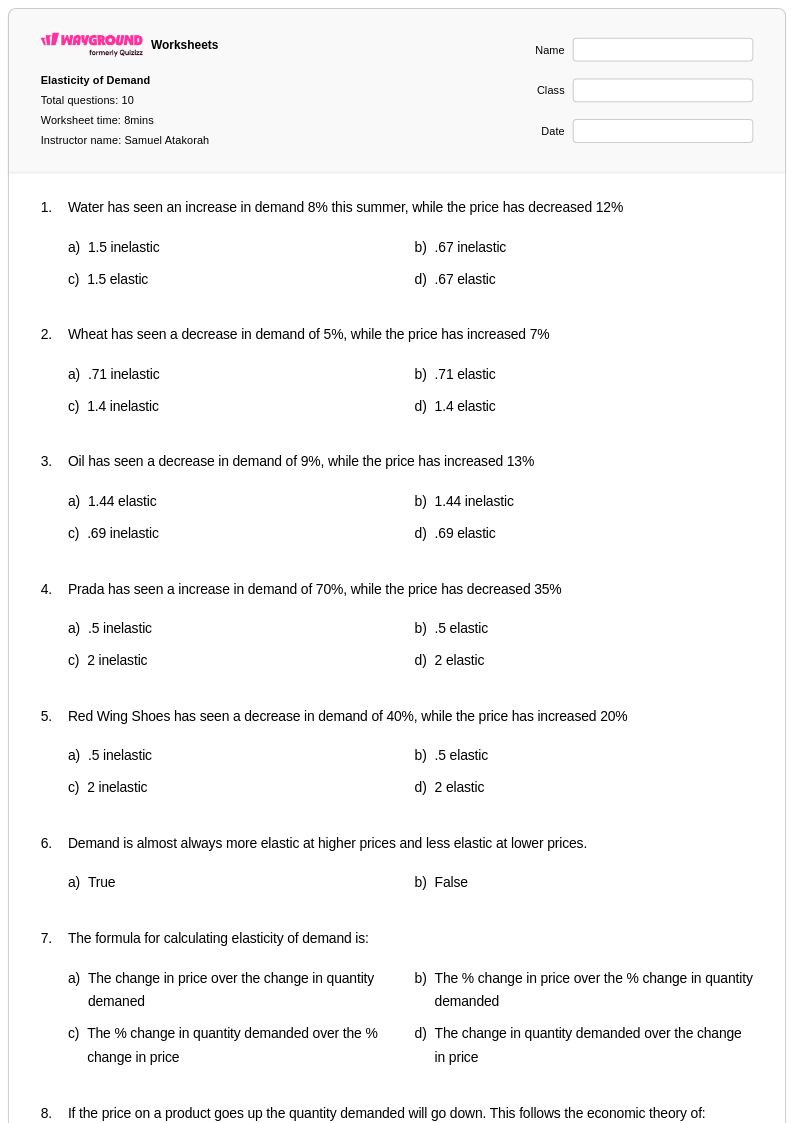
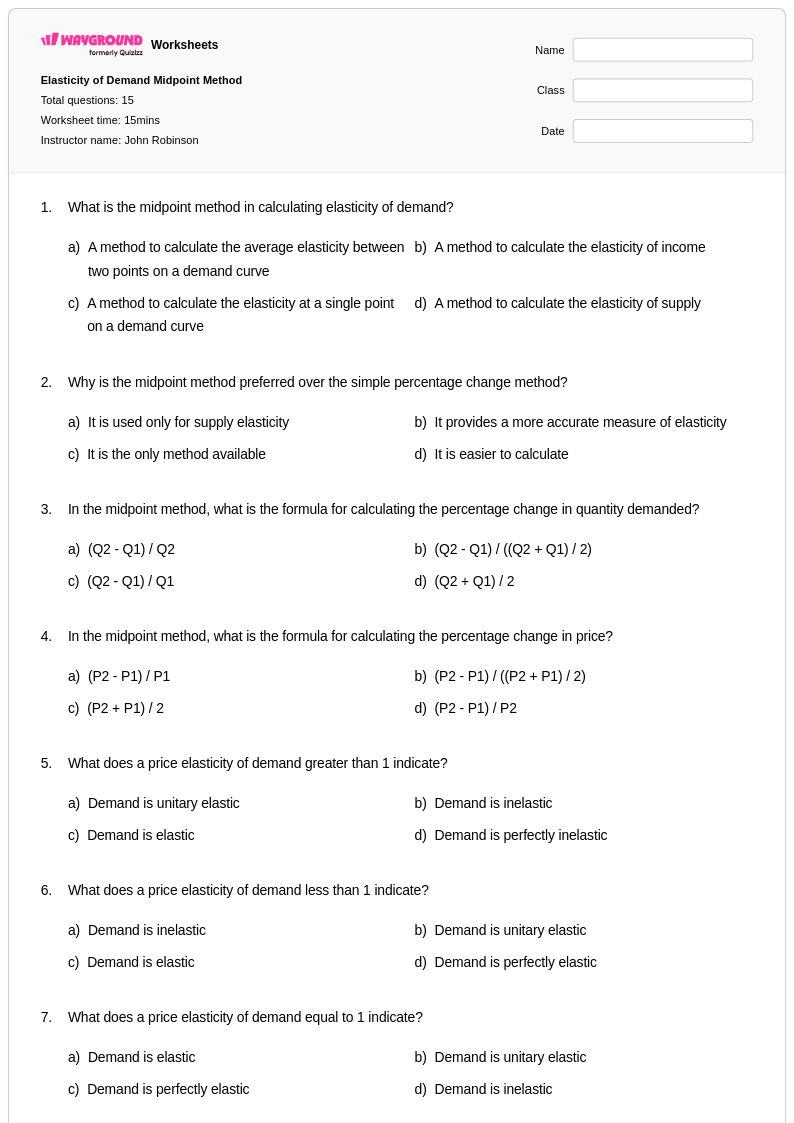
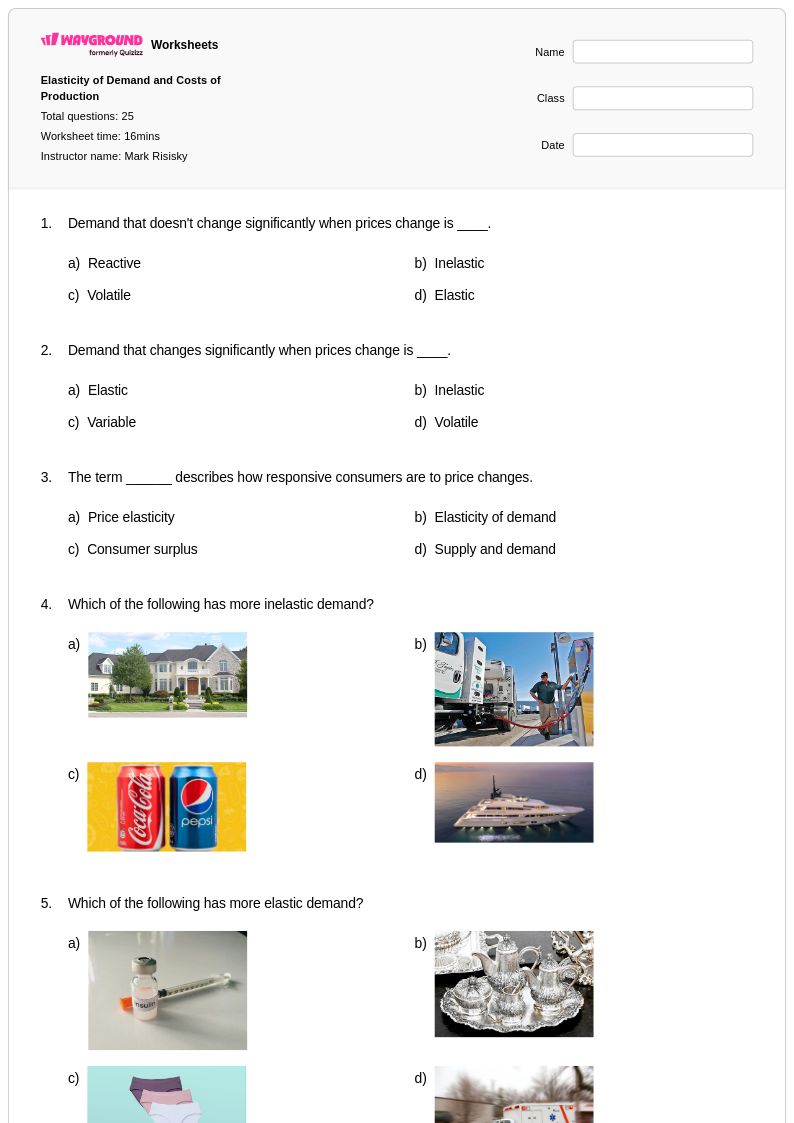
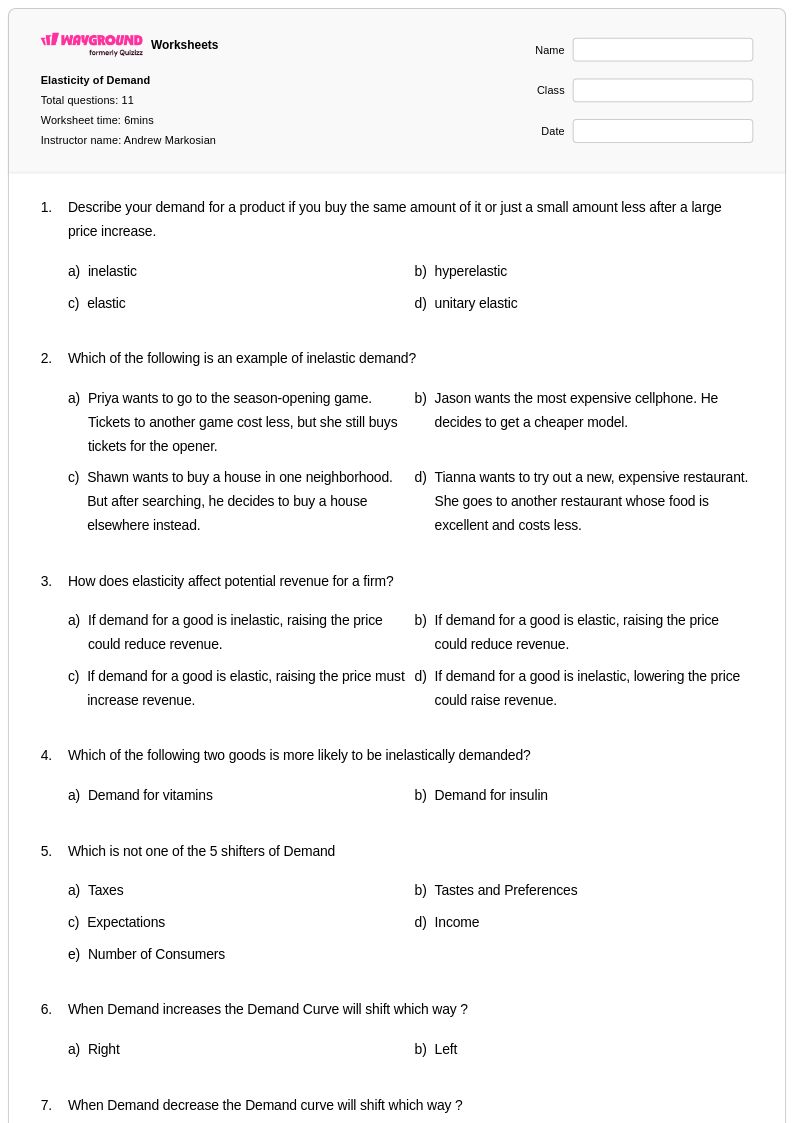
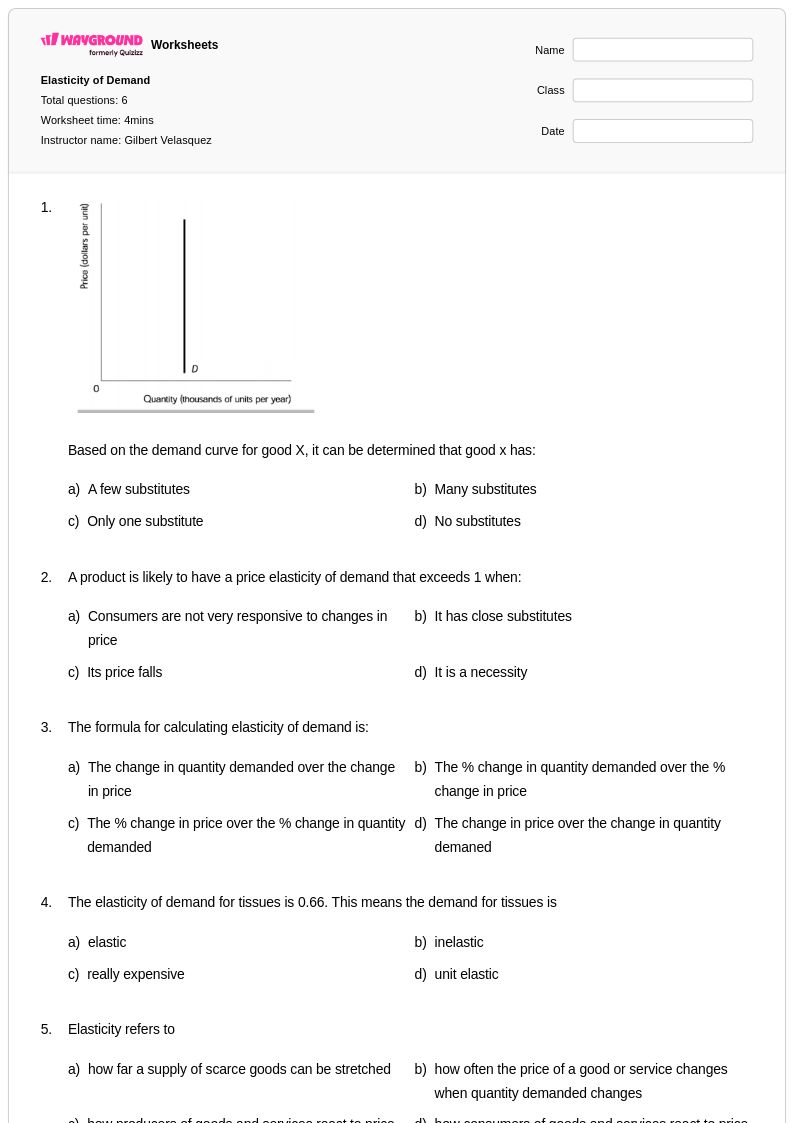
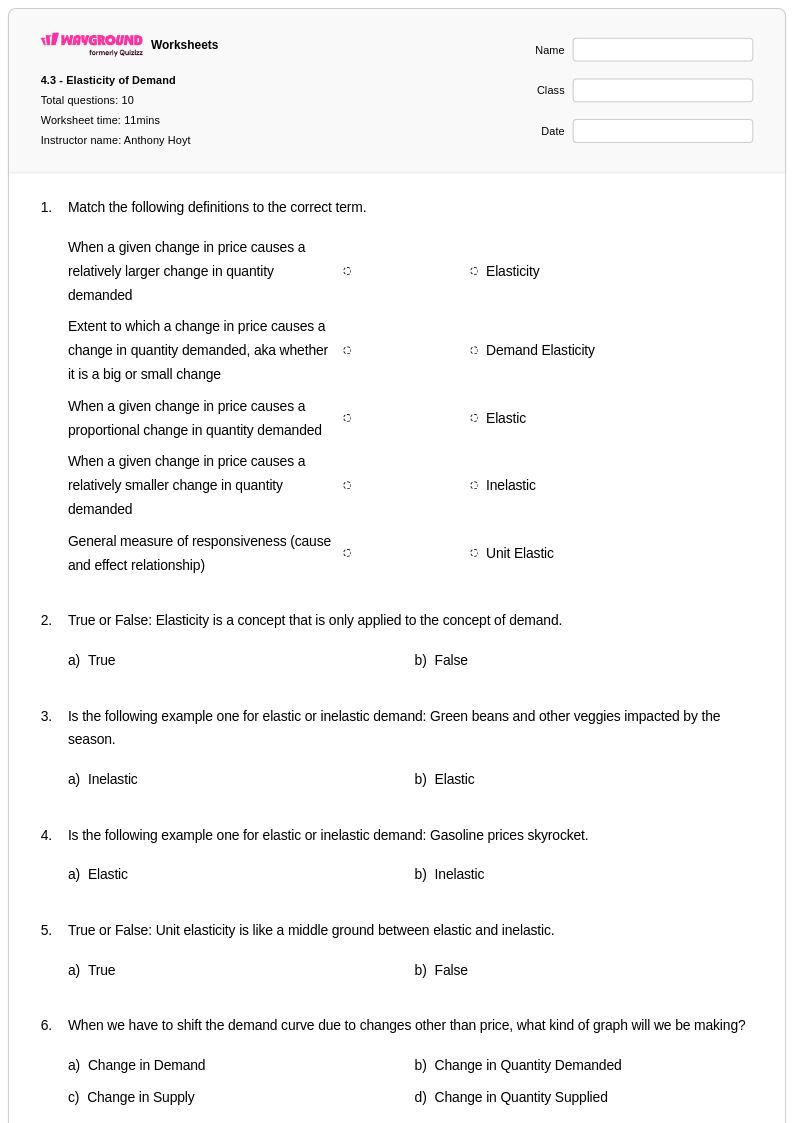
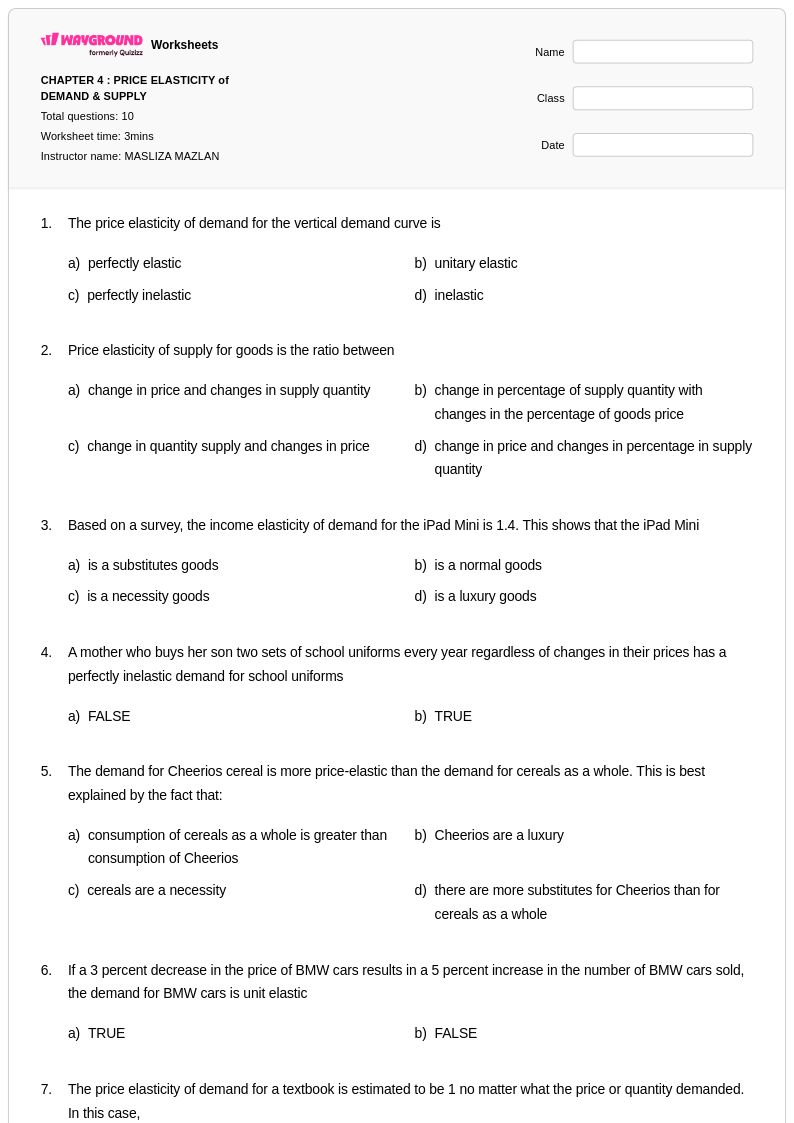
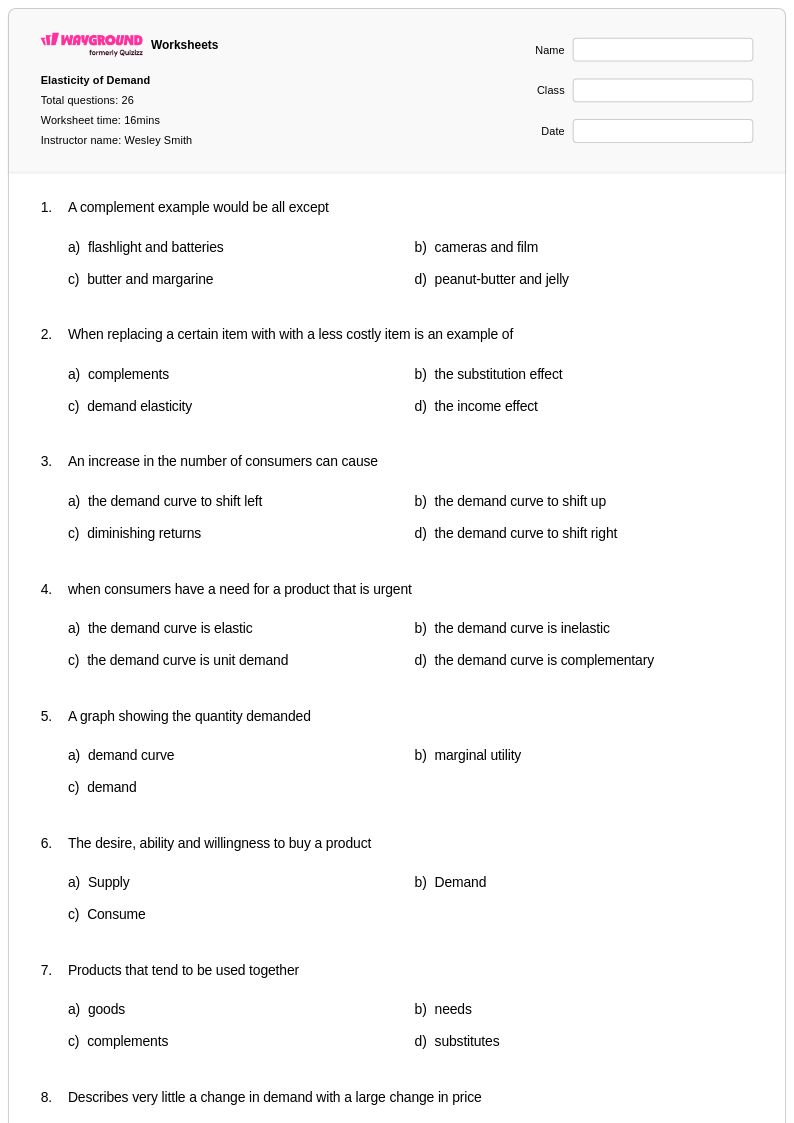
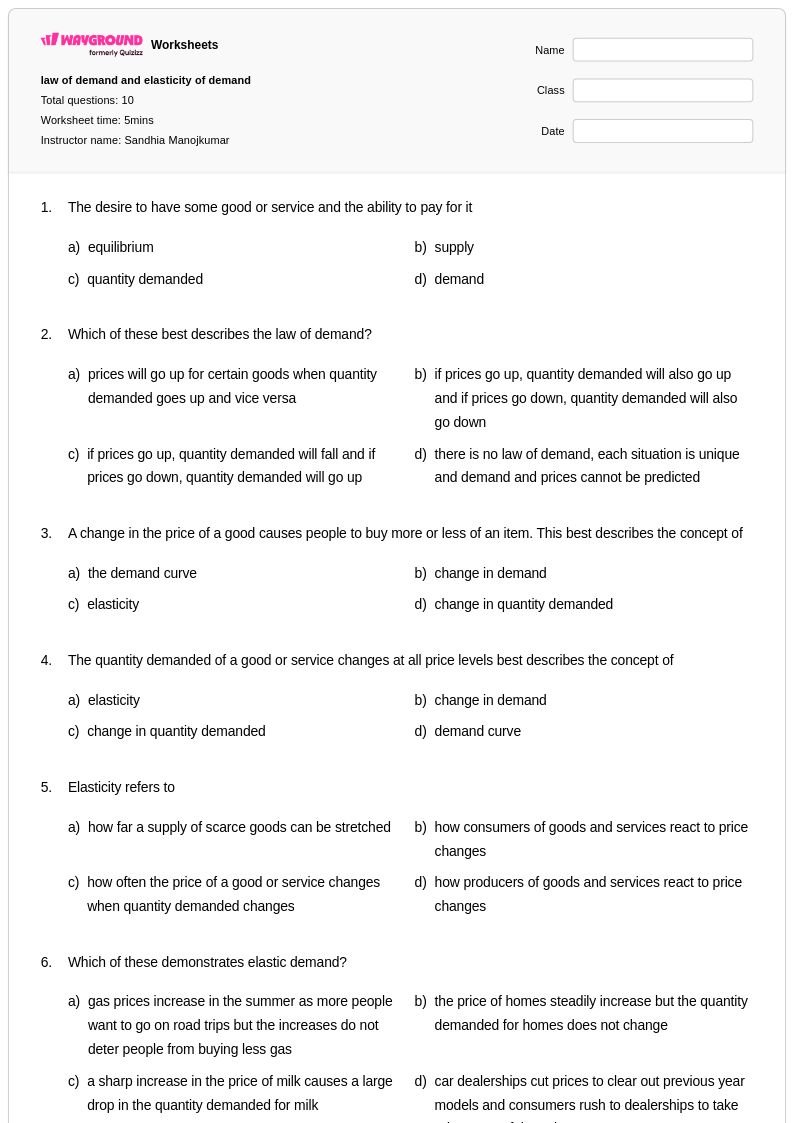
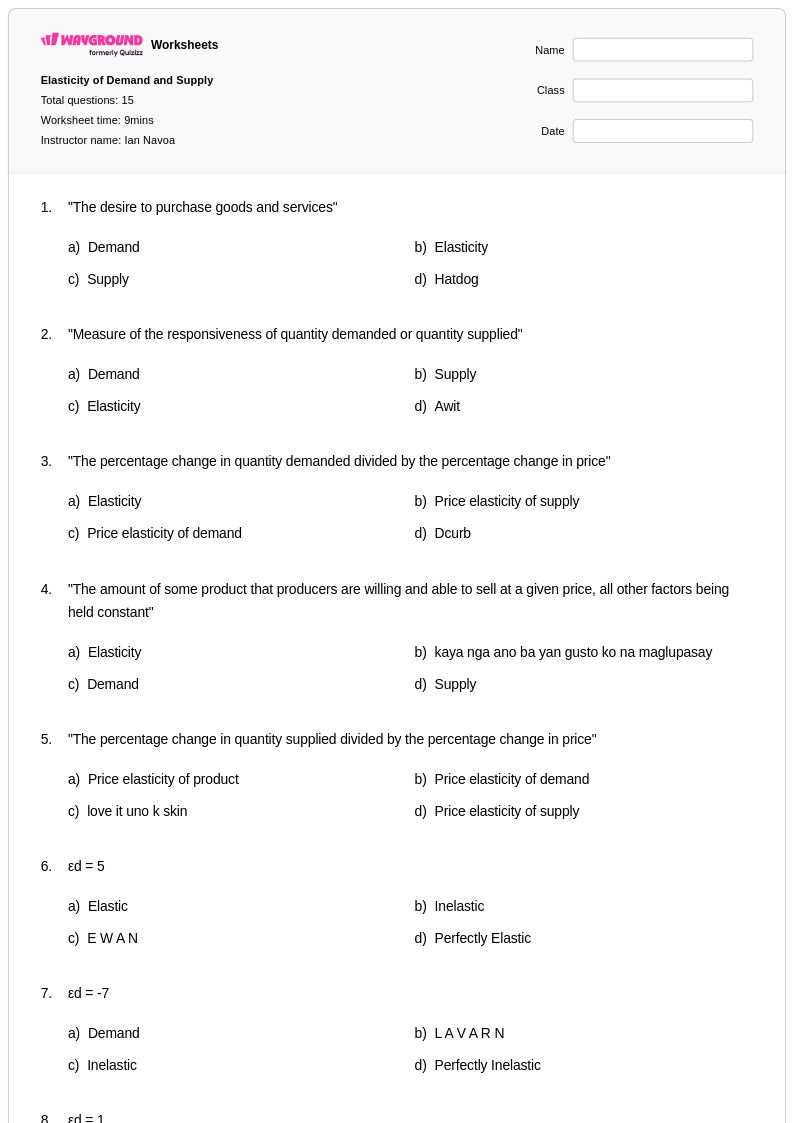
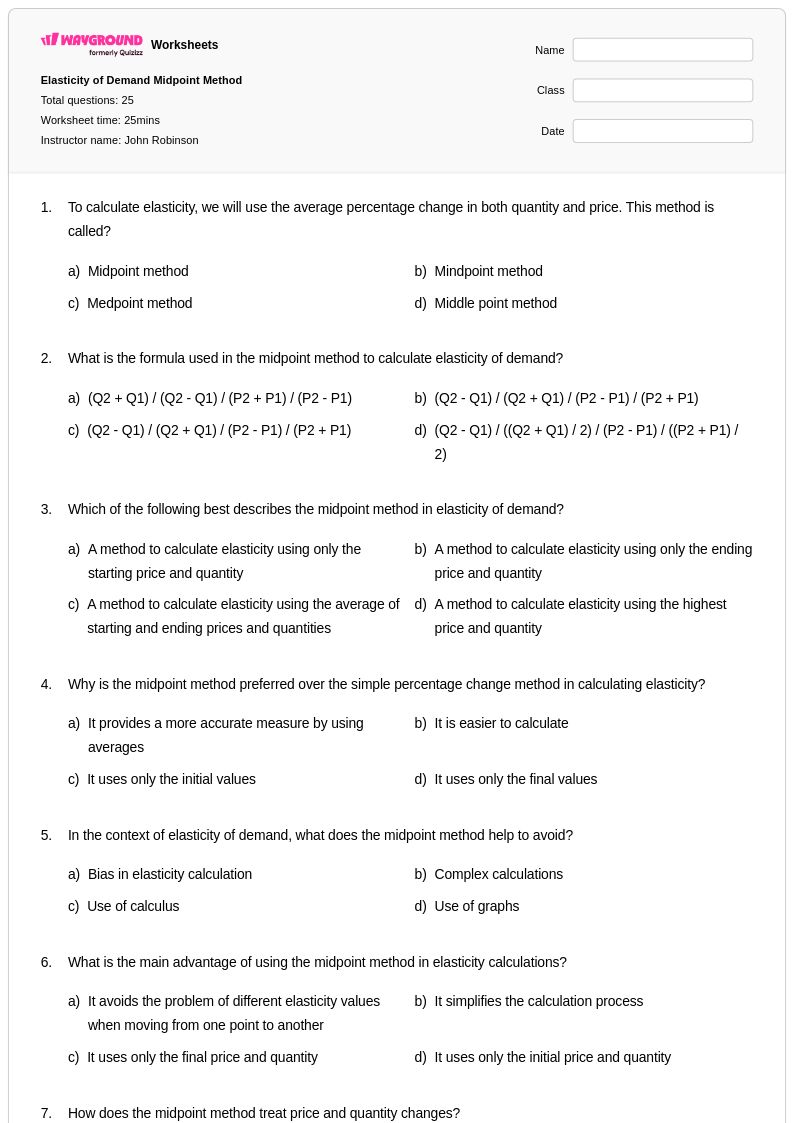
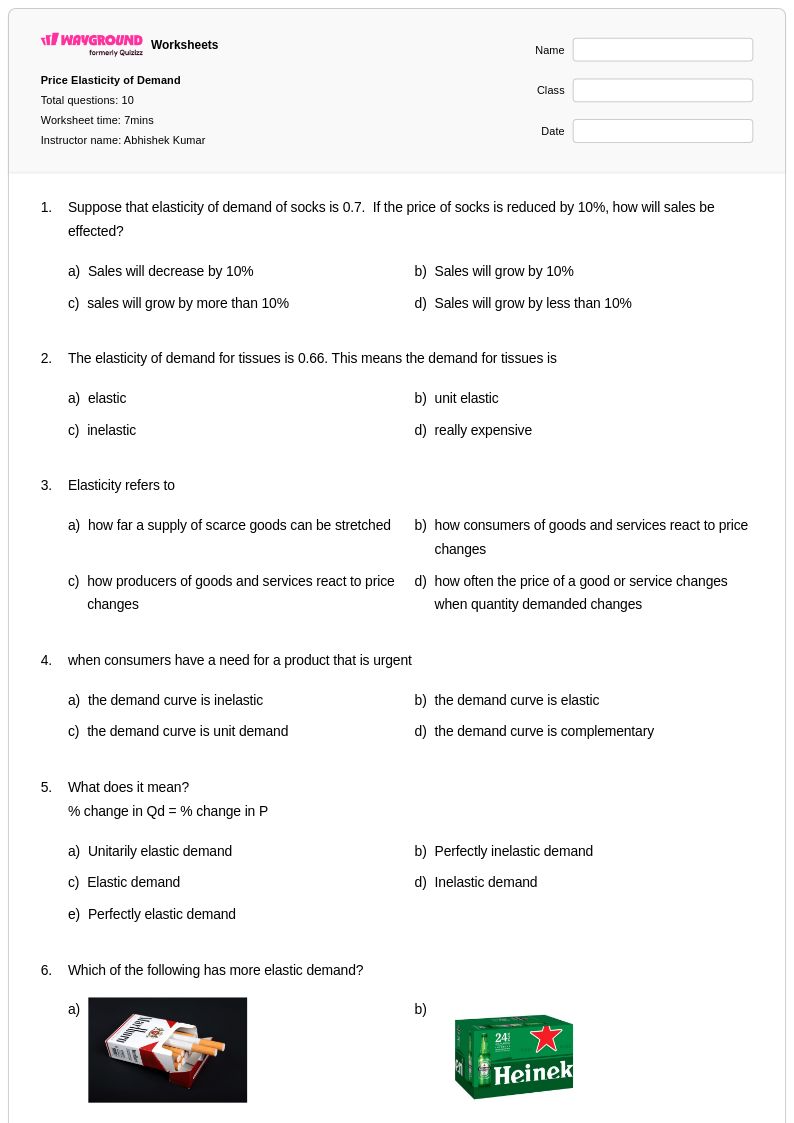
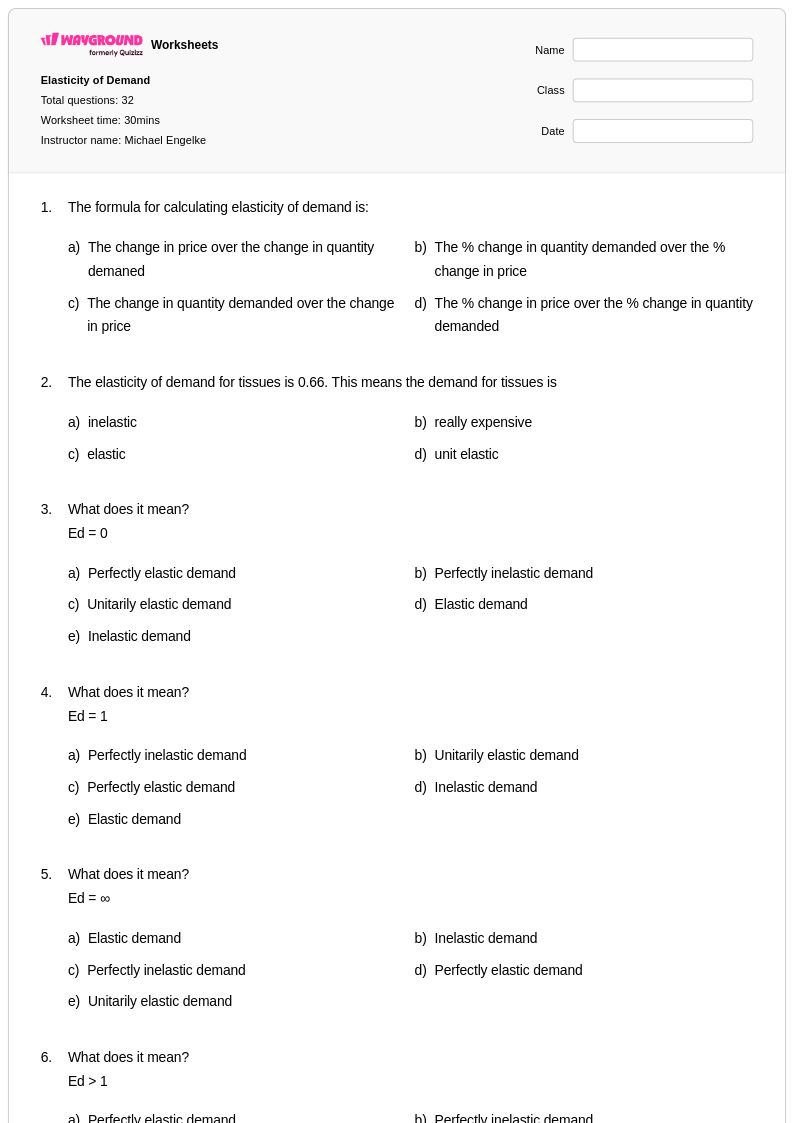
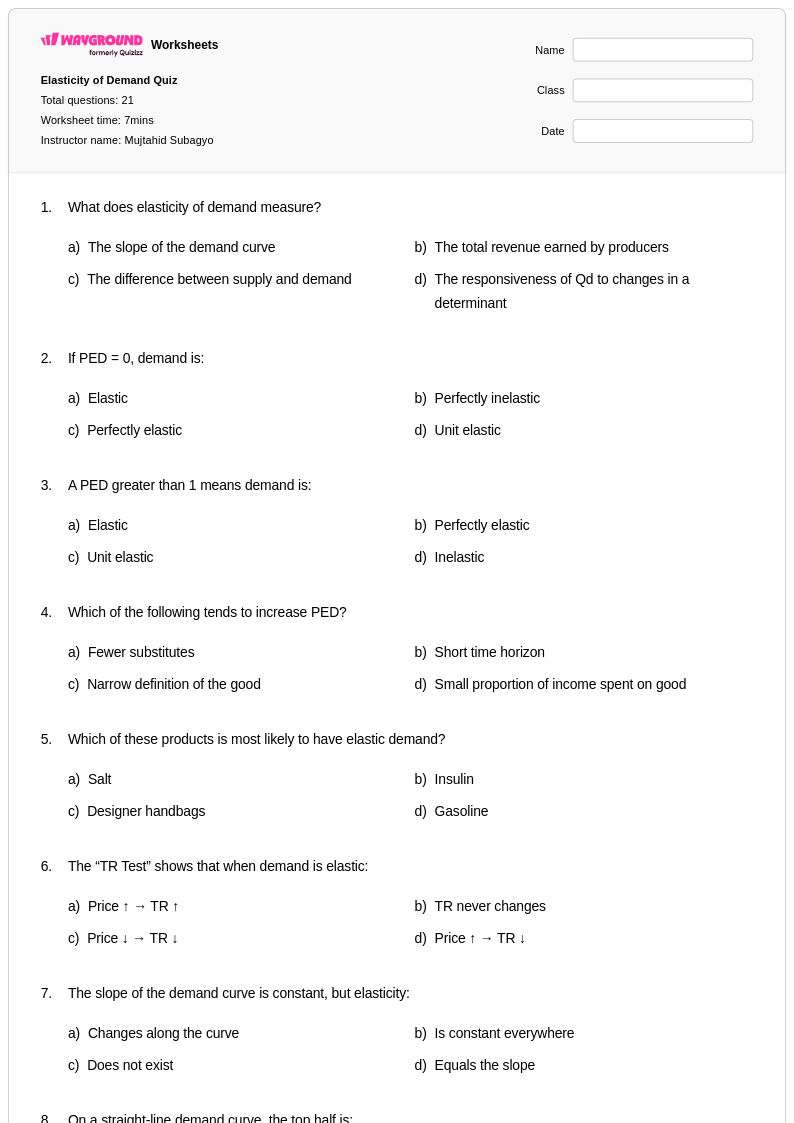
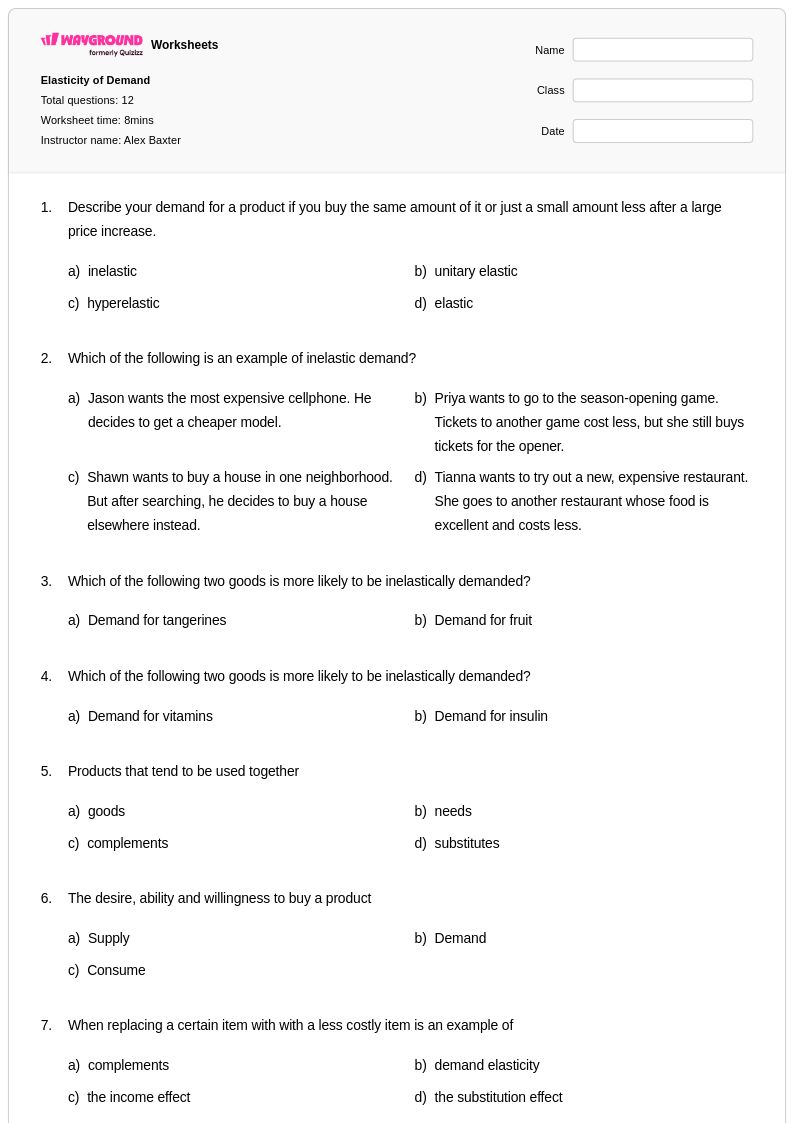
Explore Wayground's free elasticity of demand worksheets and printables that help students master price sensitivity concepts through engaging practice problems and comprehensive answer keys.
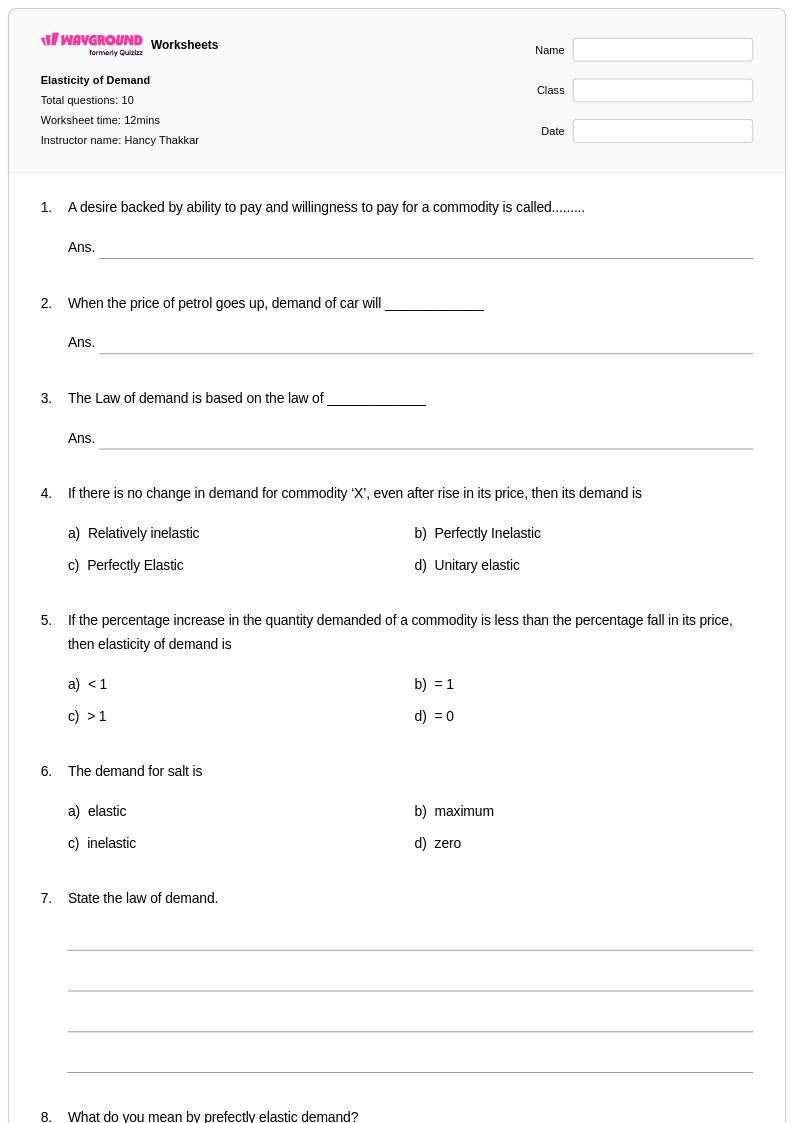
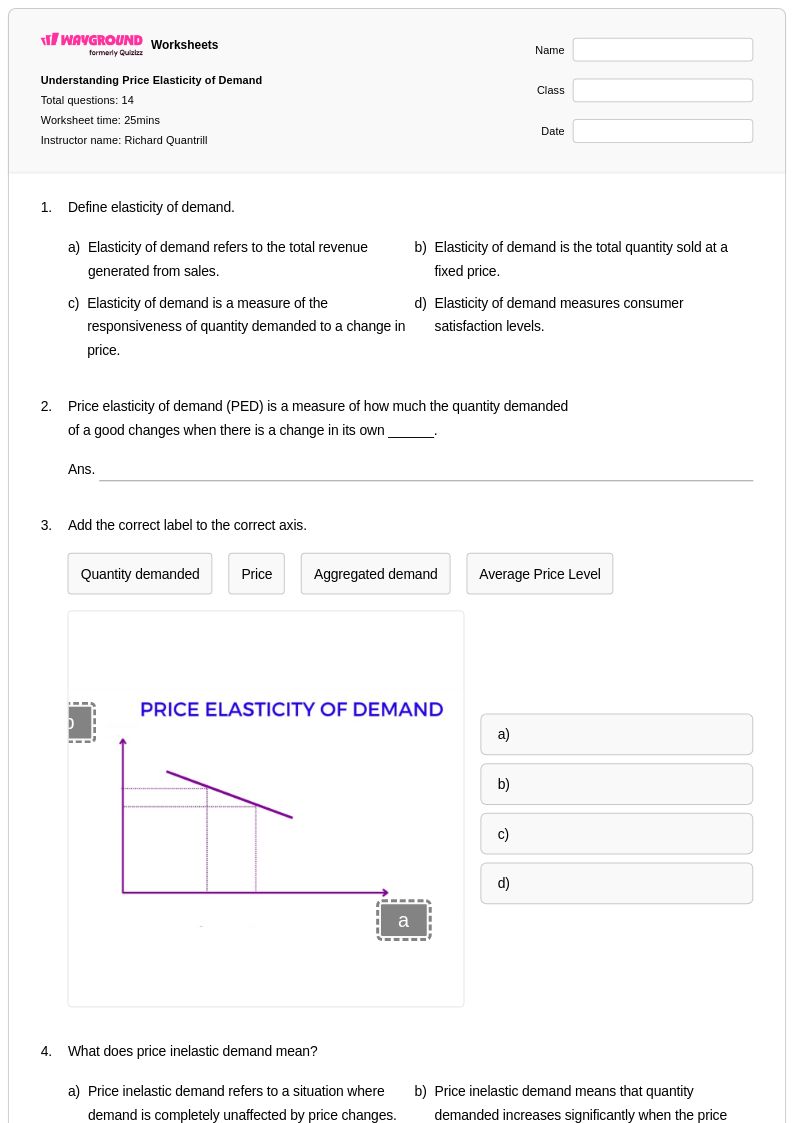
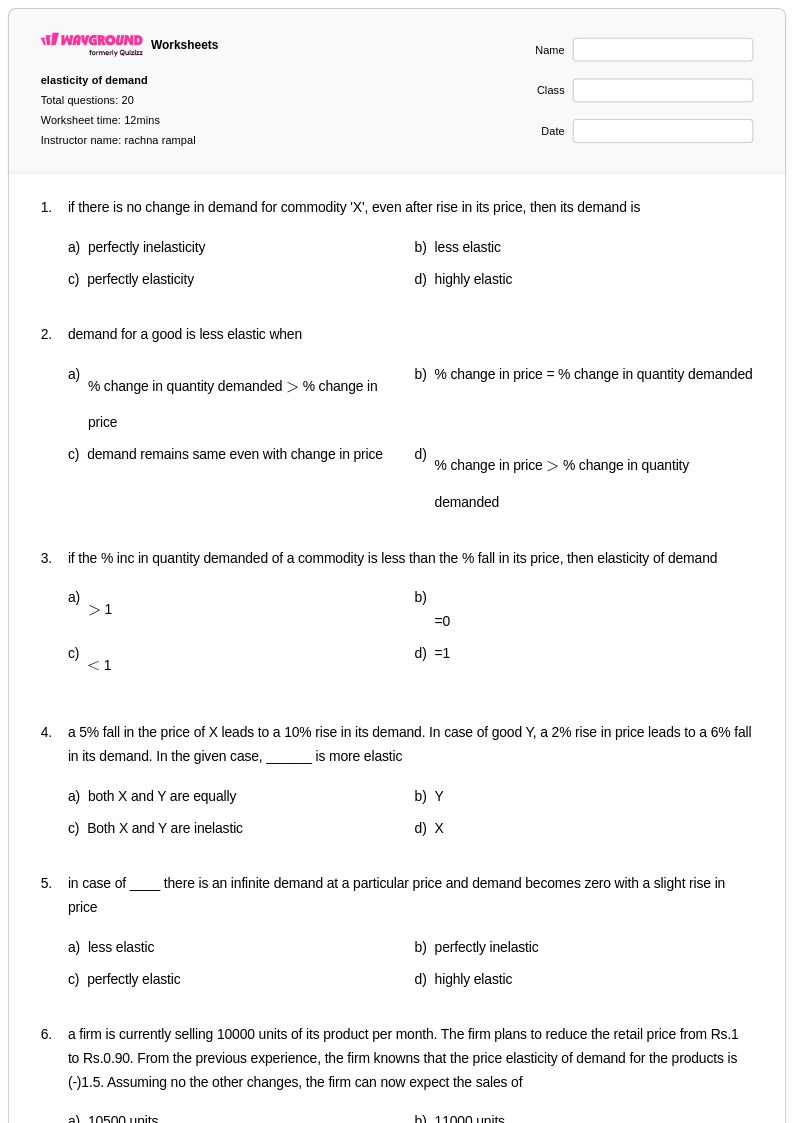
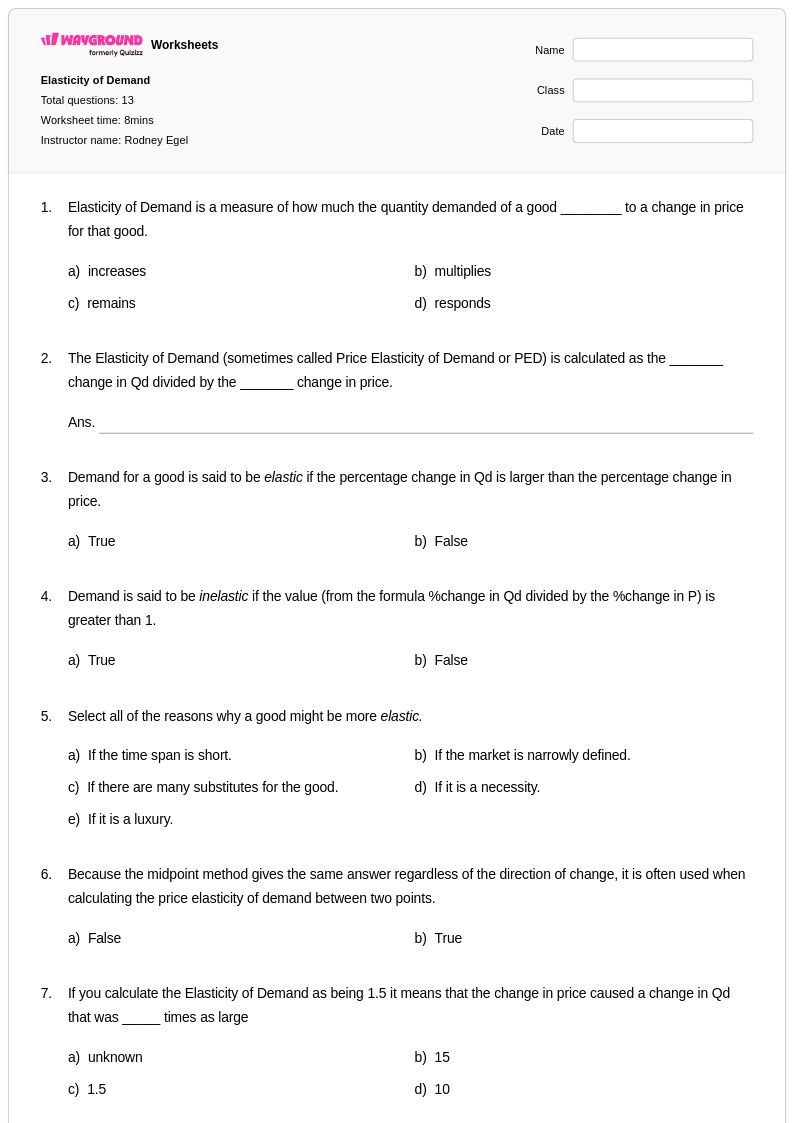
Elasticity of demand worksheets available through Wayground (formerly Quizizz) provide comprehensive resources for students to master this fundamental economic concept that measures how responsive consumer demand is to changes in price, income, or other factors. These expertly crafted worksheets guide students through essential skills including calculating price elasticity coefficients, interpreting demand curves, analyzing consumer behavior patterns, and distinguishing between elastic and inelastic goods. Each worksheet collection includes detailed answer keys to support independent learning and assessment, while the free printable materials offer practice problems ranging from basic elasticity calculations to complex real-world scenarios involving luxury goods, necessities, and substitute products. Students develop critical analytical abilities as they work through exercises that connect mathematical concepts with practical economic decision-making, building fluency in interpreting elasticity values and their implications for business pricing strategies and market dynamics.
Wayground (formerly Quizizz) empowers teachers with millions of teacher-created elasticity of demand resources that streamline lesson planning and enhance student understanding through robust search and filtering capabilities. The platform's standards-aligned worksheet collections support differentiated instruction by offering materials at various complexity levels, from introductory elasticity concepts to advanced applications in market analysis and consumer theory. Teachers can easily customize worksheets to match their specific curriculum needs while accessing both printable pdf formats for traditional classroom use and digital versions for interactive learning environments. These versatile tools prove invaluable for targeted remediation with struggling students, enrichment opportunities for advanced learners, and systematic skill practice that reinforces economic reasoning abilities, enabling educators to address diverse learning needs while maintaining rigorous academic standards in economics education.
FAQs
How do I teach elasticity of demand in a way students actually understand?
Start with concrete, familiar examples before introducing formulas. Ask students whether they would still buy gas if prices doubled, or whether they would stop buying name-brand sneakers. This grounds the abstract concept of price sensitivity in real consumer decisions. Once students have the intuition, introduce the price elasticity of demand coefficient and work through calculations together using those same examples.
What exercises help students practice calculating price elasticity of demand?
Students benefit most from practice problems that require them to calculate the price elasticity coefficient using the percentage change formula, then interpret what the resulting value means. Effective exercises pair a calculation with a follow-up question — for example, asking whether the good is elastic or inelastic and what that implies for a firm's pricing strategy. Problems should span a range of goods, including necessities, luxury items, and products with close substitutes, to help students recognize patterns across contexts.
What mistakes do students commonly make when working with elasticity of demand?
The most common error is confusing the slope of a demand curve with its elasticity — students often assume a steeper curve always means more inelastic demand, which is not accurate. A second frequent mistake is misapplying the percentage change formula by using absolute values incorrectly or dividing in the wrong order. Students also struggle to distinguish between elastic and inelastic interpretations of values near 1, so explicit practice with borderline cases is valuable.
How do I help students distinguish between elastic and inelastic demand?
Teach students to anchor their thinking on two questions: how many substitutes does this good have, and is it a necessity or a luxury? Goods with many substitutes or luxury status tend to be elastic, meaning consumers are highly responsive to price changes. Necessities and goods with few substitutes tend to be inelastic. Once students internalize these determinants, classifying goods becomes more intuitive and less dependent on memorizing definitions.
How can I use Wayground's elasticity of demand worksheets in my classroom?
Wayground's elasticity of demand worksheets are available as printable PDFs for traditional classroom use and in digital formats for technology-integrated learning environments, including the option to host them as a quiz directly on Wayground. This flexibility lets teachers assign them as in-class practice, homework, or formative assessments without additional preparation. Each worksheet includes a complete answer key, supporting both independent student work and teacher-led review.
How do I support students who are struggling with elasticity of demand concepts?
For students who are struggling, reduce the complexity by isolating one skill at a time — start with just identifying whether a good is likely elastic or inelastic before introducing coefficient calculations. Wayground supports individual student accommodations such as read aloud, reduced answer choices, and extended time, which can be configured per student without disrupting the rest of the class. Pairing these accessibility settings with targeted practice problems at lower complexity levels helps struggling learners build confidence before progressing to multi-step elasticity scenarios.