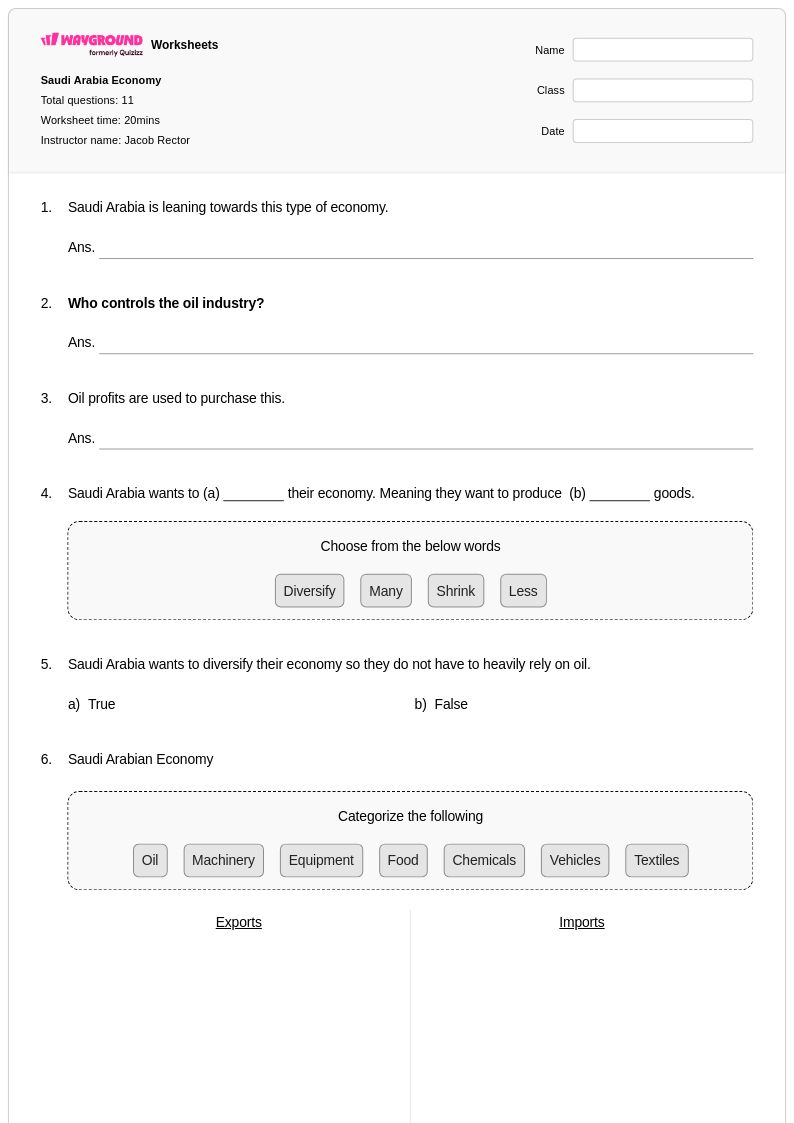
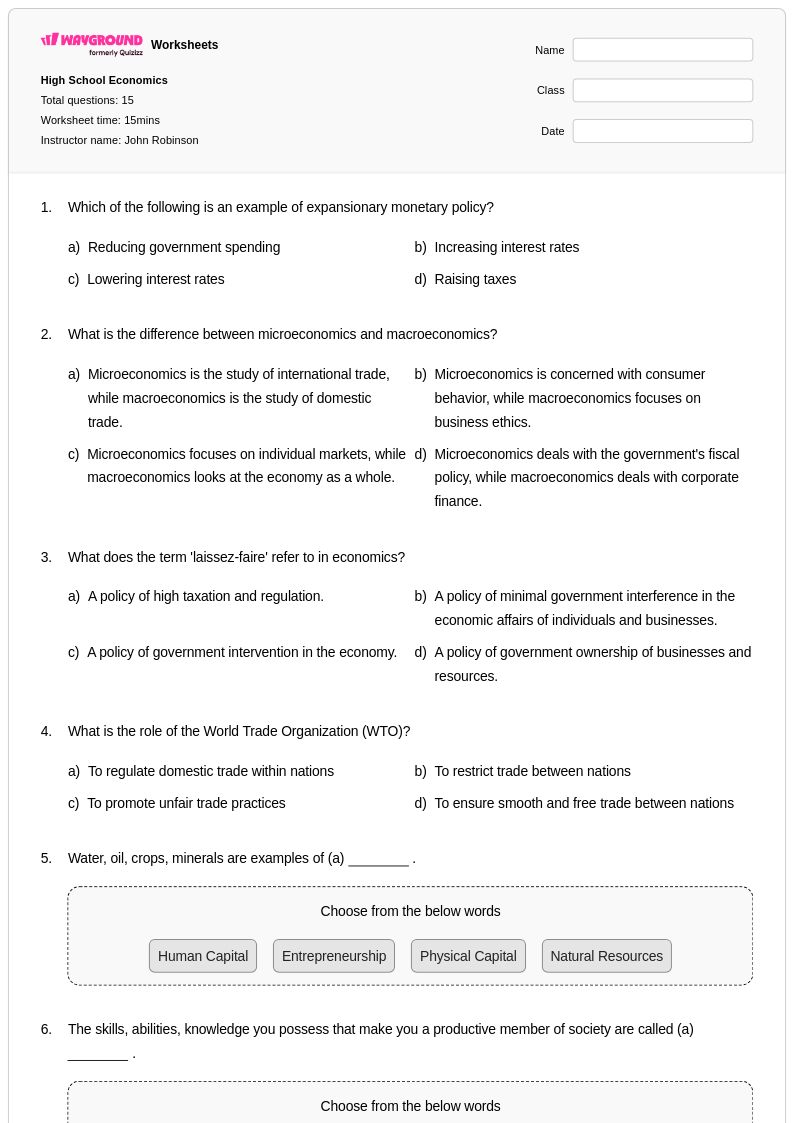
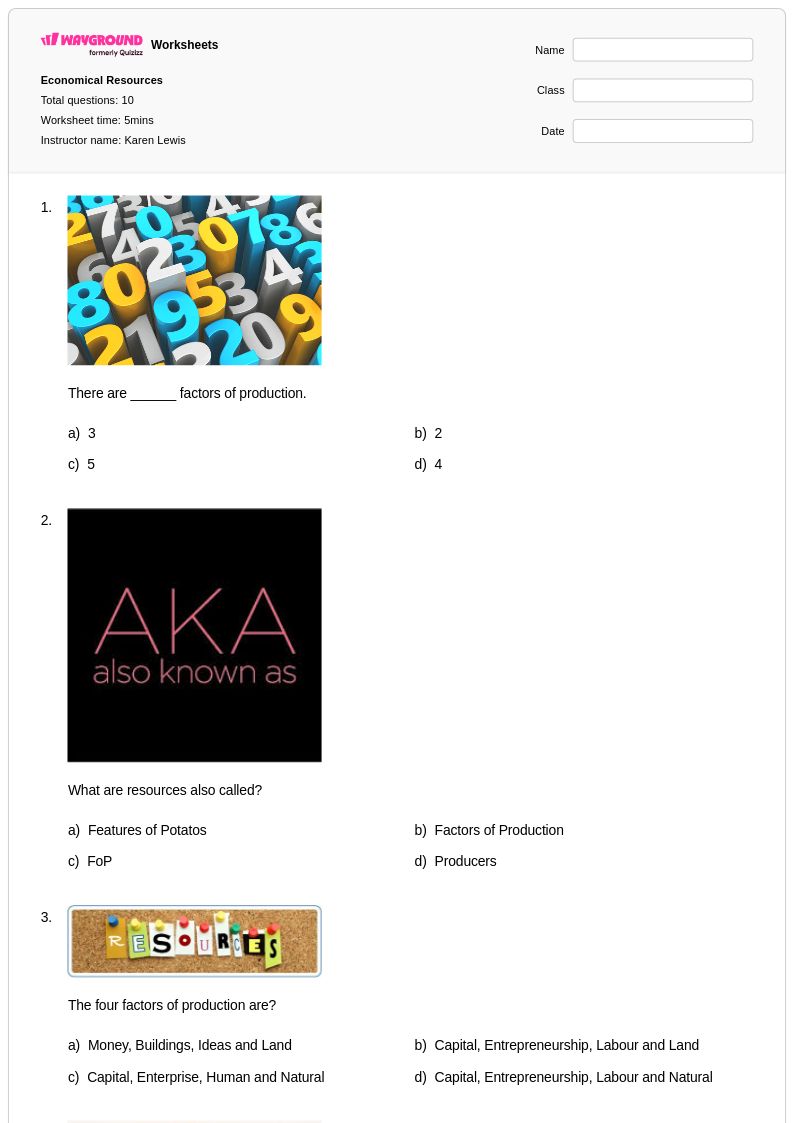
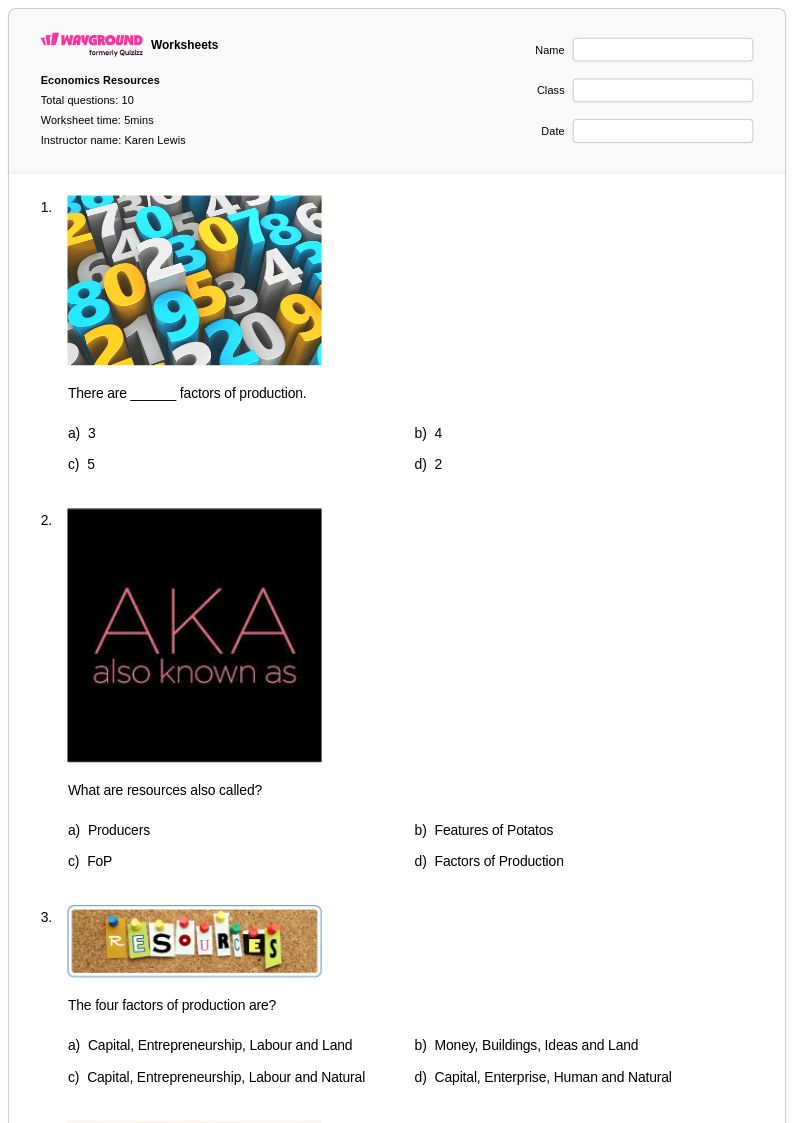
Explore free entrepreneurship worksheets and printables that help students learn business fundamentals, startup strategies, and economic principles through engaging practice problems with comprehensive answer keys.
Entrepreneurship worksheets available through Wayground (formerly Quizizz) provide comprehensive resources for developing students' understanding of business creation, innovation, and economic opportunity. These carefully crafted materials strengthen essential skills including market analysis, business plan development, financial literacy, and risk assessment while introducing fundamental concepts such as supply and demand, profit and loss, and competitive advantage. Students engage with practice problems that simulate real-world business scenarios, from identifying target markets to calculating startup costs and projecting revenue streams. Each worksheet collection includes detailed answer keys to support independent learning and self-assessment, with free printable pdf formats ensuring accessibility for diverse classroom environments and homework assignments.
Wayground (formerly Quizizz) empowers educators with millions of teacher-created entrepreneurship resources that streamline lesson planning and enhance student engagement across all grade levels. The platform's robust search and filtering capabilities allow teachers to quickly locate worksheets aligned with specific learning standards and curriculum objectives, while built-in differentiation tools enable customization for varying skill levels and learning needs. Resources are available in both printable and digital formats, including downloadable pdfs, providing flexibility for in-person, remote, or hybrid instruction. These comprehensive worksheet collections support targeted skill practice, remediation for struggling learners, and enrichment opportunities for advanced students, helping teachers create dynamic learning experiences that prepare students for the complexities of modern entrepreneurial thinking and economic decision-making.
FAQs
How do I teach entrepreneurship concepts to students?
Effective entrepreneurship instruction moves students through a progression from understanding core vocabulary (supply and demand, competitive advantage, profit and loss) to applying those concepts in simulated business scenarios. Start by grounding students in market analysis and then challenge them to build out a basic business plan, including identifying a target market, estimating startup costs, and projecting revenue. Connecting abstract economic principles to real-world decision-making helps students internalize the material more durably than lecture alone.
What exercises help students practice business planning and entrepreneurship skills?
Practice exercises that mirror real-world business decisions are the most effective for building entrepreneurship skills. Worksheet tasks such as identifying target markets, calculating startup costs, projecting revenue streams, and analyzing risk give students structured experience with the full arc of business creation. These scenario-based problems develop financial literacy and critical thinking simultaneously, which is why entrepreneurship worksheets that simulate actual startup decisions add more instructional value than rote definition exercises.
What mistakes do students commonly make when learning about entrepreneurship and business fundamentals?
A common misconception is that entrepreneurship is primarily about having a great idea, when in practice the ability to analyze a market, manage costs, and assess risk is what determines viability. Students often conflate revenue with profit, underestimate startup costs, or ignore the role of competitive advantage when evaluating a business concept. Targeted practice with profit-and-loss calculations and market analysis problems helps correct these errors before they become entrenched.
How can I differentiate entrepreneurship worksheets for students at different skill levels?
Differentiation in entrepreneurship instruction typically means scaffolding the complexity of business scenarios rather than changing the core concepts. Advanced students can work through multi-step revenue and cost projections, while struggling learners may benefit from reduced answer choices or focused practice on a single skill such as identifying a target market. On Wayground, teachers can apply accommodations such as reduced answer choices, extended time, and read-aloud support to individual students, allowing the same worksheet to serve the full range of learners in a class without singling anyone out.
How do I use entrepreneurship worksheets from Wayground in my classroom?
Wayground's entrepreneurship worksheets are available as printable PDFs for traditional classroom and homework use, as well as in digital formats for technology-integrated or hybrid learning environments. Teachers can also host worksheets as a live quiz on Wayground, making them suitable for both independent practice and whole-class instruction. Each worksheet includes a comprehensive answer key, supporting self-assessment and independent learning without additional teacher preparation.
How do I align entrepreneurship worksheets to specific curriculum standards?
Aligning entrepreneurship resources to standards is most efficient when you can filter by concept area rather than browsing broadly. Wayground's search and filtering tools allow teachers to locate worksheets aligned with specific learning standards and curriculum objectives, covering areas such as financial literacy, market analysis, business plan development, and economic principles. This makes it straightforward to slot targeted practice materials directly into an existing unit without building resources from scratch.