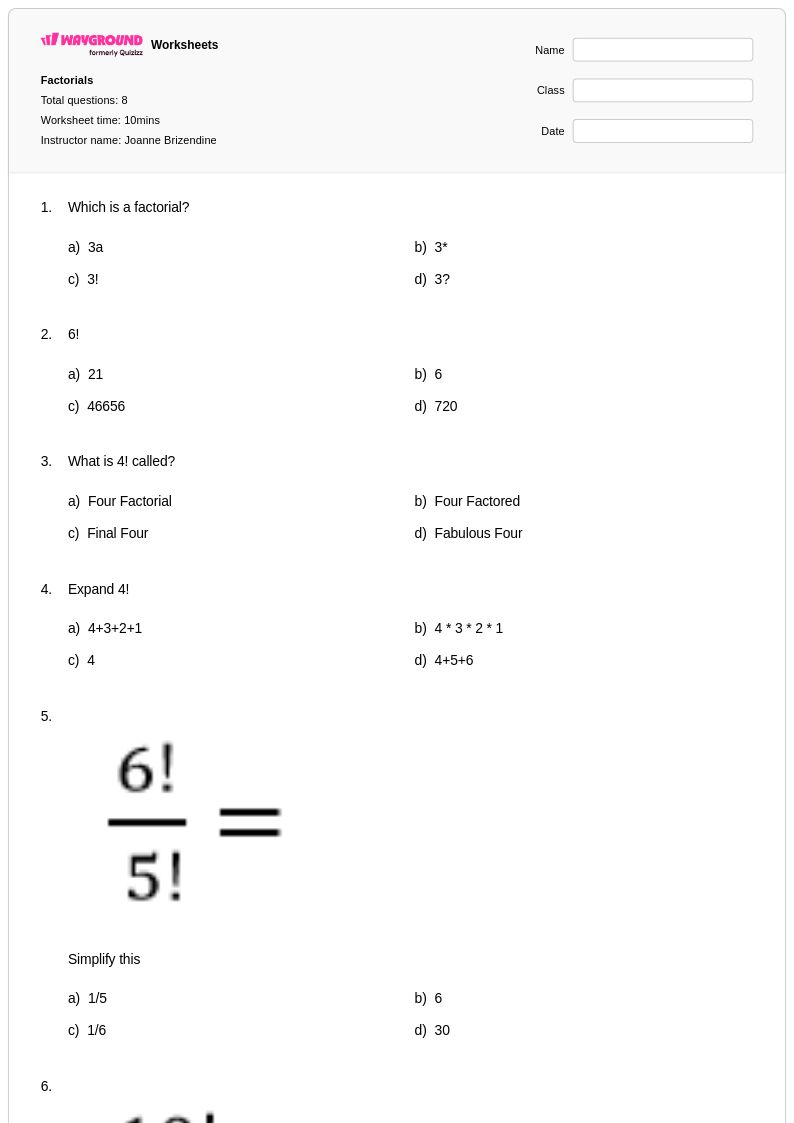
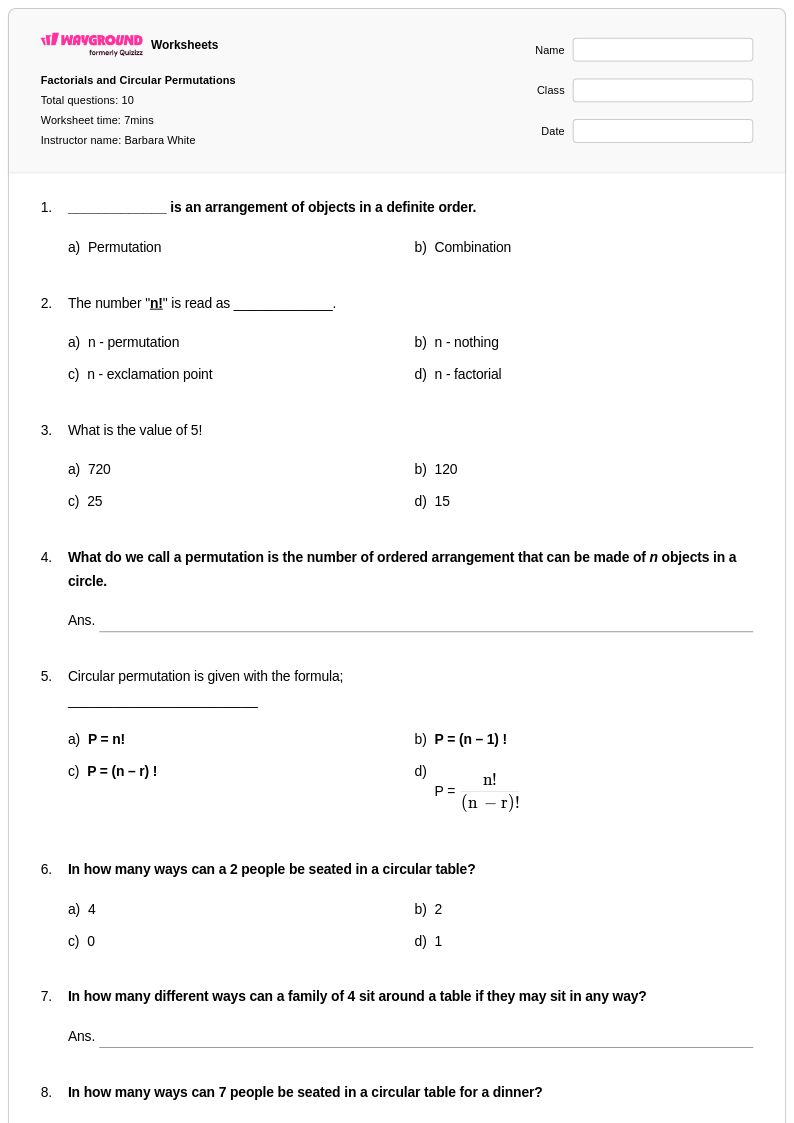
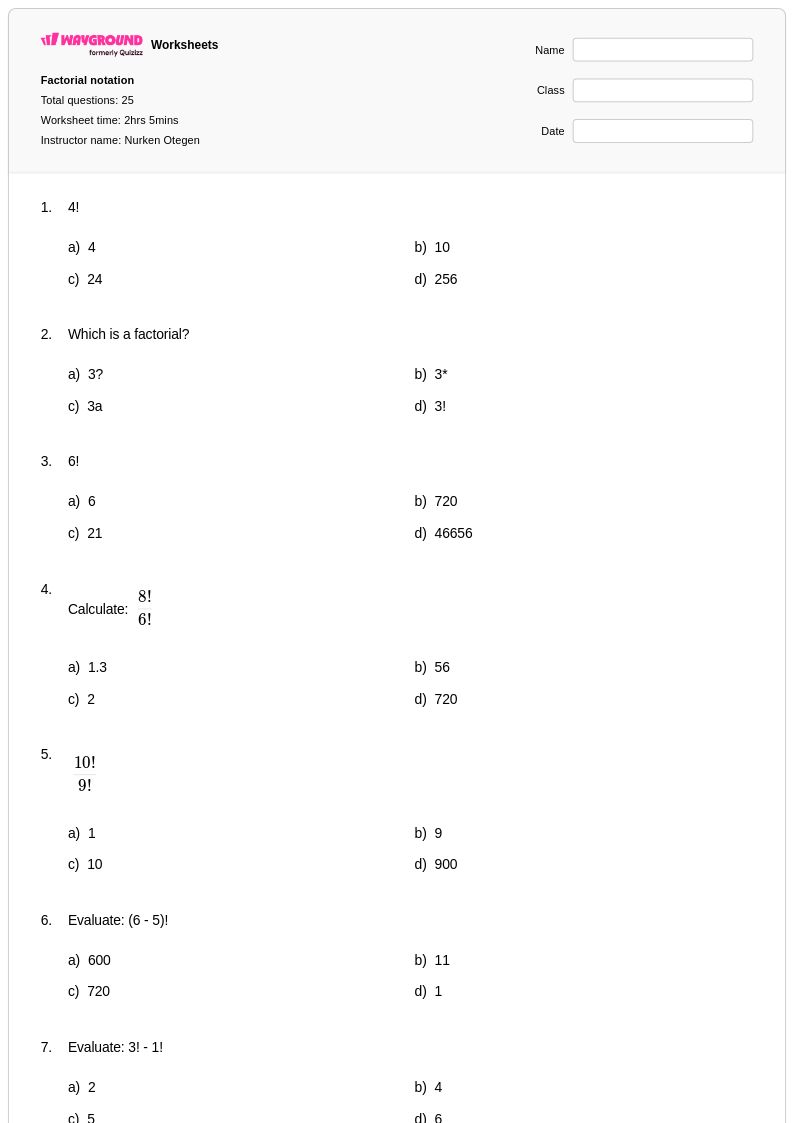
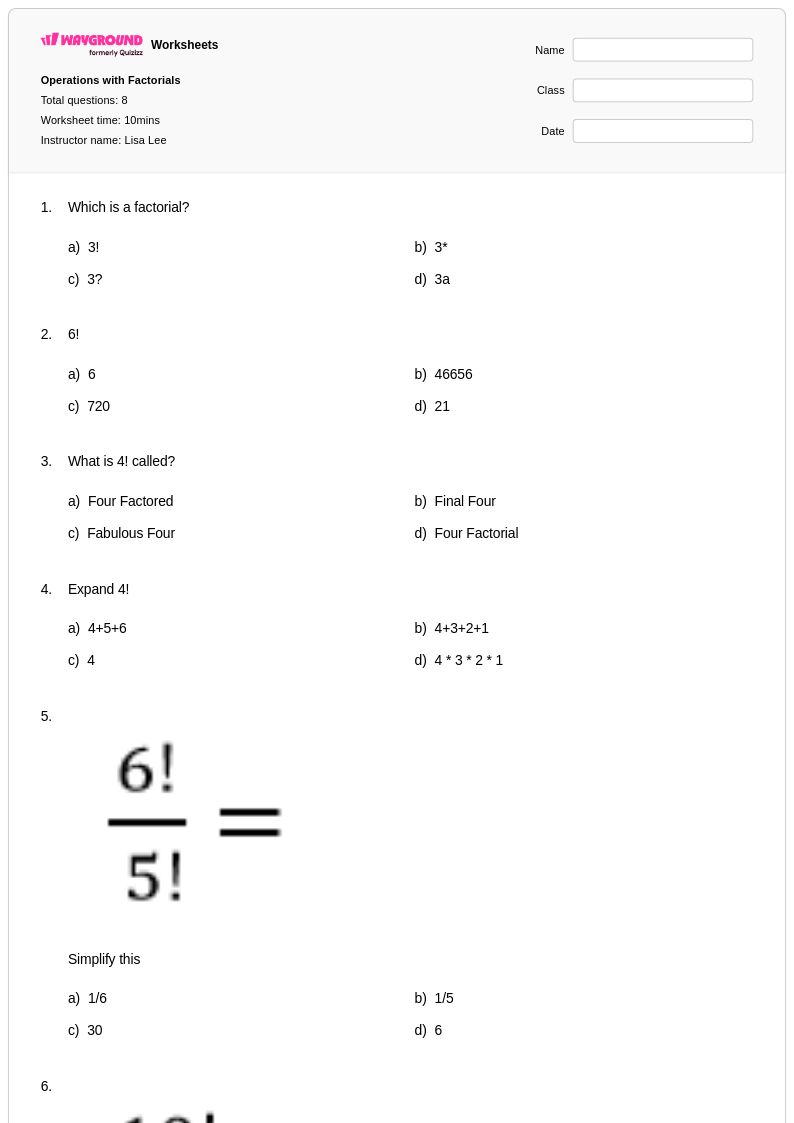
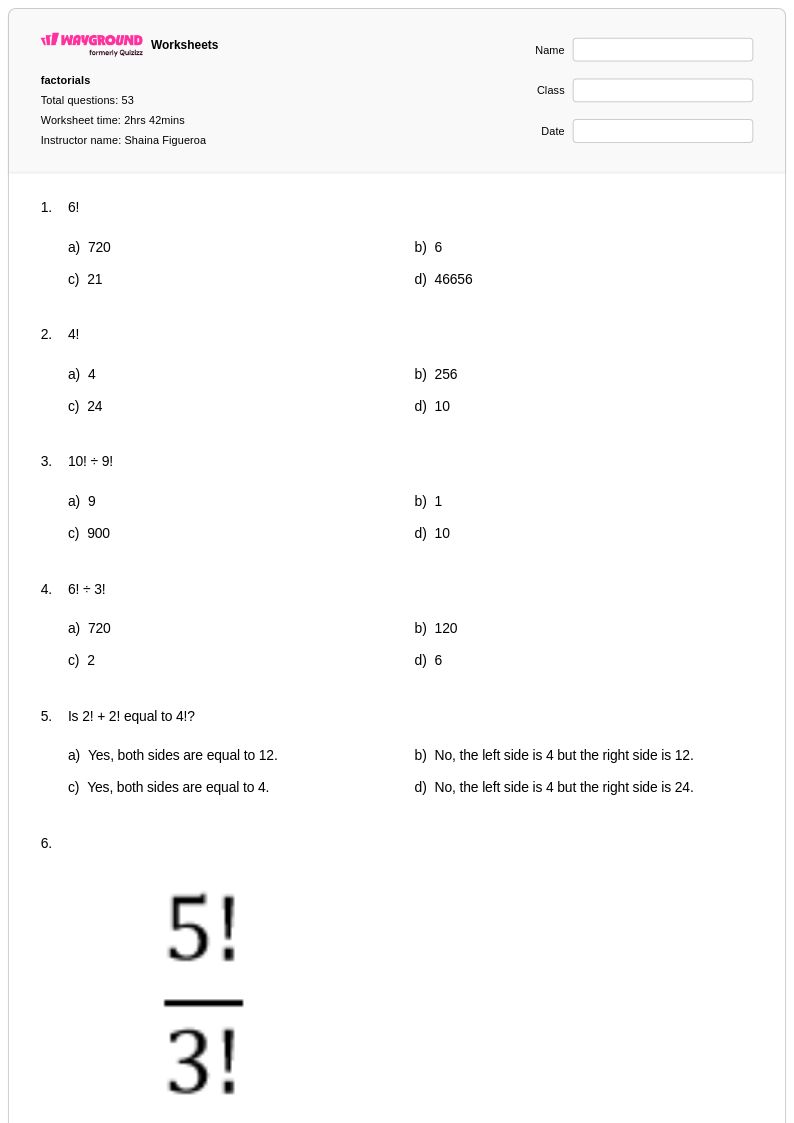
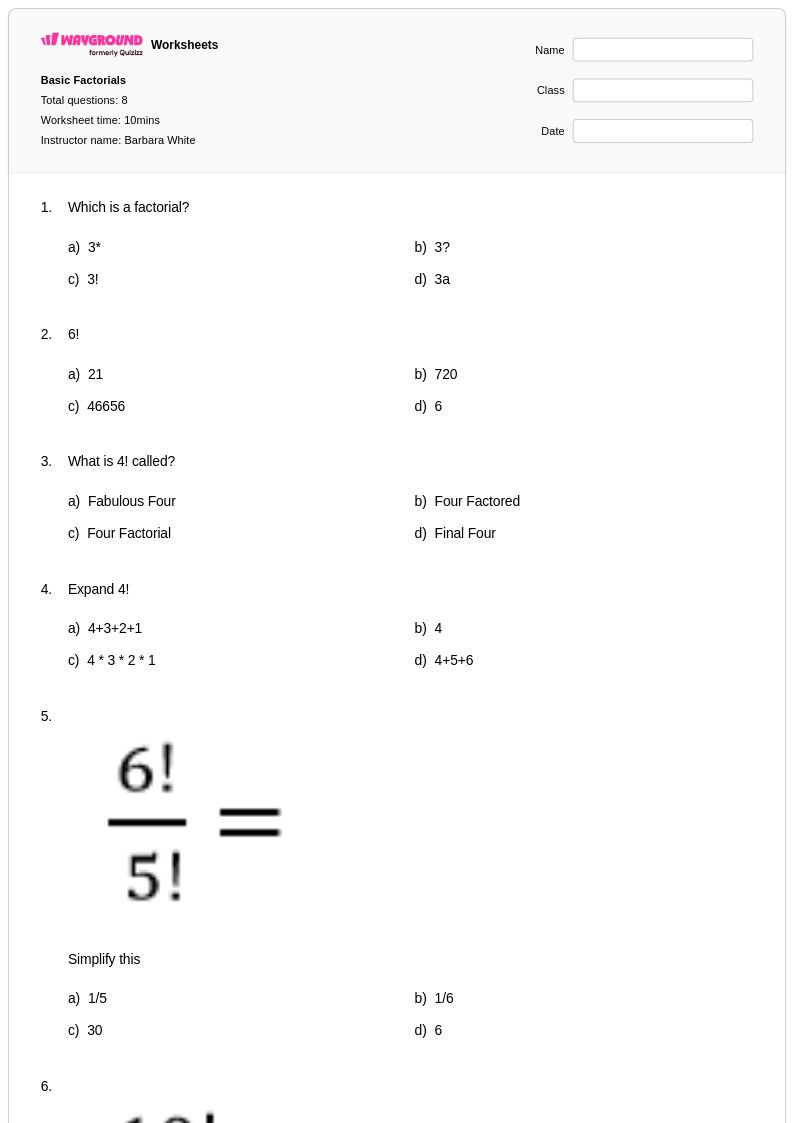
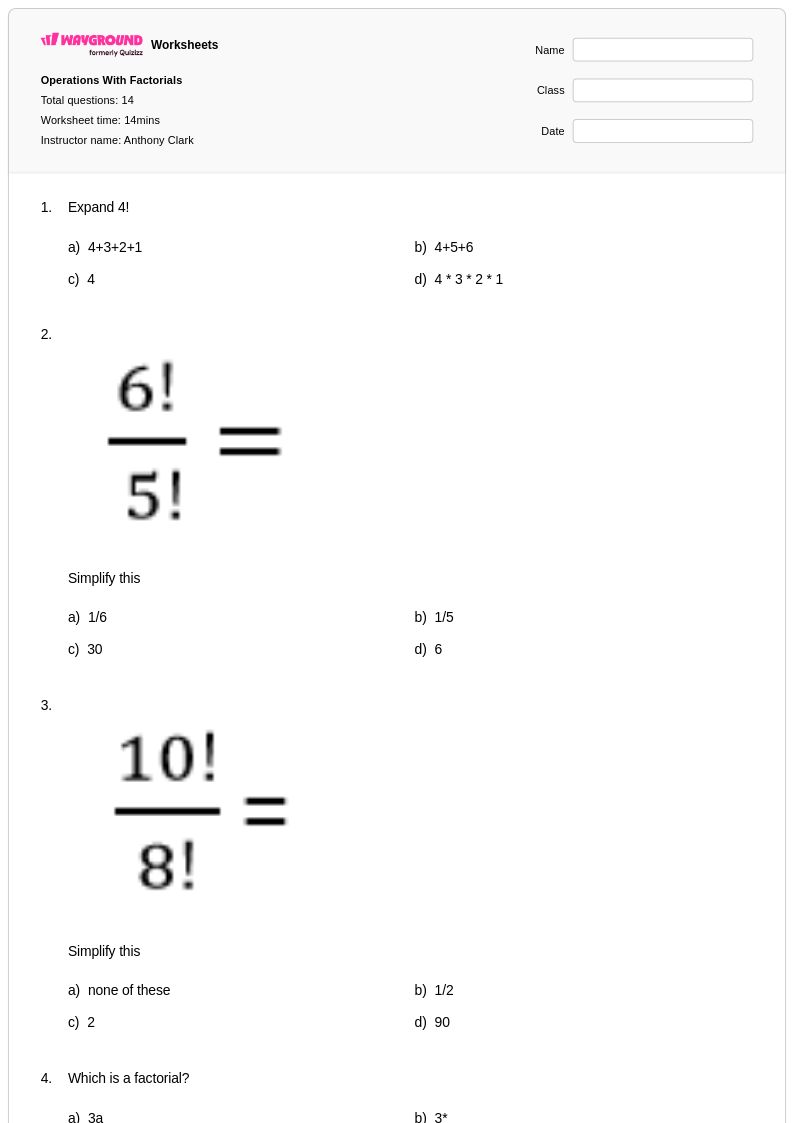
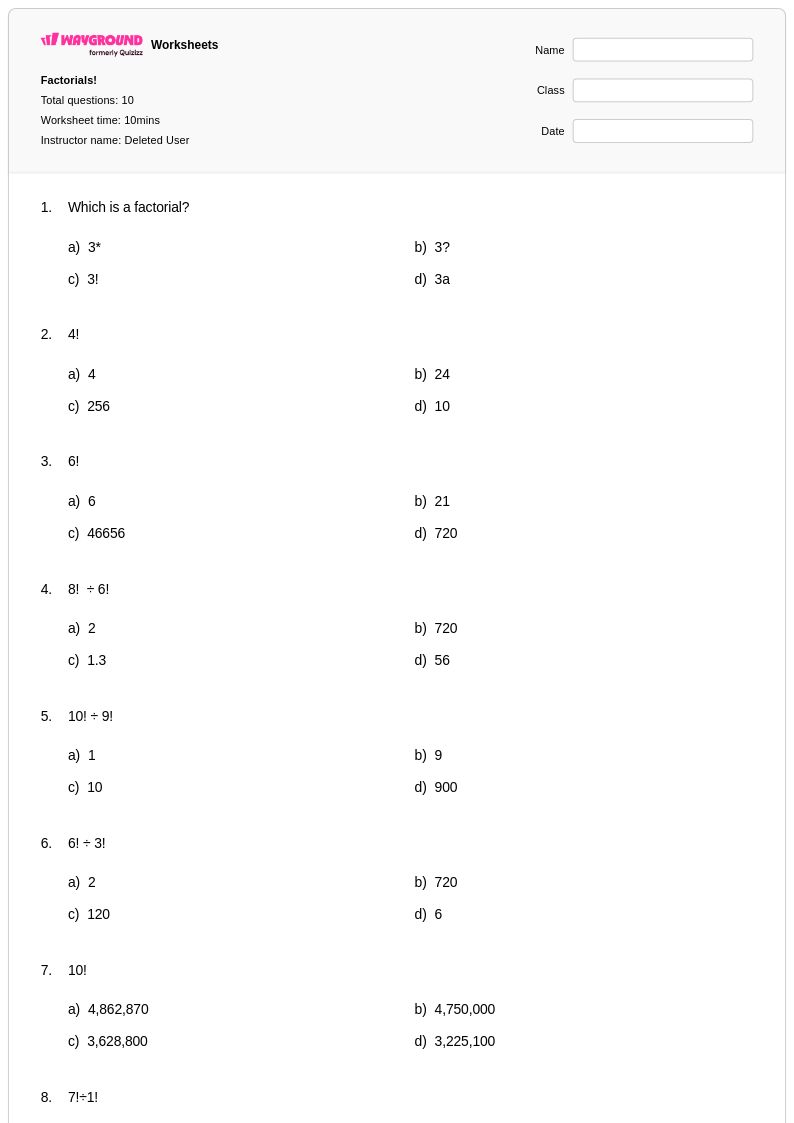
Explore Class 6 factorials through Wayground's comprehensive collection of free worksheets and printables, featuring engaging practice problems with answer keys to help students master this essential probability and statistics concept.
Explore printable Factorials worksheets for Class 6
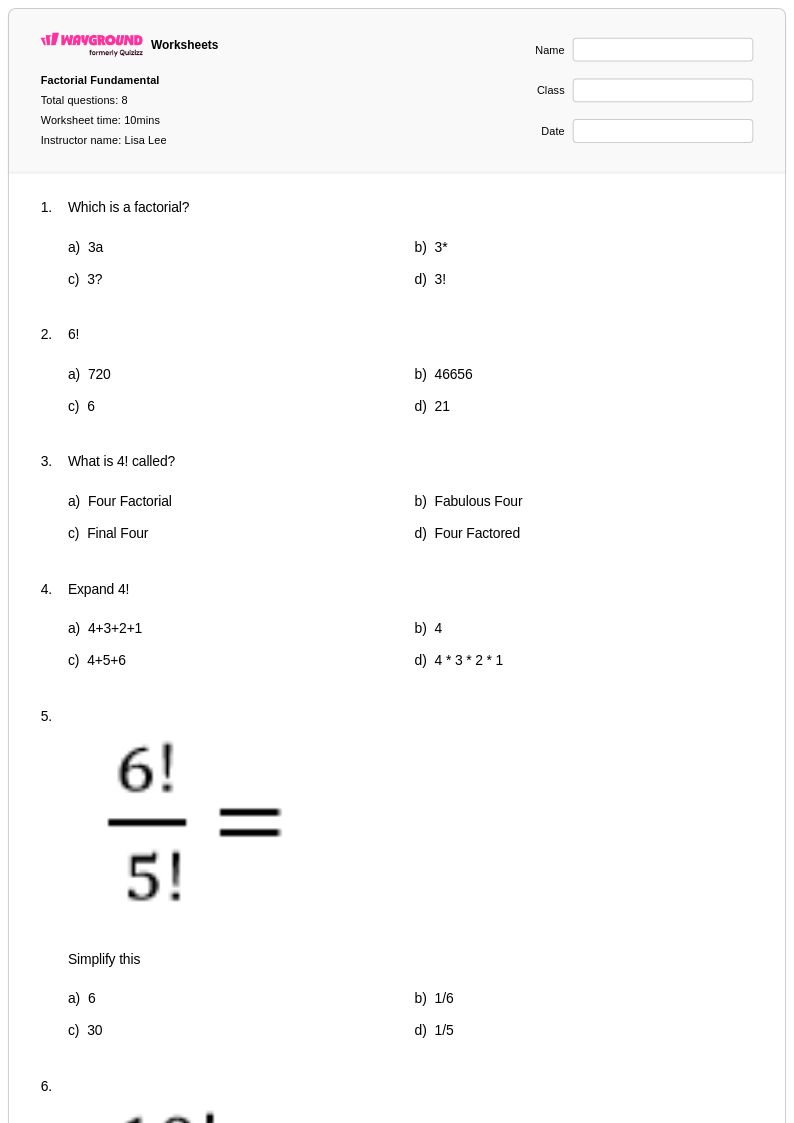
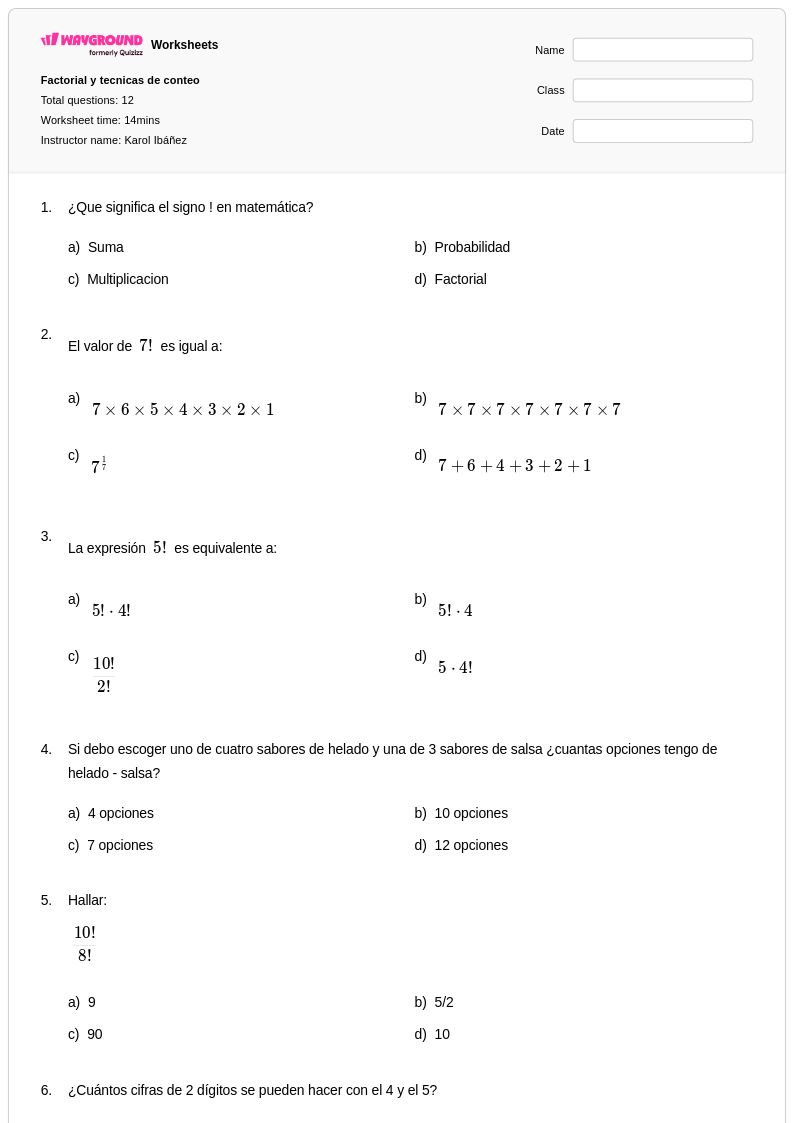
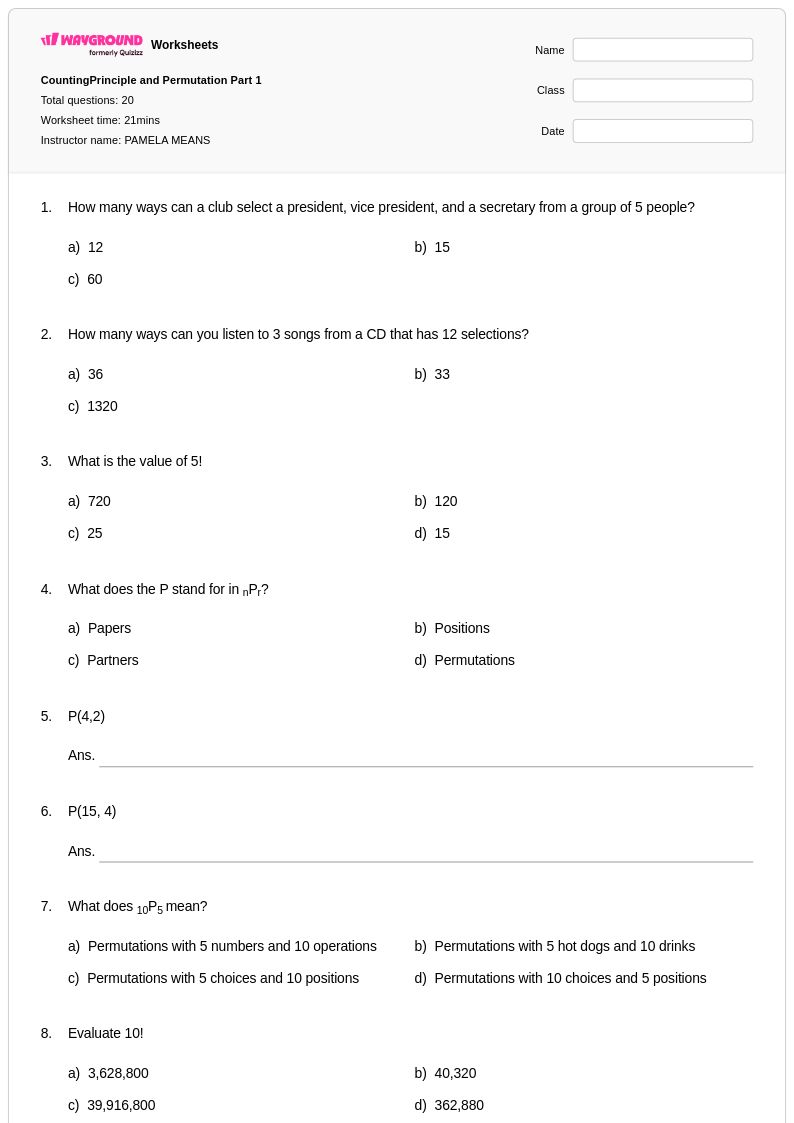
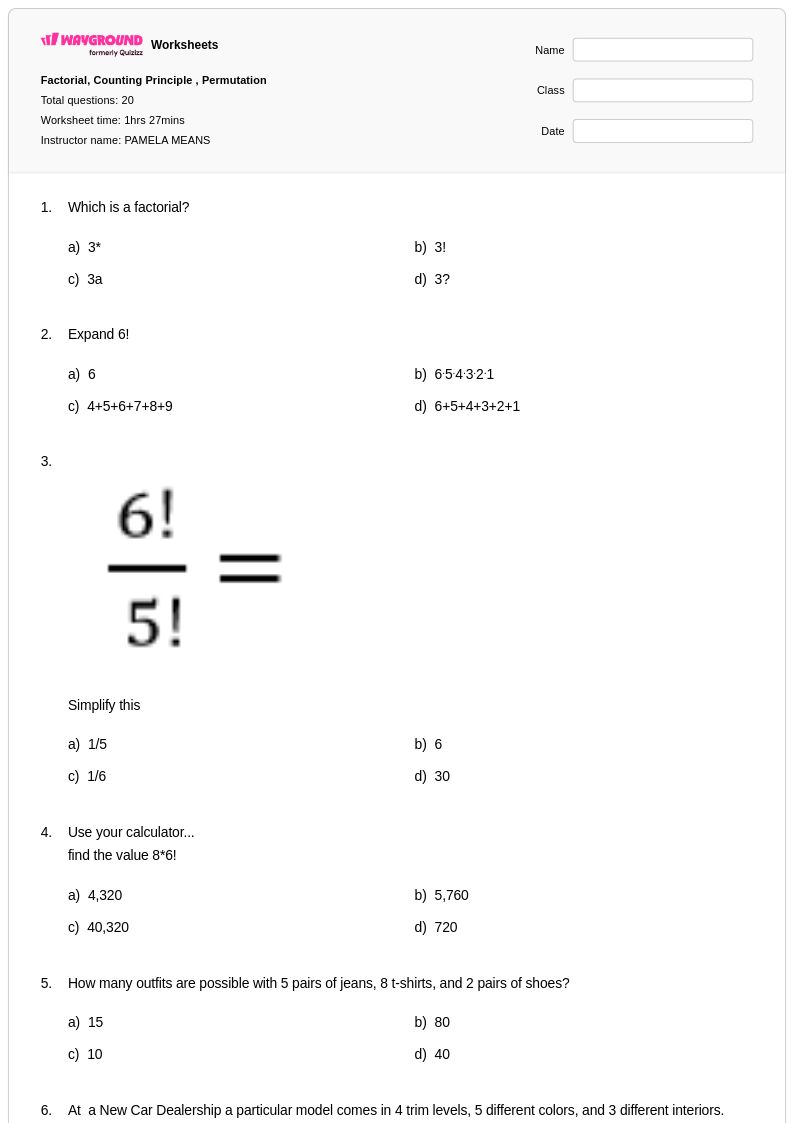
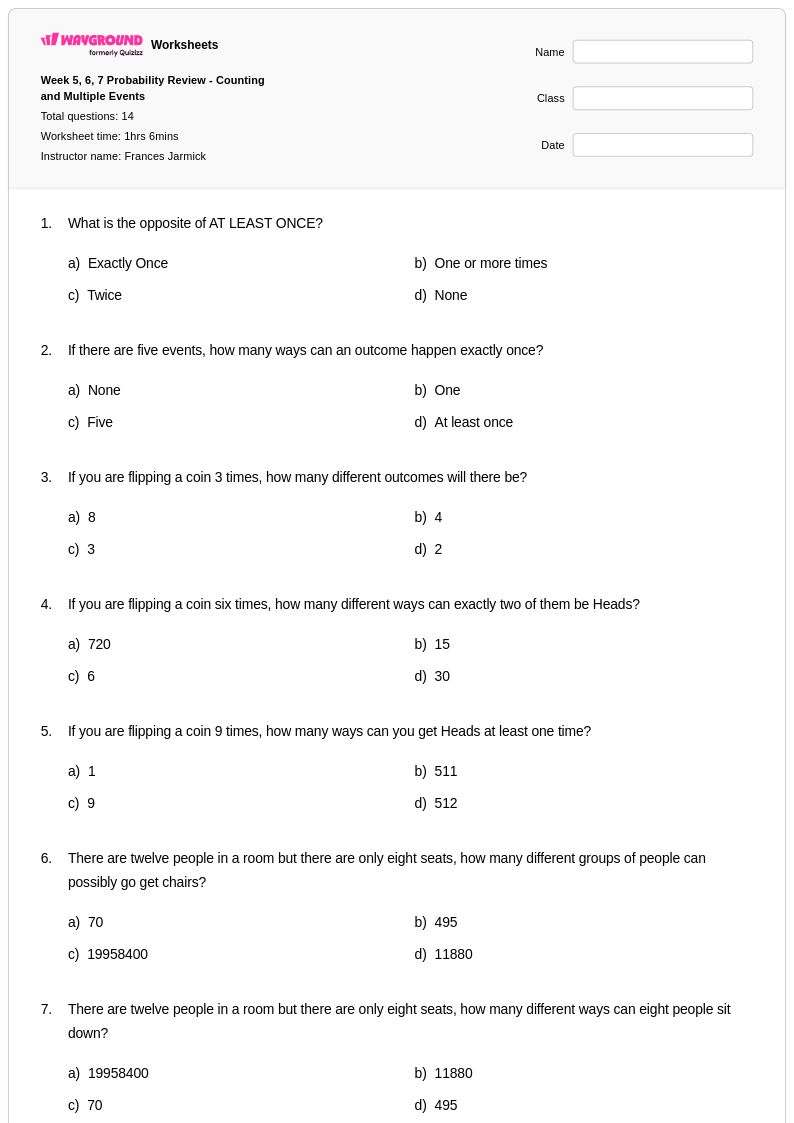
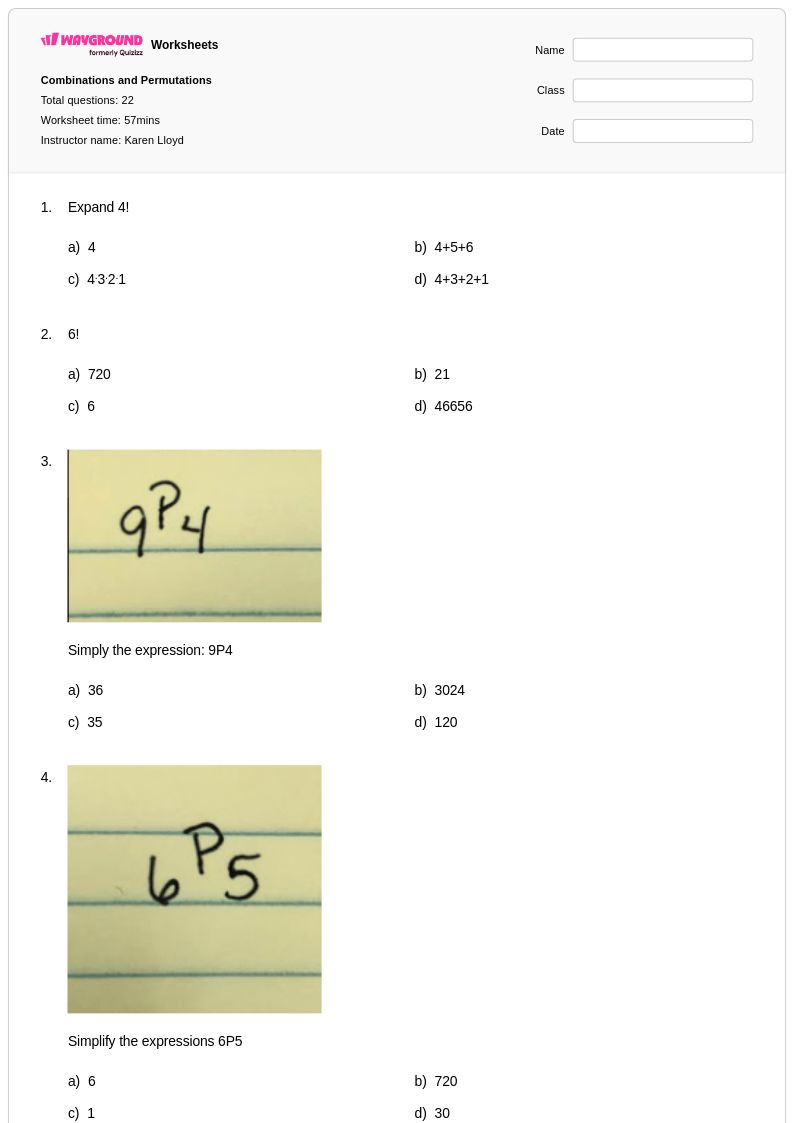
Factorials form a fundamental building block in Class 6 mathematics, introducing students to the concept of sequential multiplication and laying the groundwork for more advanced probability and statistics concepts. Wayground's comprehensive collection of factorial worksheets provides educators with expertly designed practice problems that help students master the notation, calculation, and application of factorials in mathematical contexts. These free printable resources include detailed answer keys and structured exercises that guide sixth-grade learners through computing factorials from basic single-digit numbers to more complex multi-digit calculations, while also exploring how factorials connect to permutations and counting principles that will become essential in their mathematical development.
Wayground, formerly Quizizz, empowers teachers with millions of educator-created factorial worksheets that can be easily searched, filtered, and customized to meet diverse classroom needs. The platform's robust collection includes materials aligned with state and national mathematics standards, offering both printable PDF formats for traditional classroom use and digital versions for technology-integrated learning environments. Teachers can leverage the platform's differentiation tools to provide appropriate challenges for students at varying skill levels, whether they need foundational practice with simple factorial calculations or enrichment activities that explore factorial applications in real-world problem-solving scenarios, making lesson planning more efficient while ensuring comprehensive skill development in this critical mathematical concept.
FAQs
How do I introduce factorials to 6th graders?
Anchor it in something they already know: counting arrangements. Ask students how many ways three books can be ordered on a shelf, have them list the possibilities, then show that 3 × 2 × 1 gives the same answer. From there, introduce the notation 3! as shorthand for that product. Sixth graders grasp the concept quickly when it starts as a counting question rather than a new operation dropped on them cold.
What factorial exercises are appropriate for 6th grade?
At this level, practice should focus on: computing factorials of small whole numbers (1! through 7! or so), writing out the expanded multiplication to reinforce what the notation means, and simple word problems about arranging objects. Permutation formulas are typically too abstract for Grade 6 — the goal here is fluency with the operation itself and understanding why 0! = 1.
What misconceptions do 6th graders have about factorials?
The most persistent one is that 0! should equal 0, because 'zero of anything is nothing.' It's worth spending a few minutes on the logical explanation: there is exactly one way to arrange zero objects (do nothing), so 0! = 1. The second common error is stopping the multiplication too early — writing 4! = 4 × 3 × 2 and forgetting the final × 1, which doesn't change the answer but signals the student doesn't fully understand where the sequence ends.
How do I use these Grade 6 factorial worksheets in my classroom?
The worksheets include a complete answer key, which makes them practical for independent practice or homework without extra prep. You can assign them digitally through Wayground as a self-paced quiz, or print the PDF for in-class work — useful for days when you want students off screens. Either way, the content and formatting are the same.
Is teaching factorials in 6th grade aligned with Common Core?
Factorials aren't explicitly named in Common Core's Grade 6 standards, but they connect directly to the statistics and probability strand that begins in Grade 6 — specifically the work on understanding how to count outcomes systematically. Introducing factorial notation in Grade 6 gives students a concrete tool that supports the permutation and combination concepts they'll encounter more formally in Grades 7 and beyond. Think of it as building the arithmetic foundation before the formula work starts.
How can I support 6th graders who struggle with factorial calculations?
For students who find the descending multiplication hard to track, a simple scaffold helps: write out the full expansion (5! = 5 × 4 × 3 × 2 × 1) before computing, rather than trying to hold it mentally. On Wayground, you can enable the Read Aloud feature for students who process better by hearing the problem, and adjust font size or spacing on the printed worksheet to reduce visual clutter — both small changes that make a real difference for students still building number sense.