Free Printable Identifying the Main Idea Worksheets for Class 1
Class 1 identifying the main idea worksheets from Wayground help young readers develop essential comprehension skills through engaging printables, free practice problems, and guided activities with complete answer keys.
Explore printable Identifying the Main Idea worksheets for Class 1
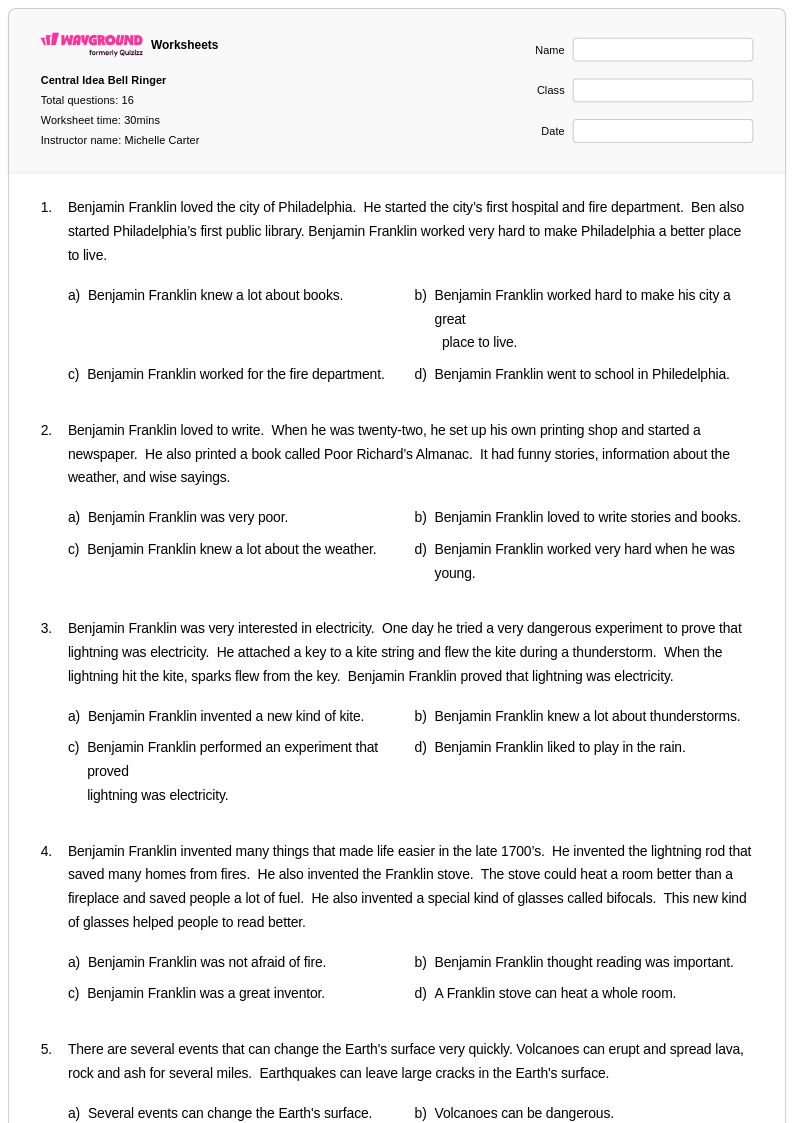
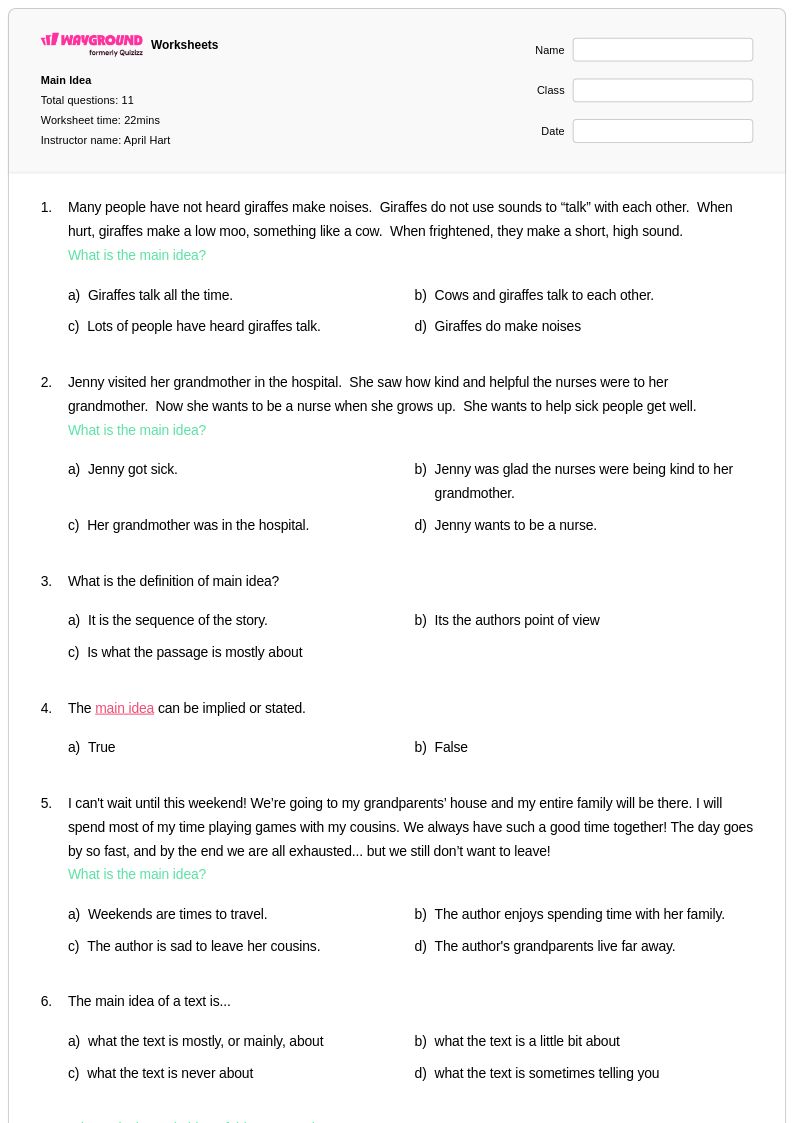
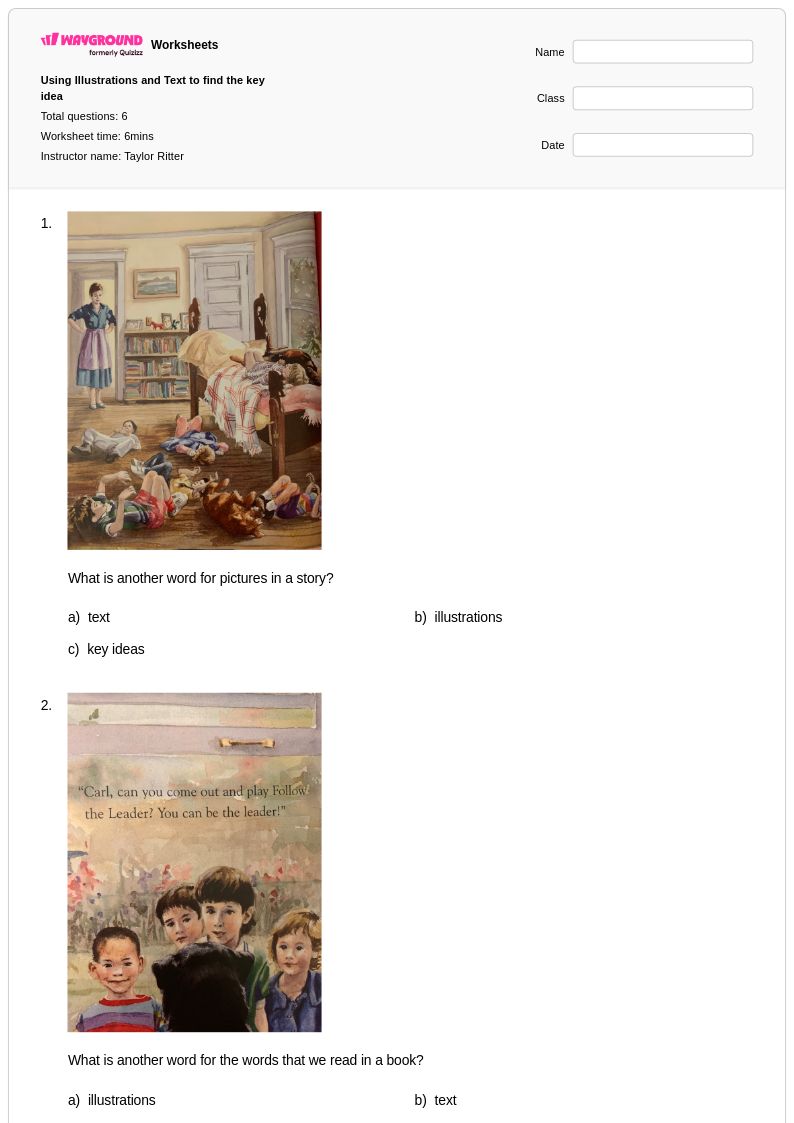
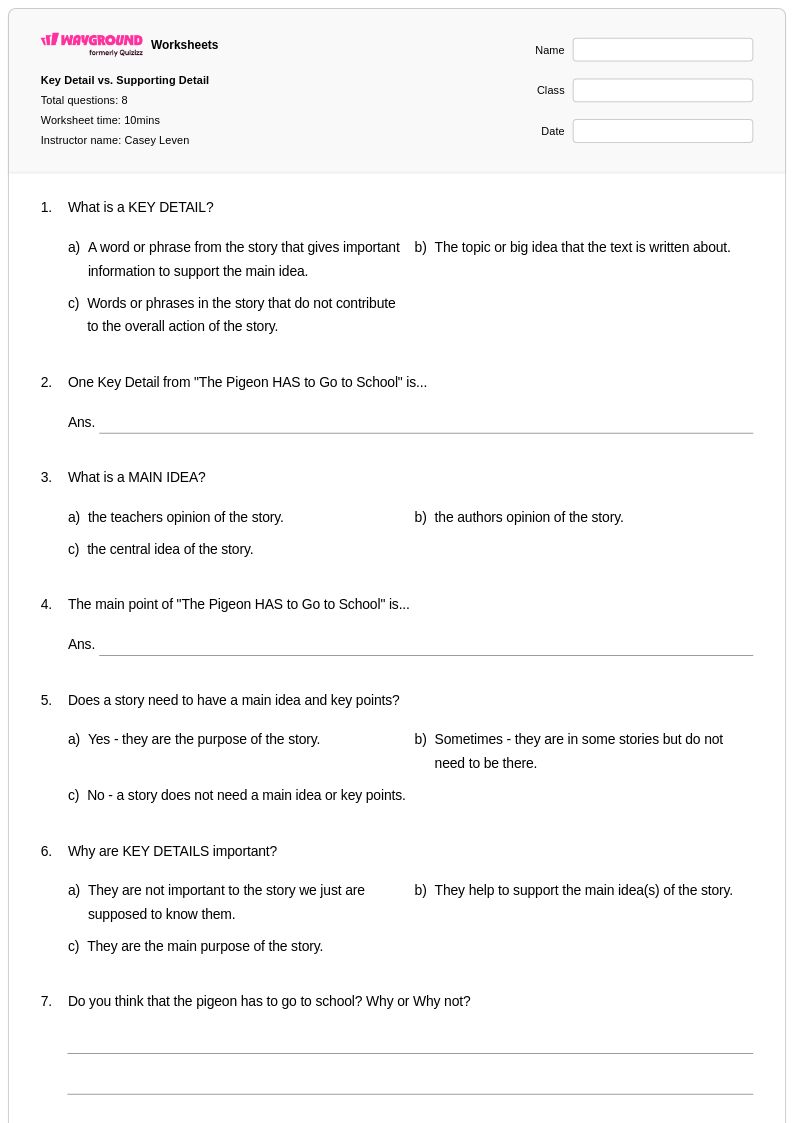
Identifying the main idea worksheets for Class 1 students available through Wayground provide essential foundation-building practice for developing readers who are learning to distinguish between central concepts and supporting details in simple texts. These carefully crafted printables focus on helping young learners recognize what a story or passage is primarily about, strengthening critical thinking skills that form the backbone of reading comprehension. Each worksheet typically presents age-appropriate texts followed by practice problems that guide students through the process of determining the most important message or theme, with answer keys provided to support both independent work and guided instruction. The free resources emphasize visual cues, simple sentence structures, and familiar topics that resonate with first-grade students, making the abstract concept of main idea more concrete and accessible through repeated practice with varied text types.
Wayground's extensive collection of main idea identification worksheets draws from millions of teacher-created resources, offering educators powerful search and filtering capabilities to locate materials perfectly suited to their Class 1 students' specific needs and reading levels. The platform's standards alignment ensures these resources support curriculum requirements while providing differentiation tools that allow teachers to customize content for diverse learners, from those needing additional practice to students ready for enrichment activities. Available in both printable pdf formats and digital versions, these worksheets seamlessly integrate into lesson planning whether used for whole-class instruction, small group remediation, or individual skill practice, empowering teachers to provide targeted support that builds students' confidence in identifying main ideas across various text structures and genres.
FAQs
How do I teach students to identify the main idea in a passage?
Start by teaching students to ask, 'What is this mostly about?' after reading a passage, then model how to distinguish that central idea from the supporting details around it. Anchor instruction in text structure by pointing students to topic sentences at the beginning of paragraphs and clincher sentences at the end, which often restate the main idea. Practice with short, focused passages before moving to multi-paragraph texts, and use think-alouds to make the selection process visible. Consistent exposure to both fiction and nonfiction builds the flexibility students need to apply this skill across subjects.
What is the difference between the main idea and the topic of a passage?
The topic is the subject of a text — what it is about in a word or phrase — while the main idea is the specific point the author is making about that topic. For example, 'penguins' is a topic, but 'penguins are uniquely adapted to survive in extreme cold' is a main idea. Students frequently confuse the two, naming only the topic when asked for the main idea. Teaching this distinction explicitly, and requiring complete-sentence responses for main idea answers, helps correct this common error.
What mistakes do students commonly make when identifying the main idea?
The most frequent error is selecting a supporting detail rather than the overarching idea — students gravitate toward the most interesting or specific sentence rather than the one that ties the whole passage together. A second common mistake is confusing the topic with the main idea, producing answers that are too broad or too narrow. Students also struggle when the main idea is implied rather than stated explicitly, making it essential to practice inference alongside topic sentence identification. Repeated exposure to varied text types helps students recognize these patterns across different genres.
What exercises help students practice identifying the main idea?
Effective practice exercises include selecting the best main idea from multiple-choice options, writing a main idea statement in the student's own words, and sorting details into 'main idea' versus 'supporting detail' categories. Graphic organizers that prompt students to record the main idea at the top and list supporting details below build the habit of thinking hierarchically about text. Short nonfiction passages are especially useful because the central idea is often explicitly stated, giving students a clear model before tackling implied main ideas in fiction or longer texts.
How do I use Wayground's identifying the main idea worksheets in my classroom?
Wayground's identifying the main idea worksheets are available as printable PDFs for direct classroom distribution and in digital formats for technology-integrated instruction, including the option to host them as a quiz on Wayground. Printable versions work well for independent practice, guided small-group sessions, or take-home assignments, while digital formats allow for immediate feedback in one-to-one or lab settings. Each worksheet includes a complete answer key, reducing grading time and providing clear explanations teachers can use during review. For students who need additional support, Wayground's accommodation settings allow teachers to enable read-aloud, extended time, or reduced answer choices on an individual basis.
How do I differentiate main idea instruction for struggling readers?
For struggling readers, begin with shorter, single-paragraph passages that have an explicit topic sentence, then gradually increase text length and complexity. Scaffold the task by providing sentence starters such as 'This passage is mostly about...' to reduce the cognitive load of open-ended responses. On Wayground, teachers can enable individual accommodations including read-aloud so questions and passage text are read to students, reduced answer choices to lower the difficulty of multiple-choice items, and extended time to allow for careful rereading. These settings can be applied to specific students without affecting the experience of the rest of the class.
How is identifying the main idea different in fiction versus nonfiction?
In nonfiction, the main idea is often explicitly stated in a topic sentence and reinforced through facts, examples, or statistics, making it more accessible for early practice. In fiction, the main idea is frequently implied through character actions, dialogue, and plot events, requiring students to synthesize rather than locate a single sentence. Teaching both text types is important because students encounter each in academic reading across subjects. Beginning with nonfiction and gradually introducing fiction passages helps build the inferencing skills needed for literary main idea identification.