Free Printable Naming Ionic and Covalent Bonds Worksheets for Class 6
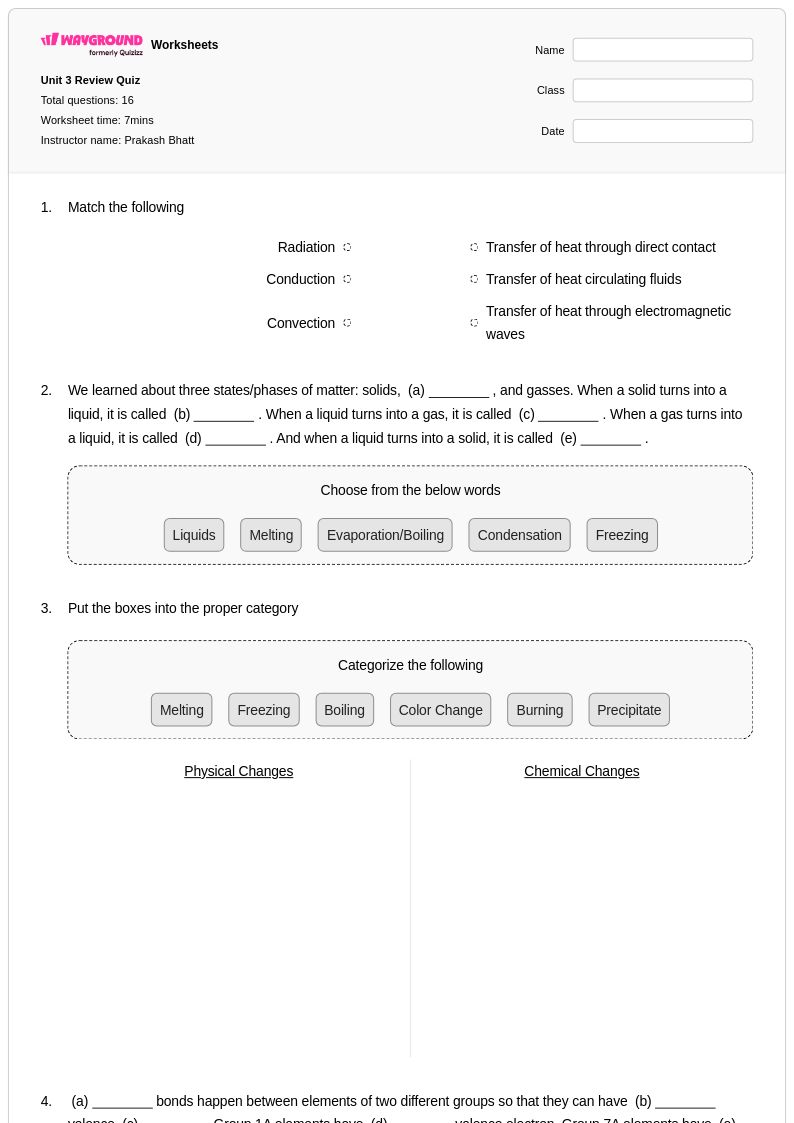
Class 6 students can master naming ionic and covalent bonds with Wayground's free printable chemistry worksheets, featuring comprehensive practice problems and detailed answer keys in convenient PDF format.
Explore printable Naming Ionic and Covalent Bonds worksheets for Class 6
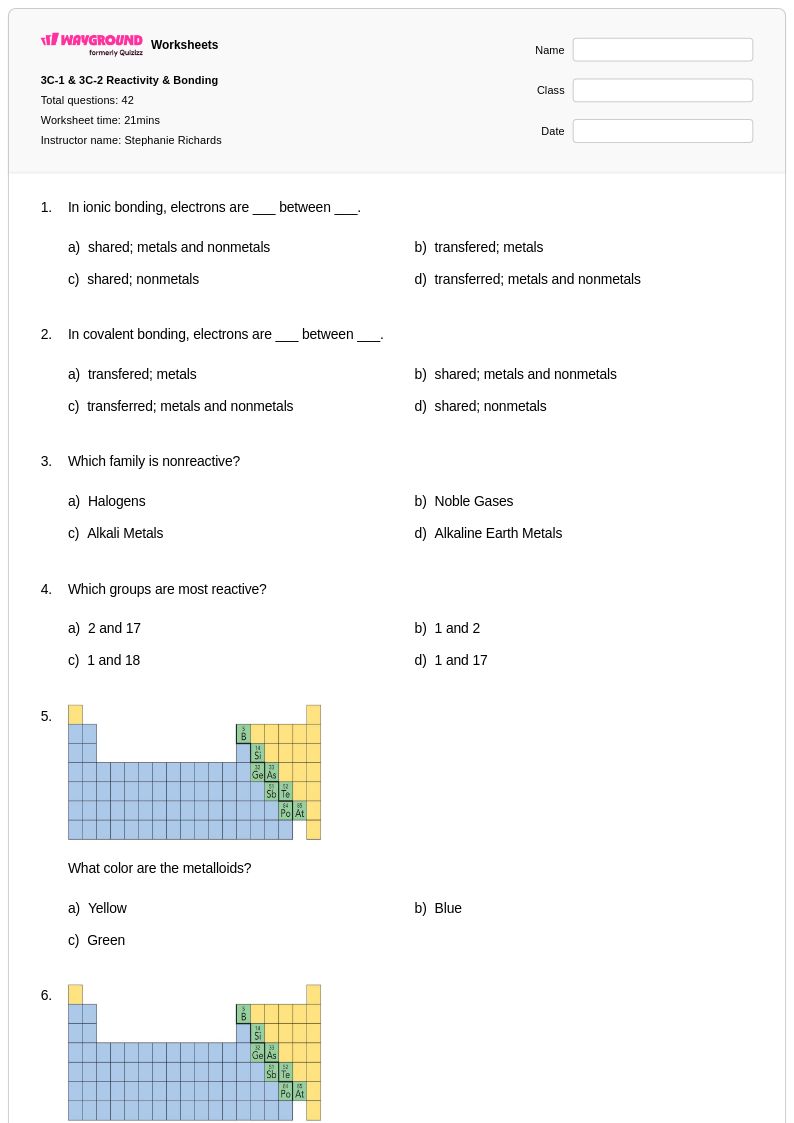
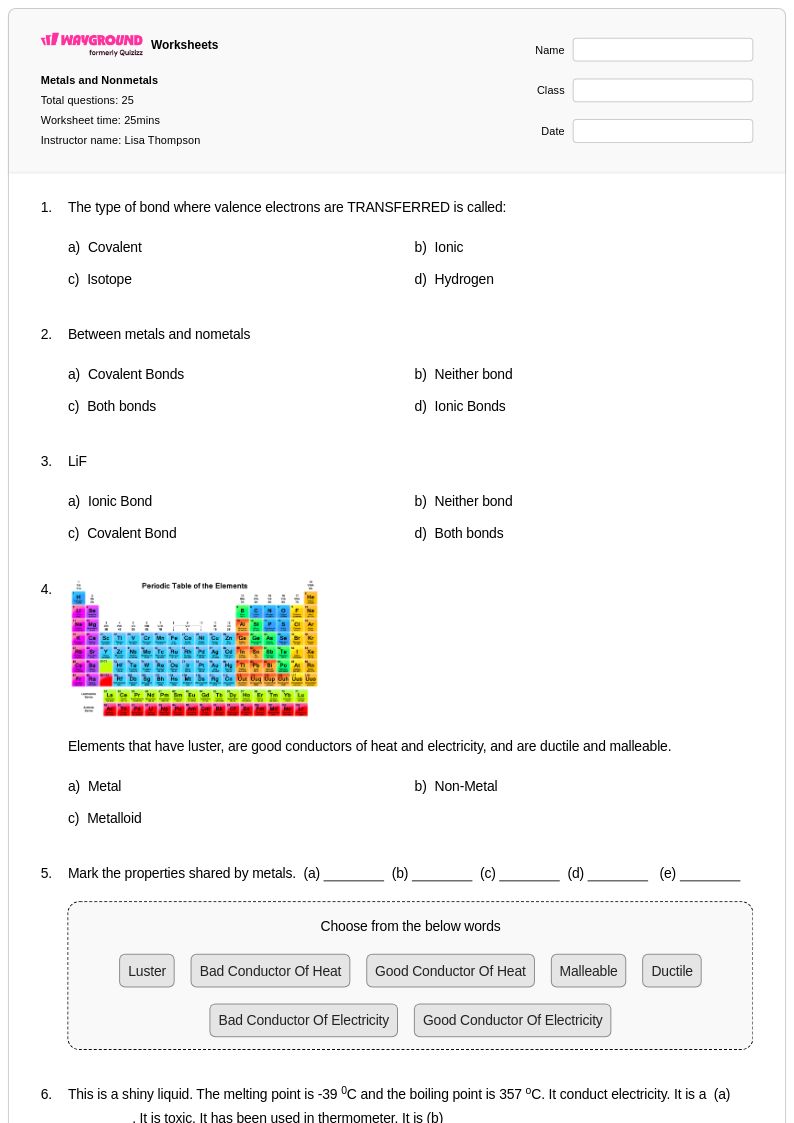
Naming ionic and covalent bonds represents a fundamental skill in Class 6 chemistry that forms the foundation for understanding chemical compounds and molecular structures. Wayground's comprehensive collection of worksheets helps students master the essential distinctions between ionic bonds, formed when electrons transfer between metals and nonmetals, and covalent bonds, created when atoms share electrons. These carefully designed practice problems guide students through systematic approaches to identifying bond types, writing chemical formulas, and applying naming conventions for both ionic compounds and covalent molecules. Each worksheet includes detailed answer keys that support independent learning and self-assessment, while the free printable format ensures accessibility for all students. The pdf resources provide structured opportunities to practice recognizing common polyatomic ions, understanding prefixes in covalent compound names, and developing confidence with chemical nomenclature rules.
Wayground's extensive platform empowers teachers with millions of educator-created resources specifically designed to support chemistry instruction at the Class 6 level. The robust search and filtering capabilities allow instructors to quickly locate worksheets that align with specific standards and learning objectives for chemical bonding concepts. Teachers can easily differentiate instruction by selecting from varying difficulty levels and problem types, ensuring that both struggling learners and advanced students receive appropriate challenges. The flexible customization tools enable educators to modify existing worksheets or combine resources to create targeted practice sets for remediation or enrichment activities. Available in both printable and digital formats including downloadable pdfs, these resources streamline lesson planning while providing consistent opportunities for skill practice and formative assessment in chemical nomenclature and bonding theory.
FAQs
How do I teach students to name ionic and covalent compounds?
Start by teaching the two systems separately before asking students to distinguish between them. For ionic compounds, students need to identify the metal cation and nonmetal anion, apply charge balancing, and recognize polyatomic ions. For covalent compounds, students use Greek prefixes (mono-, di-, tri-, etc.) to indicate the number of each nonmetal atom. Once each system is solid individually, introduce mixed practice sets that require students to first identify the bond type before naming the compound.
What exercises help students practice naming ionic and covalent compounds?
The most effective practice exercises include compound identification drills (where students classify a formula as ionic or covalent before naming it), fill-in-the-blank naming tables, and formula-writing tasks that reverse the naming process. Worksheets that separate binary ionic, ternary ionic (with polyatomic ions), and binary covalent compounds into distinct sections help students build procedural fluency with each rule set before mixing them. Progressive problem sets that increase in complexity are especially effective for building long-term retention.
What mistakes do students commonly make when naming ionic and covalent compounds?
The most common error is applying the prefix system used for covalent compounds to ionic compounds, or vice versa. Students frequently write 'monosodium chloride' instead of 'sodium chloride,' or miss the prefix on the first element of a covalent compound. Confusing polyatomic ions with simple anions is another persistent error, particularly with sulfate vs. sulfide or nitrate vs. nitride. Students also struggle with transition metal ions that have multiple oxidation states, often omitting the Roman numeral needed to specify the charge.
How do I help students tell the difference between ionic and covalent compounds?
Teach students to use the periodic table as their first tool: compounds formed between a metal and a nonmetal are ionic, while compounds formed between two or more nonmetals are covalent. Ammonium compounds are a notable exception worth flagging early. A simple decision flowchart posted in the classroom can reduce working memory load while students are still building automaticity. Practice problems that include sorting tasks before naming tasks reinforce this classification step as a non-negotiable first move.
How do I use Wayground's naming ionic and covalent bonds worksheets in my classroom?
Wayground's naming ionic and covalent bonds worksheets are available as printable PDFs for traditional classroom use and in digital formats for technology-integrated or remote learning environments. Teachers can also host the worksheets as a quiz directly on Wayground, making them suitable for formative assessment. Each worksheet includes a complete answer key, so students can self-check during independent practice or teachers can use them for efficient grading. The varied difficulty levels and problem types allow teachers to select resources that match specific instructional goals, whether introducing nomenclature for the first time or providing targeted remediation.
How do I differentiate naming ionic and covalent compounds practice for struggling students?
For students who need additional support, reduce the scope of each practice session by isolating one compound type at a time rather than mixing ionic and covalent in the same worksheet. On Wayground, teachers can apply accommodations such as reduced answer choices to lower cognitive load for individual students, or enable Read Aloud so questions are read aloud for students with reading difficulties. Extended time settings can also be configured per student for timed digital activities. These accommodations can be applied to specific students without affecting the rest of the class.