Free Printable Periodic Table Trends Worksheets for Class 8
Explore Class 8 periodic table trends with Wayground's free chemistry worksheets and printables, featuring practice problems and answer keys to help students master atomic radius, ionization energy, and electronegativity patterns.
Explore printable Periodic Table Trends worksheets for Class 8
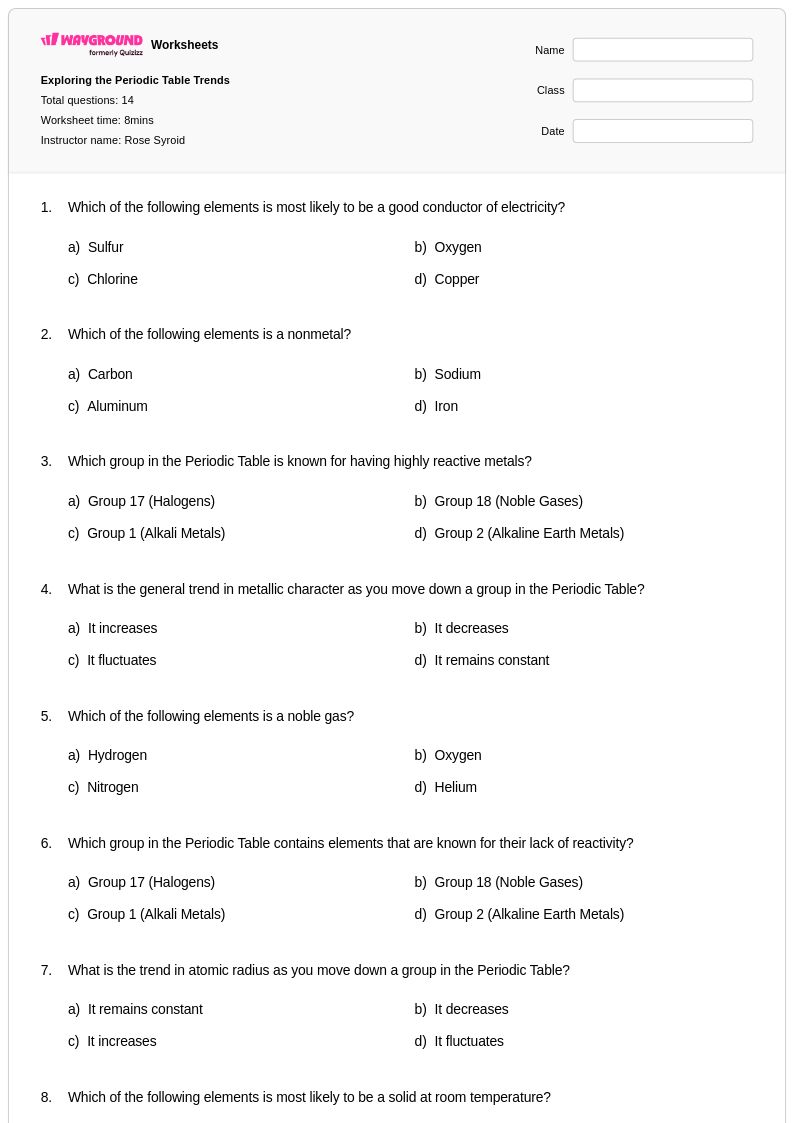
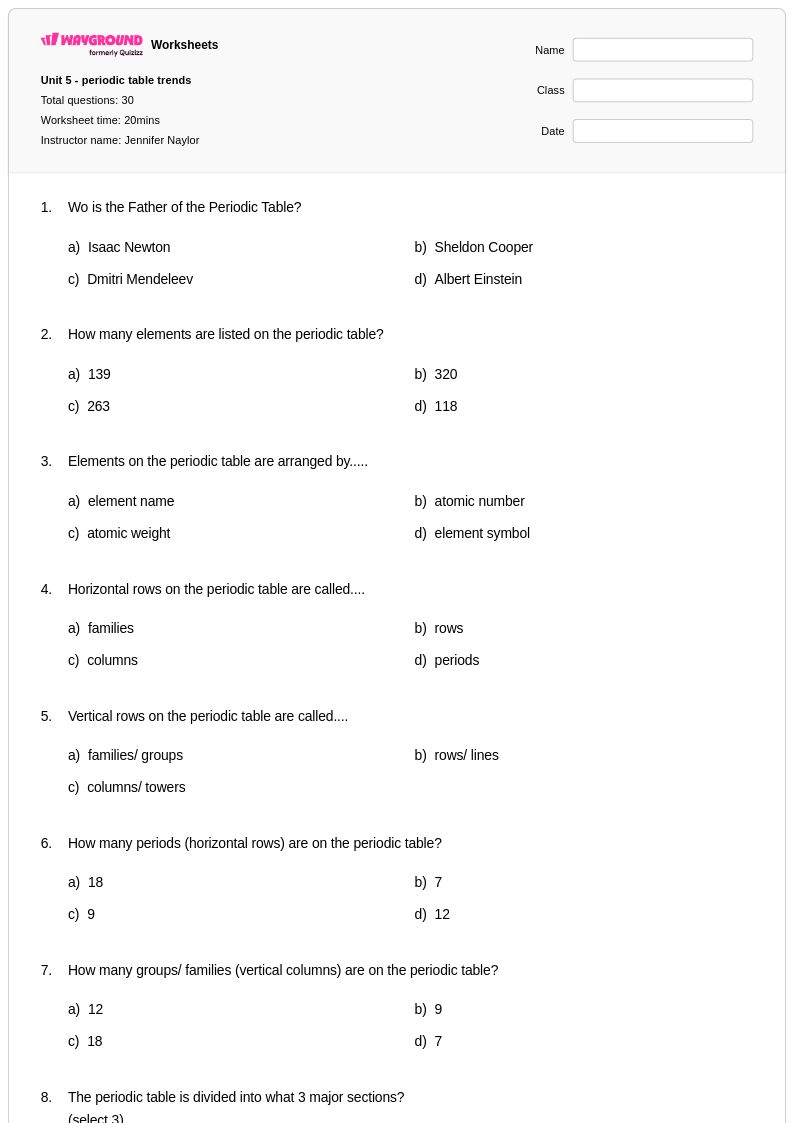
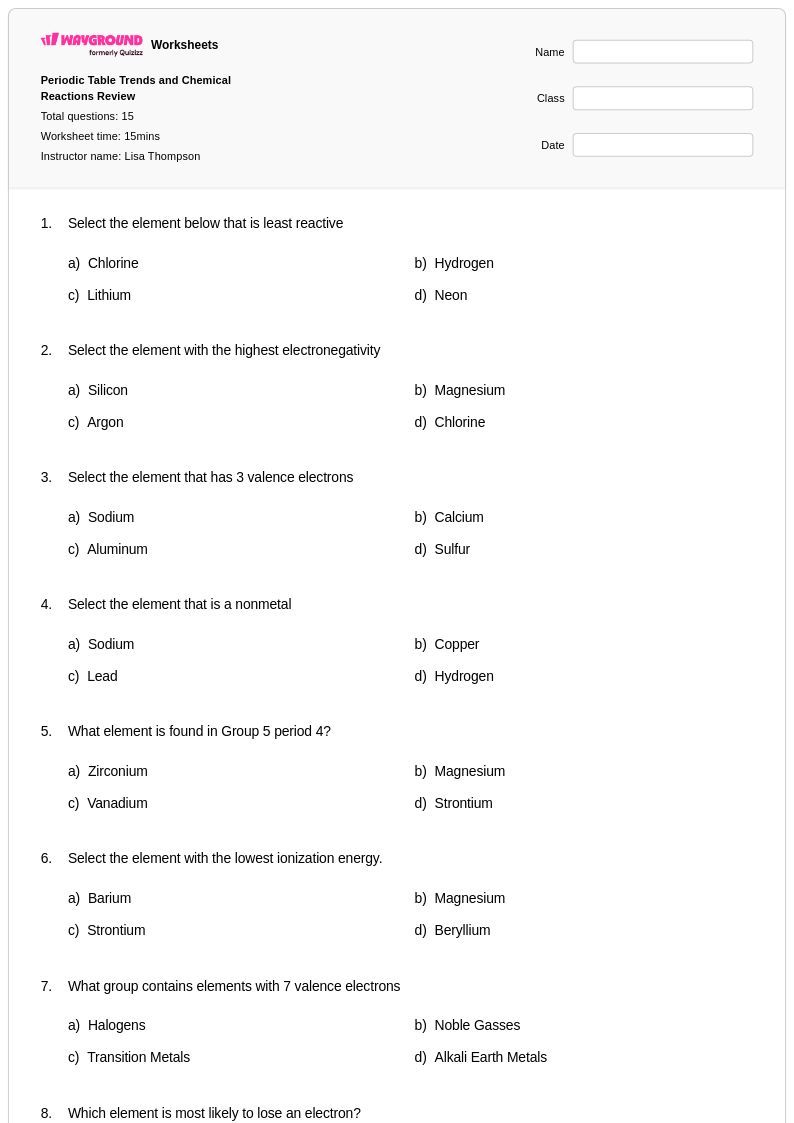
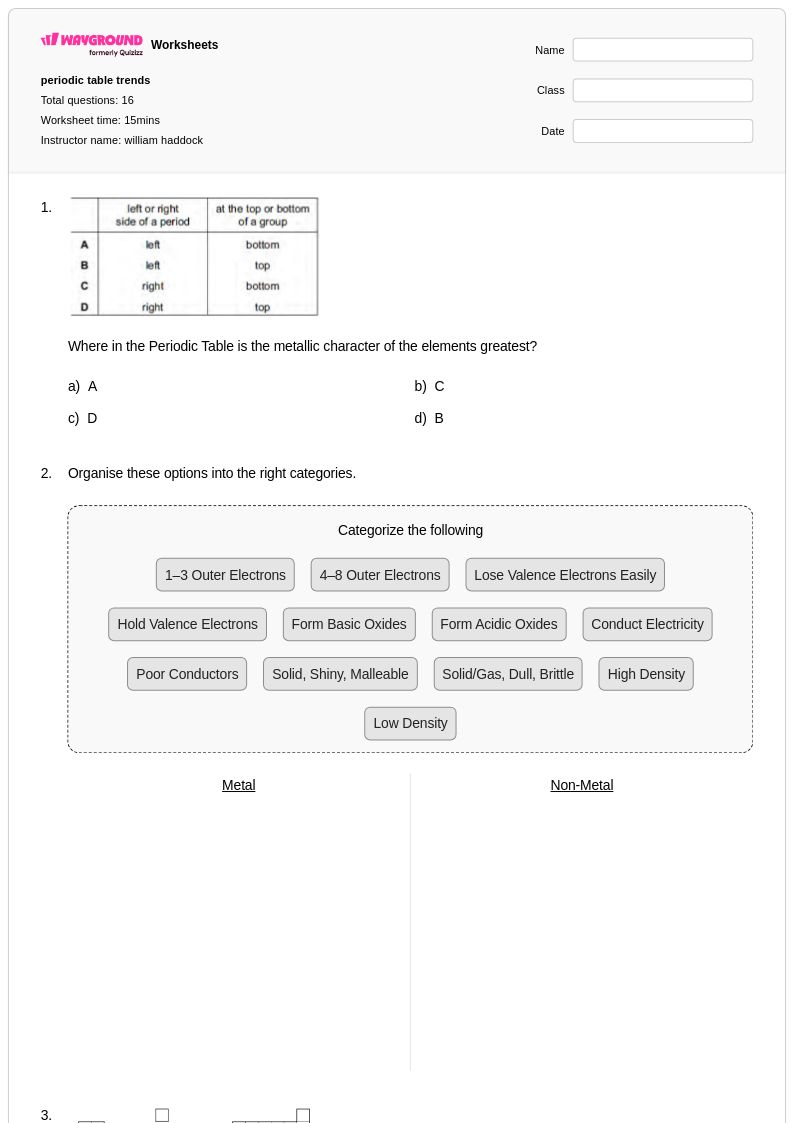
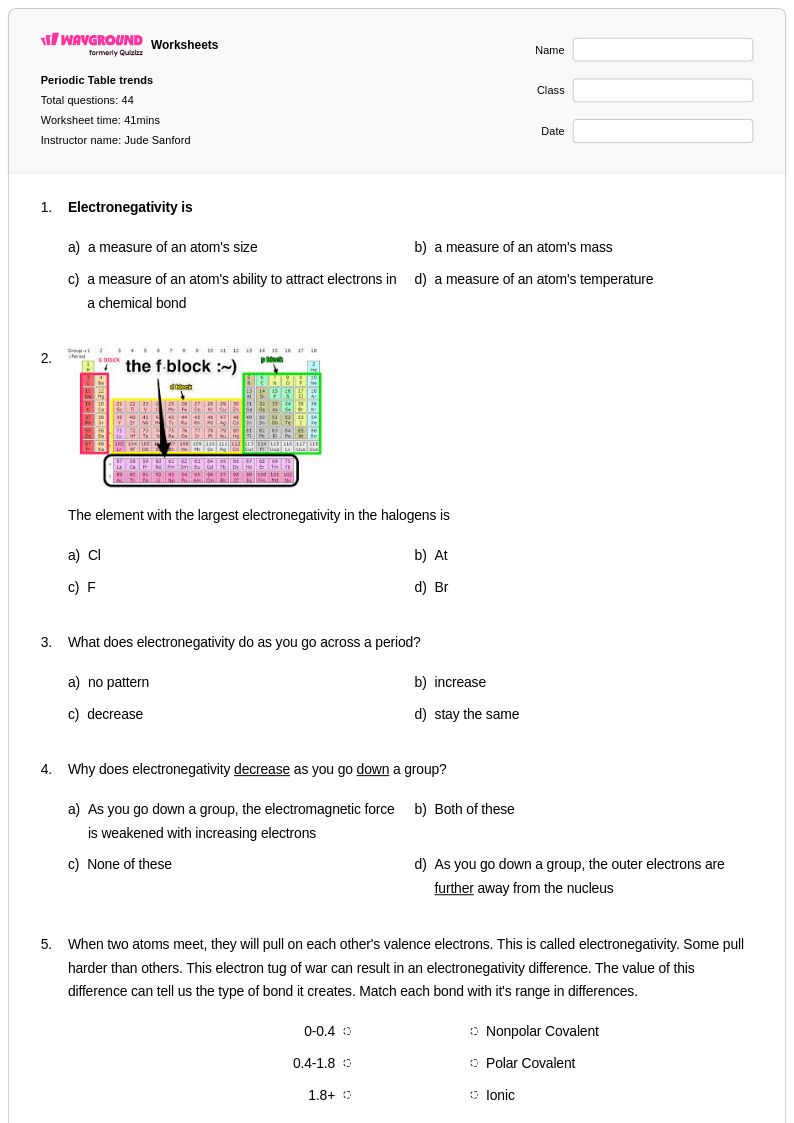
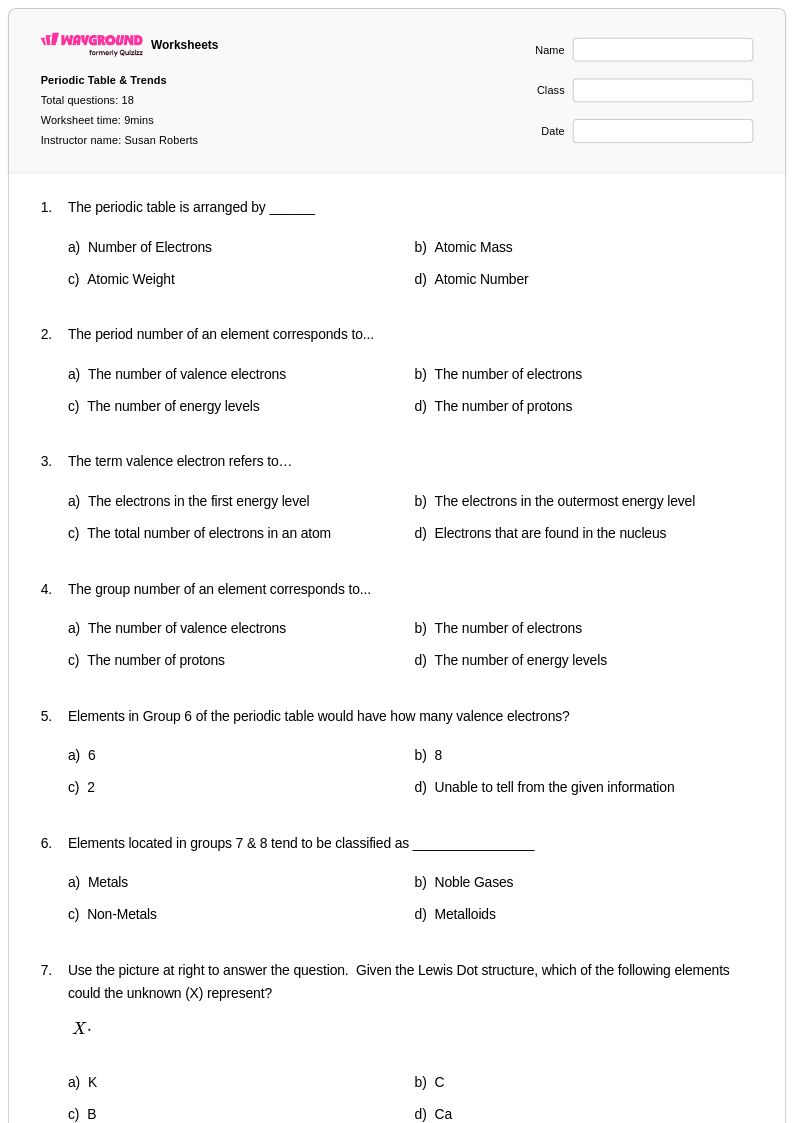
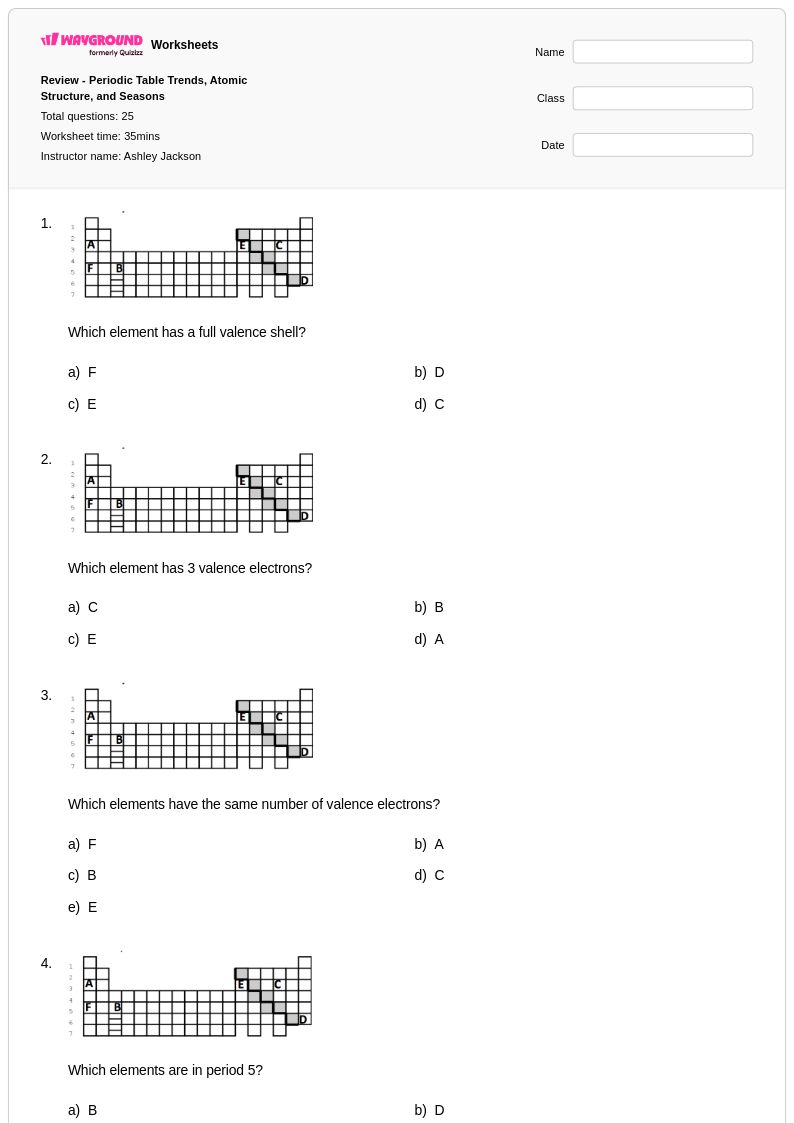
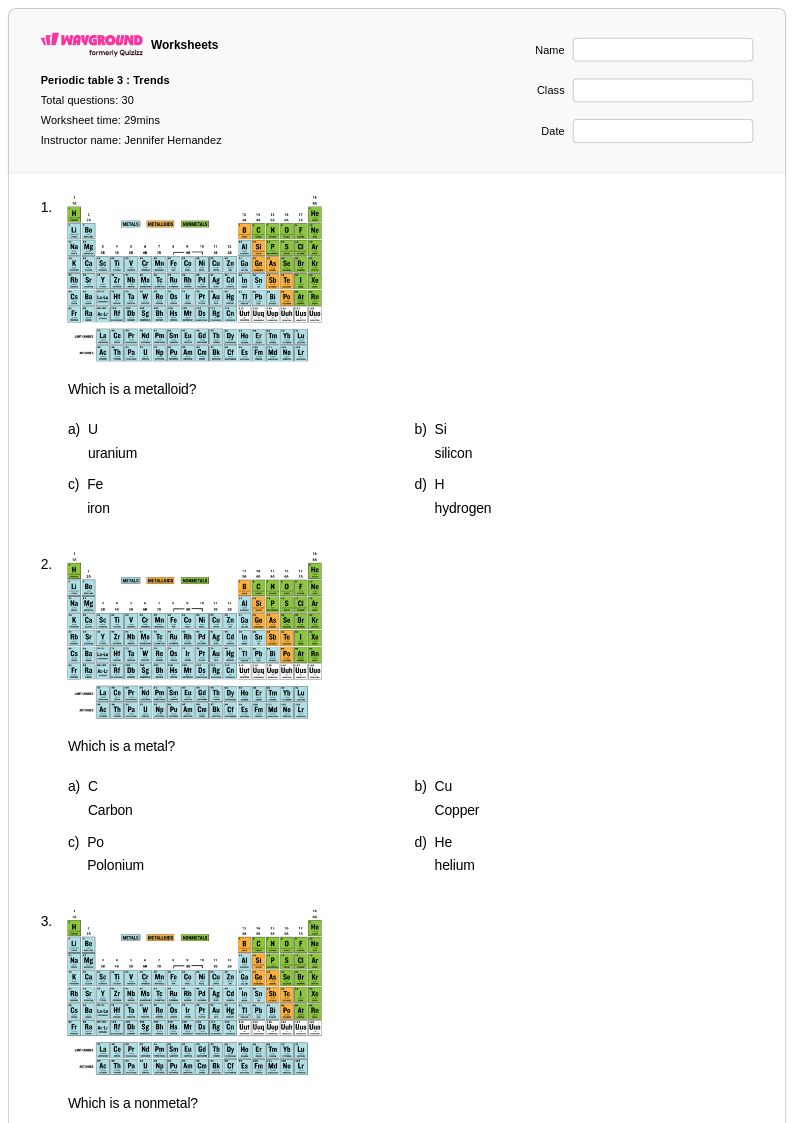
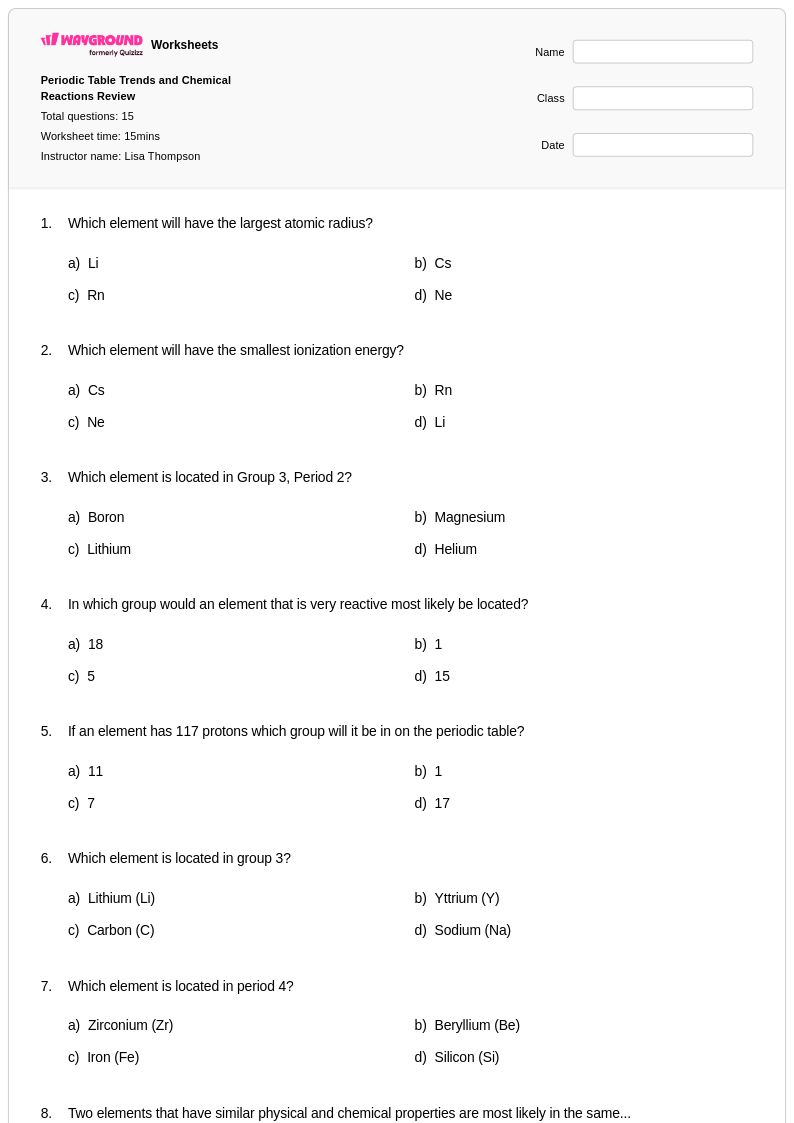
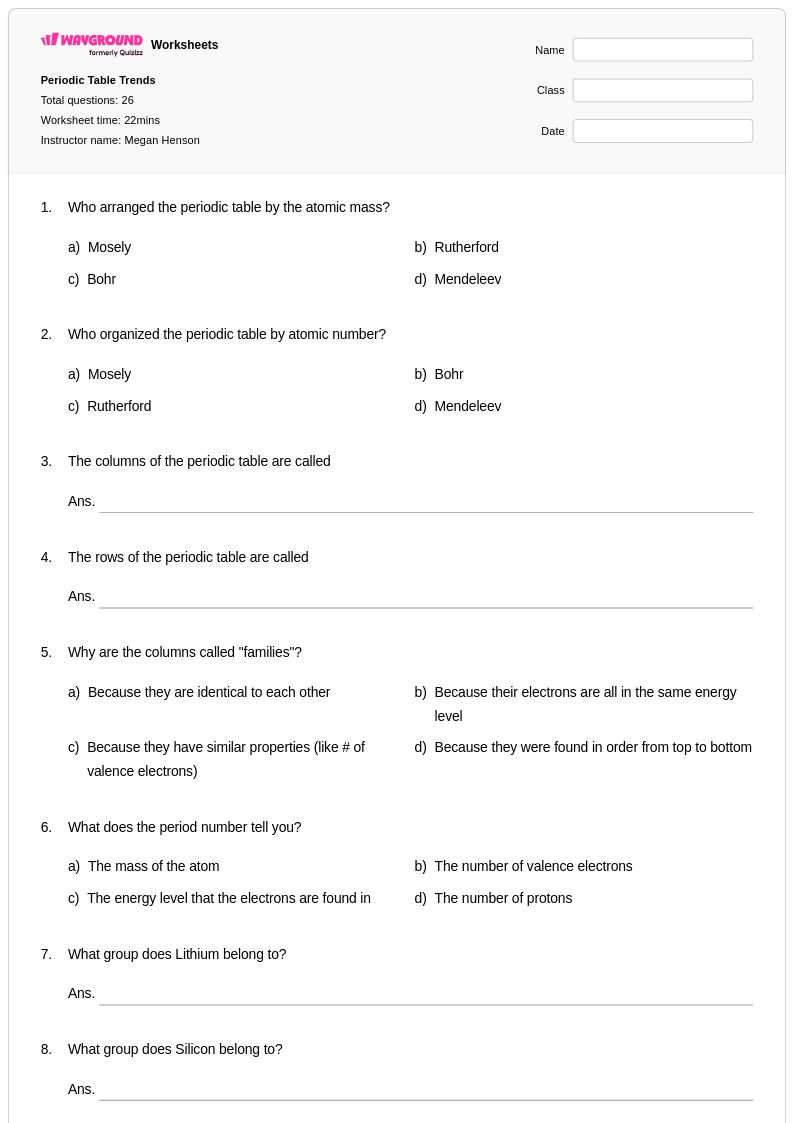
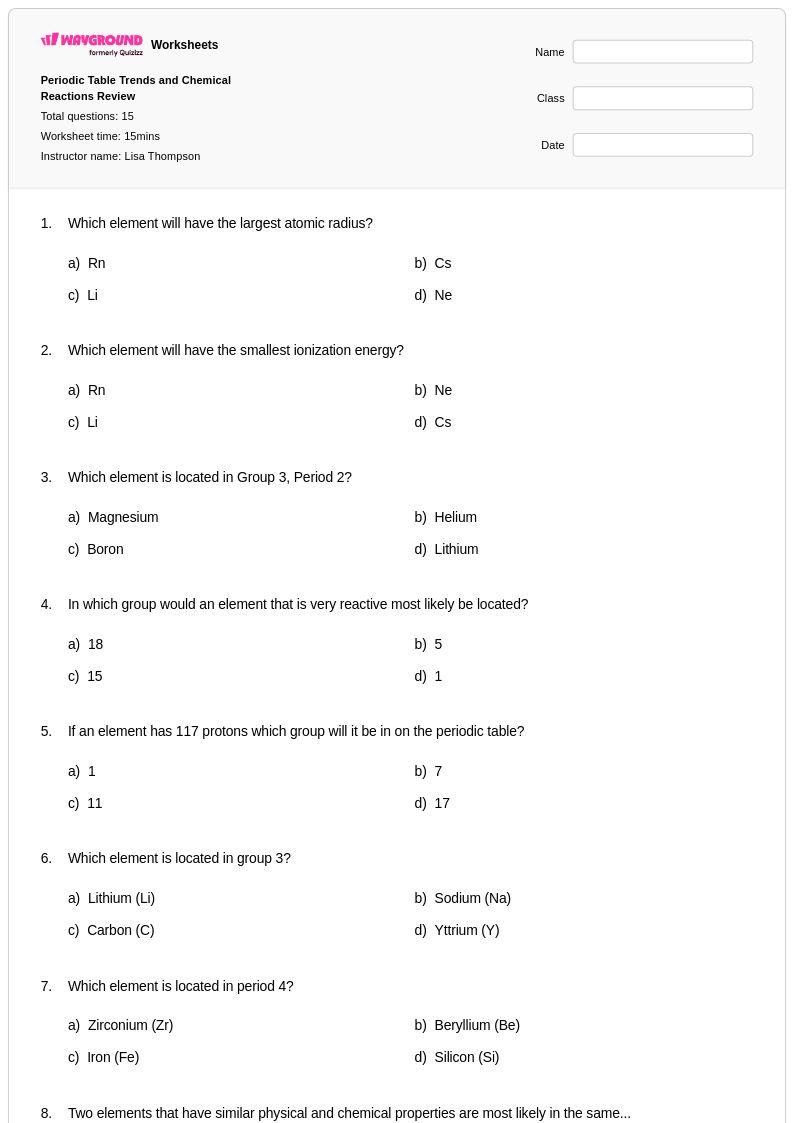
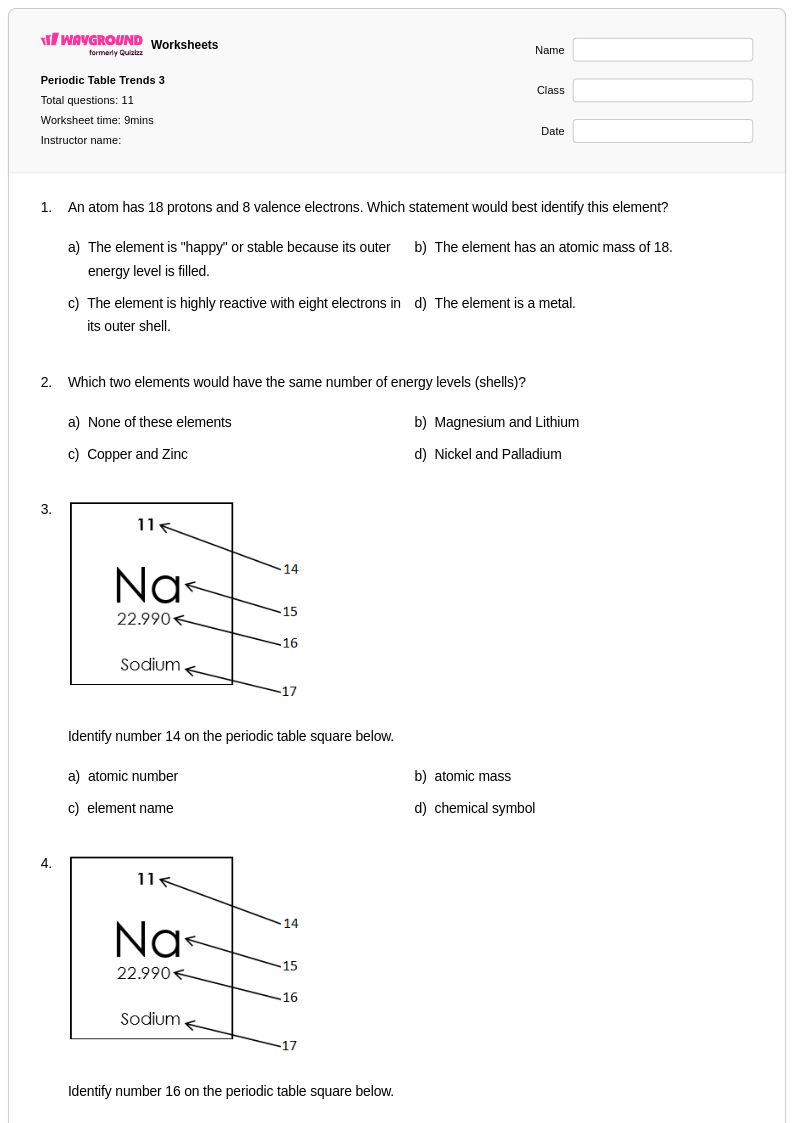
Periodic table trends worksheets for Class 8 chemistry students available through Wayground (formerly Quizizz) provide comprehensive practice with the fundamental patterns that govern element properties across the periodic table. These educational resources focus on helping students master critical concepts including atomic radius trends, ionization energy patterns, electronegativity changes, and metallic character variations as they move across periods and down groups. The worksheets strengthen analytical thinking skills by presenting practice problems that require students to predict element properties, compare atomic characteristics, and explain the underlying reasons for observed trends. Teachers can access complete answer keys alongside each printable worksheet, ensuring efficient grading and enabling students to check their understanding independently. These free resources include both foundational exercises for skill building and more complex problems that challenge students to apply periodic trends in real-world chemical scenarios.
Wayground (formerly Quizizz) supports chemistry educators with an extensive collection of teacher-created periodic table trends worksheets, drawing from millions of high-quality resources developed by experienced science professionals. The platform's advanced search and filtering capabilities allow teachers to quickly locate materials that align with specific curriculum standards while accommodating diverse learning needs through built-in differentiation tools. Educators can customize existing worksheets or create entirely new practice sets, with content available in both digital formats for online learning and downloadable pdf versions for traditional classroom use. These flexible resources prove invaluable for lesson planning, targeted remediation for students struggling with trend identification, enrichment activities for advanced learners, and systematic skill practice that builds confidence in predicting element behavior. The comprehensive nature of the worksheet collection ensures that teachers can provide consistent, standards-aligned practice opportunities that reinforce the mathematical relationships underlying periodic trends while developing students' ability to interpret and apply these patterns in chemical reasoning.
FAQs
How do I teach periodic table trends effectively?
Effective instruction on periodic table trends begins with establishing the organizing logic of the periodic table itself — periods and groups as predictors of behavior. Teachers typically introduce one trend at a time, starting with atomic radius since it provides an intuitive visual anchor, then build toward ionization energy and electronegativity by explaining how nuclear charge and shielding interact. Using color-coded gradient visuals alongside direct practice problems reinforces both conceptual understanding and the ability to make comparative predictions.
What exercises help students practice periodic table trends?
The most effective practice exercises for periodic table trends require students to rank elements within a period or group, predict unknown values based on position, and explain the reasoning behind each trend rather than simply recalling the pattern. Worksheets that combine trend identification with short written justifications are particularly useful because they reveal whether students understand the underlying atomic structure concepts or are only memorizing directional rules. Periodic table trends worksheets on Wayground systematically build from basic identification tasks to advanced property prediction problems.
What mistakes do students commonly make when learning periodic table trends?
The most common misconception is confusing the direction of atomic radius and ionization energy trends across a period — students often assume larger atoms always have higher ionization energy, when in fact ionization energy increases as atomic radius decreases moving left to right. Students also frequently conflate electronegativity with electron affinity, treating them as interchangeable. Another persistent error is failing to account for exceptions, such as the lower ionization energy of oxygen compared to nitrogen, which stems from electron-electron repulsion in paired orbitals.
How can I differentiate periodic table trends instruction for students at different skill levels?
For students who are still developing foundational understanding, reducing the number of trends addressed simultaneously and providing partially completed tables can lower cognitive load without removing rigor. More advanced students benefit from open-ended prediction tasks that ask them to justify element behavior using atomic structure principles. On Wayground, teachers can apply individual accommodations such as reduced answer choices or read-aloud support for specific students, while the rest of the class works through standard settings — all without drawing attention to those adjustments.
How do I use Wayground's periodic table trends worksheets in my classroom?
Wayground's periodic table trends worksheets are available as printable PDFs for traditional classroom use and in digital formats for technology-integrated environments, making them flexible for homework, in-class practice, or remediation. Teachers can also host the worksheets as a live quiz on Wayground, enabling real-time response tracking. Each worksheet includes complete answer keys, so teachers can use them for independent student practice, peer review, or formative assessment with minimal preparation time.
How does atomic radius change across a period and down a group?
Across a period from left to right, atomic radius decreases because increasing nuclear charge pulls electrons closer to the nucleus while the number of electron shells remains constant. Down a group, atomic radius increases because each successive element adds a new electron shell, placing valence electrons farther from the nucleus. These opposing trends form one of the foundational patterns students must internalize before they can meaningfully interpret ionization energy or electronegativity data.