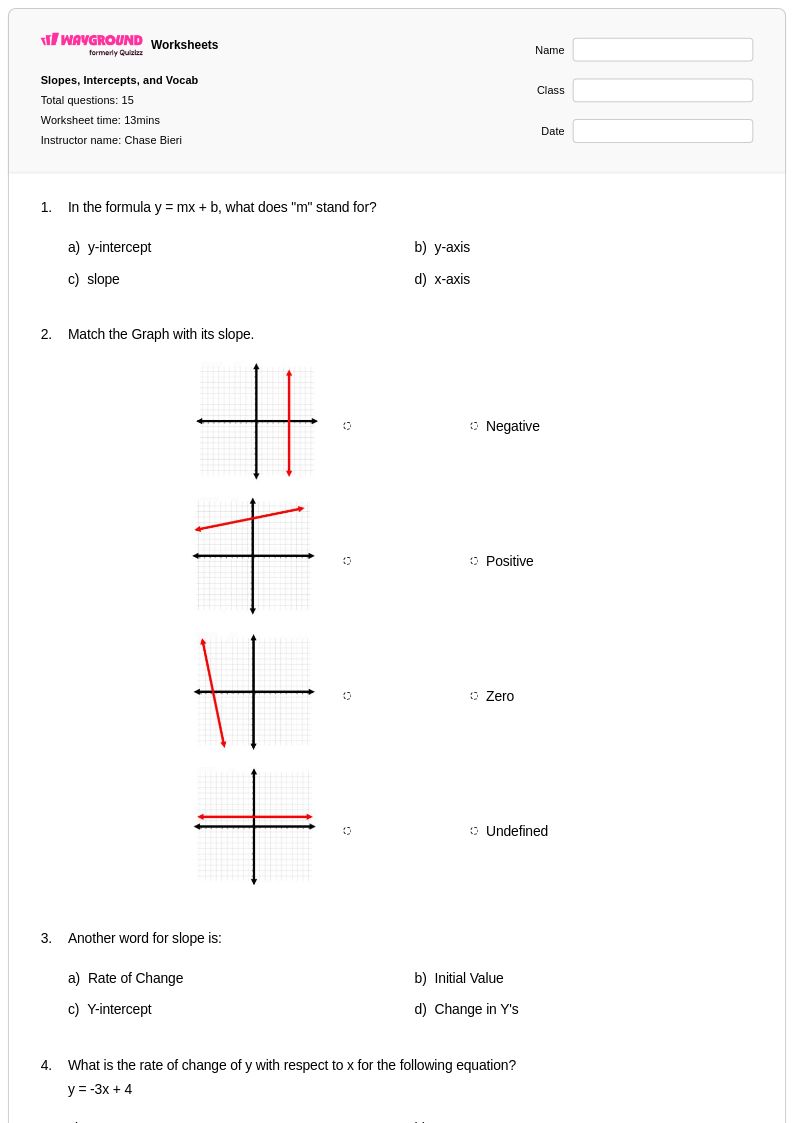
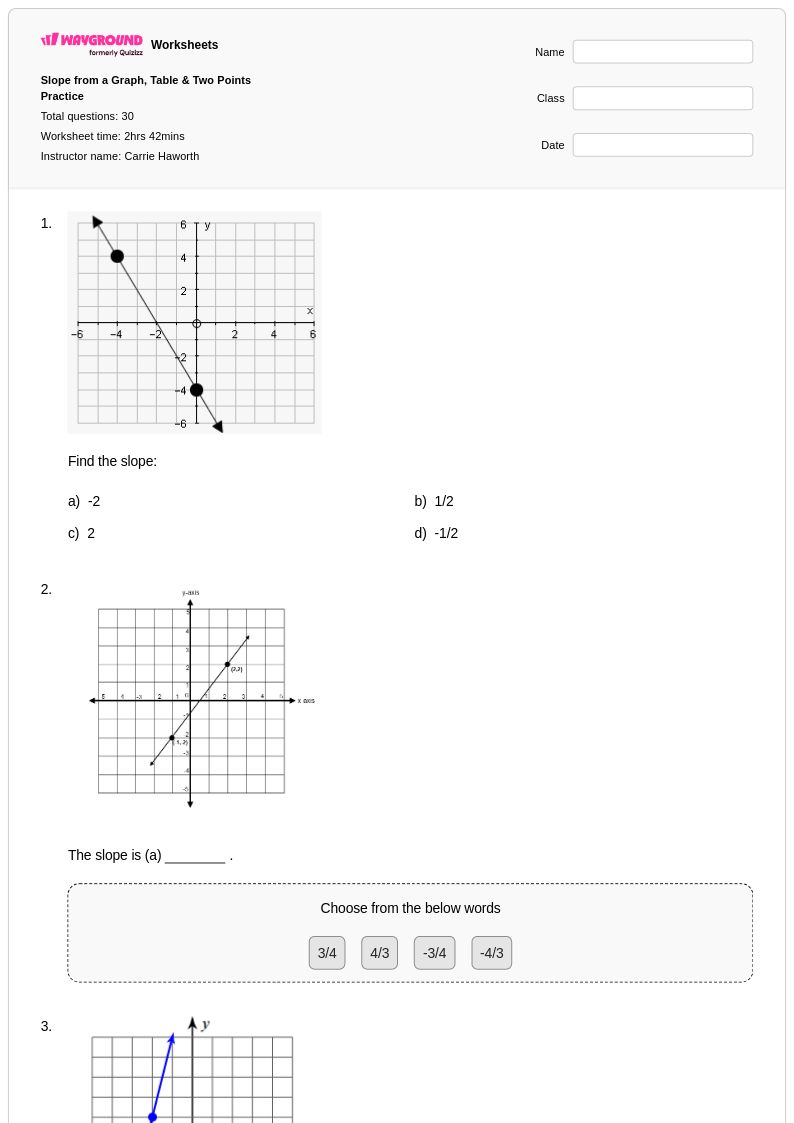
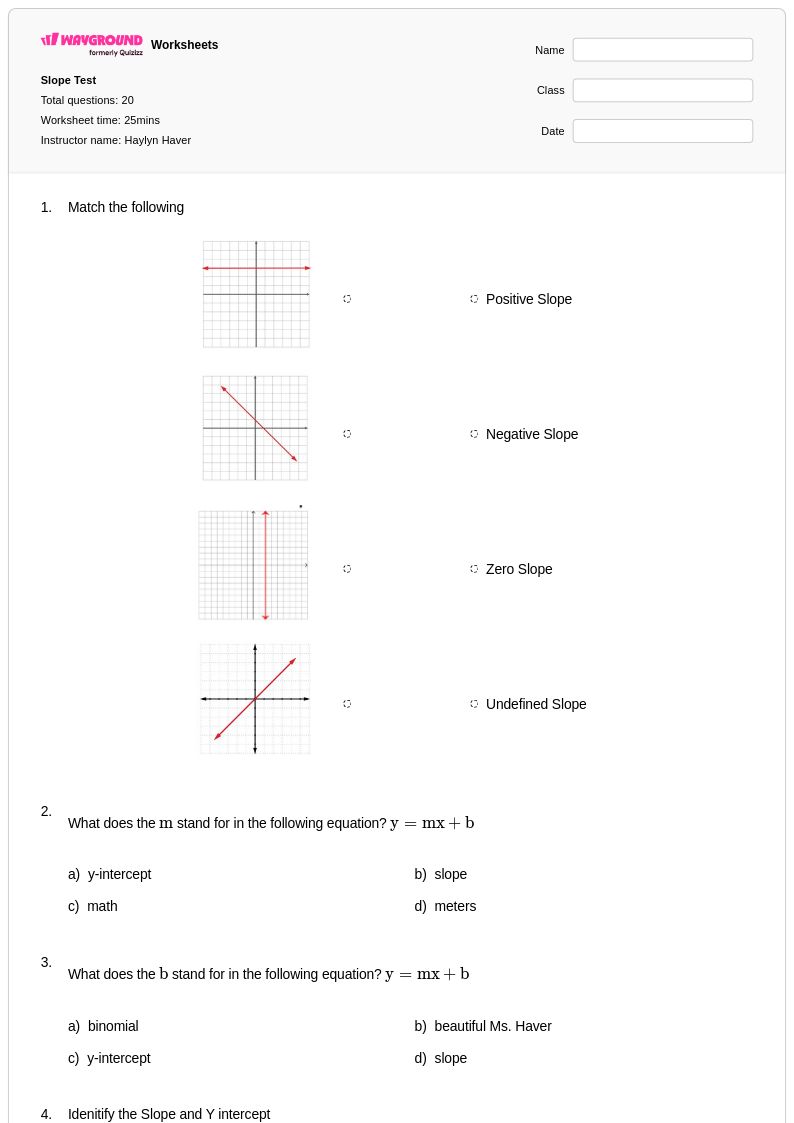
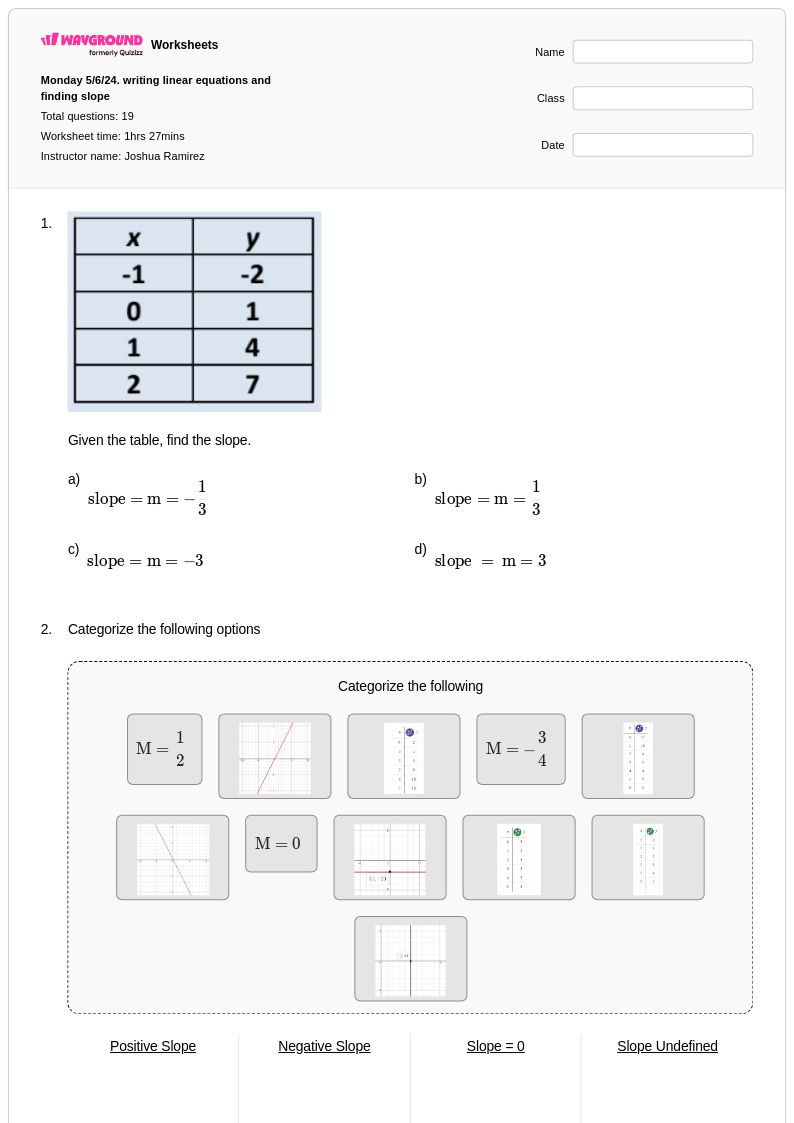
Access free slope fields worksheets and printables through Wayground to help students master directional field analysis, solution curve sketching, and differential equation visualization with comprehensive practice problems and answer keys.
Slope fields worksheets available through Wayground (formerly Quizizz) provide comprehensive practice with one of calculus's most visual and intuitive concepts for understanding differential equations. These carefully designed worksheets guide students through the process of sketching direction fields, interpreting solution curves, and connecting graphical representations to their underlying differential equations. Students develop critical analytical skills by working with practice problems that range from basic slope field construction to advanced applications involving equilibrium solutions and phase portraits. Each worksheet includes detailed answer keys that help students verify their graphical interpretations and understand common misconceptions, while the free printable pdf format ensures accessibility for both classroom instruction and independent study.
Wayground (formerly Quizizz) empowers mathematics educators with millions of teacher-created slope field resources that streamline lesson planning and enhance student comprehension of differential equations. The platform's robust search and filtering capabilities allow teachers to quickly locate worksheets aligned with specific calculus standards, whether focusing on directional fields for autonomous equations or more complex non-autonomous systems. Differentiation tools enable instructors to customize difficulty levels and problem types to meet diverse learning needs, supporting both remediation for struggling students and enrichment opportunities for advanced learners. Available in both printable and digital formats including downloadable pdfs, these worksheet collections facilitate flexible implementation across traditional and technology-enhanced classroom environments, ensuring students receive targeted skill practice that bridges the gap between abstract differential equation theory and visual mathematical reasoning.
FAQs
How do I introduce slope fields to my students?
Start by connecting to a concept they already know: the derivative dy/dx represents the slope of a function at a given point. Frame a slope field as a visual map of these slopes. For a given differential equation, you can pick a few (x, y) coordinates, calculate the slope at each one, and draw a small line segment with that slope. The collection of these segments reveals the shape of the family of solution curves.
What exercises help students practice with slope fields?
Effective practice moves from interpretation to creation. Start with matching exercises where students connect a differential equation to its corresponding slope field. Then, provide a field and an initial condition, asking them to sketch the particular solution curve. Finally, have them construct a simple slope field from scratch for an equation like dy/dx = x or dy/dx = y.
What are common student mistakes when working with slope fields?
A frequent error is confusing the variables. For an equation like dy/dx = 2x, students might incorrectly think the slope depends on the y-coordinate. They may also struggle to see the overall flow of the solution curves, getting bogged down in calculating individual slopes without interpreting the larger pattern.
How do slope fields fit into the calculus curriculum?
Slope fields are a key concept in the AP Calculus curriculum, building on the foundation of derivatives from Common Core's high school standards. They serve as a critical visual bridge, allowing students to analyze the behavior of solutions to differential equations graphically before they learn the algebraic techniques to solve them. This reinforces the connection between a function's derivative and the shape of its graph.
How can I use this slope fields worksheet in my class?
You can assign this worksheet in multiple ways to fit your classroom's needs. Host it as an interactive digital quiz on Wayground for immediate student feedback, or provide it as a printable PDF for hands-on paper practice. Every worksheet includes a complete answer key to streamline grading or support self-assessment.
How can I support students who struggle with this visual topic?
For students finding the visual-spatial task difficult, Wayground offers several supports. You can create an alternate version of the worksheet with a dyslexia-friendly font or wider spacing to improve readability. For digital assignments, consider enabling the Read Aloud feature for the differential equation or reducing the number of answer choices on matching questions to lower cognitive load.