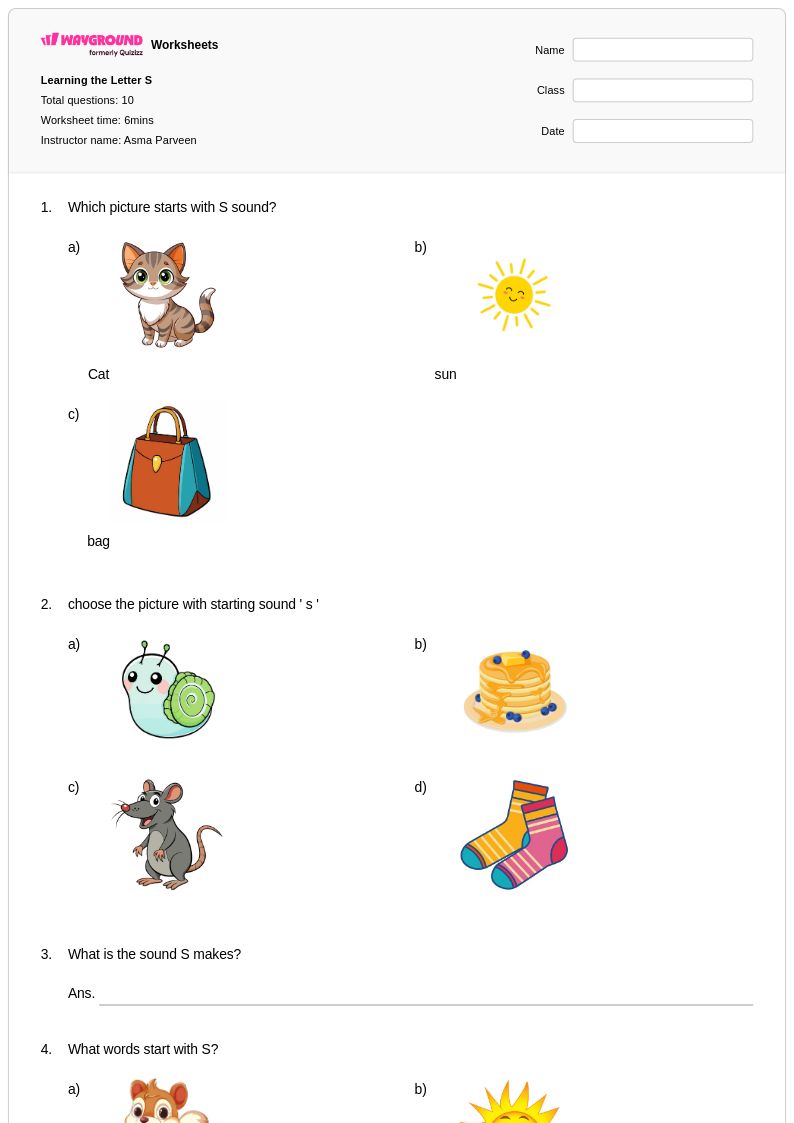
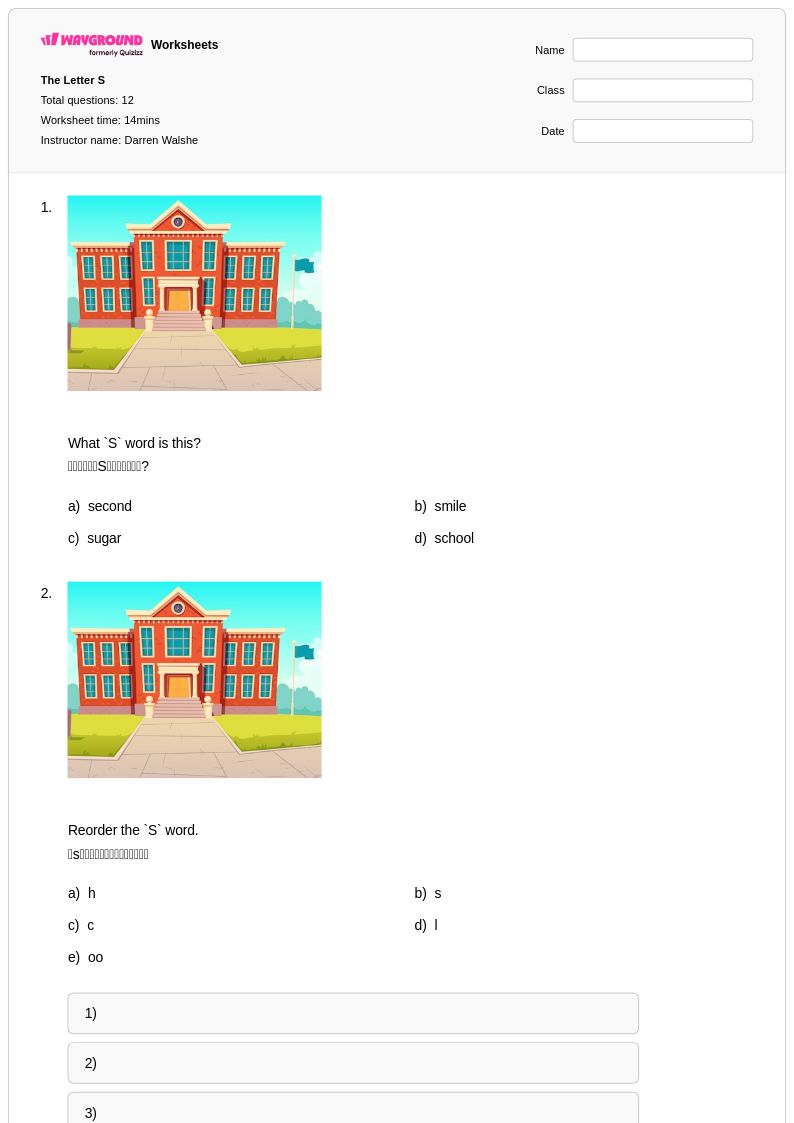
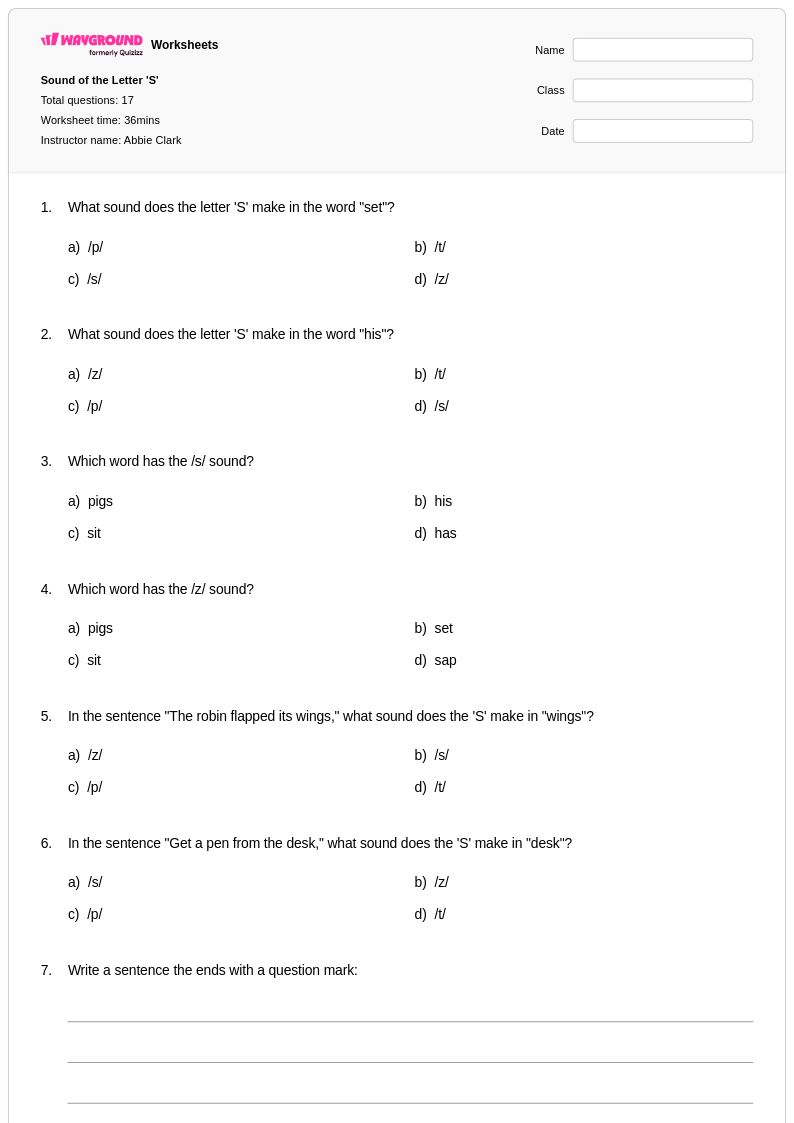
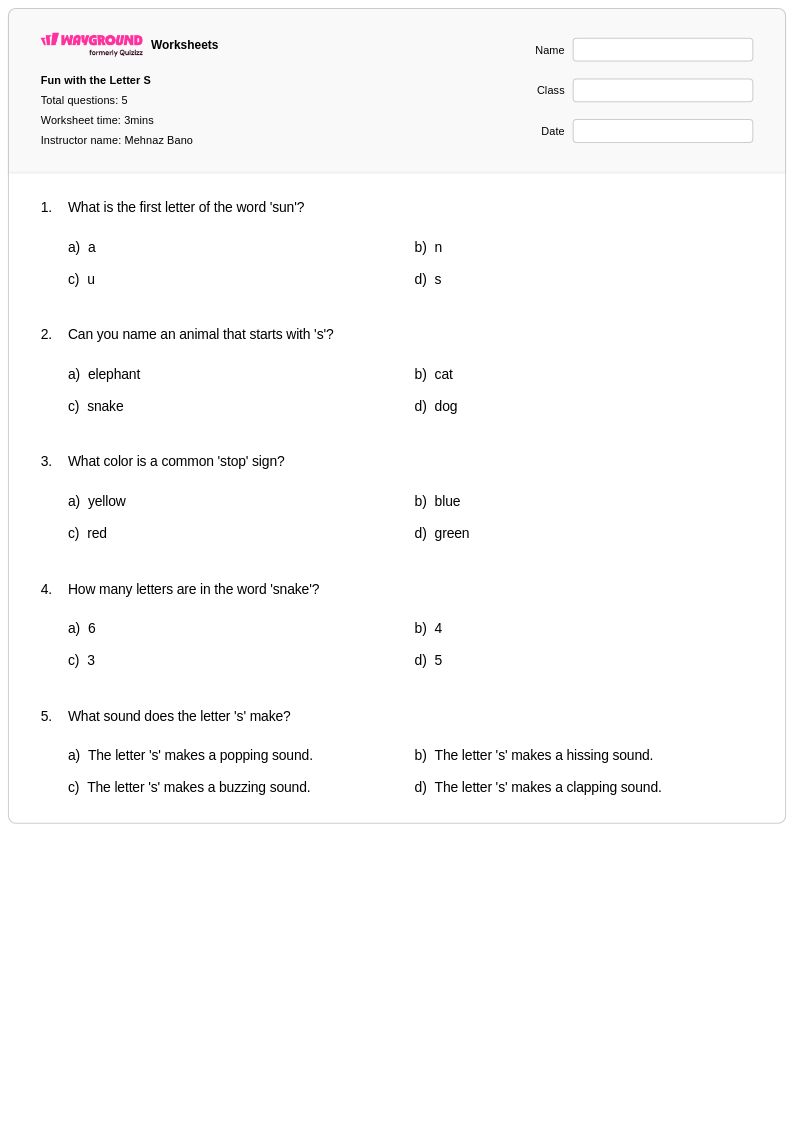
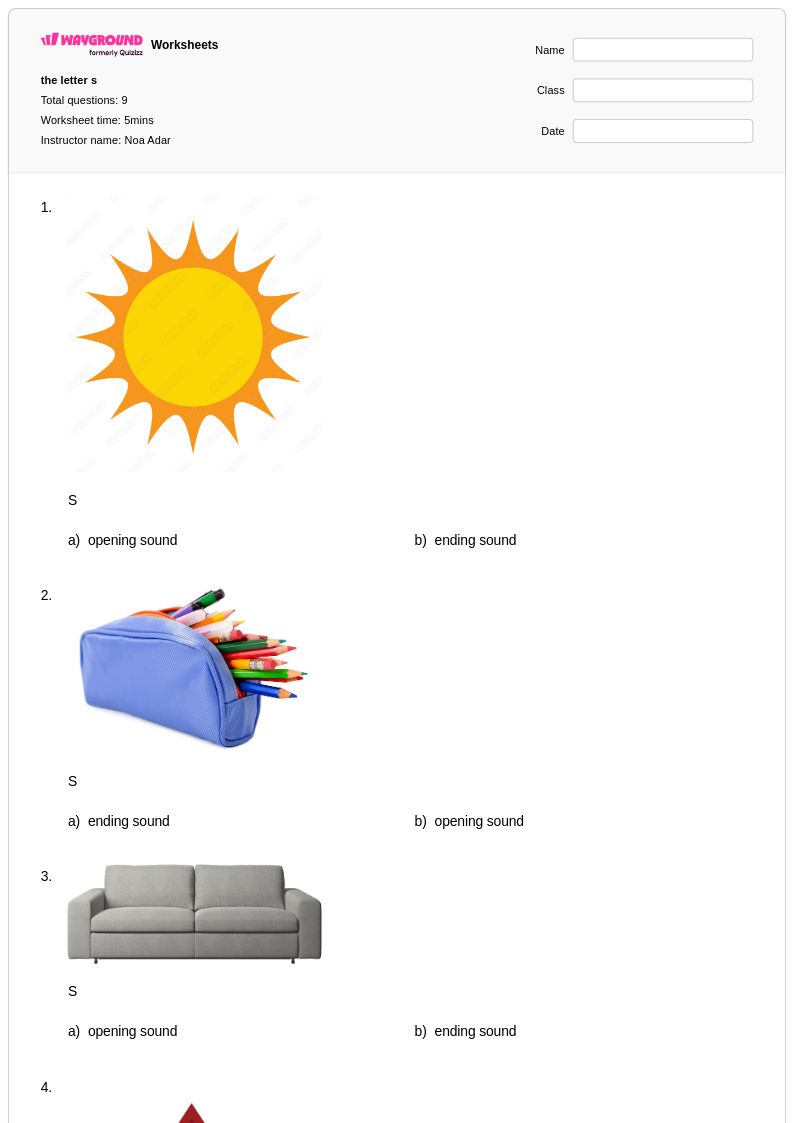
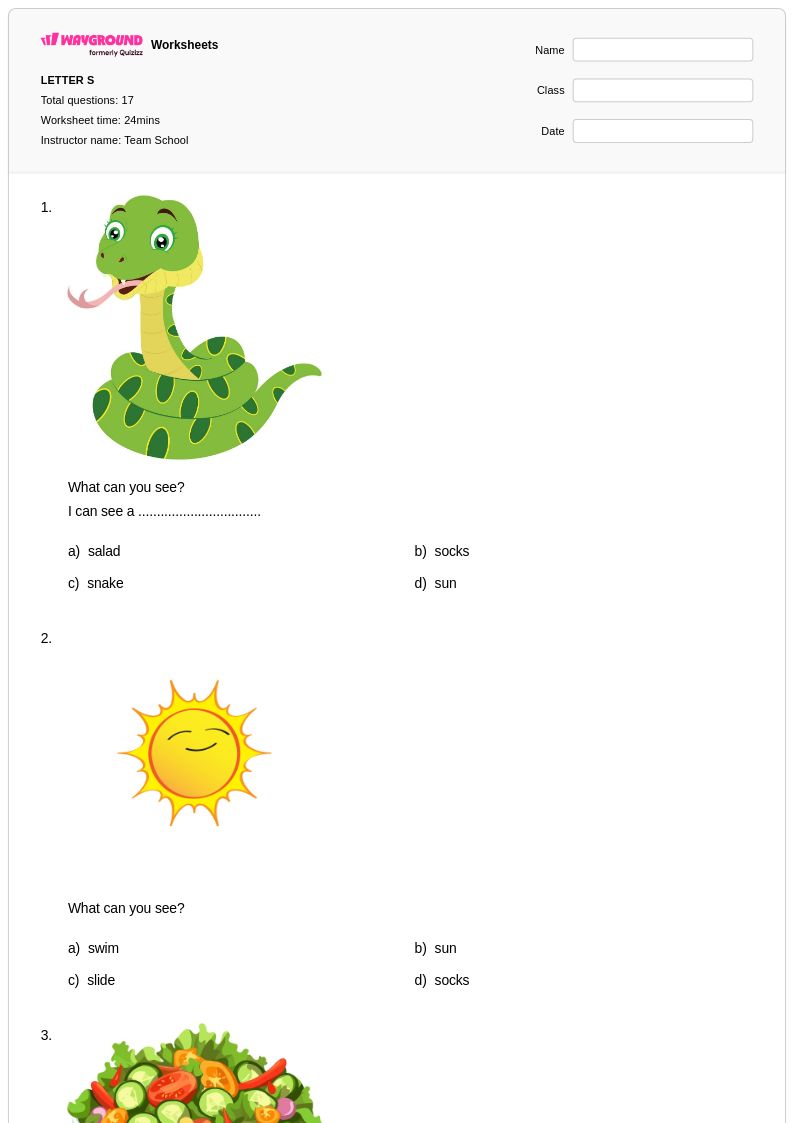
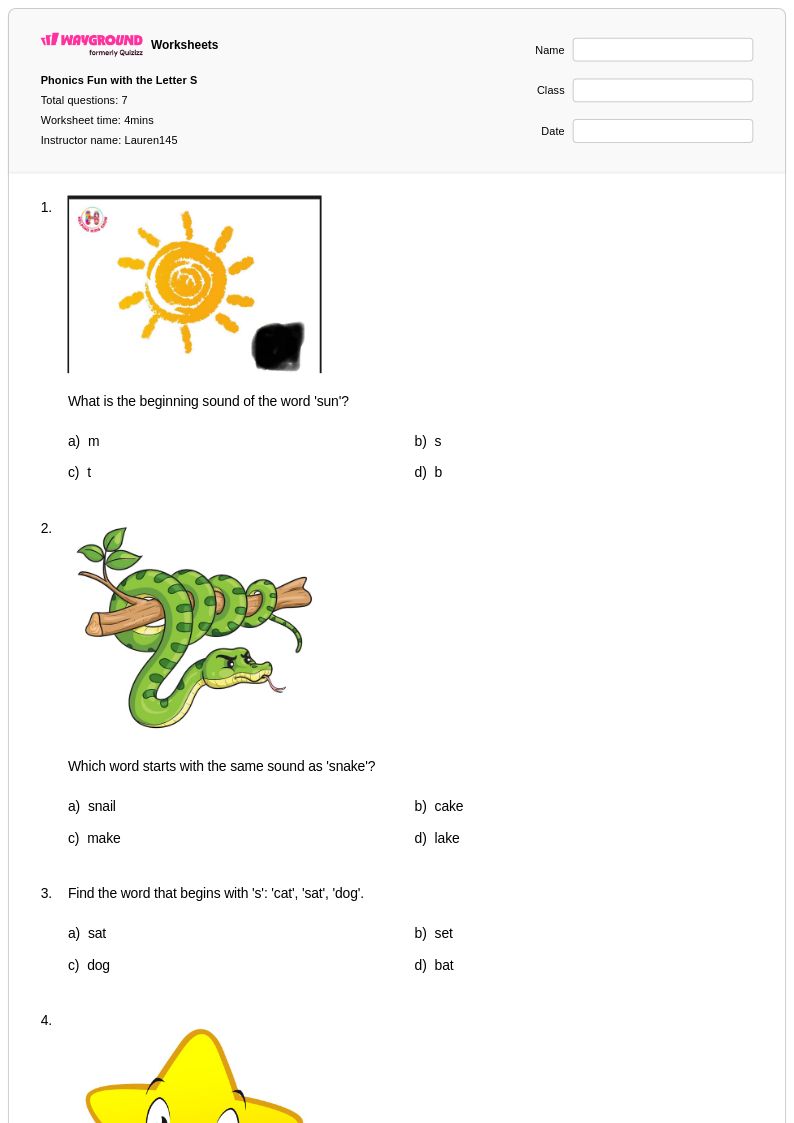
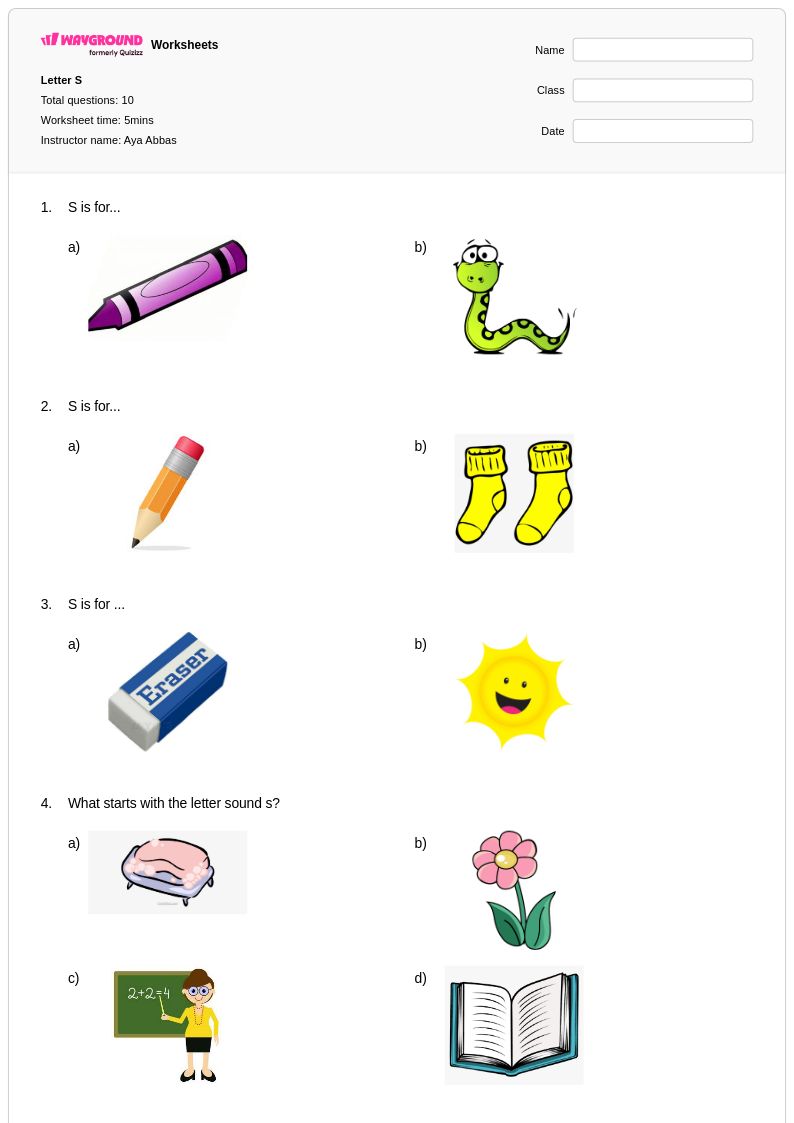
Explore Wayground's free Letter S worksheets and printables that help students master letter recognition, formation, and phonics through engaging practice problems with complete answer keys.
The Letter S worksheets available through Wayground (formerly Quizizz) provide comprehensive practice for students learning to recognize, write, and work with this essential consonant. These educational resources focus on building foundational literacy skills through systematic letter recognition activities, proper letter formation practice, and phonetic awareness exercises that help students connect the letter S with its corresponding sounds. The collection includes free printables featuring tracing activities, identification exercises, and beginning sound practice problems that reinforce letter-sound relationships crucial for early reading development. Each worksheet comes with a corresponding answer key to support effective assessment and immediate feedback, while the pdf format ensures convenient access for both classroom instruction and home practice sessions.
Wayground (formerly Quizizz) empowers teachers with millions of teacher-created Letter S resources that streamline lesson planning and differentiated instruction. The platform's robust search and filtering capabilities allow educators to quickly locate age-appropriate materials that align with literacy standards and specific learning objectives. Teachers can customize worksheets to match individual student needs, whether for remediation support or enrichment activities, while accessing both printable and digital formats to accommodate diverse classroom environments. These flexible tools enable educators to provide targeted skill practice, conduct formative assessments, and adapt instruction based on student progress, ultimately supporting more effective literacy instruction and improved learning outcomes for students mastering this fundamental letter recognition skill.
FAQs
How do I teach the letter S to early learners?
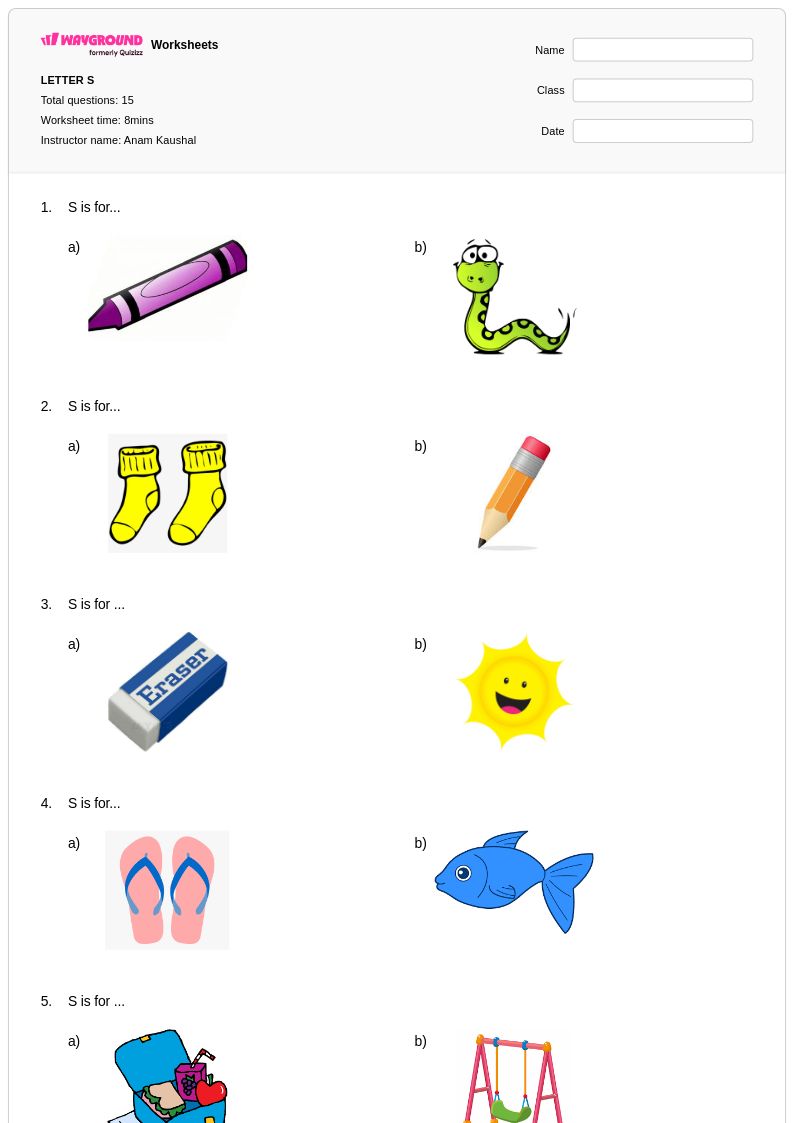
Teaching the letter S effectively involves connecting letter recognition, formation, and sound in sequence. Begin with visual identification so students can distinguish uppercase and lowercase S from other letters, then introduce proper stroke formation through guided tracing. Once students can write the letter consistently, reinforce the /s/ sound through beginning-sound activities that link the letter to familiar words like 'sun,' 'sock,' and 'snake.' Multisensory approaches, such as tracing in sand or forming the shape with clay, help reinforce muscle memory alongside phonemic awareness.
What exercises help students practice the letter S?
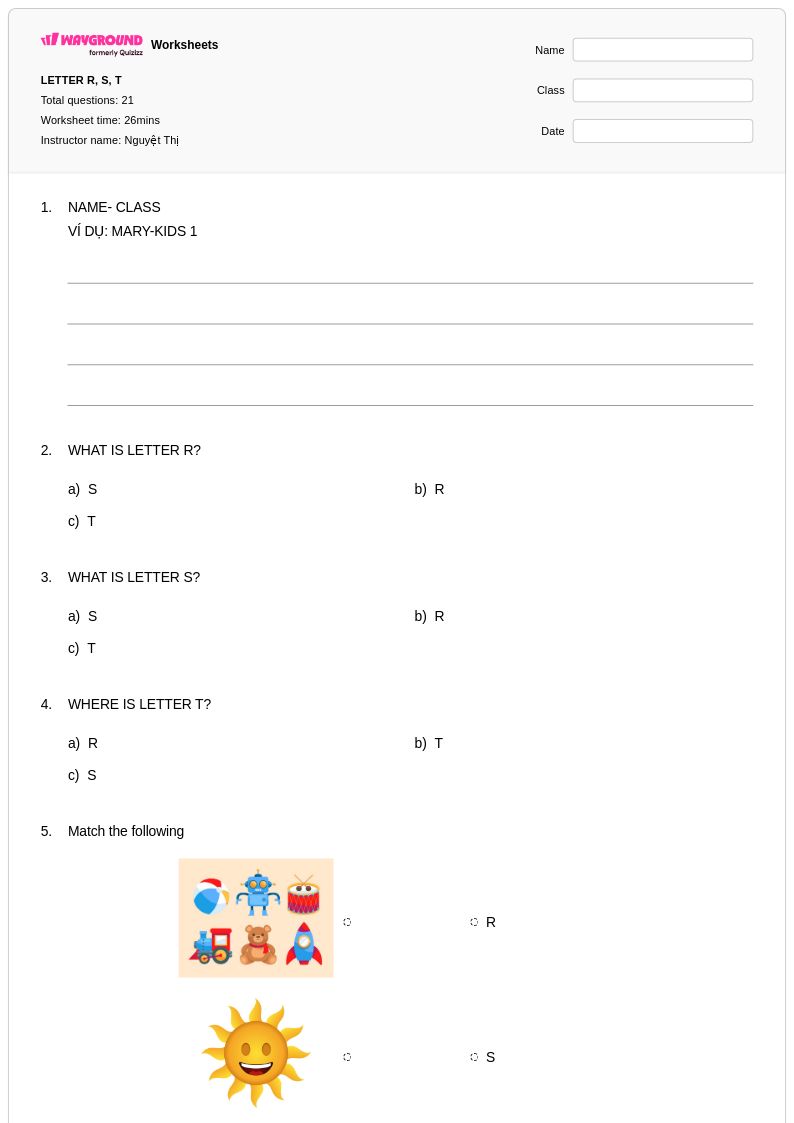
Effective practice exercises for the letter S include tracing uppercase and lowercase forms to build formation habits, circling or sorting pictures that begin with the /s/ sound, and matching activities that connect the letter to objects or words. Beginning-sound identification tasks are particularly useful because they reinforce the letter-sound relationship that underpins early decoding. Repeated, varied practice across recognition, writing, and phonics tasks helps consolidate the letter S as a reliable building block for reading and spelling.
What mistakes do students commonly make when learning the letter S?
One of the most common errors is reversing or mirroring the letter S, writing it as a backward curve, which reflects developing spatial awareness rather than a deeper literacy gap. Students also frequently confuse the /s/ sound with /z/, especially in words where S makes a voiced sound, such as 'is' or 'his.' During beginning-sound tasks, learners sometimes select pictures based on spelling assumptions rather than the initial sound they hear, so explicit phonemic awareness instruction alongside letter work is important.
How can I use Letter S worksheets to support different learners in my classroom?
Letter S worksheets on Wayground are available as both printable PDFs and in digital formats, making them adaptable for in-person, remote, and blended learning environments, and teachers can host them as a quiz directly on Wayground. For students who need additional support, Wayground's digital format allows teachers to enable accommodations such as read aloud, reduced answer choices, and extended time, which can be assigned to individual students without disrupting the rest of the class. These settings are reusable across sessions, reducing setup time for recurring accommodations.
At what age or grade level should students be working on letter S recognition and formation?
Letter S recognition and formation is typically introduced in pre-K and kindergarten, where foundational literacy instruction focuses on the alphabet as a whole. Most students engage with individual letter worksheets between ages 4 and 6, though some early learners may encounter letter S activities as early as preschool through name recognition or phonics readiness programs. Students who need remediation in first grade may also benefit from targeted letter S practice, particularly if letter reversals or phonics gaps are identified during early literacy screening.