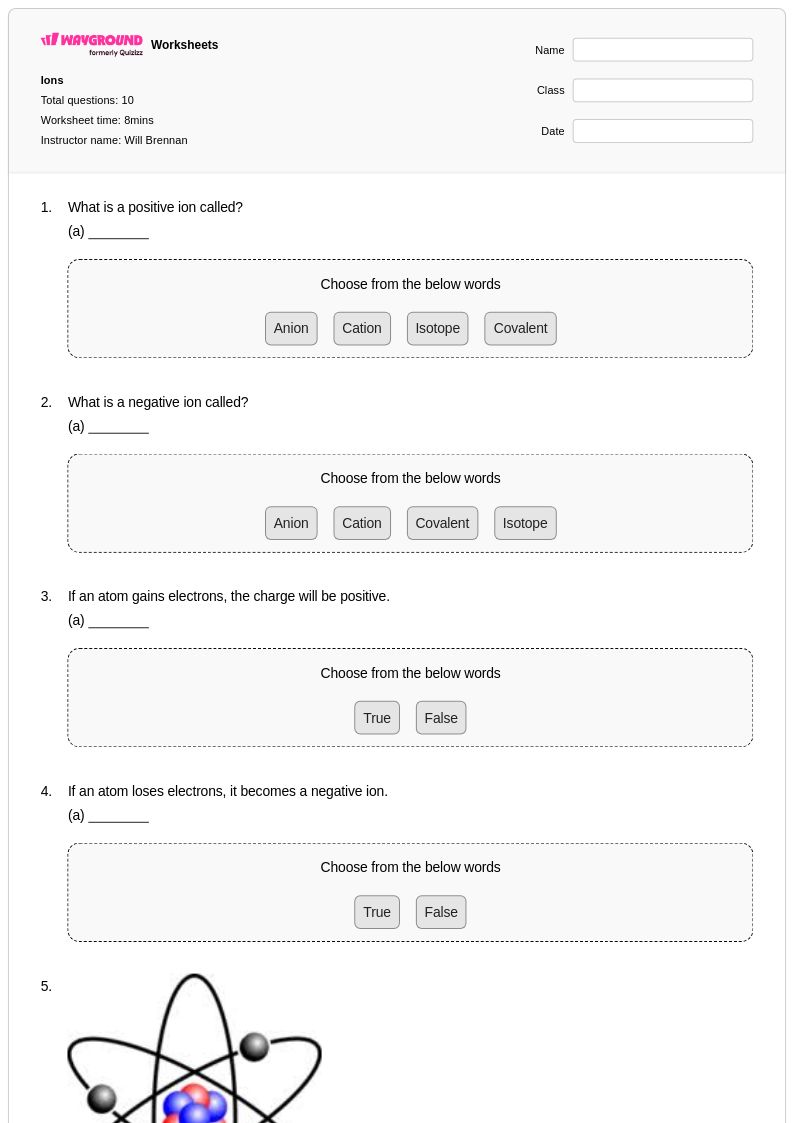
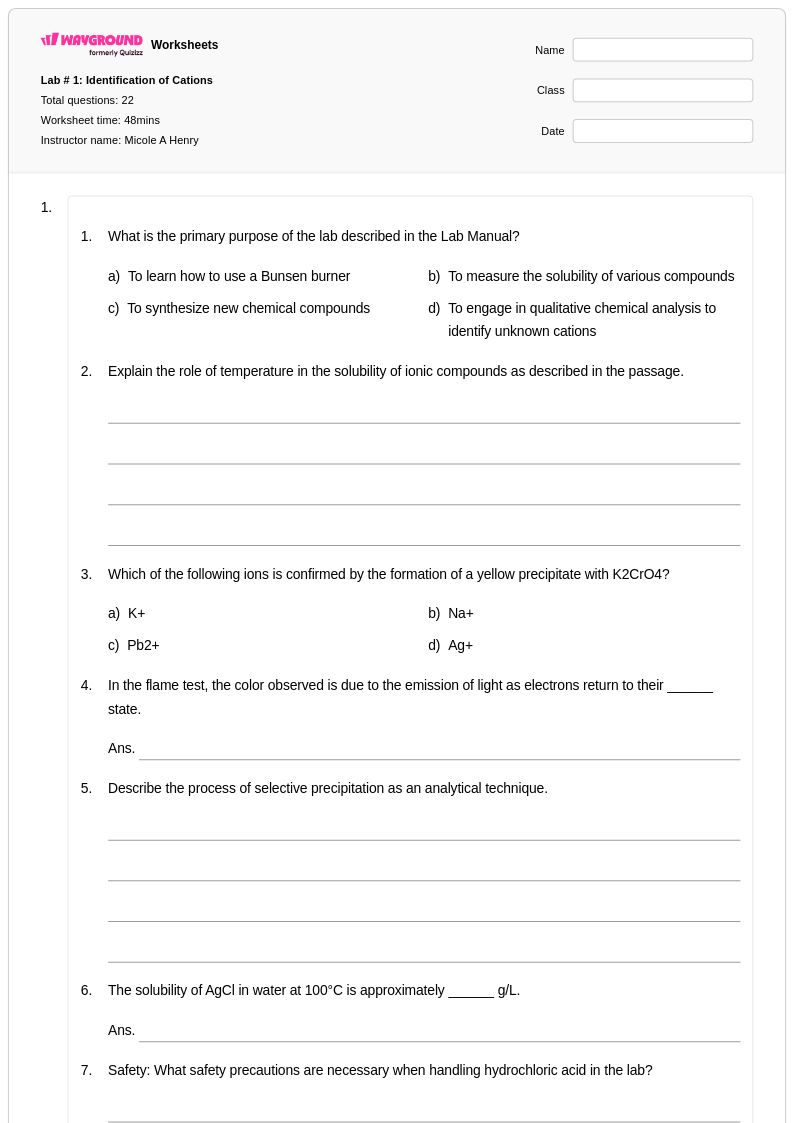
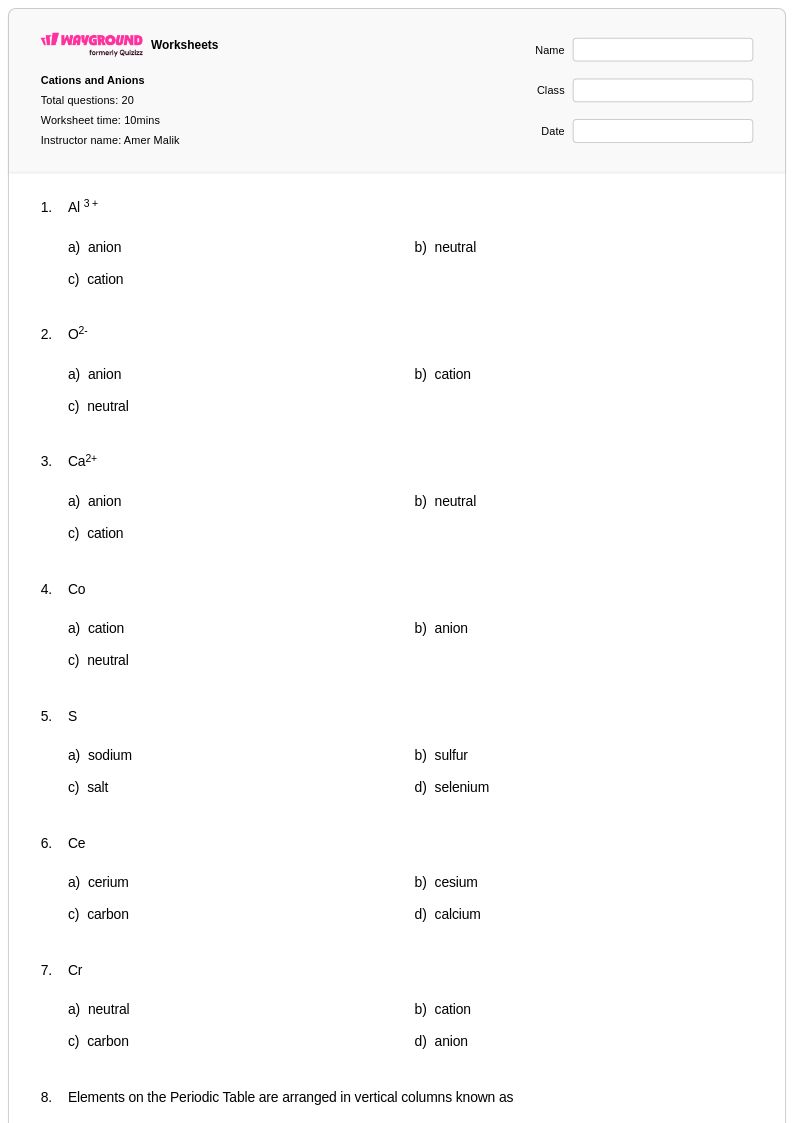
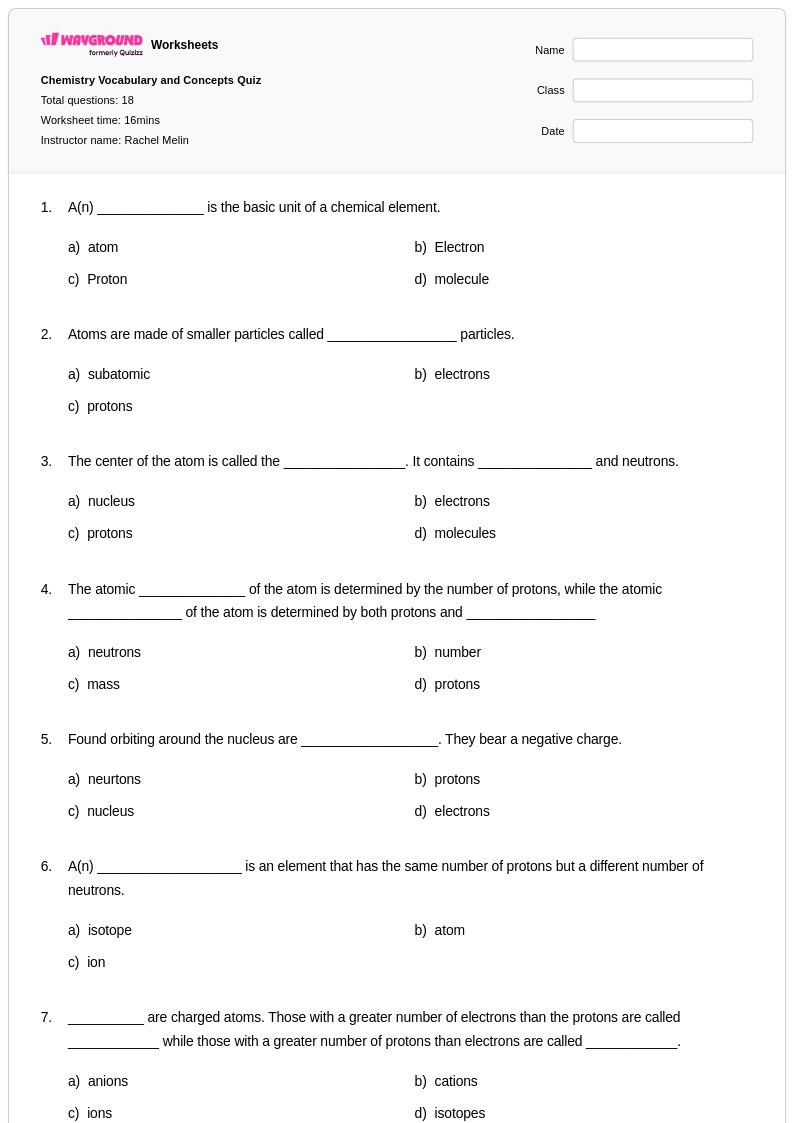
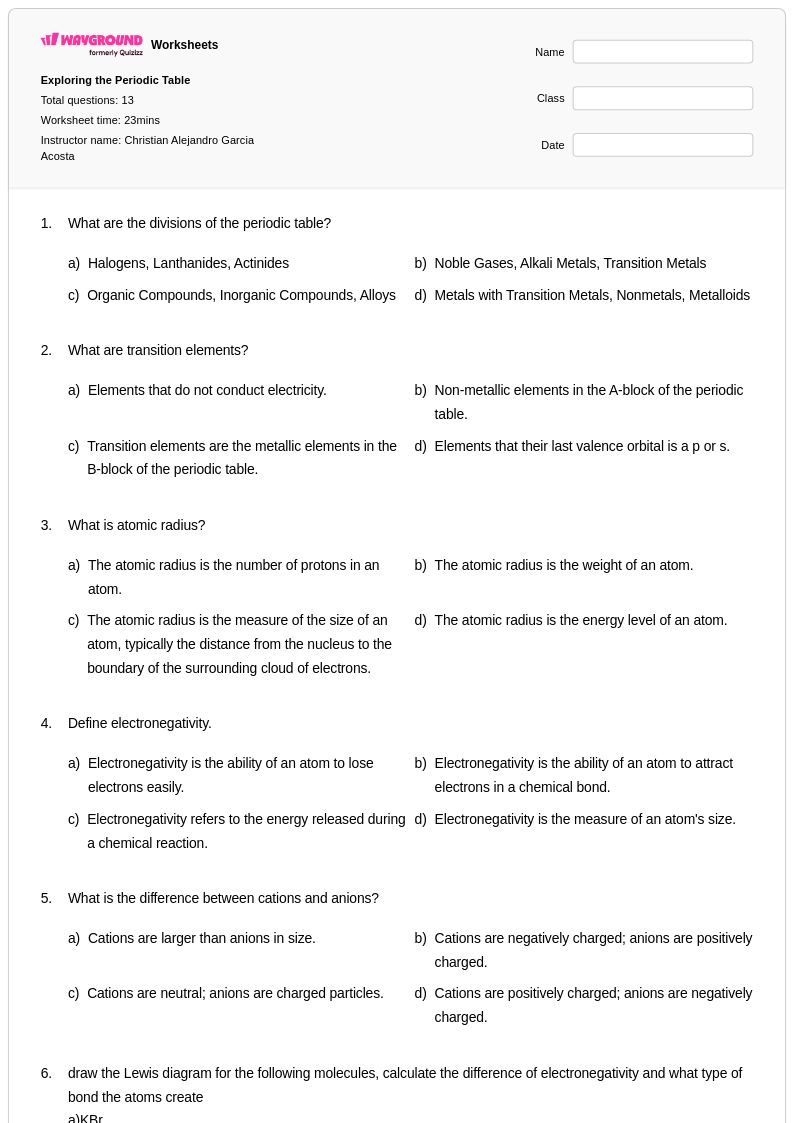
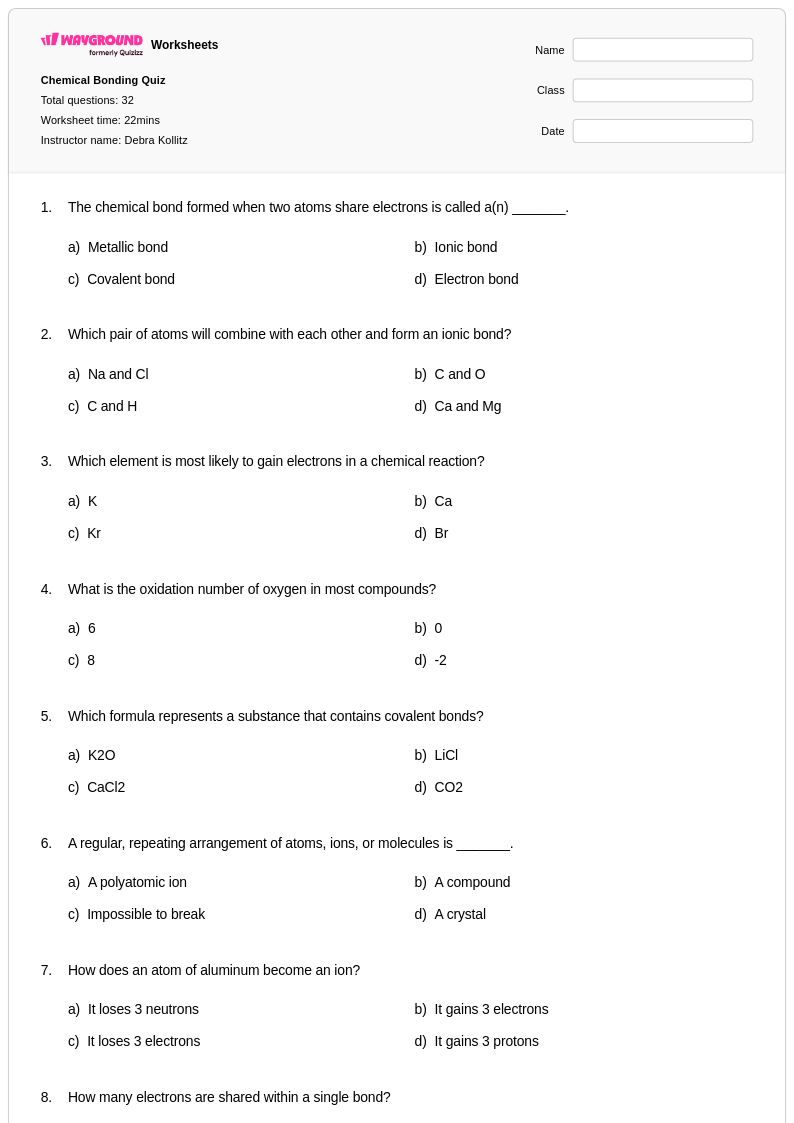
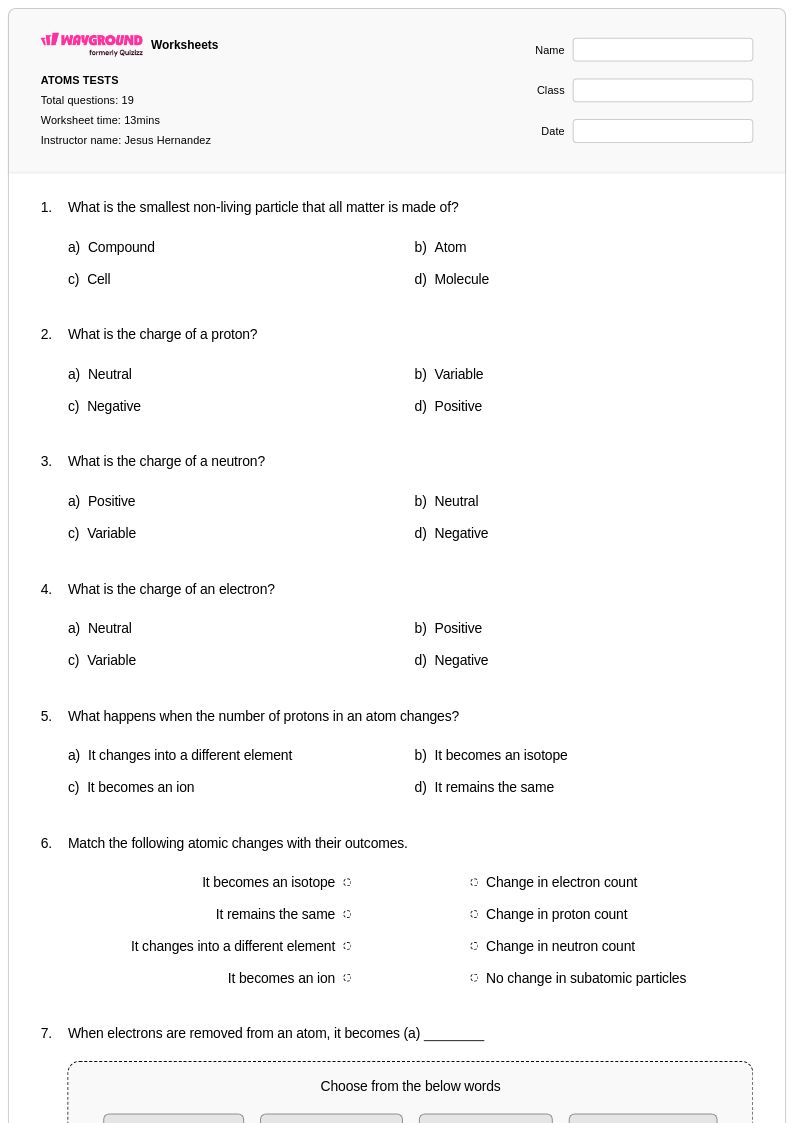
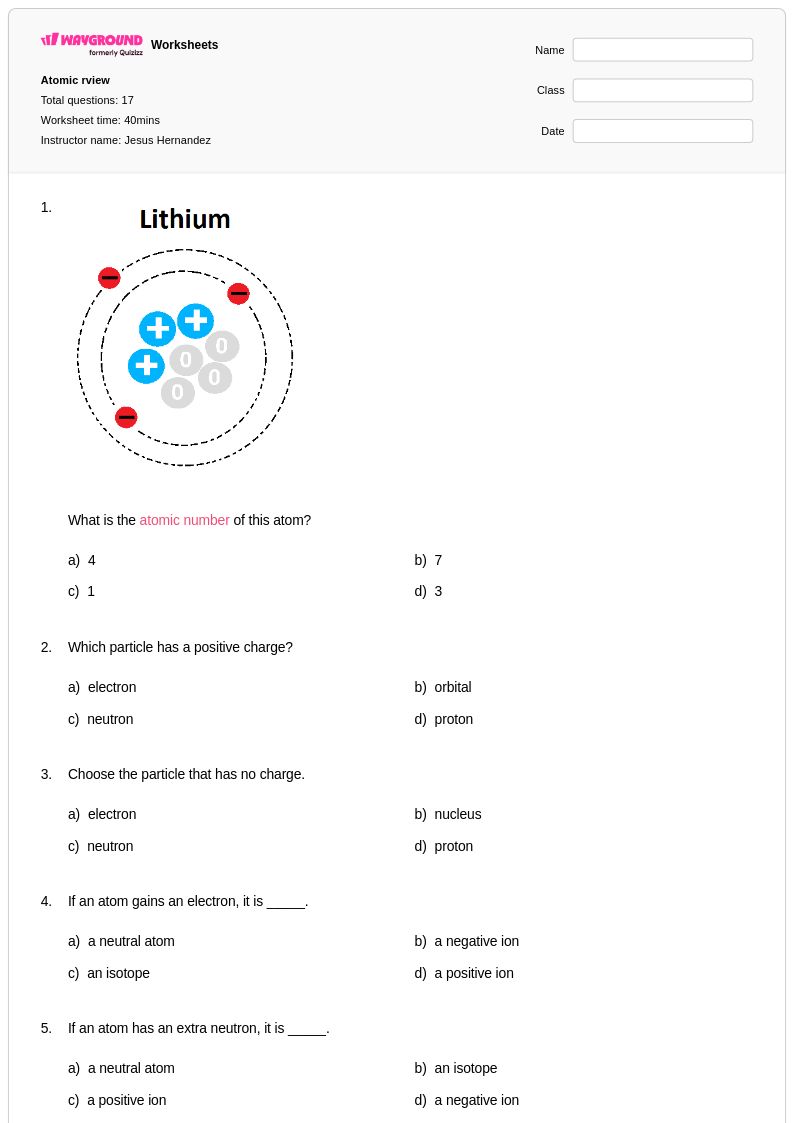
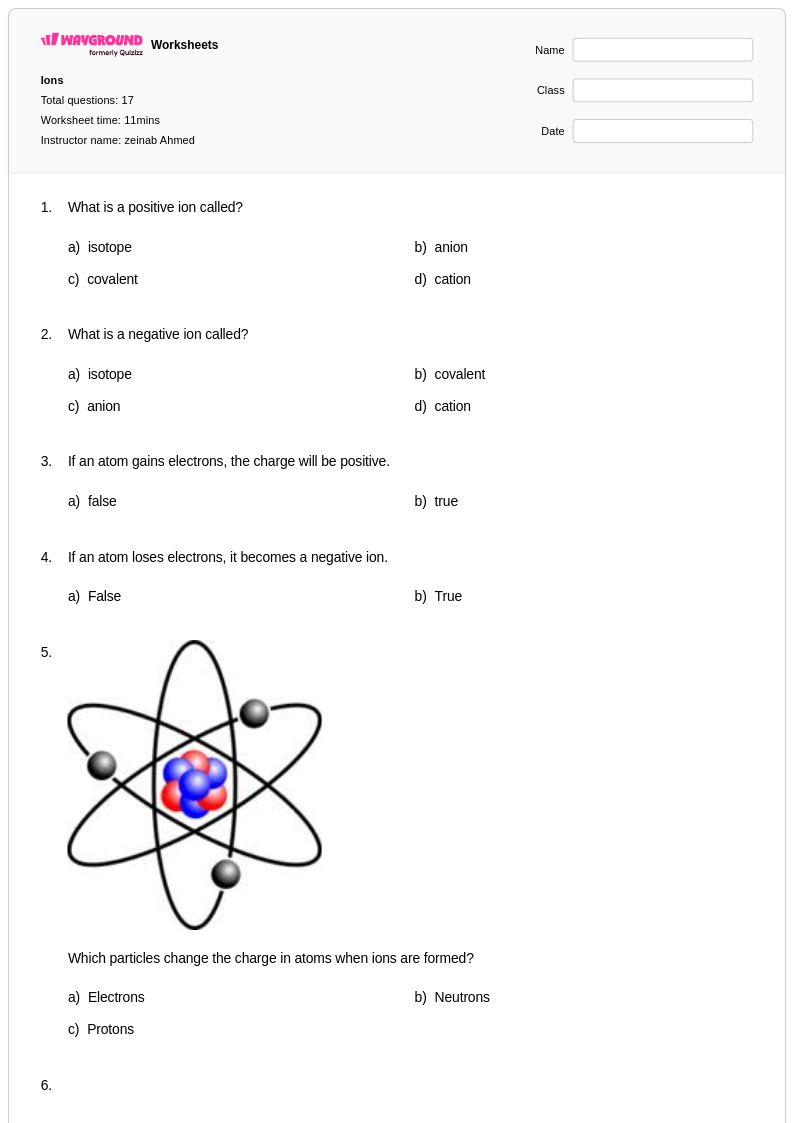
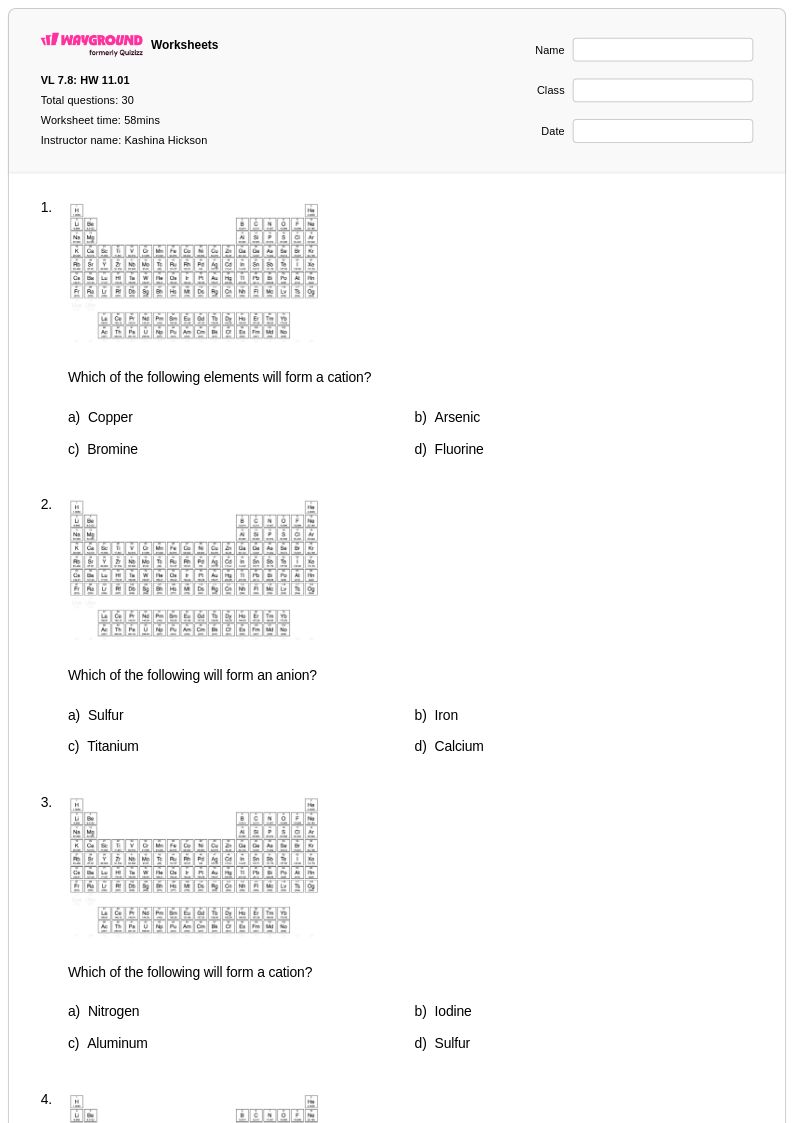
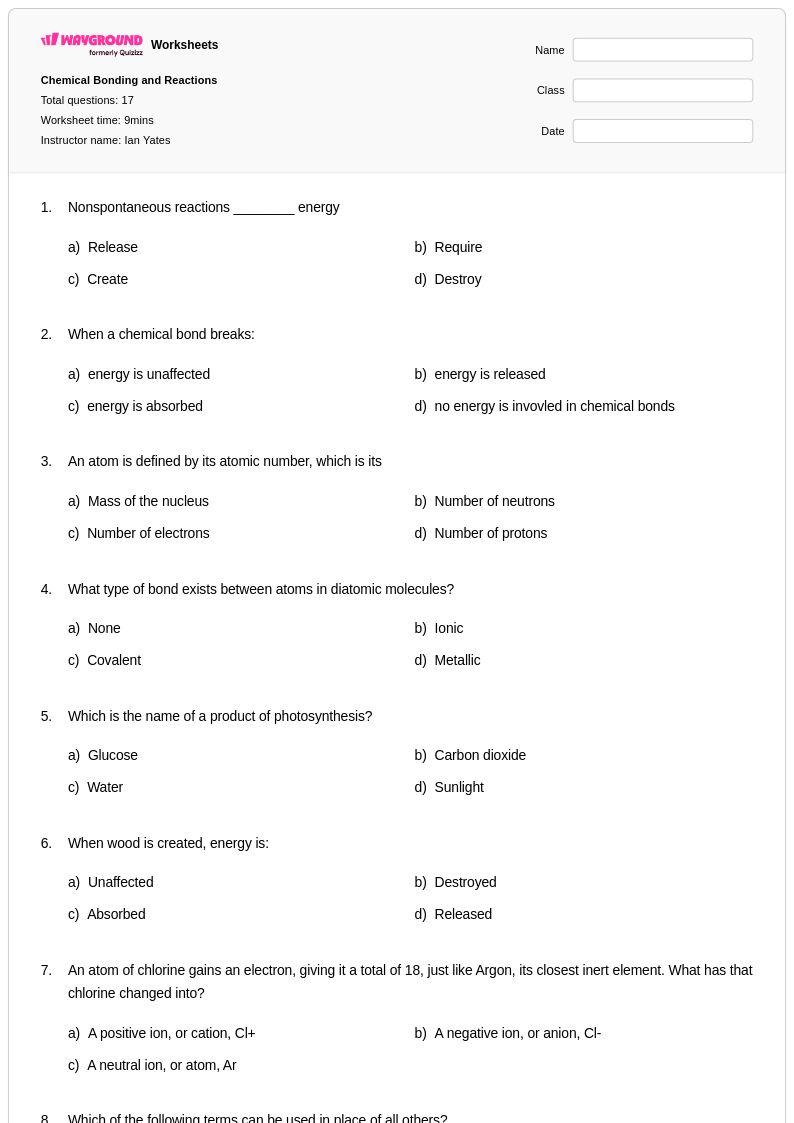
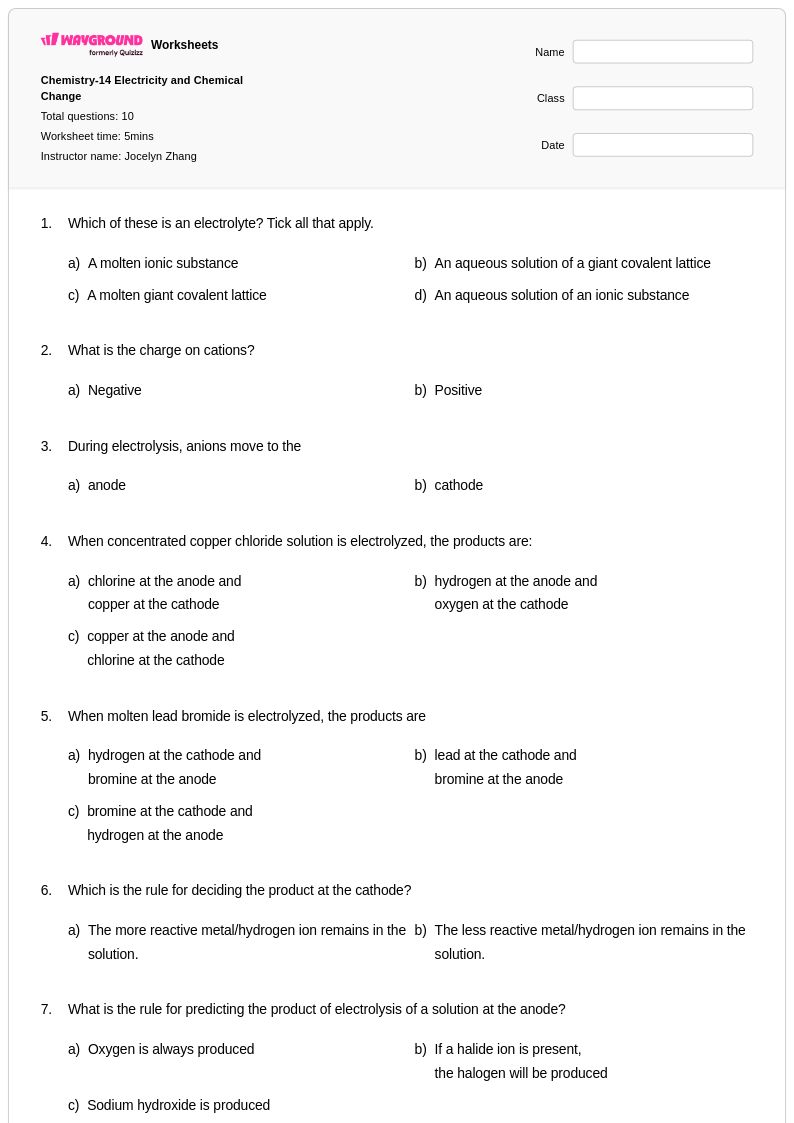
Explore Wayground's comprehensive Grade 7 cations worksheets featuring free printables and practice problems with answer keys to help students master positively charged ions in chemistry.
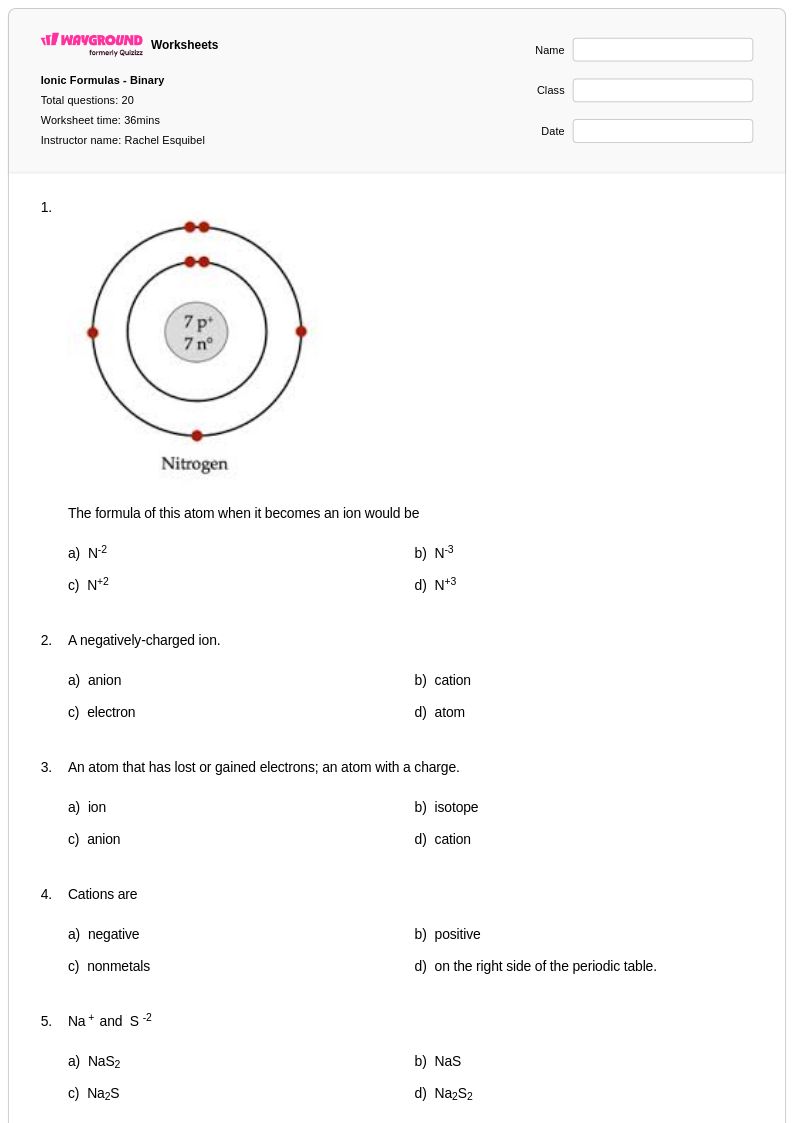
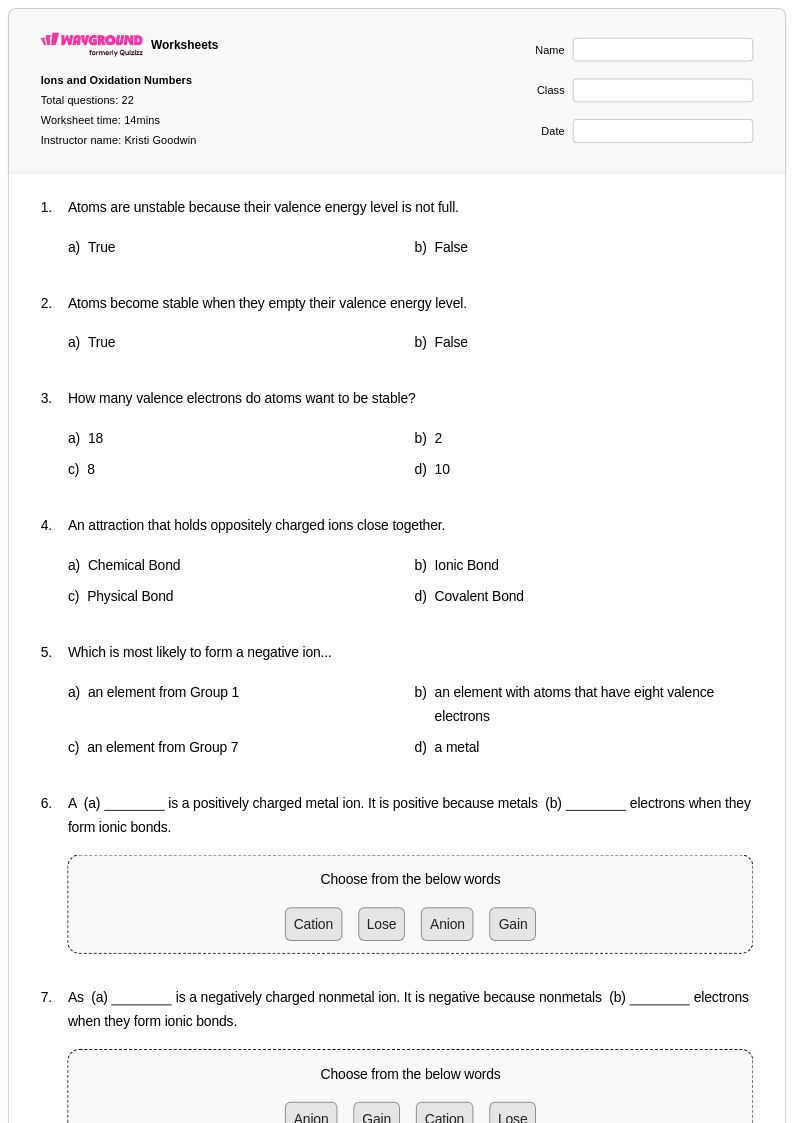
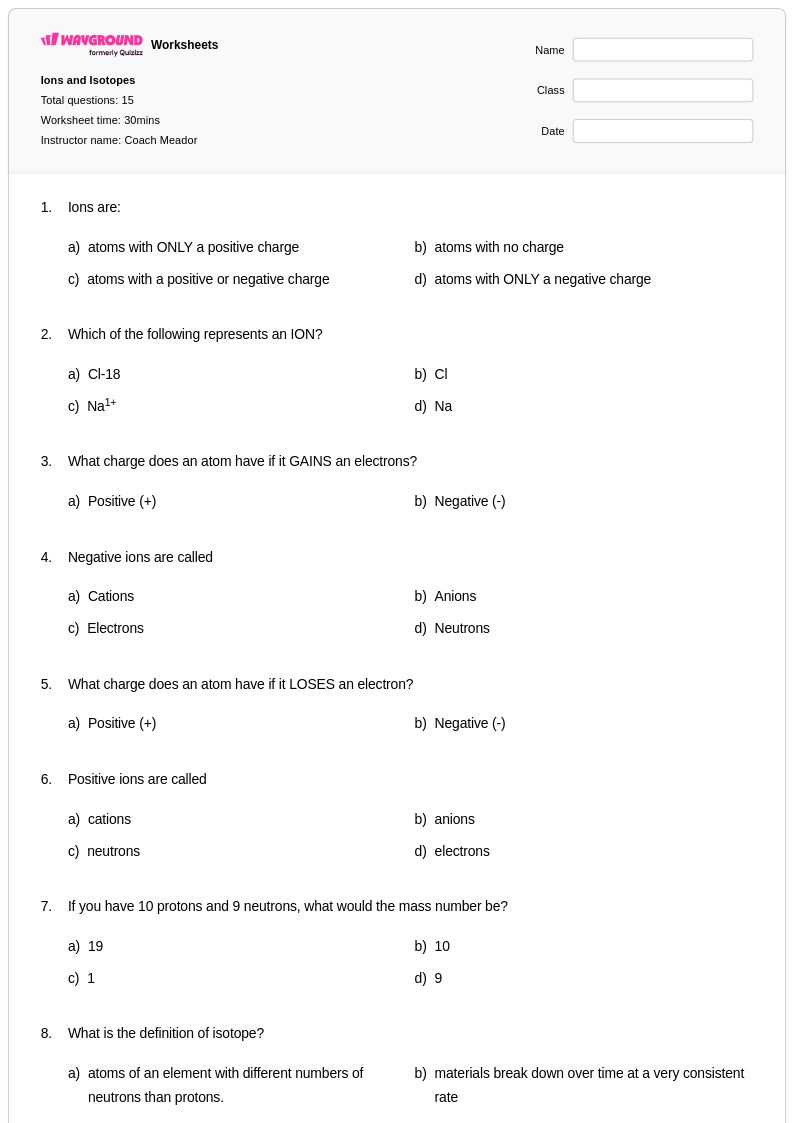
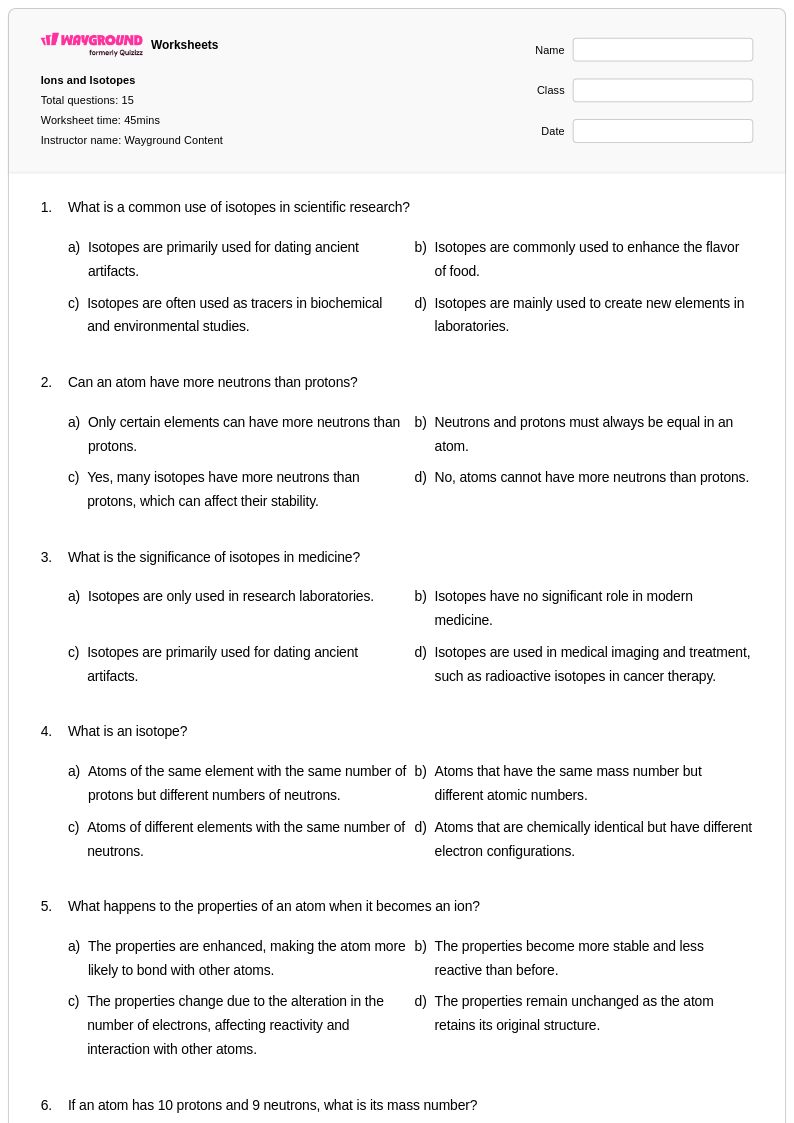
Grade 7 cations worksheets available through Wayground (formerly Quizizz) provide comprehensive practice materials designed to help middle school students master the fundamental concepts of positively charged ions in chemistry. These educational resources strengthen critical skills including identifying common cations, understanding their formation from neutral atoms through electron loss, recognizing naming conventions for monatomic and polyatomic cations, and applying knowledge of ionic charges in chemical formulas. The collection features diverse practice problems that progress from basic cation identification to more complex applications involving ionic compounds, with each worksheet including detailed answer keys to support independent learning and self-assessment. Teachers can access these free printables in convenient PDF format, making it easy to distribute materials for classroom instruction, homework assignments, or targeted skill reinforcement.
Wayground (formerly Quizizz) supports chemistry educators with an extensive collection of teacher-created cation worksheets drawn from millions of high-quality educational resources. The platform's robust search and filtering capabilities enable teachers to quickly locate materials aligned with specific learning standards while offering differentiation tools that accommodate diverse student needs and learning levels. These Grade 7 cation worksheets are available in both printable and digital formats, including downloadable PDFs that provide flexibility for various instructional settings and learning preferences. The comprehensive collection supports effective lesson planning by offering materials suitable for initial concept introduction, skill practice sessions, remediation for struggling learners, and enrichment activities for advanced students, while the customization features allow teachers to modify worksheets to match their specific curriculum requirements and classroom objectives.
FAQs
How do I teach cations to chemistry students?
Start by grounding students in atomic structure, specifically the role of valence electrons, before introducing the concept of electron loss and positive charge formation. Use the periodic table to show predictable patterns: Group 1 metals lose one electron, Group 2 lose two, and transition metals vary. Connecting cation formation to real-world examples like sodium in table salt or calcium in bones helps students see why cations matter beyond the classroom.
What exercises help students practice identifying and writing cations?
Effective practice includes exercises where students determine the charge of a cation based on an element's group number, write the correct ionic symbol with charge notation, and identify cations within chemical formulas. Matching activities that pair elements to their most common cation charges reinforce periodic table patterns, while ionic compound formation problems require students to apply cation knowledge in context.
What mistakes do students commonly make when learning about cations?
A frequent error is confusing the number of electrons lost with the resulting charge — students sometimes write the charge as negative rather than positive after electron loss. Many students also struggle with transition metals, which can form multiple cation charges, and incorrectly assume all metals form only one type of cation. Additionally, students often mix up the notation for ionic charge and atomic mass number when writing ion symbols.
How do cation worksheets help students understand ionic bonding?
Cation worksheets build the foundational knowledge students need to understand ionic bonding by requiring them to predict charges, recognize charge patterns across the periodic table, and pair cations with anions to form neutral compounds. Because ionic bonding depends entirely on understanding how and why cations form, targeted practice with cation identification directly strengthens students' ability to write correct ionic formulas and predict compound properties.
How can I use Wayground's cation worksheets in my classroom?
Wayground's cation worksheets are available as printable PDFs, making them easy to distribute in a traditional classroom setting, and in digital formats that work well for online or hybrid instruction. Teachers can also host the worksheets as a quiz directly on Wayground, enabling real-time tracking of student responses. Answer keys are included with every worksheet, supporting both independent student practice and teacher-led review sessions.
How can I support students who struggle with cation concepts?
For students who need additional support, breaking practice into smaller steps — first identifying the element's group, then determining electrons lost, then writing the ion symbol — reduces cognitive overload. On Wayground, teachers can apply accommodations such as reduced answer choices or read-aloud settings for individual students, which is especially helpful for learners who need scaffolding when navigating multi-step chemistry problems.