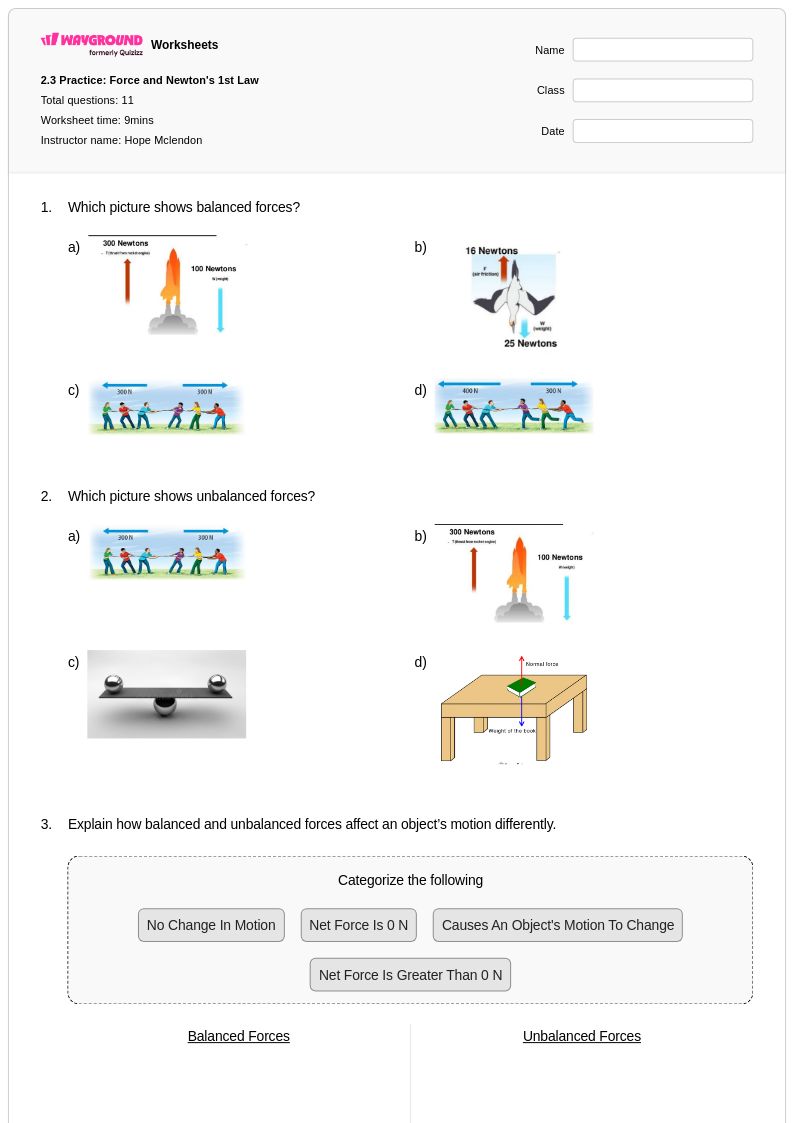
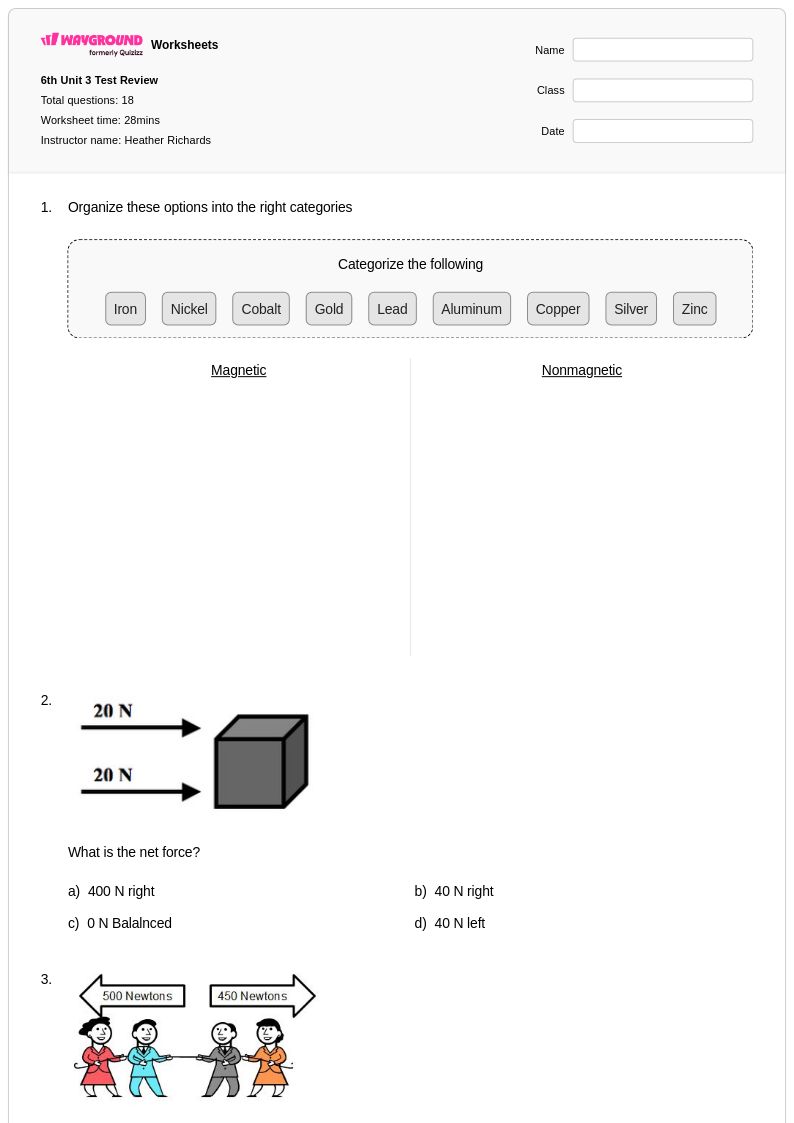
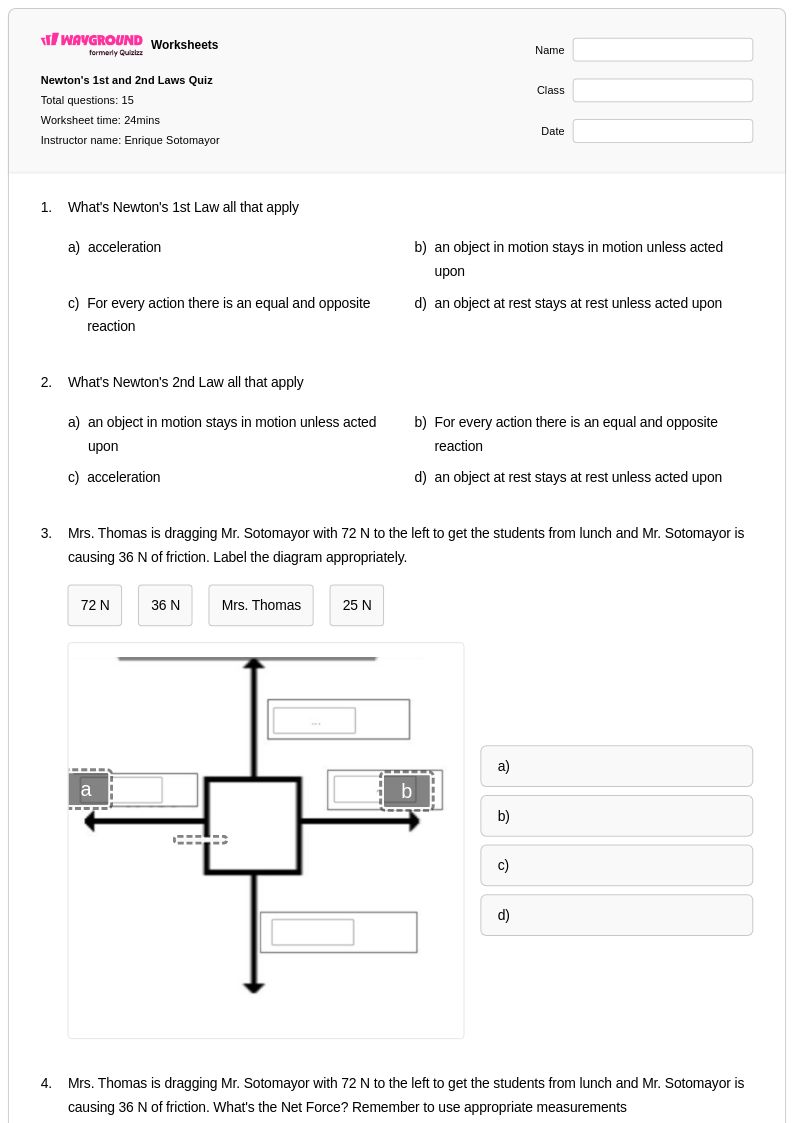
Free Printable Coulomb's Law and Electric Force worksheets
Enhance understanding of Coulomb's Law and Electric Force with Wayground's comprehensive collection of free physics worksheets, featuring printable PDFs, practice problems, and detailed answer keys to master electrostatic interactions.
Explore printable Coulomb's Law and Electric Force worksheets
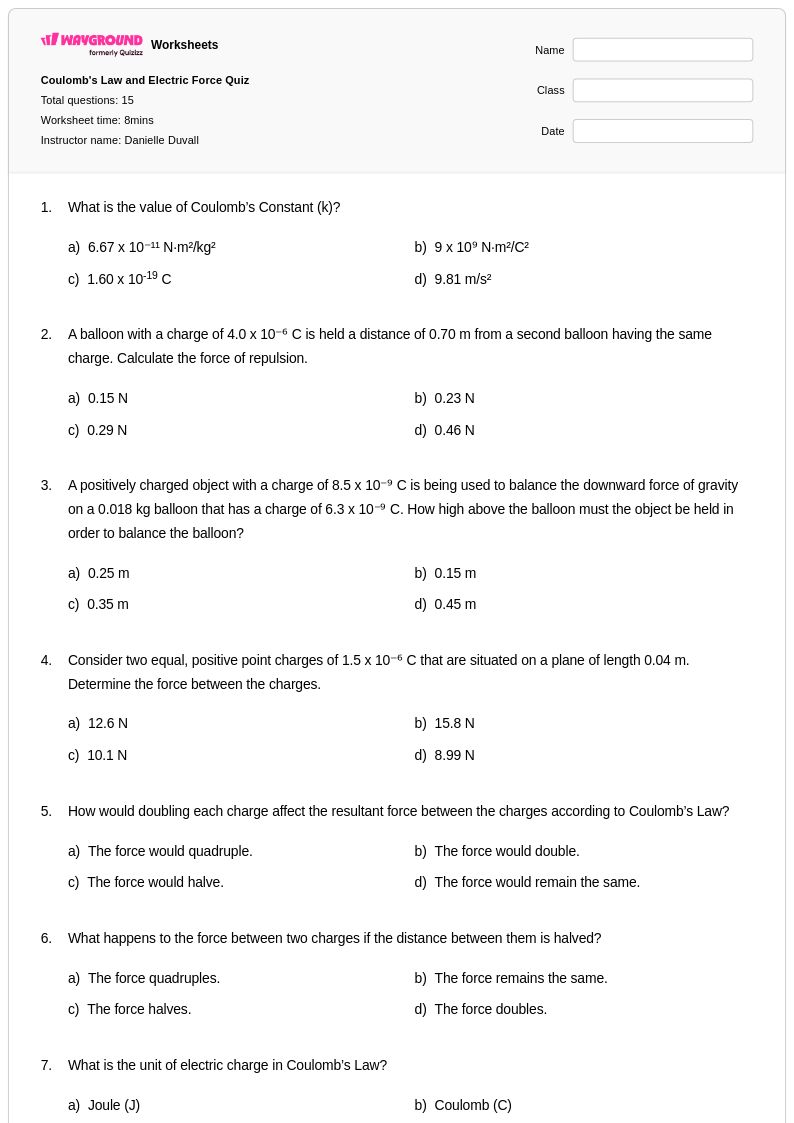
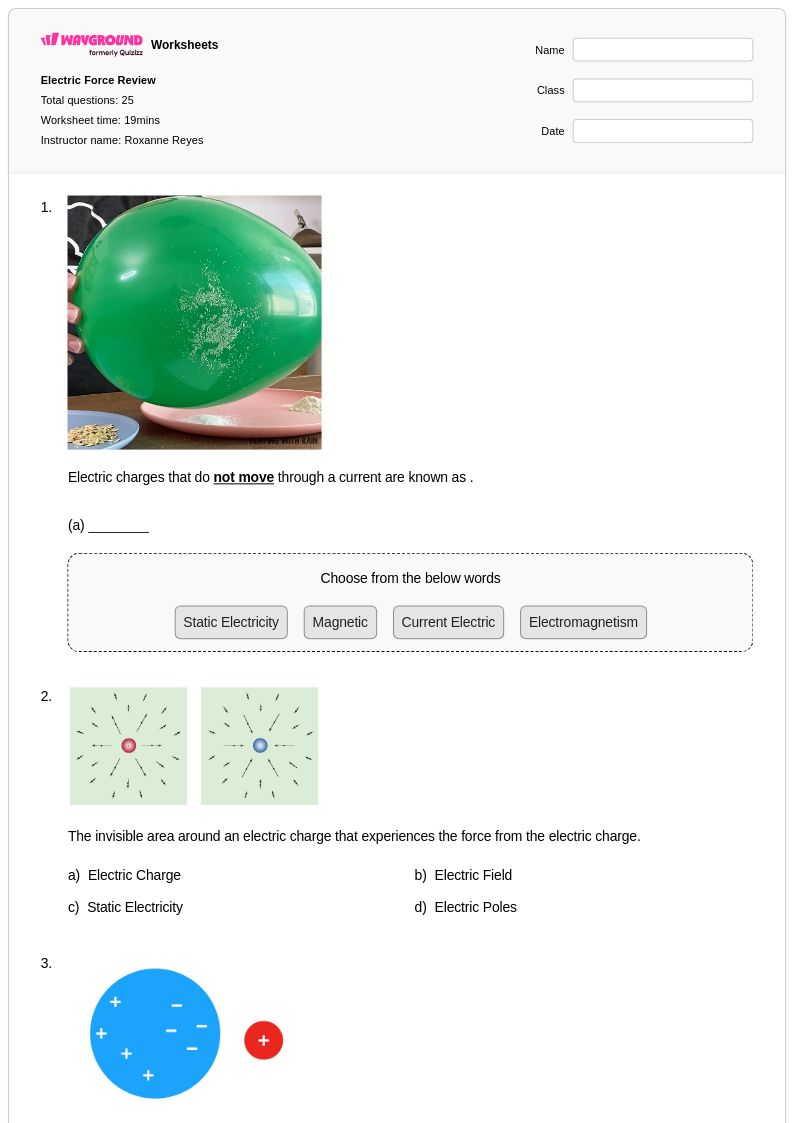
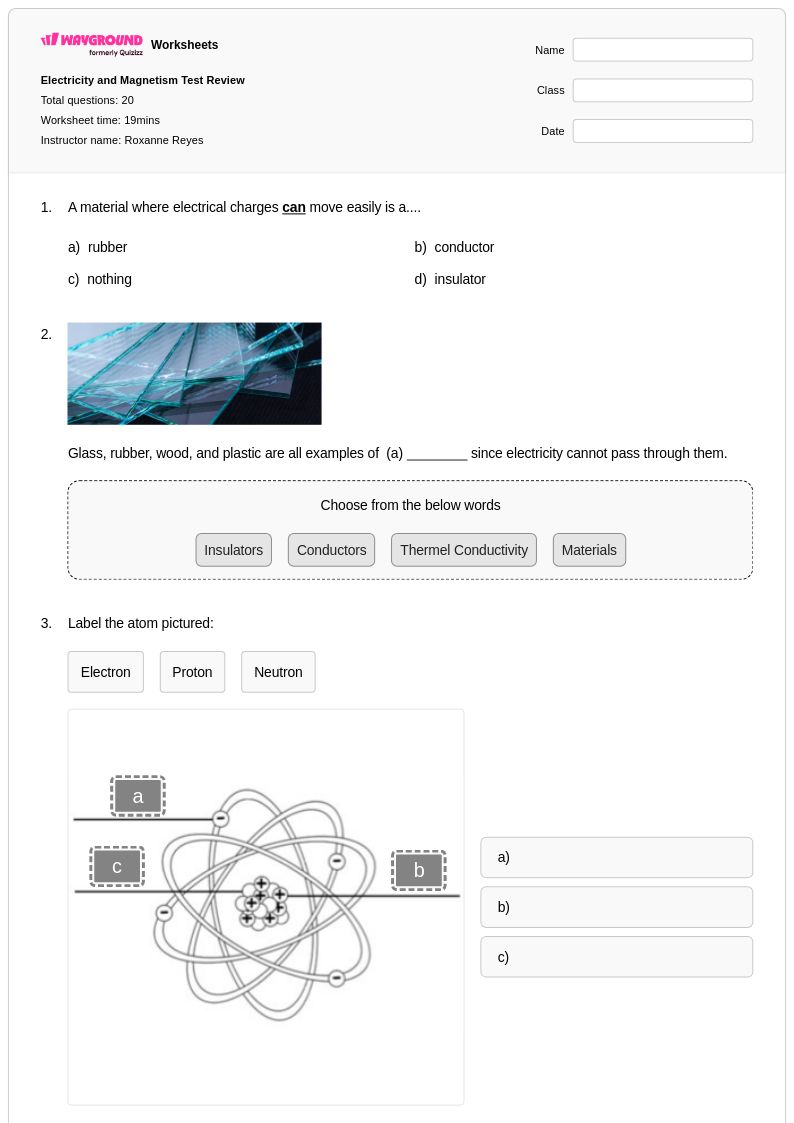
Coulomb's Law and Electric Force worksheets available through Wayground (formerly Quizizz) provide comprehensive practice materials that help students master one of the fundamental principles governing electrostatic interactions. These carefully designed resources guide learners through calculating electric forces between charged particles, applying the inverse square relationship, and understanding how distance and charge magnitude affect electrostatic forces. The worksheets strengthen critical physics skills including mathematical problem-solving with scientific notation, vector analysis of multiple charge systems, and conceptual understanding of electric field interactions. Each worksheet collection includes detailed answer keys that support independent learning and self-assessment, while the free printable format ensures accessibility for diverse learning environments. Practice problems range from basic force calculations between two point charges to complex scenarios involving multiple charges and electric field superposition.
Wayground (formerly Quizizz) empowers physics educators with millions of teacher-created resources specifically focused on Coulomb's Law and Electric Force concepts, featuring robust search and filtering capabilities that allow instructors to quickly locate materials aligned with specific physics standards and learning objectives. The platform's differentiation tools enable teachers to customize worksheet difficulty levels, supporting both remediation for students struggling with electrostatic concepts and enrichment activities for advanced learners ready to tackle complex charge distribution problems. These resources are available in both printable and digital formats, including downloadable pdf versions that facilitate flexible lesson planning and seamless integration into existing physics curricula. The extensive customization options allow educators to modify problems, adjust mathematical complexity, and tailor content to meet diverse student needs, making these worksheets invaluable for targeted skill practice, formative assessment, and reinforcement of electric force principles across various instructional contexts.
FAQs
How do I teach Coulomb's Law to high school physics students?
Start by grounding students in the concept that electric force depends on both the magnitude of charges and the distance between them before introducing the formula. Use analogies to Newton's Law of Universal Gravitation to help students recognize the inverse square relationship. From there, move into worked examples with two point charges before introducing multi-charge systems and vector addition of forces.
What types of practice problems help students get better at Coulomb's Law calculations?
Students benefit most from a progression that starts with straightforward two-charge force calculations and builds toward problems involving scientific notation, unit conversion, and multiple charges requiring vector superposition. Problems that vary charge sign, magnitude, and distance independently help students isolate each variable's effect. Including both numeric and conceptual questions strengthens both procedural fluency and deeper understanding of electrostatic principles.
What mistakes do students commonly make when applying Coulomb's Law?
The most common error is neglecting to square the distance in the denominator, treating the inverse square relationship as a simple inverse proportion. Students also frequently confuse scalar magnitude of force with vector direction, especially in multi-charge problems where forces must be added as vectors. Another recurring mistake is unit inconsistency, particularly when charge is given in microcoulombs rather than coulombs.
How do I help students who struggle with the math in Coulomb's Law problems?
Break the calculation into explicit steps: identify knowns, convert units, substitute into the formula, and then simplify using scientific notation. Repeated scaffolded practice with scientific notation outside of the physics context can reduce the cognitive load when students encounter it within Coulomb's Law problems. On Wayground, teachers can apply accommodations such as reduced answer choices or read-aloud support for individual students to make these problems more accessible without modifying the core physics content.
How can I use Coulomb's Law worksheets to assess student understanding?
Use a mix of calculation-based and conceptual questions to distinguish between procedural recall and genuine understanding of electrostatic principles. Problems that ask students to predict how force changes when distance is halved or charge is doubled are particularly diagnostic, as they reveal whether students understand the inverse square relationship rather than just applying the formula mechanically. Answer keys included with Wayground worksheets support self-assessment and allow students to identify and correct errors independently.
How do I use Coulomb's Law worksheets from Wayground in my classroom?
Wayground's Coulomb's Law worksheets are available as printable PDFs for traditional classroom use and in digital formats for technology-integrated environments, including the option to host them as a quiz directly on Wayground. Teachers can assign worksheets for in-class practice, homework, or formative assessment, and the included answer keys make grading and student self-review straightforward. The platform's search and filtering tools allow you to quickly locate worksheets aligned to specific physics standards and learning objectives.