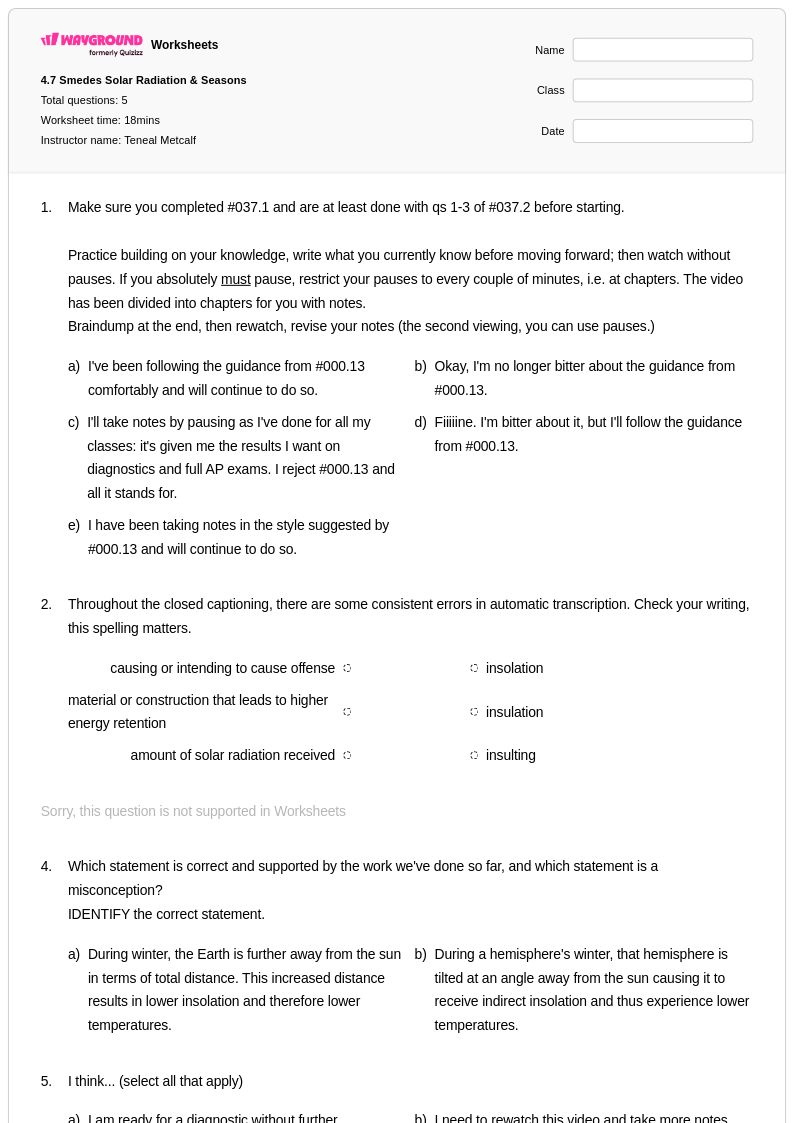
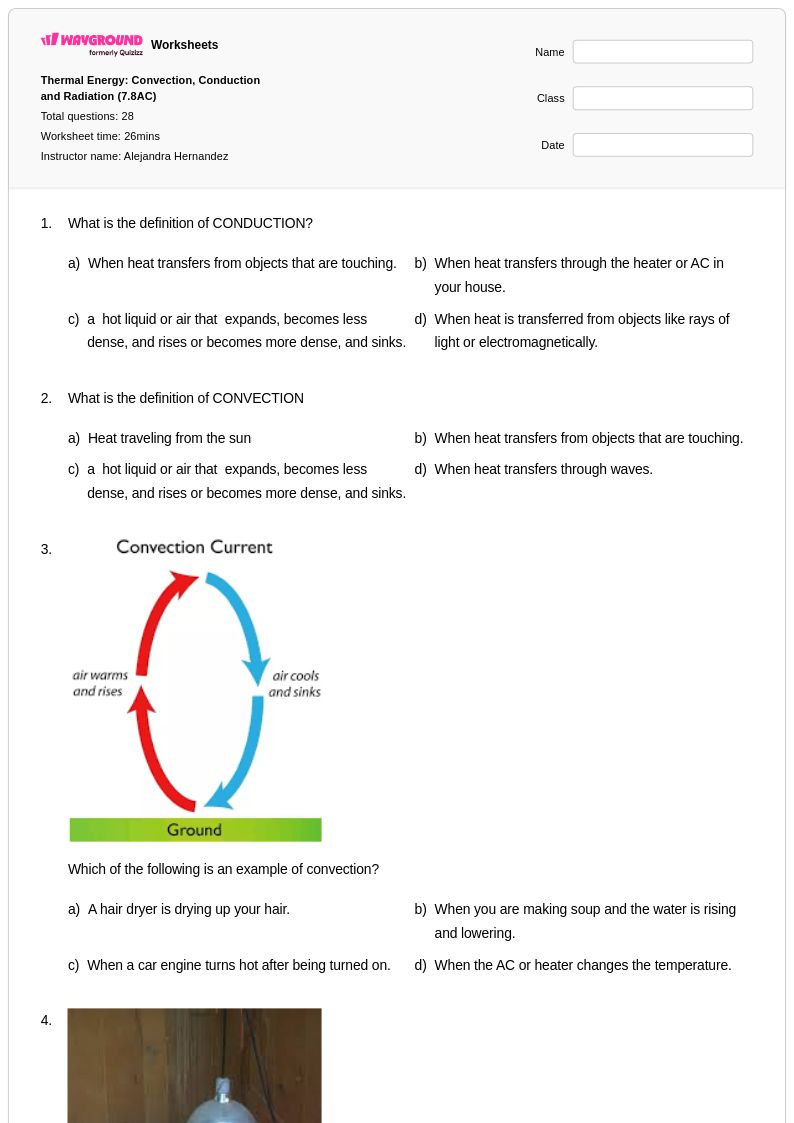
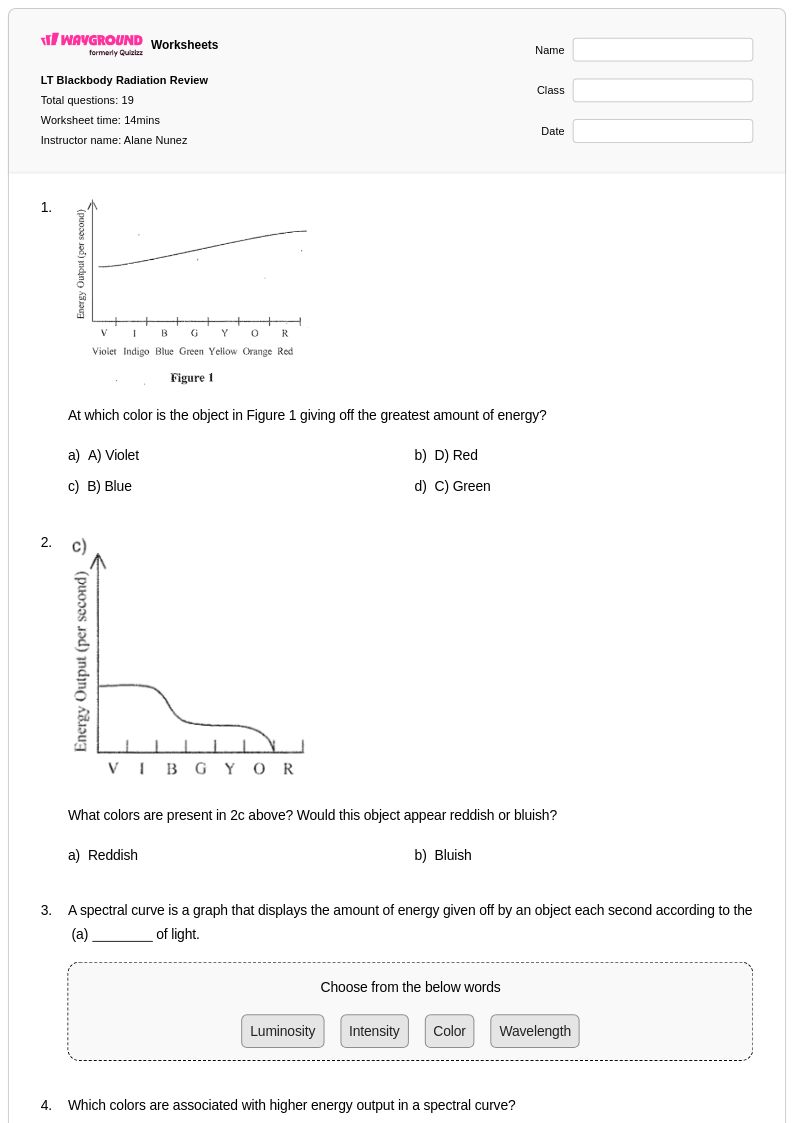
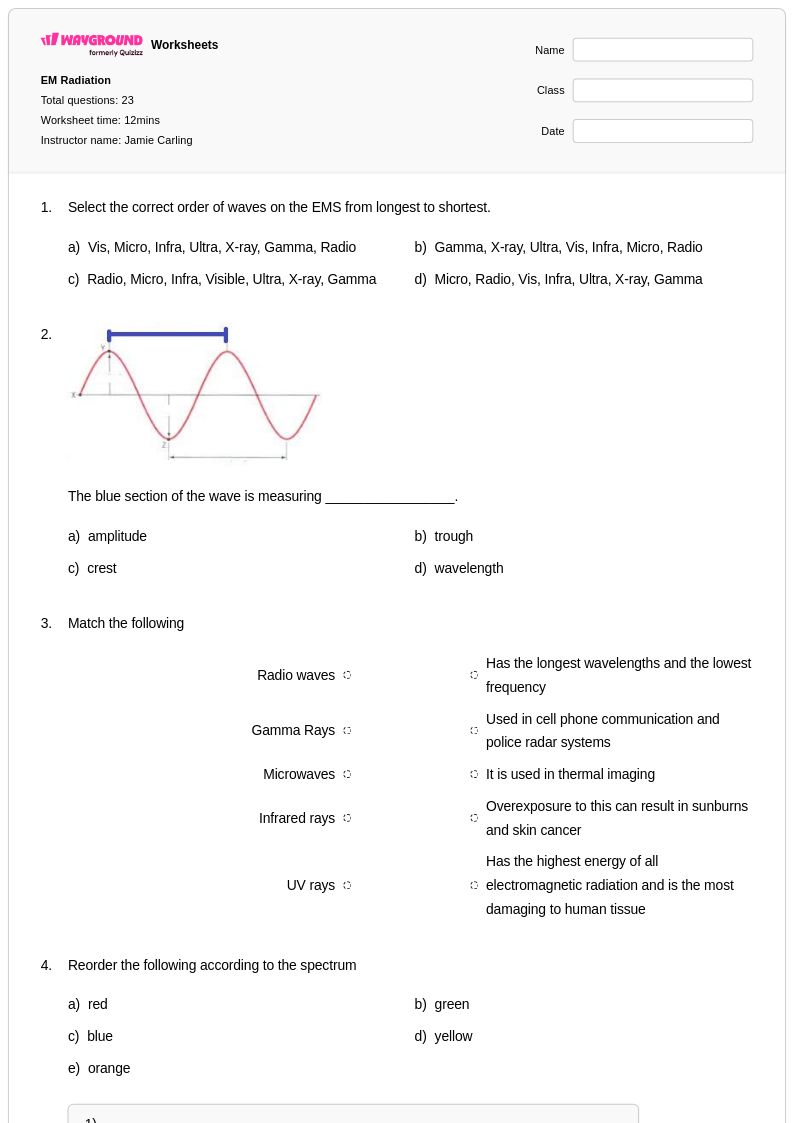
Explore Wayground's comprehensive collection of radiation worksheets featuring free printables and practice problems with answer keys to help students master electromagnetic spectrum concepts, nuclear physics, and radioactive decay principles.
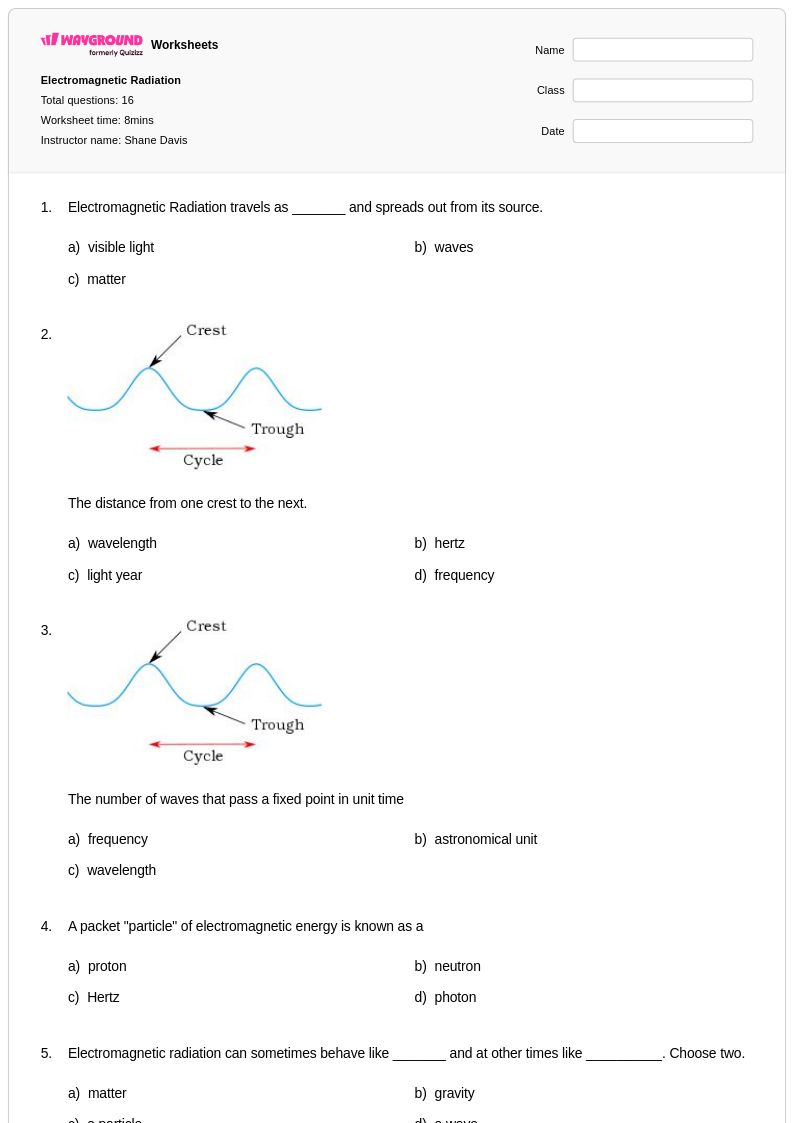
Radiation worksheets available through Wayground (formerly Quizizz) provide comprehensive coverage of electromagnetic radiation, nuclear decay processes, and energy transfer mechanisms that form the foundation of modern physics understanding. These expertly designed educational resources strengthen students' analytical skills in calculating wavelengths and frequencies, interpreting electromagnetic spectrum diagrams, solving radioactive decay problems, and understanding the relationship between energy and radiation. The collection includes detailed practice problems that guide learners through complex concepts such as alpha, beta, and gamma radiation characteristics, half-life calculations, and the inverse square law for radiation intensity. Each worksheet comes with a complete answer key and is available as a free printable pdf, making it easy for educators to implement immediate assessment and provide targeted feedback on student comprehension of radiation principles.
Wayground (formerly Quizizz) empowers educators with millions of teacher-created radiation worksheets that can be seamlessly integrated into physics curricula through robust search and filtering capabilities organized by specific radiation concepts and difficulty levels. The platform's standards alignment ensures that worksheet collections meet curriculum requirements while offering differentiation tools that allow teachers to customize content for varying student abilities and learning objectives. These flexible resources are available in both printable pdf format and interactive digital versions, enabling instructors to efficiently plan lessons, provide targeted remediation for struggling students, offer enrichment opportunities for advanced learners, and deliver consistent skill practice across diverse learning environments. The comprehensive worksheet library supports evidence-based instruction by providing immediate access to high-quality materials that reinforce radiation concepts through varied problem-solving approaches and real-world applications.
FAQs
How do I teach radiation and the electromagnetic spectrum to high school physics students?
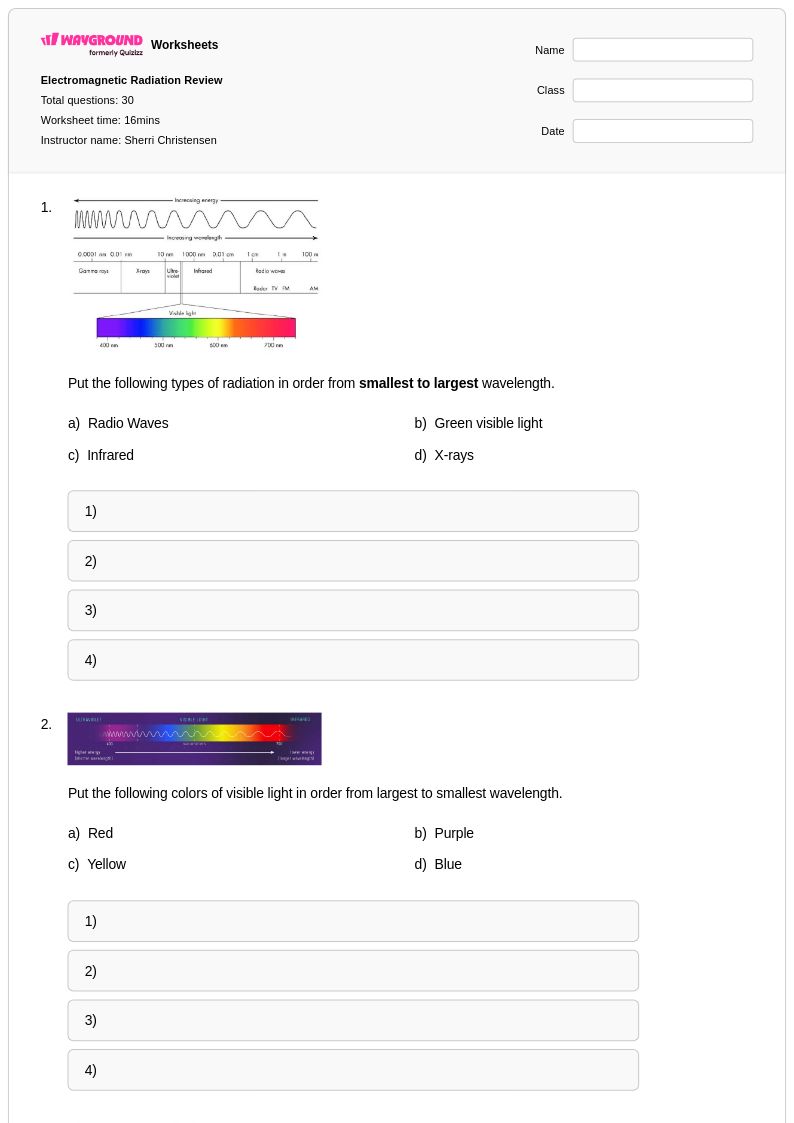
Start by building a conceptual foundation: establish that radiation is energy traveling through space as waves or particles, then introduce the electromagnetic spectrum from radio waves to gamma rays in order of increasing frequency and energy. Use diagrams to help students visualize the inverse relationship between wavelength and frequency before introducing the wave equation. Connecting each region of the spectrum to a real-world application — such as microwaves, X-rays, or visible light — helps students retain the ordering and properties of each type.
What practice problems help students get better at half-life and radioactive decay calculations?
Students benefit most from a sequenced approach: begin with conceptual problems where they predict how much of a sample remains after one, two, or three half-lives, then progress to algebraic problems using the decay formula. Problems that require students to work both forward (given time, find remaining amount) and backward (given remaining amount, find elapsed time) are especially effective at solidifying understanding. Including real isotopes with known half-lives, such as Carbon-14 or Iodine-131, adds scientific context and prepares students for real-world applications.
What are the most common mistakes students make when solving electromagnetic radiation problems?
The most frequent error is confusing wavelength and frequency — students often assume that longer wavelengths mean higher energy, reversing the actual relationship. A related mistake is misapplying the wave equation (c = λf) by using inconsistent units, particularly forgetting to convert nanometers to meters before calculating. Students also commonly conflate ionizing and non-ionizing radiation when comparing alpha, beta, and gamma types, which leads to errors in both conceptual questions and shielding or safety problems.
How do I use Wayground's radiation worksheets in my classroom?
Wayground's radiation worksheets are available as printable PDFs for traditional classroom use and in digital formats for technology-integrated environments, giving teachers flexibility to assign them as in-class practice, homework, or quiz material. You can also host them directly as a quiz on Wayground, which enables immediate scoring and feedback. Each worksheet includes a complete answer key, so grading and follow-up instruction can happen without delay.
How can I differentiate radiation worksheets for students at different skill levels?
Wayground supports student-level accommodations that allow teachers to customize the experience for individual learners without disrupting the rest of the class. Options include extended time per question, read-aloud support for students who need audio access to content, and reduced answer choices to lower cognitive load for struggling learners. These settings can be configured from the Students tab, session settings page, or Classes tab, and are saved for reuse across future assignments.
What's the difference between alpha, beta, and gamma radiation, and how should I teach it?
Alpha radiation consists of helium nuclei (two protons and two neutrons) and has the lowest penetrating power, stopped by a sheet of paper or a few centimeters of air. Beta radiation involves high-energy electrons or positrons and requires aluminum or plastic shielding. Gamma radiation is high-energy electromagnetic radiation with the greatest penetrating power, requiring dense materials like lead or thick concrete to attenuate effectively. Teaching these three types together through a comparison chart — covering charge, mass, speed, and penetration — helps students build accurate mental models and avoid conflating their properties.