Free Printable Series and Parallel Resistors worksheets
Explore Wayground's free series and parallel resistors worksheets with printable PDFs, practice problems, and answer keys to help students master circuit analysis and electrical resistance calculations.
Explore printable Series and Parallel Resistors worksheets
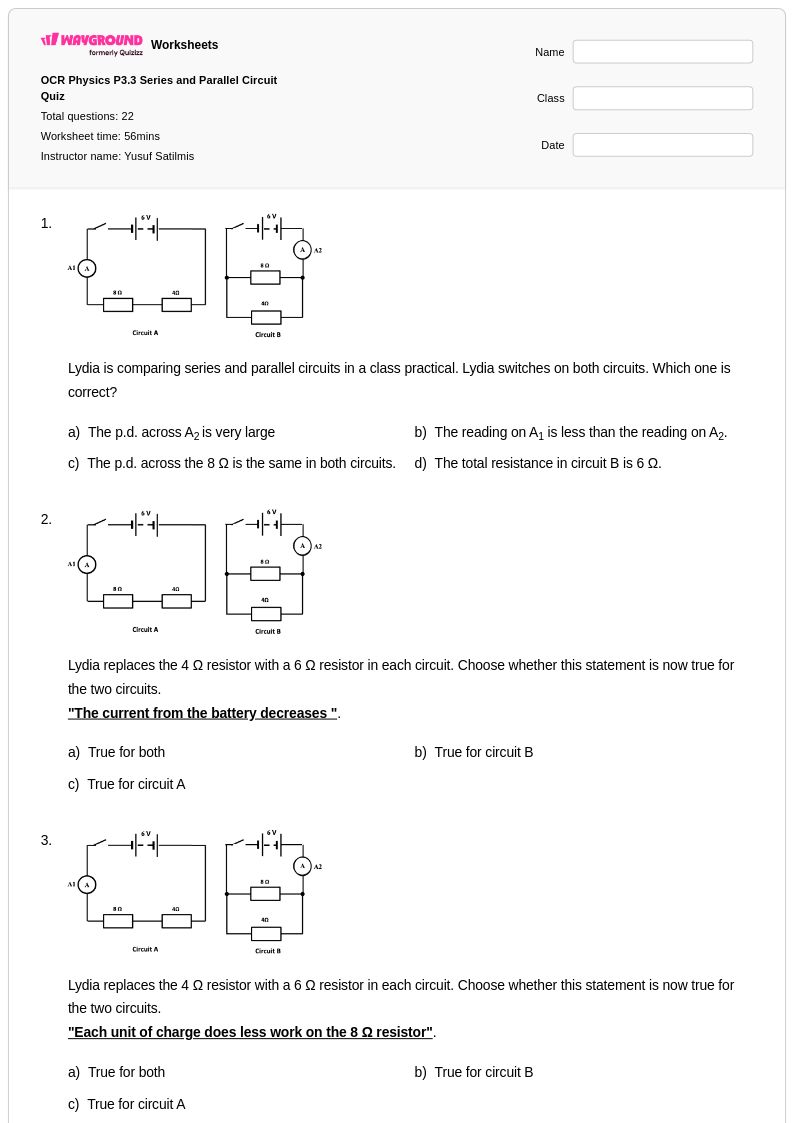
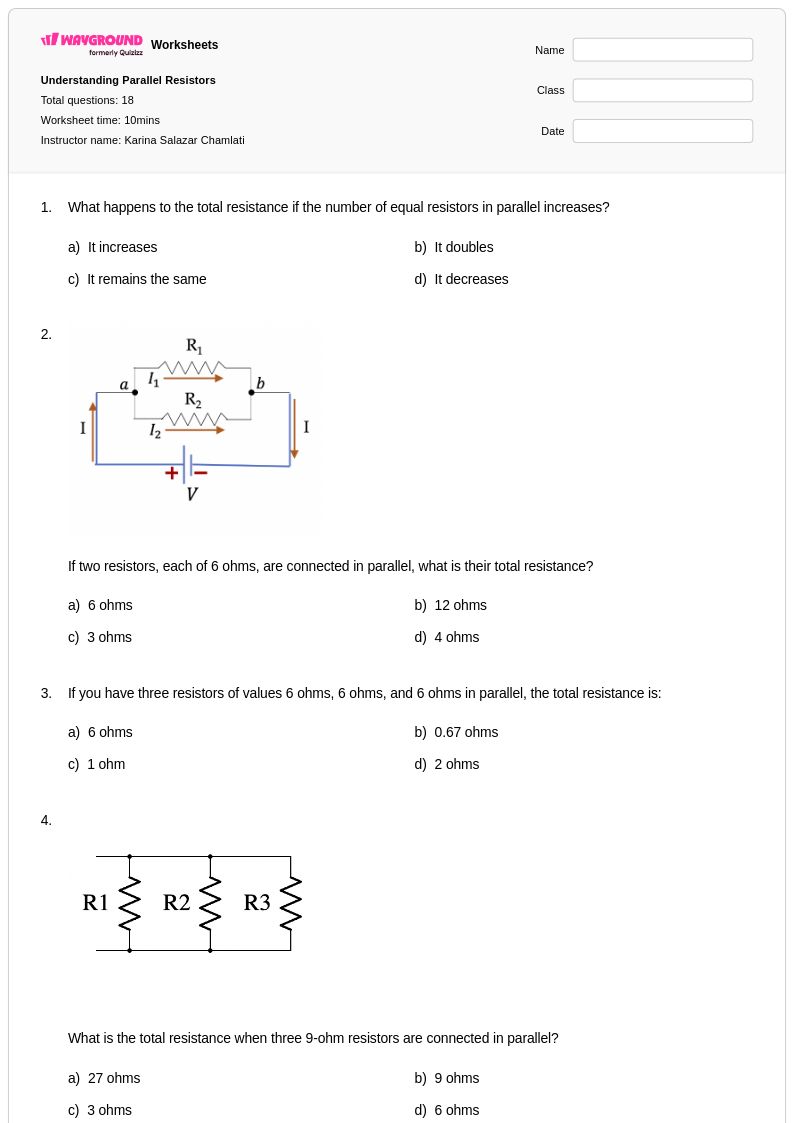
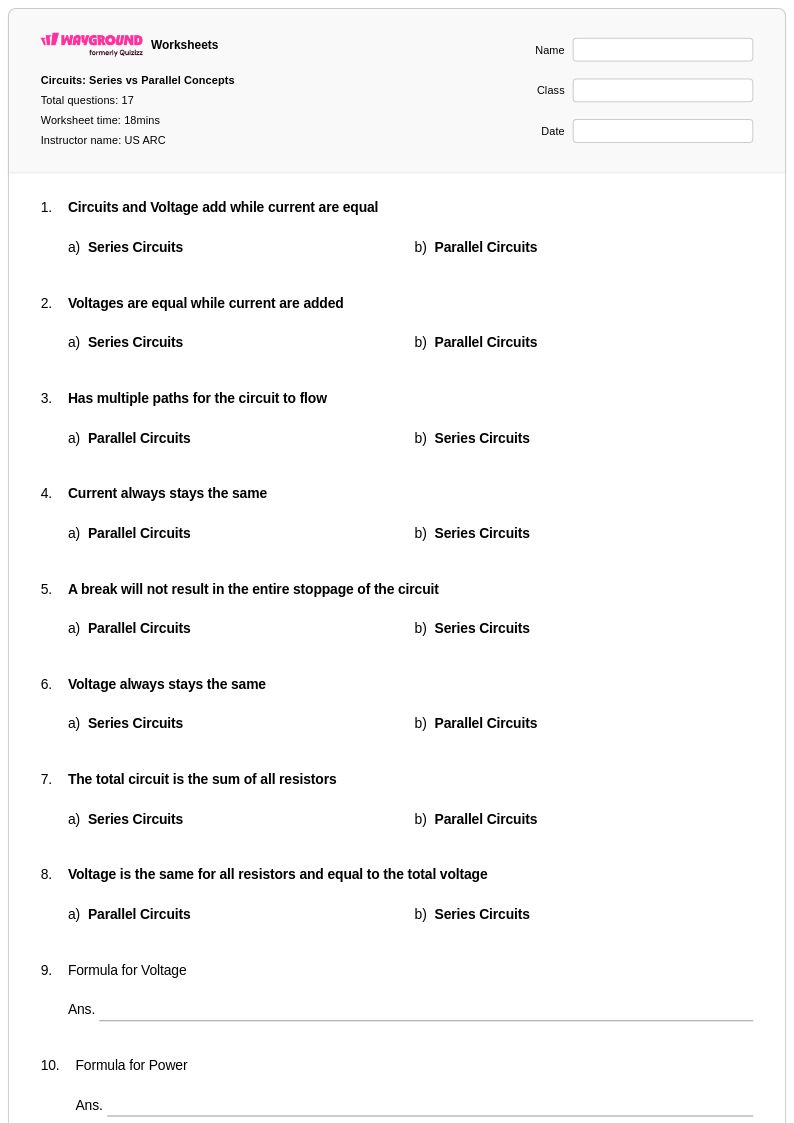
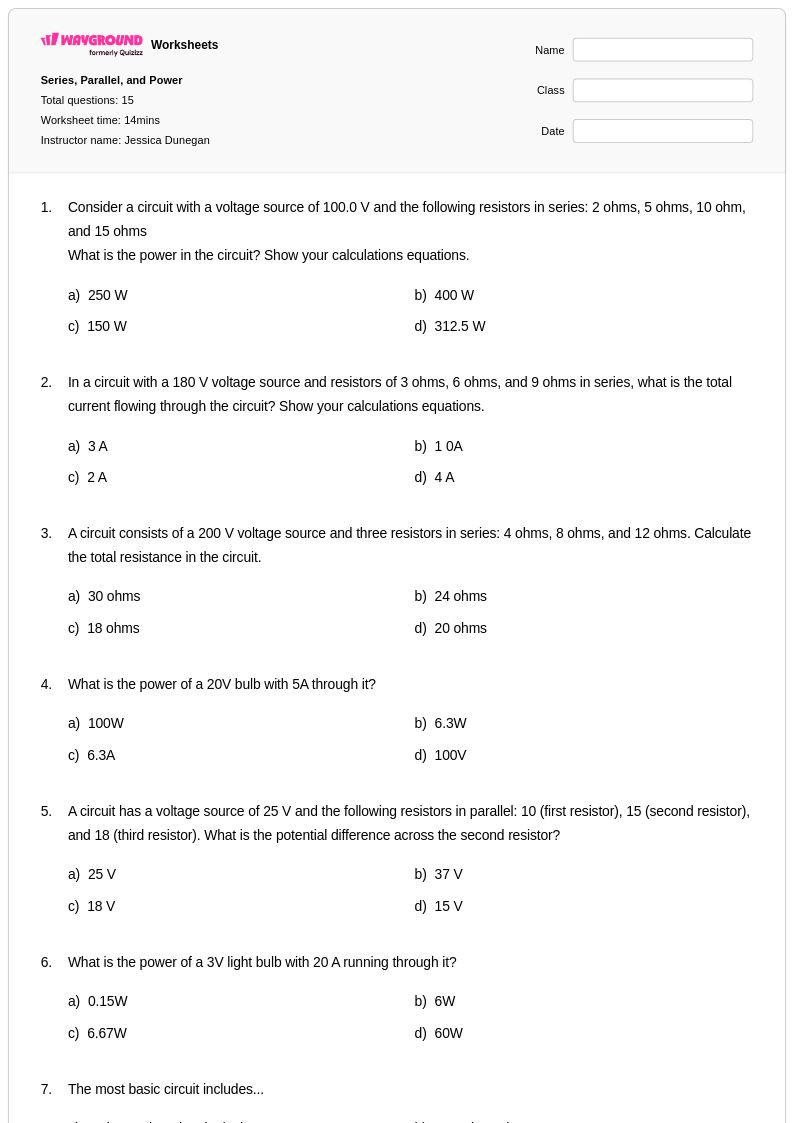
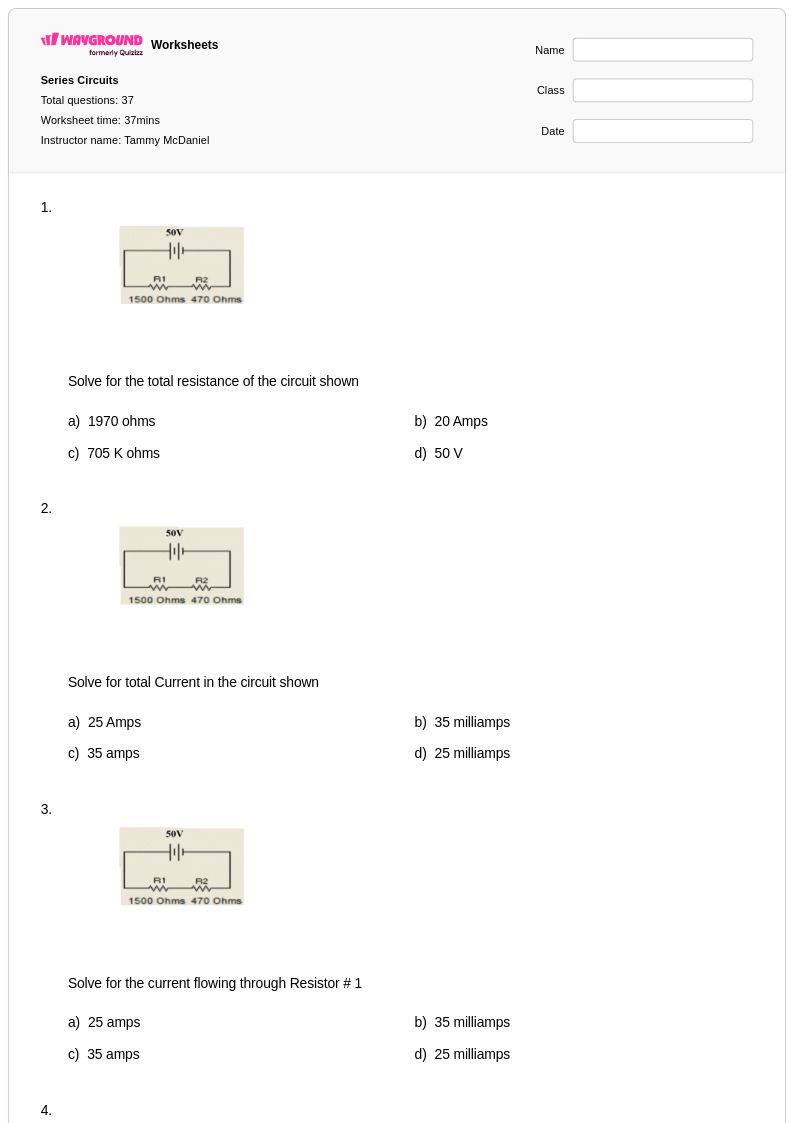
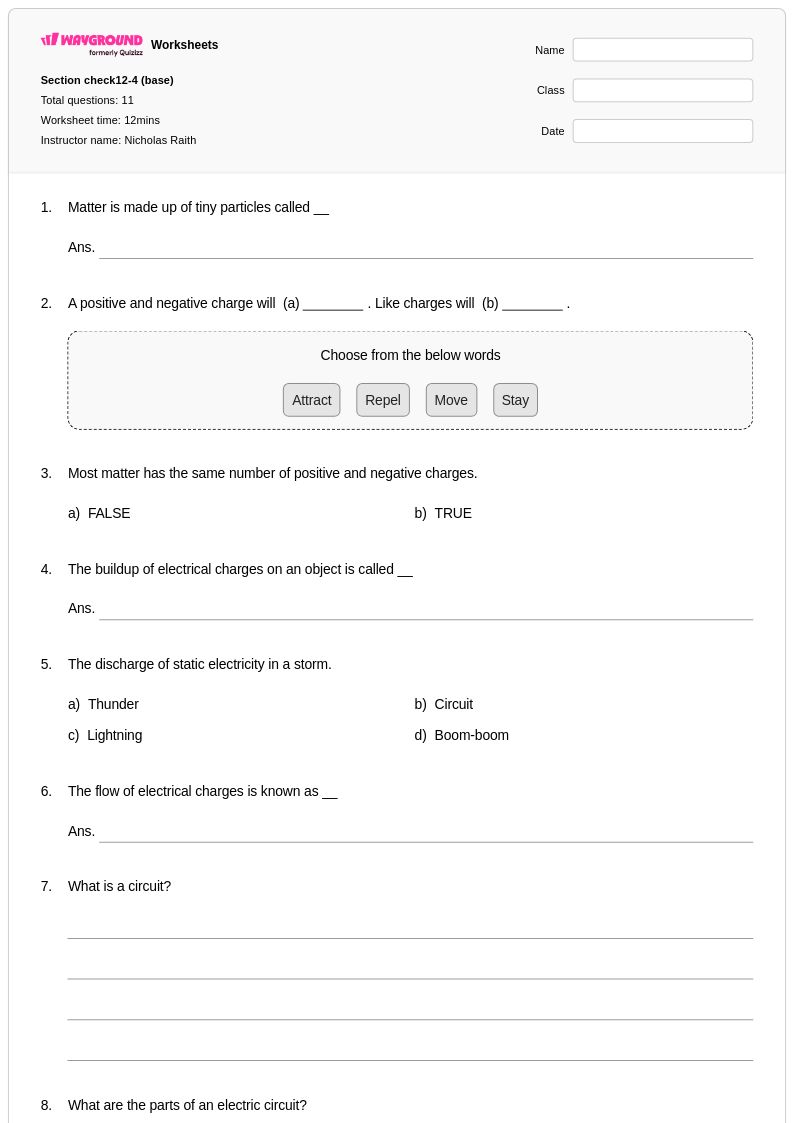
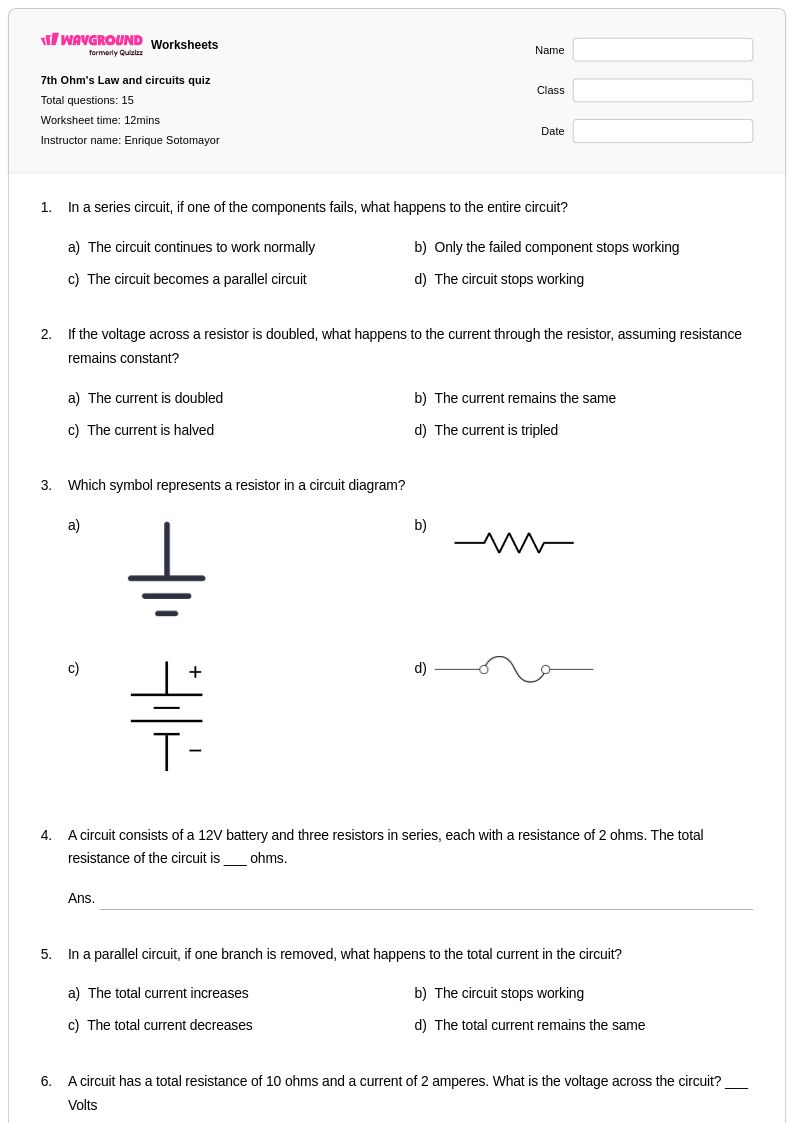
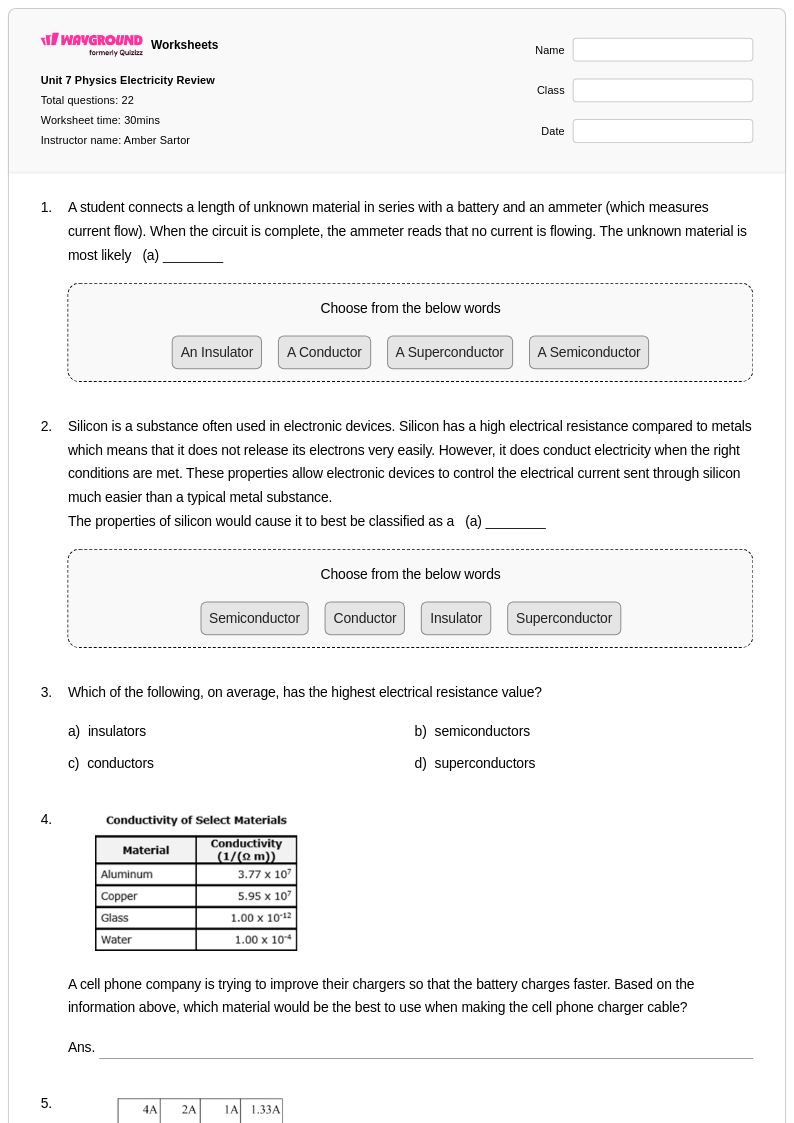
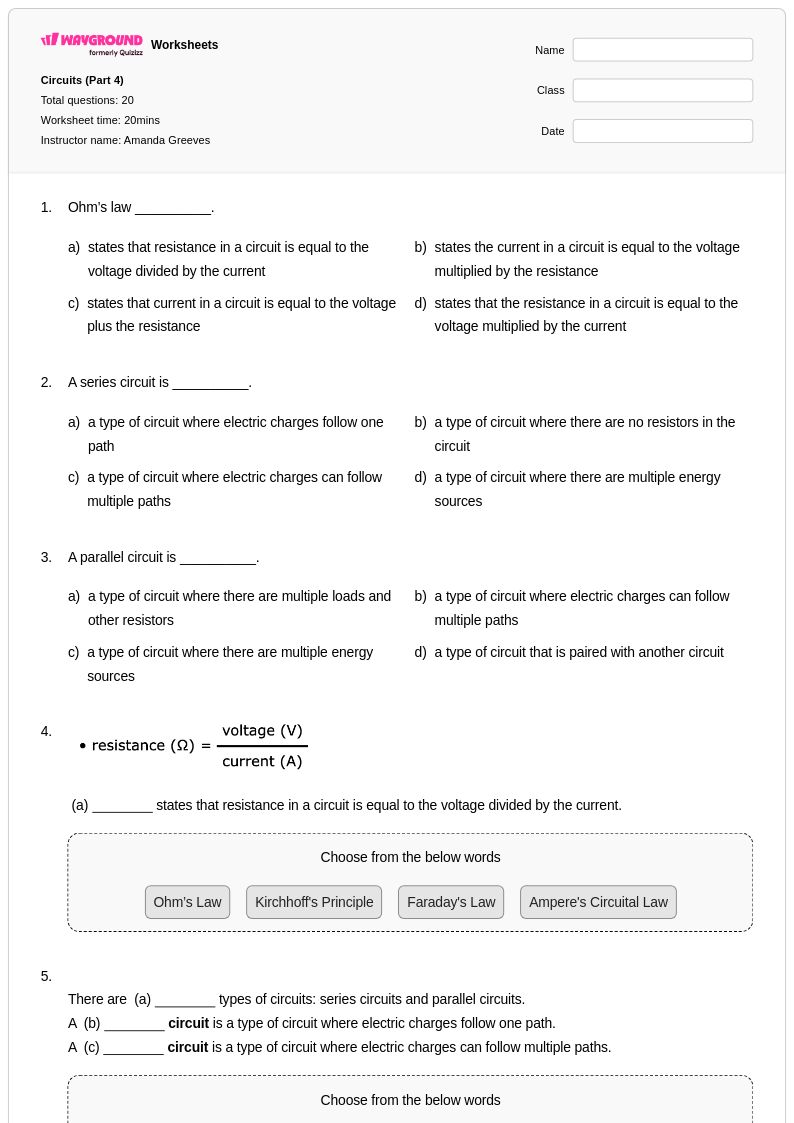
Series and parallel resistors worksheets available through Wayground (formerly Quizizz) provide comprehensive practice materials that help students master one of the most fundamental concepts in circuit analysis and electrical physics. These carefully designed worksheets guide learners through calculating equivalent resistance, analyzing current and voltage distribution, and applying Ohm's law in complex circuit configurations. Students develop critical problem-solving skills as they work through practice problems that range from simple series circuits to intricate combination networks, while teachers benefit from complete answer keys that facilitate efficient grading and targeted feedback. The free printable resources include detailed diagrams, step-by-step solution guides, and varied problem sets available in convenient pdf format, ensuring students can practice both computational techniques and conceptual understanding of how electrical current behaves in different resistor arrangements.
Wayground (formerly Quizizz) empowers educators with millions of teacher-created physics resources specifically focused on series and parallel resistor concepts, featuring robust search and filtering capabilities that allow instructors to locate materials perfectly aligned with their curriculum standards and learning objectives. The platform's differentiation tools enable teachers to customize worksheet difficulty levels and problem types, making it simple to provide appropriate challenges for students at various skill levels while maintaining engagement across diverse learning needs. These flexible resources are available in both printable and digital formats, including downloadable pdf versions, supporting seamless integration into lesson planning whether for in-person instruction, remote learning, or hybrid educational environments. Teachers can efficiently address remediation needs for struggling students, provide enrichment opportunities for advanced learners, and deliver consistent skill practice that builds confidence in circuit analysis and electrical engineering fundamentals.
FAQs
How do I teach series and parallel circuits to high school physics students?
Start by building conceptual understanding before introducing calculations: use physical circuit diagrams or simulations to show how current has only one path in a series circuit but splits across branches in a parallel circuit. Once students can identify circuit types visually, introduce equivalent resistance formulas — summing resistors for series, and using the reciprocal formula for parallel. Reinforce with Ohm's law applications so students can calculate current and voltage at each component, not just the total circuit.
What practice problems help students get better at calculating equivalent resistance?
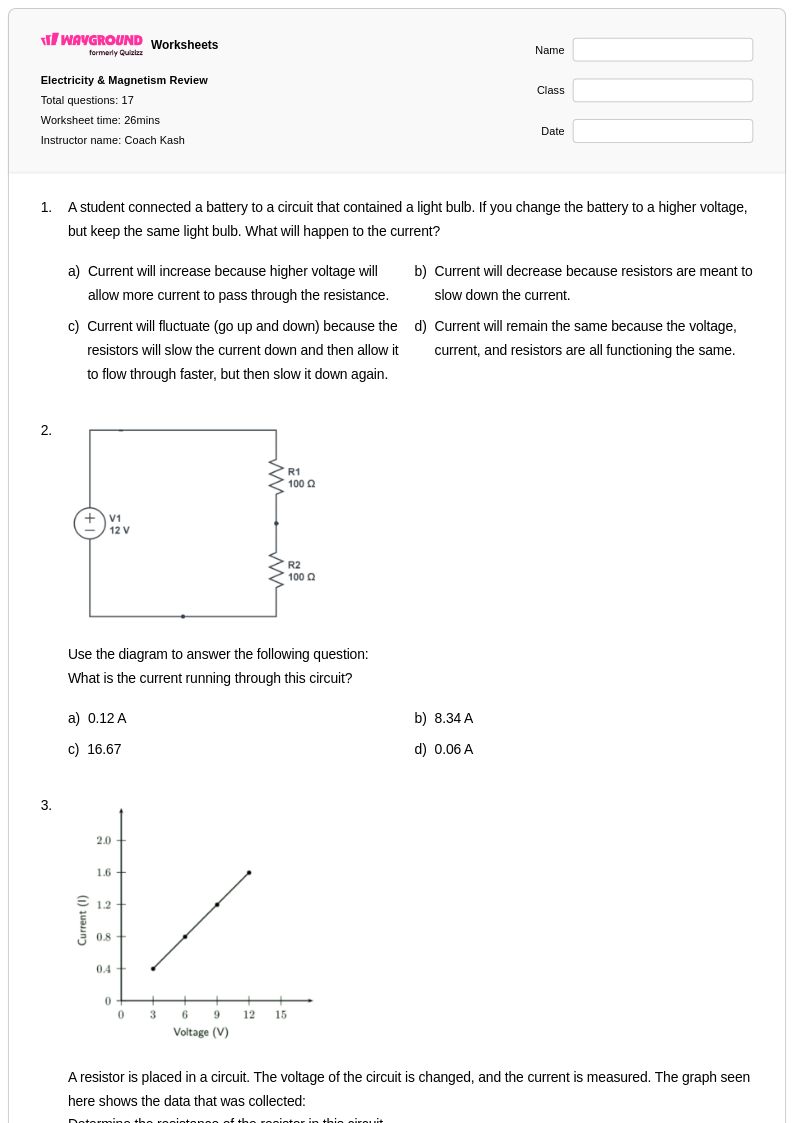
Students benefit most from problems that gradually increase in complexity — starting with pure series or pure parallel configurations before moving to combination circuits that require multi-step analysis. Effective practice includes calculating equivalent resistance, then using that value to find total current, and finally working backward to find voltage drops or branch currents at individual resistors. Worksheets that include labeled circuit diagrams alongside numerical problems help students connect visual circuit structure to algebraic calculations.
What mistakes do students commonly make when solving series and parallel resistor problems?
The most common error is applying the wrong formula to the wrong circuit type — students frequently add resistors in parallel instead of using the reciprocal method, or forget to take the final reciprocal after summing. In combination circuits, students often fail to correctly identify which resistors are in series and which are in parallel before attempting any calculation. Another frequent mistake is assuming current is the same throughout a parallel circuit, when in fact it divides across branches, while voltage remains constant.
How do I differentiate series and parallel resistor worksheets for students at different skill levels?
For struggling students, begin with single-type circuits using only two resistors and provide the formula alongside the problem. Advanced learners can be challenged with multi-branch combination circuits that require several reduction steps before arriving at equivalent resistance. On Wayground, teachers can apply accommodations such as reduced answer choices or read-aloud support for individual students, and extended time settings can be configured per student without notifying the rest of the class.
How do I use Wayground's series and parallel resistors worksheets in my classroom?
Wayground's series and parallel resistors worksheets are available as printable PDFs for traditional classroom use and in digital formats for technology-integrated or remote learning environments, giving teachers flexibility in how they assign and collect student work. Teachers can also host worksheets as a quiz directly on Wayground, enabling real-time tracking of student responses. Complete answer keys are included with each worksheet, making grading efficient and allowing teachers to quickly identify which concepts need reteaching.
How does Ohm's law connect to series and parallel resistor problems?
Ohm's law (V = IR) is the core tool students use once equivalent resistance is found — it allows them to calculate total current from the source voltage, or find voltage drops across individual resistors in a series circuit. In parallel circuits, Ohm's law applies at each branch individually, since voltage is equal across all parallel branches but current varies by resistance. Students must be comfortable moving between the circuit-level and component-level application of Ohm's law to solve multi-step problems accurately.