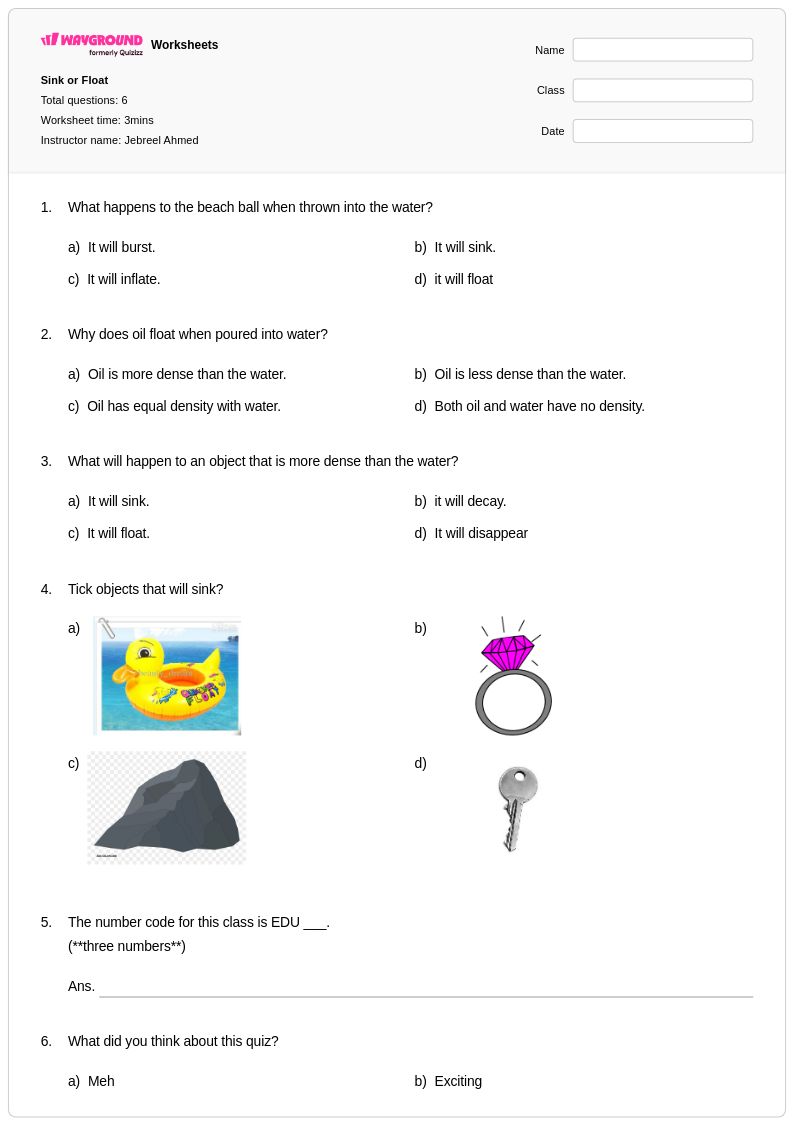
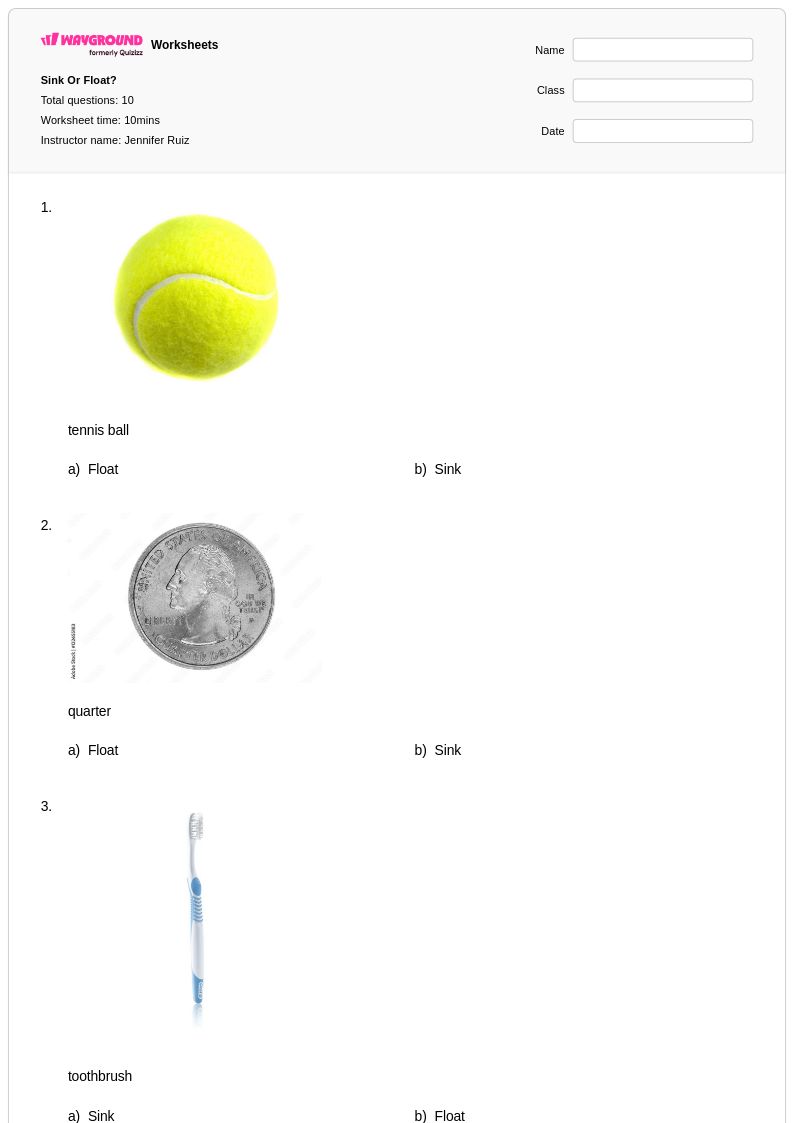
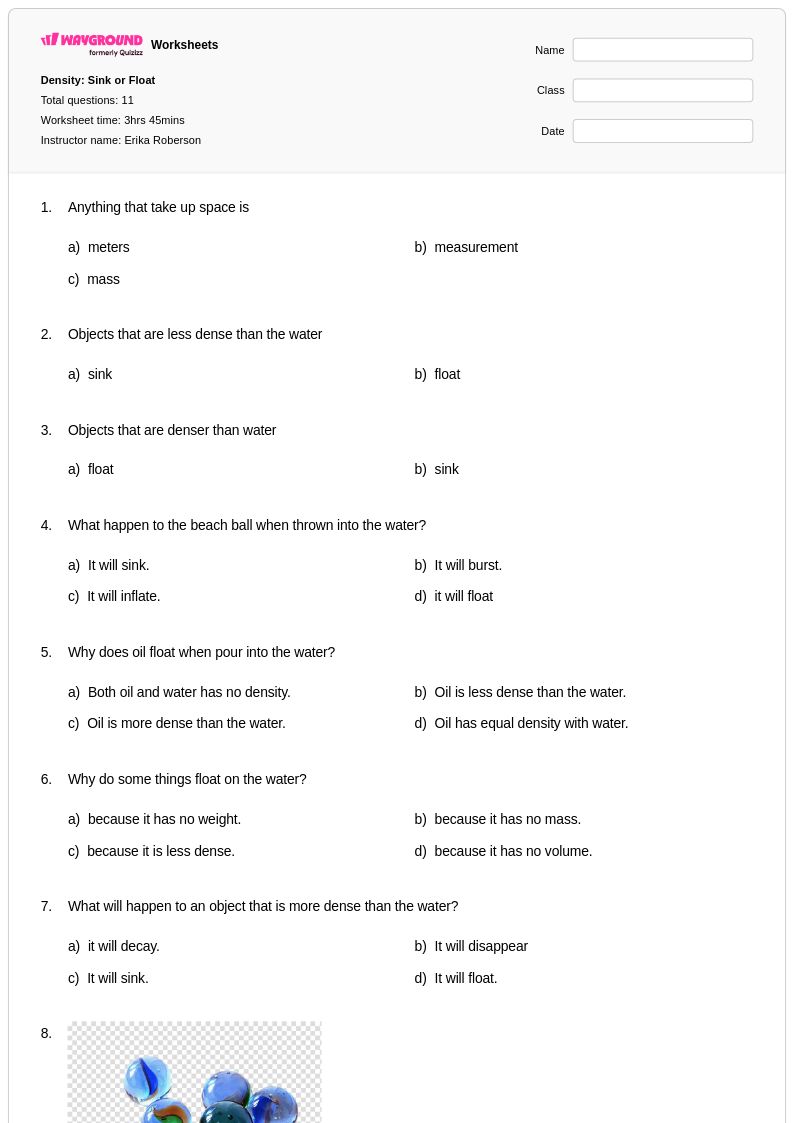
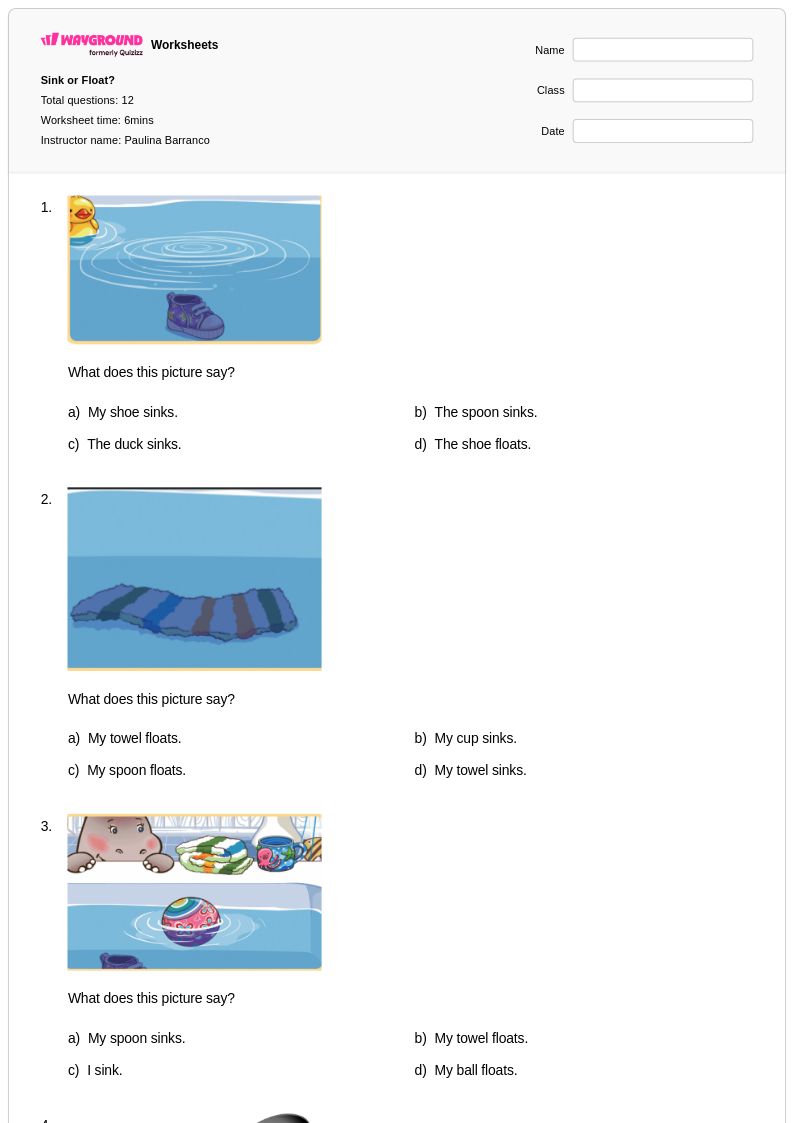
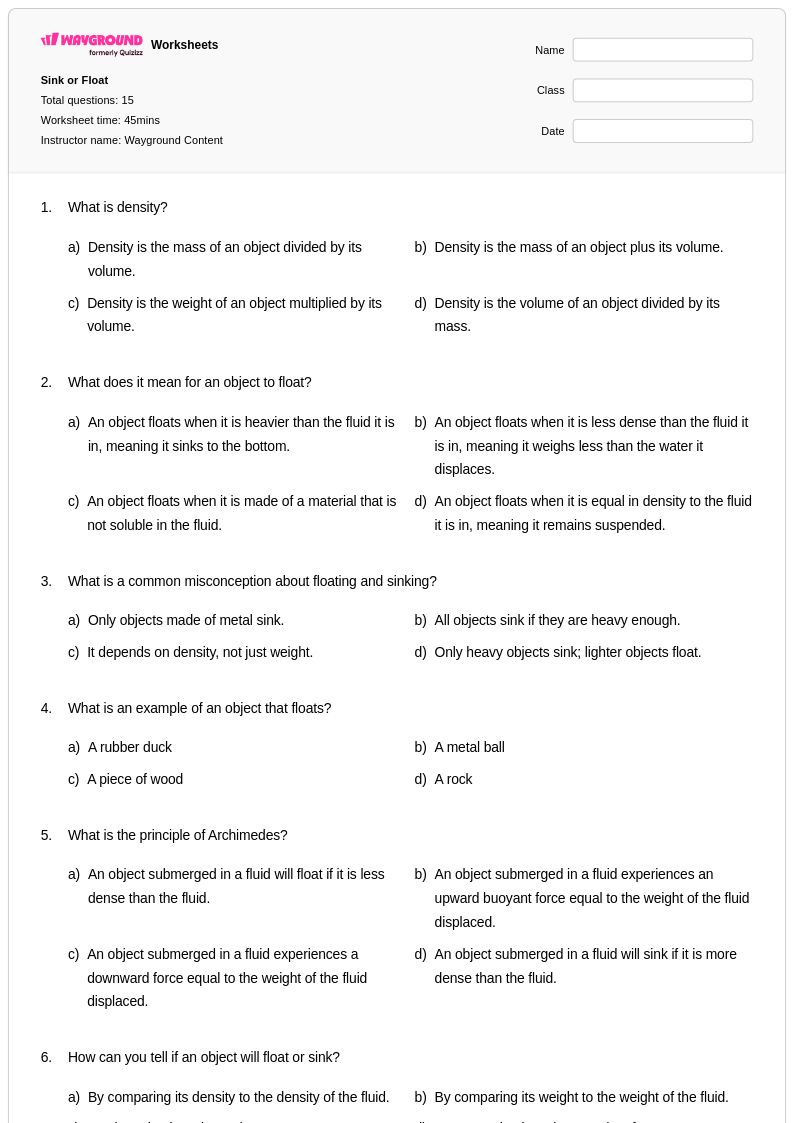
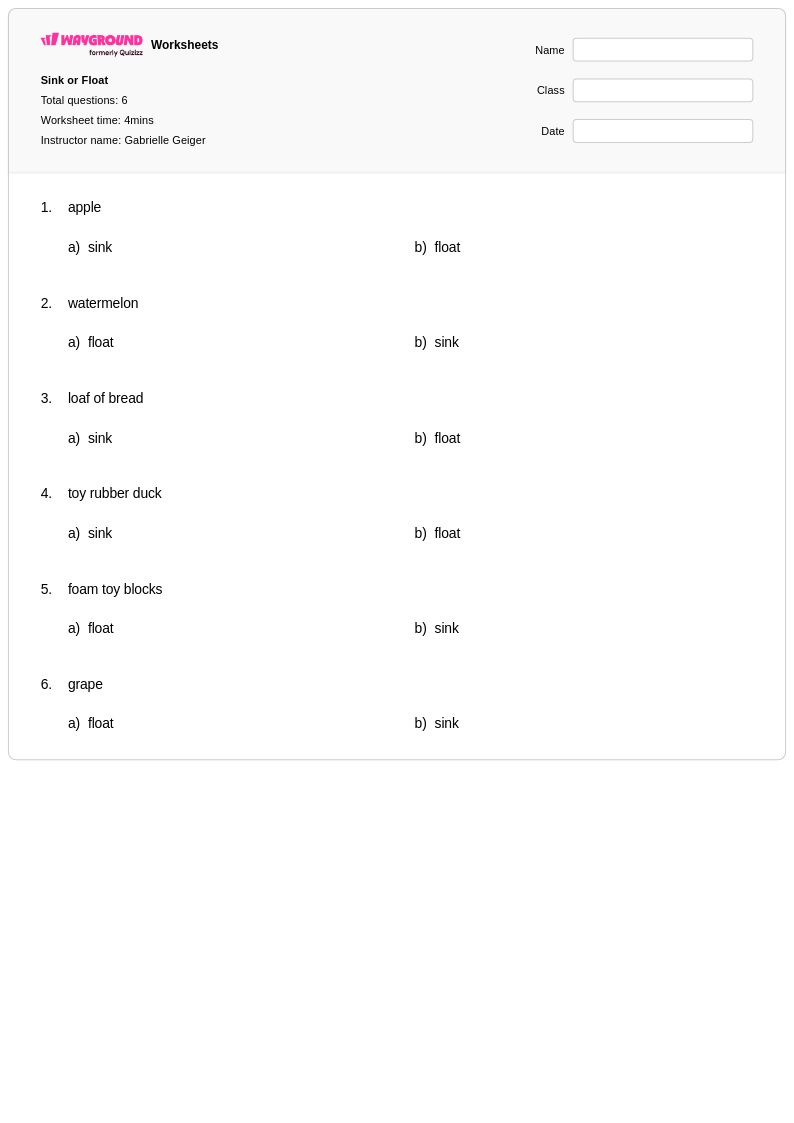
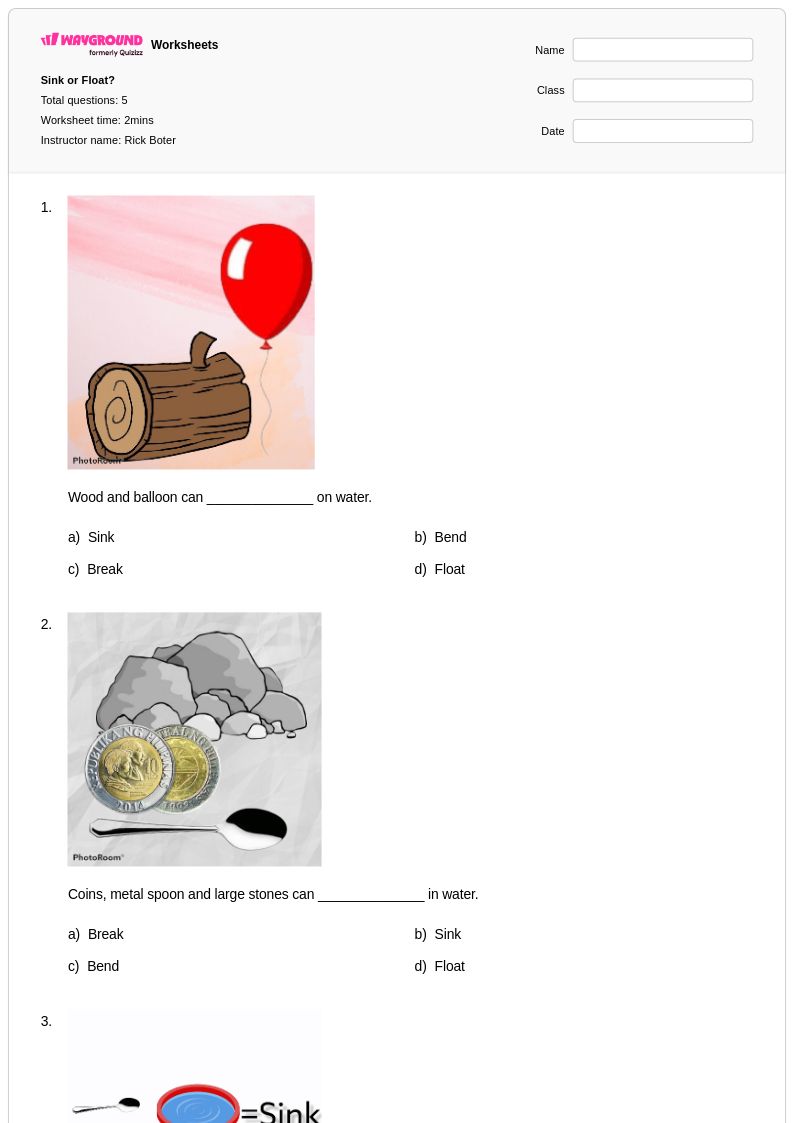
Explore Wayground's comprehensive collection of sink or float worksheets with free printables and answer keys to help students master density concepts through engaging hands-on practice problems and PDF activities.
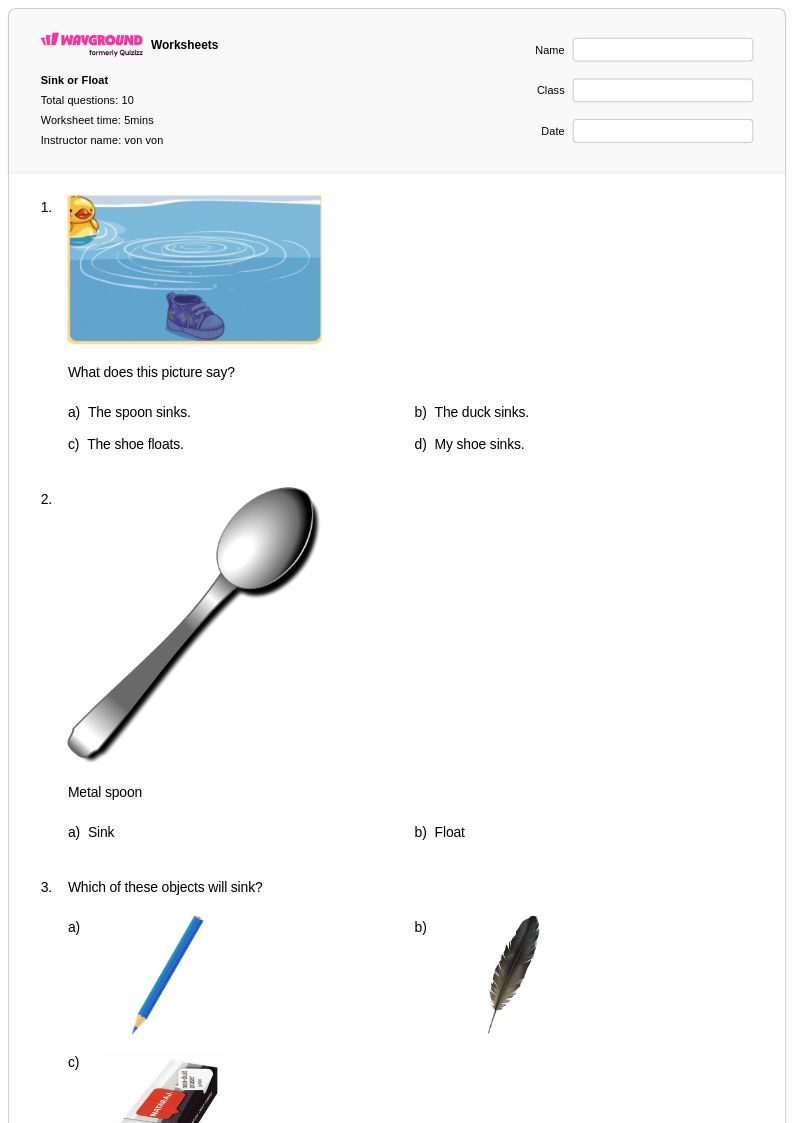
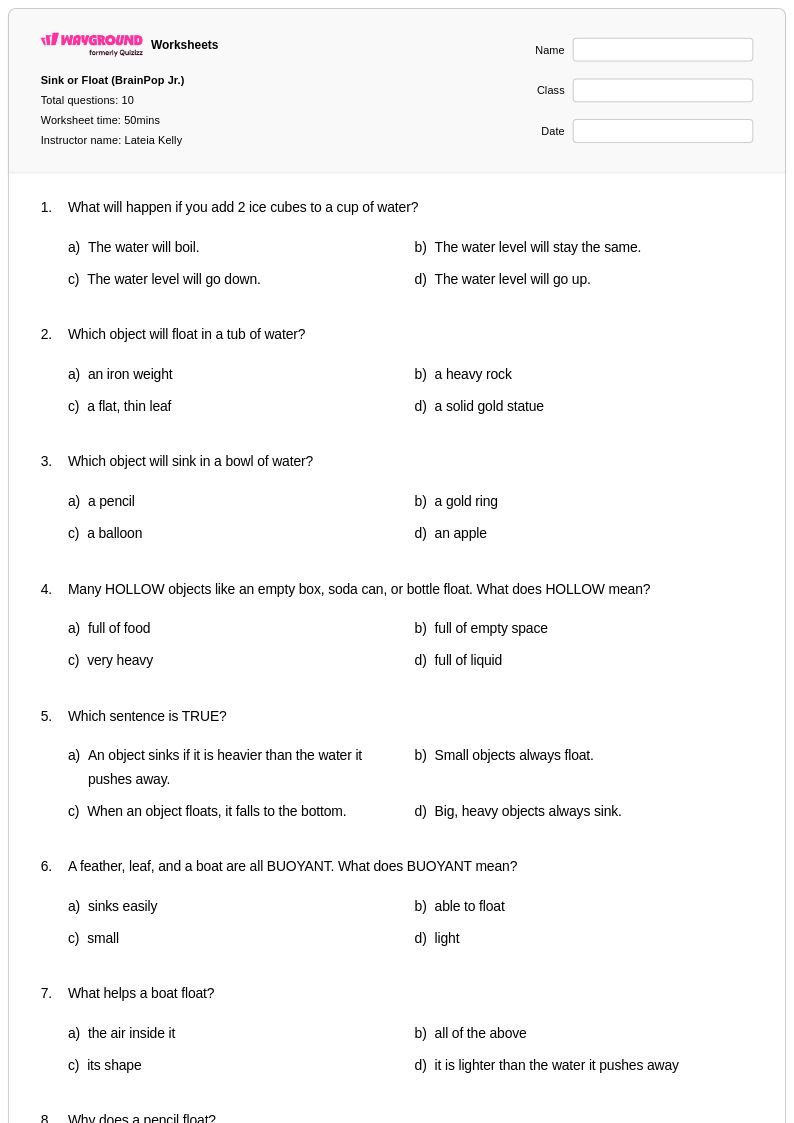
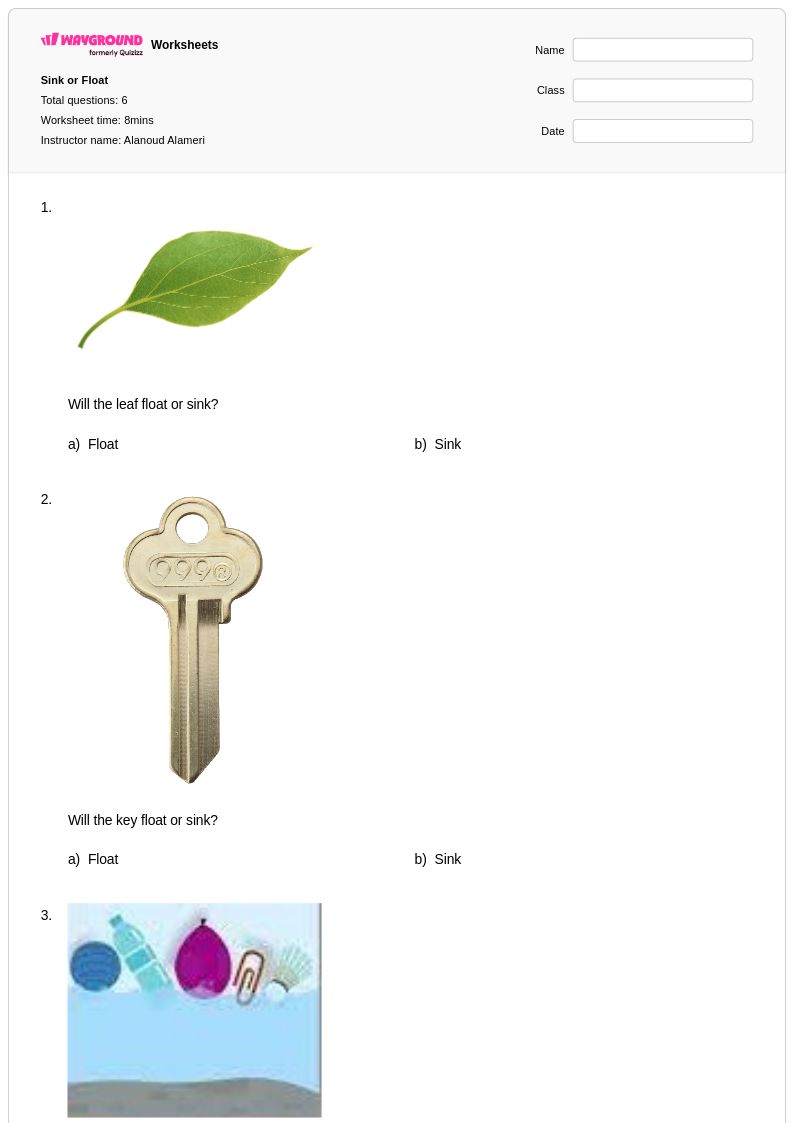
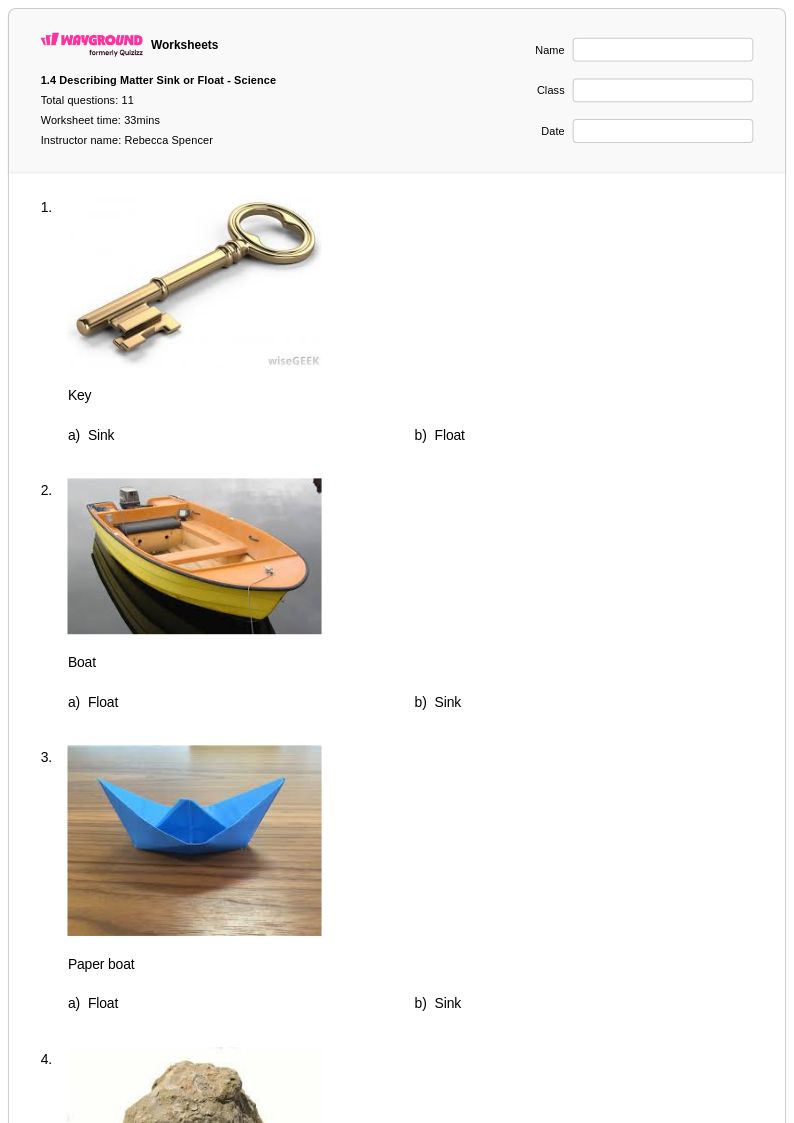
Sink or float worksheets available through Wayground (formerly Quizizz) provide students with engaging opportunities to explore fundamental physics concepts related to density, buoyancy, and material properties. These comprehensive educational resources strengthen critical thinking skills as students predict, observe, and analyze why different objects behave differently when placed in water or other liquids. The worksheets incorporate hands-on prediction activities, scientific observation charts, and practice problems that guide learners through the scientific method while building understanding of Archimedes' principle and density relationships. Each resource includes detailed answer keys and is available as free printables in convenient PDF format, making them accessible for both classroom instruction and independent study.
Wayground (formerly Quizizz) empowers educators with an extensive collection of millions of teacher-created sink or float resources that streamline lesson planning and enhance student engagement. The platform's robust search and filtering capabilities enable teachers to quickly locate age-appropriate materials that align with science standards and match their specific instructional needs. These differentiation tools support diverse learning styles through customizable content that can be adapted for remediation or enrichment activities, while flexible formatting options allow seamless integration into both digital and printable classroom environments. Teachers can efficiently modify worksheets to target specific skill gaps, create progressive practice sequences, or develop comprehensive assessment materials that reinforce conceptual understanding of buoyancy principles across various learning contexts.
FAQs
How do I teach sink or float concepts to young students?
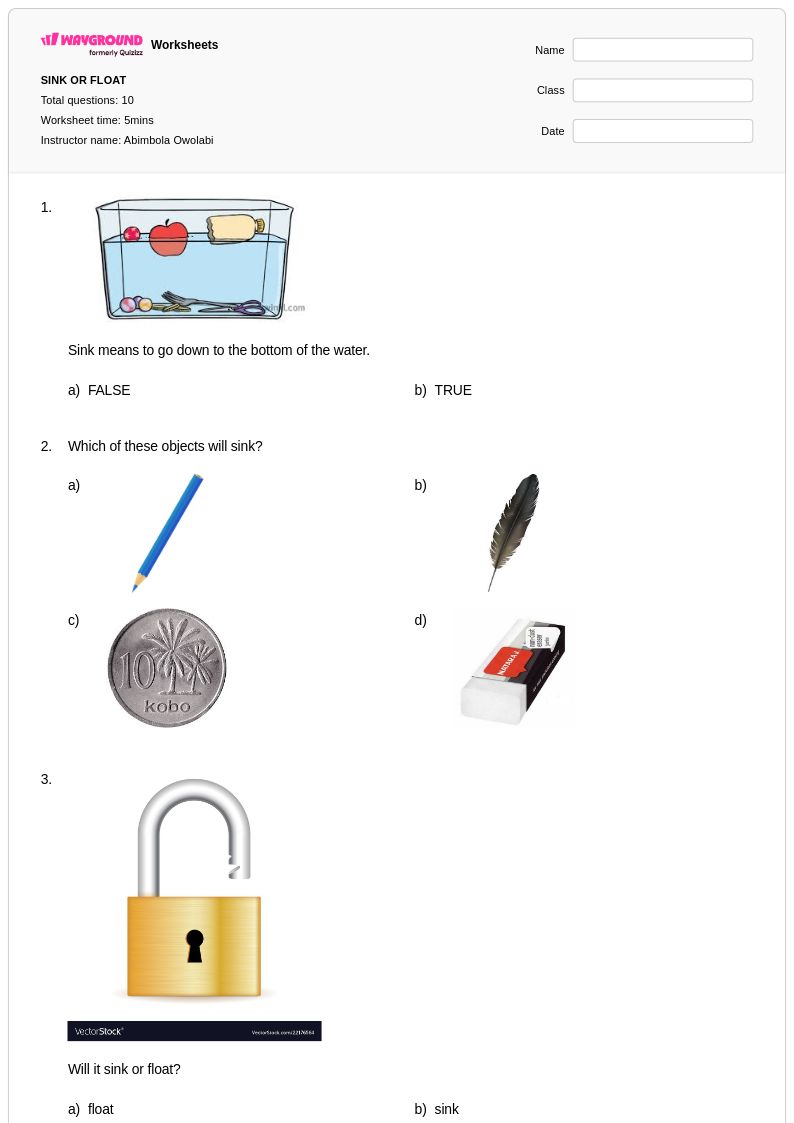
Start by building on prior knowledge — ask students whether they think a rock or a sponge will sink before any formal instruction begins. Then introduce density and buoyancy through direct observation using everyday objects like coins, corks, and plastic toys in a water tub. Connecting predictions to outcomes helps students internalize why objects sink or float rather than simply memorizing rules. Introducing Archimedes' principle at the end of the activity, after students have observed it firsthand, gives the vocabulary meaning.
What exercises help students practice sink or float and density concepts?
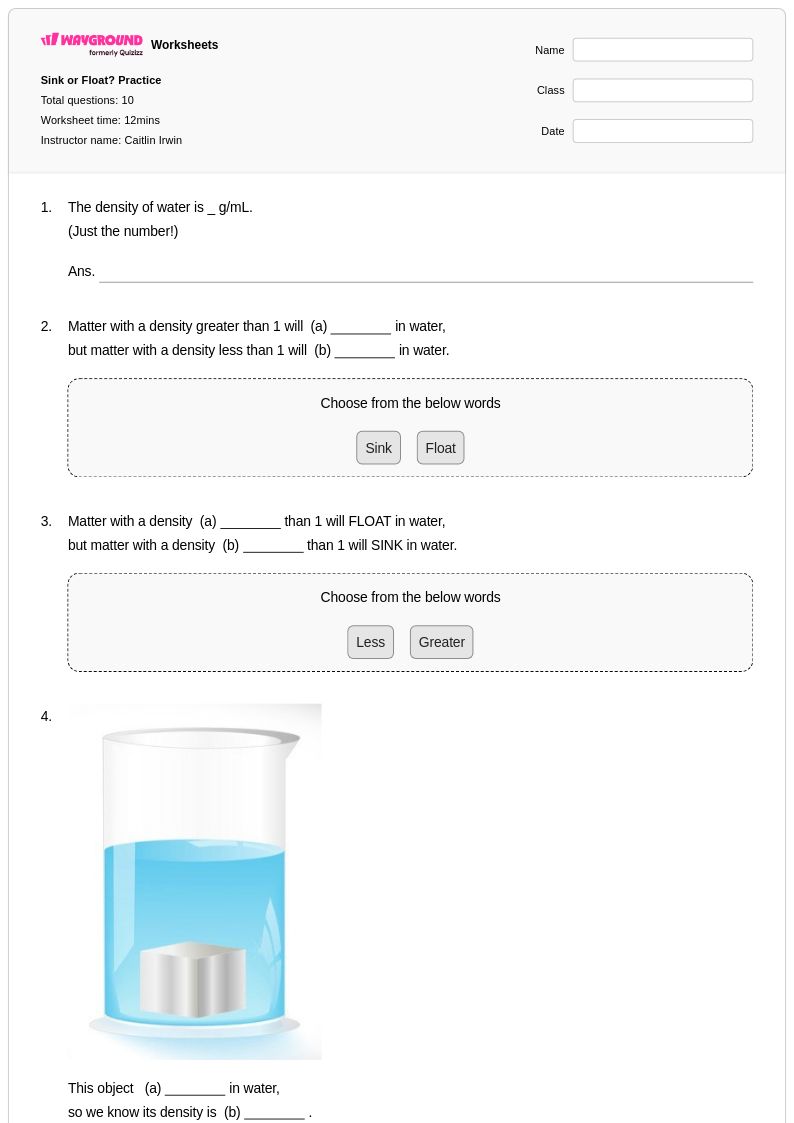
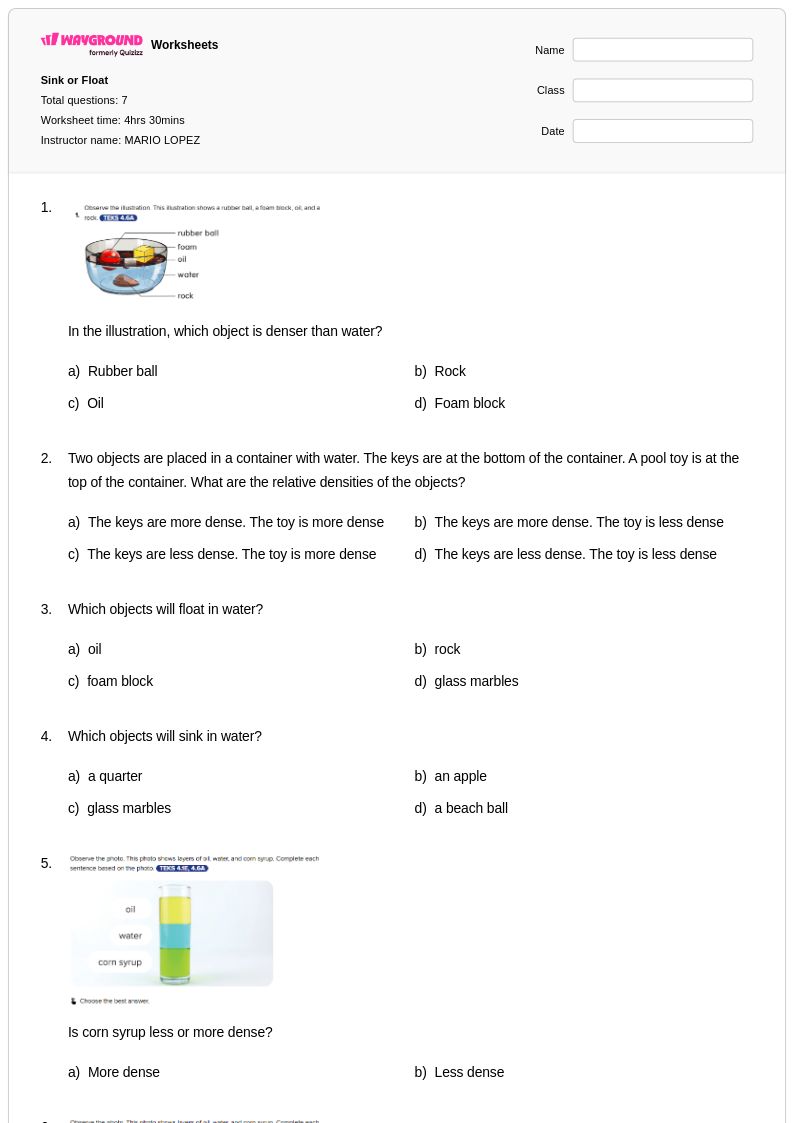
Prediction-and-observation charts are among the most effective practice formats because they require students to commit to a hypothesis before testing it, which deepens engagement with the outcome. Practice problems that ask students to compare object density to water density (1 g/cm³) help formalize the concept mathematically. Scientific method worksheets that walk students through question, hypothesis, data collection, and conclusion reinforce both the content and the process simultaneously.
What mistakes do students commonly make when learning about sink or float?
The most common misconception is that heavier objects always sink and lighter objects always float. Students often confuse mass with density, which leads to incorrect predictions for large, hollow objects like boats or small, dense objects like metal ball bearings. Teachers should explicitly address the role of shape and air displacement alongside density to correct this thinking. Asking students to explain why a steel ship floats while a steel marble sinks is a reliable way to surface and challenge this misconception.
How can I differentiate sink or float instruction for students at different levels?
For students who need additional support, reduce the number of variables by limiting trials to objects with clearly contrasting densities before introducing edge cases. For advanced learners, extend the activity by having them calculate the density of objects using mass and volume measurements and compare these values to water. Wayground supports individual student accommodations including reduced answer choices to lower cognitive load and read-aloud functionality for students who need audio support, which can be assigned per student without affecting the rest of the class.
How do I use Wayground's sink or float worksheets in my classroom?
Wayground's sink or float worksheets are available as printable PDFs for hands-on lab activities and in digital formats for technology-integrated classrooms. Teachers can assign them as pre-lab prediction exercises, in-class observation guides, or post-activity review sheets. Digital versions can also be hosted as a quiz directly on Wayground, making it easy to collect student responses and track understanding in real time. Each worksheet includes a complete answer key, so teachers can use them for independent practice or structured assessment with minimal preparation time.
How does sink or float connect to broader science standards?
Sink or float activities address foundational physical science standards related to properties of matter, density, and buoyancy, which appear across multiple grade bands in the Next Generation Science Standards (NGSS) and similar state frameworks. The scientific method skills embedded in prediction-and-observation activities also support crosscutting concepts like cause and effect and patterns. Because the concept scales from simple qualitative observation to quantitative density calculations, it can be revisited at increasing levels of complexity as students advance through elementary and middle school science.