Enhance student crisis management skills with Wayground's comprehensive collection of free social studies worksheets, featuring printable PDFs, engaging practice problems, and complete answer keys to build critical thinking and problem-solving abilities.
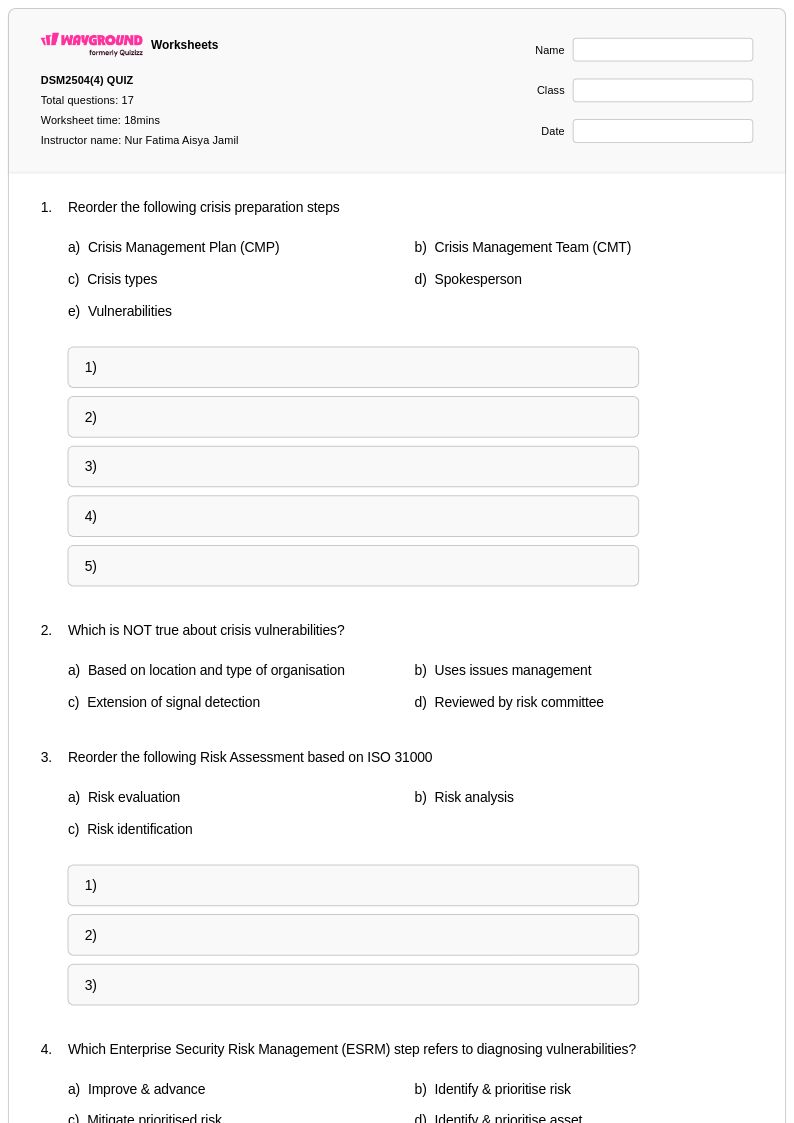
Crisis management worksheets available through Wayground (formerly Quizizz) provide comprehensive resources for developing critical decision-making and problem-solving skills in challenging situations. These carefully designed educational materials help students understand the fundamental principles of crisis response, including identifying potential threats, assessing risks, developing action plans, and implementing effective communication strategies during emergencies. The worksheets strengthen essential competencies such as critical thinking under pressure, collaborative problem-solving, and emotional regulation while building confidence in handling unexpected situations. Teachers can access complete answer keys, downloadable pdf formats, and free printables that offer structured practice problems covering scenarios from natural disasters to interpersonal conflicts, ensuring students develop practical crisis management abilities applicable across various contexts.
Wayground (formerly Quizizz) empowers educators with an extensive collection of teacher-created crisis management resources, drawing from millions of professionally developed worksheets that address diverse emergency preparedness topics. The platform's robust search and filtering capabilities allow teachers to quickly locate materials aligned with specific learning standards and differentiate instruction based on individual student needs. Flexible customization tools enable educators to modify existing worksheets or create personalized content, while both printable and digital pdf formats provide versatile implementation options for classroom instruction, remote learning, or hybrid environments. These comprehensive features support strategic lesson planning, targeted remediation for struggling learners, enrichment opportunities for advanced students, and consistent skill practice that builds genuine competency in crisis response and emergency preparedness across all educational settings.
FAQs
How do I teach crisis management to students?
Effective crisis management instruction begins with helping students recognize the stages of a crisis: identification, assessment, response, and recovery. Teachers often use scenario-based learning to simulate real-world situations such as natural disasters or interpersonal conflicts, prompting students to apply decision-making frameworks under pressure. Building in structured reflection after each scenario reinforces emotional regulation alongside tactical thinking.
What exercises help students practice crisis management skills?
Scenario-based worksheets are among the most effective tools for practicing crisis management, as they require students to identify threats, assess risks, and develop action plans within a structured format. Practice problems that span a range of contexts, from natural disasters to school-based interpersonal conflicts, help students generalize their skills across situations. Repeated exposure to varied scenarios builds both confidence and competency in responding to unexpected challenges.
What common mistakes do students make when learning crisis management?
Students frequently conflate urgency with effective action, rushing to solutions without first assessing the nature or severity of the threat. Another common error is overlooking communication strategies, focusing solely on physical response plans while neglecting how information should be shared during an emergency. Teachers should also watch for students who struggle to regulate emotional responses in simulated high-pressure scenarios, as this can impair their judgment when applying decision-making frameworks.
How can I differentiate crisis management instruction for students with different learning needs?
Differentiation in crisis management can include reducing the complexity of scenarios for struggling learners while offering multi-step, open-ended problems for advanced students. On Wayground, teachers can apply student-level accommodations such as Read Aloud for students who need audio support, reduced answer choices to lower cognitive load, and extended time settings, all configurable per student without notifying the rest of the class. These settings are reusable across future sessions, making consistent differentiation manageable over time.
How do I use Wayground's crisis management worksheets in my classroom?
Wayground's crisis management worksheets are available as printable PDFs for traditional classroom use and in digital formats for technology-integrated or remote learning environments. Teachers can also host worksheets as a live quiz on Wayground, giving students an interactive experience while generating real-time performance data. Complete answer keys are included with every worksheet, reducing teacher prep time and supporting consistent grading.
How do crisis management worksheets support critical thinking skills?
Crisis management worksheets build critical thinking by placing students in structured decision-making scenarios where they must weigh risks, evaluate options, and justify responses, skills that transfer well beyond emergency preparedness contexts. Problems that require students to develop communication strategies or collaborative action plans specifically target higher-order thinking, pushing students past recall toward analysis and synthesis. Over time, this kind of structured practice develops the cognitive habits students need to handle genuinely unpredictable situations.