Explore Wayground's comprehensive collection of Early Mesopotamia worksheets and printables that help students discover ancient civilizations through engaging practice problems, free PDF resources, and detailed answer keys.
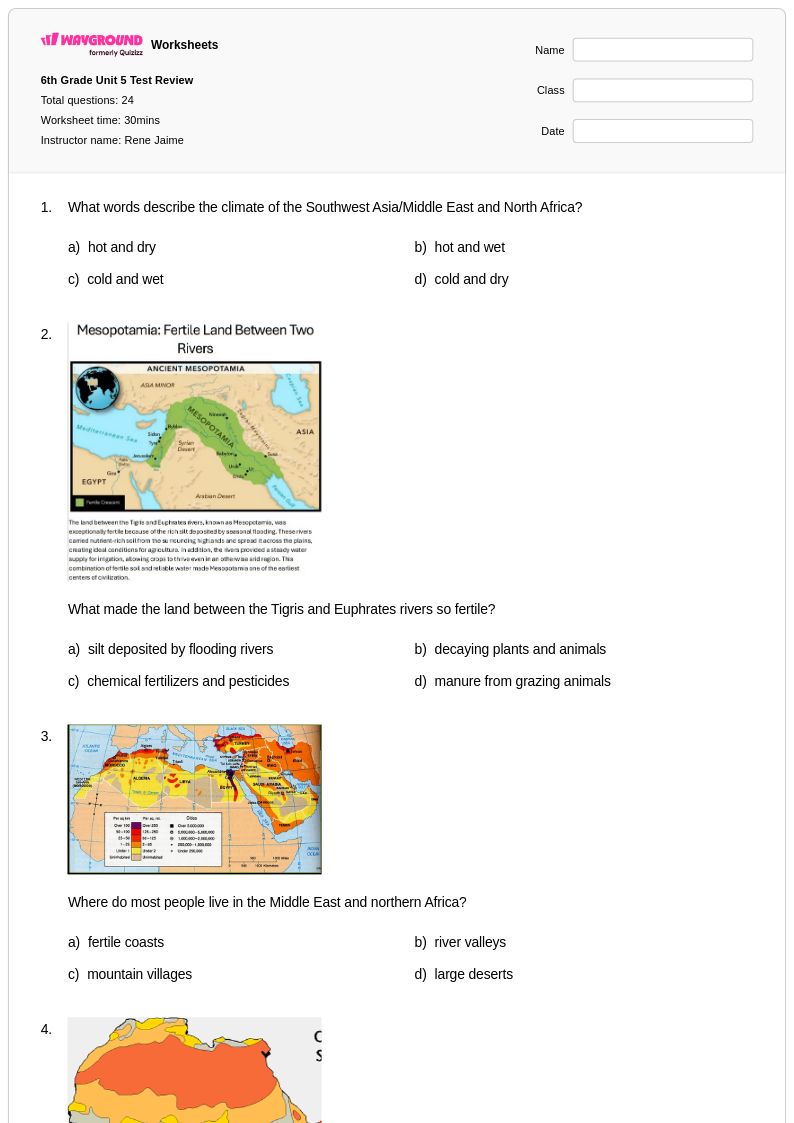
Early Mesopotamia worksheets available through Wayground (formerly Quizizz) provide comprehensive educational resources that immerse students in the study of humanity's first major civilization. These carefully crafted materials focus on essential concepts including the development of Sumerian city-states, the invention of cuneiform writing, the Code of Hammurabi, and the geographical advantages of the Tigris and Euphrates river valley. Students engage with practice problems that strengthen critical thinking skills through analysis of primary source documents, archaeological evidence, and historical timelines that trace the evolution from nomadic societies to complex urban centers. Each worksheet comes with a detailed answer key and is available as a free printable pdf, enabling educators to seamlessly integrate these resources into lesson plans while providing students with structured opportunities to explore the foundations of human civilization, including innovations in agriculture, government, religion, and technology that emerged in ancient Mesopotamia.
Wayground (formerly Quizizz) empowers teachers with access to millions of educator-created Early Mesopotamia worksheets that support diverse classroom needs through sophisticated search and filtering capabilities aligned with social studies standards. The platform's differentiation tools allow educators to customize content complexity and format, ensuring materials meet varying student abilities while maintaining academic rigor in historical analysis and comprehension. Teachers can efficiently plan instruction by accessing both printable and digital formats, including downloadable pdfs that facilitate flexible classroom implementation whether for in-person learning, remote instruction, or hybrid environments. These extensive resources prove invaluable for targeted remediation when students struggle with chronological thinking or cause-and-effect relationships, while also providing enrichment opportunities for advanced learners ready to explore deeper connections between Mesopotamian innovations and their lasting impact on subsequent civilizations, ultimately supporting skill practice that builds historical literacy and analytical reasoning essential for social studies mastery.
FAQs
How do I teach Early Mesopotamia to middle school students?
Start by grounding students in geography — the Tigris and Euphrates river valley and why its fertile land made it a cradle for civilization. From there, build outward into the development of Sumerian city-states, cuneiform writing, and early government systems like the Code of Hammurabi. Using primary source analysis and historical timelines helps students trace the shift from nomadic societies to organized urban centers, which is the conceptual core of any Mesopotamia unit.
What are good practice activities for students learning about ancient Mesopotamia?
Effective practice for Early Mesopotamia includes analyzing archaeological evidence, interpreting historical timelines, and working through primary source documents such as excerpts from the Code of Hammurabi. Structured worksheets that ask students to identify cause-and-effect relationships — such as how geographic advantages shaped agricultural and governmental innovation — reinforce both content knowledge and historical thinking skills. These activities push students beyond memorization toward genuine historical reasoning.
What common mistakes do students make when studying Early Mesopotamia?
Students frequently struggle with chronological thinking, conflating events from different periods of Mesopotamian history or misplacing the development of cuneiform writing relative to other milestones. Another common error is treating Mesopotamia as a monolithic civilization rather than understanding the distinct roles of Sumerian city-states. Students also often underestimate the significance of geography, missing the connection between the river valley's resources and the rise of agriculture, trade, and centralized governance.
How do Early Mesopotamia worksheets help students understand the Code of Hammurabi?
Worksheets focused on the Code of Hammurabi typically ask students to analyze specific laws, identify the social hierarchy they reflect, and evaluate how they compare to modern legal concepts. This kind of structured primary source analysis helps students connect ancient governance to broader themes of justice, class, and state power. Guided questions on a worksheet scaffold the analysis so students at different reading levels can engage meaningfully with the original text.
How do I use Early Mesopotamia worksheets in my classroom?
Early Mesopotamia worksheets on Wayground are available as printable PDFs for traditional classroom use and in digital formats for technology-integrated or remote learning environments. Teachers can also host them as a quiz directly on Wayground, making it easy to assign, collect, and review student work in one place. Each worksheet includes a detailed answer key, so they work equally well for in-class instruction, independent practice, or homework assignments.
How can I differentiate Early Mesopotamia instruction for students with varying skill levels?
For students who struggle with reading-heavy historical content, Wayground's Read Aloud feature can read questions and content aloud, and the reduced answer choices option lowers cognitive load on assessments. Font size and theme adjustments through Reading Mode support students with visual accessibility needs. For advanced learners, worksheets that draw connections between Mesopotamian innovations and their influence on later civilizations provide meaningful enrichment beyond the core curriculum.