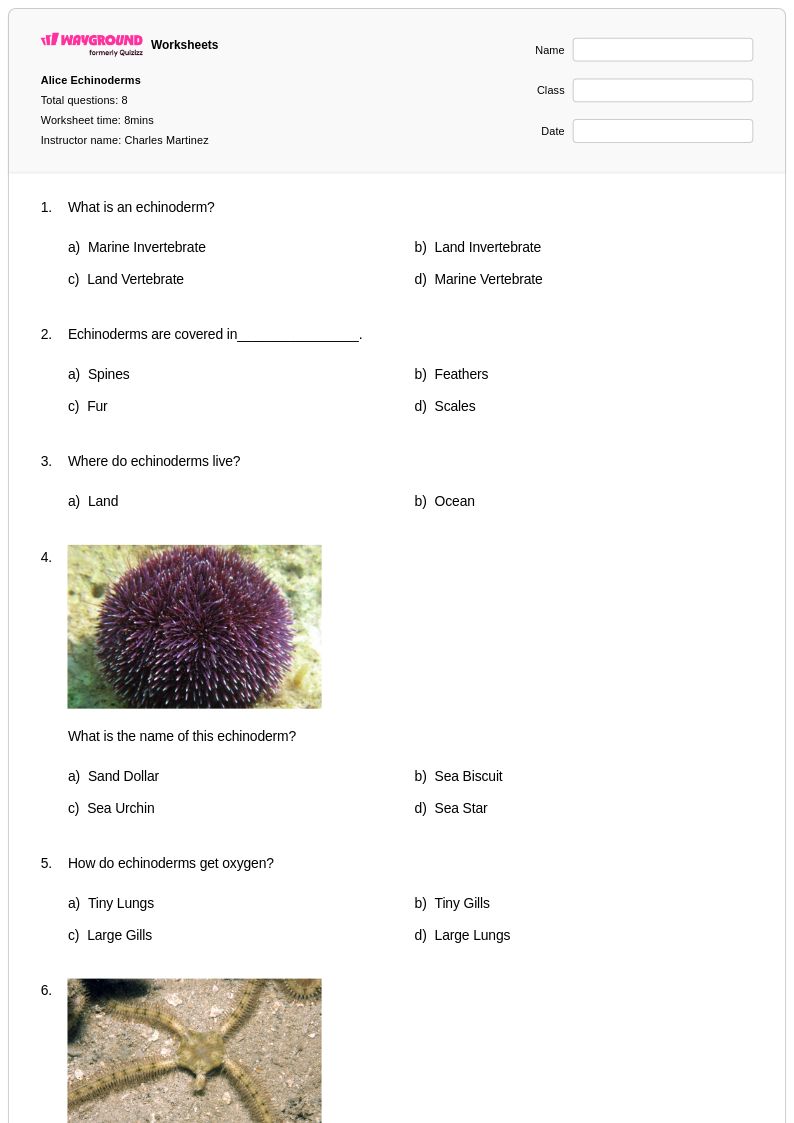
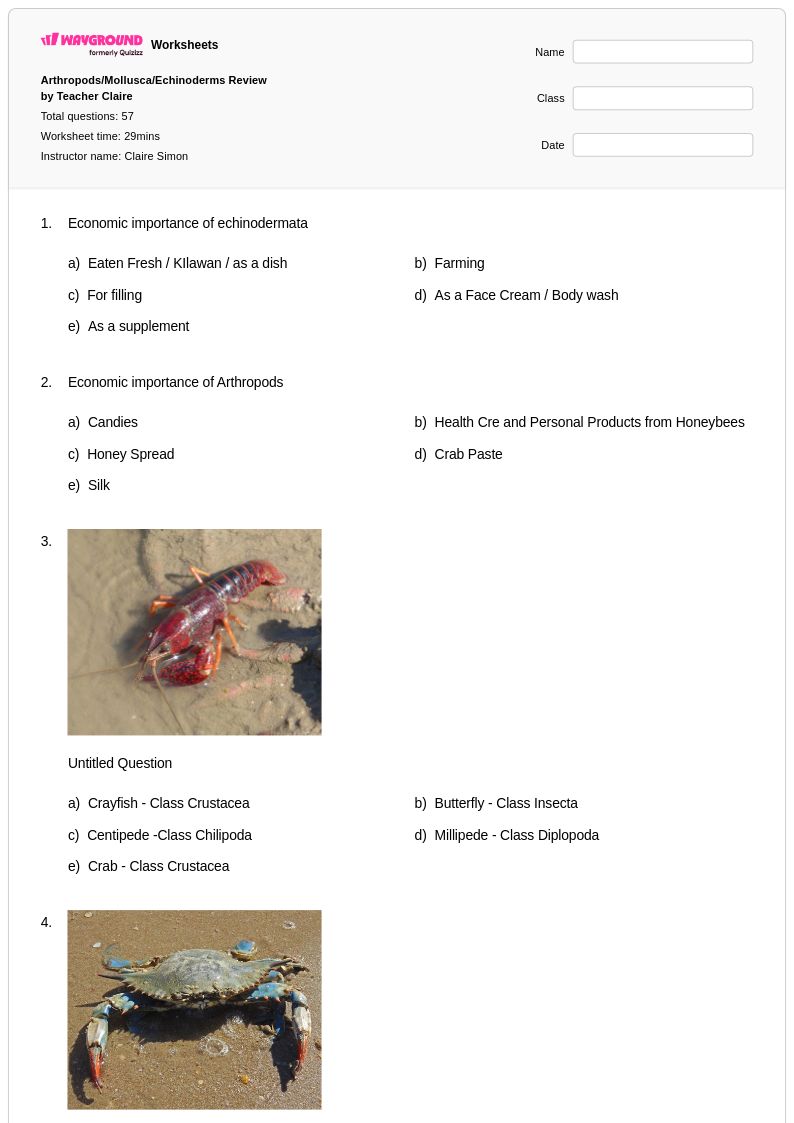
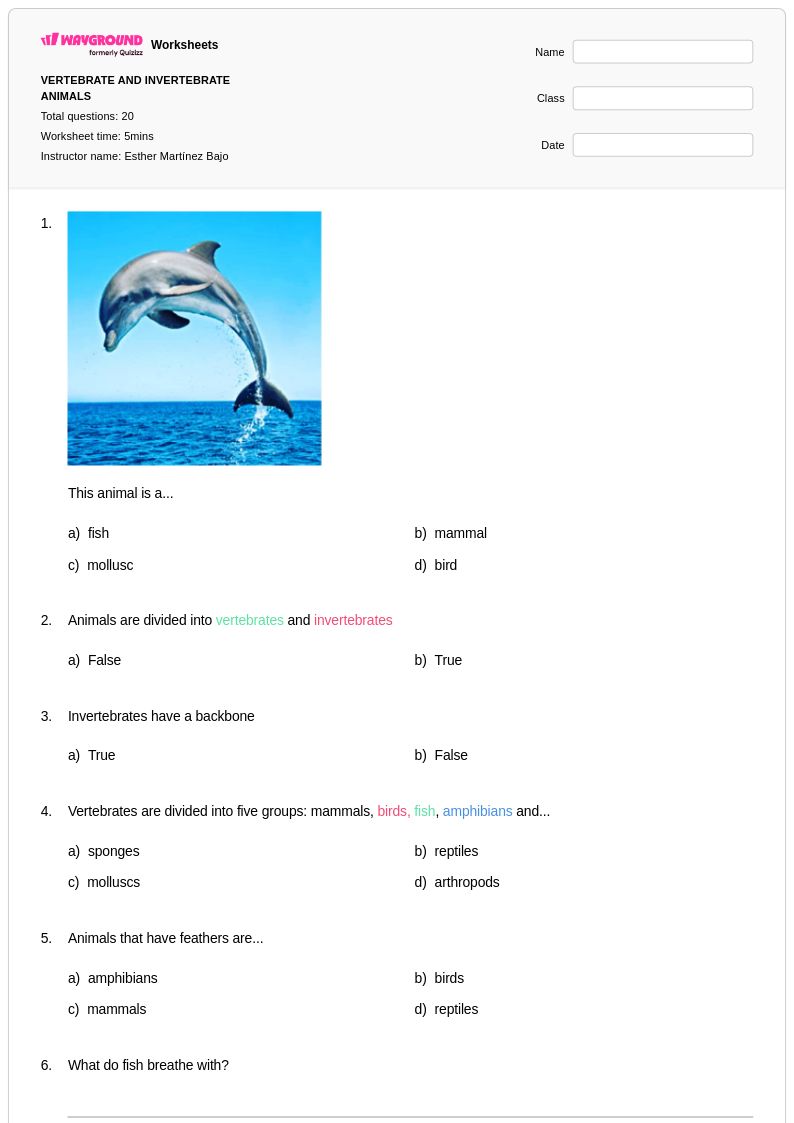
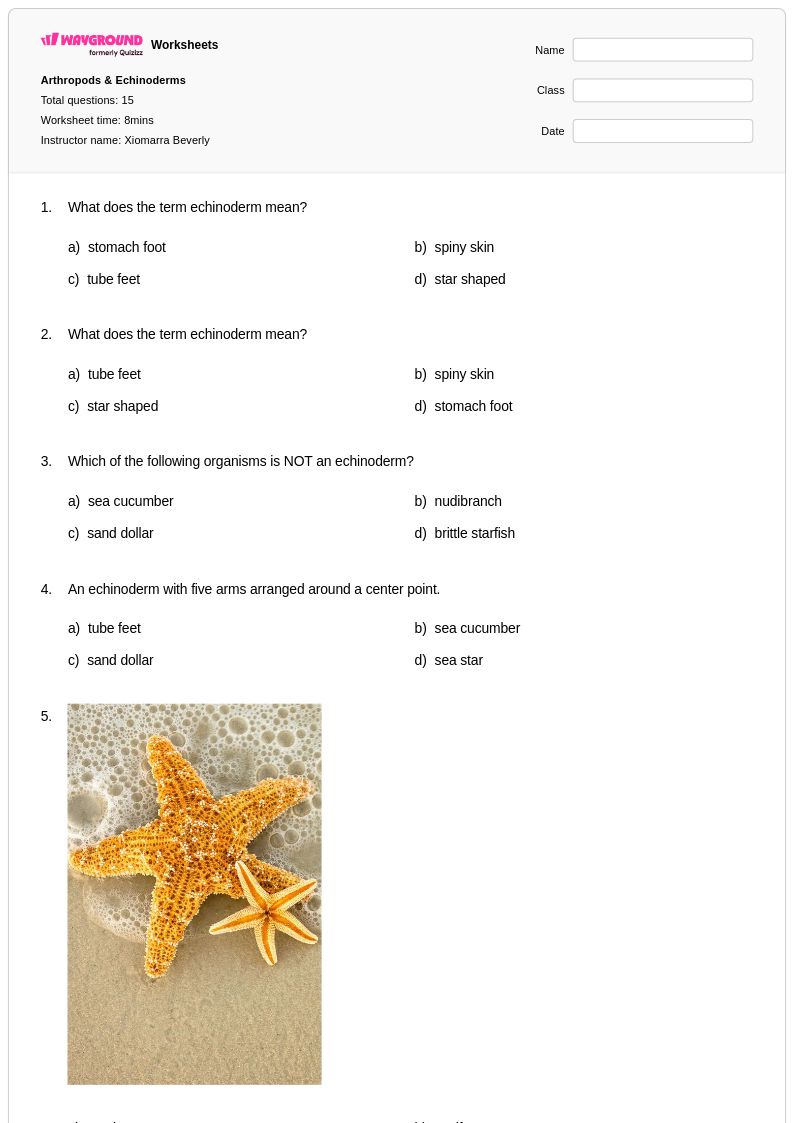
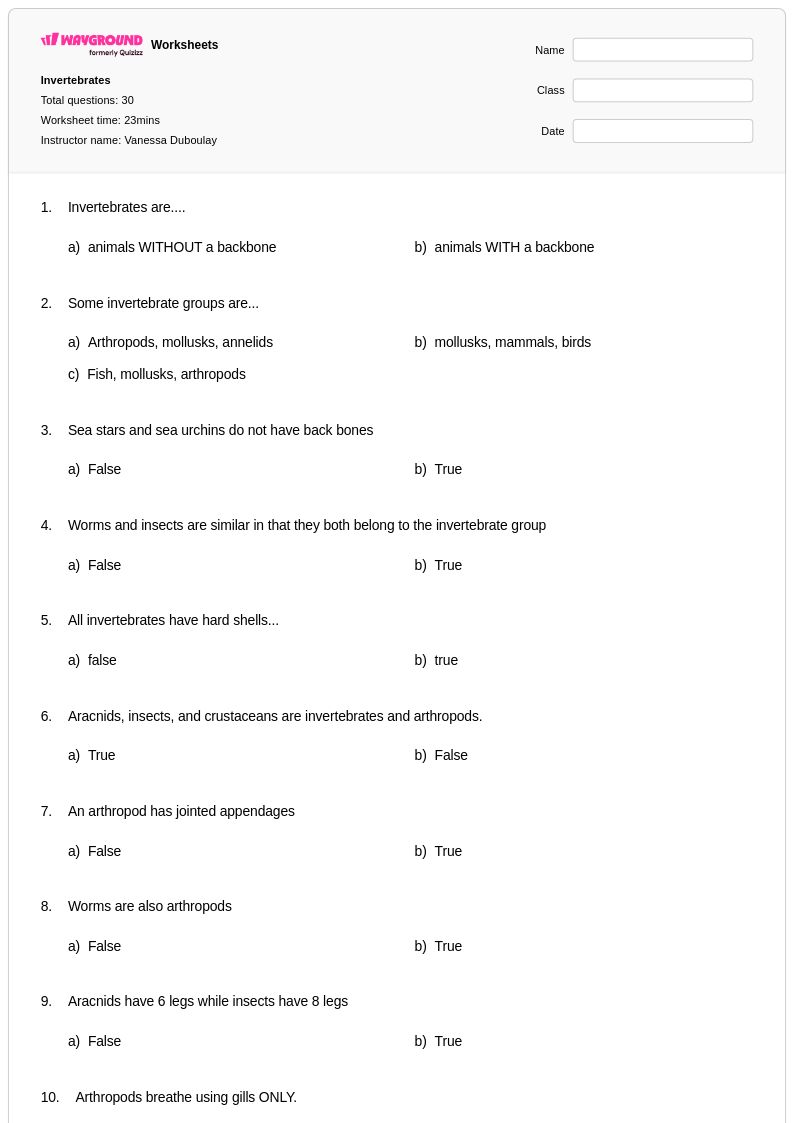
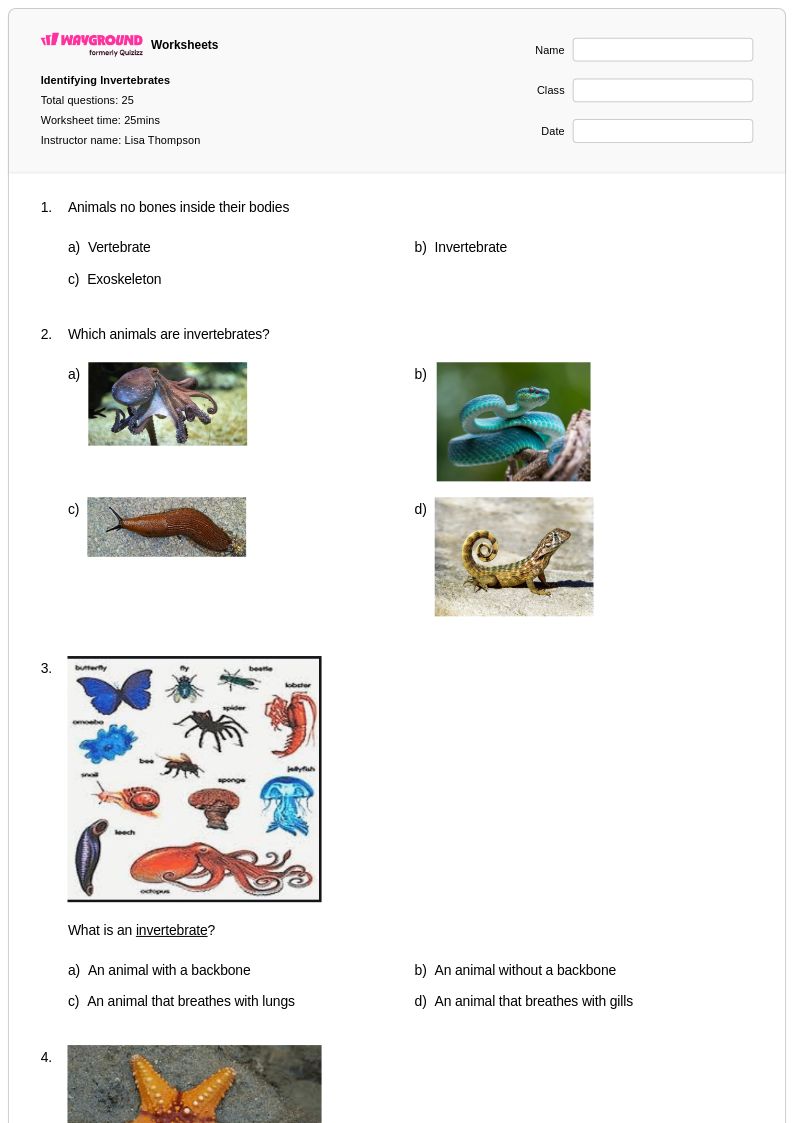
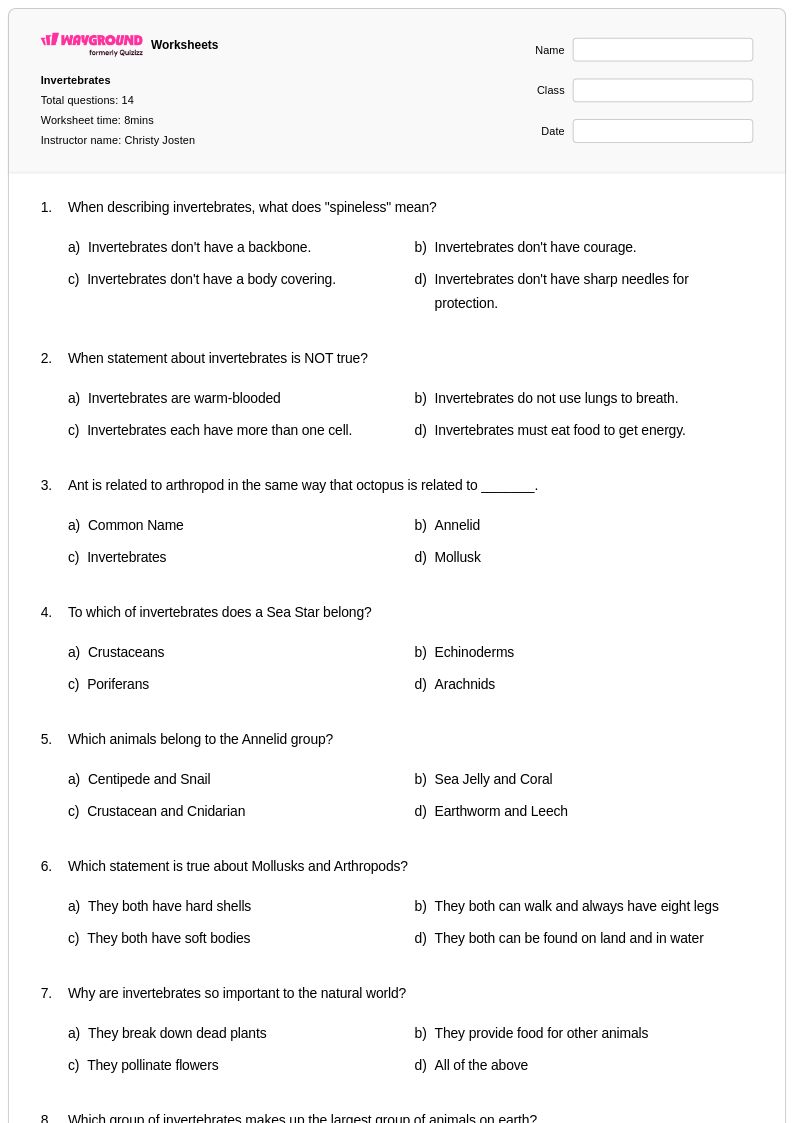
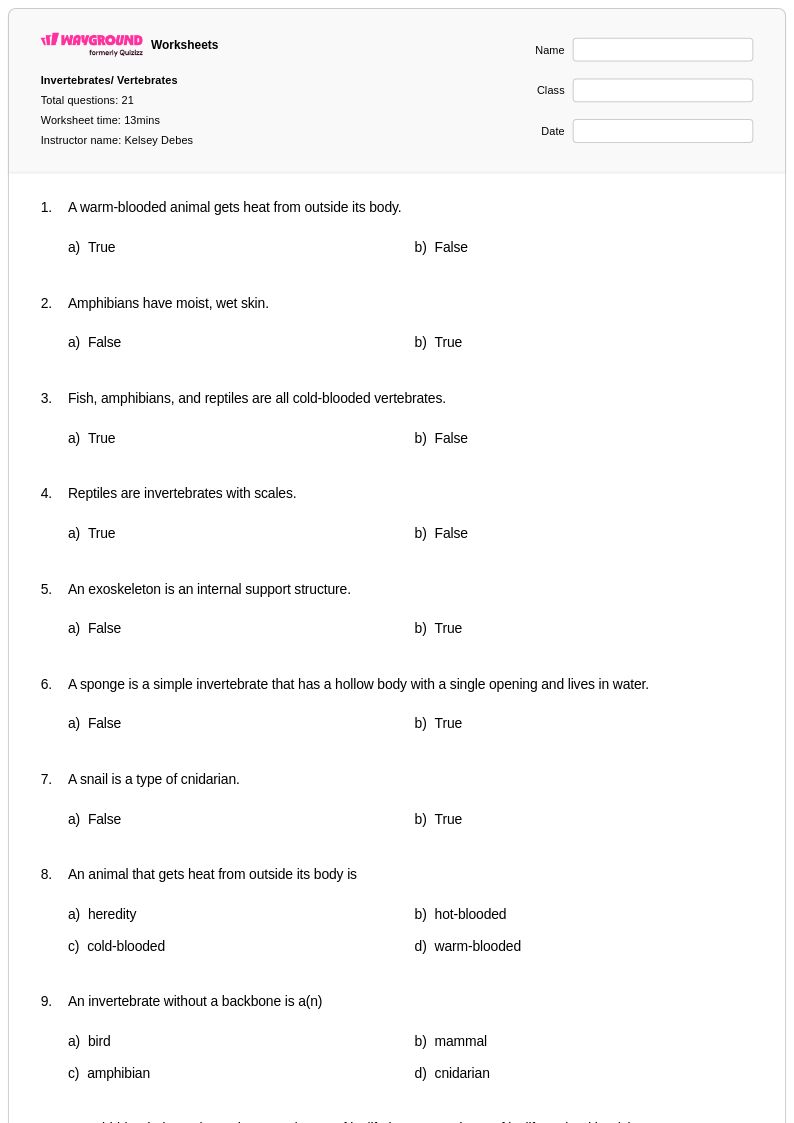
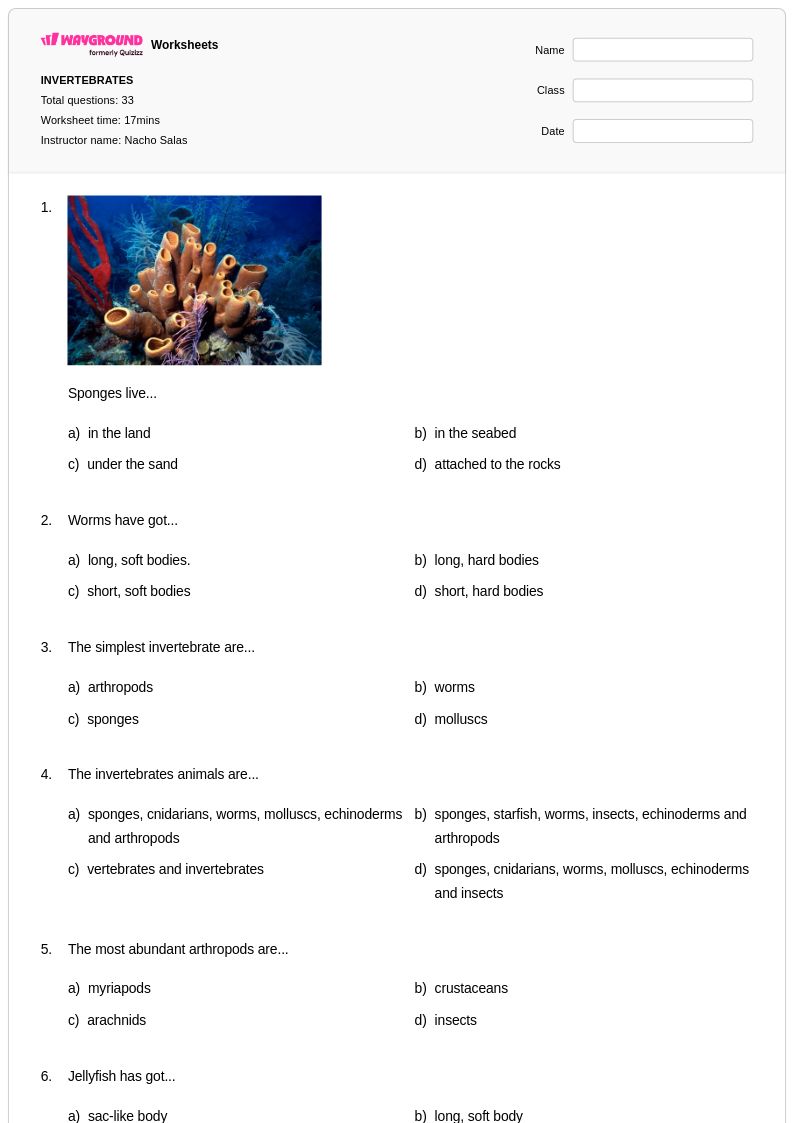
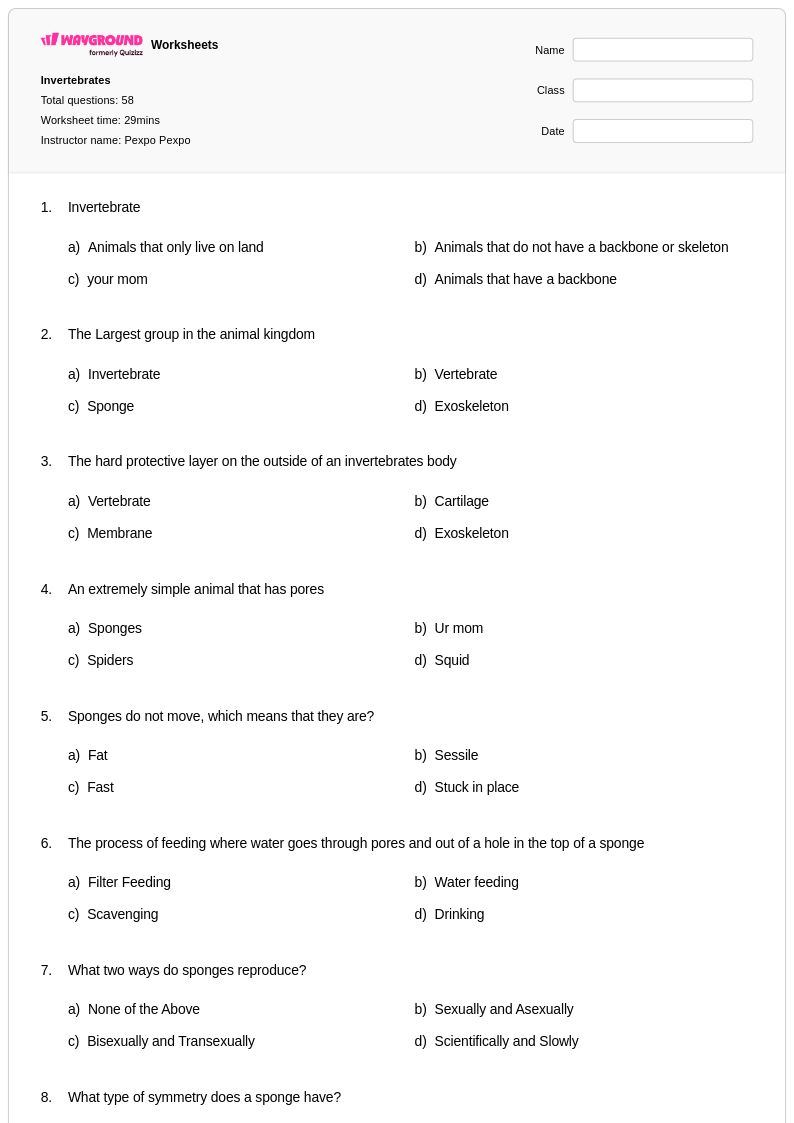
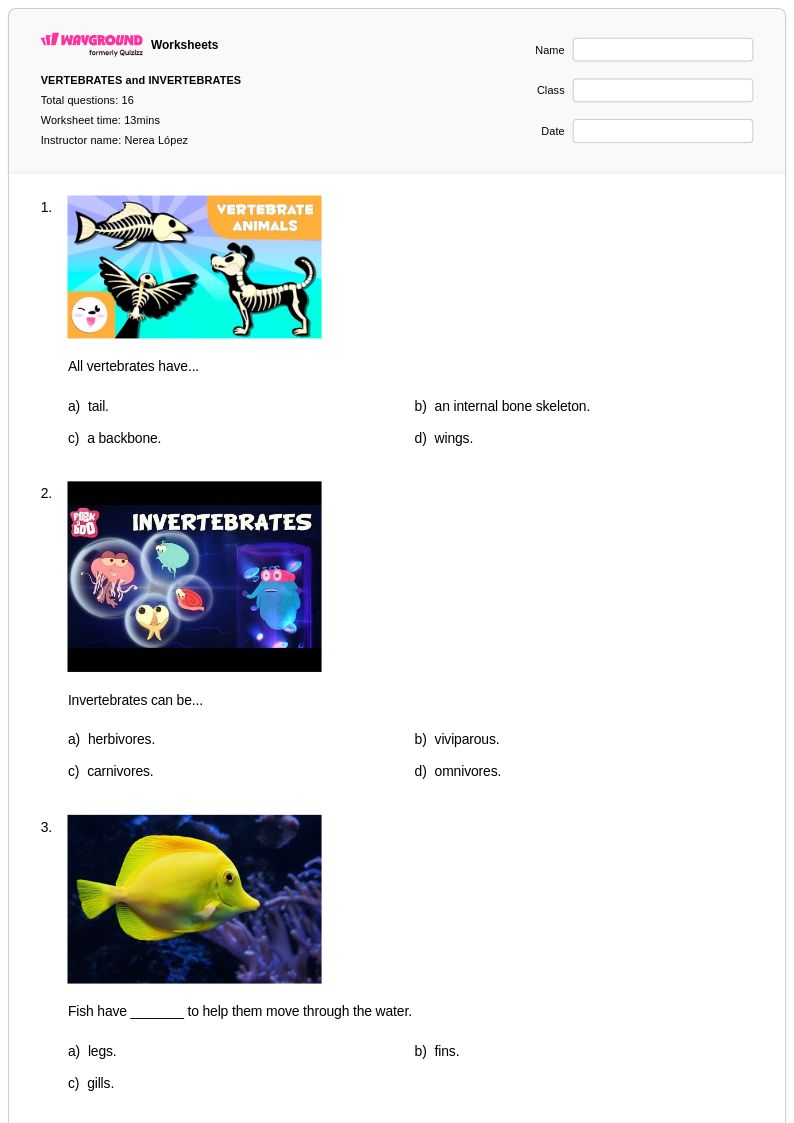
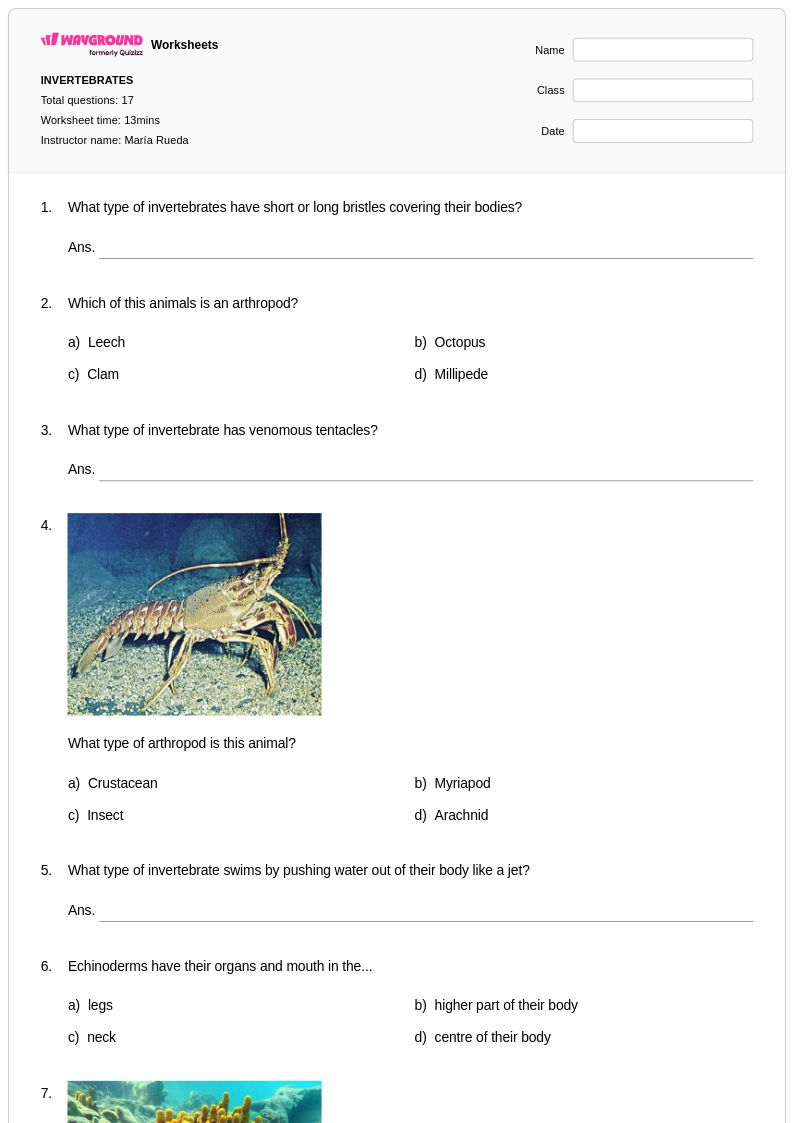
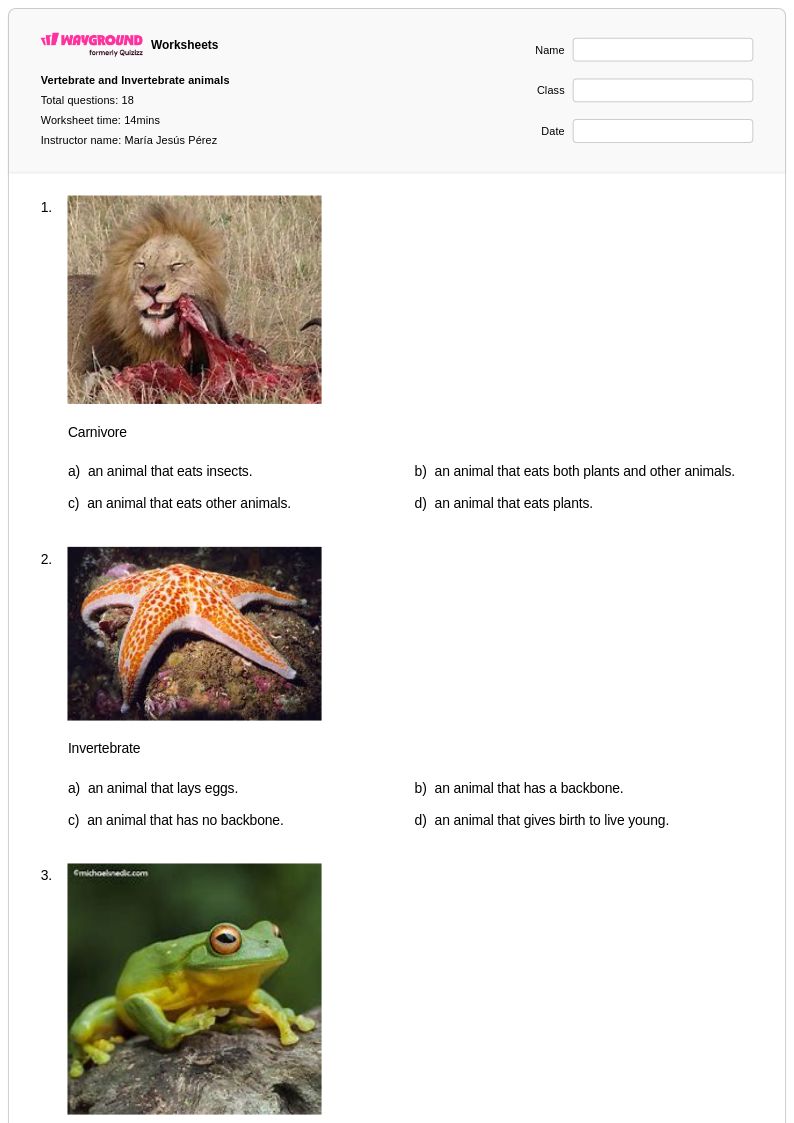
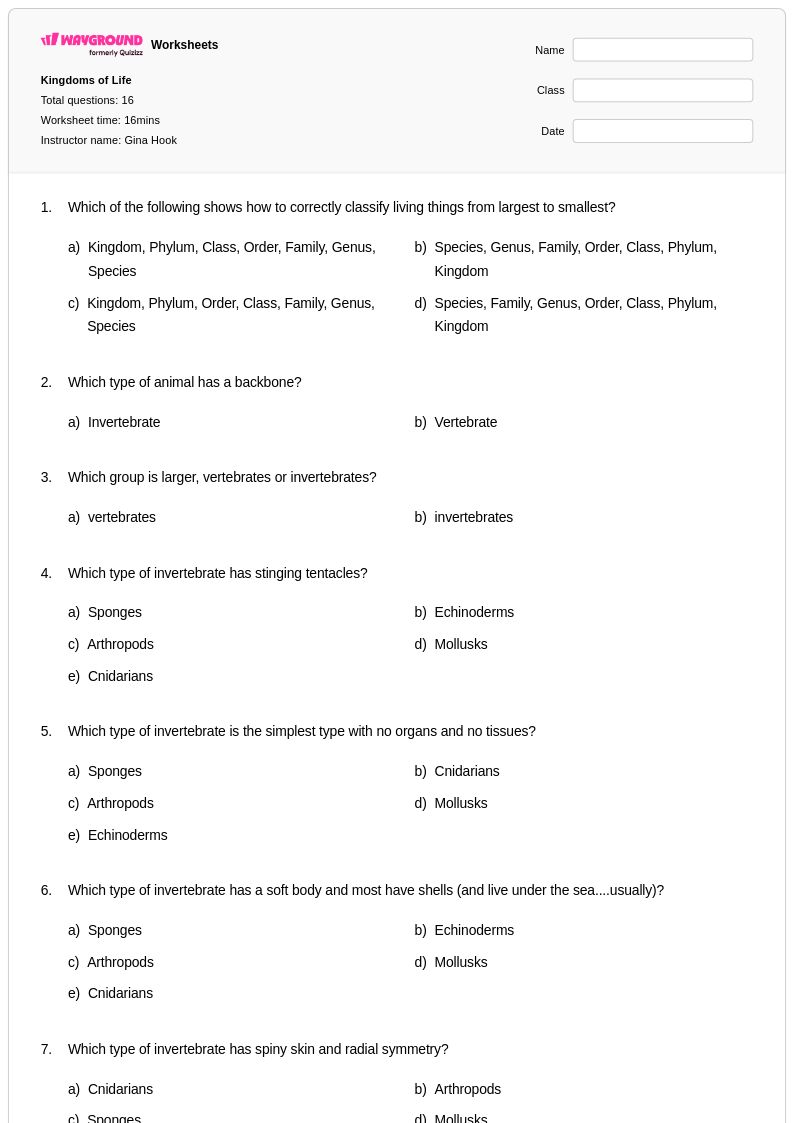
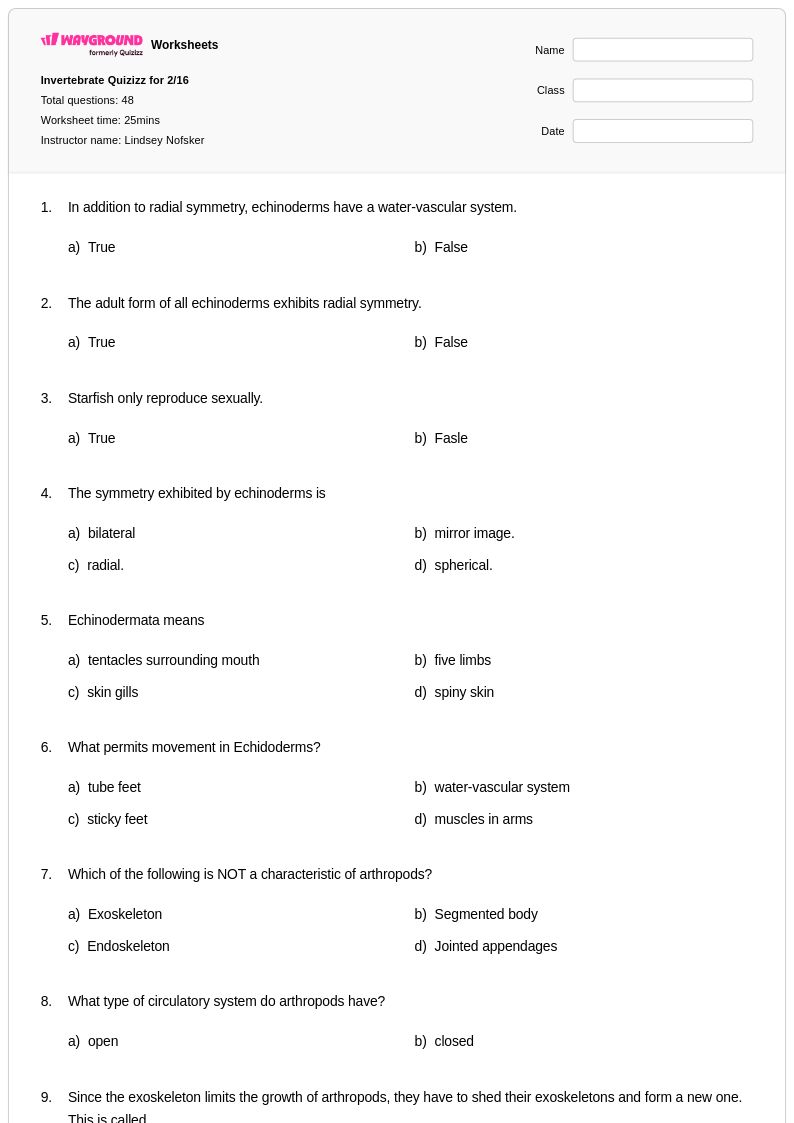
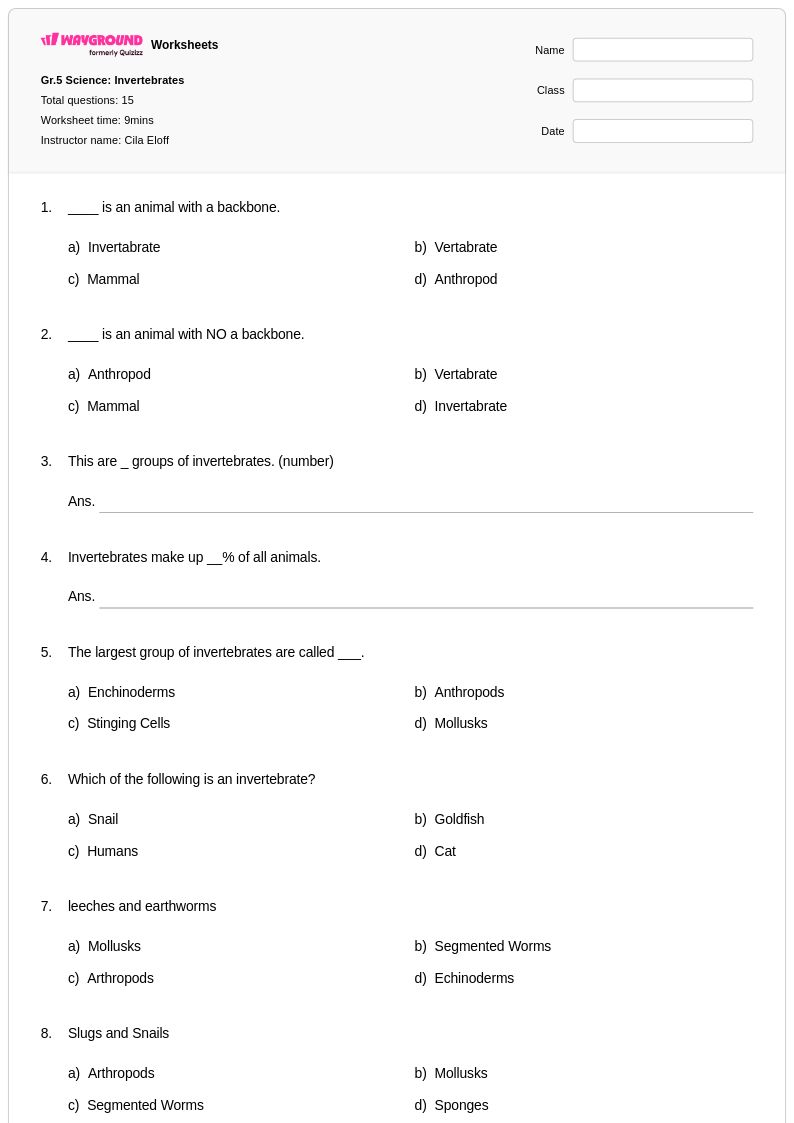
Explore free Grade 4 echinoderms worksheets and printables from Wayground that help students discover starfish, sea urchins, and sea cucumbers through engaging practice problems and activities with complete answer keys.
Explore printable Echinoderms worksheets for Grade 4
Echinoderms worksheets for Grade 4 students through Wayground (formerly Quizizz) provide comprehensive exploration of these fascinating marine invertebrates, including starfish, sea urchins, sea cucumbers, and sand dollars. These educational resources strengthen students' understanding of echinoderm characteristics such as their unique radial symmetry, water vascular system, and spiny skin features that distinguish them from other animal groups. The worksheets incorporate engaging practice problems that challenge fourth graders to identify different echinoderm species, compare their body structures, and analyze their roles in ocean ecosystems. Each printable resource includes detailed answer keys to support independent learning and self-assessment, while the free pdf format ensures easy classroom distribution and home study access.
Wayground (formerly Quizizz) empowers teachers with millions of educator-created echinoderm worksheets specifically designed for Grade 4 biology instruction, featuring robust search and filtering capabilities that allow quick location of materials aligned with specific learning standards and curriculum requirements. The platform's differentiation tools enable teachers to customize worksheet difficulty levels, making it simple to provide appropriate challenges for diverse learners while addressing individual student needs through targeted remediation and enrichment activities. Available in both printable and digital formats including downloadable pdfs, these comprehensive worksheet collections support flexible lesson planning whether teachers need quick skill practice exercises, comprehensive unit assessments, or supplementary materials that reinforce echinoderm concepts through varied instructional approaches.
FAQs
How do I teach echinoderms to my biology students?
Start by anchoring instruction on the defining traits that set echinoderms apart from other invertebrates: radial symmetry, a water vascular system, and tube feet. Use labeled diagrams of sea stars, sea urchins, and sea cucumbers to walk students through body plan differences before introducing shared characteristics. Connecting echinoderms to their ecological roles in ocean ecosystems, such as sea urchins controlling algae growth, helps students see why this phylum matters beyond taxonomy.
What worksheet activities help students practice echinoderm anatomy?
Labeling diagrams of the water vascular system, tube feet, and radial symmetry structures gives students repeated exposure to anatomical vocabulary in context. Classification exercises that ask students to sort echinoderms by class, body plan, or feeding strategy reinforce organizational thinking. Practice problems that connect anatomy to function, such as explaining how tube feet enable locomotion or how the madreporite regulates water pressure, push students beyond simple recall.
What mistakes do students commonly make when learning about echinoderms?
Students frequently confuse radial symmetry in adult echinoderms with the bilateral symmetry of their larval stage, which is an important evolutionary detail they often overlook. Many also misunderstand the water vascular system, assuming it functions like a circulatory system rather than a hydraulic mechanism for movement and feeding. Another common error is treating regeneration as universal across all echinoderms, when in fact the capability varies significantly by class and species.
How do I differentiate echinoderm instruction for students at different skill levels?
For struggling students, focus on visual-heavy worksheets with labeled diagrams and simplified matching tasks before introducing written explanation prompts. Advanced learners benefit from comparative anatomy problems that ask them to connect echinoderm adaptations to evolutionary pressures or to contrast echinoderms with other marine invertebrate phyla. On Wayground, teachers can apply accommodations such as read aloud support, reduced answer choices, and extended time to individual students without affecting the rest of the class, making differentiation practical within a single assignment.
How can I use Wayground's echinoderm worksheets in my classroom?
Wayground's echinoderm worksheets are available as printable PDFs for traditional classroom use and in digital formats for technology-integrated environments, giving teachers flexibility regardless of their classroom setup. Teachers can also host worksheets directly as a quiz on Wayground, enabling real-time student responses and instant scoring. Each worksheet includes a complete answer key, reducing prep time and making it straightforward to use these materials for independent practice, homework, or formative assessment.
How do I assess whether students understand the water vascular system in echinoderms?
Effective assessment goes beyond asking students to label parts and requires them to explain mechanism, for example, describing how water pressure in the ampullae extends tube feet or how the system supports gas exchange in the absence of specialized respiratory organs. Short-answer questions that ask students to trace water flow from the madreporite through the ring canal and radial canals reveal whether they understand the system as an integrated process rather than a list of parts. Common misconceptions to probe include the idea that tube feet are muscle-driven rather than hydraulically controlled.