Explore comprehensive Grade 12 France geography worksheets and printables that help students master French physical features, regions, and cultural landscapes through engaging practice problems, free PDF resources, and detailed answer keys.
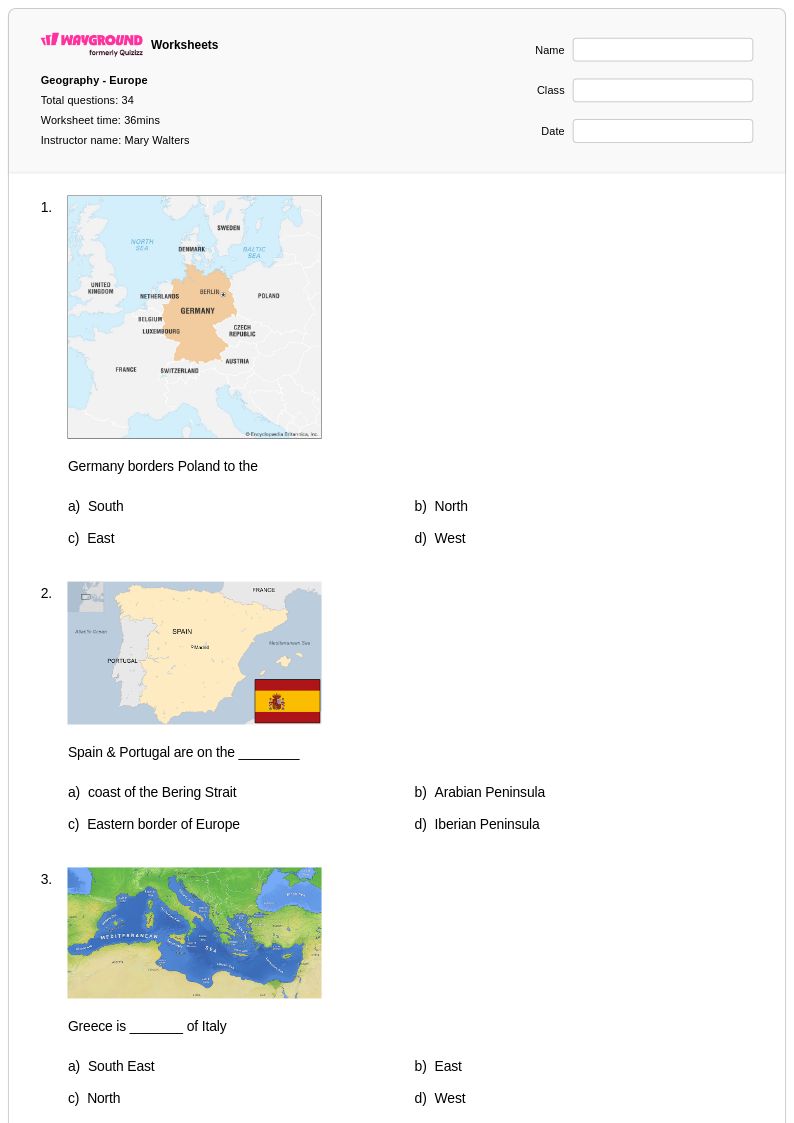
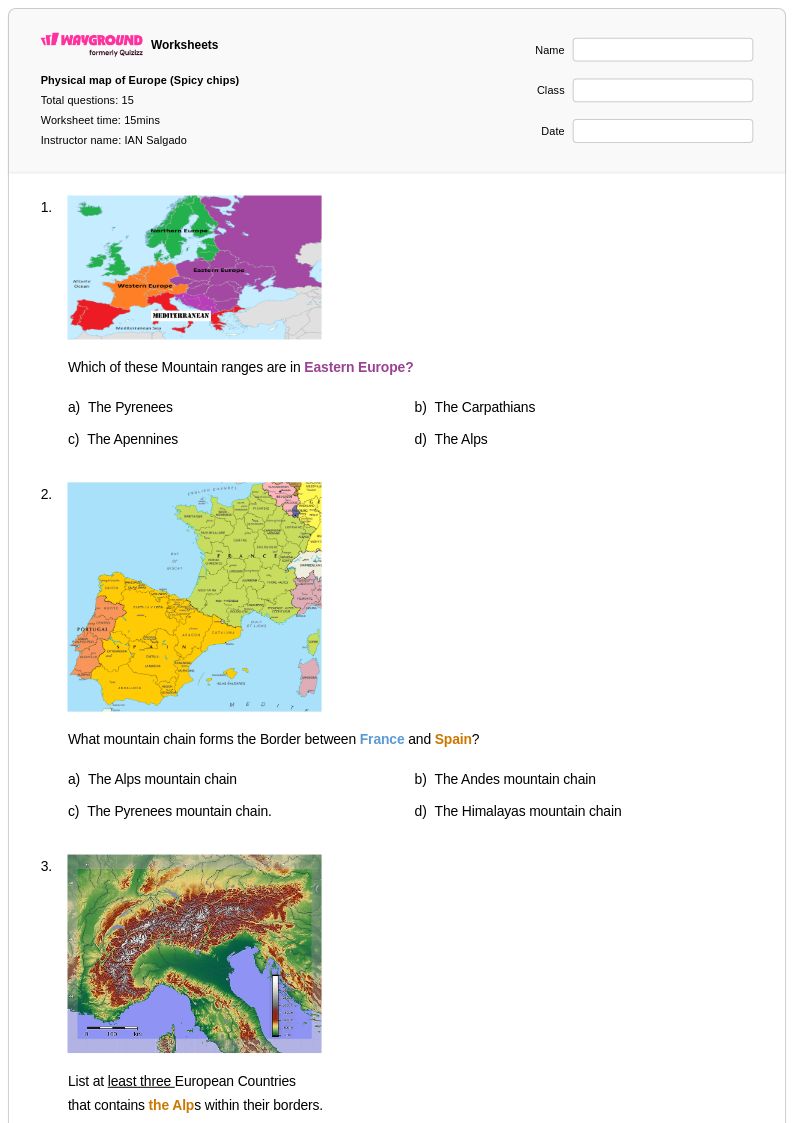
Grade 12 France geography worksheets available through Wayground (formerly Quizizz) provide comprehensive coverage of France's physical and human geography, designed to deepen students' understanding of this influential European nation. These expertly crafted materials explore France's diverse topography from the Alpine peaks to the Mediterranean coastline, examine urban hierarchies centered around Paris, and analyze regional variations in culture, economy, and demographics. Students engage with practice problems that require critical analysis of France's role in the European Union, its colonial legacy, and contemporary geopolitical significance. The worksheets strengthen essential geographic skills including map interpretation, spatial analysis, and comparative regional studies while building knowledge of French administrative divisions, transportation networks, and environmental challenges. Each resource includes comprehensive answer keys and is available as free printable pdf downloads, making them accessible for both classroom instruction and independent study.
Wayground (formerly Quizizz) supports educators with an extensive collection of millions of teacher-created resources specifically designed for advanced geographic studies, featuring robust search and filtering capabilities that allow teachers to locate materials aligned with specific curriculum standards and learning objectives. The platform's differentiation tools enable instructors to customize worksheets for varying skill levels within Grade 12 classrooms, supporting both remediation for students needing additional geographic concept reinforcement and enrichment for those ready to explore advanced spatial relationships and geopolitical analysis. Teachers can access these France geography materials in both printable and digital formats, including downloadable pdfs that facilitate seamless integration into lesson planning and assessment strategies. This flexibility proves invaluable for skill practice sessions, formative assessments, and comprehensive review activities that prepare students for advanced placement examinations and post-secondary geographic studies.
FAQs
How do I teach France geography to students effectively?
Start with France's physical geography — its major rivers like the Seine and Rhône, mountain ranges like the Alps and Pyrenees, and coastal regions along the Mediterranean and Atlantic. From there, layer in political geography by having students locate major cities such as Paris, Lyon, and Marseille on maps. Connecting physical features to human settlement patterns helps students understand why French cities and regions developed where they did.
What exercises help students practice identifying French regions and landmarks?
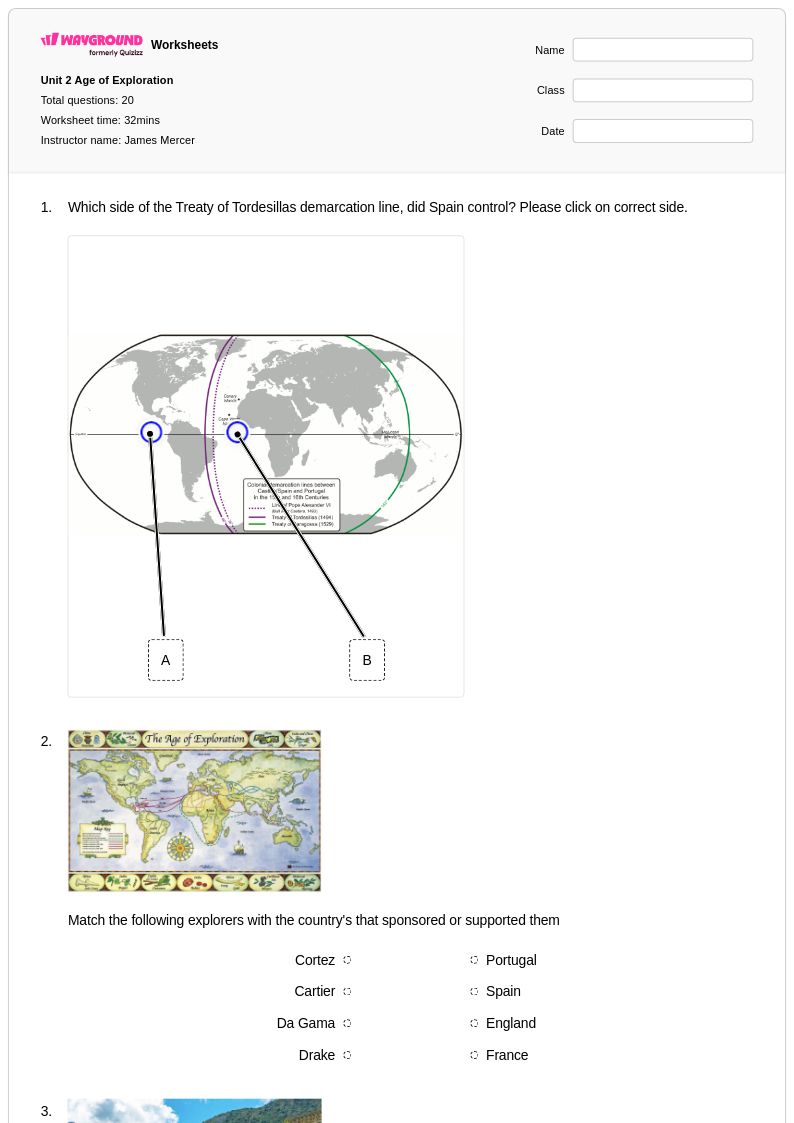
Labeling maps of France's major cities, rivers, and mountain ranges is one of the most effective practice formats because it builds both recall and spatial reasoning simultaneously. Worksheets that ask students to match physical features to their geographic descriptions or place them within the broader European context reinforce terminology and location knowledge together. Practice problems that connect landmarks to their regions — such as the Alps to southeastern France or the Loire Valley to central France — help students move beyond memorization toward meaningful geographic understanding.
What mistakes do students commonly make when learning about France's geography?
A frequent misconception is treating France as a single uniform landscape when it actually spans several distinct physical regions, from alpine terrain in the east to flat coastal plains in the west and northwest. Students also commonly confuse France's major rivers — particularly the Seine, Loire, and Rhône — misidentifying which cities sit along which waterways. Another common error is underestimating France's size and geographic diversity relative to its neighbors, which affects students' ability to interpret its regional influence within Europe.
How can I use France geography worksheets in my classroom?
France geography worksheets on Wayground are available as printable PDFs for traditional classroom use and in digital formats for technology-integrated environments, making them suitable for in-person, hybrid, and remote settings. Teachers can also host the worksheets as a quiz directly on Wayground, which allows for real-time student responses and easier progress tracking. Each worksheet includes a complete answer key, reducing prep time and making them practical for both guided instruction and independent practice.
How does France's location in Europe make it an important topic in geography class?
France's position at the western edge of continental Europe gives it borders with eight countries, including Germany, Spain, and Italy, making it a natural focal point for lessons on European political geography and trade routes. Its diverse terrain — spanning the Alps, the Pyrenees, major river systems, and two coastlines — makes it an ideal case study for connecting physical geography to human activity. Teaching France's geographic significance helps students build a transferable framework for analyzing how location and landscape shape a nation's role in regional and global contexts.
How do I differentiate France geography worksheets for students at different skill levels?
For students who are still building foundational skills, start with basic map labeling tasks focused on major cities and borders before introducing physical features or regional analysis. More advanced learners can be challenged with questions that connect France's geography to its economic activity, cultural regions, or historical significance. On Wayground, teachers can apply accommodations such as read aloud support, reduced answer choices, and extended time to individual students, ensuring that differentiation is built into the assignment rather than managed separately.