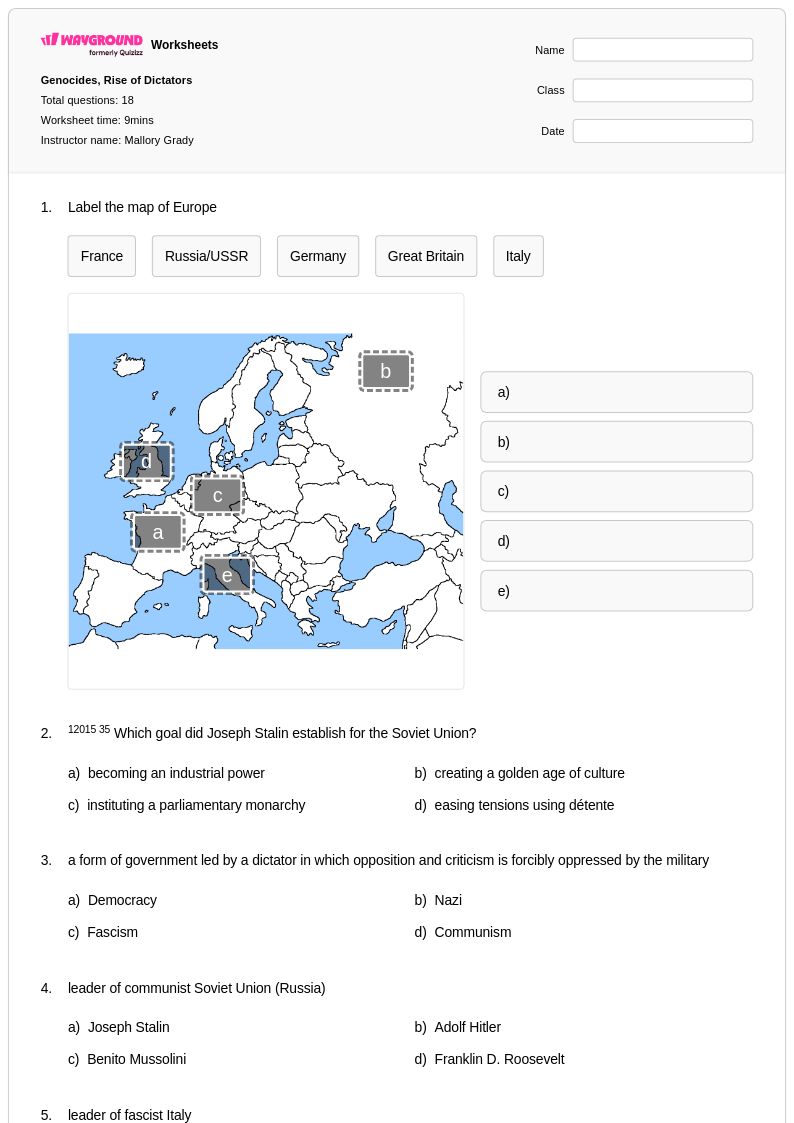
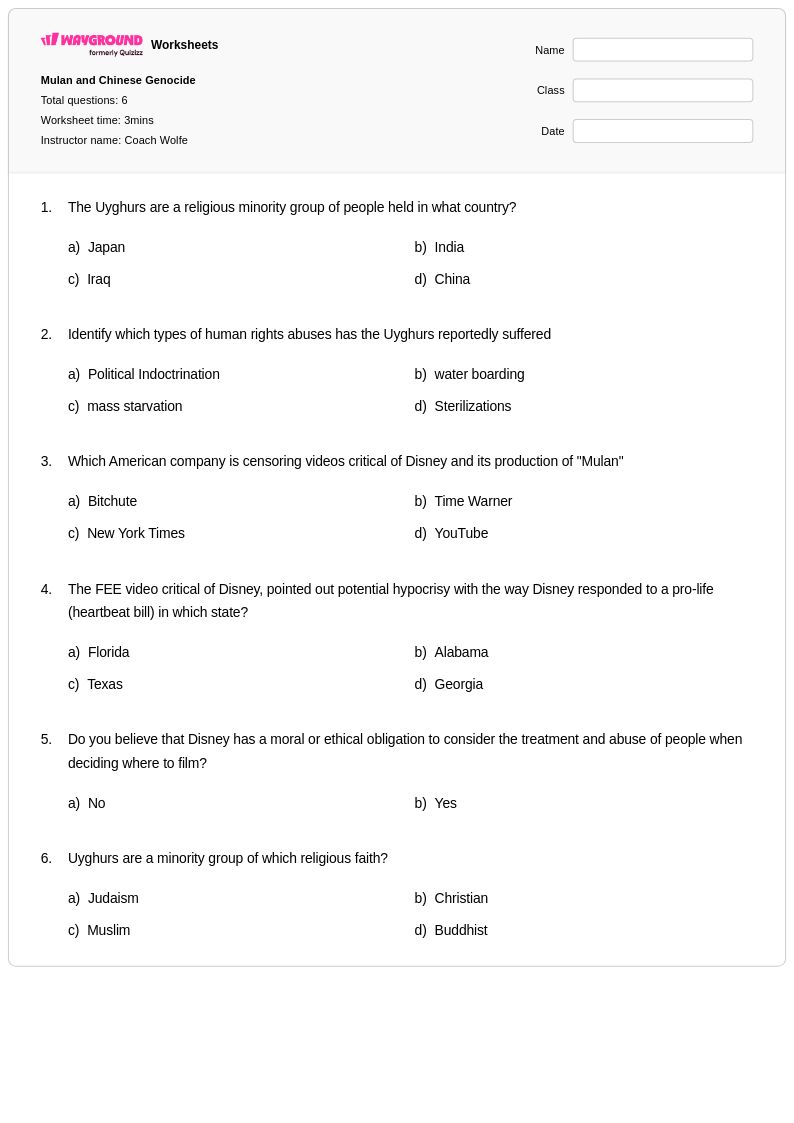
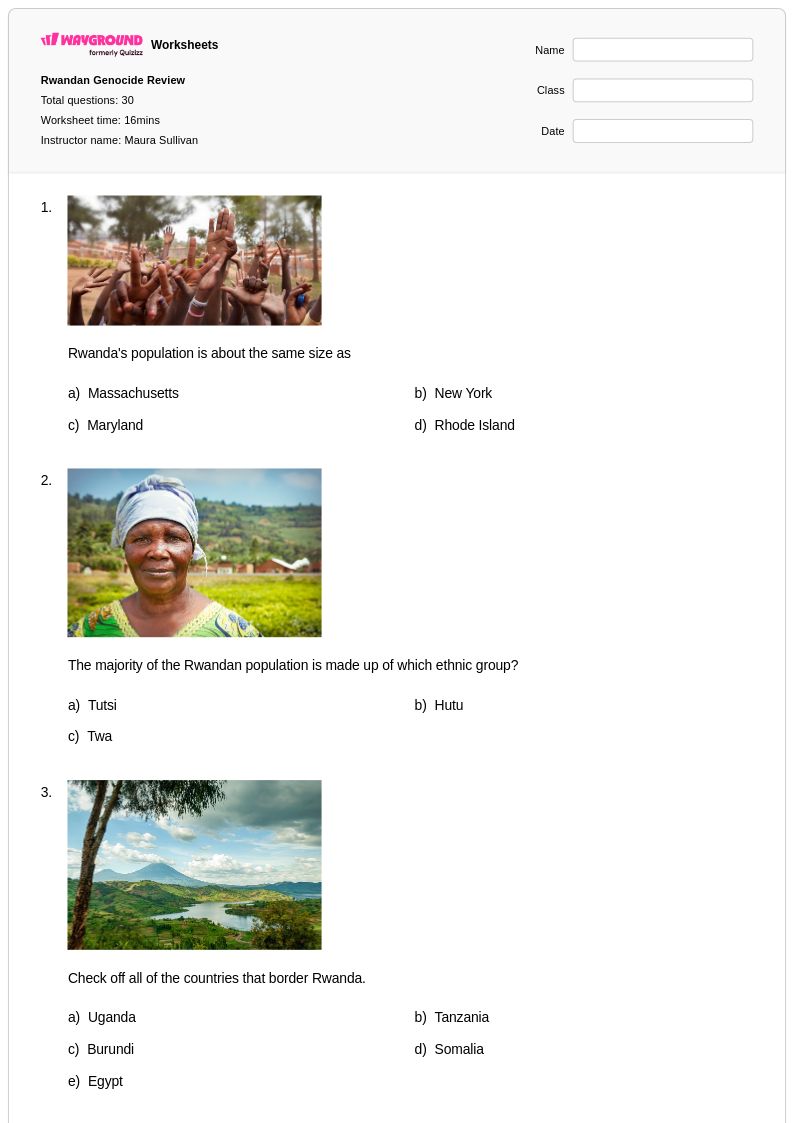
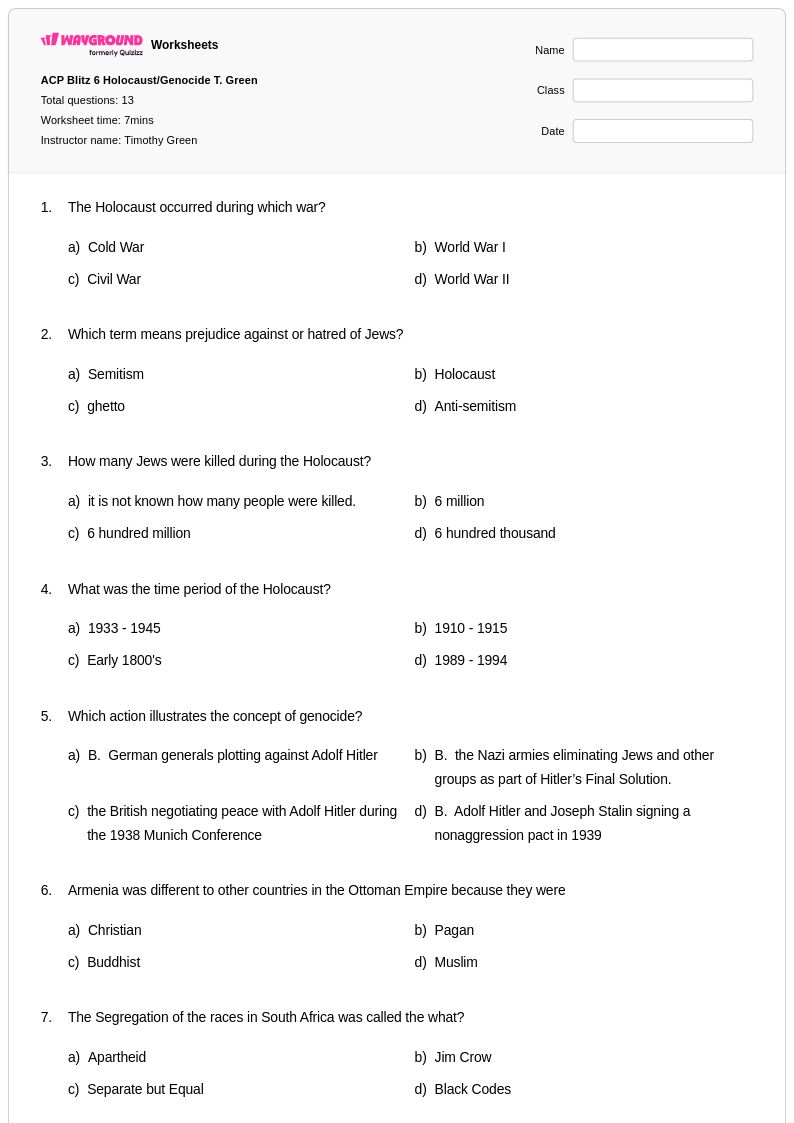
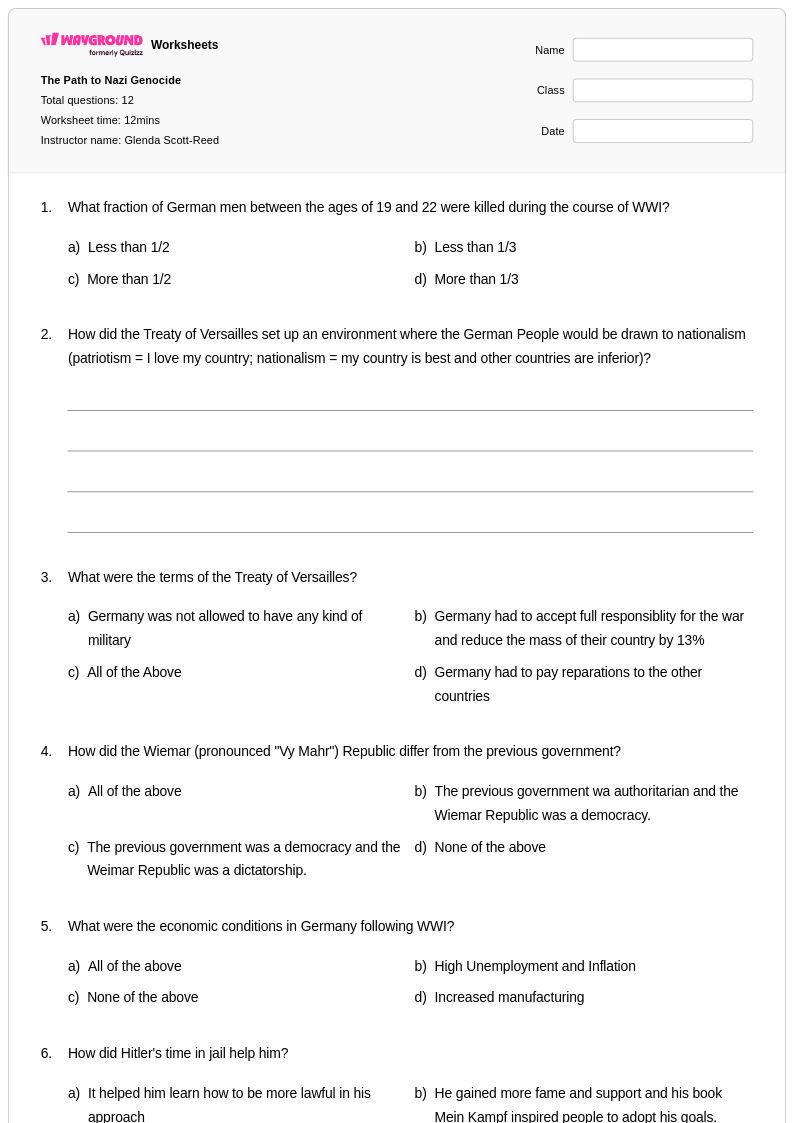
Explore Wayground's free genocide worksheets and printables that help students examine historical atrocities, analyze causes and consequences, and develop critical thinking skills about human rights through comprehensive practice problems with answer keys.
Genocide worksheets available through Wayground (formerly Quizizz) provide educators with comprehensive resources to address one of history's most challenging yet essential topics. These worksheets are designed to help students understand the systematic nature of genocide, examine historical case studies including the Holocaust, Armenian Genocide, Rwandan Genocide, and other atrocities, while developing critical thinking skills about prevention and human rights. The materials strengthen students' ability to analyze primary sources, evaluate historical evidence, and understand the complex social, political, and economic factors that contribute to mass violence. Each worksheet comes with a detailed answer key and is available as a free printable pdf, featuring practice problems that encourage students to examine perpetrator motivations, victim experiences, and international responses to genocidal acts.
Wayground (formerly Quizizz) supports educators teaching about genocide through millions of teacher-created resources that undergo rigorous quality standards and alignment with social studies frameworks. The platform's advanced search and filtering capabilities allow teachers to locate age-appropriate materials that match their specific curricular needs, whether focusing on historical analysis, human rights education, or comparative genocide studies. Differentiation tools enable instructors to modify content complexity for diverse learners, while flexible customization options allow adaptation of worksheets for various learning objectives. Available in both printable and digital pdf formats, these resources facilitate comprehensive lesson planning and provide targeted practice for skill development, remediation support for struggling students, and enrichment opportunities for advanced learners exploring the historical significance and contemporary relevance of genocide prevention.
FAQs
How do I teach genocide in a way that is age-appropriate and academically rigorous?
Teaching genocide effectively requires balancing historical accuracy with emotional sensitivity. Begin by establishing clear learning objectives around historical analysis, human rights, and prevention, then use structured case studies such as the Holocaust, Armenian Genocide, and Rwandan Genocide to help students identify patterns across different contexts. Scaffolding primary source analysis and providing guiding questions allows students to engage critically without being overwhelmed by the material.
What exercises help students practice analyzing the causes and consequences of genocide?
Effective practice exercises include cause-and-effect graphic organizers that map social, political, and economic factors leading to mass violence, as well as document analysis tasks using testimonies, propaganda, and international response records. Comparative case study activities that ask students to identify structural similarities across different genocides build higher-order thinking and deepen understanding of how and why these atrocities occur.
What misconceptions do students commonly have when studying genocide?
A common misconception is that genocide is a spontaneous or unpredictable event rather than a systematic process involving deliberate policy, propaganda, and institutional complicity. Students also frequently underestimate the role of bystanders and international inaction, focusing almost exclusively on perpetrators and victims. Addressing these misconceptions early through evidence-based analysis helps students develop a more accurate and complete historical understanding.
How can I help students examine perpetrator motivations without humanizing or excusing atrocity?
Teachers can guide students to analyze perpetrator motivations through a sociological and historical lens, examining how ideology, dehumanization, obedience to authority, and systemic incentives shape behavior during genocide. Framing this analysis as understanding rather than justification, and consistently centering victim experiences alongside perpetrator actions, helps students maintain moral clarity while developing sophisticated historical reasoning.
How do I use genocide worksheets from Wayground in my classroom?
Wayground's genocide worksheets are available as printable PDFs for traditional classroom use and in digital formats for technology-integrated learning environments, making them flexible for in-person, hybrid, and remote settings. Teachers can also host worksheets as a quiz directly on Wayground, which allows for real-time student engagement and streamlined assessment. Each worksheet includes a complete answer key, reducing prep time and supporting consistent grading.
How can I differentiate genocide instruction for students at different reading and skill levels?
Wayground supports differentiation through built-in accommodation tools, including Read Aloud for students who need audio support, reduced answer choices to lower cognitive load for struggling learners, and adjustable font sizes and themes through Reading Mode. These settings can be assigned to individual students or the whole class and carry over across sessions, allowing teachers to consistently support diverse learners without disrupting the rest of the class.
How do I connect genocide studies to contemporary human rights education?
Connecting historical genocide case studies to contemporary human rights frameworks helps students understand the ongoing relevance of prevention efforts and international accountability. Activities that ask students to evaluate the role of the UN Genocide Convention, examine early warning signs of mass violence in current events, or analyze the responsibilities of bystander nations bridge historical content with present-day civic and human rights literacy.