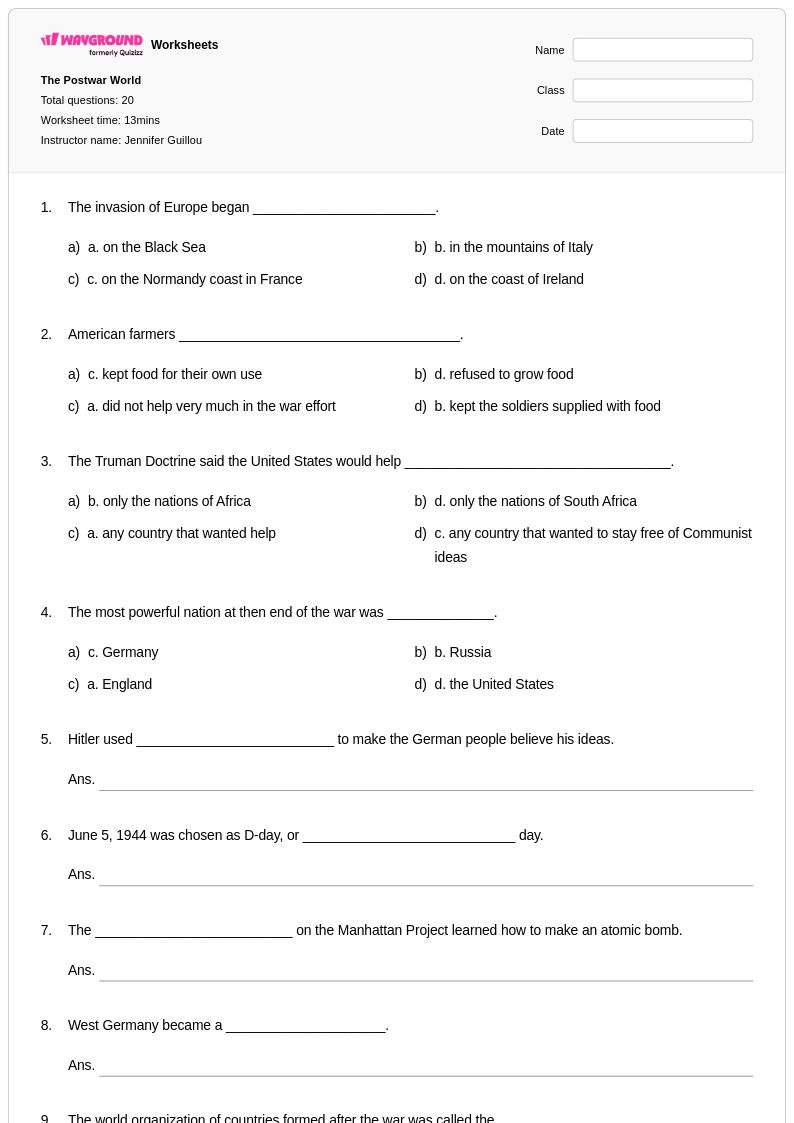
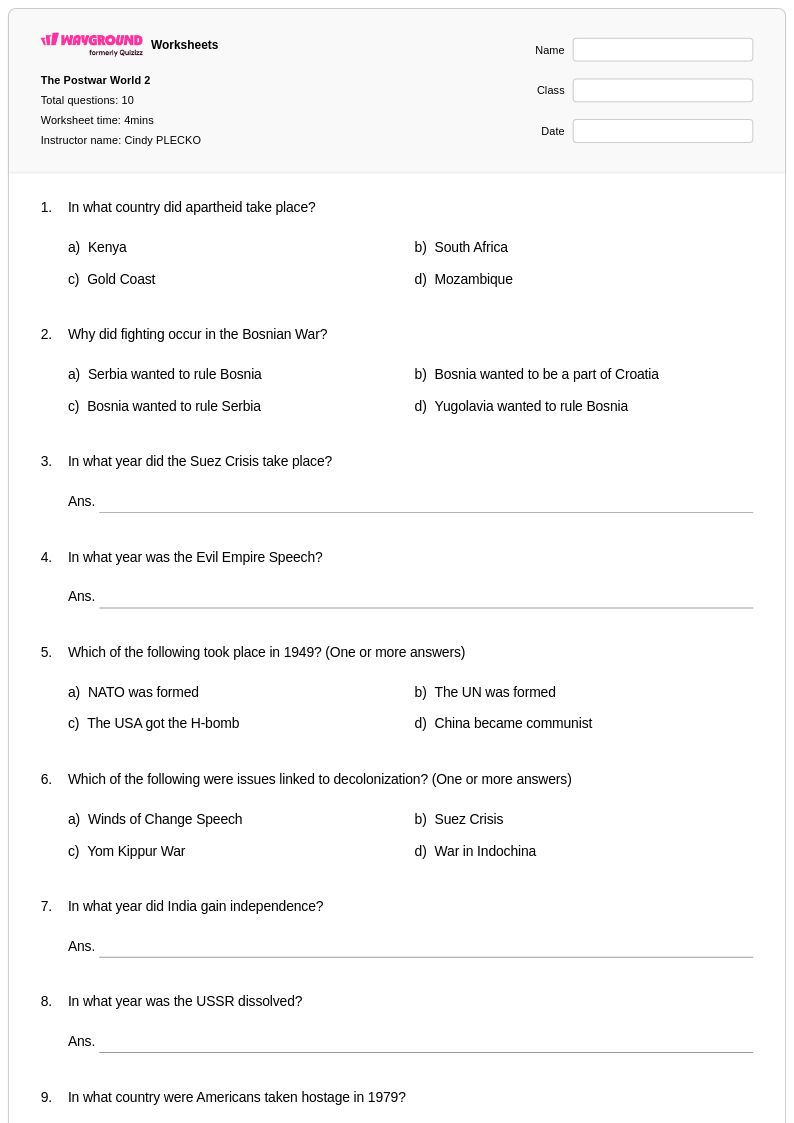
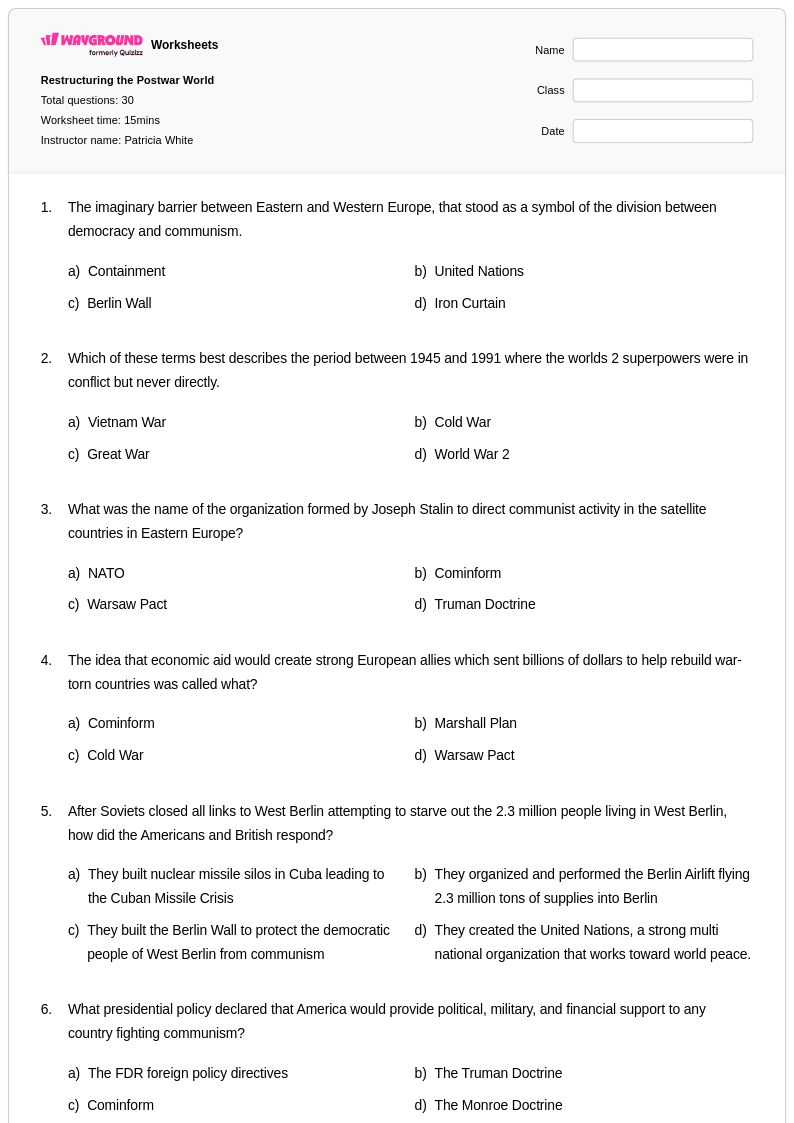
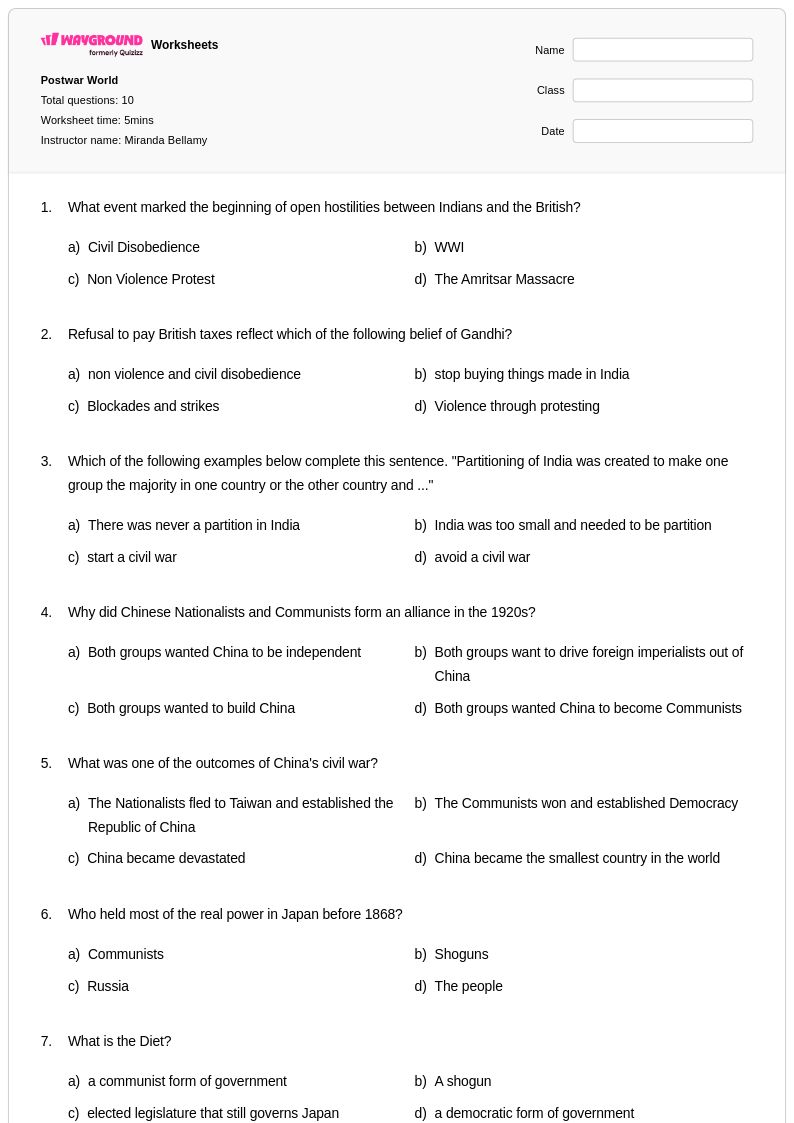
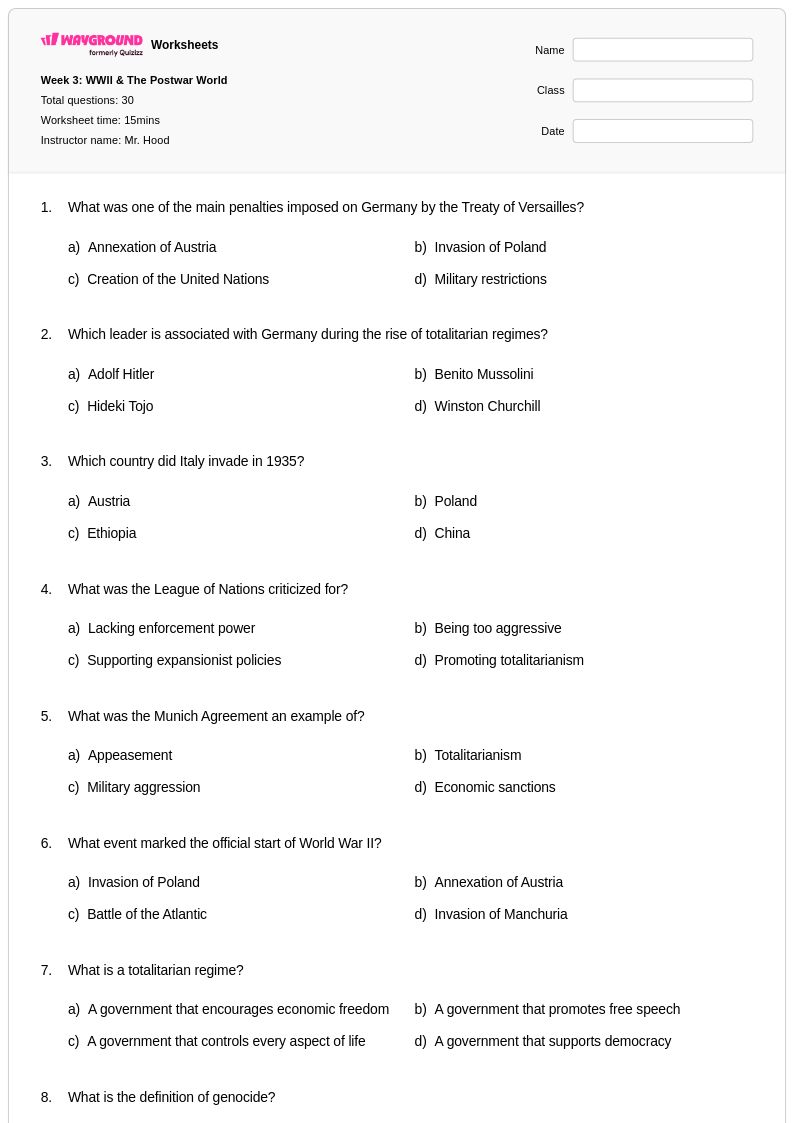
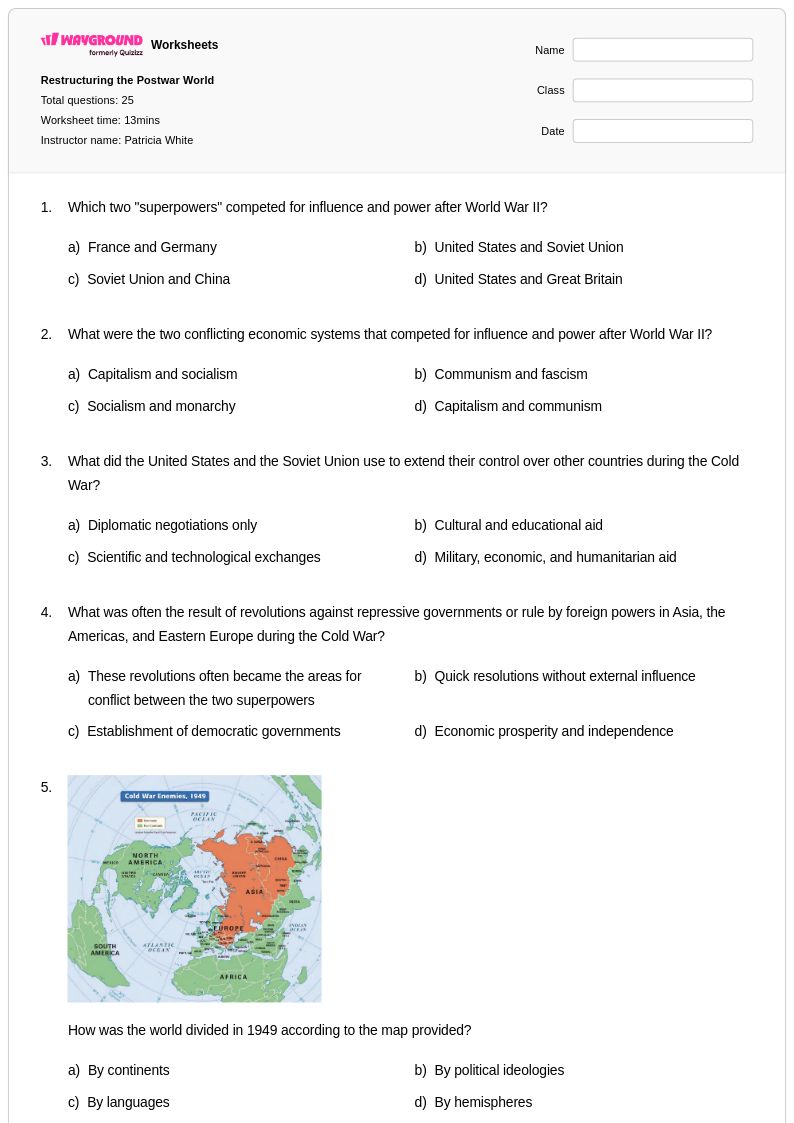
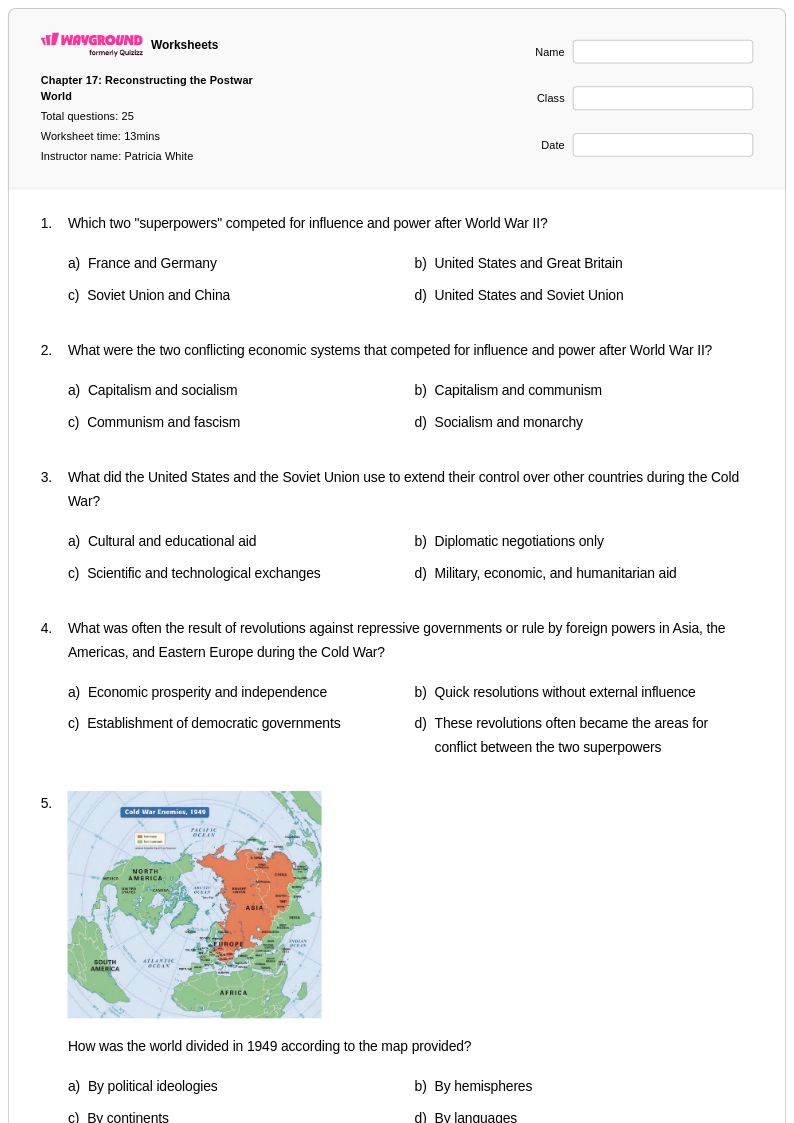
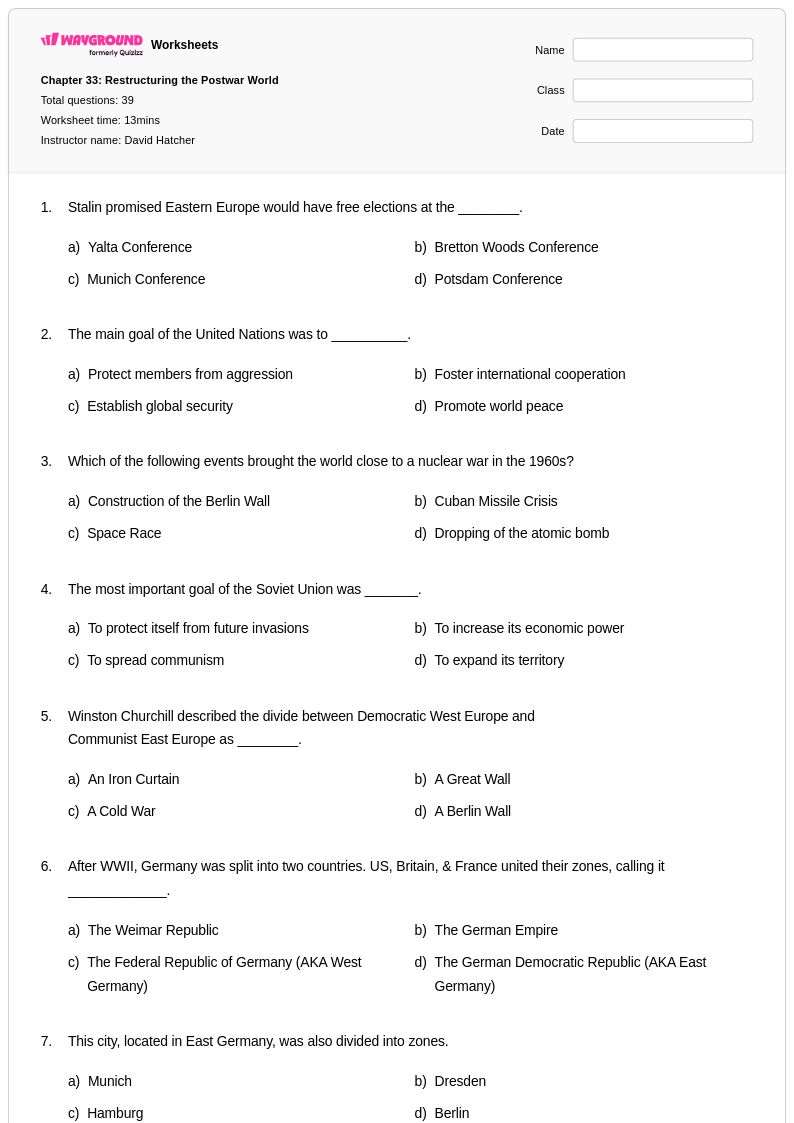
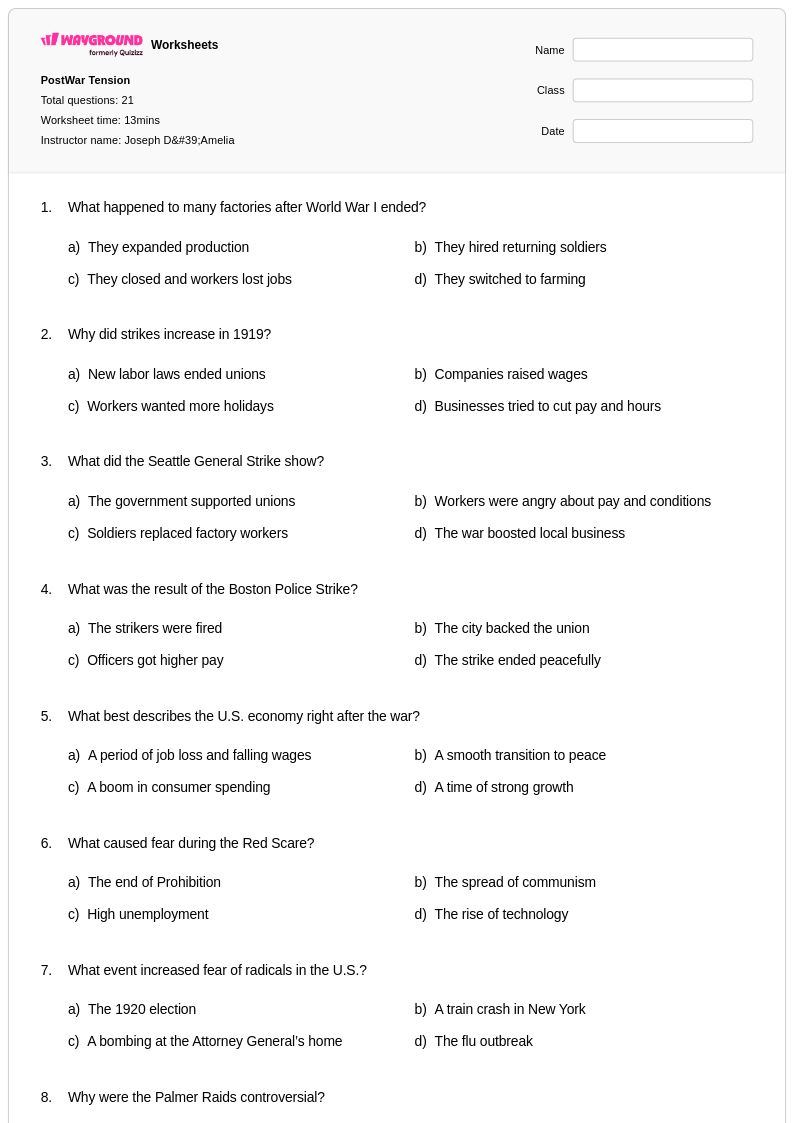
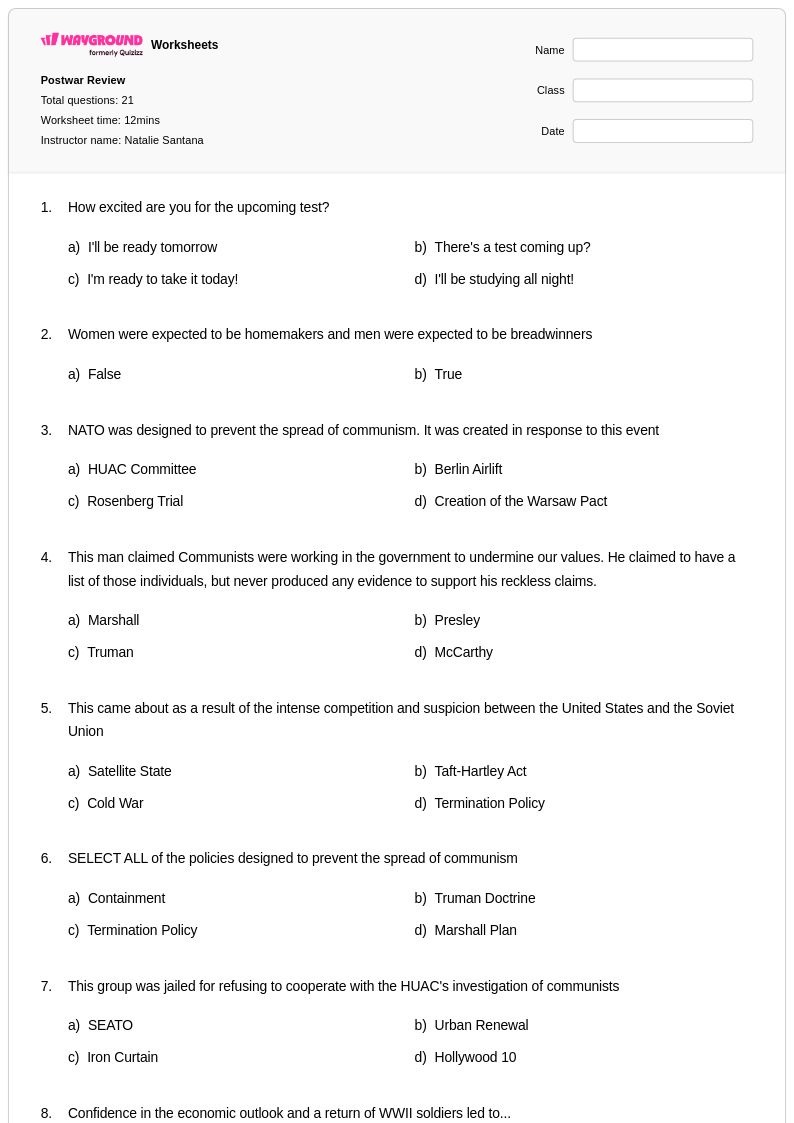
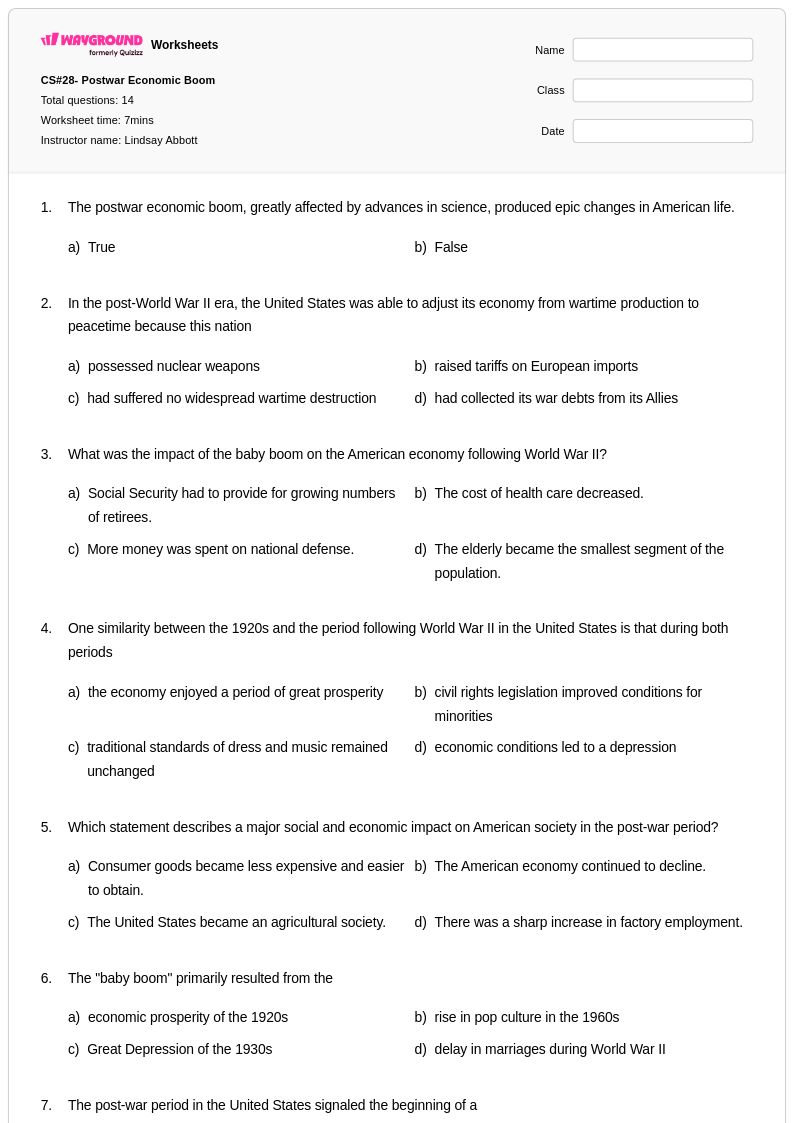
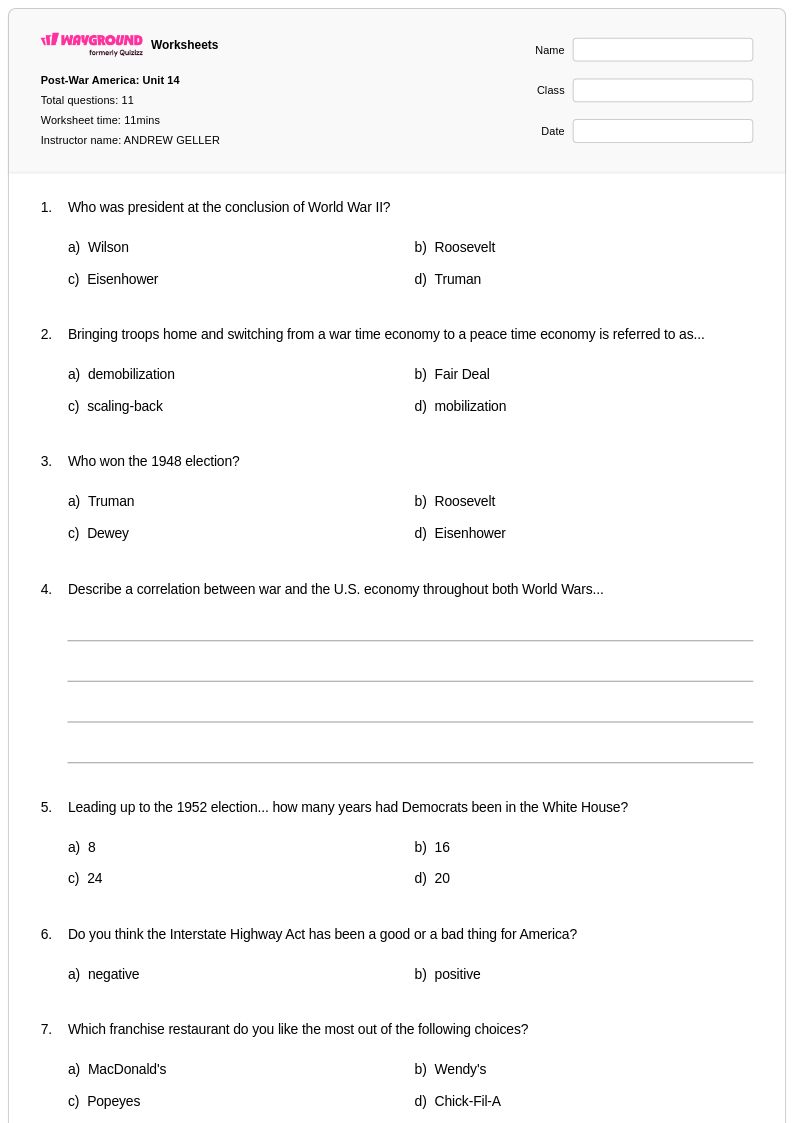
Explore Wayground's comprehensive collection of free Postwar World worksheets and printables that help students analyze the political, economic, and social changes following major global conflicts through engaging practice problems and detailed answer keys.
Postwar World worksheets available through Wayground (formerly Quizizz) provide comprehensive coverage of the complex political, economic, and social transformations that reshaped global civilization following World War II. These educational resources examine critical developments including the emergence of superpowers, decolonization movements across Africa and Asia, the establishment of international organizations like the United Nations, and the ideological tensions that defined the Cold War era. The worksheets strengthen essential analytical skills by guiding students through primary source analysis, cause-and-effect relationships, and comparative studies of different regional responses to postwar challenges. Each resource includes detailed answer keys and practice problems that reinforce understanding of key concepts such as the Marshall Plan, NATO formation, the Berlin Airlift, and the beginning of the nuclear age, with many materials available as free printables in convenient pdf format.
Wayground's extensive collection draws from millions of teacher-created resources specifically designed to support comprehensive instruction on postwar global developments. The platform's advanced search and filtering capabilities enable educators to locate materials aligned with specific curriculum standards while accessing differentiation tools that accommodate diverse learning needs and skill levels. Teachers can seamlessly customize worksheets to emphasize particular aspects of postwar reconstruction, from European recovery programs to the partition of India, ensuring content relevance for their specific classroom objectives. Available in both printable and digital formats including downloadable pdfs, these versatile resources support flexible lesson planning whether used for initial instruction, targeted remediation, advanced enrichment activities, or ongoing skill practice that builds students' capacity to analyze the lasting impact of postwar decisions on contemporary global affairs.
FAQs
How do I teach the Postwar World to middle or high school students?
Teaching the Postwar World effectively means organizing instruction around the major fault lines that emerged after 1945: the ideological rivalry between the United States and Soviet Union, the collapse of European colonial empires, and the creation of new international institutions like the United Nations. Start with the immediate aftermath of World War II to establish context, then trace how decisions made at Yalta, Potsdam, and in the Marshall Plan shaped decades of global politics. Using primary sources alongside cause-and-effect frameworks helps students move beyond memorizing events and toward analyzing how postwar decisions created the modern world.
What exercises help students practice analyzing the Postwar World?
Effective practice for the Postwar World includes cause-and-effect mapping exercises where students trace how specific events, such as the Berlin Airlift or the formation of NATO, led to broader Cold War dynamics. Comparative analysis tasks asking students to contrast decolonization movements in Africa versus Asia build higher-order thinking while reinforcing regional specifics. Primary source analysis worksheets tied to speeches, treaties, or political cartoons from the era give students practice interpreting historical evidence rather than just recalling facts.
What are the most common mistakes students make when studying the Postwar World?
One of the most frequent errors is treating the Cold War as a purely military conflict rather than an ideological, economic, and proxy-war rivalry that played out across multiple continents. Students also tend to conflate decolonization with immediate independence and stability, missing the prolonged struggles and regional instability that followed in many nations. Another common misconception is underestimating the role of international organizations like the United Nations or the World Bank in shaping postwar reconstruction, reducing the era to a US-Soviet binary.
How do I help students understand the connection between the Marshall Plan and Cold War strategy?
Present the Marshall Plan not just as humanitarian aid but as a deliberate geopolitical strategy to prevent war-weakened Western European nations from turning toward communism. Have students compare the economic conditions of countries that received Marshall Plan funds with those that fell under Soviet influence, which makes the strategic logic concrete and visible. Pairing this with primary source excerpts from George Marshall's Harvard speech allows students to practice analyzing intent behind policy, a critical skill for any postwar unit.
How do I use Postwar World worksheets from Wayground in my classroom?
Wayground's Postwar World worksheets are available as printable PDFs for traditional classroom use and in digital formats for technology-integrated environments, so they work whether students are in seats or working remotely. Teachers can use these resources for direct instruction, targeted review of specific topics like NATO formation or the nuclear age, or as quiz-style assessments hosted directly on the Wayground platform. Digital hosting allows teachers to apply accommodations such as read aloud, extended time, or reduced answer choices for individual students, ensuring all learners can access the same rigorous content.
How do I differentiate Postwar World instruction for students at different skill levels?
For students who struggle with the volume and complexity of postwar events, focus first on a small number of pivotal decisions, such as the Truman Doctrine or the partition of India, before broadening to global patterns. Advanced students benefit from comparative and evaluative tasks, such as assessing whether the United Nations succeeded in its founding goals or analyzing competing historical interpretations of the Cold War's origins. On Wayground, teachers can assign accommodations like reduced answer choices or read aloud to individual students without flagging those adjustments to the rest of the class, making differentiation discreet and manageable.