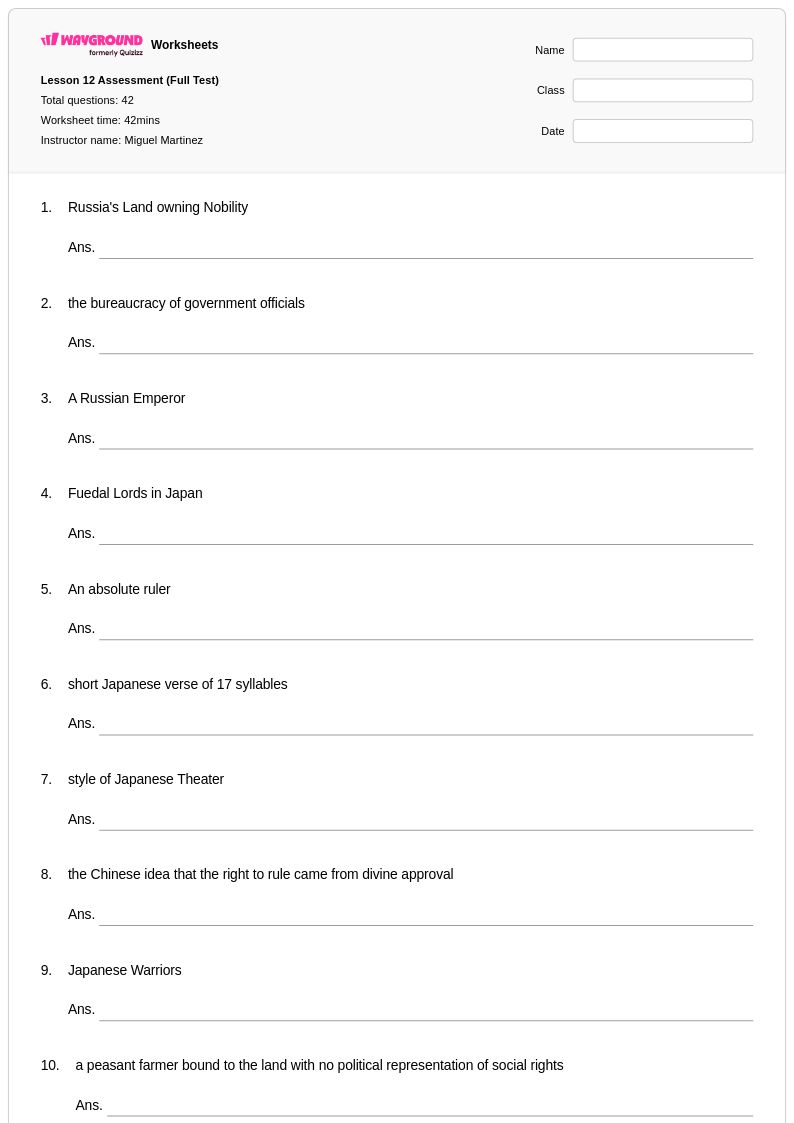
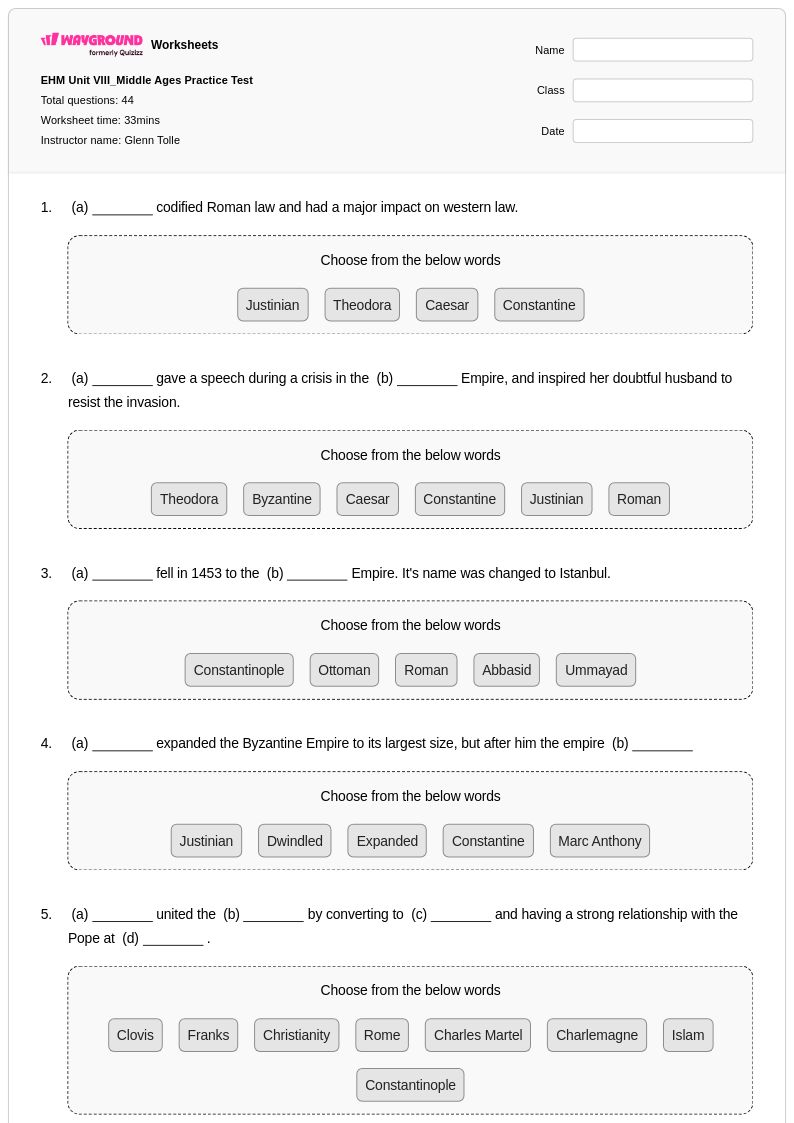
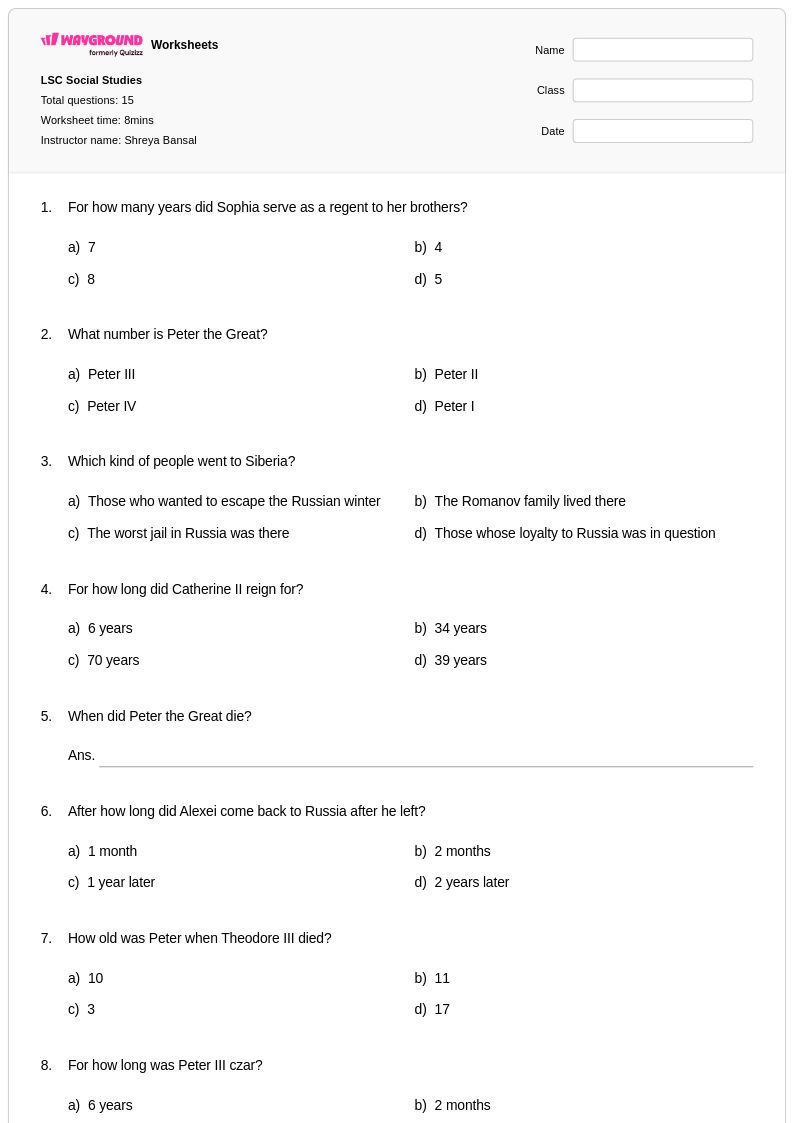
Explore Wayground's free Romanov Dynasty worksheets and printables that help students learn about Russia's last imperial family, featuring engaging practice problems and comprehensive answer keys in downloadable PDF format.
Romanov Dynasty worksheets available through Wayground (formerly Quizizz) provide comprehensive coverage of Russia's most influential royal family, spanning their 304-year reign from 1613 to 1917. These educational materials strengthen students' analytical skills by examining key figures like Peter the Great, Catherine the Great, and Nicholas II, while exploring pivotal events including the Great Northern War, territorial expansions, and the dynasty's dramatic end during the Russian Revolution. The worksheets incorporate primary source analysis, timeline construction, and cause-and-effect relationships that help students understand how the Romanovs transformed Russia from a medieval state into a major European power. Each printable resource includes detailed answer keys and practice problems that reinforce critical thinking about political absolutism, social reform, and the complex factors that led to imperial collapse, making these free materials invaluable for developing historical reasoning skills.
Wayground (formerly Quizizz) supports educators with an extensive collection of millions of teacher-created Romanov Dynasty resources that streamline lesson planning and enhance student engagement. The platform's robust search and filtering capabilities allow teachers to locate age-appropriate materials that align with world history standards, while differentiation tools enable customization for diverse learning needs and skill levels. These worksheets are available in both printable pdf formats for traditional classroom use and digital versions for interactive learning environments, providing flexibility for various teaching approaches. Teachers can effectively use these resources for initial skill practice, targeted remediation for struggling learners, and enrichment activities for advanced students, ensuring that all learners develop a sophisticated understanding of how the Romanov Dynasty shaped Russian history and influenced global political developments through revolution and war.
FAQs
How do I teach the Romanov Dynasty to high school students?
Teaching the Romanov Dynasty effectively means anchoring instruction in specific rulers and turning points rather than treating the 304-year reign as a single arc. Start with Peter the Great's Westernization reforms, trace Catherine the Great's territorial expansion, and build toward Nicholas II and the conditions that produced the Russian Revolution. Using cause-and-effect frameworks helps students connect political absolutism, social inequality, and military failures as compounding factors rather than isolated events.
What exercises help students practice analyzing the Romanov Dynasty?
Timeline construction is one of the most effective practice formats for this topic because the dynasty's 304-year span requires students to sequence events, identify patterns, and distinguish between short-term and long-term causes of change. Primary source analysis — particularly decrees, letters, or political cartoons from the era — pushes students to interpret perspective and bias. Cause-and-effect mapping around events like the Great Northern War or the 1917 Revolution reinforces analytical writing skills alongside content knowledge.
What mistakes do students commonly make when studying the Romanov Dynasty?
The most common misconception is treating the Russian Revolution as a sudden event rather than the product of long-term systemic pressures, including economic inequality, military defeat in World War I, and weakening tsarist authority across multiple reigns. Students also frequently conflate the contributions of different rulers, attributing Peter the Great's military reforms to Catherine the Great or vice versa. Another frequent error is oversimplifying Nicholas II as solely responsible for the dynasty's collapse without accounting for the structural forces that made imperial autocracy unsustainable by 1917.
How do I use Romanov Dynasty worksheets in my classroom?
Romanov Dynasty worksheets on Wayground are available as printable PDFs for traditional classroom use and in digital formats for technology-integrated or hybrid learning environments, including the option to host them as a quiz directly on Wayground. Printable versions work well for structured in-class analysis, while digital formats allow for self-paced or remote completion. All worksheets include answer keys, making them practical for both initial instruction and independent review.
How can I differentiate Romanov Dynasty instruction for students at different skill levels?
For struggling learners, scaffolding with guided timelines or simplified cause-and-effect graphic organizers before moving to open-ended analysis reduces cognitive overload while keeping content rigorous. Advanced students benefit from comparing Romanov absolutism to contemporary European monarchies or analyzing primary sources with minimal scaffolding. On Wayground, teachers can apply individual accommodations such as read aloud support, reduced answer choices, or extended time to specific students, ensuring the same worksheet serves diverse learners without requiring separate materials.
How does the Romanov Dynasty connect to broader world history standards?
The Romanov Dynasty is a central case study in political absolutism, imperial expansion, and revolutionary change, making it directly relevant to most world history and AP European History standards. Its arc from Peter the Great's modernization through the 1917 Revolution connects themes of state formation, nationalism, industrialization, and social upheaval that appear across multiple units. Teaching the Romanovs in parallel with other contemporary empires also helps students understand how global power shifts in the 18th and 19th centuries set the conditions for 20th-century conflict.